Labor Regulators Just Issued A Complaint Against Postmates

Postmates

Postmates, the anything on-demand startup, has run afoul of labor regulators in Chicago.

On Thursday, the National Labor Relations Board&;s regional office in Chicago announced it had found “merit to the October 2015 charge filed against the on-demand food delivery service.”

The board issued a complaint alleging Postmates violated its drivers&039; employment rights “by prohibiting them from discussing terms and conditions of employment, including safety, with other drivers.”

The complaint also alleges Postmates violted the rights of its employees by requiring them to enter into arbitration agreements.

The San Francisco-based Postmates has raised more than $238 million in venture capital since it was founded in 2011. NLRB documents list the “number of workers at dispute location” as 10,000.

WeWork, an office space rental startup that helped popularize co-working, recently faced similar allegations from the NLRB over arbitration clauses. That company agreed to amend its employee handbook as part of a settlement filed in September.

If Postmates fails to reach a settlement with the employee who filed the initial charges with the NLRB, there will be a hearing in Chicago on January 26, 2017.

Postmates declined comment on the NLRB complaint citing company policy on “pending litigation or similar matters.”

Quelle: <a href="Labor Regulators Just Issued A Complaint Against Postmates“>BuzzFeed

Little Policy Talk At Trump Meeting With Tech, Telecom Lobbyists

Facebook/ Donald Trump

If you&;re eager for a policy agenda outlining Donald Trump&039;s vision for American technology, you&039;ll have to keep waiting.

Trump&039;s presidential transition team met with dozens of tech, telecom, and media representatives Friday, but according to several people familiar with the meeting, team Trump offered little insight into the Republican Presidential candidate&039;s view on tech policy. The transition team instead outlined planning priorities for the first days of a Trump administration, selecting presidential appointments, and soliciting donations.

Representatives from Google, Uber, and Twitter attended the meeting. They were joined by trade and advocacy groups including the Consumer Technology Association, the Information Technology Industry Council and the Internet Association. About 50 people attended the off-the-record meeting, which took place at the offices of the law firm Baker Hostetler, in Washington, DC. The Motion Picture Association of America (MPAA) and AT&T were also represented.

Tech groups were asked to name regulations they&039;d like to see abolished under a Trump presidency.

Sources familiar with the gathering said the Trump transition team referred attendees to the Trump campaign website for details on policy priorities. They noted as well that tech groups were asked to recommend agency appointments, and to name regulations they&039;d like to see abolished under a Trump presidency.

The tech companies and groups were given a chance to share their own policy priorities, which focused around international trade, STEM education, Federal IT, as well surveillance and privacy.

Trump’s transition team was represented by executive director Rich Bragger and general counsel Bill Palatucci. While the chair of the transition operation Gov. Chris Christie was billed to attend, his campaign schedule with Trump in New Hampshire kept him away, according an invitation obtained by BuzzFeed News. Ado Machida, the head of policy implementation, and Cam Henderson, the finance director, were there as well.

Many of the same organizations in attendance were involved in private sessions with the RNC earlier this year, leading up the party’s convention in July. The GOP platform calls for expanding broadband access across the country, support for so called “on-demand” platforms like Uber and Airbnb, and Congressional leadership on the controversy surrounding government access to encrypted communication.

Several trade and advocacy groups have called on the Trump campaign to release a detailed tech policy agenda. Hillary Clinton unveiled her technology plan this summer, which includes a proposal to connect every American household to high speed internet by 2020.

While Trump has campaigned largely on his business acumen, an influential group of Silicon Valley leaders has openly criticized him, voicing their opposition to his campaign. This summer, nearly 150 executives, engineers, researchers, and investors, including Apple co-founder Steve Wozniak, Vint “father of the internet” Cerf, and the CEOs of Slack, Box, Yelp, and Tumblr said “Trump would be a disaster for innovation.” In dramatic fashion, Trump himself has antagonized the chief executives of Apple and Amazon as well, and has appeared to take positions on net neutrality, encryption, and internet censorship that clash with widely held views among technologists.

Quelle: <a href="Little Policy Talk At Trump Meeting With Tech, Telecom Lobbyists“>BuzzFeed

Here’s Alphabet’s Pitch To “Smart”-ify Your City

Sidewalk Labs

In April, a team of representatives from Sidewalk Labs — a subsidiary of Alphabet, which is also Google’s parent company — visited Columbus, Ohio, to pitch city officials on a sprawling, ambitious plan to overhaul the city’s transportation infrastructure.

Sidewalk proposed managing and expanding the city’s transportation data on transit routes, passengers, parking spaces, cars, and more. In the process, Sidewalk promised to give the city “new superpowers” and make it more accessible.

By mid-year, Sidewalk Labs had pitched at least six other tech-hungry cities — San Francisco, Austin, Pittsburgh, Denver, Kansas City, and Portland — on the same bold proposal.

In Columbus, the company’s representatives said, two systems called Flow and Link could “pinpoint the causes of congestion,” reduce the “emissions and distracted driving that results from circling for parking,” “encourage ride-sharing,” and provide “ultra-fast gigabit WiFi.” That could be a significant improvement in a city where an estimated 82% of commuters drive to work. And though Sidewalk’s presentation does not name the final cost of the systems — it’d depend on a range of factors — it claims that the new approach could ultimately return a profit to Columbus.

But outsourcing these traditionally municipal concerns to a private company — and a high-profile technological innovator, at that — would be a stark change that could have implications well beyond central Ohio.

Those promises and more are detailed in a set of documents BuzzFeed News obtained through a freedom-of-information request to Columbus. Among the contents:

  • Sidewalk Labs’ slide decks presented to Columbus in the April meeting.
  • A proposed “memorandum of understanding” that Sidewalk sent to city officials.
  • A spreadsheet that Sidewalk shared to help the city estimate potential revenues and costs associated with the company’s proposal.

Some excerpts from these documents have been published by other outlets, including The Guardian and Recode. But until now the documents have not been reproduced in full. You can find them at the bottom of this post.

Sidewalk Labs targeted its pitch to cities competing for the Department of Transportation’s Smart City Challenge. In June the DOT named Columbus the competition’s winner, beating the six other finalists for the $40 million prize.

Columbus and Sidewalk Labs haven’t reached any formal agreements, according to Jeff Ortega, assistant director for the city’s Department of Public Service.

“At this point, discussions are centered around whether or not the company’s ‘Flow’ platform can help link health providers and residents in disadvantaged neighborhoods to facilitate transportation options,” Ortega told BuzzFeed News this week. “At this point, if Sidewalk Labs were to be engaged, the engagement would only be specific to this purpose.”

Sidewalk Labs declined to comment specifically on its pitch to Columbus. But in an op-ed published this summer, Daniel Doctoroff, the company’s CEO, wrote that its “conversations with city officials and urban planners” around the country “taught us many important lessons.” He continued: “Our role during these talks was to learn what the public sector is already trying, and discuss ways to help those trials become successful.”

The pitch

Transportation is rapidly becoming consumerized,” the pitch deck begins. To keep pace, “cities must innovate with the private sector.”

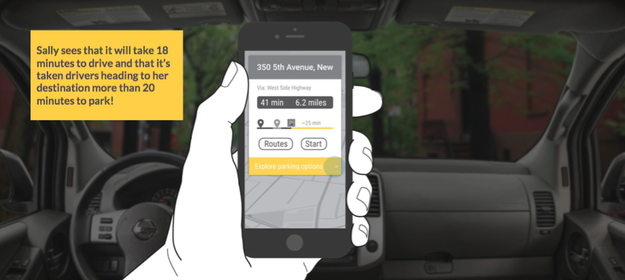
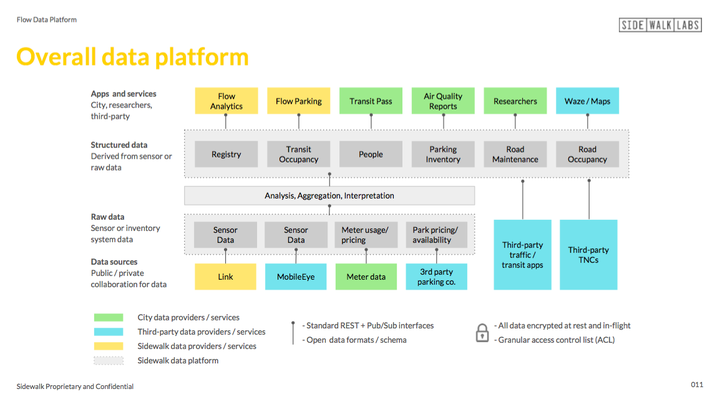
At the heart of the proposed collaboration is Sidewalk’s data platform, which would integrate data from city records, digital sensors, and “third-party data providers” such as Google Maps, Waze (the navigation app acquired by Google in 2013), Uber, and Lyft.

Sidewalk Labs / Via documentcloud.org

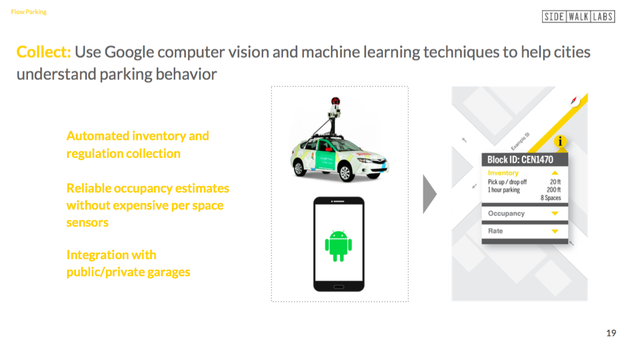
Some of the data might come from camera-equipped cars…

Sidewalk Labs / Via documentcloud.org

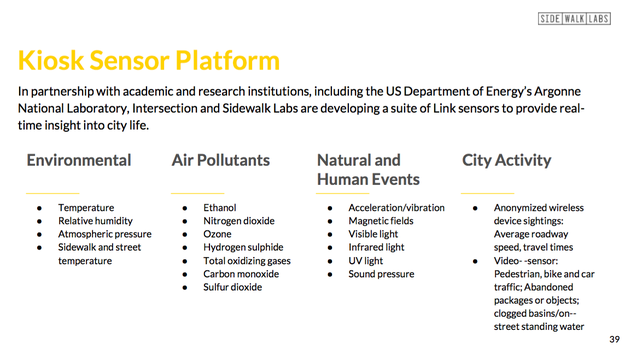
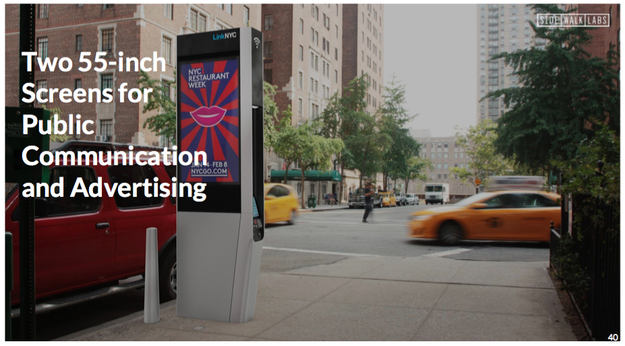
…or camera-equipped, smartphone-sensing kiosks, such as those already installed in New York City:

Sidewalk Labs / Via documentcloud.org

Sidewalk Labs / Via documentcloud.org

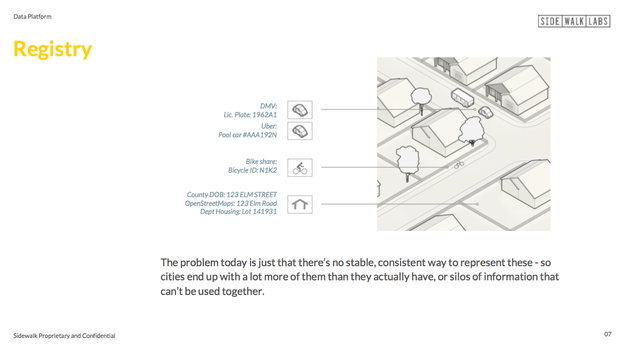
Sidewalk also proposes helping cities standardize data from their various, cacophonous databases, and collate that data into a core “registry”:

Sidewalk Labs / Via documentcloud.org

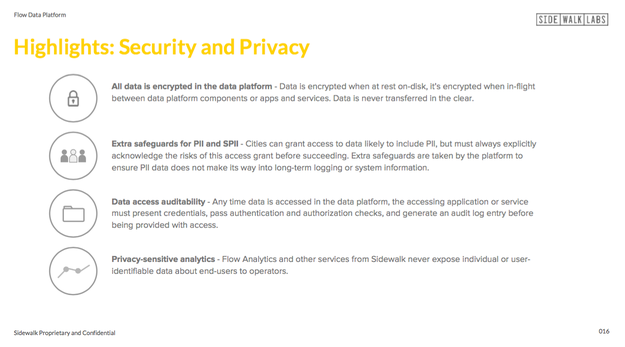
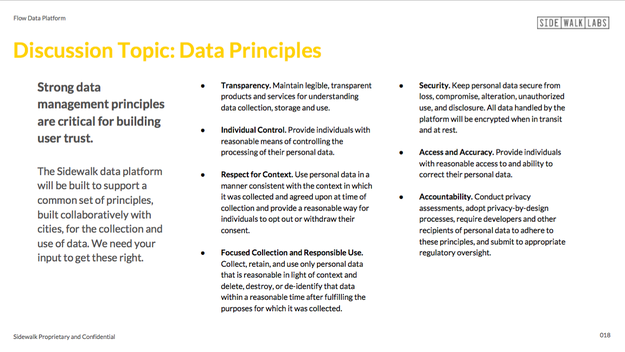
Worried about the implications of vast, privately managed database containing loads of sensitive information? Sidewalk Labs says it hears you:

Sidewalk Labs / Via documentcloud.org

Sidewalk Labs / Via documentcloud.org

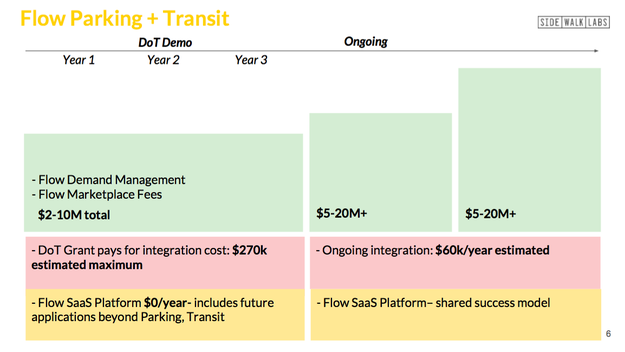
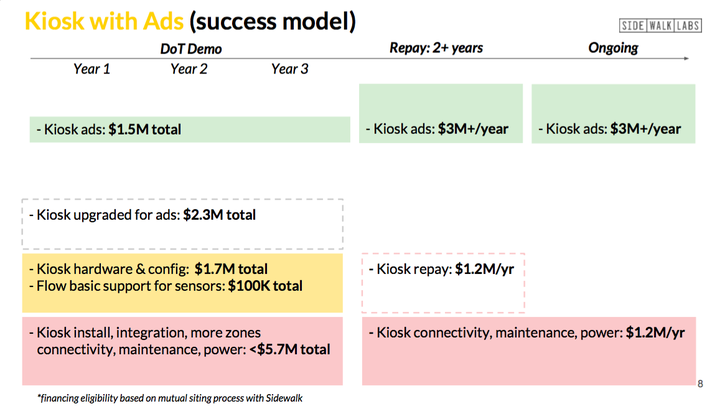
Toward the end of the pitch, Sidewalk throws in a sweetener: Not only will its services improve transportation in Columbus, but they could actually make the city money.

Some of that money could come from fees for matching people with transit options and parking spots…

Sidewalk Labs / Via documentcloud.org

…while other revenue could come from ads placed on those roadside kiosks:

Sidewalk Labs / Via documentcloud.org

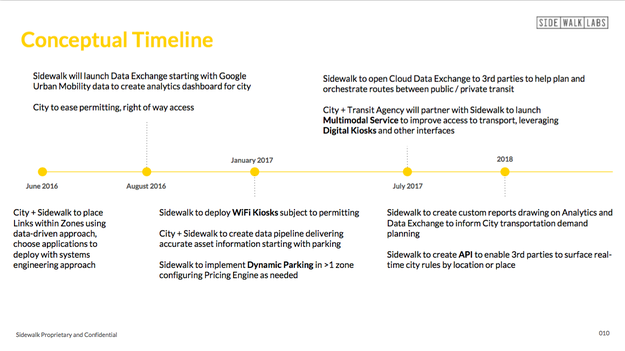
In the final slide of the main pitch deck, Sidewalk lays out its “conceptual timeline”:

Sidewalk Labs / Via documentcloud.org

Want to explore the documents in full? Here they are:

Sidewalk Labs / Via documentcloud.org

Via documentcloud.org

Via documentcloud.org

Via documentcloud.org

Via documentcloud.org

To download the financial modeling spreadsheet, click here.

Quelle: <a href="Here’s Alphabet’s Pitch To “Smart”-ify Your City“>BuzzFeed

Twitter Adds Autoplay Video Module To ‘Home’ Tab For Live NFL Streams

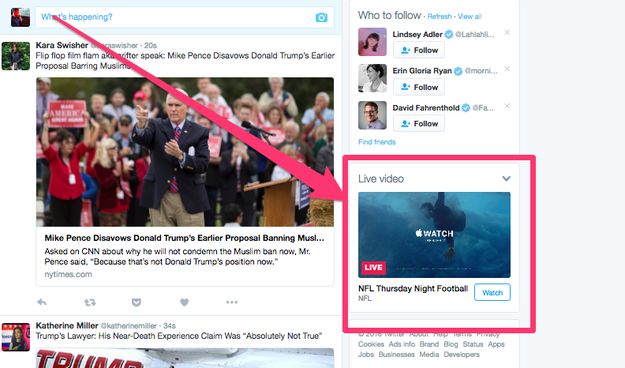
Twitter is finally promoting its live NFL live streams prominently on its website.

Beginning tonight, Twitter will showcase the Thursday Night Football games for which it has snagged streaming rights in a new autoplay video module next to the timeline on the &;Home&039; tab of its desktop website. Twitter is currently two games into a ten game deal, with the third coming tonight. It plans to give them all the same &039;Home&039; tab promotion.

Reached by BuzzFeed News, a Twitter spokesperson shared the following statement: “As we’ve said before, we’re going to continue exploring ways to make our live video content on Twitter more discoverable.”

Autoplaying NFL games on the Home tab — beside the all-important Timeline — should both increase Twitter’s NFL viewer numbers, and make advertisers happy. Two weeks ago, when Twitter aired its second NFL game, the company reached 2.2 million people, with an average audience of 327,000 viewers per minute. That was up from the 2.1 million that watched Twitter’s first NFL game, with an average audience of 243,000 viewers per minute.

That significant increase in viewers from week to week suggests that the first week’s tune in wasn’t simply due to the novelty factor. Now that Twitter is pushing the games much harder with this new module, the number should only grow. Advertisers, of course, will be glad their ads are reaching more viewers too.

Quelle: <a href="Twitter Adds Autoplay Video Module To ‘Home’ Tab For Live NFL Streams“>BuzzFeed

Soylent Food Bars Might Be Making Some People Throw Up

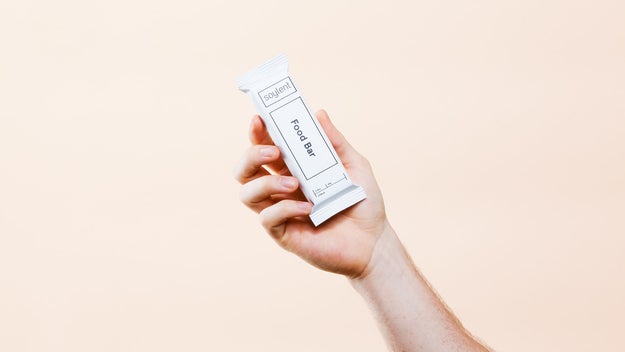
Soylent, the company behind the sludgey meal replacement products designed to provide “maximum nutrition with minimal effort,” first introduced the Soylent Bar in August 2016.

Since the snack bar&;s launch, a small number of users have claimed that they experienced “nausea,” vomiting,” and/or “diarrhea” after consuming the bar which, according to the company, provides 12.5% of daily nutritional requirements. In a statement to BuzzFeed News, Soylent said that after investigating the complaints, it is “very confident in the safety of the bars.” The company suggests that affected customers consult a doctor before continuing to consume Soylent products.

Soylent

Some first reports of Soylent bars causing gastro-intestinal distress appeared on the company&039;s community forum on Sept. 7, 2016 when member “Raylingh” started a discussion thread titled “Nausea and vomiting several times after eating food bars.” The user tracked responses to that post on a spreadsheet , collecting self-reported data that reveals that all 24 members who responded to the thread suffered from nausea, all but one vomited, and just six had diarrhea.

In a /r/soylent subbreddit posted on Oct. 5, user pernambuco claimed they had “the worst vomiting episode I ever experienced” after consuming a Soylent Food Bar. The Redditor said the bars consumed had the expiration date of July 14, 2017, which matches the expiry date of bars bought by at least 13 vomiting customers on user Raylingh&039;s Soylent community spreadsheet.

In response to pernambuco&039;s Reddit thread, at least four other Soylent Bar users (Equipoisonous, WestTexasRedneck, rhaikh, and FirebirdAhzrei) cited similar symptoms.

Redditor TipsFirstStupid, who allegedly drinks Soylent 2.0 every day for breakfast, became “violently ill” with “uncontrollable diarrhea” and “so nauseous I have to puke” after eating the bars.

According to Soylent&039;s website, the Bar (along with the company&039;s drink powder, bottled drink, and coffee product) are “Generally Recognized As Safe” by the FDA.

However, according to the FDA&039;s online inspection database, the facility that produces Soylent Bars, Betty Lou&039;s in McMinnville, Oregon, has not undergone a Foodborne Biological Hazards inspection since 2014, two years before the Bar was launched. Soylent claims that last FDA inspection was as recent as March 2016.

FDA

Sources close to Soylent&039;s production processes say that the company conducted its own internal review of the Betty Lou facility four months ago. The FDA inspects the facilities, but a third party agency does quality control for the final, finished good.

The sources suggested that the complaints might be due to a sensitivity to sucralose, an artificial sweetener. There is three times as much Sucralose in Soylent&039;s bar (about 30 milligrams) compared to the 1.6 version of the company&039;s drink powder.

In an official statement provided to BuzzFeed News, Soylent said that the number of complaints about its bars represents about .03% of those sold. The bars typically undergo multiple quality control programs for yeast, mold, and other microbacterial testing.

After acquiring boxes from customers who complained, Soylent employees personally consumed the boxes&039; remaining bars without effects. At this time, Soylent has no plans to dial back the amount of sucralose in the bar, but may re-formulate in the future.

Here is Soylent&039;s statement in full:

We have become aware via our support channels of a limited number of instances of people experiencing indigestion or discomfort following consumption of our Soylent bar. To date the number of complaints we have received represents less than 0.03% of the number of bars we have sold. While this is an extremely small number of complaints, and all packaged and prepared food products have some risk of intolerance, we take every single one very seriously.

The safety and quality of our bars is verified via a comprehensive food industry standard program. First, we exclusively source from qualified suppliers and use only those ingredients that include a certificate of analysis (COA) for rigorous physical, chemical and microbiological criteria. Second, the bars are manufactured at an FDA inspected, GFSI certified facility under a thorough food safety and quality program. Lastly, the bars are subjected to an additional microbiological testing program before being released from the co-manufacturer and sent to our warehouses.

After these reports, we have retrieved remaining bars from our consumers and have personally consumed many of the remaining bars without adverse effects. We have also sent them for further microbiological testing and all tests have come back negative. Based on this we remain very confident in the safety of the bars.

A certain subpopulation of individuals may have an allergy, intolerance or sensitivity to ingredients such as soy and / or sucralose, or certain vitamin and mineral sources and should consult with their doctor before continuing to consume these products.

Quelle: <a href="Soylent Food Bars Might Be Making Some People Throw Up“>BuzzFeed

Snapchat's Parent Company Could Go Public As Early As March

John Paczkowski

Snap Inc, maker of Snapchat, is preparing paperwork for an IPO that could value the firm at $25 billion, the Wall Street Journal reports; the paperwork indicates that the IPO could happen in March of 2017.

The possible valuation is a marked jump from Snap&;s previous market cap, $17.8 billion, first reported in May.

Thought it is not clear whether Snap Inc is a profitable business, it generated $60 million in revenue in 2015 and is on track to earn $250 and $350 million in 2016, according to the Journal. Snapchat has projected it could earn $1 billion in revenue in 2017.

The news comes on the heels of Snap Inc&039;s first hardware product, Spectacles.

Snapchat declined BuzzFeed News&039; request for comment.

Quelle: <a href="Snapchat&039;s Parent Company Could Go Public As Early As March“>BuzzFeed

Spotify Ads May Have Served Malware To Your PC

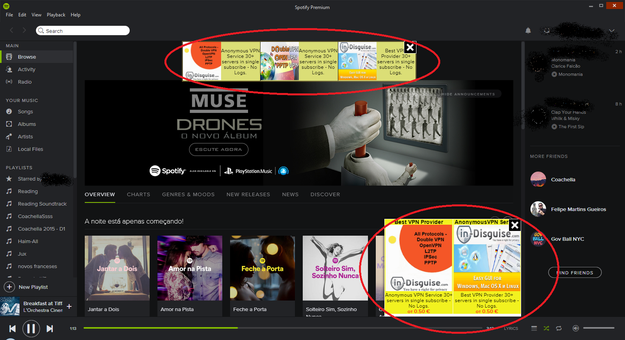
Spotify users are complaining that Spotify Free is infecting their browsers with malware via ads on the music streaming site. The virus opened “questionable website pop-ups” on browsers, as Spotify called them in a reply to a request for help.

The issue has affected Mac, Linux, and Windows users, the BBC reports. Spotify Premium subscribers, who pay for the service, do not see any ads and were therefore not vulnerable to the attack.

Spotify user Titaviana’s Spotify application. Other Spotify users responded to her complaint by saying she should reinstall the application to get rid of the unsightly banner ads. She made her complaint in June 2015.

Spotify user Titaviana / Via community.spotify.com

Spotify user “tonyonly” posted on the Spotify Community page, “There&;s something pretty alarming going on right now with Spotify Free. If you have Spotify Free open, it will launch – and keep on launching – the default internet browser on the computer to different kinds of malware / virus sites. Some of them do not even require user action to be able to cause harm.” According to tonyonly, the ads do not require clicks to infect users’ computers.

Spotify responded to the tonyonly saying that it had shut down the issue and that only a small number of users had experienced difficulties. The company called the incidents “isolated.”

Other users voiced their concerns on Twitter:

The BBC reported that maladvertising appeared on Spotify in 2011, the year the streaming service launched in the US, and hit users with the Blackhole Exploit Kit, a type of Trojan Horse virus. Users saw malware-infected advertising banners within their Spotify applications that then ran malicious code within their browsers. Spotify later apologized for the problem.

Maladvertising isn&039;t the only gripe people have with Spotify&039;s advertising. Users have complained on Spotify&039;s community page of too many ads, repeating ads, and seeing ads even after paying for Spotify Premium.

This isn&039;t the only gripe people have with Spotify&039;s advertising. Users have complained on Spotify&039;s community page of too many ads, repeating ads, and even seeing unsightly banner ads.

Austin Kramer, global head of dance and electronic music at Spotify, said at a recent conference, “Our ad team is building ways for the free product to be profitable,” suggesting that Spotify is searching for new ways to serve users advertisements. Spotify, which claims 40 million paying subscribers and 100 million active users, is not yet a profitable business.

Spotify has not yet replied to a request for comment.

Quelle: <a href="Spotify Ads May Have Served Malware To Your PC“>BuzzFeed

Popular Photo Altering App Prisma Will Now Transform Your Videos Into Wild, Otherworldly Scenes

Popular Photo Altering App Prisma Will Now Transform Your Videos Into Wild, Otherworldly Scenes

Prisma, a popular photo altering app that transforms photos into artistic-looking images, is today introducing video effects that transform everyday life into fantasy worlds.

Prisma, a popular photo altering app that transforms photos into artistic-looking images, is today introducing video effects that transform everyday life into fantasy worlds.

Prisma uses AI to “repaint” still images in the styles of famous painters. It debuted in June and already has 70 million users, according to co-founder Aram Airapetyan.

Okay, on to Prisma&;s effects. Take a look at this video of Ocean Beach in San Francisco (turned into a GIF):

Now check it out with Prisma&039;s effects applied:

Here&039;s a GIF of the first debate between Hillary Clinton and Donald Trump:

giphy.com

And here it is in Prisma&039;s appropriately titled effect: “The Scream,” a tribute to Edvard Munch&039;s 1893 painting of the same name.

Here&039;s a boring video of me on Market Street in San Francisco:

And here it is with Prisma:

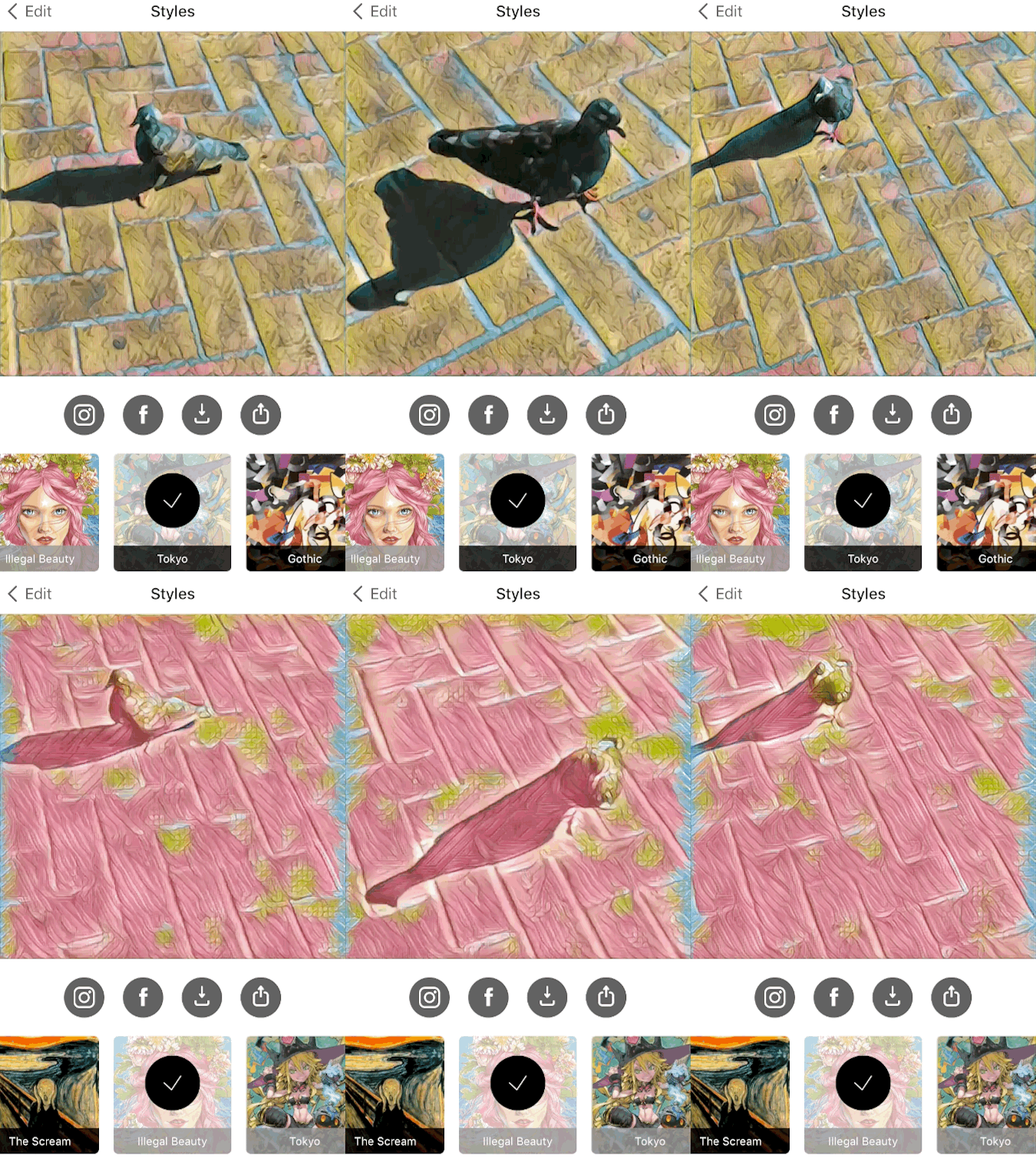
Now take a look at this Pigeon:

See how much better it looks like inside Prisma?

Prisma takes a moment or two to convert the videos, so be prepared for wait for a bit.

Here&039;s a look at a few more Prisma effects doing work on the San Francisco Muni:

Prisma has already processed 3 billion pictures. Some users have even made their own makeshift Prisma videos by stitching together hundreds of Prisma processed photos. Such as this rock video:

youtube.com

The video feature will be available globally on iOS starting today.

Quelle: <a href="Popular Photo Altering App Prisma Will Now Transform Your Videos Into Wild, Otherworldly Scenes“>BuzzFeed

This Startup Wants To Smarten Up Your Smart Home Devices

Today, Thington launches. It’s a smart assistant app that aims to simplify smart home devices.

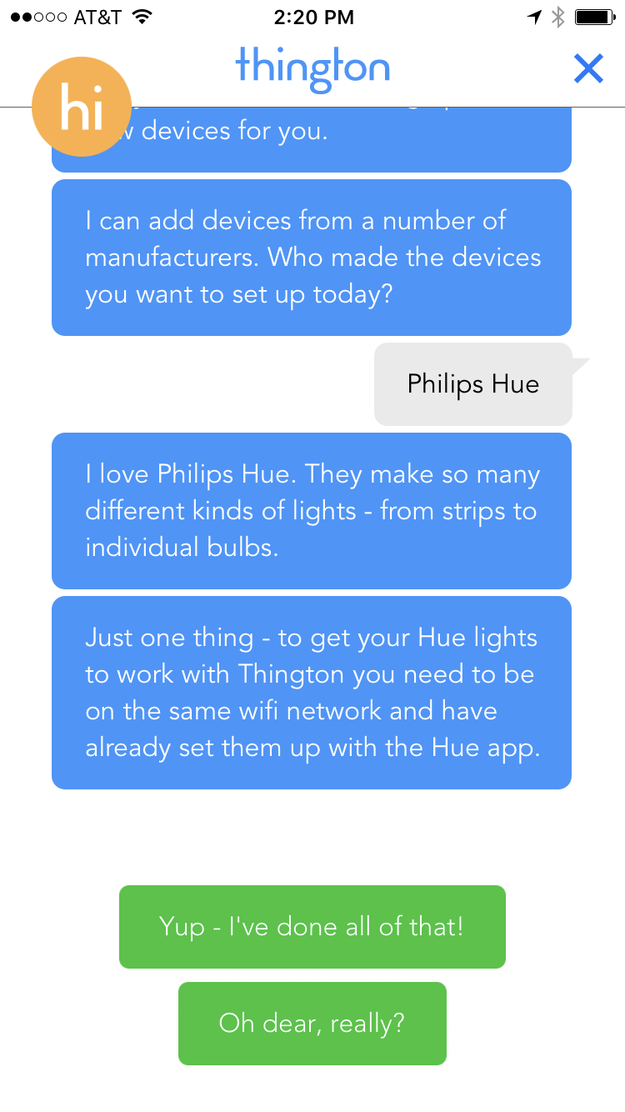
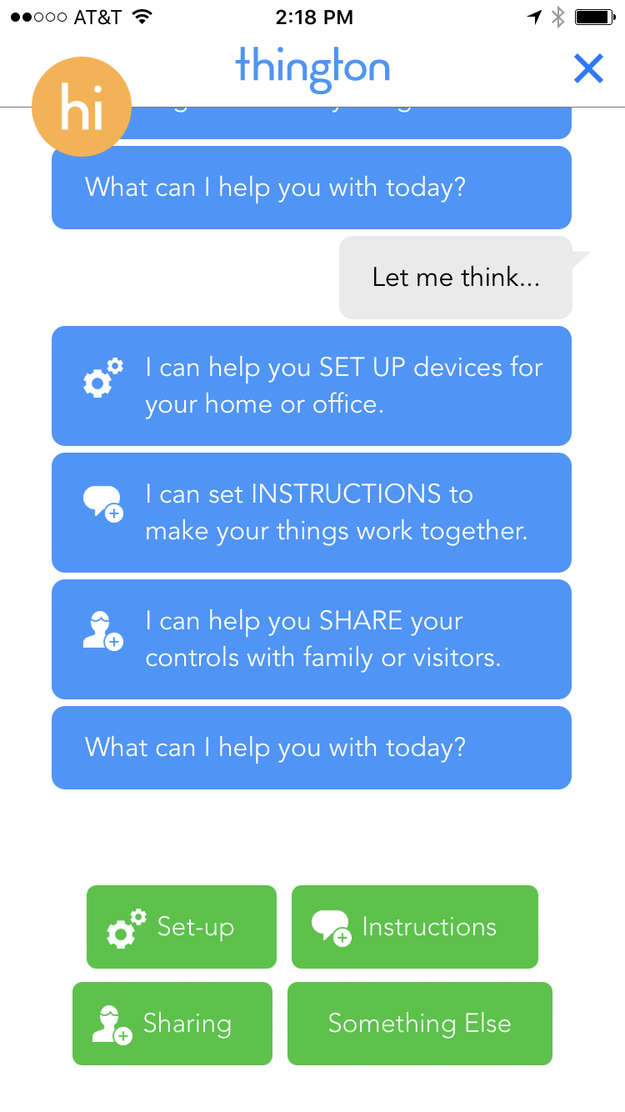
Thington’s distinctive feature? Thington Concierge, a conversational bot that helps you set up and control the smart things you’ve already set up in your home. From weather stations to light switches to security cameras, it supports a range of devices.

How does it work?

With its bot messenger interface, Concierge allows you to create rules for your house. You can set your lights to glow fluorescent during the day and incandescent during the night, or to turn on when you get home. Or, for example, you can program your Nest thermostat to lower the heat while you’re sleeping in your cozy bed, and then to raise the temperature before you wake up. And you can add people to a “Guest List” to give them access to your home&;s controls when they’re visiting you. These kinds of combinations and features, Thington founders Tom Coates and Matt Biddulph believe, is their product’s competitive edge: It’s more like an assistant with a personality than a remote.

Giving your smart home that personality, Biddulph said, is only made possible by simplifying all the different devices and unifying their interfaces. That&039;s Thington&039;s biggest technical challenge. “We want it to be like texting a friend who knows how to set up this kind of stuff instead of needing a degree in computer science.”

Image courtesy of Thington

Coates and Biddulph founded Thington after Coates created House of Coates, an automated Twitter account for his house that tracks when his electronics turn on and off, as well as Coates’ own movements. The account received a fair amount of positive press, which got Coates thinking about how the Internet will connect and transform homes.

“After the social web, there’s the physical. The tendrils of the internet extend,” Coates said. It’s no coincidence Thington’s feed looks a lot like Twitter’s; users even have to log in with their Twitter accounts. This is one of the more perplexing Thington features: If you, or your guests, aren&039;t on Twitter, you&039;re out of luck. Creating a Twitter account just to control your smart home devices seems like an unnecessary hurdle for an app that&039;s designed to simplify your life.

How big is the connected home market?

Do we need a conversational remote for smart homes? Biddulph told BuzzFeed News, “These aren’t ‘wildly niche’ devices; it’s just an early market.” The Thington founders estimate these devices are in “10 to 25% of American homes.” They might be a little optimistic — The Economist cites research that 6% of US homes have smart devices.

Right now, Thington only works with devices from five manufacturers. But Biddulph and Coates estimate that 80 to 85% of manufacturers they&039;ve spoken to have agreed to work with them, so they say more device compatibility is on the way.

Image courtesy of Thington

How will Thington make money?

Thington will, eventually, recommend other smart devices for users’ homes. That capability isn’t launching today, though.

“We want to build that trust first with our users first, then take advertisements by manufacturers,” Biddulph told BuzzFeed News. “We don’t want to be invasive.” The company also encrypts users’ data and scrubs it after a few weeks. According to the founders, the app only tracks your movements when you’re inside a Thington-enabled house.

What else is out there?

According to Business Insider, an estimated 1.6 to 3 million homes have an Amazon Echo speaker, which comes with the smart home system Alexa, according to Business Insider. Alexa can also serve as a central control for smart devices. Google announced Google Home, an Alexa lookalike, on Tuesday. And Apple’s HomeKit comes pre-installed on iPhones. Thington is competing with a number of smart home apps.

Coates pointed out that the apps don’t do the same thing — HomeKit only works with pre-approved smart devices, whereas Thington aims to work with every flavor. But it&039;s yet to be seen if the average user will discern that difference.

Quelle: <a href="This Startup Wants To Smarten Up Your Smart Home Devices“>BuzzFeed

Instagram At 6: Kevin Systrom On Moments, Mission, Ads, And Stories

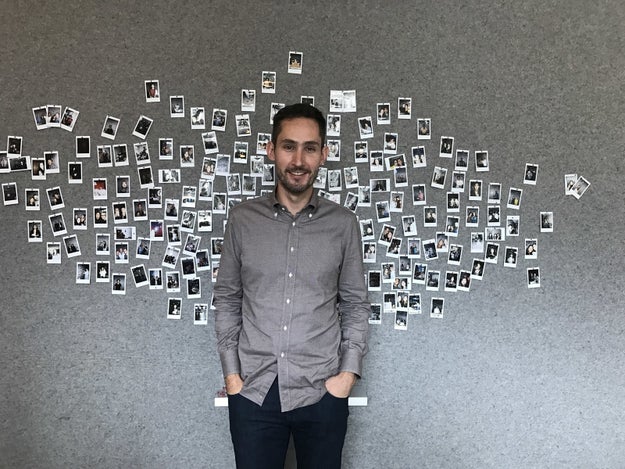
Instagram CEO Kevin Systrom in front of a photo wall at the Blue Bottle café inside the company&;s new headquarters building.

Mat Honan

It’s been a hell of a year for Instagram. The photo and video sharing network shipped a slew of new features and updates in 2016, many of them controversial. In March, it irked people by changing the way it displays updates in its feed, moving from purely chronological to an algorithmic ordering. In May, it set off a ruckus with a change to the familiar Instagram logo. And in August it absolutely, positively steamed the internet by rolling out a new Stories feature that obviously cloned a marquee Snapchat feature. Along the way, Instagram also released new tools to fight trolls, went big on video, added an army’s worth of advertisers, and — just last week — moved into a new office. Phew&;

That&039;s a bevy of changes for a company that was once famously deliberate — perhaps even slow — at evolving its product. But they&039;ve all had a healthy effect on Instagram. It is now sitting on 500 million daily active users, 100 million of whom view its new Stories feature daily. According to the company’s leadership, people are spending far more time in the app both viewing and posting images. And because of that, Instagram now boasts more than half a million advertisers on its platform every month. That translates into a lot of revenue for a company that today turns 6 years old.

For Instagram&039;s sixth birthday, BuzzFeed News sat down with founder and CEO Kevin Systrom to talk about the company&039;s recent past and near future, and the rapid evolution it has undergone. He was upbeat — happy, even — and insistent that the changes Instagram has undertaken this year are crucial to its continued growth and relevance — even if they did provoke a backlash from users and critics.

“I think companies that fail are typically companies that look at themselves as a set of features,” Systrom said of Instagram&039;s decision to get into video and move beyond its iconic square photo. “Companies that succeed look at themselves as mission-based companies. … So if Instagram&039;s mission is to make sure that everyone can capture and share the world’s moments, and use them to form stronger relationships with one another, how do you say to someone, ‘I&039;m sorry, you can&039;t post that photo unless you crop it into a square and fit everyone in’? That&039;s a ridiculous argument.”

That kind of thinking made the decision to introduce video to Instagram an easy one. Thanks to better cameras, faster networks, and more on-device storage, our video usage is rapidly increasing, and every social platform — Twitter, Facebook, Snapchat — is barreling to highlight it. Instagram is no different. But where the company&039;s photo content is instantly recognizable and iconic, its video looks pretty much the same as everyone else’s. Systrom maintains that the videos posted to Instagram differ from those found elsewhere, but he acknowledged that Instagram&039;s video-viewing experience isn&039;t quite there yet.

“I agree, the video format in our viewer does feel similar to what a lot of other people are doing,” Systrom said. “I think that&039;s fine for now, but it&039;s not where we want to end up. We want to innovate and improve the experience.”

This mission-driven approach also explains Instagram&039;s decision to abandon its original logo (which Systrom himself designed) for a new one with a flatter, more abstracted aesthetic.

“You form your own identity over time,” Systrom explained. “We wanted to make sure that people knew we were not just a camera app on your phone. We are much more than that. We are about media. We are about diversity. We are about expression. The new logo aligns with our principles — simplicity, universality, understandability. It also aligns with our mission, which is not just to be a camera company, but to be a moments company. The logo is abstracted from the physical camera. It acknowledges that we are, in fact, about moments.”

That moments line sounded a bit odd given Instagram&039;s recent move away from a purely chronological feed. If the the company&039;s mission is capturing and sharing moments, doesn’t it make more sense to display them as they happened? One of Instagram’s early big cultural breakthroughs, for example, was in 2011, when New York City was hit by a blizzard, and its residents relentlessly shared photos of their slogs through the snow. We as a society experience these unexpectedly serendipitous moments where we fire up Instagram and see our friends all experiencing the same things at the same time. How will people showcase and experience those moments — such as a particularly vivid sunset in Manhattan or a gorgeous rainbow stretching across San Francisco — in an algorithm-driven world?

“Nowhere in our mission is it about being real-time,” Systrom said. “I don&039;t think we are focused on making sure you have a news feed of an unfolding event in real-time view. And I think that&039;s okay. You should still see rainbows, generally, together — especially if they&039;re good rainbows, in which case the best ones will rise to the top.”

According to Systrom, when Instagram rolled out its algorithmic timeline, people were missing about 70% of the images and videos in their feeds. So the company introduced tweaked things so that the 30% they do see is likely to be the stuff they care about most.

Systrom said Instagram experimented with several different versions of a ranked feed before landing on the one it rolled out and has since refined. The feed is now calibrated to prioritize the content with which people are most likely to engage. And, according to Systrom, that has driven people to spend more time on Instagram and upload more even more content to it.

“In general, feed is still a very, very real time,” Systrom observed. “We just take the last [updates] since you checked Instagram — which for most people is maybe a couple of hours — and we make sure that the best stuff&039;s at the beginning.”

Mat Honan

But nothing else has been as controversial for Instagram as its decision to clone Snapchat Stories. Systrom consistently talks about taking problem-solving and mission-driven approaches to the company&039;s product. In this particular case, the problem that needed solving was a simple one: getting people to post more content to Instagram more often.

“It’s pretty well-known that on Instagram you post the highlights of your day,” Systrom said. “I wish it weren&039;t that way. I wish people felt more free to share as much as they wanted during the day.”

For Instagram, that was a troubling conundrum.

“As we dug into our user studies, I realized very quickly that we had to find a solution that made it so you didn&039;t have to post your profile,” Systrom explained. “After some tests, we added a check box that said ‘expire from my profile’ or ‘don&039;t post to my profile.’ But no one understood why they would do that.”

So in August, in an attempt to get people to post more casual kinds of content in a way they already understood, Instagram rolled out Stories. For anyone who had used Snapchat — which offers a near-identical feature of the same name — the update felt…pretty familiar&033; The Verge called it a “near perfect copy” of Snapchat Stories. TechCrunch described it as “a Snapchatty feature.” The New York Times said it “takes a page” from Snapchat. BuzzFeed News wrote, “It’s hard to view Instagram Stories as anything other than a direct shot at (or, less charitably, blatant rip-off of) Snapchat Stories.”
Systrom, at the time, leaned into the criticism. And he still vigorously defends Instagram&039;s move to adopt a feature that has been for Snapchat a huge driver of engagement.


“We have a lot employees that believe passionately in ephemerality,” Systrom said. “And I wanted to be sure that we were doing the right thing for the community — not just reacting to what was out there because it was cool or hip. Ephemerality had to be adopted in a way that worked. And a signal that it is working is that after just a few months, over 100 million people, daily, use Instagram Stories. So, forget about pride of authorship, internally or externally — it&039;s working.”

Quelle: <a href="Instagram At 6: Kevin Systrom On Moments, Mission, Ads, And Stories“>BuzzFeed