Elon Musk And Uber CEO Travis Kalanick To Advise Trump, Apple CEO To Meet Privately

Toru Hanai / Reuters

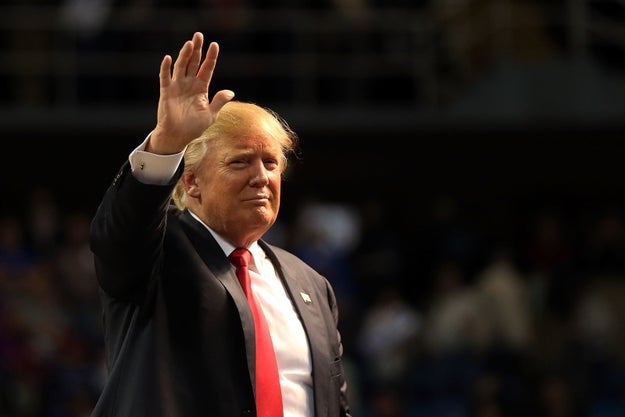
President-elect Donald Trump named Elon Musk, the head of SpaceX and Tesla, and Uber CEO Travis Kalanick to his growing panel of industry chieftains Wednesday, a group convened to provide regular economic guidance to the next president. PepsiCo&;s CEO Indra Nooyi has been added as well.

Billed as the President’s Strategic and Policy Forum, the panel was announced earlier this month, comprised of 16 business leaders, including the heads of Walmart, Disney, and General Motors. Among the initial batch of CEOs, IBM was the sole technology company represented, making the addition of Musk and Kalanick, all the more important in Trump&039;s efforts to channel and recruit the expertise of Silicon Valley.

“America has the most innovative and vibrant companies in the world, and the pioneering CEOs joining this Forum today are at the top of their fields,” Trump said, when the forum was first unveiled. “My Administration is going to work together with the private sector to improve the business climate and make it attractive for firms to create new jobs across the United States from Silicon Valley to the heartland.”

Tesla has not yet responded to a request for comment.

Kalanick told BuzzFeed News in a statement: “I look forward to engaging with our incoming president and this group on issues that affect our riders, drivers and the 450+ cities where we operate.”

Trump is slated to meet with Musk and a who&039;s who of tech industry titans Wednesday afternoon, with job creation expected at the top of the agenda. Among the guests planning to attend: Tim Cook of Apple, Jeff Bezos of Amazon, Sheryl Sandberg of Facebook, and Satya Nadella of Microsoft.

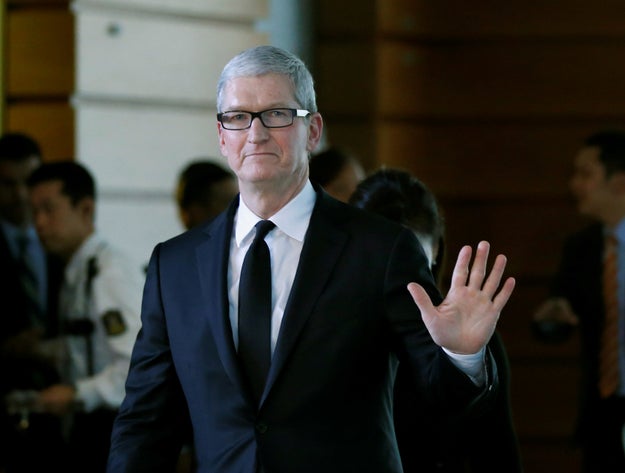
Cook and Musk are also expected to meet with Trump privately. Apple has not responded to a request for comment.

Quelle: <a href="Elon Musk And Uber CEO Travis Kalanick To Advise Trump, Apple CEO To Meet Privately“>BuzzFeed

Facebook Tests "M Suggestions," Laying Groundwork For More AI In Messenger

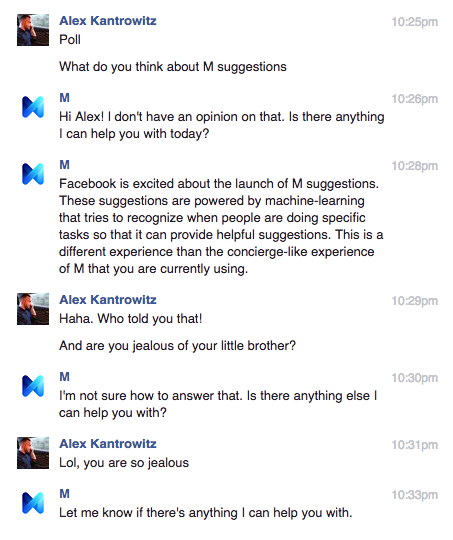
Facebook’s “M” virtual assistant hasn’t been rolled out to all that many people, but its interactions with a limited user base have helped train Facebook’s artificial intelligence systems, and now the masses may benefit.

M suggestions in action

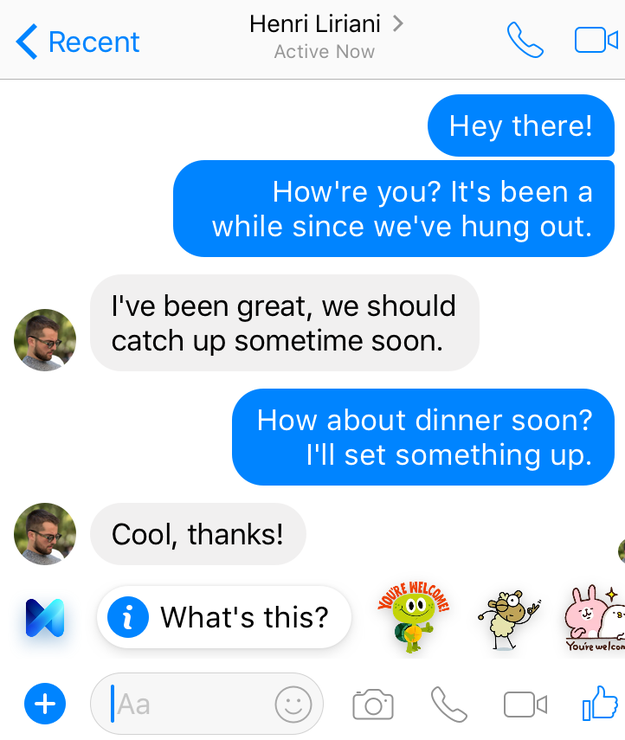
Today, Facebook is starting a small test in the US for “M suggestions,” a new feature that will suggest certain actions based on the context in conversations within the Messenger app.

The test feature will suggest things like sending a location after someone asks a question like “where are you?,” or it will offer a small selection of stickers you may want to send in response to a message. “M” will show up in these conversations with its own chat avatar.

“Think of this as a version of M that can actually help suggest the right capabilities at the right time,” Messenger head David Marcus told BuzzFeed News.

The virtual assistant version of M has been in tests for over a year and still has no set date for a bigger rollout, but Marcus said Facebook wants to bring it to the public. “M suggestions,” if rolled out more broadly, could help push the schedule up a bit, getting a completely automated version of M into the hands of Messenger&;s over 1 billion users, albeit in a much more lightweight capacity than the assistant version.

“Hopefully with this side of it, we’ll have a path to opening it up to everyone fairly quickly,” Marcus said.

There’s still a good deal of technology that goes into creating these basic suggestions. Facebook essentially needs to understand what you’re saying in messages to make sure its suggestions aren’t annoying, and its technology also adjusts its suggestions based on how you interact with M. “It seems completely pedestrian, but it’s actually very hard to do,” Marcus said, referencing Messenger’s sticker suggestions.

Other suggestions Messenger already makes, such as event reminders and ride hailing, will be rolled under the “M suggestions” umbrella as well.

Facebook M in action

Facebook&039;s M suggestions can be seen as a defensive move in some ways. Google Assistant, a virtual assistant inside Google’s Allo messaging app, can also be called into conversations, and Allo suggests responses based on the conversation’s context with “Smart Replies.” Asked for his thoughts on Google Assistant, Marcus declined to address it directly.

The virtual assistant competition between Google and Facebook could get interesting very quickly, especially since assistants fit in both companies’ territory. A great assistant could be a competitive advantage for a messaging app, and if it&039;s developed outside of Facebook, it could be a threat since the company owns both Messenger and WhatsApp, two massive messaging apps. On the other hand, virtual assistants can help people look for something online, the pillar Google’s business is built on. For now though, neither company appears to be under imminent threat from the others’ virtual assistant efforts.

M suggestions will roll out to a very small group, but Marcus said Facebook hopes to gradually expand it in the first half of next year.

Quelle: <a href="Facebook Tests "M Suggestions," Laying Groundwork For More AI In Messenger“>BuzzFeed

iPhone Apps Could Be A Revolution In Health — If People Use Them

Jacoblund / Getty Images

More than a year and a half ago, Apple unveiled a new breed of iPhone apps that would let people participate in scientific studies anytime, anywhere — at least in theory. Now, a new study indicates that smartphones do have the potential to capture useful data about thousands of people’s health and exercise habits in their daily lives, not just during a trip to the doctor or a clinical trial center.

But it also shows that if iPhones are to become the next big tool in science, researchers will have to conquer a challenge familiar to every app developer: how to keep people from getting bored and quitting.

The study, published Wednesday in JAMA Cardiology, reveals the first results of an app that was part of Apple’s much-hyped foray into health, a field that has been relatively slow to digitize. “This is the blossoming of mobile device medical research,” said Eric Topol, a cardiologist and genetics researcher at the Scripps Research Institute, who was not involved with the study, in an interview with BuzzFeed News.

At a widely publicized and livestreamed event in March 2015, Apple introduced ResearchKit, a tool to build apps to study conditions like breast cancer, Parkinson’s disease, type 2 diabetes, and asthma — to name a few of the ResearchKit apps that launched that month.
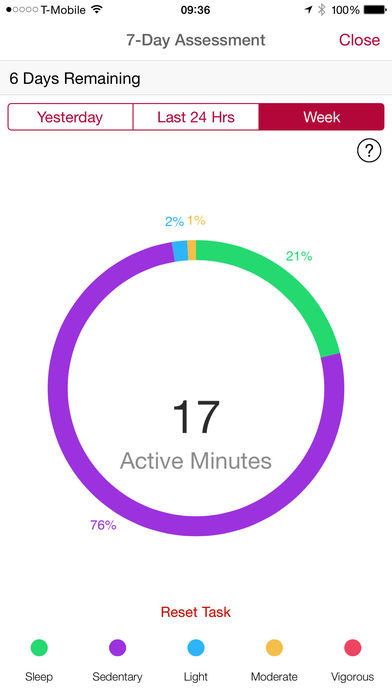
MyHeart Counts

Via itunes.apple.com

One of the apps, MyHeart Counts, run by a team at Stanford University, aimed to measure people’s cardiovascular health. Between March and October 2015, nearly 50,000 people from all 50 states signed up for the weeklong study, and 40,000 of them submitted health data of some kind. These unusually high numbers suggest that smartphone-conducted studies can reach many more people than traditional studies ever have.

Before this, “there hasn’t been 40,000 patients capturing their data about their activity through a medical research app,” Topol said. “That is a standout.”

At the same time, relatively few people took the extra step of doing some of the tasks that the app asked them to do. Just shy of 5,000 people completed a six-minute walk test, a common proxy of heart health, with their phones in hand, according to the study. And while 40,000 people filled out some portion of the app’s health questionnaires, only about 1,300 provided all the information needed to calculate their personalized health risks.

That squares with a recent study that showed that for the first five ResearchKit apps that launched, including MyHeart Counts, the percentage of daily users quickly dropped to 25% or below within the first three months.

“This is a very significant problem with this new form of medical research,” Topol said. “You accrue lots of people, but to keep them engaged, long-term, is perhaps the greatest challenge.” Apps could keep people coming back, he suggested, by offering participants something valuable in return, like personalized insights about their health.

While Euan Ashley, the study’s senior author, acknowledges the steep drop-off rate, he sees those figures optimistically. Although only 10% or so of eligible people did the six-minute test, Ashley noted, this group was about 10 times bigger than any other study of people doing the same test. Clinical trials in general sometimes see 30% or more of patients drop out.

The app was also valuable, he said, because it monitored people’s physical movements in the background. It showed, for example, that people were active about 15% of the time their movements were recorded in a week (assuming that people carried their phones or wore a fitness-tracking device when on the go).

“Instead of asking ‘How many steps did you take last week?’, ‘How many flights did you climb?’, we can actually measure that. I think that’s a groundbreaking thing.”

“The scope of it and scale of it is new and represents a huge opportunity,” Ashley, an associate professor of cardiovascular medicine at Stanford University School of Medicine and one of the leaders of the MyHeart Counts study, told BuzzFeed News. “Instead of asking ‘How many steps did you take last week?’, ‘How many flights did you climb?’, we can actually measure that. I think that’s a groundbreaking thing.”

When MyHeart Counts and the other original ResearchKit apps launched, no one — including researchers — knew whether people would be receptive, Ashley said. Since then, several more ResearchKit apps have launched.

“Given that these launch studies were the first of a kind, the idea you could use these devices that fit in everyone’s pockets and pull them out multiple times a day for clinical research to help patients — that was unknown,” he said. “The number-one finding that we’re reporting is that this is possible.”

While all clinical trials struggle to enroll a diverse and representative group of patients, this study’s demographics also underscore some inherent challenges to smartphone studies. Obviously, only people with the financial means to own iPhones could participate. And while clinical researchers traditionally meet their subjects in person, that’s not possible when the study is done exclusively through an app. So it’s possible that a small number of people purposely faked their data, Ashley acknowledged, although he doubts that the group was big enough to skew the data.

Christine Lemke, president of Evidation Health, a startup that studies and validates health apps, called the study a promising look at the potential future of research.

“It’s feasible to deliver studies like this,” she said. “More of them, please.”

Quelle: <a href="iPhone Apps Could Be A Revolution In Health — If People Use Them“>BuzzFeed
Your Next Uber Ride In San Francisco May Be In A Self-Driving Car

Uber

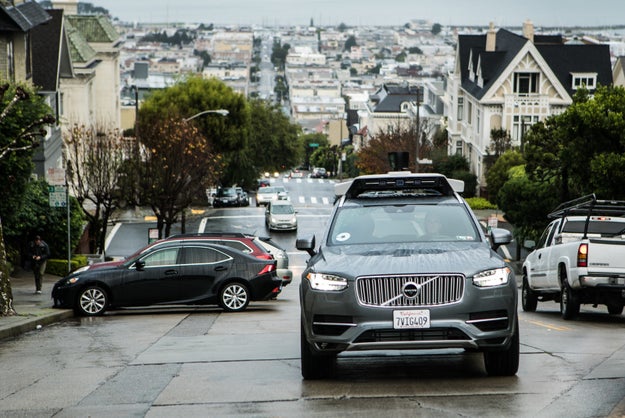
Hailing an Uber in San Francisco? Your next ride might be in one of the ride-hail giant’s self-driving cars.

Uber, which began putting riders in autonomous cars in Pittsburgh in September as part of a pilot program, is expanding its testing grounds to San Francisco. Starting Wednesday, riders who hail an UberX to travel within the city’s limits might be picked up in one of the company’s handful of self-driving Volvos. Uber wouldn’t say exactly how many self-driving vehicles will hit the road in San Francisco, but said it plans to have a total of 100 self-driving cars there and Pittsburgh by the end of 2016.

For now, the cars aren’t 100% autonomous: Each vehicle still has a human driver behind the wheel to begin each ride – by starting the ignition, shifting gears, and exiting a parking lot to reach the road, for example. A screen on the dashboard will tell the driver when the car’s computers determine that it is safe to turn on autonomous mode. And in the front passenger seat, a human copilot with a laptop will monitor the car’s trajectory. The driver can take over at any time, and if the car determines a situation is too precarious, it may also beep and kick control back to the driver, whose hands are to remain hovered near the wheel. There’s a big red button near the gears, which a driver can push to turn off autonomous mode, or he or she can simply resume control of the vehicle by taking the wheel.

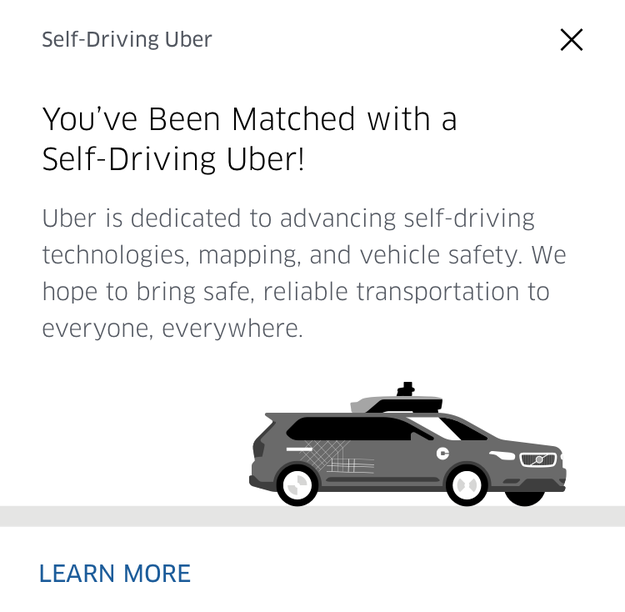
If you’re matched with a self-driving Uber, you’ll see this notification:

Uber

Riders have the option to turn down autonomous Uber rides by canceling their requests.

Driving in San Francisco will present a different set of challenges for autonomous cars than Pittsburgh: the California city has more traffic, more bikes and pedestrians, and narrower lanes. The self-driving cars will only accept rides from passengers whose routes are contained within the city of San Francisco’s perimeters – so no trips to Oakland or Palo Alto, for example.

“It will look for routes where we have excellent support for autonomy,” said Matt Sweeney, head of product at Uber. The cars will rely on Uber’s own mapping technology and will drive at a maximum speed of 30 MPH, meaning that they will avoid highways.

Sweeney wouldn’t say which cities Uber is planning to bring its autonomous vehicles to next, but its ambitions for self-driving vehicles are expansive.

“The promise of self-driving is core to our mission of reliable transportation, everywhere for everyone,” Anthony Levandowski, head of Uber’s self-driving team, wrote in a blog post announcing the expansion. “While it won’t happen overnight, self-driving will be an important part of the future.”

The company became the first to put passengers in self-driving cars through ride-hail in September in Pittsburgh, only 18 months are opening its Advanced Technologies Center, where many of its autonomous driving engineers work. Uber also purchased Otto, a self-driving truck startup, this summer. Otto completed its first self-driving truck delivery – a beer run for Anheuser-Busch – in October. And earlier this month, Uber announced it had purchased an artificial intelligence startup called Geometric Intelligence and said it is opening an AI lab to focus on machine-learning efforts such as self-driving.

Uber’s self-driving expansion makes to SF also makes its rivalry with Google, based in nearby Mountain View, more evident. Google announced on Tuesday that it’s spinning its self-driving car program off into an independent company called Waymo, which will live under the parent company Alphabet’s umbrella. Waymo is also planning a ride-sharing program with Fiat Chrysler, The Information reported Monday.

Quelle: <a href="Your Next Uber Ride In San Francisco May Be In A Self-Driving Car“>BuzzFeed

Amazon's Prime Video Is Now Live In The Company's Largest Market Outside The US

Brian Ach / Getty Images

Amazon has launched its video streaming service Prime Video in India, the company&;s largest geographical market outside the United States.

The service is bundled with a Prime subscription in India, which is the cheapest in the world at $15 a year, but has been available for an introductory price of $7 since the company launched it in the country in July.

Amazon Prime Video competes directly with Netflix, which expanded simultaneously to 130 countries, including India, in January.

Prime Video sharply undercuts Netflix on price in India, where the cheapest Netflix subscription costs Rs. 500 a month ($7.4). It also competes with more than a dozen local streaming services which offer a mix of free ad-supported content, as well as paid options.

Launching Prime Video in India is a strategic milestone for Amazon. Thanks to a rapid smartphone penetration and falling data prices, the country is an important market for most US tech companies.

At an event in Washington in June, Amazon CEO Jeff Bezos said that the company would invest up to $5 billion in India. Amazon&039;s aggressive expansion in the country has worried local rivals like Flipkart, India&039;s largest e-commerce startup, who recently appealed for protectionist policies from the Indian government to stave off cash-rich rivals like Amazon.

Unlike Netflix, which launched in India with no Indian content at all, Amazon Prime Video already has dozens of launch titles in Hindi, Bengali, Marathi, Tamil, and Telugu. Amazon has also partnered with several major film production studios in India to make dozens of Bollywood titles available on its service, and has included local language subtitles for English-language shows like Mad Men, Seinfeld, Person of Interest, Mad Men, and more. Also available are US-produced Amazon Originals series like Transparent and Bosch.

Quelle: <a href="Amazon&039;s Prime Video Is Now Live In The Company&039;s Largest Market Outside The US“>BuzzFeed

Facebook Spokesperson Calls Muslim Registry "Straw Man"

Lluis Gene / AFP / Getty Images

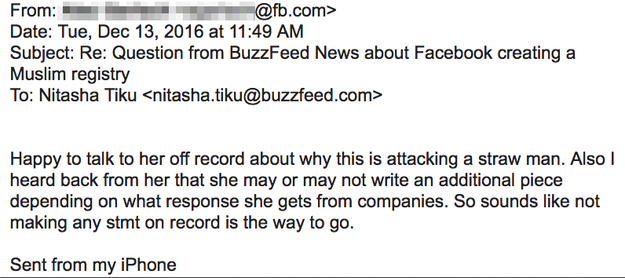
A spokesperson for Facebook, accidentally responding to a BuzzFeed News reporter via email, called the notion of a Muslim registry a “straw man.” Seemingly thinking he was addressing a colleague, he suggested that the best course of action was to not respond to the reporter&;s inquiry.

Earlier today BuzzFeed News emailed Facebook to ask whether the social networking giant would make a commitment to limit data collection that could be used for ethnic or religious targeting, including a pledge not to build a registry of Muslims, if asked to do so by the government. A Facebook public relations representative intended to forward our request, along with a message about how to respond, within Facebook, but accidentally sent the email to BuzzFeed News instead and in doing so, provided inadvertent insight into how the company plays the optics game.

BuzzFeed News

Facebook had not responded to previous requests for clarification on whether or not it would participate in building a Muslim registry. BuzzFeed News asked again today in light of the fact that Facebook COO Sheryl Sandberg will attend a tech summit at Trump Tower tomorrow, and because a group of 60 or so engineers and employees for major tech companies just signed a pledge not to comply with practices that could be used to target people or build databases based on their religious beliefs.

In the email that was accidentally sent to BuzzFeed News, the PR rep calls this “attacking a straw man.”

Happy to talk to her off record about why this is attacking a straw man. Also I heard back from her that she may or may not write an additional piece depending on what response she gets from companies. So sounds like not making any stmt on record is the way to go.

The representative subsequently called, and asked that the email be considered off the record. This preference for off the record spin over on the record comments is fairly typical of large tech companies. Facebook ultimately declined to comment.

However, the possibility that President Elect Donald Trump will try to create a Muslim registry is not a straw man. Trump has repeatedly been given a chance to clarify whether he supports the idea. He has been asked about it by everyone from Fox News to George Stephanopoulos. On more than one occasion he has chosen not to rule out the possibility of a Muslim registry. The question of such a registry arose based on Trump&039;s comments about Muslims and his intention to build a database of Syrian refugees.

Since the election, Kansas Secretary of State Kris Kobach, an advisor to Trump&039;s transition team, told Reuters that Trump&039;s immigration policy group is considering reinstating the National Security Entry-Exit Registration System (NSEERS), a suspended federal program used to keep a database of immigrants from countries that have a Muslim majority from 2001 to 2012.

Facebook, of course, already asks for and retains sensitive information about the race, religion, and location of its users and allows advertisers to target narrow segments of people based on that personal information. Government officials here and abroad already use the social network to track activists and dissidents.

Quelle: <a href="Facebook Spokesperson Calls Muslim Registry "Straw Man"“>BuzzFeed

How Malik Obama Became A Twitter "Shitlord" And Alt-Right Darling

Perhaps the weirdest subplot in this year&;s unprecedentedly weird presidential election was the bromance between Donald Trump and Malik Obama, President Obama&039;s half-brother. In July, Malik, a 58-year-old with dual US and Kenyan citizenship, announced that he would support Trump&039;s presidential bid. Shortly afterward, Trump welcomed his support on Twitter. By October, the Trump campaign invited Obama to the final presidential debate, where he snapped a photo alongside Kellyanne Conway.

Malik Obama&039;s reasons for supporting Trump remain somewhat unclear and may stem from hard feelings he has towards his half-brother. But whatever the reason, that support was vehement, particularly on Twitter, where he was so adamantly pro-Trump that his account was often accused of being a parody.

But shortly before the election, Obama was verified by Twitter. And since that verification, something weird has happened: Malik Obama has gone full chanterculture, shitlord, troll, adopting much of the language and similar tactics to those used by the alt-right.

To wit: Obama frequently calls his opponents cucks. Obama discusses the Swahili meaning of the “Harambe.” Obama rails against “fake news” like CNN and the Huffington Post. Obama goes back and forth with Bill Mitchell. Obama assures his followers that he has not been “spirit cooked” (Pizzagate for “satanic rite.”) Obama shares Pepe memes of himself bearing the name “Memelike Obameme.” Etc.

It&039;s a lot to take in: Barack Obama&039;s half brother, who was the best man at the president&039;s wedding, is now a proud -loving shitlord. How could a Kenyan immigrant who only a few years away from social security, so quickly develop such a mastery of the current alt-right cultural memefield of tropes and jokes?

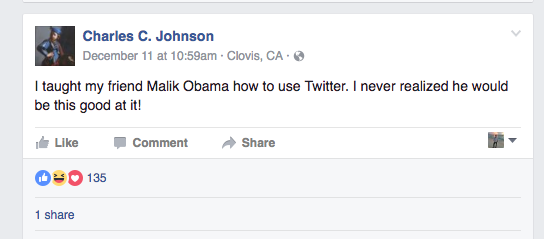
The only thing that&039;s sure about the answer is that it involves Chuck Johnson in some way. According to both Obama and Johnson — the notorious journalist and troll who was controversially kicked off Twitter for asking his followers for money so he could “take out” civil rights activist DeRay Mckesson — it&039;s all very simple: the latter taught the former how to use Twitter really, really well. On Saturday, Obama tweeted

And responding to an email from BuzzFeed News asking how he had mastered Twitter so quickly, Obama wrote “It&039;s a wonderful medium for expressing oneself. Chuck Johnson got me started and my followers have taught me a lot. But most of it is just plain knack&;”

Reached via email, Johnson concurred. According to him, the two connected in the spring in Washington, DC (Obama lived for years in Maryland), where Johnson began teaching Obama his method.

“I teach people neurolinguistic programming,” Johnson wrote. “I have them speak while they tweet so that it appears more conversational and I make sure that they tap into people&039;s emotions and not just their intellect. When Malik Obama told me he supported Donald Trump I helped him throughout the process.”

But today, Wesearchr, Johnson&039;s crowd-sourced investigations company, retweeted a tweet suggesting that Johnson had groomed Malik Obama as part of a master plan to get back at Twitter.

Both Obama and Johnson denied that Johnson writes the president&039;s half-brother&039;s tweets.

“Malik Obama is a grown man who does his own tweets,” Johnson wrote. “I do my own stunts.”

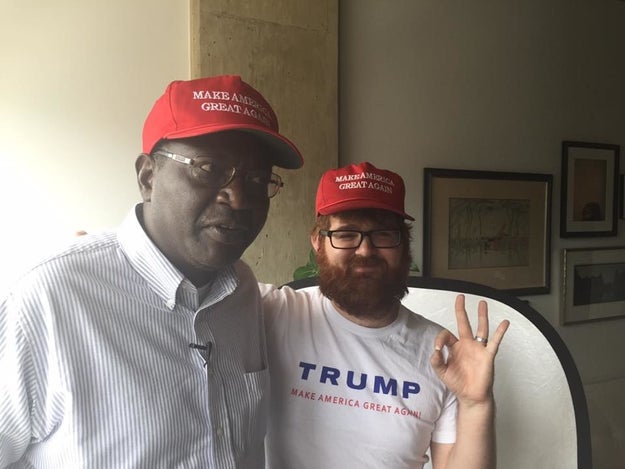
There&039;s no question that Johnson and Obama know each other — they were photographed together for Johnson&039;s other venture, a news site called GotNews.com.

Asked for details into how Johnson taught him Twitter, Malik Obama asked for a “token payment” of $1000. (Obama has a history of asking journalists for money; last year he asked a POLITICO reporter for $10,000 to talk.)

“You want everything for free?” he asked, when refused payment.

Quelle: <a href="How Malik Obama Became A Twitter "Shitlord" And Alt-Right Darling“>BuzzFeed

Google Spins Out Self-Driving Car Unit Into A New Company Called Waymo

Waymo

Google is spinning out its self-driving car program into a new company called Waymo, its chief executive John Krafcik announced Tuesday. Waymo will live under the umbrella of Alphabet, Google’s parent company.

“We’ll continue to have access to the resources and infrastructure that Alphabet provides,” Krafcik told reporters on Tuesday.

Krafcik said that Google conducted its first fully driverless rides in every day traffic in Austin last year, using a car with no steering wheels and no pedals. “We’ve taken over 10,000 trips with Googlers and guests in cities where we’re currently driving,” he observed.

Waymo

Google&;s spin-off of Waymo comes as the company, which began developing self-driving technology in 2009, moves to scale its technology. Competitors – namely, Uber – have already begun pilot programs to put passengers in self-driving cars in Pittsburgh. Those cars, however, still include steering wheels and pedals, as well as human drivers and co-pilots who steer cars to the road before turning on autonomous mode.

During today&039;s Waymo launch event, engineers said the company continues to calibrate its autonomous cars, improving their navigational abilities as well as their rides.

“We’re putting a lot of effort into making our cars more comfortable and having them be smoother,” Dmitri Dolgov, a principal engineer at Waymo, told reporters. “We’re continuing to build up map technology, and take our cars to new and different places.”

Quelle: <a href="Google Spins Out Self-Driving Car Unit Into A New Company Called Waymo“>BuzzFeed

Silicon Valley Engineers Pledge To Never Build A Muslim Registry

Spencer Platt / Getty Images

A group of nearly 60 employees at major tech companies have signed a pledge refusing to help build a Muslim registry. The pledge states that signatories will advocate within their companies to minimize collection and retention of data that could enable ethnic or religious targeting under the Trump administration, to fight any unethical or illegal misuse of data, and to resign from their positions rather than comply.

The group describes themselves as “engineers, designers, business executives, and others whose jobs include managing or processing data about people.”

Silicon Valley tech companies themselves have, for the most part, stayed silent or declined to comment when asked about similar commitments to upholding civil rights. The pledge, which is posted at Neveragain.tech, comes a day before top executives at major tech companies plan to attend a summit hosted at Trump Tower in Manhattan. Recode reported that Apple CEO Tim Cook, Facebook COO Sheryl Sandberg, Google CEO Larry Page, Tesla and SpaceX CEO Elon Musk, Microsoft CEO Satya Nadella, and perhaps Amazon CEO Jeff Bezos accepted an invitation to the summit from President-Elect Donald Trump.

Ka-Ping Yee, a software engineer at Wave, formerly of Google, and Leigh Honeywell, a security engineering manager at Slack, helped organize the Never Again pledge. Yee told BuzzFeed News that he didn&;t know why tech companies have not made similar commitments. “What&039;s important to me is that individuals who care about the ethical use of technology can step forward, show how many of us there are, and say that there are lines we will not cross,” said Yee.

Last month, after Facebook CEO Mark Zuckerberg said it was “pretty crazy” to think that fake news could have affected the presidential election, a group of renegade Facebook employees formed an unofficial task force to investigate Facebook&039;s role in promoting propaganda.

“Ultimately, it&039;s individuals who make decisions and do the work, and can take personal responsibility for their choices; if enough individuals refuse to participate, unethical projects can&039;t proceed,” Yee added.

The pledge says:

We, the undersigned, are employees of tech organizations and companies based in the United States. We are engineers, designers, business executives, and others whose jobs include managing or processing data about people. We are choosing to stand in solidarity with Muslim Americans, immigrants, and all people whose lives and livelihoods are threatened by the incoming administration’s proposed data collection policies. We refuse to build a database of people based on their Constitutionally-protected religious beliefs. We refuse to facilitate mass deportations of people the government believes to be undesirable.

We have educated ourselves on the history of threats like these, and on the roles that technology and technologists played in carrying them out. We see how IBM collaborated to digitize and streamline the Holocaust, contributing to the deaths of six million Jews and millions of others …

Honeywell said that the idea for a pledge came out of “informal discussions among techie friends.” Roughly 30 people collaborated on the text. “We reached out to some civil society groups for feedback – we didn’t want it to be written in a vacuum,” she said. The organizers then looked within their existing networks to enlist others.

Right now within tech companies “there’s a lot of conversation happening about what people’s ethical lines are,” Honeywell told BuzzFeed. “I think that’s really important. We don’t know what’s ahead, but we can at least lay down some ethical boundaries for our own behavior, and hopefully encourage others to do the same.”

As part of the pledge, the signatories have committed to the following actions:

  • We refuse to participate in the creation of databases of identifying information for the United States government to target individuals based on race, religion, or national origin.

  • We will advocate within our organizations:

    • to minimize the collection and retention of data that would facilitate ethnic or religious targeting.

    • to scale back existing datasets with unnecessary racial, ethnic, and national origin data.

    • to responsibly destroy high-risk datasets and backups.

    • to implement security and privacy best practices, in particular, for end-to-end encryption to be the default wherever possible.

    • to demand appropriate legal process should the government request that we turn over user data collected by our organization, even in small amounts.

  • If we discover misuse of data that we consider illegal or unethical in our organizations:

    • We will work with our colleagues and leaders to correct it.

    • If we cannot stop these practices, we will exercise our rights and responsibilities to speak out publicly and engage in responsible whistleblowing without endangering users.

    • If we have the authority to do so, we will use all available legal defenses to stop these practices.

    • If we do not have such authority, and our organizations force us to engage in such misuse, we will resign from our positions rather than comply.

  • We will raise awareness and ask critical questions about the responsible and fair use of data and algorithms beyond our organization and our industry.”

Quelle: <a href="Silicon Valley Engineers Pledge To Never Build A Muslim Registry“>BuzzFeed

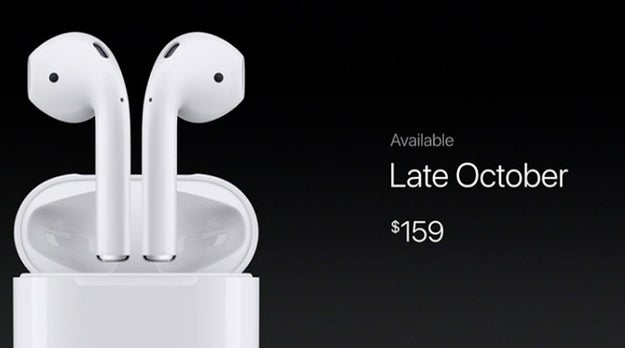
Apple's  Airpods Now Available For Pre-Order After Unusual Delay

Apple's Airpods Now Available For Pre-Order After Unusual Delay

Looks like Apple&;s new Airpods will arrive in time for the winter holiday shopping binge after all. On Tuesday morning that the wireless earbuds became available for purchase online with a ship date of Wed Dec 21.

Apple introduced AirPods in September alongside the headphone jack-less iPhone 7, touting them as a technically superior alternative to wired earbuds. Packed with a custom-designed Apple chip, accelerometers, optical sensors, beam-forming microphones, and antennas, Airpods are diminutive in-ear computers and a big part of Apple&039;s vision for the future of audio. “These are as advanced a project as Apple Pencil,” Apple SVP Phil Schiller told BuzzFeed News back in September. “We started this project when we started the Watch project. We knew we needed a great wireless solution for audio. We said, ‘What if you could design what the future of headphones should look like?’ That’s what we asked the team to do.”

When it announced Airpods in September, Apple said the $159 headphones would begin shipping in October. But on October 26, with the month nearly concluded, the company said it was delaying their retail availability. “We don’t believe in shipping a product before it’s ready,” an Apple spokesperson told BuzzFeed News. “We need a little more time before AirPods are ready for our customers.” Apple did not provide an explanation for the postponement, its first big delay of a new product since the white iPhone 4 in 2010.

Asked to explain the issue behind Airpods&039; delay, Apple declined comment. But a person familiar with the product&039;s development said it required additional “fine-tuning” related to sound performance and battery life.

View Video ›

Facebook: video.php

Quelle: <a href="Apple&039;s Airpods Now Available For Pre-Order After Unusual Delay“>BuzzFeed