SpaceX Just Made History By Relaunching A Rocket Into Space For The First Time

SpaceX made history (again) by successfully relaunching and landing a recycled rocket, a key step toward making spaceflight a lot cheaper.

If at first you do succeed, try, try again. That’s what SpaceX did with its Falcon 9 rocket relaunch on Thursday night, marking an industry first for shooting a recycled rocket back into space.

If at first you do succeed, try, try again. That's what SpaceX did with its Falcon 9 rocket relaunch on Thursday night, marking an industry first for shooting a recycled rocket back into space.

Nasa / Getty Images

Elon Musk’s California-based company launched and landed the refurbished Falcon 9 rocket in less than a year, a milestone for the aerospace industry and a crucial step in the tech CEO’s mission to significantly cut the cost of spaceflight.

Elon Musk's California-based company launched and landed the refurbished Falcon 9 rocket in less than a year, a milestone for the aerospace industry and a crucial step in the tech CEO's mission to significantly cut the cost of spaceflight.

Bruce Weaver / AFP / Getty Images


View Entire List ›

Quelle: <a href="SpaceX Just Made History By Relaunching A Rocket Into Space For The First Time“>BuzzFeed

Apple Just Opened A Centre In India To Help Indian Developers Make Better Apps

Apple

Apple officially opened an App Accelerator — essentially an incubator for developers creating apps for the iPhone, iPad, Mac, Apple TV, and the Apple Watch — in the Indian city of Bengaluru on Friday. The objective is simple: getting developers in a country where 97% of smartphones run Android to dip their toes in the Apple waters.

Indian developers can sign up for free at the Accelerator where experts known as Apple Technology Evangelists will brief about 500 developers each week on developing for Apple’s platforms. According to a press release, Apple will also work with developers on a one-on-one basis to offer detailed app analysis and feedback to enhance their apps on Apple’s various platforms. Apple CEO Tim Cook had first announced the Accelerator during his visit to India in May 2016.

Phil Schiller, Apple’s Vice President of Worldwide Marketing who is in India for the launch, told Indian technology news blog Gadgets360 that Apple wants to “accelerate the quality and innovation of the apps that are being created [in India]” and to “bring some of our unique Apple expertise close to developers who are making their great software.”

It’s easy to see why that might be crucial for Apple. Thanks to Android’s dominance in emerging markets like India, developers in these countries often develop their apps for Android first, and, in some cases, Android only. More importantly, engaging with local developers would allow Apple to understand the needs of the Indian market and help tailor future versions of its operating systems to its needs, said analysts who spoke to BuzzFeed News.

“India is home to more than a million software developers, so Apple naturally wants to get as many of them as possible hooked to the Apple ecosystem,” Neil Shah, Research Director of Devices and Ecosystems at market analysis agency Counterpoint, told BuzzFeed News. “Not losing this vast talent pool to other players like Google and Facebook is essential for them.”

Shah also points out setting up a centre like this also allows the company to win brownie points with the Indian government, with which it has been grappling for months to be allowed to set up Apple Stores in India. The country’s stringent laws require certain kinds of foreign companies to source components locally before they can set up a retail presence within India, something that Apple has been resisting. “Setting up an App Accelerator in the country would help Apple show its commitment to contributing to the Indian economy by generating software jobs,” said Shah.

Apple is collaboration partners at launch are Practo, a $600 million health-tech startup based in Bengaluru, and game developer Reliance Games. But some iOS developers in India told BuzzFeed News that they wish Apple had reached out to smaller developers in the country rather than wealthy startups with dedicated Apple development teams.

“I think companies with small teams — between 5 and 40 people — are the ones that would really benefit from Apple’s Accelerator,” said Shashwat Pradhan, founder of Emberify, which makes an iOS life-logging app called Instant. “Having hands-on guidance from Apple would be great for indie developers like us who can’t really afford to go to WWDC (Apple’s annual conference for developers) in California every year.”

Quelle: <a href="Apple Just Opened A Centre In India To Help Indian Developers Make Better Apps“>BuzzFeed

After Internet Privacy Vote, Some ISPs Pledge Not To Sell Browsing Histories

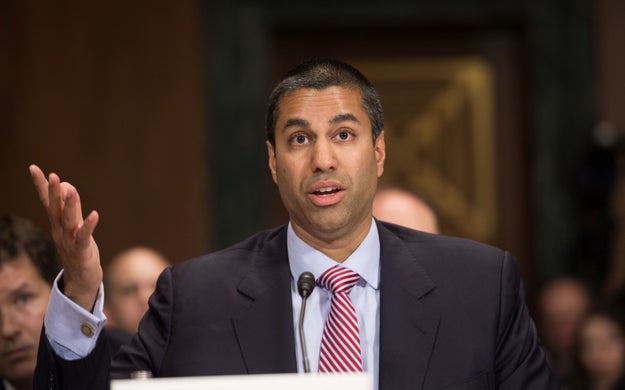
FCC Chairman Ajit Pai

Nicholas Kamm / AFP / Getty Images

This week, Congress voted to gut internet privacy regulations. The new legislation — which only needs President Trump’s signature to become law — would make it easier for internet providers like Comcast and Verizon to sell your browsing history and other information about your online habits to third parties. But just as giant carriers are seeing new avenues for data collection and ad revenue opening up, two California-based internet providers have pledged not to sell their customers’ browsing history, or any other data.

Sonic, a carrier with around 100,000 subscribers that offers service to most of California, and Monkeybrains, a San Francisco-based provider with around 9,000 subscribers, both promise to never sell your internet browsing history, subscriber information, or usage data.

“We&;re not in the business of selling data and we&039;ve never done so. We provide internet as a service and that’s it,” Alex Menendez, co-founder of Monkeybrains.net, told BuzzFeed News. “We have consistently had pro-consumer policies with regards to our privacy practices,” Dane Jasper, the CEO of Sonic, told BuzzFeed News. “We have a long history of differentiating ourselves that way.”

The Electronic Frontier Foundation consistently gives Sonic the highest marks on its annual scorecard “Who Has Your Back,” which evaluates the privacy and transparency practices of internet and technology companies. Monkeybrains counts the EFF as a client of its own. Both companies were among more than a dozen small-scale ISP and networking companies who publicly opposed the repeal of the internet privacy rules. But most Americans don’t have access to these services and have to rely on big ISPs for internet access.

Back in January, several major internet providers, including Comcast, Verizon, AT&T, Charter, and T-Mobile, voluntarily pledged to abide by a set of “ISP Privacy Principles” which rely on guidelines shaped by the Federal Trade Commission. However, there’s a crucial difference between these FTC guidelines and the more robust Obama-era rules that Congress just voted to overturn. The rules established that your browsing history is considered “sensitive” information, meaning that broadband providers first need to get permission before they can share it with third party companies like advertisers.

The ISPs, in their privacy principles, made no such commitment. They favor the older FTC guidelines, where customers’ browsing history may be collected and shared by default, without your affirmative consent.

Now that a Republican-controlled Congress has voted to ensure that these stronger rules won’t take effect, consumer advocates and former regulators have argued that key protections have been erased. Internet providers now have more freedom to make money off of your online activity.

“There is no reason to compete on privacy — that&039;s the problem.”

Under its privacy policy, AT&T, for example, states that it may collect: “IP addresses, URLs, data transmission rates and delays. We also learn about the pages you visit, the time you spend, the links or advertisements you see and follow, the search terms you enter, how often you open an application, how long you spend using the app and other similar information.”

“We or our advertising partners may use anonymous information gathered through cookies and similar technologies, as well as other anonymous and aggregate information that either of us may have to help us tailor the ads you see on non-AT&T sites,” the privacy policy states. “For example, if you see an ad from us on a non-AT&T sports-related website, you may later receive an ad for sporting equipment delivered by us on a different website. This is called Online Behavioral Advertising, which is a type of Relevant Advertising.”

When asked how they planned to use customers’ web histories if the rules were removed, AT&T, Verizon, and Sprint directed BuzzFeed News to their privacy policies. Comcast, Charter, and T-Mobile did not respond to queries about their use of browsing history. (Disclosure: Comcast Corp.&039;s NBCUniversal is an investor in BuzzFeed.)

Telecom industry representatives and Republican lawmakers say they oppose the privacy rules because they unfairly target ISPs, while favoring web companies like Google and Facebook. Because the rules don’t apply to these companies, they can use their customers’ data to rake in ad dollars.

USTelecom told BuzzFeed News that the repeal opens up advertising opportunities for internet providers, which may be helpful to consumers. NCTA — The Internet & Television Association told BuzzFeed News that the repeal will allow internet providers to better compete in the advertising marketplace.

But privacy advocates and Democratic lawmakers have argued that internet subscribers need special protections for two main reasons. The first is that ISPs can monitor everything a person does online, so long as the traffic is unencrypted, which is something web services like Google and Facebook cannot do. Second, most Americans live in areas with only a single internet provider. That means they can’t switch to more privacy-friendly ISPs like Sonic or Monkeybrains; instead, they’re forced to accept the privacy practices of a single carrier if they want internet access.

“We don&039;t believe that telephone companies should listen to our telephone calls,” Sonic’s Jasper said, using an analogy to describe how customers view their internet providers. “Carriers are in a different position, and that position is a trusted position in the minds of consumers.”

On platforms like YouTube and Gmail, for example, Jasper said there is a commonly understood relationship, where businesses provide a free service in exchange for advertising that’s shaped around tracking your behavior. This “implicit compact,” he argued, doesn’t exist between customers and their internet service providers.

Jeff Chester, the executive director of the Center for Digital Democracy, told BuzzFeed News that he hopes consumer pressure might influence how internet providers modify their data collection, but absent strong regulations, he believes the economic incentives are too strong for the big ISPs to ignore. “There is no reason to compete on privacy — that&039;s the problem,” he said.

“You could make the argument that it’s good business — and it is — but there are no regulations requiring any real privacy protections at all. If everybody is just buying and selling your data, then being the one that says &039;No, I&039;ll do better&039; does impact the bottom line.”

Quelle: <a href="After Internet Privacy Vote, Some ISPs Pledge Not To Sell Browsing Histories“>BuzzFeed

Twitter Tweaked How Replies Work And People Have All The Feelings

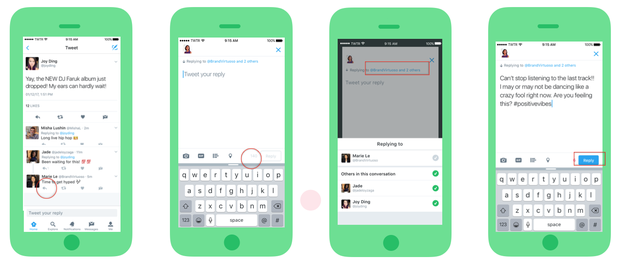
Twitter revamped its reply feature today: @usernames won’t show up in replies to tweets anymore.

Twitter revamped its reply feature today: @usernames won't show up in replies to tweets anymore.

It used to be that a bunch of @ usernames would show up in your Twitter replies, which could occupy a significant chunk of the 140 character limit for tweets. Now, the @ names won&;t appear in the reply itself. The names of the people in the conversation will appear above the tweet, and you can control who&039;s part of the conversation by tapping on that list of names.

And people are ~stressed~

giphy

People pointed out that it&039;s tough to remove yourself from replies with the new feature:

giphy

And just generally…loathe the change

But some people love it, I guess?

The overwhelming majority of reactions have been negative, though.

Twitter rolled back a similar feature in December in response to widespread outrage.

The company has recently shipped a number of updates; many of them are intended to curb abuse. In June 2016, it announced that GIFs, videos, photos, and other media wouldn&039;t count toward the 140-character limit.

It&039;s worth noting that pretty much any time Twitter rolls out a change, people get mad. Twitter did not respond to request for comment.

Quelle: <a href="Twitter Tweaked How Replies Work And People Have All The Feelings“>BuzzFeed

Lyft Is Launching A Commuter Shuttle Service

Lyft, your “woke” ride-hailing option, has started testing a shuttle service in San Francisco and Chicago.

Available only during commute hours (6:30 to 10 a.m. and 4 to 8 p.m. on weekdays), Lyft says its shuttles will cost a fixed price that won&;t be subject to surge pricing during high-demand commuting hours. Lyft says the cost of a Shuttle ride will vary depending on the length of the trip; a screenshot the company shared with BuzzFeed News suggests a benchmark price for a Shuttle ride is $3.50.

Lyft says Shuttle is an extension of its Line service, a cheap and popular carpool feature that is competitive with Uber Pool. “Lyft Line is the future of rideshare, and we often test new features that we believe will have positive impact on our passengers&039; transportation options,” the company statement reads.

A Lyft spokesperson said drivers will earn the same amount driving Shuttle as they do driving Lyft Line.

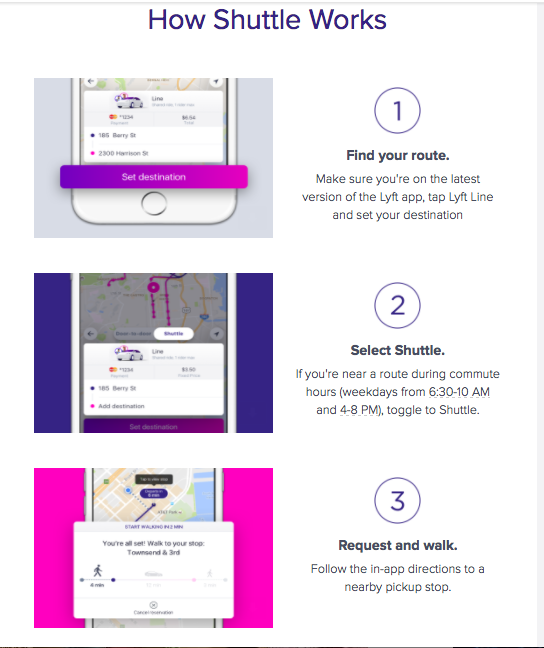
To book a shuttle ride, passengers type in their destination, get matched with a Lyft shuttle route, and walk to the pick up spot. Commuters trying to make the morning meeting can expect Shuttle to estimate how long it will take to walk to the pickup spot, how long the drive will be, and how long it will take to walk from the drop off point to the final destination.

Here’s how the system will work, based on an email Lyft sent to customers.

Here's how the system will work, based on an email Lyft sent to customers.

Lyft Line is a door-to-door ride hail service with extra stops to pick up and drop off fellow carpoolers along the way, but Shuttle has fixed routes, and passengers will need to walk to central points on both ends of the trip.

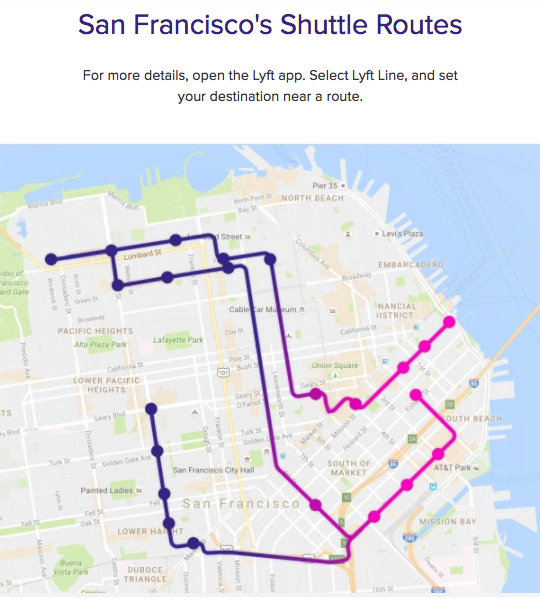
Based on the email, it looks the shuttle routes in San Francisco will primarily serve passengers who live and work in the city&039;s posher neighborhoods (like the Marina and Russian Hill) and the South of Market neighborhood where lots of tech companies have their offices. Lyft says Shuttle will only appear as an option when you launch the app if you&039;re near one of these routes.

If the idea of multiple people sharing a ride from a mutually convenient origin point to mutually convenient destinations along a fixed route sounds a lot like a bus to you, you&039;re right. Ride-hailing services have been working with public transit authorities in various cities, and they&039;ve had aspirations to replace or at least augment mass transit for a while now.

The use of private shuttle buses instead of public transit options is a historically contentious issue in San Francisco, where busloads of tech employees use private, company-funded shuttles to get to and from work in Silicon Valley everyday. But there&039;s also opportunity, and therefore competition, in the commuter transit space; last fall, Ford acquired Chariot, a San Francisco-based shuttle company that is also meant to supplement public transportation.

Quelle: <a href="Lyft Is Launching A Commuter Shuttle Service“>BuzzFeed

Tesla's Valuation Could Overtake Ford Any Day Now

Susana Bates / AFP / Getty Images

Tesla, the loss-making electric car company that sold about 84,000 vehicles last year, is now worth about as much as Ford, which sold 6.7 million cars in 2016 and turned a $4.6 billion profit.

Valuations for the two companies converged in recent months, as Ford slid and Tesla surged. By Wednesday afternoon, Tesla was worth $45.2 billion and Ford&;s was valued at $46.6 billion, according to Bloomberg data. Tesla could overtake Ford any day now, and become America&039;s second most valuable car company. GM, the current number one, is worth about $54 billion.

How wildly optimistic are investors about electric cars? Based on its current market price, Tesla is worth about $600,000 per vehicle sold in 2016, while Ford is worth about $7,000, according to calculations by Barclays analyst Brian Johnson.

Here’s the market valuation of Ford, in light blue, and Tesla, in black, over the last 12 months, up to the close of trading Tuesday

The stock market, of course, is supposed to reflect how investors rate the future of a company, not its past. On that front, Tesla, founded in 2003, has plenty of reasons for optimism. The company is right at the front of the two biggest trends in the industry: electric engines and self-driving cars.

And its revenues are heading up, fast: in 2016 it brought in $7 billion, up 73% on the year prior and up almost 1600% compared to four years ago. Ford&039;s revenue barely moved in 2016 and is up about 14% since 2012.

Analysts expect Tesla&039;s revenues to keep surging as it releases more affordable models — their best guess is the company could sell $19 billion worth of cars in 2018, according to data collected by S&P Global Market Intelligence. Ford, on the other hand, is expected by analysts to see its revenues fall slightly in the same period.

A man driving a 1911 Model T Ford in Scotland.

Jeff J Mitchell / Getty Images

Ford, like other major carmakers, is making sizable investments in self-driving technology and electric vehicles, but none have captured the imagination like Tesla. Imagination or not, Ford is in good shape to benefit from lower gas prices, as buyers move away from sedans and towards Ford&039;s more profitable SUVs and trucks.

But it&039;s easy to see why investors have a crush on Tesla. If the future of of transport involves a network of self-driving electric cars, powered by batteries that charge with solar power, Tesla has set itself up to benefit from it. The company is rushing to build a giant battery factory, and now owns a major solar power business as well.

Tesla stock has risen 22% in the last year, and 714% in the last five years. Ford shares, on the other hand, have fallen by 11% and 5% in the last 1 and 5 years respectively.

Tesla also earned the endorsement of another massive technology company on Tuesday, when Tencent, the Chinese internet conglomerate that runs the social network WeChat, bought 5% of the company. Tencent is a “new adherent” of the “Tesla cult,” Johnson wrote.

Some still have their doubts. Hedge fund manager Jim Chanos has long questioned Tesla&039;s business prospects, and those of its recently acquired solar energy business, Solar City, saying that the loss-making car company would constantly have to take new money from shareholders to fund its losses.

Johnson said in February that the jump in Tesla stock (the shares fell after the election and started rising again in December) had “less to do…with anything around the near-term financials, and more to do with the nearly superhero status of Elon Musk.”

Quelle: <a href="Tesla&039;s Valuation Could Overtake Ford Any Day Now“>BuzzFeed

Here Are The 15 Most Batshit Things People Have Lost In Ubers

Here Are The 15 Most Batshit Things People Have Lost In Ubers

Uber released a series of ~fascinating~ lists today about what people lose in Ubers and when they lose it.

Giphy

The top five most commonly lost items are what you&;d expect.

William Andrew / Getty Images

  1. Phone
  2. Ring
  3. Keys
  4. Wallet
  5. Glasses

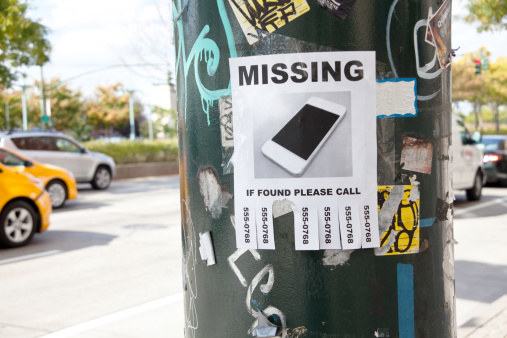
Getting back your phone seems tricky, given that Uber is an app. But it&039;s possible.

There are certain cities where people are more prone to losing their stuff:

Giphy

  1. Los Angeles
  2. New York City
  3. San Francisco

Tbh, though, these just seem like the cities where people take the most Ubers.

In 2016, a lot of people left something behind in their Uber on Halloween weekend:

Giphy

More people were absent-minded on October 30 and December 11 than any other days of the year. Saturday and Sunday are the days when people lose the most stuff — again, these are the days when it seems people take Uber most frequently. Uber did say that it sees an increase in lost plane tickets on Saturdays and lost wedding dresses on Sundays.

The real treasure, though, is the company&039;s roundup of the “most unique” items abandoned in Ubers:

&; We have some questions.

Vera Storman / Getty Images

  1. Lobster (was it still alive when you got it back?)
  2. Potted plant (same question as the lobster)
  3. “Valuable Nordic walking poles” (how much $$ we talkin&039;?)
  4. Lottery ticket (same question)
  5. “Sweet potato care package” (“who&039;s my little sweet potato?” —your mom, probably)
  6. Rubber mallet (who are you, the Joker?)
  7. Laser (What kind? For tag, for science, or for annoying people in a movie theater?)
  8. Hot Cheetos (honestly girl they&039;re like $1 plz chill?)
  9. Smoke machine (it&039;s lit?)
  10. Bullet proof vest (…um, what were going to use that for?)
  11. “Meat packet” (…what?)
  12. “Expensive slipper” (hope Cinderella wasn&039;t mad?)
  13. Diary (did the driver read it?)
  14. Arm sling (you took it off and forgot your arm was broken?)
  15. “Money bag” (you used an Uber as a getaway car for a bank robbery?)

Uber wouldn&039;t tell us what happened when people asked for the items back.

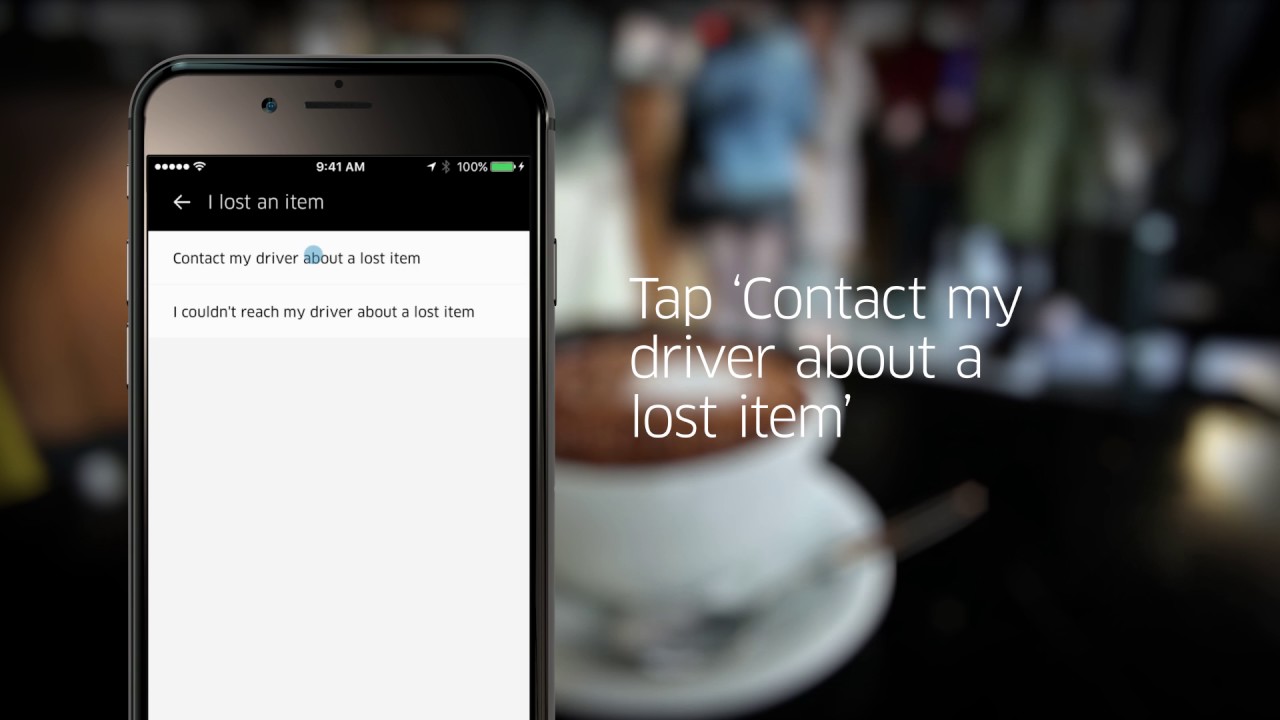
Just FYI, here&039;s how you can get your lobster back if you leave it in an Uber, ya klutz:

youtube.com

Quelle: <a href="Here Are The 15 Most Batshit Things People Have Lost In Ubers“>BuzzFeed

Congress Votes To Gut Internet Privacy Rules

The House voted Tuesday to repeal landmark internet privacy rules that required broadband companies to first get consent before sharing their customers&; sensitive information, including browsing history and location data, with advertisers and other third party companies. The vote comes a week after the Senate approved the repeal. Now President Trump&039;s signature is the final step needed to abolish the privacy protections.

Passed by the Federal Communications Commission in October, the rules also forced broadband providers to tell customers about the data they collect, why they collect it, and to identify the kinds of third party companies that might be given access to that information. Parts of the internet privacy rules were scheduled to take effect later this year. Others, including a provision that required broadband companies to protect consumer information from hackers and data breaches, had already kicked in. FCC Commissioner Ajit Pai, however, moved to block the data security rules earlier this month.

Republican lawmakers and the telecom industry have staunchly opposed the regulations. They have argued that the rules unfairly target internet providers, like Comcast and AT&T, and offer an advantage to other web companies that regularly harvest and sell customer information. Since businesses like Facebook and Google are not bound by the FCC rules, critics say the privacy regulations singled out broadband companies.

“These rules varied from the industry principles developed last year and established a double-standard by creating different sets of regulation for internet service providers on the one hand and the rest of the internet ecosystem on the other,” US Telecom CEO Jonathan Spalter said in a statement last week.

But a coalition of consumer and privacy groups have argued that internet providers occupy a powerful position in people&039;s internet use. Groups including the ACLU, the Electronic Frontier Foundation, and Free Press say that the rules are a crucial protection in the digital age.

“We are one step closer to a world where ISPs can snoop on our traffic, sell our private information to the highest bidder, and pre-install spyware on our mobile phones,” Jeremy Gillula, a senior staff technologist for the Electronic Frontier Foundation, told BuzzFeed News.

Unlike social media companies, and other kinds of advertisers and web trackers, broadband providers can monitor all unencrypted internet traffic. Democratic lawmakers have also pointed out that many Americans only have a single internet provider serving their community, leaving them no choice but to accept whatever data collection practices are in place if they want internet service.

3 Invasive Things Your ISP Could Do If the Privacy Rules Are Repealed

1. Selling Your Browsing History

“The consequences of repeal are simple: ISPs like Comcast, AT&T, and Charter will be free to sell your personal information to the highest bidder without your permission — and no one will be able to protect you,” wrote Gigi Sohn, counselor to former FCC chairman Tom Wheeler, in an op-ed at the Verge Monday.

While Americans can use free browser tools to block many types of web tracking, monitoring by internet providers is much harder to prevent. “Your ISP is in a privileged position, where they can see everything,” said Gillula, who has written about the “creepy” data collection that ISPs can conduct if the regulations are gutted.

“Any attempt to block the ISP from monitoring you, they have the power to override,” Ernesto Falcon legislative counsel at EFF, told BuzzFeed News.

2. Compiling Internet Profiles And Injecting Targeted Ads

“There are major medical, financial, and legal websites — like the US Courts, for example — that are largely unencrypted. ISPs will be able to build detailed profiles of their customers — knowing when they&039;re at vulnerable points in their lives — and sell that information to practically whomever they wish,” Gaurav Laroia, policy counsel at Free Press, told BuzzFeed News. If someone is visiting a medical website, for instance, third parties can infer what illnesses they may suffer from, revealing sensitive health information.

“It&039;s well-established that these internet companies are looking hungrily at companies like Facebook and Google; they want in on that advertising action,” Jay Stanley, a senior policy analyst with the ACLU, told BuzzFeed News. “This is an effort by them to preserve the ability to monetize people&039;s information. And without these rules, they are going to plow forward.”

3. Deploying Hidden Tracking Cookies On Our Phones

Following a 15-month investigation, the FCC settled with Verizon Wireless last year over the company&039;s use of so called “supercookies” — tracking code that could not be deleted, which Verizon used to monitor customers&039; online activity without their permission.

“It didn’t matter if you were browsing in Incognito or Private Browsing mode, using a tracker-blocker, or had enabled Do-Not-Track: Verizon ignored all this and inserted a unique identifier into all your unencrypted outbound traffic anyway,” the EFF&039;s Gillula wrote. The browsing history, according to the FCC, was collected for several years without consent; Verizon and other third party companies used it for targeted advertising.

For privacy advocates, pervasive data collection of your internet activity can be enormously invasive. “The websites you visit can indicate information about your financial life, you sexual life, your medical life, what disease you have, what diseases you might be worried you have,” said Stanley.

“We don&039;t even know what other derivative uses exist, because no one has ever had this type of information on consumers,” Falcon said, referring to new types of data collection and novel forms of the sale of personal data. “That&039;s what&039;s most frightening.”

Quelle: <a href="Congress Votes To Gut Internet Privacy Rules“>BuzzFeed

Pro-Trump Media Has A New Obsession: The White House Briefing Room

Pro-Trump Media Has A New Obsession: The White House Briefing Room

Lee Stranahan / Via youtube.com

Following Trump administration Press Secretary Sean Spicer&;s pledge to establish a White House press corps with voices “outside of Washington”, a number of unabashedly Trump-friendly news outlets have made the pilgrimage to the west wing briefing room — the symbolic heart of the establishment. Their goal: to bring their anti-elite, pro-Trump, and occasionally trollish brand of coverage to the White House.

For some of these self-described “real news” outlets and personalities, landing a seat in the White House briefing room is vindication of their often sensational and semi-factual 2016 presidential campaign stories which some believe undermined the candidacy of Hillary Clinton and helped propel Trump to the Oval Office. For others, it’s a chance to ask questions the mainstream media won’t touch. And for many, there’s a singular benefit worth the trip to Washington alone: the exposure that comes from seeing and being seen on the highest rated show on daytime TV.

“The briefing room has become a piece of pop culture for this generation and the people who followed the election every day on TV and are now glued to the day-to-day,” one newer White House correspondent told BuzzFeed News. For the reporter, being in the room brings with it the intoxicating proposition of asking a question that could set news cycle for the day — or the week. “And so it&039;s definitely an opportunity for far-right, crazy blogosphere types to make a name for themselves. It’s that way for anyone new but definitely true for the far-right guys. Everyone’s watching.”

“It&039;s definitely an opportunity for far-right, crazy blogosphere types to make a name for themselves.”

For Jim Hoft and Lucian Wintrich of the far-right blog Gateway Pundit, a short time in the briefing room has generated enormous returns. Hoft, Gateway Pundit’s founder, announced Wintrich’s White House correspondent position at ‘The Deploraball’ the night before Trump was sworn in as president. Since then, the 28- year old Wintrich has been the focus of dozens of articles (one by this writer), the star of a documentary film, and last week, the subject of a lengthy New Yorker profile. Earlier this month, he was the alleged victim of an altercation inside the briefing room involving Fox Radio’s John Decker, who, according to Wintrich and a few observers, openly chastised Gateway Pundit as a racist, xenophobic outlet. The incident — the details of which are disputed by both parties — was partially witnessed and tweeted by the well-followed members of the White House press corps, written up in a variety of publications, and outrage-shared across the pro-Trump internet, casting Wintrich among the far-right as the heroically aggrieved party, just trying to do his job.

But Wintrich has yet to ask a question of Spicer. Instead, he’s opted to “feel out the room” and “learn the protocols” before jumping in. “If you see pictures of me on Twitter in the briefing room. I’m literally squeezed in the corner taking notes,” he told BuzzFeed News.

The daily briefing spectacle has caught the eye of non-Washington types like New Right blogger and Twitter personality, Mike Cernovich, who lives in California. “It&039;s so good for your brand to be in the room now because it still seems like this prestigious place,” he told BuzzFeed News. “That&039;s why the press corps is losing it — White House access is a major status thing and now it feels like everyone&039;s able to do it.”.

While Spicer’s briefings may appear more open to the media’s fringes, the truth is, the briefing has never been overly exclusive. Day passes for a trip to the press room require little more effort than submitting some personal information to the White House (caveat: full-time “hard passes” are much harder to obtain). Cernovich said he has tentative plans to try and drop by a briefing sometime in April. Last week on Twitter he asked his followers, “should I get a White House pass?” (again, it doesn’t quite work that way, but the sentiment suggests he wants to show up). Responses ranged from “Light eradicates darkness. DO IT&;” to “I think we should revoke CNN&039;s and give it to you.”

The conspiracy and pro-Trump news site Infowars has deftly injected itself into the Beltway news cycle multiple times without even stepping into the briefing room. In February, Infowars’ founder Alex Jones posted a video falsely claiming he’d secured White House press credentials from the Trump administration. Jones subsequently walked back that claim, explaining he’d simply taken initial steps to secure credentials. Then, in late January, Jones hired former World Net Daily writer and fellow conspiracy theorist, Jerome Corsi to head up an Infowars Washington bureau. In early February, Corsi tweeted that the White House had told him it “didn’t think there would be any problem in Infowars and Alex Jones and me getting press credentials.”

Two weeks ago, Lauren Southern, a controversial far-right Canadian media personality, made her way to DC to attend a White House briefing, where she tweeted a selfie with the caption, “Independent media takeover.” The tweet ricocheted around the internet; for pro-Trumpers it was another win for the unsung voices of “new media.” Southern — known for her previous denunciations of both rape culture and popular feminism— showing up in the briefing room registered to some as alarming breach. A few hours after posting the selfie, Media Matters ran a story with the headline, “Meet Lauren Southern, The Latest “Alt-Right” Media Troll To Gain Access To The White House Press Briefing.” The story called Southern “just the latest of the fringe, sycophantic “alt-right” media personalities that the White House is letting into its press briefings.”

Southern said she decided to show up in the room after Wintrich’s confrontation. “I heard there was hostility towards new media in the briefing room and wanted to see the experience for myself,” she told BuzzFeed News, adding that she intends to return “in order to ask questions the MSM won&039;t touch.”

The new prestige of the White House briefing room reverses decades of decline. For years the role of White House correspondent had gradually shifted from being central in journalism to one that many reporters dreaded as being captive to unresponsive, low level aides while big stories broke across the internet and elsewhere. As such, tensions over briefing room access have flared in the early weeks of Trump’s presidency. A number of reporters for mainstream outlets have voiced public concerns on Twitter over Spicer and President Trump’s penchant for calling on conservative media outlets during press conferences.

This month, after a reporter for the Heritage Foundation’s Daily Signal served as the press pool reporter for a Vice Presidential event, the Washington Post’s Paul Farhi questioned partisanship’s role in the White House press corps in an article headlined, “What’s a legitimate news outlet? A new face in the White House press pool raises questions.” And in a recent New Yorker article, White House correspondents and camera crew from legacy news outlets were quoted sniping at the new publications that have popped up in the briefing room. In one instance a radio correspondent was overheard bemoaning that, “at best, they don’t know what they’re doing…at worst, you wonder whether someone is actually feeding them softball questions.”

The prickly reception given to White House briefing room newcomers isn’t exactly unprecedented. At his first press conference in 2009, President Obama’s decision to call on The Huffington Post’s Sam Stein prompted a mini news cycle of its own. In 2009, Time Magazine described Obama’s decision as such: “the whole White House media shop, has crossed a Rubicon of sorts, acknowledging the equivalent legitimacy of an unapologetically unobjective media outlet, which lives nowhere but the Internet and which didn&039;t even exist four years ago”

At the time, New York Times White House reporter, Peter Baker called the decision to add partisan-leaning blogs to the press corps “troubling,” arguing that “We’re blurring the line between news and punditry even further and opening ourselves to legitimate questions among readers about where the White House press corps gets its information.” It’s a position Baker still appears to hold today; this month he told the told The Daily Signal that the issue has only grown murkier. “It becomes harder to draw lines now and say this organization is acceptable and this one is not,” he wrote.

Multiple self-professed members of pro-Trump outlets told BuzzFeed News their welcome to the room by more established outlets was less than friendly — “there’s a palpable tension there,” Wintrich told BuzzFeed News. While two other White House correspondents said allegations of a freeze-out were “overblown.” The discrepancy likely results from the spectrum of conservative outlets and reporters in the Trump press room. While some, like Wintrich and Gateway Pundit delight in trolling, plenty of reporters from right-leaning new media outlets try to play it straight and push the administration on claims like wiretapping and Russian interference in the election. “Plenty of those guys come from conservative outlets but still show up everyday ready to do the hard work like everyone else,” one White House correspondent said.

“They&039;re playing right into our fucking hands — it&039;s ridiculous.”

Regardless, the perceived tension and occasional hand-wringing from mainstream media is having the — perhaps unintended — consequence of elevating the profiles of the new faces in the room. The trolls, in essence, have been fed.

“They&039;re playing right into our fucking hands — it&039;s ridiculous,” Wintrich said describing the reaction to the briefing room altercation a few weeks ago. “So many members of conservative media after this happened reached out all supportive and told me how unfair the situation was. That&039;s street cred for me.” For Southern, the reaction from places like Media Matters is what will keep her coming back to the press room. “I literally just stood there and this was their reaction? I look forward to seeing the collective meltdown when I actually get a question in,” she said.

“I think members of the media are doing a disservice to themselves by putting so much attention on people who don&039;t report each day from the White House and use the briefing to bring attention to themselves,” one White House reporter said. “The Gateway Pundit situation was an ordeal and all but at the end of the day I don&039;t know I’ve ever read anything by [Wintrich]. So why not just ignore it?” In Southern’s case, Cernovich agrees. “They&039;re so triggered by the presence of people like Wintrich that they made him into an overnight sensation. He got the mainstream media to troll themselves.”

Quelle: <a href="Pro-Trump Media Has A New Obsession: The White House Briefing Room“>BuzzFeed

Uber's Leadership Is 78% Male, According To Its New Diversity Report

Justin Sullivan / Getty Images

Uber&;s leadership is 78% male and 22% female, according to a new diversity report released by the company today.

The report — Uber&039;s first-ever — comes about a month after Uber launched an internal investigation into sexism allegations, after a female former engineer posted a viral account alleging systemic sexism and sexual harassment at the company.

According to the report, tech leadership — those with director-level positions or higher — is 88.7% male and 11.3% female.

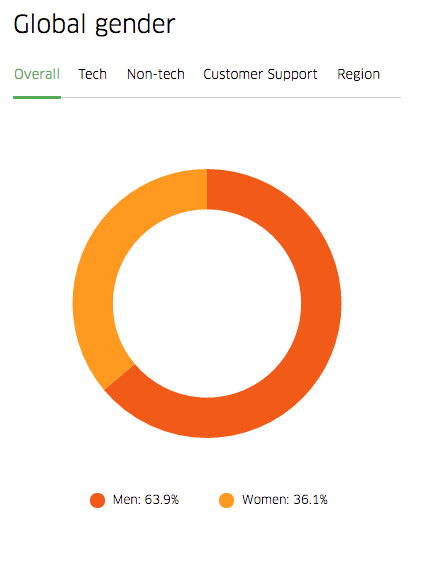
Overall, Uber is 63.9% male and 36.1% female, as of March 2017.

Uber

For comparison, Twitter&039;s latest diversity report said the company was 37% female as of December 2016.

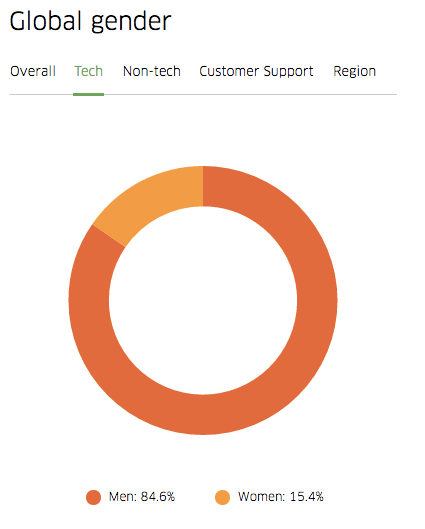
But in tech roles, the gap widens to 84.6% male and 15.4% female.

Uber

In non-tech roles, staff is 44.4% female and 55.6% male.

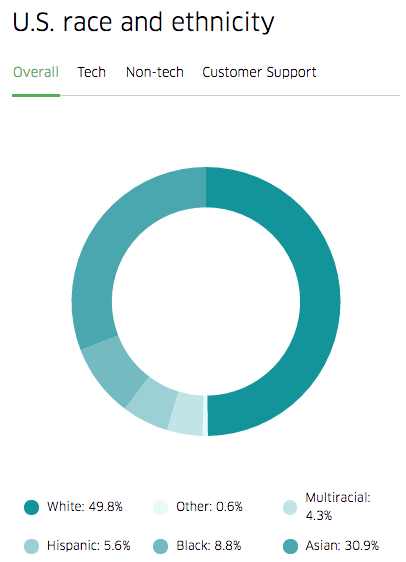
The report also covered race. Uber&039;s U.S. workforce is 49.8% white, 30.9% Asian, 8.8% black, 5.6% Hispanic, 4.3% mixed race and 0.6% “other.”

Uber

Bloomberg reported last week that Uber’s own recruiters were denied access to its diversity data, stymying their efforts to hire more women and people of color.

US leadership overall is 76.7% white, 20.2% Asian, 2.3% black and 0.8% Hispanic. Uber said it has no black or Hispanic people in tech leadership roles.

Tech leadership in the US is 75% white and 25% Asian.

In January, civil rights leader Jesse Jackson wrote a letter to Uber asking the company to release diversity data on the heels of its hiring of Bernard Coleman III as head of diversity and inclusion.

Liane Hornsey, Uber&039;s chief human resources officer, said in a conference call with reporters last week that the company plans to hold new training sessions called “Why Diversity Matters,” “How to be an Ally,” and “Building Inclusive Teams.”

“This report is a first step in showing that diversity and inclusion is a priority at Uber,” Uber CEO Travis Kalanick said in a statement provided by a spokesperson.

In Uber&039;s first companywide meeting on Feb. 21 after sexism allegations became public, Kalanick apologized for leading the company up to that point and promised staff Uber would “do better.” Two days later, women of Uber urged Kalanick to begin “listening to your own people,” and start “admitting to ourselves as a company that we have a systemic problem,” according to leaked audio obtained by BuzzFeed. On Friday, The Information reported that Kalanick and a team of five Uber employees visited an escort bar during a work trip to Seoul in mid-2014, leading to an HR complaint from a female employee who felt uncomfortable.

Quelle: <a href="Uber&039;s Leadership Is 78% Male, According To Its New Diversity Report“>BuzzFeed