Apple Says It Is “Completely Rethinking” The Mac Pro

Apple Says It Is “Completely Rethinking” The Mac Pro

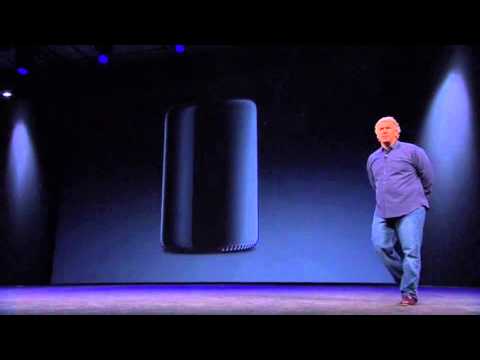
The Mac Pro, Apple’s marquee desktop machine, hasn’t been refreshed since 2013. But lest you think it was forgotten, the diminutive black obelisk is top of mind at Apple these days — specifically how to reimagine it in a way that will appeal to professionals frustrated by its seemingly stalled evolution. To that end, there is officially a new Mac Pro in the pipeline, but it&;s going to be a while before it arrives.

“We are completely rethinking the Mac Pro,” Phil Schiller, Apple’s SVP of worldwide marketing said during a recent roundtable with a handful of reporters at the company’s Machine Shop hardware prototyping lab. And it won&039;t just be the computer. “Since the Mac Pro is a modular system, we are also doing a pro display. There’s a team working hard on it right now.”

Apple executives Phil Schiller and Craig Federighi

Brooks Kraft / Apple

That&039;s good news for anyone worried that Apple’s lost interest in its highest end desktop, but there’s a caveat per Schiller: “You won’t see any of these products this year.” The team working on them has been told to take its time and to design a system that can deliver a wide range of performance — one that can easily and efficiently be upgraded with the latest technologies for the pro audience for which it&039;s intended.

That upgradability is crucial, because it’s lacking in the current Mac Pro — a feature Apple unwittingly sacrificed when it bet on a striking, and strikingly clever, design. Sadly for Apple, the “can’t innovate any more, my ass” quip with which Schiller unveiled the Mac Pro to the world in 2013 was applicable in a more literal sense four years later when the company found that the machine’s design restricted its ability to upgrade it.

“We designed ourselves into a bit of a corner,” Craig Federighi, Apple’s SVP of Software Engineering said of the current Mac Pro’s unique arrangement of pro computer innards around a triangular heat sink inside a cylindrical chassis. “We wanted to do something bold and different. What we didn’t appreciate completely at the time was how we had so tailored that design to a specific vision that in the future we would find ourselves a bit boxed in — into a circular shape.”

John Ternus, Apple’s VP of hardware engineering offered a similarly fun-while-it-lasted assessment of the Mac Pro. “It served its purpose well,” he said. “It just doesn&039;t have the flexibility we now know we need to have.”

Though not unprecedented, these are rare admissions for Apple, which has historically taken a “people don&039;t know what they want until you show it to them” approach to product design. So too was the mechanism in which that admission was delivered: An afternoon roundtable in one of Apple’s inner sanctums. The Machine Shop is simultaneously ripe with Mac history and the possibility of Mac history yet-to-be-made. It&039;s all glass cases of old Macs and QuickTake camera prototypes in the outside hallway, computer driven precision cutting machines inside — many with their contents hidden by drapes of black fabric. It’s exactly the kind of place meant to give critics pause if they had been questioning Apple’s commitment to the Mac Pro.

The Machine Shop at Apple&039;s Product Realization Lab.

Brooks Kraft / Apple

“We made something bold that we thought would be great … and what we discovered is that it was great for some and not others — enough so, that we realized we had to take another path … and look for the next answer,” Schiller said.

For now, the next answer — a reimagined Mac Pro — is a ways off. But in the meantime, Apple’s giving the current Mac Pro line a spec bump that will freshen it a little and give pros a bit more value for their dollar — a $2,999 rig with 6-core Intel Xeon processor, dual AMD FirePro D500 GPUs and 16GB of memory; And a $3,999 rig with an 8-core processor and dual D700 GPUs.

Quelle: <a href="Apple Says It Is “Completely Rethinking” The Mac Pro“>BuzzFeed
President Trump Just Repealed Rules That Banned ISPs From Selling Your Private Data

David Ramos / Getty Images

President Trump just repealed landmark internet privacy rules that restricted what Internet service providers (ISPs) could do with customers&; private information. Now, companies like Verizon, AT&T, and Comcast will no longer be obligated to obtain your consent before selling and sharing your data, and they don&039;t have to notify you about what kind of data they collect.

Congress approved the rollback on March 28 in a 215-205 vote. The Federal Communications Commission had only approved the rules in October 2016, and they hadn&039;t fully taken effect yet.

“A measure to roll back crucial privacy protections has crossed the finish line, and Internet users are worse off for it,” the Electronic Frontier Foundation said in a statement emailed to BuzzFeed News. It also noted that the measure to repeal the privacy rules also bars the FCC from creating similar protections in the future.

A lot of people on Twitter were also unhappy:

Republican lawmakers opposed the original regulations before and after they passed. Telecommunications companies argued that the rules gave unfair competitive advantages to internet companies like Google and Facebook, which are allowed to track and sell data.

Democratic lawmakers have pointed out that the comparison is not entirely accurate: ISPs have the capability to monitor all unencrypted browsing, whereas companies that offer specific services and platforms have a much more limited capacity to do so.

Verizon and Comcast have not immediately responded to requests for comment. AT&T referred to a statement posted Friday on its policy blog.

On Friday, Verizon, AT&T, and Comcast all released statements assuring customers that they would respect their privacy. But privacy advocates said these promises are misleading. There are a few ISPs out there that have pledged to never sell any of their customers&039; information to third parties. But because most Americans live in areas with only a single internet provider, they&039;re forced to accept that company&039;s data sharing practices if they want internet access.

Last week, my colleague Hamza Shaban&039;s talked to privacy experts about what would happen if Trump repealed the privacy rules:

Here are three invasive things your ISP can now do with your data:

1. Sell Your Browsing History

“The consequences of repeal are simple: ISPs like Comcast, AT&T, and Charter will be free to sell your personal information to the highest bidder without your permission — and no one will be able to protect you,” wrote Gigi Sohn, counselor to former FCC chairman Tom Wheeler, in an op-ed on The Verge Monday.

While Americans can use free browser tools to block many types of web tracking, monitoring by internet providers is much harder to prevent. “Your ISP is in a privileged position where they can see everything,” said Gillula, who has written about the “creepy” data collection that ISPs can conduct if the regulations are gutted.

“Any attempt to block the ISP from monitoring you, they have the power to override,” Ernesto Falcon, legislative counsel at EFF, told BuzzFeed News.

2. Compile Internet Profiles And Inject Targeted Ads

“There are major medical, financial, and legal websites — like the US Courts, for example — that are largely unencrypted. ISPs will be able to build detailed profiles of their customers — knowing when they&039;re at vulnerable points in their lives — and sell that information to practically whomever they wish,” Gaurav Laroia, policy counsel at Free Press, told BuzzFeed News. If someone is visiting a medical website, for instance, third parties can infer what illnesses they may suffer from, revealing sensitive health information.

“It&039;s well-established that these internet companies are looking hungrily at companies like Facebook and Google; they want in on that advertising action,” Jay Stanley, a senior policy analyst with the ACLU, told BuzzFeed News. “This is an effort by them to preserve the ability to monetize people&039;s information. And without these rules, they are going to plow forward.”

3. Deploy Hidden Tracking Cookies On Our Phones

Following a 15-month investigation, the FCC settled with Verizon Wireless last year over the company&039;s use of so called “supercookies” — tracking code that could not be deleted, which Verizon used to monitor customers&039; online activity without their permission.

“It didn’t matter if you were browsing in Incognito or Private Browsing mode, using a tracker-blocker, or had enabled Do-Not-Track: Verizon ignored all this and inserted a unique identifier into all your unencrypted outbound traffic anyway,” the EFF&039;s Gillula wrote. The browsing history, according to the FCC, was collected for several years without consent; Verizon and other third-party companies used it for targeted advertising.

For privacy advocates, pervasive data collection of your internet activity can be enormously invasive. “The websites you visit can indicate information about your financial life, your sexual life, your medical life, what disease you have, what diseases you might be worried you have,” said Stanley.

“We don&039;t even know what other derivative uses exist, because no one has ever had this type of information on consumers,” Falcon said, referring to new types of data collection and novel forms of the sale of personal data. “That&039;s what&039;s most frightening.”

Quelle: <a href="President Trump Just Repealed Rules That Banned ISPs From Selling Your Private Data“>BuzzFeed

The Trump Administration Is Cracking Down On Employers Of High-Skilled Immigrants

The government will be cracking down on employers that fraudulently use visas to hire cheap labor, according to an announcement Monday morning from U.S. Citizen and Immigration Services (USCIS).

Monday was also the first day people could start applying for H-1B, or “skilled” US visas, which large tech companies including Google, Microsoft,, and Facebook rely on to hire engineering talent from overseas.

“The Trump administration will be enforcing laws protecting American workers from discriminating hiring practices,” said Sean Spicer regarding the H-1B program during a press briefing on Monday.

According to the announcement, USCIS will target its crackdown on companies that are hard to find public information on, that apply for visas for employees who work at an offsite location, and/or that are H-1B visa dependent.

Being H-1B dependent means 15% or more of your workforce is on a high-skilled work visa; Facebook, for example, is H-1B visa dependent. A spokesperson for the company didn’t immediately respond to request for comment.

In tech, the vast majority of H-1B visas go to consulting firms like Wipro, Tata and Infosys, which would be the most heavily impacted by a crackdown on the visa program. Representatives of those firms did not immediately respond to a BuzzFeed News request for comment.

During his presidential campaign, Donald Trump threatened to get rid of the skilled visa program entirely. Since then, his view on the issue seems to have tempered. (He’s also met with tech executives, some of whom are now his advisors.) More recently, the administration has said it wants to stop H-1B visa fraud — when companies use visas to access cheap foreign labor rather than to fill jobs they can’t find qualified American workers to do — while continuing to allow the highest skilled workers from other countries into the U.S.

But Trump ultimately didn’t reduce the maximum number of visas made available to employers this year.

“The H-1B visa program should help U.S. companies recruit highly-skilled foreign nationals when there is a shortage of qualified workers in the country,” Monday’s news release reads. “Yet, too many American workers who are as qualified, willing, and deserving to work in these fields have been ignored or unfairly disadvantaged. Protecting American workers by combating fraud in our employment-based immigration programs is a priority for USCIS.”

Meanwhile, on Friday, USCIS published a memo that will require employers to provide extra proof that computer programmers are, in fact, high-skilled workers deserving of jobs in the US, Bloomberg reported Monday. (A spokesperson for USCIS told Bloomberg that the memo does not reflect “a change in policy.”)

A vocal subset of American computer programmers argue that the H-1B visa program, which was started in 1990, made it possible for companies to lay off American workers and replace them with lower-paid immigrants. There’s evidence this has occurred at Disney and UCSF, and smaller employers found to be engaging in such activities have recently been indicted.

To accomplish its goal, USCIS set up an email address, REPORTH1BABUSE@USCIS.DHS.GOV, where US workers who observe fraud — as well as immigrants who believe they’re being exploited — can report abuse. The immigration agency will also “continue random and unannounced visits” to workplaces where H-1B holders are employed across the country.

“This may weed out some shady employers” who were in the process of filing H-1B petitions this week, immigration lawyer Emily Lopez Neumann told BuzzFeed News in an email. “It may also make it more difficult for legitimate employers to get the workers they need.”

Most high-skilled immigrants working in the U.S. come from China and India, and many have been waiting anxiously for news on how the Trump administration would deal with the high-skilled visa program. Earlier this year, talk of congressional H-1B visa reform caused Indian tech firms to lose more than $7 billion in value in a single hour.

Quelle: <a href="The Trump Administration Is Cracking Down On Employers Of High-Skilled Immigrants“>BuzzFeed

You Can Now Search Snap Stories For Stuff Like Basketball Games And Puppies

You can now search for Snap Stories by place and topic.

The options are endless: “Puppies,” “Atlanta Falcons,” your favorite bar, “spring break,” “election day,” etc. The feature launches today in Miami and will roll out later in other cities, though Snap declined to specify exactly when and where.

youtube.com

In a blog post released Friday, Snap said that its curation team had become “overwhelmed” by the number of Stories people had produced and submitted to the collective, localized Our Story feature, so the company decided to allow users to search for them on their own.

We’ve built a new way to understand what’s happening in Snaps that are submitted to Our Story, and to create new Stories using advanced machine learning. The results have been amazing: you can search over one million unique Stories on Snapchat&;

According to a Snap spokesperson, the Stories you can search for cast a much wider net for Stories than the professionally curated Our Stories, Publisher Stories, and Shows that you’ll still see in “Discover” and “Featured” sections throughout the app. Snaps shown in Our Stories typically focus on big events, like The Grammys, Super Bowl, or a presidential debate.

In 2016, Snap acquired the search engine Vurb for $114.5 million. The company said it developed its new Search feature in-house. Snap said the new feature works by algorithmically identifying what’s happening in submitted Stories based on things like caption text, time, and visual elements.

Snap made its Initial Public Offering one month ago at a valuation of $34 billion. It&;s stock price has since fallen.

The change comes as Facebook is creating a Stories-esque feature in all of its flagship apps: Messenger, Whatsapp, Instagram, and, most recently, Facebook.

Quelle: <a href="You Can Now Search Snap Stories For Stuff Like Basketball Games And Puppies“>BuzzFeed

The Music Industry Kind Of Likes Streaming Now, But It's Still Nervous

51% of the music industry&;s revenue comes from streaming, according to a report published Thursday by the Recording Industry Association of America (RIAA).

Paid streaming services like Spotify and Apple Music accounted for just 9% of the industry&039;s revenue in 2011, grew to 34% in 2015, and jumped to 51% in 2016 with 22.6 million people paying for them.

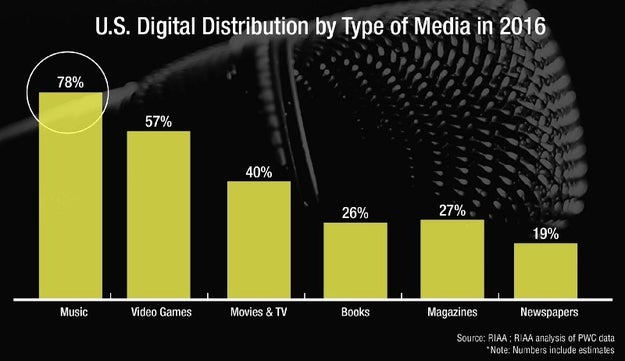
According to an accompanying blog post, “2016: A Year of Progress For Music,” 78% of all US music is distributed through digital channels. Digital distribution overtook physical music sales — mostly made up of CDs — globally in 2015.

RIAA

These are truly strange times. The music industry used to hate streaming. Now it&039;s in love with it.

Giphy

The precursors to online music streaming were free services like Kazaa and Napster that let you download pirated music. Limewire viruses, anyone? Spotify, too, though, tbh.

Streaming is here to stay. But it&039;s still unclear if the music business will ever make as much money as it did during the heyday of CDs.

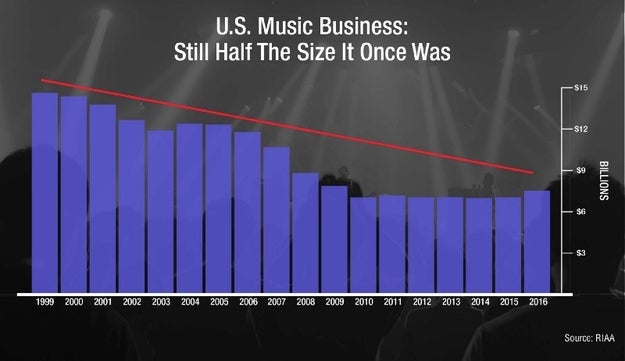
Overall industry revenue rose by 11.4% in 2016, which was the biggest increase in over a decade.

But it’s still just a fraction of what it used to be.

But it's still just a fraction of what it used to be.

RIAA

Spotify, the world&039;s biggest streaming music service, is and always has been unprofitable. Maybe that&039;ll change in 2017? The RIAA cautioned people that the industry&039;s recovery from it steep losses in the mid-aughts “is fragile and fraught with risk.” Sales of CDs and song downloads are declining fast, especially as Apple more heavily favors its streaming service over iTunes. Digital music is hard.

Pandora, one of the first services to offer streaming radio and formerly the music industry&039;s archenemy, just released an on-demand streaming service that faces stiff competition from Spotify and Apple Music. Investors are pressuring Pandora to sell itself, just as the company started to be on better terms with the recording industry.

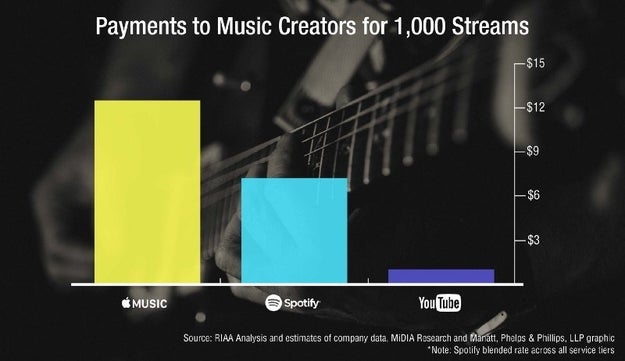
Some things don&039;t change, though. The music industry is still mad at YouTube for how little it pays artists:

The RIAA wrote, “a platform like YouTube wrongly exploits legal loopholes to pay creators at rates well below the true value of music.” The RIAA launched Value The Music today in conjunction with other industry groups to lobby for policy change that would monetarily favor artists and record labels.

RIAA

Quelle: <a href="The Music Industry Kind Of Likes Streaming Now, But It&039;s Still Nervous“>BuzzFeed

Policy Experts Slam ISP Privacy Vows After Congressional Vote

GeekWire

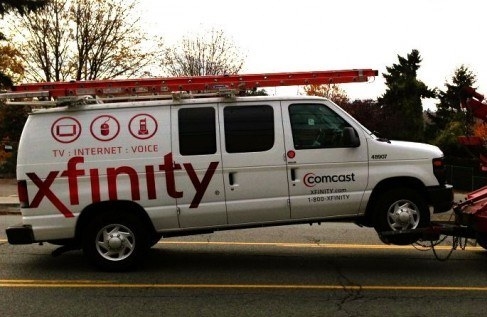
AT&T and Comcast are pushing back against concerns that the repeal of Obama-era internet privacy rules might harm their customers and lead to invasive business practices that rely on harvesting your personal data.

On Friday, AT&T and Comcast both released lengthy statements touting their commitment to privacy and reassuring customers that little has changed since Congress moved to gut regulations that would make it easier for them to sell information about their online habits to third parties. But representatives from the Electronic Frontier Foundation, Public Knowledge, and the Center for Digital Democracy told BuzzFeed News that the consequences of the repeal may differ sharply from the comforting messages delivered by the telecom giants.

“There is a lot to say about the nonsense they&;ve produced here,” said Ernesto Falcon, legislative counsel at EFF. “There is little reason to believe they will not start using personal data they&039;ve been legally barred from using and selling to bidders without our consent now. The law will soon be tilted in their favor to do it.”

At the beginning of Comcast&039;s statement the company claims it will never sell the individual browsing histories of their customers. Comcast goes on to say that it will not share customers “sensitive” information without their permission. But “sensitive” has a very specific meaning when it comes to privacy rules.

According to the Federal Trade Commission&039;s guidelines — which Comcast has pledged to abide by — browsing history is not always considered “sensitive” information, though privacy experts say it can contain revealing information about our financial, political, religious, sexual, medical, and social lives.

“Comcast saying that it doesn&039;t sell individual browsing history is not the same thing as Comcast being prohibited from doing so.”

One crucial distinction between “sensitive” and “non-sensitive” information has to do with consent. With non-sensitive data, internet providers don&039;t need to get your explicit permission to collect and share it. In contrast, sensitive data requires that you opt-in, that you first give affirmative consent before ISPs can share it.

Perhaps one of the most important things the Obama-era privacy rules did was classify browsing history as sensitive data, giving Americans stronger protections online. The rules were passed by the Federal Communications Commission in October, and parts of the regulations were slated to kick in later this year. But the major carriers — including Comcast and AT&T — prefer the older FTC guidelines, in which customers&039; online habits can be surveilled, sorted, and sold more easily.

In his statement Friday, Gerard Lewis, Comcast&039;s deputy general counsel and chief privacy office said: “We do not sell our broadband customers’ individual web browsing history. We did not do it before the FCC’s rules were adopted, and we have no plans to do so.” (Disclosure: Comcast Corp.&039;s NBCUniversal is an investor in BuzzFeed.)

But Dallas Harris, a policy fellow with Public Knowledge said she isn&039;t convinced that a mere pledge by a corporation can replace robust privacy protections. “Comcast saying that it doesn&039;t sell individual browsing history is not the same thing as Comcast being prohibited from doing so,” she said. “Without these rules, when and if they decide to start selling individual web browsing history, they can now bury it on page twenty of their privacy website and give you the option to opt-out 20 clicks away from where you log-in. That is unacceptable.”

Jeff Chester, the executive director of the Center for Digital Democracy acknowledged that Comcast doesn&039;t directly share the browsing histories of individual customers, but he still characterized the company&039;s statement as “misleading.” “It’s used for direct targeting by the ISP and is supplemented by brand and other digital media data,” he said.

In AT&T&039;s statement, Bob Quinn, the company&039;s senior executive vice president pointed to the “web browsers, search engines, and social media platforms” that, he said, are actually the entities who collect and use the most consumer information online. Quinn argued that having stricter privacy rules for ISPs, “confuses” customers rather than protects them.

But Chester and other privacy advocates say that ISPs have significant visibility into our online lives, sometimes more so than Web companies like Facebook or Google. “[ISPs] have a lion’s share of geo-location and other specialized data,” he said. “They should have safeguards instead of pointing to others.”

Howard echoed that sentiment, noting that asking ISPs to implement stronger privacy rules seems a modest demand. “We are just asking internet providers to get your permission before they collect sensitive information about you,” she said.

Quelle: <a href="Policy Experts Slam ISP Privacy Vows After Congressional Vote“>BuzzFeed

This American Shero Buttchugged Mountain Dew

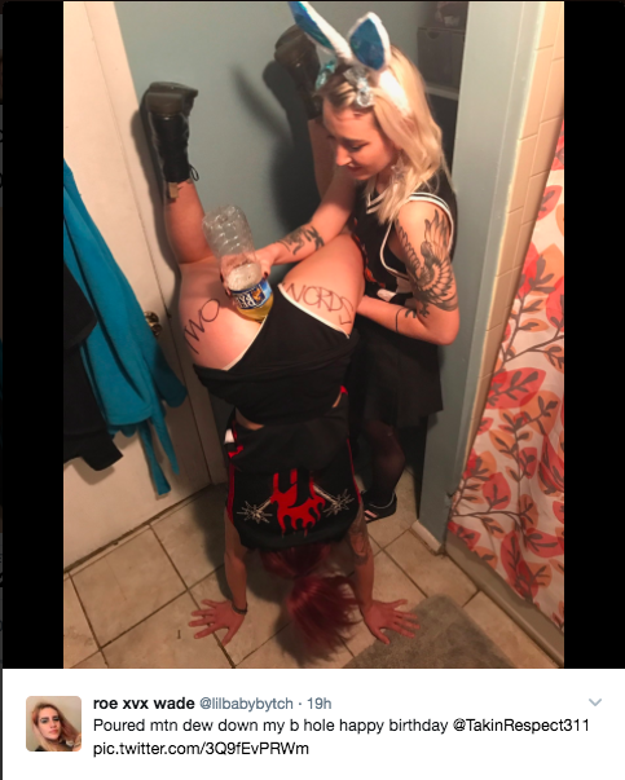
Susan B. Anthony. Rosa Parks. Hillary Clinton. And now add to that list of feminist icons, @lilbabybytch. On the second to last day of Women’s History Month, this fearless woman leaned in and broke a whole new barrier: the first woman to buttchug Mountain Dew.

WARNING: PIC IS OF SOMEONE BUTTCHUGGING MOUNTAIN DEW. WE WARNED YOU.

WARNING: PIC IS OF SOMEONE BUTTCHUGGING MOUNTAIN DEW. WE WARNED YOU.

Twitter: @lilbabybytch

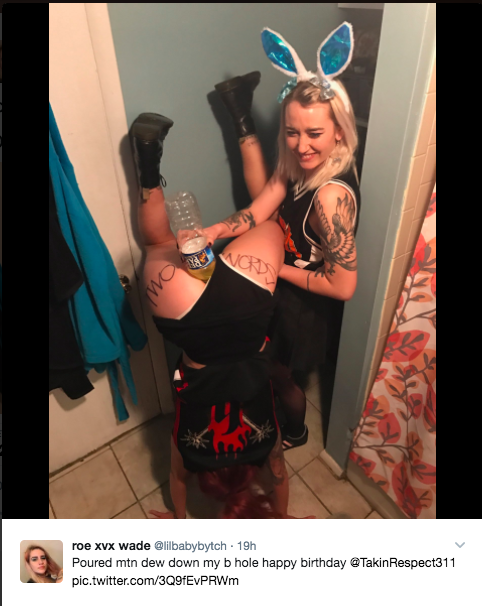
A second angle:

A second angle:

Here&;s the link to the tweet, which we can&039;t embed here because we can&039;t blur it.

Twitter: @lilbabybytch

NOTE: BUZZFEED DOES NOT ACTUALLY ENDORSE BUTTCHUGGING ANYTHING. DO NOT DO THIS. SERIOUSLY. WE MEAN IT.

This isn’t the first time @lilbabybytch has shattered the glass ceiling of doing dirtbag stuff. In 2015, she made headlines here at BuzzFeed for buttchugging cough syrup with the help of her friend @freakmommy. It may surprise you that both women do not drink or do drugs, nor do any of the partygoers at the Mountain Dew event.

Here’s @lilbabybytch in 2015 buttchugging cough syrup (NSFW):

Here's @lilbabybytch in 2015 buttchugging cough syrup (NSFW):

Twitter: @freakmommy

I caught up with this American shero to ask her a few questions about her groundbreaking journey to fully do the Dew.

BuzzFeed: What inspired you to undertake this experiment?

@lilbabybytch: Well the same as with the alcohol-free cough syrup, I just wanted to see if it would work at all. Coffee enemas are pretty common, so I wanted to try some uncharted caffeine suppository territory.

So what happened when you did it? Did it work? Did it all just poop/splash out?

So a can of Mountain Dew only has about 55mg of caffeine in it, and I did not get anywhere near 12 oz. in there. I didn&039;t notice any obvious effects, but I couldn&039;t sleep. I lay awake grinding my teeth for about four hours&; I shotgunned a Mountain Dew after the buttchug though, so honestly there&039;s too many variables to speak on it definitively.

Here’s a video of it in action. WARNING: VERY NSFW

So it stayed inside you?

I didn&039;t poop for four hours. I thought I would have the runs (it felt like I would), but it was pretty mellow and ended quickly. Here&039;s a picture of my friend Carolyn next to the part that leaked out of my butt in the couple minutes afterward:

Note the wet spot on the couch ^^^^^

@lilbabybytch

Any weird poops after?

No&033; It didn&039;t get my digestion going off in any weird way. I wish it had.

Was it classic Mountain Dew, or one of the flavors, like Code Red?

Classic. My favorite flavor is Voltage.

Any advice for the fans out there?

If you wanna get a lot of liquid in your ass, do it like an enema. Handstands are not conducive to receiving large volumes of soda. But most of all, you don&039;t need to do drugs to have fun.

LINK: Meet The Girl Who Buttchugged Cough Syrup

Quelle: <a href="This American Shero Buttchugged Mountain Dew“>BuzzFeed

How To Keep Your Browsing History Actually Private

Last week, the House repealed Internet privacy rules requiring broadband companies to ask for your consent before sharing or selling your information, like browsing history, location data, app usage data, and content communications. If Donald Trump signs the legislation into law, all of your unencrypted online activity – essentially everything you do on websites without a padlock in the URL bar – is up for grabs by advertisers.

Without these privacy protections, your porn viewing, shopping, and search habits could be made public. There is, however, one very easy way to maintain your privacy: using a virtual private network, or a VPN, which is like an Invisibility Cloak for your browsing history.

Twitter: @AbbottColton

Who does the repeal affect?

You, and everyone else reading this article in the US, are subject to having their browsing history sold to the highest bidder. That is, unless you subscribe to Sonic or Monkeybrains, two California-based providers that have pledged to not sell browsing history.

What can my Internet company actually do under the repeal?

As my colleague Hamza Shaban pointed out, your Internet service provider can not only sell your browsing history, but compile web profiles, inject targeted ads, and deploy hidden tracking cookies on your phone.

Some companies (including Charter, Cogent, DirecPC) have also been known to hijack searches through a service called Paxfire, and send you to brands that paid for more traffic.

What the heck is a VPN?

A VPN, or virtual private network, is a service that will privatize everything you do on the Internet through encryption. In other words, it will hide your IP address (which reveals your physical location) and the pages you’re visiting. A VPN is like a secret tunnel that turns all of the data running through Internet cables into gibberish, so your Internet service provider (AT&T, Comcast, Charter, etc.) can’t see what you’re up to and, therefore, can’t sell that information to marketers.

It’s safer, too. Most VPNs have servers that scan data in real-time for websites with hidden malicious software.

This “VPN thing” sounds really complicated. How hard is it to set up?

Not hard at all&;&033; Using a VPN usually means downloading software or a mobile app, and logging onto a website, signing in, clicking connect, and then… that’s it. For some services, you’ll be automatically logged into the VPN every time you use your home Internet. You may, however, need to select a VPN server location before you can connect to the Internet. You can use a VPN anywhere you are: on your phone, on home Wi-Fi, on plane Wi-Fi, etc.

cwtv.com / Via giphy.com

How do I choose what VPN service to use?

Picking the right VPN is actually a little complicated, but hopefully this guide will make it less so.

Security expert Francis Dinha, CEO of Private Tunnel, offered a few of his best tips:

– “Stay away from free services, because you’ll go back to the same problem. Some VPNs are going to collect your information to push advertisements to monetize,” said Dinha. Hola VPN was caught violating user privacy in 2015. Just remember: There’s no such thing as a free lunch&033;

– Dinha also advised staying away from providers that use weak protocols. If you’re not sure what makes a protocol strong, VPN University has a great chart comparing different methods. It shows that OpenVPN is the strongest protocol, followed by L2TP (Layer 2 Tunnel Protocol), and the Windows PC-only SSTP (Secure Socket Tunneling Protocol), which all use 256-bit level encryption. On the product site you’re looking at, look for those bolded words and you should be safe.

– Avoid PPTP (point-to-point tunneling protocol) at all costs. Vulnerabilities in the protocol were exposed in 2012, when Moxie Marlinspike (the founder of Open Whisper Systems, which is what the encryption for WhatsApp, Signal, and other apps, is based on) created software called CloudCracker that could crack any PPTP connection.

– When looking for tools to protect your privacy, the Electronic Frontier Foundation’s Noah Swartz said to look for a product using an open-source technology (like OpenVPN), that would allow other engineers to verify that its code retain strong encryption and best practices.

– Also, make sure the provider doesn’t log any user activity (some VPNs keep extensive logs of users’ IP addresses) and has a strong commitment to privacy.

That detailed VPN comparison chart is the most comprehensive way to look at every aspect of most major providers, including logging, privacy policy, pricing, and connection speeds. On this chart, green means “generally good,” yellow means “something of concern,” and red means “something of major concern.” There’s even a version for the color blind&033;

So, what apps meet those requirements?

A 2015 study compared 14 popular VPN service providers and found that the only services that did not suffer from “IPv6 traffic leakage,” which is when your VPN fails to hide your unique IP address, were TorGuard, Private Internet Access, VyprVPN, and Mullvad. Astrill was not secure against IPv6 leaks, but was safe against DNS hacking, which is when a third party (like a hacker or an Internet service provider) redirects queries to a different site.

For those more technically proficient, you can try running your own DIY VPN, using Streisand or OpenVPN Install on GitHub.

What are the downsides I should know about?

First and foremost, it’s important that you select a provider with a strong privacy policy that you can trust, because VPNs have the ability to see all of your traffic, log your activity, and modify that traffic (see the How do I choose a VPN? section). Even when using a VPN, it’s important to use sites that have HTTPS turned on (any website with a lock icon in the URL bar) and apps with end-to-end encryption, like WhatsApp or iMessage (between iPhones only).

If you really want to stay anonymous, you should use Tor, which scrambles your activity through a network of servers so it’s virtually undetectable. It will, however, affect browsing speeds.

If you’re concerned about government surveillance, you should know that a VPN doesn’t completely anonymize you, especially if you’re using an account tied to your real name.

Using a VPN can also mean random connection hiccups. Usually the ol’ turn-it-off-then-turn-it-on-again method does the trick.

When using a VPN, your Internet connection is routed through a server that may be in a different state or country, which means the content you look at may reflect that VPN location.

VPN’s don’t protect you from phishing (those sketchy emails that look like password reset forms), so make sure you’re protecting your privacy in other ways, too (like using two-factor verification).

Looking to learn more about protecting your privacy? Read this guide.

Quelle: <a href="How To Keep Your Browsing History Actually Private“>BuzzFeed

You Can Play Ms. Pac-Man In Google Maps

April Fool&;s came a day early.

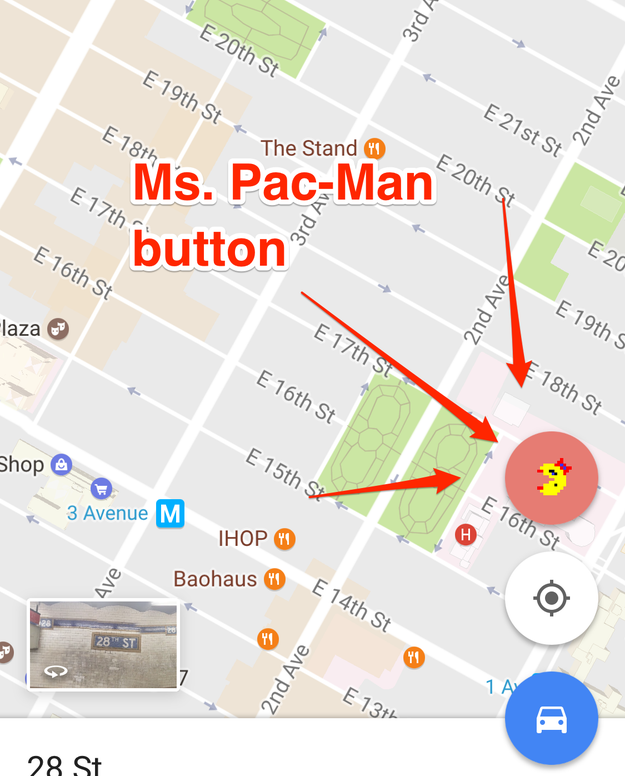
Google Maps just released a Ms. Pac-Man game for April Fool’s Day.

Google Maps just released a Ms. Pac-Man game for April Fool's Day.

To play, make sure your app is updated, then open it and hit the Ms. Pac-Man button on the side.

To play, make sure your app is updated, then open it and hit the Ms. Pac-Man button on the side.

Then, just run away from the ghost thingees while chomping up little balls. You know, play Ms. Pac-Man —but in Google Maps. Enjoy.

Then, just run away from the ghost thingees while chomping up little balls. You know, play Ms. Pac-Man —but in Google Maps. Enjoy.

media.giphy.com


View Entire List ›

Quelle: <a href="You Can Play Ms. Pac-Man In Google Maps“>BuzzFeed

People In Their Thirties Can't Stop Hoarding CDs

I swear, I used to be cool. There was a time I cared a lot about music, which is the thing you care about when you’re cool. And now I’m old and not cool and don’t really care anymore and I mostly just listen to the radio or the Spotify top 50 while I’m at the gym. And even though I don’t care, I still have a box of my old CDs under my bed that I haven’t touched in years.

This box represents my musical taste from high school and college, approximately 1996–2004. It’s horrible. I’m deeply embarrassed by this box. At the time, I thought I had very cool taste in music, but a lot of that era has not aged well, and some of the buzzy bands of the early aughts have faded into obscurity (Longwave, anyone?). I’ll be blunt: There’s a lot of mid-&;90s ska revival.

I think of this box kind of like the painting in The Picture of Dorian Gray. As time passed and I aged, the Get Up Kids CDs got more and more gnarled and horrifying.

I’ve read Marie Kondo’s The Life-Changing Magic of Tidying Up, and I believe in the doctrine. I’ve purged my closet, my books, and my knickknacks, but I just can’t get rid of that box of CDs under my bed. I haven’t played any of them in years, and have no intention to.

My terrible box of CDs. Note at least FOUR Less Than Jake albums.

BuzzFeed News

The heyday of CDs wasn’t that long. The first year they outsold cassettes was 1993, and the transition to digital was cemented in 2005 when the affordable iPod shuffle came out. So the cohort of people whose prime music consumption years — high school and college — happened during the reign of CDs are now in their thirties and forties. They’ve dragged this box around for several apartment moves, but maybe now they’re having kids and need the space. (Our CDs may not be long for this world anyway; recent evidence shows that “CD rot” means that discs are degrading at around 25 years in some cases.)

Mike Pace, age 38, has hundreds of CDs stored in his parents’ basement. “I&039;ve been trying to figure out the best way to sell them but have NO IDEA,” he told me. “My mom&039;s been asking me for years to get rid of them and part of me is willing, but only if I can find them a good home.”

My coworker at BuzzFeed, Sami Promisloff, is also a fully grown adult abusing her parents’ basement as a storage space. The remnants of her middle and high school jam band phase numbers an estimated 300–400 CDs in binders, and then more stacked on spindles.

“I was on the leading edge of tape trading turning into CD trading, which then turned into LimeWire and Kazaa for any good gigs I didn&039;t yet own, plus Archive.org rips,” she told me. “I have an entire book with live Phish CDs only, and another one that&039;s gotta be 50% Dave Matthews Band followed by other H.O.R.D.E. tour alumni (ranked in order of importance, and the order is very profound/purposeful).”

Because live gig tapes are huge in the jam band community, Promisloff’s collection is almost exclusively burned CDs, which means there’s no chance of her selling it to a used CD store.

Not that she’d get much for them anyway. The market for used CDs is, well, not great. Academy Records, a used CD and vinyl shop in Manhattan, has plenty of customers, even on a rainy Monday afternoon. Ari Finkel, their 23-year-old used CD buyer, also plays in an experimental band. He’s an anachronism — a fresh-faced relic from another time when snooty record store clerks were a recognizable breed (Finkel hasn’t seen Empire Records, but admits that High Fidelity is completely accurate). He doesn’t even really own that many CDs, and admits, “most people my age want nothing to do with this.” The typical CD seller he sees is over 30, and it’s not unusual to see them unsuccessfully try to dump their whole collection. “Generally if someone brings them all in and they’re an able-bodied young person, we’ll tell them to bring them to Housing Works [a charity thrift store] a block away.”

Donation is your other option — charity resale shops like Goodwill or Housing Works will always take them. A clerk at a Paramus, NJ Goodwill told me that plenty of people still buy their used CDs, which sell for $1.99 each. Another Goodwill in Maryland explained that if they end up with more CD donations than they sell (which happens fairly often), they move the excess around to other stores or other parts of their organization. So a CD donation is always appreciated.

Academy will almost always buy classical and classic rock: A Beatles or Rolling Stones CD will sell, so they’ll buy it for $1). They’ll also take stuff that’s obscure or out of print. They may take your Belle & Sebastian album if they don’t have any on hand at the moment, but don’t expect more than 50 cents for it. Finkel swears that his personal taste doesn’t come into play when he buys for the store; he only goes by cold capitalism. He knows for certain that the following will not sell:

  • One hit wonders from the ‘00s or ‘10s (sorry, The Ting Tings)

  • Any U2 from the ‘00s (‘80s/’90s are ok)

  • Those “chillout” electronica compilations that sound like Svedka ads. Finkel notes that somehow everyone whose entire collection is otherwise exclusively rock seems to have one of these terrible mix CDs

Academy also receives a fair amount of full CD collections coming from estates after someone died. When CDs first came out, a lot of baby boomers re-bought their whole vinyl collections onto the hot new technology — tons of Steely Dan and Fleetwood Mac. Now, Academy is getting calls from widows or children who are getting rid of the whole collection. For big collections and for older people, they’ll do house calls.

Ryan Martin, a late-thirtysomething who ran a indie label called Dais for experimental music, sold off his collection through a housecall. The famous record store Princeton Record Exchange in Princeton, NJ came to his Brooklyn apartment and gave him $7,000 for his full collection of more than 10,000 CDs. Of course, this was 10 years ago. “Even the appraiser who wrote me the check was like, ‘ha, good thing you are doing this now; in 2-3 years these will be worthless,’’ Martin said. He was fairly unsentimental about letting his collection go. “Seven grand was an unthinkable amount of money for me back then, so it was more like jubilation. I think I went out to a fancy dinner when the check cleared.”

Chris Capese works via word of mouth, and will come to your house, appraise your collection, buy it, and haul it off. He only works with real-deal collections, not your one box of Smash Mouth CDs.

Both he and Finkel pointed out that how many copies of a title were printed affects the market in a way you might not have considered. We tend to think of albums in digital terms now, where tangible supply is never an issue. Not so with CDs. “The more popular an artist is, the less valuable it will be,” Finkel said. “Music from the ‘90s and ‘00s was this golden era of CDs where everything was being manufactured in such huge quantities. Things like R.E.M. or Oasis, there are just so many copies in existence.”

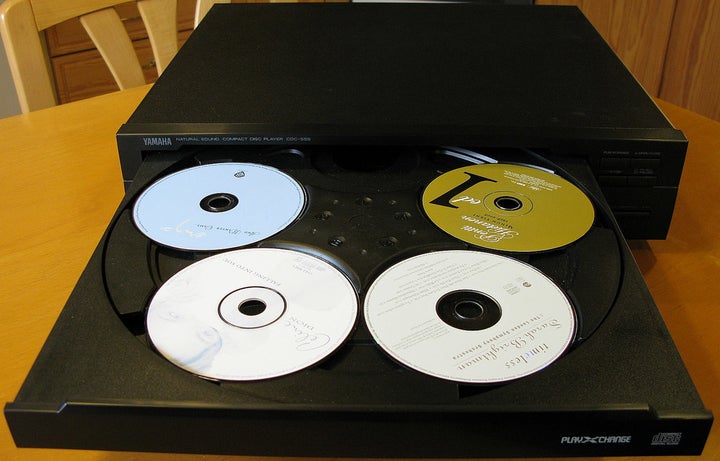
A magic five-disc changer.

Leo-setä / Creative Commons 2.0 / Via flic.kr

Without sounding too “kids these days&;”, I think that kids these days will never understand the way that owning physical copies of music feels so different than streaming or mp3s. Musical taste will always be important for young people, and almost certainly more access to music means kids will love even more of it. But the intense feelings you get when you go to a store and buy a CD and bring it home and remember the track order and the liner notes – that’s different. And that’s why us old people are so attached to them. It’s hard to say goodbye to those memories not only of enjoying your teenage music, but also of being a young person who had the time to sit and read the lyrics in the liner notes along while listening to the album in entirety. Our CD collections aren’t just nostalgia, they’re part of our identities.

Elizabeth Olson, 38, kept her old CDs in a paid storage space for years while moving cross country for work and living in a small apartment. Now settled with a house and a baby in the New Jersey suburbs, she has room in the basement for her boxes. “Part of me hopes that one day my son will bring home a dusty CD player from the thrift store and be super excited to listen to It’s A Shame About Ray,” she said.

Quelle: <a href="People In Their Thirties Can&039;t Stop Hoarding CDs“>BuzzFeed