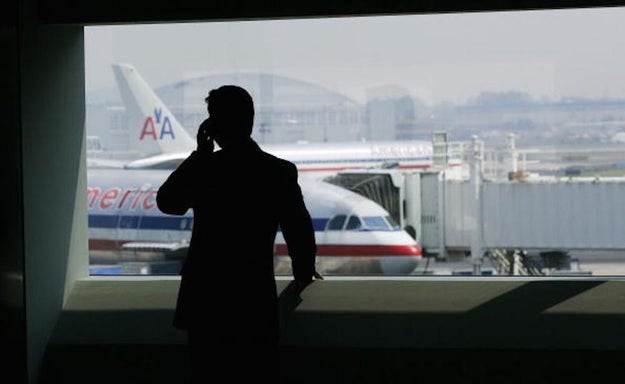
You’re Stuck With Gogo: Government Reverses Plan For Cell Service On Planes

Getty Images/Chris Hondros

Flyers won&;t be able to use their own mobile networks in-flight anytime soon. The chairman of the Federal Communications Commission on Monday voted against a proposed rule that would have relaxed restrictions on in-flight mobile device use, essentially terminating it. Of the two other FCC leaders who will vote on the proposal, one had previously sided with the chairman against it.

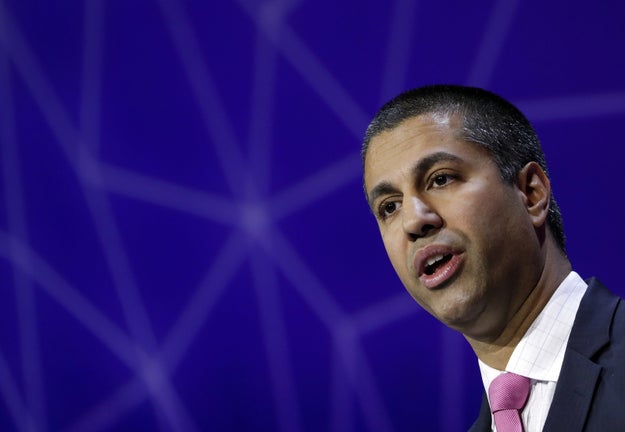
“I do not believe that moving forward with this plan is in the public interest,” FCC Chairman Ajit Pai said in a statement on Monday. “Taking it off the table permanently will be a victory for Americans across the country who, like me, value a moment of quiet at 30,000 feet.”

The rule was introduced in December 2013 by then FCC Chairman Tom Wheeler, a democrat who resigned in January and said current laws were “outdated and restrictive.”

The FCC, which regulates communications like telephones, mobile devices, and internet services, prohibits in-flight mobile usage to protect against the threat of interference with wireless networks on the ground.

While passengers can connect via pay-for services such as Gogo Inflight Internet, which many complain is expensive and slow, the proposed rule would have given airlines permission to decide if they would install equipment allowing passengers use of their own phones and their own wireless carriers above 10,000 feet.

The FCC explained in a blog post:

“The proposal would create a way for passengers to utilize their devices over their mobile wireless networks for email, texting and Internet use. Many consumers can already use Wi-Fi services onboard aircraft for these purposes. The proposal would provide more competition in the marketplace and give consumers more choices to use their devices in the manner that works best for them—either through Wi-Fi or their wireless provider. The result is that consumers could potentially have access to similar services aboard aircraft that they have come to rely with their mobile wireless networks on the ground.”

Soon after the rule was introduced, flyers sent dozens of passionate comments to the FCC urging the commission to vote against allowing passengers to make in-flight phone calls.

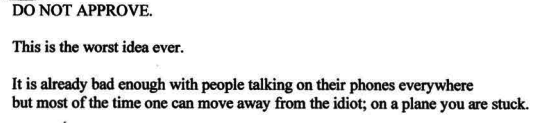
“This is the worst idea ever,” said one commenter.

"This is the worst idea ever," said one commenter.

FCC.gov / Via ecfsapi.fcc.gov

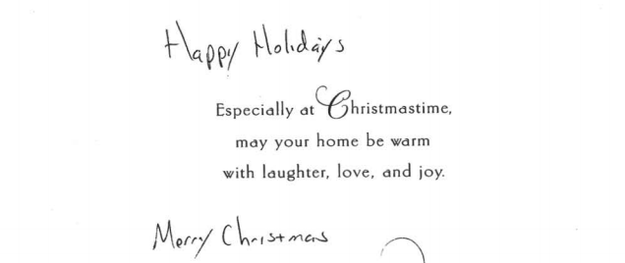
“What better use of my extra Christmas card than to ask you to please use any influence you have to … guide airlines towards allowing data but not voice use in flight,” said one person, who was polite enough to wish the commission “Happy Holidays.”

"What better use of my extra Christmas card than to ask you to please use any influence you have to ... guide airlines towards allowing data but not voice use in flight," said one person, who was polite enough to wish the commission "Happy Holidays."

FCC.gov / Via ecfsapi.fcc.gov

“NOOOOOOOOOOOOOOOOOOOOOOOOOOOOOOO…”

"NOOOOOOOOOOOOOOOOOOOOOOOOOOOOOOO..."

FCC.gov / Via ecfsapi.fcc.gov

Commissioner Michael O&039;Reilly, a republican who sided with Pai against the rule when it was proposed in 2013, and Commissioner Mignon Clyburn, a democrat who said the rule would promote competition by giving travelers more data service options, still must vote on the rule.

Quelle: <a href="You’re Stuck With Gogo: Government Reverses Plan For Cell Service On Planes“>BuzzFeed

Tech Companies Reject A Proposal For Voluntary Net Neutrality

Eric Gaillard / Reuters

Proponents of strong net neutrality rules in Silicon Valley and beyond are bracing for a big fight in the coming months. Ajit Pai, the new Chair of the Federal Communications Commission appointed by President Trump, is pushing to undo widely celebrated Obama-era rules designed to maintain a free and open internet. Instead, Pai plans to propose that internet service providers would only have to volunteer not to engage in unfair practices. Predictably, net neutrality advocates are already rebelling against the idea.

Pai advanced his proposal, which is still in a preliminary stage, in a meeting with telecom trade groups last week, sources familiar with the matter told BuzzFeed News. The plan would roll back the open internet order passed by the FCC in 2015, which prohibits ISPs from favoring or discriminating against certain types of web traffic, and would replace the net neutrality regulations with pledges by internet providers to avoid anti-competitive behavior like blocking or throttling.

But government officials and tech companies who support open internet rules say the proposal is net neutrality in name only. They warn the proposal is watered down and would strip internet users of crucial protections, while giving internet gatekeepers like Comcast and AT&T more power to influence what people see and do online.

“Chairman Pai’s proposal would put the future of an open and free internet in the hands of big corporations.”

“If recent press reports are true, we are gearing up for a battle that could eviscerate the widely supported open Internet protections adopted by the FCC,” Mignon Clyburn, the sole Democratic commissioner on the FCC, told BuzzFeed news in a statement. “Rolling back these basic consumer and competition protections should be highly alarming to anyone who cares about the free and open internet.”

For consumer advocates, Democratic lawmakers, and much of the tech industry, network neutrality is a vital protection against internet companies manipulating online activity. Without strictly enforced rules, ISPs will have more power to unfairly promote their own content, or dissuade users from using competing services, advocates say. And not only does net neutrality protect online businesses like video streaming services and media outlets, it also promotes the free speech rights of Americans who rely on the free flow of information and expression online.

“The only way to protect a free and open internet is with strong net neutrality rules of the road – not voluntary guidelines – that ensure businesses, innovators and families can use the world’s greatest platform for commerce and communications,” Democratic Sen. Ed Markey of Massachusetts, told BuzzFeed News in a statement. “Chairman Pai’s proposal would put the future of an open and free internet in the hands of big corporations and the powerful few at the expense of consumers.

A spokesperson for the FCC declined to comment.

ISPs maintain that net neutrality regulations are overly burdensome and discourage the telecom industry from investing in infrastructure, since broadband providers must shoulder the costs of surging web traffic — without the ability to charge businesses that use massive amounts of data.

“The FCC decided to apply last-century, utility-style regulation to today&;s broadband networks,” Chair Pai said during a speech at Mobile World Congress in Spain earlier this year.

In a major victory for net neutrality advocates last year, however, a federal appeals court upheld the open internet rules that require internet providers to treat all web traffic equally. Further appeals are still pending.

According to the sources familiar with Pai&039;s meeting, the Federal Trade Commission, which can hold companies accountable for their marketing statements and terms of service, would enforce ISPs&039; promises.

“The framework is voluntary. I think we all know what voluntary commitments are worth.”

But some in Silicon Valley view the proposal as a non-starter. “Getting commitments from ISPs that have campaigned vociferously against net neutrality seems like a recipe for disaster for meaningful net neutrality protections,” Evan Engstrom, the executive director of Engine, a policy and advocacy group for startups, told BuzzFeed News.

Chris Riley, the director of policy for Mozilla, described the proposal as “misguided,” and criticized the lack of clear enforcement mechanisms.

“This isn&039;t real net neutrality,” said Michael Cheah, Vimeo&039;s general counsel. “Even if these were great rules, which they are not, this is not a framework that helps the industry. This is a framework that is meant to help the incumbent ISPs,” he told BuzzFeed News.

Even with commitments to not block people from accessing certain websites and services, net neutrality is more than just adhering to strict rules, Cheah said; it&039;s a broader concept that ISPs shouldn&039;t mess with traffic, at all. If the FCC repeals the rules, ISPs could more easily create internet fast lanes, privilege the content of partner media companies, discount data used for select services, and place caps on web data, Cheah said.

“The framework is voluntary. I think we all know what voluntary commitments are worth. It is every industry&039;s dream to be voluntarily regulated,” Cheah said.

For video streaming companies like Vimeo and the broader community of startups, weaker net neutrality rules could mean higher costs and impaired growth. Data-hungry businesses might need to broker deals with ISPs to quickly deliver their services over the web. Cheah said that without the money or right business connections, this could stifle innovation for a multitude of services.

While streaming TV company Roku declined to comment on reports of Chair Pai&039;s proposal, a spokesperson told BuzzFeed News, “[I]n general we believe that clear rules should be in place to ensure that the Internet remains open for content and services to be distributed to consumers without interference or other discriminatory practices.”

Netflix also declined to comment on the proposed net neutrality roll back. But a spokesperson referred BuzzFeed News to the company&039;s January shareholder letter. In it, Netflix said that a weakening of net neutrality rules is unlikely to affect its business because of its popularity and existing relationships with ISPs. But Netflix went on to say that internet providers should not be the ones to decide which services can grow and succeed on the internet.

This week, the Internet Association, a major web trade group representing Netflix, Google, Facebook, and Amazon will meet with Chair Pai to discuss a range of tech policy issues, including net neutrality, a source familiar with the meeting told BuzzFeed News.

A spokesperson for the Internet Association declined to comment on the meeting, but told BuzzFeed news: “People expect access to the entire internet when they pay for their connection, which is why it is so important for strong, enforceable net neutrality rules to be in place.”

Quelle: <a href="Tech Companies Reject A Proposal For Voluntary Net Neutrality“>BuzzFeed

Amazon's Largest Rival In India Just Raised $1.4 Billion From Microsoft, eBay, And Tencent

Abhishek Chinnappa / Reuters

Amazon’s largest rival in India, Flipkart, announced Monday that it is raising $1.4 billion from Microsoft, eBay, and China’s Tencent. The funding, which is the largest round ever raised by a private Indian technology company, values Flipkart at $11.6 billion.

As a part of this deal, eBay is selling its Indian operations to Flipkart for a $500 million cash investment and an equity stake in the company, although eBay India will continue to operate in India as an independent entity. According to an eBay press release, the company has also signed an exclusive agreement with Flipkart to cross-promote products between the services.

“We are delighted that Tencent, eBay and Microsoft — all innovation powerhouses — have chosen to partner with us on their India journey,” Flipkart’s founders, Sachin and Binny Bansal, said in a statement. “We have chosen these partners based on their long histories of pioneering industries, and the unique expertise and insights each of them bring to Flipkart.”

Flipkart’s other investors include Tiger Global Management, Naspers Group, Accel Partners and DST Global.

This latest round of funding gives Flipkart some much-needed ammunition as it battles Amazon in India, one of the world’s fastest growing internet markets. According to recent report co-authored by the Internet and Mobile Association of India, the country’s internet users could reach 450 million by June 2017 — a large and tempting market that both Silicon Valley technology companies and their Indian rivals are racing to capture.

Amazon, which entered India in 2013, has invested $5 billion so far. Amazon CEO Jeff Bezos has reportedly told the company’s executives to “do what it takes to succeed” in India and to “not worry about the cost.” A recent report published in The New York Times claimed that Amazon is looking at opening brick-and-mortar grocery stores in the country where traditional street bazaars still dominate.

Analysts say that new round of funding will help Flipkart defend its market share in the price-sensitive Indian market against Amazon, which has quickly become the second-largest online shopping destination behind Flipkart in less than four years.

“This investment could give Flipkart just enough scale and momentum to take on Amazon again,” Pavel Naiya, senior analyst at Counterpoint Research told BuzzFeed News. “It’s likely that we’ll see Amazon focusing on smaller Indian towns in the future to expand its market share in India.”

Quelle: <a href="Amazon&039;s Largest Rival In India Just Raised .4 Billion From Microsoft, eBay, And Tencent“>BuzzFeed

This Is The Russian Hacker Detained For Maybe Helping Hack The 2016 Campaign

Vitaliy_87 / Getty Images

SAN FRANCISCO — For years Pyotr Levashov, aka Peter Severa, was known to authorities as one of the world’s most prolific spam kingpins.

Levashov, who lived in St. Petersburg, travelled freely under a lifestyle so lavish that one fellow Russian hacker told BuzzFeed News he “would have embarrassed an oligarch.” Last week, he was arrested in Barcelona while vacationing with his family under an international warrant at the request of the US.

Normally, the arrest of a spammer wouldn’t illicit international headlines, no matter how prolific. But over the weekend Levashov’s wife told the Russian state-owned broadcaster Russia Today that her husband’s arrest was due to his involvement in a “computer virus” which was “linked to Trump’s win.” Immediately, online forums were abuzz that one of the Fancy Bears — a group of Russian, government-linked hackers — had been caught.

Yet the arrest of Levashov, a well-known figure in cybercriminal circles, has less to do with the US government hunting down elusive members of the Russian government’s elite squad of hackers, and more to do with authorities finally cracking down on the murky underworld of Russian cybercriminals who have aided Russia’s ever-growing cyberwar in pursuit of their geopolitical goals. For years, cybersecurity researchers and US authorities have tracked the murky ties between cybercriminals and the Russian state, including how malware first developed for criminal enterprises has made its way into state-sponsored cyberattacks on Russia’s neighbors. Over the last six months, US authorities have appeared to be stepping up their efforts to arrest the cybercriminals who work with the Russian state.

“We’ve reached a boiling point with Russia. They are the closest competitor to the US when it comes to cyberespionage and cyberattacks,” said Milan Patel, managing director at the K2 cybersecurity firm, and former Chief Technology Officer of the FBI’s cyber division. “With Russia now, a lot is coming the forefront and being made public about how they run their cyber activities.”

Last month, the US announced charges against two Russian intelligence officers and two hackers over a massive Yahoo breach. US authorities said the group hacked into Yahoo, compromising more than 500 million email accounts, in order to target the emails of just a handful of Russian journalists, opposition politicians, and government officials, for cyberespionnage.

The Justice Department refused to comment on Levashov’s arrest to BuzzFeed News or on the case against him. For years Levashov has been listed as among the top 10 perpetrators of spam in the world by Spamhaus, a group that tracks spammers. Cybersecurity researcher Brian Krebs has also documented how Levashov appeared to be a moderator for online communities which profited from spam, and how he served as a linchpin between virus writers with spam networks.

In 2012, Russian cybersecurity researchers Andrei Soldatov and Irina Borogan, reported that Russian hacker forums believed that Peter Severa (believed to be Levashov’s online alias) had been recruited by the Russia’s national security service, the FSB. The researchers wrote that Peter Severa had been attempting to recruit hackers on online forums.

The alias of Peter Severa was also named by a 2012 court filing by Microsoft, which outlined how the extensive spam network had been used to spread a host of computer viruses. One of those, the Kelihos virus, was used to spread spam during the 2012 Russian elections that pushed fake news stories about the candidate running against Russian President Vladimir Putin. Those emails included unsubstantiated allegations that Putin’s opponent, Mikhail D. Prokhorov, had come out as gay.

It is unclear how, or if, Levashov is tied to the hacks on the DNC, as his wife told Russia Today. One Russian hacker, reached by BuzzFeed News Monday, said he was doubtful Levashov had any direct connection the hacks, but that is was possible malware developed by him had been repurposed in some form.

“They commin for everyon[e] man,” wrote the hacker, via a secure messaging app. His communication with BuzzFeed News was done so on condition of anonymity. “People need keep their head down.”

In previous conversations the hacker, who says he has no ties to the Russian state, has said that Russian cybercriminals are alarmed by the recent arrests among their group and believe the US is on a vendetta. He said that while Russian cybercriminals still enjoy freedom of movement and protection within Russia — as long as their actions don’t target the Russian State — they have become increasingly paranoid about travel and communication outside Russia.

Quelle: <a href="This Is The Russian Hacker Detained For Maybe Helping Hack The 2016 Campaign“>BuzzFeed

A More Humble Facebook Is Deploying Charm And Its Checkbook To Win Over Critics

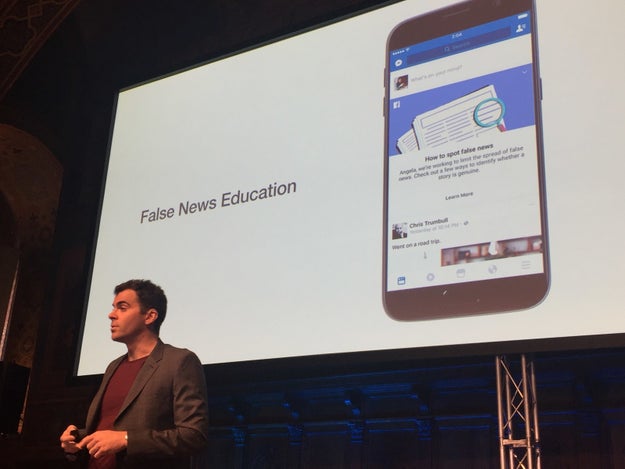
Adam Mosseri onstage at the International Journalism Festival in Perugia, Italy.

Craig Silverman

PERUGIA, Italy — “This actually makes me a little bit uncomfortable,” said Adam Mosseri, Facebook’s VP of News Feed, to a packed room of journalists and members of the public on Friday.

Mosseri was there to explain how Facebook News Feed works, and to share new projects related to news discovery and “integrity” the company is working on for its close to 2 billion global users. What made Mosseri uncomfortable, he said, was giving a sneak peek at new products they were testing — products that might never be fully rolled out.

“We don’t generally share much about what we’re doing before we do it,” he said.

Those in the audience could be forgiven for thinking Mosseri was talking less about his product roadmap and more about being in that room at the International Journalism Festival in Perugia, Italy. Almost exactly two years before, Andy Mitchell, the company’s director of global media partnerships, gave a keynote that in the ensuing time has become viewed by attendees of the IJF as something of a PR disaster.

Mitchell&;s prepared remarks back in 2015 weren&039;t the issue. It was his handling of questions about difficult topics such as censorship and Facebook&039;s responsibilities as a platform that stuck with people.

“Do you think that you are accountable for the quality and integrity of your decisions to your community of users?” asked George Brock of City, University of London, to applause from the audience.

“We have to create a great experience for people on Facebook, and like I said earlier Facebook should be a complimentary news source,” Mitchell replied.

Brock tried to yell out a follow up but time was up. People left feeling Facebook was doing everything it could to avoid acknowledging its massive influence over the digital news ecosystem.

Brock wrote afterward that Mitchell&039;s answers were “condescending and dishonest.” Press critic and professor Jay Rosen said Mitchell and Facebook were “treating us like children at a Passover seder who don’t know enough to ask a good question.”

Two years later, people still remember.

“It was horrible,” said a European journalist seated next to me at Mosseri’s talk this year. She saw Mitchell and wanted to see if Mosseri would be any different. “If [Mitchell] had stayed any longer I had the feeling people would storm the stage. He tried to downplay Facebook’s role and people felt bullshitted.”

Up until very recently, Facebook was known for keeping its product roadmaps, checkbook, and public comments close to its chest. The company is also sometimes seen as avoiding panels and public events where its people might face tough questions about the power it wields over digital news. On top of that, for a long time it steadfastly clung to the idea that it&039;s purely a technology company.

But in the months since it was rocked by criticism for the spread of misinformation on its platform during the US election, Facebook began changing how it engages with the news industry, and how it talks about its role providing information to people. The company recently announced it’s a key funder of a new $14 million initiative about “news integrity.” That followed a January launch of the Facebook Journalism Project.

At this year&039;s festival it launched a new program to educate users in 14 countries about how to spot “false news.” This is the latest effort around misinformation, which also includes a recently rolled-out partnership with third-party fact-checking groups, among other initiatives.

Facebook is now a company where CEO Mark Zuckerberg writes a 6,000-word essay on his view of community, and where he now acknowledges that Facebook is a “new kind of platform” that brings with it “a new kind of responsibility.” (“It could have been shorter,” Mosseri joked about Zuckerberg’s manifesto during his talk.) Zuckerberg’s Facebook profile also recently featured a photo of him and his wife reading a local newspaper during a visit to Alabama.

View Video ›

facebook.com

“It seems like a good time to say thank you to all the journalists around the world who work tirelessly and sometimes put their lives in danger to surface the truth,” he wrote.

Running through all of this is a new, humble tone that Mosseri put on display right from the start.

“It’s a difficult time to be in the news industry,” he said. “We’re trying to figure out how we might be better partners and we haven’t always been the best at communicating, which is really in my opinion a problem with News Feed.”

Mosseri’s keynote was part of a full-court press at IJF. The company sent what festival organizer Chris Potter told BuzzFeed News was roughly 30 employees to give workshops and to sit on panels about contentious topics such as fake news and online misinformation. A phalanx of PR staff set up private meetings with Mosseri and select journalists.

“A cynic would say, ‘Oh it’s PR and corporate marketing,’” Potter said in an interview. “That’s one point of view, and it’s reasonable given past experience. But I think there’s a bit more to it than that.”

He said Facebook reached out to him last year to say it wanted to play a big role in this year’s festival. “There’s been no imposition, no arrogance, no kind of heavy-handedness” in his dealings with the company, according to Potter.

“Whether you believe it or not, whether it’s marketing or truth, at least there is an effort being made, it seems to me, to reach out and say, ‘Yeah, this is a collective problem,’” he said.

That’s one of the core messages from the new, humble Facebook.

“Issues like false news are bigger than Facebook,” Mosseri said onstage. “They require industry-wide solutions and there are no silver bullets.”
Craig Silverman

The company now freely talks about its responsibility to users and to the news industry.

“We are a very large platform and that comes with very serious responsibilities, and one of which is to make sure we’re doing our part to support informed communities,” Mosseri said.

“I’ve noticed this time around the whole Facebook team, not just Adam Mosseri, they’re all singing from the same hymn sheet,” Potter said. “They’ve certainly gone through some rigorous staff training to make sure they know how to respond to particular questions. There’s no “How dare you’ kind of response [from them].”

Another line delivered consistently by Facebook executives is that the company doesn&039;t want to “become the arbiters of truth” when it comes to content. It’s attempting to walk the line between reducing the spread of misinformation on its platform while simultaneously sidestepping concerns about censorship and political bias.

Jeff Jarvis, a professor at CUNY’s Graduate School of Journalism, is one of the people who brought Facebook to the table to fund the News Integrity Initiative, which his school will administer. He sees that funding, which he stresses comes with no restrictions on how it will be spent, as part of a bigger change at Facebook. Jarvis said the shift may also have something to do with the other big platform the news industry is always obsessing over: Google.

“What we always saw was Google was ahead in the public-facing end of news and not so much on the product side, and Facebook was ahead on the product side but not so much on the public-facing voice,” Jarvis said. “And now I think that Facebook is trying to catch up on the public-facing voice very quickly.”

Google has spent, or pledged, hundreds of millions of dollars in the past few years on initiatives related to the news industry. It’s also been present on panels at conferences. This year at the festival Facebook and Google held receptions in the exact same room, with the exact same food and drink on offer, one day after each other.

This is just the start of Facebook’s new charm and chequebook offensive for the news industry. So while Mosseri and other executives are ready to talk about its responsibility to the news industry and how to stop false content from going viral, other questions go unanswered.

After his keynote, Mosseri was asked to share data about the collaboration with third-party fact-checkers to label false content. He responded but didn&039;t share any data. Partners involved in the program have told BuzzFeed News they have yet to see much in the way of data from the company, and the head of the International Fact-Checking Network also tweeted about the lack of data so far.

Jeff Jarvis was onstage with Mosseri to moderate a Q&A after the keynote. After the fact-checking question he walked over to George Brock, the journalism professor whose question to Andy Mitchell two years ago stuck in the minds of so many. Jarvis told BuzzFeed News he told Brock ahead of time to be ready with a question, as a way to connect the dots back to what happened the last time Facebook was on this stage.

But rather than pushing Facebook to acknowledge its role and responsibility to news and the information ecosystem, Brock urged Mosseri to think bigger than journalism.

“You’re the largest one-stop shop for information on the planet and I think you should stop worrying quite so much about problem-solving for journalism,” Brock said. “What actually you’re doing is you have a potential role in a reconstruction effort in civil society … . You could go a lot further. I want to encourage you to go there. Will you go?”

The crowd began to applaud and a smile spread across Mosseri’s face.

“We’re certainly going to try,” he said.

Quelle: <a href="A More Humble Facebook Is Deploying Charm And Its Checkbook To Win Over Critics“>BuzzFeed
Uber Says It Didn't Steal Waymo's Self-Driving Tech

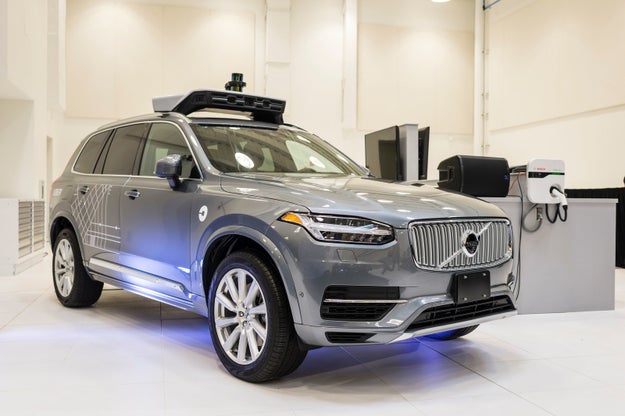
A pilot model of the Uber self-driving car is displayed at the Uber Advanced Technologies Center on September 13, 2016 in Pittsburgh, Pennsylvania.

Afp / AFP / Getty Images

Uber denied Waymo’s allegations that it is using technology stolen from the Alphabet company by an ex-employee before he joined Uber, saying in a court filing that it is “unambiguously developing its own technology independent of Waymo.”

The court filing on Friday comes in response to Waymo’s request last month for a federal judge to halt Uber’s self-driving car efforts. Waymo filed a lawsuit in February against Uber, alleging that former employee Anthony Levandowski downloaded 14,000 company files before leaving and starting his own self-driving truck company, Otto. Uber purchased Otto last year and installed Levandowski as the leader of its self-driving car program.

The lawsuit centers around laser technology called LiDAR (Light Detection And Ranging), which helps self-driving cars see and navigate. Uber says its own technology is “fundamentally different” from Waymo’s – Uber’s design uses four lenses, while Waymo’s uses a single lens – and called the request to pause its self-driving program a “misfire.”

“A cursory inspection of Uber’s LiDAR and Waymo’s allegations fall like a house of cards,” Uber said.

Uber said its own forensic analysis concluded that no Waymo documents crossed over into Uber’s systems, and that halting its program “would impede Uber’s efforts to remain a viable business.” (Uber CEO Travis Kalanick has called self-driving cars an existential threat to the ride-hail giant’s business.) The company also said the fact that Waymo waited for five months after learning Levandowski downloaded files to seek an injunction against Uber shows a lack of urgency. And it provided testimony from Scott Boehmke, who began developing the company’s own LiDAR systems in 2015.

Uber also provided testimony from another employee who joined Otto after leaving Waymo, Sameer Kshirsagar, who’s also named in Waymo’s suit. Waymo alleges he also downloaded files before leaving the company for Otto. The testimony says that he downloaded specific documents cited in Waymo’s allegations while creating a transition memo for his team before departing, but did not take them with him. In the case of another document, a checklist, Kshirsagar said he may have forwarded them to a personal device for review while working at Waymo, but has not accessed them since he left the company.

“I did not take any confidential Google/Waymo documents with me upon my departure from Google/Waymo for use at Uber and/or Otto. I have not used any confidential Google/Waymo documents or information in my work for Uber and/or Otto,” Kshirsagar’s statement says. “I was never directed by anyone, at Uber or Otto, or otherwise, to take confidential documents or information from Google or Waymo.”

The ride-hail giant also filed three additional documents with its response. Two were from LiDAR experts: one from Paul McManamon, a scientist at the University of Dayton, and the other from a laser and optoelectronic design consultant named Michael Lebby. Both declarations support Uber’s claim that some parts of the design of Waymo’s LiDAR technology are not trade secrets and are publicly known within the field. The third declaration was from the head of a New York-based digital forensics lab.

Uber may have searched its own servers, but Levandowski, the leader of its self-driving car program, has asserted a Fifth Amendment right to avoid self-incrimination. That means he isn’t cooperating in the search.

On Wednesday, Judge William Alsup warned that “I’ve never seen a record this strong in 42 years,” referring to Waymo’s body of evidence against Uber, according to Reuters.

In response to Uber’s court reply on Friday, a Waymo spokesperson said the company based its request for the judge to halt Uber’s self-driving car program “based on clear evidence.”

“Uber’s assertion that they’ve never touched the 14,000 stolen files is disingenuous at best, given their refusal to look in the most obvious place: the computers and devices owned by the head of their self-driving program,” Waymo said.

Quelle: <a href="Uber Says It Didn&039;t Steal Waymo&039;s Self-Driving Tech“>BuzzFeed

Hackers Had Access To Tax Data For Up To 100,000 FAFSA Users

Chip Somodevilla / Getty Images

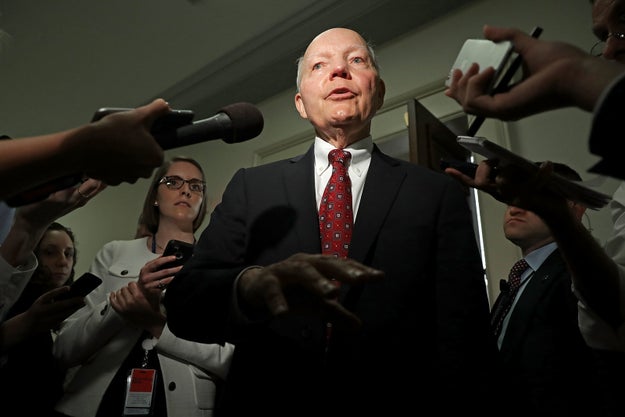
Hackers gained access to the tax records of up to 100,000 people who used a government-created financial aid tool, the Internal Revenue Service commissioner said Thursday, explaining why the tool was taken offline at the peak of application season last month.

The tool was built into the government&;s Free Application for Federal Student Aid (FAFSA), and enabled users to import their tax information into their financial aid and student loan forms. It was compromised in a security breach, and fraudulent refunds using the data have already cost the government $30 million and exposed tens of thousands of people to identity theft.

About 8,000 fraudulent tax refunds were issued because of the breach of the so-called IRS Data Retrieval Tool, IRS commissioner John Koskinen said in testimony before the Senate Finance Committee. Another 14,000 fraudulent refunds were blocked.

The tool was taken offline in March with no warning from the government, and the IRS and Education Department initially said it would return within weeks. The outage is now expected to drag into October. “I told them that as soon as there was any indication of criminal activity, we would have to take that application down,” Koskinen said.

The shuttering of the tool has caused massive headaches and a cascade of other consequences for some financial aid applicants and student loan borrowers, particularly low-income students. It requires students to manually input data that they may not readily have access too, and with the tool offline, students are more likely to have their FAFSA applications flagged for vetting — a time-consuming process that could cause first-come, first-serve aid to run out for some students, and that evidence suggests may deter others from applying for aid altogether.

The IRS uses filers&039; adjusted gross incomes as the primary way to verify taxpayers&039; identity, but the data retrieval tool was designed to allow people to more easily access that same number. Koskinen said that the IRS had detected a “pattern of activity” that suggested the tool was being used fraudulently.

Quelle: <a href="Hackers Had Access To Tax Data For Up To 100,000 FAFSA Users“>BuzzFeed

Twitter Sues Feds Over Attempt To Reveal Identity Behind @ALT_USCIS Account

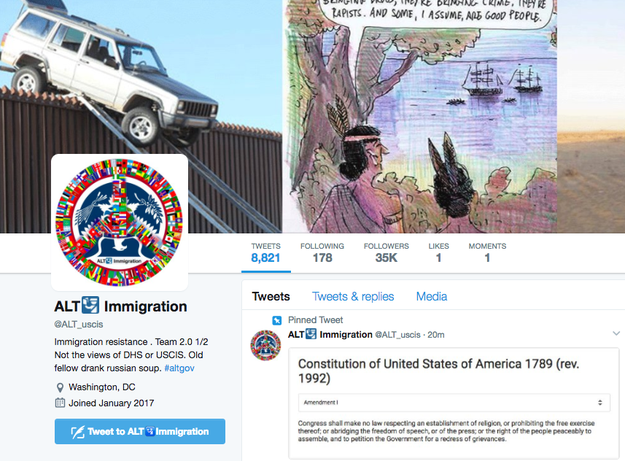
Via Twitter: @ALT_uscis

WASHINGTON — Twitter sued the Trump administration on Thursday, trying to stop an attempt at forcing the company to reveal personal information about the user of the @ALT_USCIS account.

“The rights of free speech afforded Twitter’s users and Twitter itself under the First Amendment of the U.S. Constitution include a right to disseminate such anonymous or pseudonymous political speech,” the lawsuit argues.

Filed in federal court in California, the lawsuit seeks a court order stopping the US Customs and Border Protection (CBP) from using its summons authority to demand Twitter turn over personal identifying information relating to the account, identified on Twitter as an “immigration resistance” account and “[n]ot the views of DHS or USCIS.”

The lawsuit alleges that the request violates the First Amendment, is not authorized under the relevant summons law, violates the Administrative Procedure Act.

“In these circumstances, Defendants may not compel Twitter to disclose information regarding the real identities of these users without first demonstrating that some criminal or civil offense has been committed, that unmasking the users’ identity is the least restrictive means for investigating that offense, that the demand for this information is not motivated by a desire to suppress free speech, and that the interests of pursuing that investigation outweigh the important First Amendment rights of Twitter and its users,” Twitter&;s lawyers from Wilmer Hale — including former US Solicitor General Seth Waxman — write. “But Defendants have not come close to making any of those showings.”

The ACLU has informed BuzzFeed News that it is representing the @ALT_USCIS user, and will be making a court filing on behalf of the user in the near future, raising statutory and constitutional arguments.

“The right to anonymously speak out against the government is clearly protected by the First Amendment. We are pleased to see Twitter standing up for its users’ rights, and the ACLU will soon be filing documents in court on behalf of this user,” ACLU attorney Nathan Freed Wessler told BuzzFeed News in a statement. “To unmask an anonymous speaker online, the government must have a strong justification. But in this case the government has given no reason at all, leading to concerns that it is simply trying to stifle dissent.”

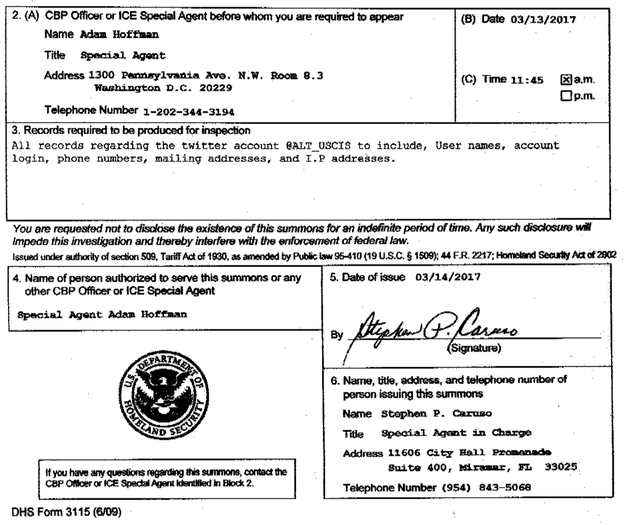
On March 14, according to the complaint, an agent with CBP faxed a summons to Twitter, ordering it to turn over “[a]ll records regarding the twitter account @ALT_USCIS to include, User name, account login, phone numbers, mailing addresses, and I.P. addresses.”

As noted in the complaint, however, “The CBP Summons ordered Twitter to produce the records to a CBP office in Washington D.C. by 11:45 A.M. on March 13, 2017—the day before the CBP Summons was faxed to Twitter.”

This is the summons faxed to Twitter:

This is the summons faxed to Twitter:

Via documentcloud.org

Read the lawsuit:

Quelle: <a href="Twitter Sues Feds Over Attempt To Reveal Identity Behind @ALT_USCIS Account“>BuzzFeed

Bernie Sanders And Elizabeth Warren Want To Restore Internet Privacy Rules

Scott Eisen / Getty Images

Just days after President Trump dealt a final blow to Obama-era internet privacy rules, Senate Democrats are trying to bring them back to life.

Sen. Ed Markey introduced legislation Thursday that would prohibit Internet service providers like Charter and Comcast from selling personal information about their customers, like web browsing history and app usage data, without first getting their permission. Backed by 10 of his Democratic colleagues — including Senators Elizabeth Warren, Bernie Sanders, and Al Franken — the bill would re-establish landmark privacy rules passed in the final months of the Obama administration.

But Sen. Markey and his co-sponsors face a determined Republican majority that fiercely opposes such rules and just voted to overturn them.

Last week, the House of Representatives moved to repeal the ISP privacy rules largely along party lines, in a 215–205 vote. And in March, all 50 votes in favor of stripping the rules were cast by Republicans.

Despite the recent loss in Congress, Democratic lawmakers and consumer advocates believe that the fight over internet privacy has mobilized voters, highlighting previously obscured privacy practices that nonetheless affect every American who uses the internet.

The new proposal, like the internet privacy rules passed by the Federal Communications Commission at last year, would make it harder for ISPs to collect and sell the information of its customers. A key provision would designate web browsing history as “sensitive” information, meaning that internet providers would first need to get your permission before they could share or sell that data.

The Obama-era FCC rules were scheduled to take effect later this year. But with the Congressional repeal and Trump&;s signature, the rules were scrapped and never kicked in. Now, your ISP can do some pretty invasive things with your private data.

“Thanks to Congressional Republicans, corporations, not consumers, are in control of sensitive information about Americans’ health, finances, and children,” Sen. Markey said in a statement to BuzzFeed News. “This legislation will put the rules back on the books to protect consumers from abusive invasions of their privacy. Americans should not have to forgo their fundamental right to privacy just because their homes and phones are connected to the internet.”

For their part, Senate Republicans saw the privacy rules as onerous regulations that unfairly targeted ISPs. Other internet companies, like Facebook and Google, for instance, didn&039;t have the same restrictions placed on them limiting what they could do with customer data. Sen. Jeff Flake, who led the Senate&039;s efforts to repeal the rules, has argued for a more “light touch” approach from the government. “What we need with the internet is uniform rules, and not to regulate part of the internet one way and another part of the internet another way,” he said after the Senate vote in March.

Shortly after Congress voted, Comcast, Verizon, and AT&T each defended their commitments to privacy, and claimed in posts on their corporate websites that little would change following the repeal of the ISP privacy rules. But policy experts and privacy advocates were quick to reject their assurances.

On Wednesday, Sen. Markey sent letters to AT&T, Comcast, Charter, Verizon, Sprint, T-Mobile, and CenturyLink asking them share details on their data collection and privacy practices. Among the 16 questions listed, Sen. Markey asked whether they get consent before collecting their customer browsing history and if they had changed their privacy policies since Trump signed the repeal. Sen. Markey asked that they respond by May 1.

Quelle: <a href="Bernie Sanders And Elizabeth Warren Want To Restore Internet Privacy Rules“>BuzzFeed

Is This Dog An Ad?

Welcome to “Is This an Ad?” — a column in which we take a celebrity’s social media post about a brand or product and find out if they’re getting paid to post about it or what. Because even though the FTC recently came out with rules on this, it’s not always clear. Send a tip for ambiguous tweets or ’grams to katie@buzzfeed.com.

THE CASE:

Meet Agador. He is an extremely Good Boy. Yes, you are, Agador, you are such a good boy.

Agador is a maltipoo with an amazing coat. So fluffy&; So soft&033; I love him.

But Agador does some strange things… like, posing with products and tagging the brand.

Like this one with a DELIGHTFULLY chubby baby wearing Honest Company diapers:

Instagram: @poochofnyc

And this with Budweiser:

Instagram: @poochofnyc

So, are these ads?

THE EVIDENCE:

Agador is owned by Allan Monteron of New York City. Monteron and his partner also run an account for Agador’s brother Fred. The level of quality of the photos — they’re shot on a real camera instead of a phone — and the styling, props and clothing are all very commercial-friendly. They look like ads.

It’s not unheard of for celebrity dogs to do stuff. Marnie, the dog with a delightfully waggly tongue, brings in enough revenue through a handful of different streams that her owner was able to quit her day job and focus on Marnie full time. Jiff, the fluffy Pomeranian star, does Instagram ads. And of course felines like Grumpy Cat and Lil’ Bub have been monetizing cuteness since way back to the early 2010s.

Plus, Budweiser has used dogs in its ad campaigns before, right? Remember a little guy named Spuds MacKenzie? They even brought him back recently&033;

Spuds Mac

Bud Lite

But on the other hand, big brands like Budweiser don’t typically do this kind of lowkey advertising on Instagram. And while Agador is on his way to viral dogdom, he’s not exactly so insanely popular that you’d imagine Starbucks doing vaguely slippery ads with him.

THE VERDICT:

Improbably, neither of these are ads, Monteron confirmed. He said that Agador HAS done other ads, and that those are clearly marked. And they are&033;

Note the sponsored tag in this one:

Instagram: @poochofnyc

Sometimes, a viral dog tagging a diaper company in an Instagram is JUST a viral dog tagging a diaper company pro bono. It&;s also kind of a good strategy if you&039;re hoping to increase your follows. “We tag these major brands in the hopes that they appreciate how we use their products and creativity to provide content that will spark interest to their followers, and repost our content,” explained Monteron.

People enjoy genuinely interacting with brands on the internet — you may not get it (I don’t) — but hey. Some people like pineapple on pizza; I don’t judge.

Quelle: <a href="Is This Dog An Ad?“>BuzzFeed