Can A Simple Blood Test Really Spot Cancer Early? Don’t Bet On It Yet, Scientists Say.
BuzzFeed News; Getty Images (2)

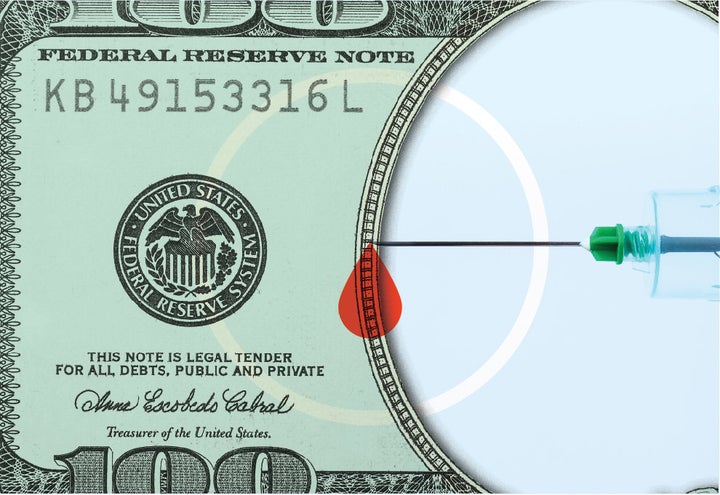
Silicon Valley startups are racing to develop a blood test for cancer that many scientists believe is years, if not decades, away.

It’s a high-stakes competition, fueled by hundreds of millions of dollars in venture capital. The winner could help millions of patients fight off cancer before the disease shows any outward symptoms — early enough to drastically improve their odds of survival.

Or at least that’s what these companies envision on their websites and pitch decks, and at scientific meetings — and investors are buying it.

Founded in 2014, Freenome raised $65 million last month from Andreessen Horowitz, Peter Thiel’s Founders Fund, and Alphabet’s venture arm GV. One of Freenome’s most prominent rivals, Grail, which spun out of the DNA-sequencing monolith Illumina in 2016, has raised an eye-popping $1 billion from the likes of Bill Gates and Jeff Bezos. Another competitor, Guardant Health, has amassed close to $200 million.

So far, however, these companies have shared scant few details about how, exactly, they’re creating a test that could fundamentally change how we deal with cancer.

Freenome’s CEO and cofounder, Gabriel Otte, told Fast Company in April 2016 that its test would hit the market within nine months, after being published in a scientific journal. In June, he wrote a blog post claiming that those results would appear “very soon.” That hasn’t happened. Otte told BuzzFeed News his staff is still setting up clinical trials and will publish results “when we’re ready to publish.” (Otte recently admitted to BuzzFeed News that he does not have a PhD, despite multiple references to the contrary in the press, company materials, and scientific conferences.)

Grail and Guardant have not published any findings, either, although their executives also say they intend to.

Academic cancer researchers, meanwhile, say producing this kind of test is an incredibly difficult scientific and logistical challenge. Nascent tumors sometimes shed telltale markers in the blood, but often don’t, and these “biomarkers” can be different from one person to another, or even in one person from one month to the next. Plus, credible data will take at least several more years to accumulate in rigorous clinical trials, if not longer.

“It’s not going to be a Star Trek, ‘let’s take a quick sample and tell you exactly what disease you have and how to treat it,’” Jeremy Jones, an assistant professor of cancer biology at the City of Hope in Los Angeles, told BuzzFeed News.

There’s no question that such a test would be revolutionary.

There’s no question that such a test would be revolutionary, giving its inventors enormous social and financial rewards.

“Early detection is incredibly attractive, because if you can detect cancers early, you can cure them at a much higher frequency,” Tony Blau, a hematologist who directs the Center for Cancer Innovation at the University of Washington, told BuzzFeed News.

Just as investors in Theranos, the $9 billion startup now fighting for its life after very public regulatory missteps, envisioned a world where doctors could test for all kinds of conditions from a few drops of blood, Silicon Valley is embracing the vision of cancer screening for everyone, early and often.

Blood tests for early-stage cancer would be drastically better than current diagnostic methods like “tissue biopsies,” in which doctors extract potentially cancerous tissue with needles and surgeries. Tests on a couple teaspoons of blood could be much less expensive and invasive, and performed more often. A highly accurate test would also have an advantage over today’s non-invasive tests. Mammograms, for instance, have high rates of both false negatives (they miss one in five breast cancers) and false positives (which happen to about half of women who get the test annually over a decade).

Scientists have long known that cancer cells routinely shed bits of DNA into the bloodstream. But in the past few years, thanks to advances in DNA sequencing, these bits have become far easier to detect.

There are already a handful of tests, led by Guardant, that use these DNA bits to detect cancer in a cancer patient’s blood, or to identify certain mutations that might be treatable with personalized therapies.

But so far, there is no reliably accurate commercial test that can do this for people who are early in the disease and have not yet been diagnosed — the lofty goal of Freenome and its competitors.

The DNA shed by early-stage tumors accounts for less than one-tenth of a percent of all DNA in a patient’s blood, said Ash Alizadeh, a Stanford University oncologist who helped develop and sell a technology to potentially help doctors monitor how a tumor responds to therapy. For some tumors, such as those that start in the brain, their DNA is virtually undetectable even in tens of milliliters of blood, he added.

“The computations are so low,” Alizadeh said. “That’s been a major challenge for early detection.”

Even if a test was able to detect every single molecule of DNA in a blood sample, that wouldn’t be enough. Machines often generate false-positive readings of clumps of cells that are deceptively cancer-like, such as moles that don’t turn into melanoma or colorectal polyps that don’t become colon cancer, Alizadeh says.

“Do we know that those changes are always going to lead to a cancer that could threaten a patient’s life?” said Blau of the University of Washington. “The answer to that is no, we don’t know that.”

Yet another hurdle is simply knowing what DNA sequences to look for, since, as Blau points out, cancer cells differ within the same patient, and even within the same tumor.

And even if a test appears to work in a lab, proving it works in people will take years. “You have to test thousands of patients, wait long enough that enough of them get cancer and enough of them ultimately die of the disease, to be able to really evaluate if a new test is a useful screening test,” Max Diehn, an assistant professor of radiation oncology at Stanford, told BuzzFeed News. (He also consults for Roche, which owns the technology he co-developed with Alizadeh.)
David Silverman / Getty Images

One of Grail’s first steps is a multi-center clinical trial in the United States with at least 7,000 patients with untreated cancer, and 3,000 cancer-free people. It began in August 2016 and plans to wrap up by August 2022.

Scientists hope to understand the molecular differences in the two groups’ blood samples, as well as how they change as disease develops. Grail has an advantage in its ties to Illumina, the world’s dominant supplier of DNA-sequencing machines, which expects Grail to become “one of Illumina’s largest customers over time.”

“Our hope is over time that we’ll be marching the population back earlier and earlier to where almost everyone who has cancer is diagnosed early,” Grail Chief Business Officer Ken Drazan told BuzzFeed News.

Guardant, on the other hand, believes that the knowledge it has already gleaned from testing 35,000 cancer samples can help pinpoint how the disease arises. President AmirAli Talasaz says that in addition to studying tumor DNA fragments, the company is looking at other kinds of chemical changes in tumors, called “epigenomic” variations. Guardant is running clinical trials of various sizes, including on high-risk patients and cancer survivors; a spokeswoman said there is no estimated date of completion.

Meanwhile, Freenome is testing its technology on patient blood samples from UC San Francisco, UC San Diego, Massachusetts General Hospital, and other clinics. For some samples, Freenome tries to predict if the patients received a cancer diagnosis or not. Other samples are from patients who are still being tracked for cancer but haven’t yet been diagnosed. In total, Freenome plans to test “thousands” of samples, though Otte declined to say how many have been tested to date. He still contends that these data will be published in a scientific journal before tests are sold commercially.

The CEO reportedly hooked Freenome’s main investor, Andreessen Horowitz, after acing a blinded test of five blood samples provided by the venture capital firm (which also invests in BuzzFeed). As Otte wrote last year, the company correctly categorized two of the samples as normal, and the other three as cancerous — and even accurately labeled what stage of disease. Although two of the cancer samples were from patients in late stages, he wrote, the third was stage one, a sign that the test could detect early cancer in a healthy-looking person.
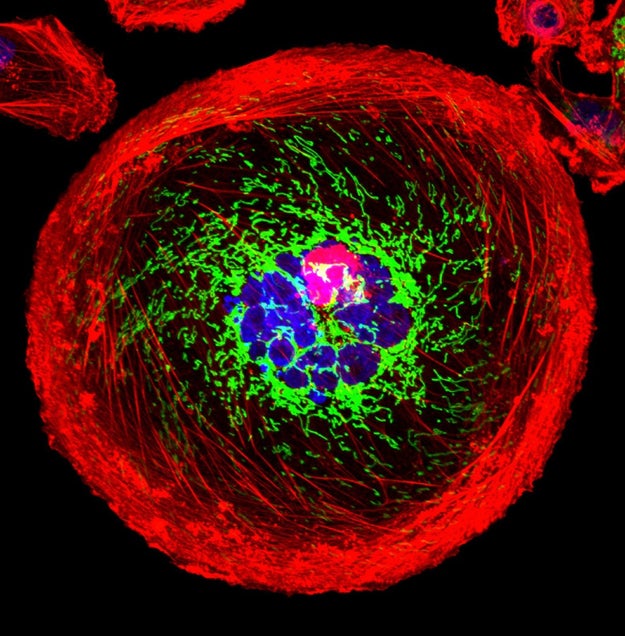
A breast cancer cell

Via visualsonline.cancer.gov

At a conference in San Francisco in February, Otte shared some striking numbers with an audience of scientists. Freenome had an accuracy rate of more than 95% in detecting the presence or absence of prostate cancer in 351 samples, according to an abstract of the presentation that Otte subsequently confirmed was real.

Supposing that Freenome’s test is as sensitive and specific as the rate claimed, “that would be a surprising result,” Diehn, of Stanford, said.

Alizadeh said there doesn’t seem to be enough information about the studies to know what to make of the technology’s apparently high performance. “For any test, especially a clinical one,” he said by email, “interpreting accuracy requires knowing the error rate.”

In Diehn’s view, too, there isn’t enough information to evaluate Freenome’s claims. “When you have a surprising result, the onus is on the scientists to provide evidence — strong evidence, supportive evidence — for such a claim.”

During his presentation, Otte also said Freenome had a 97% average accuracy rate in detecting breast, prostate, lung, and colorectal cancers across four stages of progression, including stage one. The sample size wasn’t disclosed.

“If they’re trying to say they can tell what stage a patient has, based on a blood test, I would find that would be very surprising,” Diehn said.

A stage is defined by how far a tumor has spread from where it started, which usually requires imaging and pathological tests, according to Diehn. Sometimes, he said, the only difference between a stage-one and stage-two tumor is being slightly bigger, or spreading to a single lymph node.

According to Jones, who attended the presentation, Otte said that Freenome could tell when a case of prostate cancer was aggressive or low-risk. There are “early indications” that the technology can do this, Otte told BuzzFeed News, but it is still in development.

Otte acknowledged that all of these results need to be validated in larger clinical trials. “We’re focused on making sure that we get the numbers we need to prove to the world that our tests are safe and function well.”

“What they’re saying could be they’ve developed a great test, or they don’t really have the data, and they’re trying to make it sound like they have.”

Otte’s talk left Jones impressed, he said, but wondering, “How do we know it’s real?” He understands why Freenome wouldn’t want to reveal its technology’s nitty-gritty to competitors before the test is on the market. But that choice, he said, “makes it difficult in academic science to know how valid it is.”

Diehn put it more bluntly: “What they’re saying could be they’ve developed a great test, or they don’t really have the data, and they’re trying to make it sound like they have.”

Freenome’s test picks up not only tumor DNA fragments, Otte said, but DNA changes that signal “how the immune system is responding to the presence or absence of the tumor.” Freenome’s machine-learning platform deduced that a stronger-than-expected link between these unspecified immunological signatures and cancer, Otte said.

It makes sense that the immune system would respond to an abnormal growth early on, Jones says. But “the immune system obviously responds to things other than cancer all the time,” he added. “What if a patient is on antibiotics, what if they have an active viral or bacterial infection? Does that cloud the ability to detect the cancer pattern?”

Unlike Guardant and Grail, Freenome does not have a clinical or scientific advisory board. The company is in the process of building them, Otte wrote last month.

Vijay Pande, a general partner at Andreessen Horowitz and a Freenome board member, said the company is rightfully broadening its analysis beyond just tumor DNA. “There’s a whole landscape, in principle, of what’s going on in your body available in blood,” he told BuzzFeed News.

There aren’t existing papers that describe the basis of Freenome’s approach, Pande acknowledged — but that’s because its computational methods are so advanced, they’re effectively creating new knowledge. “This is new territory,” said the former Stanford computational biologist. “This could not be done 20 years ago.”

Whether it can be done today remains to be seen.

Have a tip about the biotech world? Email reporter Stephanie Lee.

LINK: This Biotech CEO Doesn’t Have A PhD, But He Did Leave School Under A Cloud

Quelle: <a href="Can A Simple Blood Test Really Spot Cancer Early? Don’t Bet On It Yet, Scientists Say.“>BuzzFeed
Amazon Just Gave You A Way To Monitor What Your Kids Are Doing Online

Amazon just gave you a way to track what your kids are doing online.

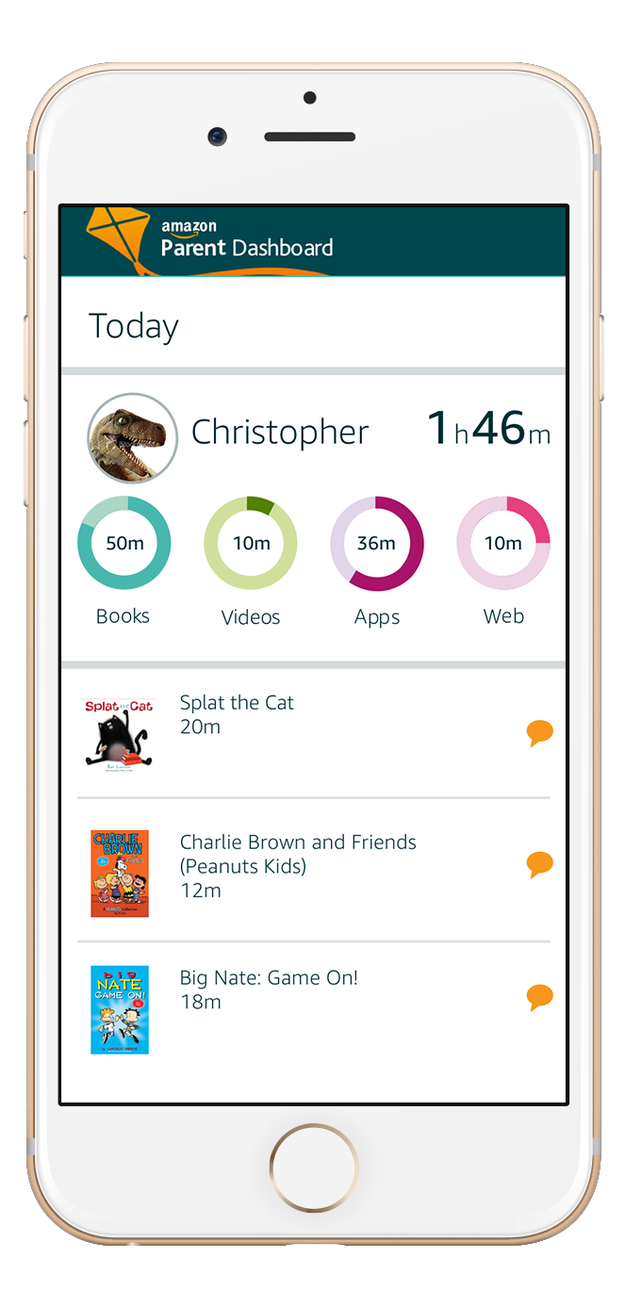
If your kids use Amazon&;s Kindle app Freetime to tablet to read, play games, or access the web, you can use a new tool called the Amazon Parent Dashboard to track — and control — what they&039;re doing.

Giphy

Fights over screen time can be a nuisance to both parents and kids, as a wealth of parenting blogs can attest to. But it&039;s not just kids who might be holding onto their devices too long: The American Academy of Pediatrics writes that “Heavy parent use of mobile devices… may be associated with more parent-child conflict.” So watch yourself, parents.

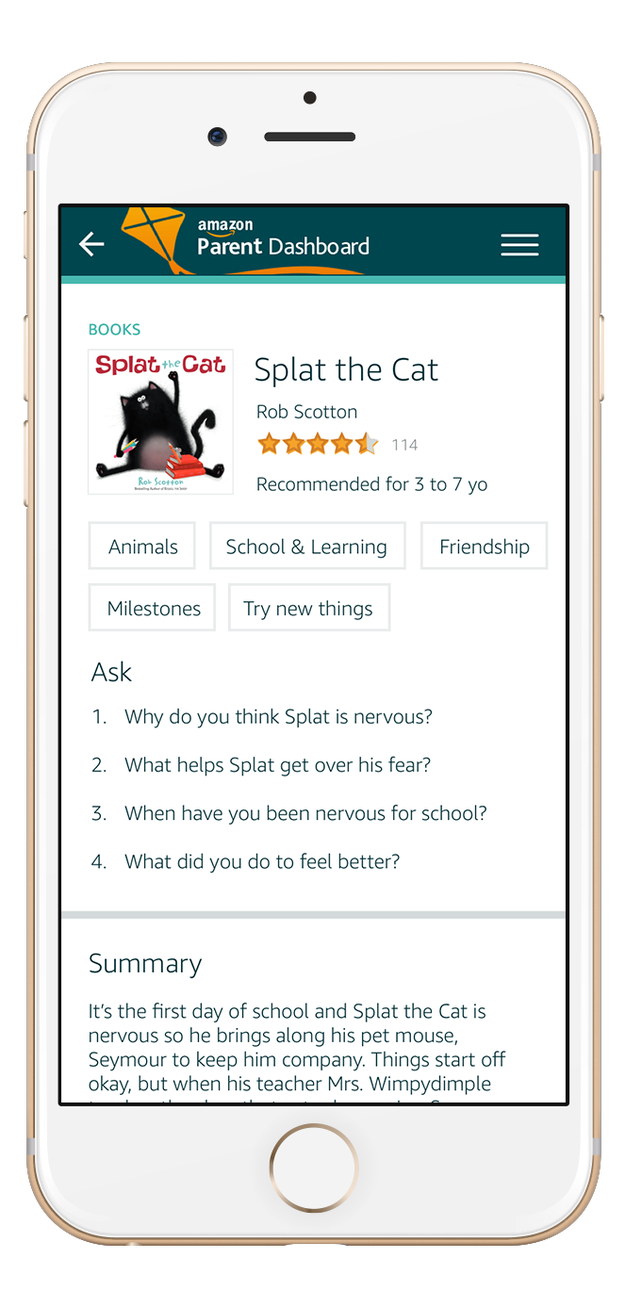
The Parent Dashboard, which parents can access through their own Amazon accounts, displays how much time a child has spent using their tablet and breaks it down into four categories: books, videos, apps, and the web. You can click on each category in the dashboard to see what your kids have been reading or playing. Parents have to go into the FreeTime app on the kids&039; Kindles to make changes to time restrictions and settings.

FreeTime already allows parents to limit how much time their kids spend on any one type of media and in the app overall, so Amazon said a tracking dashboard was the next logical step.

To make sure content available on kids&039; Kindles is appropriate, Amazon content editors whitelist sites and YouTube videos as safe for kids. The tablets are aimed at kids between the ages of three and 12 and have 10 million users worldwide, according to Amazon, though it won&039;t say how many users have bought a subscription for access to premium content. Kids also can&039;t make in-app purchases in FreeTime. (The FTC recently fined the company over unauthorized in-app game purchases made by users&039; children as they played on Amazon devices.)

Within the Parent Dashboard, Amazon launched another new feature: Spark Notes for kids&039; books.

Not literally. But almost. They&039;re called “Discussion Cards,” and Amazon content editors have written summaries and discussion questions for books, educational apps, games, and videos you can access on your kids&039; Kindle.

But they&039;re basically cheat sheets for whatever your kids are watching, reading, and playing, and give you prompts for talking with your kids about what they&039;re doing on their tablets. They might work especially well for parents with multiple kids who don&039;t want to read yet another Curious George book.

Amazon said it&039;s releasing thousands of Discussion Cards for its most popular titles within the app, but it wouldn&039;t specify exactly how many.

Kurt Beidler, Director of Kids Family at Amazon, said in a statement that the feature is intended for parents to “avoid the dreaded one-word response.” He went on: “Ideally, parents will have read the book, but they may not have had time to go through it and develop in-depth questions like we have, or they may have read the book a long time ago.”

Quelle: <a href="Amazon Just Gave You A Way To Monitor What Your Kids Are Doing Online“>BuzzFeed

Reps For Google, Facebook, And Netflix Back Net Neutrality As A New Battle Looms

Mike Blake / Reuters

Industry representatives for many of the biggest companies in tech met Tuesday with Ajit Pai, the head of the Federal Communications Commission, to express vigorous support for net neutrality rules — the Obama-era regulations that require internet providers to treat all web traffic equally. But just last week, Pai huddled with telecom trade groups to discuss his plan to undo net neutrality, which may be announced as soon as this month.

Top officials from the Internet Association, a trade organization that represents Google, Facebook, Amazon, and Netflix, among others, urged Chair Pai to keep and enforce existing open internet rules. “The internet industry is uniform in its belief that net neutrality preserves the consumer experience, competition, and innovation online,” the group&;s officials said, according to a summary of the meeting filed with the FCC.

The Internet Association also told the FCC Chair that, according to their own preliminary economic research, net neutrality rules did not negatively impact broadband investment, which contradicts claims from the telecom industry that the regulations would stymie innovation.

The FCC did not immediately respond to a request for comment.

While Internet Association President and CEO Michael Beckerman and General Counsel Abigail Slater voiced their support for current net neutrality regulations — with the FCC as the enforcer of them — they said their main priority is upholding meaningful open internet rules.

“Consumers want and need their internet experience preserved and protected, regardless of the legal or regulatory mechanism,” the officials said. “While [the Internet Association] continues its work to protect consumers by maintaining existing FCC rules, its primary focus is on the end result — meaningful net neutrality rules that withstand the test of time.”

The statement appears to leave open the possibility that Silicon Valley may support some alternative version of the net neutrality rules, as long as they adhere to key tenets of the old ones.

Among a list of “first principles,” which seem to signal what aspects of net neutrality Silicon Valley is most determined to defend, the Internet Association stated that net neutrality rules must prohibit internet fast lanes or “prioritized access”; that unreasonable interconnection tolls on over-the-top streaming services should not be used; and that the rules should apply to both mobile and fixed, in-home connections.

The power dynamics in Washington have changed since the open internet rules were passed in 2015. Under a new, Republican-dominated government, some in the tech industry fear that Chair Pai&039;s still-unofficial proposal to dismantle net neutrality will compel Silicon Valley and their allies in Congress to accept a watered-down version of the rules. “Maybe this is a way for the FCC to push the tech community towards coming to a legislative compromise,” said Evan Engstrom, the executive director of Engine, a policy and advocacy group for startups.

But Engstrom told BuzzFeed news that if a proposal to undercut net neutrality does materialize, Americans should expect massive pushback from the tech world and the broader internet community, who stand to lose platforms for free expression, and economic access to customers.

Netflix declined to comment for this story; Google, Facebook, and Amazon did not respond to requests for comment.

Quelle: <a href="Reps For Google, Facebook, And Netflix Back Net Neutrality As A New Battle Looms“>BuzzFeed

Uber’s Top PR Exec Leaves Company Amid Crises

Rachel Whetstone

Google

Uber’s PR head Rachel Whetstone is leaving the ride-hail company amid a series of crises. Her exit is just the latest in a string of executive departures as Uber grapples with fallout from systemic sexism allegations and a lawsuit over whether it stole key self-driving car technology from a competitor.

Recode first reported Whetstone’s departure. Jill Hazelbaker, Whetstone’s deputy, will be elevated to her role as Uber’s senior vice president for policy and communications.

“I am incredibly proud of the team that we’ve built – and that just as when I left Google, a strong and brilliant woman will be taking my place,” Whetstone said in a statement provided by an Uber spokesman. “I joined Uber because I love the product – and that love is as strong today as it was when I booked my very first ride six years ago.”

Whetstone, who came from Google in 2015, brought many Googlers with her when she joined Uber’s PR shop. Uber has had a particularly tough year that’s been marked by protests outside the company’s headquarters over CEO Travis Kalanick’s decision to sit on one of President Trumps economic advisory councils (he later stepped down), a viral blog in which a former female engineer alleged sexism and sexual harassment at the company, and a video that surfaced of Kalanick yelling at a driver. (Kalanick later promised to seek “leadership help.”) Last month, the company held a conference call with reporters to discuss its strategy to move forward and claimed its business is performing well despite its PR blunders.

Just this year, Uber has lost Brian McClendon (vice president of maps), Ed Baker (vice president of product and growth), Amit Singhal (senior vice president of engineering, who left related to revelations he did not disclose a sexual harassment allegation from his tenure at his ex-employer, Google), Gary Marcus (the new head of its artificial intelligence lab), and Raffi Krikorian (a director and former leader of its self-driving car program).

Quelle: <a href="Uber’s Top PR Exec Leaves Company Amid Crises“>BuzzFeed

Twitter Is Testing A Bot That Listens To Your Suggestions And Complaints

Twitter has been promoting its potential as a customer service platform for brands for some time now. And today, it&;s stepping up its efforts for its own users — with a bot.

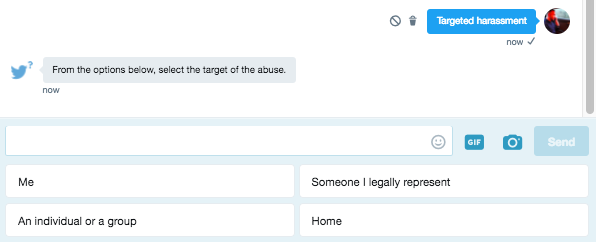
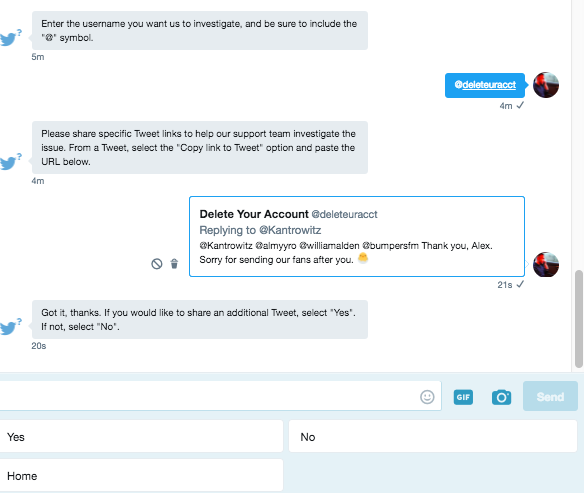
The company&039;s @support account will now handle basic user inquires via a direct message bot, one that seems like it&039;ll be used most often to tackle the abuse and harassment issues which have plagued the company through its existence.

The bot, released this afternoon, is still experimental. Twitter plans to see how people engage with it and will tweak it accordingly, according to a spokesperson. In many scenarios BuzzFeed News tested, the bot was unable to do more than simply directing us to its website to fill out forms. Still, it could be a helpful new channel for those looking for a simple way to report problematic behavior on the platform. Abuse can also be reported on tweets and accounts themselves, or via a form.

“We’re testing a new @Support DM tool to make it easier for people to get help with certain support issues, directly on Twitter. This is a very early test and will be limited in scope for the time being,” the Twitter spokesperson told BuzzFeed News.

The bot currently focuses on five categories: Accounts, Abuse, Impersonalization, General, and . Of those, the abuse category is the most built-out. Here&039;s what it looks like:

(BuzzFeed News did not actually send this report)

The bot is not well-equipped to deal with other common user requests, such as an edit tweet button. So keep dreaming on that front.

Quelle: <a href="Twitter Is Testing A Bot That Listens To Your Suggestions And Complaints“>BuzzFeed

What Happens When Your Neighbor Is A Venture Capitalist

Via sfphoenix.wixsite.com

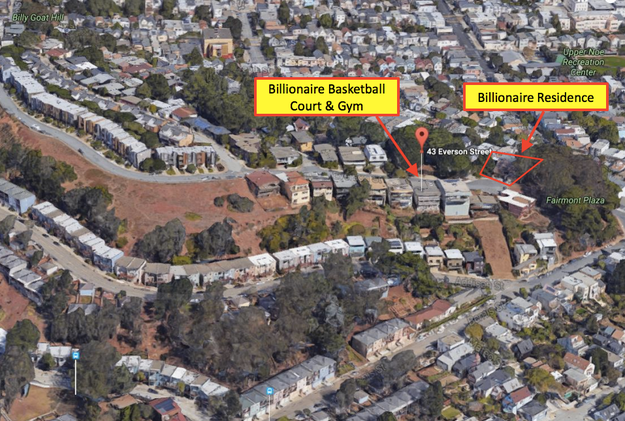
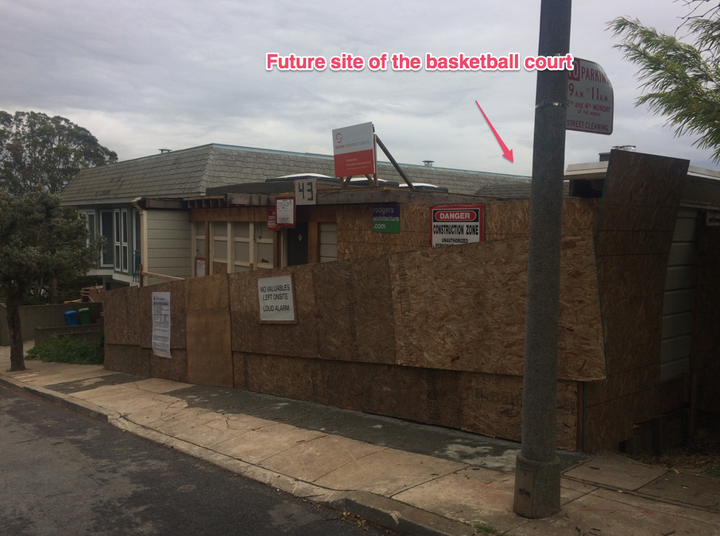
Waging a public battle against your rich neighbor with obscene tech money is practically a Bay Area tradition. In David Cowfer’s case, his angry website about an invasive species of Silicon Valley billionaire practically wrote itself. Cowfer is fighting plans to turn a six-bedroom family home in a sleepy cul-de-sac on a picturesque Glen Park hilltop into the ultimate bachelor gymnasium, including a basketball court, lockers, sauna, wet bar, lounge, and a cantilevered swimming pool. Plans also include a two-story garage door with glass panels will roll open to show a spectacular view of San Francisco — and could cause a spectacular nuisance for Cowfer, who lives next door.

The house, which sold for $2.35 million in 2015, was purchased under an anonymous LLC. So it took Cowfer nine months to figure out that the baller behind the renovation was prominent venture capitalist Keith Rabois, a Silicon Valley veteran with a contrarian Twitter account and a Stanford pedigree, who, like his buddy Peter Thiel, is also part of the so-called PayPal mafia.

This is when an ordinary NIMBY narrative — of the haves vs. the have-mores — veered in caricature. San Francisco’s Planning Department found nothing objectionable about Rabois’ construction plans, but Cowfer filed for a discretionary review to bring the issue before the city’s seven member Planning Commission. At a hearing on Thursday, neighbors told the the commission that Rabois is building a personal recreation center, not a home, because Rabois already lives in another home in the same small cul-de-sac, purchased for $3.5 million in 2011. What’s more, his co-worker at Khosla Ventures, venture capitalist Benjamin Ling, owns a $1.8 million house, purchased in 2013, next door to Rabois’ primary residence.

“It&;s like a Zuckerberg-style neighborhood takeover&;” Ryan Patterson, Cowfer’s lawyer, told BuzzFeed News after the hearing, in reference to the CEO of Facebook secretly buying up the four houses surrounding his Palo Alto mansion in 2013. “It’s a cul-de-sac with a lot of homes built in the ‘60s. Now we have two billionaires who own three homes within 150 feet of each other,” said resident Mark Brennan, who grew up across the street in the same house where his parents still live.

Rabois, however, didn’t see the big deal. “What does that have to do with anything?” he asked BuzzFeed News in response to questions about how two investors from the same firm happened to live on the quiet same block. “He bought a house, people are allowed to buy houses. People think it’s some kind of conspiracy, but I found a cool neighborhood,” and my friend followed, said Rabois.

Cowfer’s website, No Court @ Everson, refers to both investors as billionaires, a claim that was picked up in coverage of the dispute in Curbed, SFist, and a local CBS station. There is one small glitch in the all-powerful techie narrative: Ling is not a billionaire. When BuzzFeed News asked Rabois to verify the billionaire claim for himself, Rabois wrote back, “Lol.”

The view from the property being renovated

Via zillow.com

For Cowfer, however, signs of a hostile takeover kept adding up. A few months ago, a real estate agent cold-called him on behalf of Ling about buying his home, which Cowfer interpreted as an attempt “to remove me from the equation,” he said. Ling characterized it differently in an email to BuzzFeed. “I had heard that the property might be coming on the market shortly, and had made a single inquiry in hopes of getting an early look, but nothing ever came of it.”

Rabois insists that he’s made every effort to follow the rules. “[San Francisco is] one of the most heavily regulated real estate markets in history. This is so in the middle of what’s acceptable to complain about,” he said.

But at the hearing on Thursday in City Hall, neighbors argued that the renovation is out of character for Glen Park. Cowfer told the commission that lights and noise could drive down the value of homes by as much as 25 percent. “In a neighborhood where the homes are priced anywhere between $2 million and $4 million, this is not insignificant,” he said.

“I have no problem with him spending his money; he should be spending that in Pacific Heights,” said Joe O&039;Donoghue, the former head of the Residential Builders Association and final resident to argue against Rabois at the hearing. O&039;Donoghue, who speaks in a heavy Irish brogue, was the most animated speaker that afternoon, throwing his hand out with disgust when he mentioned Rabois’ plan to build “a garage door going nowhere.”

The Bay Area has a rich and varied history of absurd real estate spats between tech moguls and their neighbors. In 2011, Oracle CEO Larry Ellison got ticked off because his neighbor’s redwood trees blocked the view from his house on Billionaire’s Row in Pacific Heights. (The Wall Street Journal tried to inquire about the debacle, but “Mr. Ellison would only speak through his tree attorney,” the paper reported.) Typically these kind of clashes happen in tonier neighborhoods. Perhaps the basketball tussle in Glen Park, once a streetcar suburb for working and middle class residents, is just a sign that these disputes are moving down market.

Like real estate fights everywhere, each side is painting the other as unreasonable. Rabois had a company board meeting and couldn’t attend the hearing, but he told BuzzFeed News, “[Cowfer is] wasting taxpayer money, driving the staff actually crazy.”

Residents, however, insist that Rabois is downplaying the scope of initial plans of the basketball court. “The way Rabois’ team is talking now, it almost sounds like they’ve got a nerf hoop down there [and are] just goofing around,” said Brennan, who also pointed out that Rabois pushed through related permits before this dispute was settled.

The Planning commissioners concluded that there was enough common ground around Cowfer’s request — to shift the basketball court into the hill, so that it doesn’t jut out as far — that they told the two parties to take a few weeks and see if they could sort it out.

“This is a fairly quiet neighborhood. I don’t think people want a bunch of valet partners coming up here all the time and having all these wild parties, said Brennan “It’s not the Red Army coming out of the mountains to try to take this guy’s property away from him.”

Nitasha Tiku / BuzzFeed News

Quelle: <a href="What Happens When Your Neighbor Is A Venture Capitalist“>BuzzFeed

Delta Suffered "Failure Of Crew Tracking Systems" During Canceled Flight Fiasco

Instagram: @jolieice7

As masses of Delta fliers were left stranded at airports across the country last week, a separate drama was unfolding behind the scenes.

With thousands of flights delayed and cancelled during the five-day crisis, crew members said the airline&;s computer system lost track of them amidst the chaos. That failure poured gas on the fire, delaying more flights as the airline scrambled to get crew and pilots to the airports where they were needed. It helped turn a storm in Delta&039;s Atlanta hub on Wednesday into a multi-day fiasco that played out across the country.

The disruption was worse than the one Delta experienced last August when it suffered from a power outage that knocked out systems and grounded hundreds of flights.

This time around, “pilots and flight attendants proactively attempted multiple contacts with Crew Scheduling, went days without receiving Crew Scheduling or Tracking contact, were placed on hold (in some cases for over six hours), and were camped out in crew lounges and airports resembling refugee camps,” the chairman of Delta&039;s pilot union said in a letter to pilots on Tuesday.

The problem was acknowledged by Delta CEO Ed Bastian in an internal memo to sent to employees on Monday.

“Our recovery was hampered by a lack of available seats to accommodate customers as well as a failure of crew tracking systems to adequately position our people to do their jobs,” he wrote in the memo, which was reviewed by BuzzFeed News.

instagram.com

By Monday morning, Delta said its operations were mostly recovered, and it expected to operate more than 99% of its scheduled flights.

But at the height of the crisis, staff said the company&039;s systems were struggling to cope with a massive disruption. “The problem compounds over and over again, as more crews become stranded, a Delta employee told BuzzFeed News on Friday. “Right now, as we speak, there are hundreds of flights in our internal system that will not leave because we just don&039;t have the staff to cover them.”

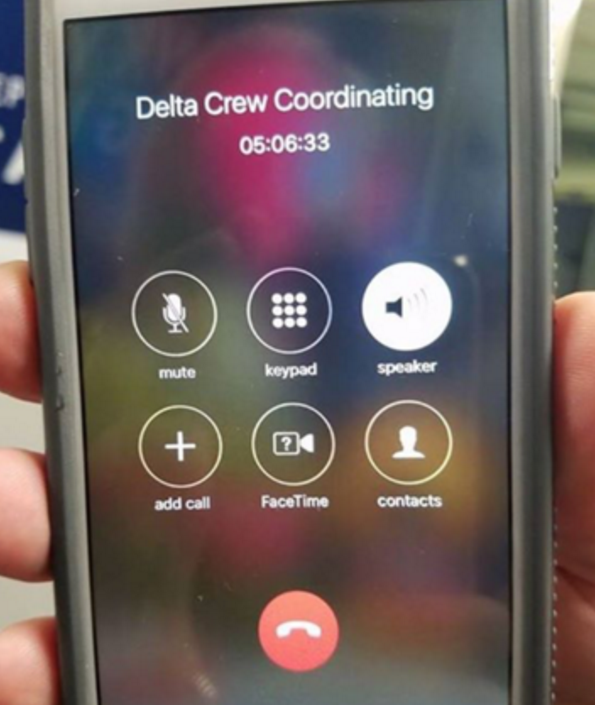
According to private social media posts seen by BuzzFeed News, some crew members said they were unable to sign into Delta&039;s scheduling system, or faced hours-long waits (and sometimes disconnections) trying to get through to scheduling by phone.

BuzzFeed News source

“Many couldn&039;t log in,” another Delta employee said. “Phone lines are useless. There is definitely an issue regarding wait times.”

Other crew members said they were not accurately tracked by Delta, which scheduled them for a flight in one airport when they were in fact in another city. Some said they were not receiving updates about their flights.

“I feel like we are lost in the system,” an employee wrote.

Many flight attendants were stranded in airport lounges far from their home cities, said one staffer who asked not to be named. Like Delta&039;s passengers, some were unable to stay in hotels and slept in the airport.

“The average wait time for crews to even get ahold of scheduling was five hours. As of [Friday], our phone line to contact scheduling and crew tracking no longer work. Crews literally have no where to turn,” said an employee.

The pilots union letter said the main problem was about connecting crew to planes, and called on the company to improve its systems. “Answers will include corporate information technology (IT) investments in crew tracking and operational control, and likely enhanced staffing in those areas. We encourage the Company to expand the technology investments they have already accelerated since the recent IT &039;disruption&039;,” the letter said.

Delta did not immediately respond to a request for more details. Bastian said in his memo that Delta continues to make investments in replacing and upgrading technology, including “significant enhancements to our crew tracking system,” and has a new data center scheduled to go on line this summer.

Last August, Delta suffered a similar widespread debacle when a power outage in Atlanta disrupted hundreds of flights.

“Since the technology outage in August, it has been my top priority to make sure Delta people don’t have to endure this type of situation again,” Bastian said. “We have made progress but clearly must redouble our efforts.”

Quelle: <a href="Delta Suffered "Failure Of Crew Tracking Systems" During Canceled Flight Fiasco“>BuzzFeed

Here's How Accurate The Fitbit Alta HR Actually Is

We pitted Fitbit&;s new ultra-slim wristband against a chest strap to see just how accurately it could measure beats per minute.

There are a lot of reasons why you’d want to get a fitness tracker. Maybe you’re trying to gather insights about your sleep, or get fitter, or lose weight. Whatever your goal, one thing is true: a fitness tracker is useless if it can’t accurately measure whatever it is you’re trying to track.

Fitbit recently debuted the Alta HR, an ultra-slim wristband with a new feature: heart rate tracking. But just how accurately can the wearable track your beats per minute? When we did a first impressions review of the Alta HR last month, our preliminary tests suggested that the tracker’s heart rate technology wasn’t always on point. So we spent the last two weeks working up a sweat while wearing the new band — and as we originally suspected, the Alta HR struggled to keep up with exercises with a lot of movement and high intensity bursts. It did, however, reliably measure resting heart rate.

Experts say most people don’t actually need to know their exact heart rate during workouts, so this may not matter to you. But accuracy does matter for some, namely people with heart conditions and endurance athletes. Fitbit also heavily markets the heart-rate tracking capability of its latest devices, like the Charge HR, Blaze, and Surge — and last year, it faced a class-action lawsuit over its allegedly inaccurate technology. (The company has called the allegations “baseless” and contested the lawsuit, as well as noting that the devices are “not intended to be scientific or medical devices.”)

With all that in mind, we set out to answer the question: Should you still consider the $150 Alta HR? Here’s what we found.

Nicole Nguyen / BuzzFeed News

Unfortunately, we didn’t have access to an electrocardiograph, a medical device that’s considered the gold standard for heart-rate measuring. Instead we used the next best thing — a chest strap monitor, which multiple studies have shown to be significantly more accurate than wrist-based heart rate monitors, as our control. And we enlisted Open Lab Fellow/chart master Lam Vo to help us sort through all of the data.

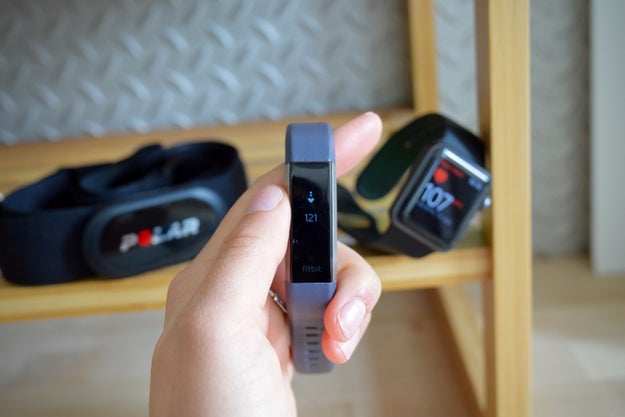
For each run and bike ride, we wore a Polar H7 chest strap, in addition to the Fitbit Alta HR and Apple Watch. Nicole wore the devices on different wrists, while Stephanie wore the devices on the same wrist.

Nicole’s Long-ish Run: A Close Look at the Data

Nicole's Long-ish Run: A Close Look at the Data

During my first-impressions workout, a quick 17-minute run with short, intense uphill sprints, the Alta HR had trouble measuring my heart rate. So, this time around, I went for a longer interval run, switching between a light jog and uphill sprints, for about 40 minutes. The terrain was a mix of trails and concrete on rolling hills.

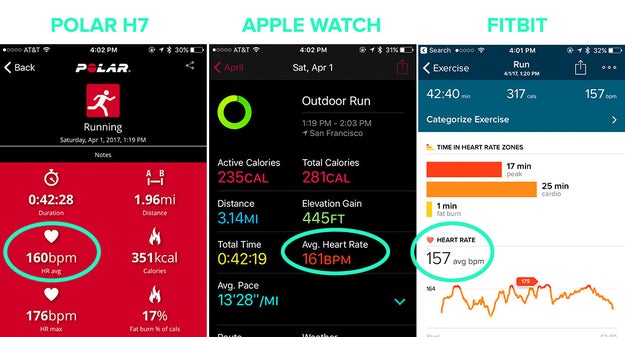
After the run, I checked each device’s workout summaries.The Polar Beat app measured a 160 beats per minute (bpm) average. Compared to that measurement, the Apple Watch overestimated the average by 1 beat (161 bpm), and the Fitbit Alta HR underestimated by 3 bpm, which is pretty impressive and consistent with Fitbit’s claim of average absolute error of less than 6 bpm versus an EKG (electrocardiograph) test strap.

I extracted the heart rate data from each device, and Lam created an interactive chart, so you can see exactly how the wearables performed throughout the duration of my run (try clicking the names of the device and hovering your mouse over the graph&;).

Nicole Nguyen / BuzzFeed News

Lam Vo / BuzzFeed News


View Entire List ›

Quelle: <a href="Here&039;s How Accurate The Fitbit Alta HR Actually Is“>BuzzFeed

Nobody Knows What Five Star Ratings Mean. That’s Bad For Gig Workers.

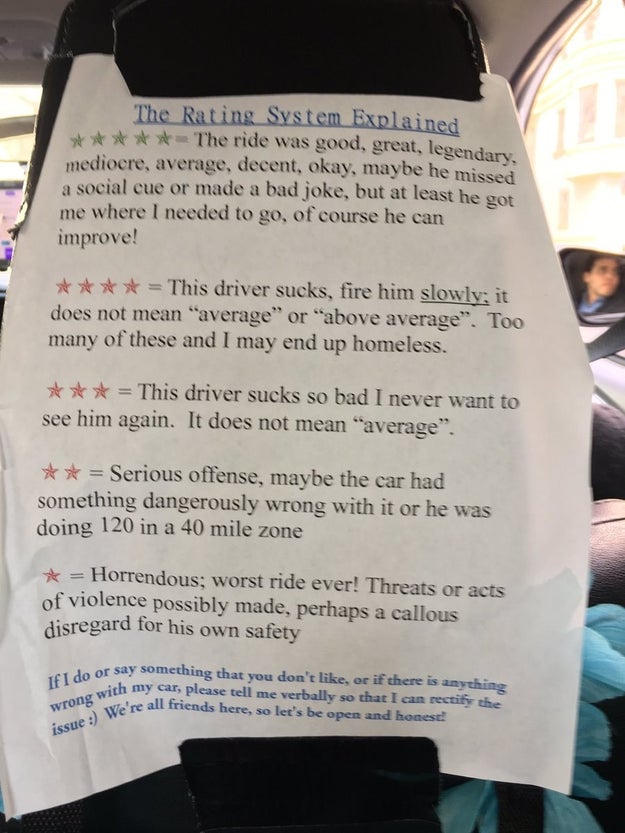
In a San Francisco Lyft car, there&;s a chart taped to the back of the front passenger seat: “The Rating System Explained.” It details — in exaggerated terms — what Lyft&039;s one- to five-star rating scale really means to drivers.

Beginning at five stars — “got me where I needed to go” — the explanations quickly descend into parodic paranoia. Four stars: “This driver sucks, fire him slowly … Too many of these and I may end up homeless.” Three stars: “This driver sucks so bad I never want to see him again.” Two stars: “maybe the car had something dangerously wrong with it or he was doing 120 in a 40 mile zone.”

Caroline O’Donovan / BuzzFeed News

One star? “Threats or acts of violence possibly made, perhaps a callous disregard for his own safety.”

Though tongue-in-cheek, this rating system explainer touches on an essential truth of the gig economy: When companies like Lyft, Uber, and Postmates penalize workers who have low ratings, anything less than five stars feels like a rebuke.

“The rating system works like this: You start off as a five-star driver,” Don, a San Francisco Lyft driver told BuzzFeed News. “If you drop below a 4.6, then your career becomes a question. Uber or Lyft will reach out to you and let you know that you are on review probation. And if you continue to drop, then you&039;re going to lose your job. They&039;ll deactivate you.”

The gig economy has made us comfortable rating the people we pay to do tasks for us. Both data and anecdotes suggest five-star rating systems are subjective, prone to bias, and generally confusing, yet labor marketplaces continue to ask customers to choose from one to five stars to determine who’s good at their job and who isn’t. Last week, Netflix officially replaced its five-star system for rating movies with a more simple thumbs-up, thumbs-down. Maybe it’s time for other data-driven platforms to consider making a change, too.

“They think that 3 is okay, and a 4 is like a B.”

Don’s concern about the impact of a low rating is well-established: Workers in the on-demand economy are at the mercy of the customers, whose in-app ratings can jeopardize an individual’s ability to earn bonuses, land gigs, and generally make a living.

Uber says only a very small percentage of drivers have ratings anywhere close to the deactivation threshold, which is a different number depending on where in the world you’re driving.

In a statement, a Lyft spokesperson said that in order to “ensure that drivers are not rated unfairly for circumstances that are out of their control, a number of steps are taken, including: ratings are based on an average of the last 100 rides; the system does not look at drivers in isolation, rather it looks at them in comparison to other drivers in their region; and drivers are able to submit comments after each ride to raise any concerns about the ride or passenger.”

But ratings are nonetheless a stressor for some drivers. Julian, who drives for both Uber and Lyft in San Francisco, said maintaining a good rating can be difficult because customers don’t really understand them. “They think that 3 is okay, and a 4 is like a B, and 5 is exceptional,” he told BuzzFeed News. “Well, if you got a 4 every time, you’d be terminated. You have to maintain a 4.7, so anything less than a 5 is not okay.”

Julian, a driver for Uber and Lyft

A few months ago, Julian was driving a female passenger to her hotel when he realized she had passed out in the back of his car. Julian called the police, who told him to roll her over onto her stomach — but he was worried about what might happen if she woke up while he was trying to help her. “The sad thing is, I was most concerned about my rating, because it was below a 4.7,” he said. (The woman woke up and ran into her hotel, Julian said; he doesn’t remember if she left a rating.)

This sort of rating anxiety extends well beyond Uber and Lyft. “The rating system is terrible,” said Ken Davis, a former Postmates courier, who noted that under the company&039;s five-star rating system couriers who fall below 4.7 for more than 30 days are suspended. Said Joshua, another Postmates courier, “I really don’t think customers understand the impact their ratings have on us.”

“I really don’t think customers understand the impact their ratings have on us.”

Instacart uses a five-star system, too; shoppers whose rating is in the top 25% of their region earn a $100 bonus. Shoppers say in most regions, just one rating that isn’t a perfect five stars usually disqualifies you for that week’s bonus. “It&039;s unbelievably annoying to wake up and see that a customer complained about something and you know it&039;s either not your fault or not true,” said Liz Temkin, who shops on Instacart in Los Angeles. (Temkin is a named plaintiff in the recently settled Instacart class-action lawsuit.)

Instacart had not provided a comment by the time this story was published. Postmates did not respond to multiple requests for comment.

The problem is, for an Instacart shopper to earn a bonus or a Postmates courier to keep their ratings up, they need the vast majority of their ratings to be five stars. Some savvy users (read: millennials) know this, and are sparing with their four- and three-star ratings. “Unless they&039;re super rude or weird, I tend to give everybody five,” said Kristen, a visitor to San Francisco who had just stepped out of a Lyft in Union Square. “That actually means something on the app. I don&039;t want to mess up their life, you know?”

But not all customers are so well informed. Wendy and her son Brian, visiting San Francisco from Indiana and using Uber for their first time, were surprised to hear that most drivers consider four stars to be a bad rating. “I would have thought 5 is excellent, and 4 is good,” Wendy said. That revelation was equally shocking to Elnaz, a longtime Uber user visiting San Francisco from LA. “Four-star sucks,” she said, incredulous. “Really?”

“Customers don&039;t understand the impact ratings have on couriers at all,” said a former Postmates community manager, who requested anonymity while discussing her previous employer. “A customer might rate a delivery three stars, assuming that three stars is fine. Several three-star ratings could bring a courier’s rating down significantly, especially if they’re new. It could even get the courier fired.”

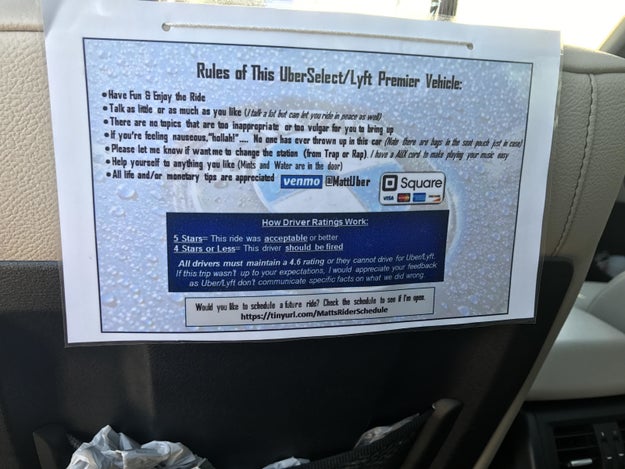
Matthew Smith is yet another Uber and Lyft driver who, frustrated with the five-star rating system, took it upon himself to draw up a custom explainer for the back seat of his car. Smith&039;s is succinct, and reads “5 stars = This ride was acceptable or better, 4 stars = this driver should be fired.”

Yet another homemade ratings explainer, this one by Matthew Smith, who wrote “4 stars or less = This driver should be fired.”

Matthew Smith

“I have consistently had riders blown away that giving me a 4 was such a bad thing… they really do feel that a 4 was a good ride,” Smith, who lives in Colorado, wrote via email. “Since having this sign up, I have had about 35 rated trips, all five stars.”

Uber and Lyft both say the vast majority of drivers do get five-star ratings. But while they argue this is evidence that most drivers are doing an excellent job, it might actually be further proof that the five-star rating system doesn’t work.

Some ride-hail passengers say they give drivers five stars because they’re worried about what might happen if they don’t. I always give five, unless they&039;re really rude or something,” said Golda, another Uber passenger. “I actually heard that even below a four or five, they can get in trouble. They&039;re just trying to earn some money, so it has to be pretty bad for me to give a bad rating.”

David Celis, a software engineer at Github who used to run a beer-rating website, says it’s not just empathy that causes people to give a lot of five-star ratings. It’s also because five-star ratings systems in and of themselves lead to choice paralysis. “The more options are presented within a rating system, the more mental effort it&039;s going to take to give a rating,” he said.

Back in 2009, YouTube found that “the overwhelming majority of videos on YouTube have a stellar five-star rating.” Shiva Rajaraman, then a product manager, started to wonder if there was something wrong with their feedback system, which was “primarily being used as a seal of approval, not as an editorial indicator of what the community thinks about a video.” Six months later, YouTube replaced its five-star ratings with a thumbs-up, thumbs-down system. If Uber and Lyft were to adopt a simple thumbs-up, thumbs-down rating system, Celis said, “on the consumer end, it would be a much better experience.”

The other problem is that not everyone can agree on what the star ratings mean — not even the companies themselves. Lyft says that five stars means “awesome,” four means “Ok, could be better,” and three means “below average.” But for Uber, five stars is “excellent,” four is “good,” and three is “OK.”

Individuals have different interpretations, too. “For some people, three could mean this is good, while four is great and five is perfect. Some people might say, nowhere is going to be perfect, so I’m going to say five stars is really good, and four is good,” Celis said. “The way you can interpret those stars is infinite, and most people don’t have the exact same system.”

Five years before Uber even existed, Yelp popularized the use of five-star rating system for reviewing restaurants and other businesses. “On Yelp, anything four stars or above is very good. Three to four stars is, it might be worth your time. Less than three stars, that’s where you start to see businesses actually fail,” said Darius Kazemi, a computer programmer and former elite Yelp user. But because of the artificial cutoff use by Uber and other apps, that system doesn’t map perfectly to the gig economy, which leads to confusion for consumers. “The Yelp cutoff for ‘You’re fired’ is three. That’s the point where you see businesses lose money. That’s a lot lower than Uber’s parallel cutoff.”

If people ascribe different meaning to the five-star ratings, and the ratings functionally mean different things depending on what app or website you’re using, it seems unlikely that the data these rating inputs produce are very meaningful. Some labor marketplaces, recognizing this, have started experimenting with ways to lessen the impact of five-point rating systems on their workers.

Rinse, an on-demand laundry service, used to text customers asking them to rate their delivery person from one to five, but the average score “basically hovered around 4.9 over the entire time period we tested it,” said co-founder Ajay Prakash. Prakash determined that the texts, which very few customers responded to anyway, weren’t producing data of much value, and scrapped them. Another example is Managed by Q, a startup that dispatches field operators to clean and manage office spaces, which stopped asking customers to rate workers partly because it created tension with clients. “Five-star review systems on their own are not good barometers of individual performance,” said Director of Product John Cockrell in an email.

“I was like, Holy shit&; The guy was nice, I wish I hadn’t done this.”

But in the world of online work, the five-star rating system remains pervasive. On sites like Fiverr and Freelancer.com, ratings left by clients affect freelancer search rankings. Feedback systems on sites like these tend to have more components than gig economy apps, but the impact is similar: the lower your rating, the lower your search rank — and the less likely you are to book a lucrative gig. Said Freelancer.com’s CEO Matt Barrie, “It&039;s kind of like Uber.”

Michael Truong is a senior product manager at Uber, where he’s working on improving the company’s rating system. We&039;re really trying to understand what riders’ feedback is for a ride,” he said.

Truong told BuzzFeed News that Uber once considered switching to a thumbs-up, thumbs-down system, but decided against it. “The emotional burden riders have, where they feel like their driver is going to get deactivated if they give a low rating, pushes people away from a thumbs-down,” he said. “So we would have no opportunity to relay that feedback to drivers.”

For the last few months, the Good Work Code has been compiling research on how to build a better rating system for labor platforms. “The managers of the company want information about how a job or gig was done, and the customer wants to offer feedback. But how do the workers actually get information that allows them to succeed and thrive in these working arrangements?” asked Palak Shah, director of the Good Work Code’s parent organization, Fair Care Labs. “It&039;s our sense … that there&039;s a lot of opportunity for growth and improvement.” The report — which recommends transparency, human interaction, processes for disputing ratings, and system that’s more dynamic than “on a scale of one to five” — is supposed to be published in the next few weeks.

John Gruber, publisher of Daring Fireball, is among those who believe that five-star rating systems don’t produce particularly useful data, and that generally speaking, binary systems are better. “There’s no universal agreement as to what the different stars mean,” Gruber told BuzzFeed News. “But everybody knows what thumbs-up, thumbs-down means.”

A few years ago, during a trip to Orlando, Gruber had an experience that made him realize how this confusion over what the stars mean can impact individuals in ways customers don’t realize. After taking a ride in an Uber that had an overpoweringly strong smell of air freshener, Gruber gave the driver a four-star rating. The next day, he got a call from an Uber employee asking him to explain what the driver had done wrong.

“I was like, Holy shit&033;” Gruber said. “The guy was nice, I wish I hadn’t done this.”

Quelle: <a href="Nobody Knows What Five Star Ratings Mean. That’s Bad For Gig Workers.“>BuzzFeed

The Crowdsourced Russia Twitter Investigation Has Prompted A Harassment Complaint

An American social media personality and journalist filed a criminal complaint Monday against the journalist and former British MP Louise Mensch, alleging a “months long campaign of cyber stalking and harassment.”

Cassandra Fairbanks, a conservative correspondent for the Russian government-owned news agency Sputnik, claims in the complaint submitted to the FBI&;s Internet Crime Complaint Center and shared with BuzzFeed News that Mensch “has initiated a witch hunt against me, engaging in serious libel and encouraging others to dig up personal information.”

Fairbanks&039; complaint appears to be first formal action against Mensch, who is the hub of a loose, crowd-source investigation into Russian influence in American politics and society, rooted in the theory that Russian involvement in Donald Trump&039;s electoral victory goes well beyond the extensive propaganda and hacking already documented by U.S. intelligence agencies. That set of Twitter investigators have at times pointed toward stories later documented by reporters, but have at other times questioned the motives — and even existence — of people apparently unconnected to any Russian conspiracy. The consequences of those attacks have, to date, been virtual, unlike the delusional right wing “pizzagate” narrative that prompted a gunman to visit a Washington pizza joint. But their focus on obscure individuals has come, those people say, at a real cost.

Last week, following a BuzzFeed News story about an anonymous pro-Trump bot master named MicroChip, Mensch and others publicly identified a California man as MicroChip. They based this claim on the man&039;s resemblance to MicroChip&039;s Twitter avatar picture (which is an image of a celebrity body builder); his name (an extremely common name that matches one of MicroChip&039;s various pseudonyms); and his interest in bitcoin. In tweets, the man called the claim “blind accusations with no fact checking” and said he had contacted Mensch, who did not respond.

The narrative curated by Mensch on her feed in hundreds of tweets a day features protagonists from Eric Garland, a self-described “futurist” known for a lengthy thread about game theory to the Republican strategist Rick Wilson, as well as villains led by Julian Assange and Vladimir Putin. It has fingered such disparate targets as Fairbanks, the left-leaning publication The Intercept, and the weird Twitter comedian Leon Chang as part of a shadowy plot by the Putin regime to influence American politics.

Chang wrote Monday that a joking post backfired when Mensch identified him as a Russian agent.

Mensch, who has more than 200,000 followers and frequently appears on cable news, has become perhaps the loudest voice on the internet among those trying to uncover details of a Russian scheme.

Fairbanks became a major target of Mensch&039;s starting with a February post, “The Carolina Conspiracy,” which accused the Maryland woman of involvement in a byzantine plot that involved inventing the persona of a teenager to entice Anthony Weiner into an inappropriate sexting relationship. The alleged goal was to give the FBI a pretext to seize his phone, laden with emails from Hillary Clinton, and ultimately to pave the way for FBI director James Comey to release his possibly election-altering letter shortly before the contest.

BuzzFeed News subsequently interviewed the teenager in person. She is real, not invented.

Since the publication of that post, Mensch has tweeted about Fairbanks hundreds of times, including, per the complaint, “outlandish claims…ranging from accusations of plastic surgery, to sex scandals, to allegations of treason.” Mensch and her followers frequently comb the social media accounts of suspected Russian agents, like Fairbanks, in an attempt to connect friends and associates to the greater plot. Today, Mensch encouraged her followers to identify a man who appeared in an image at a rally Fairbanks attended over the weekend, implying that he might be a Russian agent.

According to Fairbanks, the man works for the crowd-sourced investigations site WeSearchr and is named Tyler Bass. (Bass didn&039;t respond to an inquiry.)

Mensch initially responded to BuzzFeed News&039; request for comment over Twitter direct message by questioning the validity of the reporter&039;s past reporting and “asserting your source&039;s word as fact.”

Mensch then continued, “In the unlikely event that anybody whomsoever contacts me about her (alleged) false report, I will take a great deal of pleasure in discussing everything from her Guccifer2 contacts to her insane list of tweets with them, but I doubt I will ever hear another word on the matter.” Mensch added that filing a false police report is illegal.

Fairbanks told BuzzFeed News she had submitted dozens of Mensch&039;s tweets to Twitter but that the social network responded in each case that Mensch had not violated the site&039;s terms of service.

Fairbanks denies being involved in a plot against Anthony Weiner, and said to BuzzFeed News that although she works for the Russian government, the notion she is a Russian agent is “insane.”

“I feel like drawing attention to it is the wrong move,” Fairbanks said. “But I think I&039;m out of other options.

Quelle: <a href="The Crowdsourced Russia Twitter Investigation Has Prompted A Harassment Complaint“>BuzzFeed