6-GHz-Band: Vodafone erreicht 2,5 GBit/s im Mobilfunk
In einem Test hat Vodafone per Carrier-Aggregation auch das obere 6-GHz-Band eingesetzt. Die Branche kämpft mit den Router-Herstellern um den Frequenzbereich. (AVM, Vodafone)
Quelle: Golem

In einem Test hat Vodafone per Carrier-Aggregation auch das obere 6-GHz-Band eingesetzt. Die Branche kämpft mit den Router-Herstellern um den Frequenzbereich. (AVM, Vodafone)
Quelle: Golem

Ein Steckdosenturm mit acht AC-Steckdosen, vier USB-Ports und drei Meter langem Kabel ist bei Amazon zum günstigen Aktionspreis erhältlich. (Technik/Hardware)
Quelle: Golem

Bei Amazon gibt es den aktuellen Ladekabel-Bestseller zum Bestpreis. Nie gab es das 100-W-Kabel günstiger, doch das Angebot ist begrenzt. (USB PD, Amazon)
Quelle: Golem
How to Do Hardened Images (and Container Security) Right
Container security is understandably a hot topic these days, with more and more workloads running atop this mainstay of the cloud native landscape. While I might be biased because I work at Docker, it is safe to say that containers are the dominant form factor for running applications today. Equally important, the next generation of applications focused on AI are already running on containers. Because the world runs on containers, getting container security right is of paramount importance.
I am sad to say that most organizations who claim to be delivering container security are not. Particularly troubling are the growing ranks of hardened image providers who claim to be providing highly secure containers but are missing important components of what makes a container secure. Granted, we have a strong opinion on container security. We run the world’s largest repository and infrastructure for container hosting and management. And to be clear, our company’s future fate depends on the continued perception that containers are secure. So we have real skin in this game.
The Essential Elements of Container Security
All of this being said, as the lead security engineer at Docker, and someone with a very long history with containers, I want to lay down our vision for container security. That vision is actually uncomplicated. There are five essential ingredients of maximum container security and hardened images. Those ingredients are:
Minimal Attack Surface: A proper hardened image only includes absolutely necessary software in the container. This means stripping out the majority of libraries, agents, and modules that may deliver useful functionality but are put into software distributions by default and add both complexity and CVE exposure. Our hardening process on average eliminates over 98% of the CVE exposure of a container.
A 100% Complete Software Bills of Materials. This is the baseline and must be 100% complete (as per CISA guidance) with no minimum depth. provides accurate inventory including direct dependencies, transitive dependencies, and explicit relationships. SBOMs must be fully verifiable back to source, through open standards like SPDX or CycloneDX, standard component identifiers like PURLs, and honest gap disclosure.
Verifiable Build Provenance establishes chain of custody from source code to deployed artifact. SLSA Build Level 3 provenance provides non-falsifiable attestations about what was built, where, and by what process. If you don’t know how or where it was built and who built it, you can’t be sure it’s not tainted.
Standardized Exploitability Assessment clarifies which vulnerabilities affect specific deployment contexts. OpenVEX provides machine-readable statements about vulnerability status, enabling auditors and compliance tools to process assessments independently and properly leverage SBOMs. VEX statement transparency and interoperability make container security viable and allow teams to focus only on real risks.
Cryptographic Verification proves authenticity and integrity. Modern approaches like Sigstore and Cosign enable signing with public verification, allowing anyone to verify signatures without proprietary infrastructure. The signature and provenance chain must be transparent and easy to produce or query.
100% Transparency to Bind These Pillars Together. All of the above five elements must be transparent, not just in what they produce but in how they produce attestations, evidence, and any data or statements. This means using public sources for vulnerability intelligence (National Vulnerability Database or NVD, distribution security feeds, language ecosystem advisories, GitHub Security Advisories) with visible synchronization cadence. When CVEs listed in the KEV (Known Exploited Vulnerabilities) catalog appear, transparency ensures alignment without negotiation. This means making the CVE selection process and criteria public and allowing users to see the process. This means making the SBOM creation process transparent so users can understand how the manifests are built. Ultimately, radical transparency transforms security from a trust exercise into a verification process where you can prove your posture, auditors can validate your evidence, and customers can independently assess your claims.
Of course container security also extends into the container runtimes to execute containers with highest security standards as well as continuous observability and enforcement of organizational policies across the entire container lifecycle. I’ll cover Docker’s activities in this area in a later post.
Why You Need to Verify All Vendor Claims on “Hardened Images”
For enterprises looking to better secure containers, I want to be very, very clear. Any “hardened” container image that cannot meet these requirements is a lie. Unfortunately, a number of hardened image vendors cannot meet these requirements. Here are some of the problems we have seen with competitors’ hardened images that our users and customers have brought us for comparison:
SBOMs that don’t pass the sniff test: A Node server with no npm packages is an oxymoron. Yet, that’s what we saw. Did they rewrite Node.js to remove any need for npm? I don’t think so. This means they left key elements from their SBOMs.
SBOMs missing transitive dependencies: CISA guidance is clear. Every SBOM must contain 100% of all dependencies. Not including them may be convenient because it hand waves the problem of securing those dependencies. But it’s not right.
Proprietary and opaque CVE designation: A vendor doesn’t get to decide whether a CVE is relevant and what its severity level is. That’s what public, transparent CVE feeds are for. Any vendor that won’t reveal their exact methodology or process for CVE assessment and provide it, on demand, is hiding something.
Incomplete SLSA Build claims: SLSA Build Level 3 is a binary. You either are or you are not meeting the requirements. Calling a build “transitional” is the same as checking the “no” box.
Why We’re Flipping the Table (and Resetting Expectations) on Container Security
It’s not news to say that supply chain attacks on the open source ecosystem are out of control. The smartest Black Hat minds in the world at the most advanced APTs are laser-focused on compromising supply chains because these are among the best ways to compromise entire ecosystems. Supply chain attacks can expose a huge swath of organizations to critical breaches leading to data exfiltration, ransomware and extortion, and espionage. Because we sit at a central position in the container ecosystem, we are also exposed any time the container supply chain is compromised.
That’s why I’m writing this post. Docker has designed our hardened images explicitly to deliver on all five of the core pillars while also providing 100% transparency into process, inputs and outputs. I want to make it very easy for any platform, team, security team, CISO, or even CEO or business leader to be able to ask the right questions to determine whether their container security posture is valid, and whether the hardened images they are buying are actually delivering on their promise. (As a side note, container security is so important that we also think hardened images should be affordable to all. That’s why we’re now offering them at extremely reasonable prices, making them accessible even to two-person startups.)
Container security is not hard. Container security is not rocket science. Container security is about radical transparency, honesty, and doing right for your users. In a perfect world, everyone would be doing container security the right way, and every organization would have easy access to rock-solid containers that are properly hardened by default and completely transparent.
In this perfect world, Docker as a company is better off, the users are better off, the enterprises are better off, and the world is better off. Frankly, our competitors are also better off and their products are better. That’s a good thing. This is more than a sales pitch or an engineering rant. I guess you can call it a mission. Making the technology world safer is of fundamental importance and that’s the outcome we seek.
Quelle: https://blog.docker.com/feed/
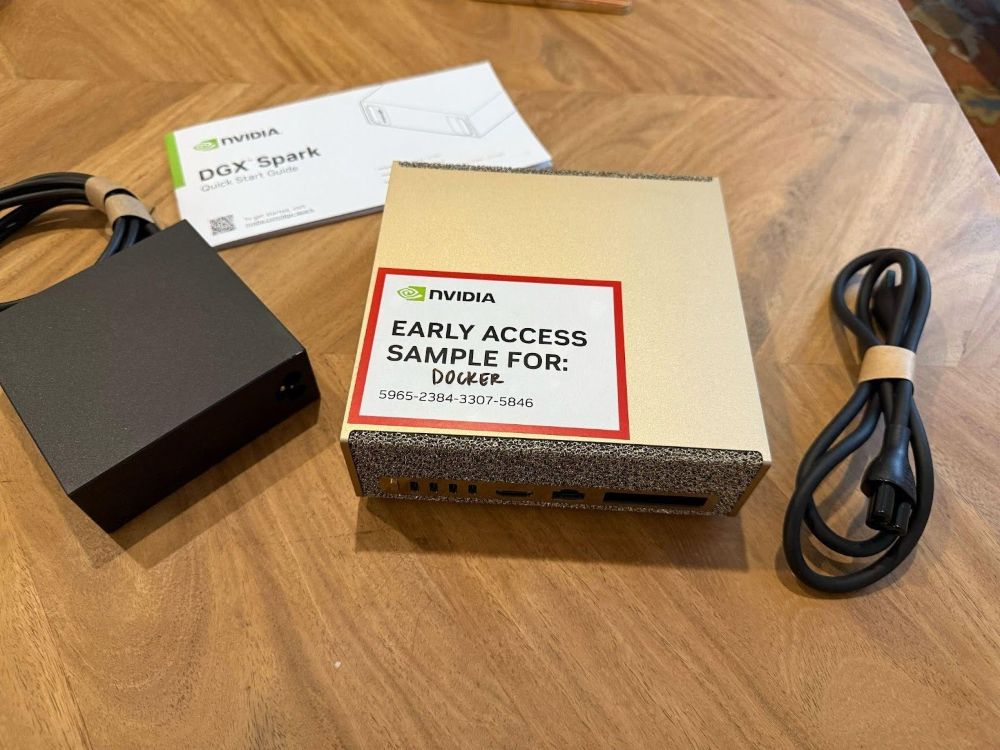
We’re thrilled to bring NVIDIA DGX™ Spark support to Docker Model Runner. The new NVIDIA DGX Spark delivers incredible performance, and Docker Model Runner makes it accessible. With Model Runner, you can easily run and iterate on larger models right on your local machine, using the same intuitive Docker experience you already trust.
In this post, we’ll show how DGX Spark and Docker Model Runner work together to make local model development faster and simpler, covering the unboxing experience, how to set up Model Runner, and how to use it in real-world developer workflows.
What is NVIDIA DGX Spark
NVIDIA DGX Spark is the newest member of the DGX family: a compact, workstation-class AI system, powered by the Grace Blackwell GB10 Superchip that delivers incredible performance for local model development. Designed for researchers and developers, it makes prototyping, fine-tuning, and serving large models fast and effortless, all without relying on the cloud.
Here at Docker, we were fortunate to get a preproduction version of DGX Spark. And yes, it’s every bit as impressive in person as it looks in NVIDIA’s launch materials.
Why Run Local AI Models and How Docker Model Runner and NVIDIA DGX Spark Make It Easy
Many of us at Docker and across the broader developer community are experimenting with local AI models. Running locally has clear advantages:
Data privacy and control: no external API calls; everything stays on your machine
Offline availability: work from anywhere, even when you’re disconnected
Ease of customization: experiment with prompts, adapters, or fine-tuned variants without relying on remote infrastructure
But there are also familiar tradeoffs:
Local GPUs and memory can be limiting for large models
Setting up CUDA, runtimes, and dependencies often eats time
Managing security and isolation for AI workloads can be complex
This is where DGX Spark and Docker Model Runner (DMR) shine. DMR provides an easy and secure way to run AI models in a sandboxed environment, fully integrated with Docker Desktop or Docker Engine. When combined with the DGX Spark’s NVIDIA AI software stack and large 128GB unified memory, you get the best of both worlds: plug-and-play GPU acceleration and Docker-level simplicity.
Unboxing NVIDIA DGX Spark
The device arrived well-packaged, sleek, and surprisingly small, resembling more a mini-workstation than a server.
Setup was refreshingly straightforward: plug in power, network, and peripherals, then boot into NVIDIA DGX OS, which includes NVIDIA drivers, CUDA, and AI software stack pre-installed.
Once on the network, enabling SSH access makes it easy to integrate the Spark into your existing workflow.
This way, the DGX Spark becomes an AI co-processor for your everyday development environment, augmenting, not replacing, your primary machine.
Getting Started with Docker Model Runner on NVIDIA DGX Spark
Installing Docker Model Runner on the DGX Spark is simple and can be done in a matter of minutes.
1. Verify Docker CE is Installed
DGX OS comes with Docker Engine (CE) preinstalled. Confirm you have it:
docker version
If it’s missing or outdated, install following the regular Ubuntu installation instructions.
2. Install the Docker Model CLI Plugin
The Model Runner CLI is distributed as a Debian package via Docker’s apt repository. Once the repository is configured (see linked instructions above) install via the following commands:
sudo apt-get update
sudo apt-get apt-get install docker-model-plugin
Or use Docker’s handy installation script:
curl -fsSL https://get.docker.com | sudo bash
You can confirm it’s installed with:
docker model version
3. Pull and Run a Model
Now that the plugin is installed, let’s pull a model from the Docker Hub AI Catalog. For example, the Qwen 3 Coder model:
docker model pull ai/qwen3-coder
The Model Runner container will automatically expose an OpenAI-compatible endpoint at:
http://localhost:12434/engines/v1
You can verify it’s live with a quick test:
# Test via API
curl http://localhost:12434/engines/v1/chat/completions -H 'Content-Type: application/json' -d
'{"model":"ai/qwen3-coder","messages":[{"role":"user","content":"Hello!"}]}'
# Or via CLI
docker model run ai/qwen3-coder
GPUs are allocated to the Model Runner container via nvidia-container-runtime and the Model Runner will take advantage of any available GPUs automatically. To see GPU usage:
nvidia-smi
4. Architecture Overview
Here’s what’s happening under the hood:
[ DGX Spark Hardware (GPU + Grace CPU) ]
│
(NVIDIA Container Runtime)
│
[ Docker Engine (CE) ]
│
[ Docker Model Runner Container ]
│
OpenAI-compatible API :12434
The NVIDIA Container Runtime bridges the NVIDIA GB10 Grace Blackwell Superchip drivers and Docker Engine, so containers can access CUDA directly. Docker Model Runner then runs inside its own container, managing the model lifecycle and providing the standard OpenAI API endpoint. (For more info on Model Runner architecture, see this blog).
From a developer’s perspective, interact with models similarly to any other Dockerized service — docker model pull, list, inspect, and run all work out of the box.
Using Local Models in Your Daily Workflows
If you’re using a laptop or desktop as your primary machine, the DGX Spark can act as your remote model host. With a few SSH tunnels, you can both access the Model Runner API and monitor GPU utilization via the DGX dashboard, all from your local workstation.
1. Forward the DMR Port (for Model Access)
To access the DGX Spark via SSH first set up an SSH server:
Using Local Models in Your Daily WorkflowsIf you’re using a laptop or desktop as your primary machine, the DGX Spark can act as your remote model host. With a few SSH tunnels, you can both access the Model Runner API and monitor GPU utilization via the DGX dashboard, all from your local workstation.
sudo apt install openssh-server
sudo systemctl enable –now ssh
Run the following command to access Model Runner via your local machine. Replace user with the username you configured when you first booted the DGX Spark and replace dgx-spark.local with the IP address of the DGX Spark on your local network or a hostname configured in /etc/hosts.
ssh -N -L localhost:12435:localhost:12434 user@dgx-spark.local
This forwards the Model Runner API from the DGX Spark to your local machine.Now, in your IDE, CLI tool, or app that expects an OpenAI-compatible API, just point it to:
http://localhost:12435/engines/v1/models
Set the model name (e.g. ai/qwen3-coder) and you’re ready to use local inference seamlessly.
2. Forward the DGX Dashboard Port (for Monitoring)
The DGX Spark exposes a lightweight browser dashboard showing real-time GPU, memory, and thermal stats, usually served locally at:
http://localhost:11000
You can forward it through the same SSH session or a separate one:
ssh -N -L localhost:11000:localhost:11000 user@dgx-spark.local
Then open http://localhost:11000 in your browser on your main workstation to monitor the DGX Spark performance while running your models.
This combination makes the DGX Spark feel like a remote, GPU-powered extension of your development environment. Your IDE or tools still live on your laptop, while model execution and resource-heavy workloads happen securely on the Spark.
Example application: Configuring Opencode with Qwen3-Coder
Let’s make this concrete.
Suppose you use OpenCode, an open-source, terminal-based AI coding agent.
Once your DGX Spark is running Docker Model Runner with ai/qwen3-coder pulled and the port is forwarded, you can configure OpenCode by adding the following to ~/.config/opencode/opencode.json
{
"$schema": "https://opencode.ai/config.json",
"provider": {
"dmr": {
"npm": "@ai-sdk/openai-compatible",
"name": "Docker Model Runner",
"options": {
"baseURL": "http://localhost:12435/engines/v1" // DMR’s OpenAI-compatible base
},
"models": {
"ai/qwen3-coder": { "name": "Qwen3 Coder" }
}
}
},
"model": "ai/qwen3-coder"
}
Now run opencode and select Qwen3 Coder with the /models command:
That’s it! Completions and chat requests will be routed through Docker Model Runner on your DGX Spark, meaning Qwen3-Coder now powers your agentic development experience locally.
You can verify that the model is running by opening http://localhost:11000 (the DGX dashboard) to watch GPU utilization in real time while coding.This setup lets you:
Keep your laptop light while leveraging the DGX Spark GPUs
Experiment with custom or fine-tuned models through DMR
Stay fully within your local environment for privacy and cost-control
Summary
Running Docker Model Runner on the NVIDIA DGX Spark makes it remarkably easy to turn powerful local hardware into a seamless extension of your everyday Docker workflow.You install one plugin and use familiar Docker commands (docker model pull, docker model run).You get full GPU acceleration through NVIDIA’s container runtime.You can forward both the model API and monitoring dashboard to your main workstation for effortless development and visibility.This setup bridges the gap between developer productivity and AI infrastructure, giving you the speed, privacy, and flexibility of local execution with the reliability and simplicity Docker provides.As local model workloads continue to grow, the DGX Spark + Docker Model Runner combo represents a practical, developer-friendly way to bring serious AI compute to your desk — no data center or cloud dependency required.Learn more:
Read the official announcement of DGX Spark launch on NVIDIA newsroom
Check out the Docker Model Runner General Availability announcement
Visit our Model Runner GitHub repo. Docker Model Runner is open-source, and we welcome collaboration and contributions from the community! Star, fork and contribute.
Quelle: https://blog.docker.com/feed/
AWS now provides immediate access to resource search capabilities in all accounts through AWS Resource Explorer. With this launch, you no longer need to activate Resource Explorer to discover your resources in a Region. To start searching, you need, at minimum, permissions in the AWS Resource Explorer Read Only Access or AWS Read Only Access managed policies. You can discover resources in the AWS Resource Explorer console, Unified Search, and AWS CLI and SDKs. To search the full inventory of supported resources, including historical backfill and automatic updates, complete Resource Explorer setup. This requires additional permissions to create a Service-Linked Role, so that Resource Explorer can automatically complete setup in each Region where you search. You can also enable cross-Region search to discover resources across all Regions in your AWS account with one-click in the Console, or with a single API call using the new CreateResourceExplorerSetup API. This feature is available at no additional cost in all AWS Regions where Resource Explorer is supported. To start searching for your resources, visit the AWS Resource Explorer console. Read about getting started in the AWS Resource Explorer documentation, or explore the AWS Resource Explorer product page.
Quelle: aws.amazon.com
Starting today, Amazon EC2 High Memory U7i instances with 12TB of memory (u7i-12tb.224xlarge) are now available in the Asia Pacific (Mumbai) region. U7i-12tb instances are part of AWS 7th generation and are powered by custom fourth generation Intel Xeon Scalable Processors (Sapphire Rapids). U7i-12tb instances offer 12TiB of DDR5 memory enabling customers to scale transaction processing throughput in a fast-growing data environment. U7i-12tb instances offer 896 vCPUs, support up to 100Gbps Elastic Block Storage (EBS) for faster data loading and backups, deliver up to 100Gbps of network bandwidth, and support ENA Express. U7i instances are ideal for customers using mission-critical in-memory databases like SAP HANA, Oracle, and SQL Server. To learn more about U7i instances, visit the High Memory instances page.
Quelle: aws.amazon.com
Amazon Relational Database Service (Amazon RDS) for SQL Server now supports the latest General Distribution Release (GDR) updates for Microsoft SQL Server. This release includes support for Microsoft SQL Server 2016 SP3+GDR KB5065226 (RDS version 13.00.6470.1.v1), SQL Server 2017 CU31+GDR KB5065225 (RDS version 14.00.3505.1.v1), SQL Server 2019 CU32+GDR KB5065222 (RDS version 15.00.4445.1.v1) and SQL Server 2022 CU21 KB5065865 (RDS version 16.00.4215.2.v1). The GDR updates address vulnerabilities described in CVE-2025-47997, CVE-2025-55227, CVE-2024-21907. For additional information on the improvements and fixes included in these updates, see Microsoft documentation for KB5065226, KB5065225, KB5065222 and KB5065865. We recommend that you upgrade your Amazon RDS for SQL Server instances to apply these updates using Amazon RDS Management Console, or by using the AWS SDK or CLI. You can learn more about upgrading your database instance in the Amazon RDS SQL Server User Guide for upgrading your RDS Microsoft SQL Server DB engine.
Quelle: aws.amazon.com

Das Streamingabo Apple TV+ existiert vom Namen her (bald) nicht mehr. Es heißt dann wie der Film-Store, die App und das Streaminggerät. (Apple TV, Apple)
Quelle: Golem

Die neuen Fritzboxen können auch per WAN-Port angeschlossen werden und mit Wi-Fi 7 funken – allerdings ohne 6-GHz-Band. (Fritzbox, Netzwerk)
Quelle: Golem






