Azure HBv4 and HX Series VMs for HPC now generally available

We are excited to announce Azure HBv4 and HX-series Virtual Machines (VMs) are now generally available. With the general availability, Microsoft is offering customers the first VMs featuring the latest 4th Gen AMD EPYC™ processors with AMD 3D V-Cache™ technology (codename ‘Genoa-X’), paired with 400 Gigabit NVIDIA Quantum-2 InfiniBand. Azure HBv4 and HX-series VMs offer leadership levels of performance, scaling efficiency, and cost-effectiveness for a variety of HPC workloads such as computational fluid dynamics (CFD), financial services calculations, finite element analysis (FEA), geoscience simulations, weather simulation, rendering, quantum chemistry, and silicon design.

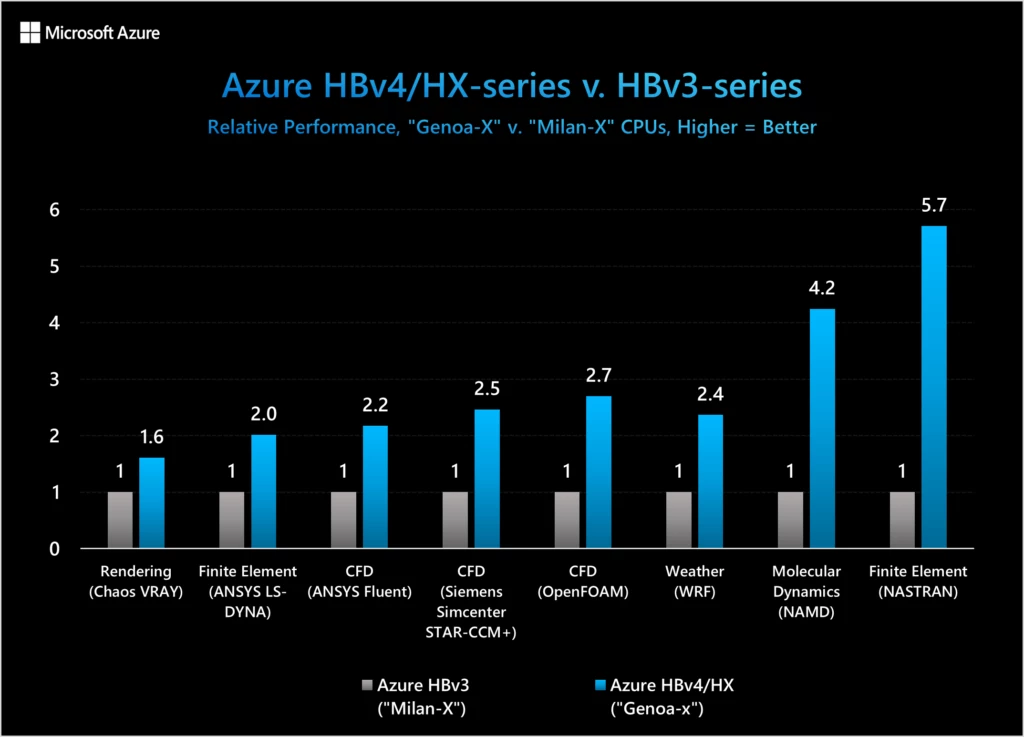
Compared to Azure HBv3-series VMs using 3rd Gen AMD EPYC™ processors (codename ‘Milan-X’), already the highest performance VMs for HPC workloads on the public cloud, customers will see up to:

1.6 times higher performance for rendering

2.4 times higher performance for weather simulation

2.7 times higher performance for CFD

4.2 times higher performance for molecular dynamics

5.7 times higher performance for structural analysis

Visit our technical blog for more detailed performance and scalability information and see below for a summary of performance across a diverse selection of widely used high performance computing (HPC) workloads.

Figure 1: Performance comparison summary of Azure HBv4/HX-series VMs to HBv3-series across diverse engineering and scientific computing workloads.

Azure HBv4 and HX-series VMs are available today in the Azure East United States region, and will soon come to the Azure Korea Central, South Central US, Sweden Central, and Southeast Asia regions.

Faster, more cost effective, and more power efficient technologies for HPC

Azure HBv4 and HX series VMs feature 4th Gen AMD EPYC™ processors with AMD 3D V-cache™ because they deliver the fastest levels of performance to a variety of memory performance-bound HPC workloads. The 2.3 GB L3 cache per VM can deliver up to 5.7 terabytes per second of bandwidth to amplify up to 780 gigabytes per second of bandwidth from main memory, for a market leading blended average of 1.2 terabytes per second of effective memory bandwidth across a broad range of customer workloads. For widely-used memory bandwidth-bound workloads like OpenFOAM, HBv4-series VMs with 4th Gen AMD EPYC CPUs with 3D V-Cache technology are already yielding up to 1.49 times higher performance than standard 4th Gen EPYC processors in Azure’s internal testing.

Figure 2: Performance comparison of HBv4/HX during Preview (no 3D V-Cache) versus General Availability (includes 3D V-Cache) from 1-8 VMs on CFD workload OpenFOAM.

Azure HBv4 and HX series VMs deliver these significant performance enhancements at lower cost and energy consumed per job directly proportional to the rate of workload speedup (such as 25 percent faster performance on a given HPC workload with AMD 3D V-Cache compared to standard 4th Gen AMD EPYC CPUs translates to the customer incurring 25 percent lower cost and power consumed per job).

Learn more about performance and scalability across a range of applications, models, and configurations, and visit Azure Docs for full technical specifications of HBv4 and HX series VMs.

Continuous improvement for even more HPC customers

Microsoft is delivering a new era of high-performance computing in the cloud; one defined by continuous improvements to the critical research and business workloads that matter most to our customers. Through our partnership with AMD, we’re making this vision a reality by raising the bar on the performance, scalability, and value we deliver with every release of Azure H-series family VMs for our HPC customers.

With the release of Azure HX series VMs, a new class within the Azure H-series family, we are extending our commitment to customers running large memory workloads like structural analysis and semiconductor design. The 1.4 terabytes of memory in every HX-series VM enables customers to run more of a data intensive workload out of memory for significant speedups and cost reductions. For widely used automotive simulators like MSC Nastran, Azure’s internal testing shows the new HX series VMs yield up to 5.7 times higher performance than HBv3-series VMs, and 9.2 times higher performance than HC-series VMs released 4 years ago featuring technology still widely utilized in on-premises HPC environments today.

Figure 3: Performance uplift from 2019–2023 on Azure H-series family Virtual Machines for structural analysis application MSC NASTRAN.

Customer Momentum

“Materials sciences researchers, including those working with Azure Quantum, stand to benefit greatly from the introduction of Azure HBv4 virtual machines featuring powerful new processors and networking technologies. The 4x performance increase on NAMD shows once again Microsoft’s commitment to continuously making the most advanced computing resources available through Azure cloud services.”—Nathan Baker, Senior Director, Partnerships for Chemistry and Materials, Azure Quantum.

“AMD EPYC™ processors, available through the Azure HB-series family of Virtual Machines via Ansys Cloud, have been instrumental in advancing our ability to deliver more CFD simulations in support of our Motorsports efforts in North America. We firmly believe that accelerating our simulation capabilities and the engineering insights gained from this work have been key to our recent string of successes in both IndyCar and IMSA prototypes. We are looking forward to evaluating the performance of Azure HBv4 and HX-series VMs powered by the 4th Generation of AMD EPYC™ processors with AMD 3D V-Cache™ technology in the very near future. We are confident that AMD and Azure will continue to deliver on their promise of sustainable performance to be realized in time-to and cost-of solution for our very complex CFD models with these processors.”—Kelvin Fu, Vice President at Honda Performance Development.

“With Azure high-performance computing, we can run more jobs and tasks in parallel.  We reduce the time to market by increasing the efficiency and the quality of the product that we release. This solution helps us to improve the product quality and reduce the risk of a delivery delay.”—Anna Palo, Digital Design Architect, STMicroelectronics.

Learn more

Azure Docs – HBv4 series Virtual Machines.

Azure Docs – HX series Virtual Machines.

Performance and Scalability of Azure HBv4 and HX VMs for HPC (Public Preview).

Find more Azure HPC resources.

Learn more about Azure HPC.

The post Azure HBv4 and HX Series VMs for HPC now generally available appeared first on Azure Blog.
Quelle: Azure

Deploy a holistic view of your workload with Azure Native Dynatrace Service

Microsoft and Dynatrace announced the general availability of Azure Native Dynatrace Service in August 2022. The native integration enables organizations to leverage Dynatrace as a part of their overall Microsoft Azure solution. Users can onboard easily to start monitoring their workloads by deploying and managing a Dynatrace resource on Azure.  

Azure Native integration enables you to create a Dynatrace environment like you would create any other Azure resource. One of the key advantages of this integration is the ability to seamlessly ship logs and metrics to Dynatrace. By leveraging Dynatrace OneAgent, users can also gather deeper observability data from compute resources such as virtual machines and Azure App Services. This comprehensive data collection ensures that organizations have a holistic view of their Azure workloads and can proactively identify and resolve issues. 

Furthermore, the integration unifies billing for Azure services, including Dynatrace. Users receive a single Azure bill that encompasses all the services consumed on the platform, providing a unified and convenient billing experience. 

Since its release, Dynatrace Service has seen continuous enhancements. In the following sections, we will explore some of the newer capabilities that have been added to further empower organizations in their monitoring and observability efforts. 

Automatic shipping of Azure Monitor platform metrics 

One of the significant advancements during the general availability of Azure Native Dynatrace Service was the automatic forwarding of logs from Azure Monitor to Dynatrace. The log forwarding capability allows you to configure and send Azure Monitor logs to Dynatrace. Logs start to flow to your Dynatrace environment as soon as the Dynatrace resource on Azure is deployed. The Azure experience allows you to view the summary of all the resources being monitored in your subscription. 

Building further, we have now added another key improvement and that is the ability to automatically obtain metrics from the Azure Monitor platform. This enhancement enables users to effectively view the metrics of various services within Azure on the Dynatrace portal. 

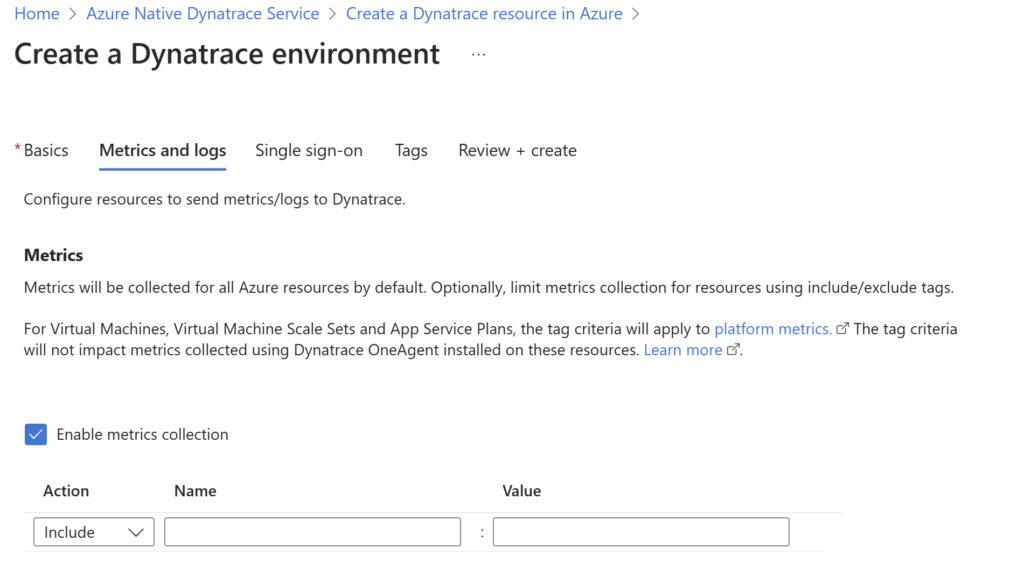
To enable metrics collection, customers can simply check a single checkbox on the Azure portal. This streamlined process makes it easy for organizations to start gathering valuable insights. For further customization, users have the option to specify tags to include or exclude specific resources for metric collection. This allows for a more targeted monitoring approach based on specific criteria.  

The setup of credentials required for the interaction between Dynatrace and Azure is automated, eliminating the need for manual configuration. Once the metrics are collected, users can conveniently view and analyze them on the Dynatrace portal, providing a comprehensive and centralized platform for monitoring and observability. 

Together with logs and metrics monitoring capabilities, Azure Native Dynatrace Service provides holistic monitoring of your Azure workloads. 

Native integration availability in new Azure regions 

During general availability, Azure Native Dynatrace Service was available in two regions, the Eastern United States and Western Europe. However, to cater to the growing demand, native integration is now available in additional regions. You can now create a Dynatrace resource in—The United Arab Emirates North (Middle East), Canada Central, and the Western United States—bringing the total number of supported regions to five. You can select the region in the resource creation experience. When selecting a region to provision a Dynatrace resource, the corresponding Dynatrace environment is provisioned in the same Azure region. This ensures that your data remains within the specified region. Hence, it gives you the power to leverage the power of Dynatrace within the Azure region while complying with the specific data residency regulations and preferences of your organization. 

Monitor activity with Azure Active Directory logs

In the realm of cloud business, early detection of security threats is crucial to safeguarding business operations. Azure Active Directory (Azure AD) activity logs—encompassing audit, sign-in, and provisioning logs—offer organizations essential visibility into the activities taking place within their Azure AD tenant. By monitoring these logs, organizations can gain insights into user and application activities, including user sign-in patterns, application changes, and risk activity detection. This level of visibility empowers organizations to respond swiftly and effectively to potential threats, enabling proactive security measures and minimizing the impact of security incidents on their operations. 

With Azure Native Dynatrace Service, you can route your Azure AD logs to Dynatrace by setting Dynatrace as a destination in Azure AD diagnostic settings.  

Committed to collaboration and integration 

The Azure Native integration for Dynatrace has simplified the process of gaining deep insights into workloads. This integration empowers organizations to optimize their resources, enhance application performance, and deliver high availability to their users. Microsoft and Dynatrace remain committed to collaborating and improving the integration to provide a seamless experience for their joint customers. By working together, both companies strive to continually enhance the monitoring and observability capabilities within the Azure ecosystem. 

The product is constantly evolving to deepen the integration, aiming to monitor a wide range of Azure workloads and uplift user convenience throughout the experience. 

Next steps 

Learn more about how to create, deploy, and manage a Dynatrace resource on Azure:

Subscribe to Azure Native Dynatrace Service from the Azure Marketplace. 

Learn more about how to deploy Dynatrace monitoring resources on Azure with documentation on Dynatrace and Azure integration. 

To discover more about Dynatrace on Azure, visit the Dynatrace documentation. 

Watch Innovate Faster with Azure Native Dynatrace Service to know more about the integration.  

Share additional information about how you use resource and subscription logs to monitor and manage your cloud infrastructure and applications by responding to this survey. 

The post Deploy a holistic view of your workload with Azure Native Dynatrace Service appeared first on Azure Blog.
Quelle: Azure

Removing barriers to autonomous vehicle adoption with Microsoft Azure

Autonomous vehicles, also known as self-driving cars, have the potential to truly revolutionize the transportation industry, with its impact anticipated across many industries. Several stubborn obstacles, however, stand in the way of mass adoption.

In the over 150 years since the automotive industry was founded, it has never experienced such rapid innovation and transformational change as it is currently experiencing. Since the advent of the horseless carriage in the 1860s, vehicle manufacturers have continued to improve the quality, safety, speed, and comfort of millions of automotive models sold around the world, each year.

Today, however, all eyes are on autonomous vehicles as a cornerstone of future human mobility.

Exponential market growth expected

Over the past decade, the impact of emerging technologies such as AI, machine vision, and high-performance computing (HPC) has changed the face of the automotive industry. Today, nearly every car manufacturer in the world is exploring the potential and power of these technologies to usher in a new age of self-driving vehicles. Microsoft Azure HPC and Azure AI infrastructure are tools to help accomplish that.

Data suggests that the global autonomous vehicle market, with level two autonomous features present in cars, was worth USD76 billion in 2020, but is expected to grow exponentially over the coming years to reach over USD2.1 trillion by 2030, as levels of autonomy features in cars continue to increase.1

The platformization of autonomous taxis also holds enormous potential for the broader adoption and usage of autonomous vehicles. Companies like Tesla, Waymo, NVIDIA, and Zoox are all investing in the emerging category of driverless transportation that leverages powerful AI and HPC capabilities to transform the concept of human mobility. However, several challenges still need to be overcome for autonomous vehicles to reach their potential and become the de facto option for car buyers, passengers, and commuters.

Common challenges persist

One of the most important challenges with autonomous vehicles is ethics. If the vehicle determines what action to take during a trip, how does it decide what holds the most value during an emergency? To illustrate, if an autonomous vehicle is traveling down a road and two pedestrians suddenly run across the road from opposite directions, what are the ethics underpinning whether the vehicle swerves to collide with one pedestrian instead of another?

Another of the top challenges with autonomous vehicles is that the AI algorithms underpinning the technology are continuously learning and evolving. Autonomous vehicle AI software relies heavily on deep neural networks, with a machine learning algorithm tracking on-road objects as well as road signs and traffic signals, allowing the vehicle to ‘see’ and respond to—for example, a red traffic light.

Where the tech still needs some refinement is with the more subtle cues that motorists are instinctually aware of. For example, a slightly raised hand by a pedestrian may indicate they are about to cross the road. A human will see and understand the cue far better than an AI algorithm does, at least for now.

Another challenge is whether there is sufficient technology and connectivity infrastructure for autonomous vehicles to offer the optimal benefit of their value proposition to passengers, especially in developing countries. With car journeys from A to B evolving into experiences, people will likely want to interact with their cars based on their personal technology preferences, linked to tools from leading technology providers. In addition, autonomous vehicles will also need to connect to the world around them to guarantee safety and comfort to their passengers.

As such, connectivity will be integral to the mass adoption of autonomous vehicles. And with the advent and growing adoption of 5G, it may improve connectivity and enable communication between autonomous vehicles—which could enhance autonomous vehicles’ safety and functioning.

Road safety is not the only concern with autonomous vehicles. Autonomous vehicles will be designed to be hyper-connected, almost like an ultra-high-tech network of smartphones on wheels. However, an autonomous vehicle must be precisely that—standalone autonomous. If connectivity is lost, the autonomous vehicle must still be able to operate fully autonomously.

That being said, there is still the risk that cyberattacks could pose a threat to autonomous vehicle motorists, compared to legacy vehicles currently on the road. In the wake of a successful cyberattack, threat actors may gain access to sensitive personal information or even gain control over key vehicle systems. Manufacturers and software providers will need to take every step necessary to protect their vehicles and systems from compromise.

Lastly, there are also social and cultural barriers to the mainstreaming of autonomous vehicles with many people across the globe still very uncomfortable with the idea of giving up control of their cars to a machine. Once consumers can experience autonomous drives and see how the technology continuously monitors a complete 360-degree view around the vehicle and does not get drowsy or distracted, confidence that autonomous vehicles are safe and secure will grow, and adoption rates will rise.

The future of travel is (nearly) upon us

As the world moves closer to a future where autonomous vehicles are a ubiquitous presence on our roads, the complex challenges that must be addressed to make this a safe and viable option become ever more apparent. The adoption of autonomous vehicles is not simply a matter of developing the technology, but also requires a complete overhaul of how we approach transportation systems and infrastructure.

To tackle the many challenges posed by autonomous vehicle adoption, companies and researchers are heavily investing resources into solving these complex challenges. For example, one way that researchers are addressing the ethical challenges posed by autonomous vehicles being able to make life or death decisions, is by developing ethical frameworks that guide the decision-making processes of these vehicles.

These frameworks define the principles and values that should be considered when autonomous vehicles encounter ethical dilemmas, such as deciding between protecting the safety of passengers versus that of pedestrians. Such frameworks can help ensure that autonomous vehicles make ethical decisions that are consistent with societal values and moral principles.

Significant investments are also being made into updating existing infrastructure to accommodate autonomous vehicles. Roads, highways, and parking areas must be equipped with the necessary infrastructure to support autonomous vehicles, such as sensors, cameras, and communication systems.

Companies are also working collaboratively with regulators, researchers, and OEMs to develop policies that ensure that autonomous vehicles can operate safely alongside traditional vehicles. This includes considerations such as how traffic signals, road markings, and signage need to be adapted to support autonomous vehicles.

In 2021, for example, Microsoft teamed up with a market leading self-driving car innovator to unlock the potential of cloud computing for autonomous vehicles, leveraging Microsoft Azure to commercialize autonomous vehicle solutions at scale.

Another global automotive group also recently announced a collaboration with Microsoft to build a dedicated cloud-based platform for its autonomous car systems that are currently in development. This ties in with their ambitious plans to invest more than USD32 billion in the digitalization of the car by 2025.

NVIDIA is also taking bold steps to fuel the growth of the autonomous vehicle market. The NVIDIA DRIVE platform is a full-stack AI compute solution for the automotive industry, scaling from advanced driver-assistance systems for passenger vehicles to fully autonomous robotaxis. The end-to-end solution spans from the cloud to the car, enabling AI training and simulation in the data centre, in addition to running deep neural networks in the vehicle for safe and secure operations. The platform is being utilized by hundreds of companies in the industry, from leading automakers to new energy vehicle makers.

Key takeaways

There is little doubt that the future of human mobility is built upon the ground-breaking innovation and technological capabilities of autonomous vehicles. While some challenges still exist, the underlying technology continues to mature and improve, paving the way for an increase in the adoption of self-driving cars long term.

The technology may soon proliferate and displace other, less safe modes of transport, with huge potential upsides for many aspects of our daily lives, such as saving lives and reducing the number of accidents, decreasing commute times, optimizing traffic flow and patterns, thereby lessening congestion, and extending the freedom of mobility for all.

With vehicle manufacturers and software firms continuously iterating on autonomous vehicle technology, continuing to educate the public on their benefits and continuing to work with lawmakers to overcome regulatory hurdles, we may all soon enjoy a new world, one where technology gets us safely from one destination to another, leaving us free to simply enjoy the view.

Learn more

Get started with Azure HPC and Azure AI infrastructure today or request an Azure HPC demo.

Learn more about Azure AI infrastructure for manufacturing:

AI-first infrastructure for Smart Manufacturing.

How AI and the Cloud are transforming computational engineering in manufacturing and consumer packaged goods.

Powering AI innovations with Azure AI infrastructure.

1https://www.alliedmarketresearch.com/autonomous-vehicle-market
The post Removing barriers to autonomous vehicle adoption with Microsoft Azure appeared first on Azure Blog.
Quelle: Azure

Azure OpenAI Service: 10 ways generative AI is transforming businesses

Technology is advancing at an unprecedented pace, and businesses are seeking innovative ways to maintain a competitive edge. Nowhere is this truer than in the realms of generative AI. From generating realistic images and videos to enhancing customer experiences, generative AI has proven to be a versatile tool across various industries. In this article, we explore 10 ways businesses are utilizing this game-changing technology to transform their operations and drive growth.

Content creation and design: Effective content creation and design are crucial for attracting and engaging customers.Generative AI enables businesses to create visually appealing and impactful content quickly and efficiently, helping them stand out in a crowded marketplace. Generative AI has revolutionized content creation by generating high-quality images, videos, and graphics. From designing logos and product visuals to creating engaging social media content, businesses are using generative AI algorithms to automate the creative process—saving time and resources.The company Typeface ingests information about the brand, including style guidelines, images, and product details. Then, with just a few clicks, customers can generate an assortment of suggested images and text—pre-defined in templates for different use cases—that employees can select and customize for use in an online campaign, marketing email, blog post, or anywhere the company wants to use it.

Accelerated automation: Automating IT tasks improves employee experiences, enhances customer interactions, and drives more efficiency within a company’s developer community.Providing employees with reliable automated support leads to increased efficiency, improved work life, and reduced operational costs.AT&T is using Azure OpenAI Service to enable IT professionals to request resources like additional virtual machines; migrate legacy code into modern code; and empower employees to complete common human resources tasks, such as changing withholdings, adding a dependent to an insurance plan, or requisitioning a computer for a new hire.

Personalized marketing: Personalization increases the chances of customer engagement and conversion and can significantly improve marketing ROI.Generative AI enables businesses to deliver hyper-personalized marketing campaigns. By analyzing customer data, generative algorithms can create dynamic content tailored to an individual’s preferences—optimizing engagement and conversion rates.Through the Take Blip platform and Azure OpenAI Service, brands can have one-on-one conversations that include an infinite flow of interactions with each customer. Interactions are digitized: customers’ requests, intentions, and desires can be recorded and used to tune the platform, making future interactions much more productive.

Chatbots and virtual assistants: Chatbots and virtual assistants powered by generative AI provide instant and accurate responses to customer queries.These intelligent systems can understand and respond to customer queries, provide recommendations, and offer personalized support—enhancing customer service, reducing wait times, improving operational efficiency, and boosting customer satisfaction and loyalty.By using a common chatbot framework along with the Azure Bot Services, Johnson & Johnson employees without technical training can now build their own bots to serve their teams and customers at a fraction of the time and cost it took to develop previous chatbot projects.

Product and service innovation: Staying innovative and meeting evolving customer demands is essential for business success.Local reporters used to be specialists—they focused their time on investigation and writing. Today, they need to be generalists who can create both written and video content and who knows how to maximize viewership on Facebook, Instagram, TikTok, YouTube, and potentially many other distribution channels.”Nota has used Microsoft Azure OpenAI Service to build two AI-assisted tools—SUM and VID. These tools do a lot of the heavy lifting needed to optimize stories for distribution and turn written pieces into engaging videos that can produce up to 10 times as much revenue as written pieces.

Language translation and natural language processing: In a globalized world, language barriers can hinder communication and business growth.Generative AI has improved language translation and natural language processing capabilities. Businesses can use generative models to accurately translate content in real time, enabling seamless communication across borders and bridging language barriers.Microsoft Azure AI services augment HelloTalk’s AI learning tools and technical capabilities, allowing users to connect with the world through language and culture exchange.

Fraud detection and cybersecurity: Businesses face constant threats from fraudsters and cyberattacks.By analyzing patterns and anomalies in large datasets, businesses can leverage generative models to detect and prevent fraud, safeguard sensitive information, and protect their digital assets.Using federated learning techniques along with Azure Machine Learning and Azure confidential computing, Swift and Microsoft are building an anomaly detection model for transactional data—all without copying or moving data from secure locations.

Predictive analytics and forecasting: Accurate predictions and forecasting are vital for effective decision-making and operational efficiency.Generative AI models excel in predictive analytics and forecasting. By analyzing historical data and identifying patterns, businesses can leverage generative algorithms to make accurate predictions and informed decisions, optimizing supply chain management, inventory forecasting, and demand planning.Azure IoT helps Husky meet their system performance needs and maintain service levels for their customers. It scales quickly as they onboard new Advantage+Elite customers and reduces the time and resources spent on infrastructure maintenance.

Creative writing and content generation: Content generation can be time-consuming and resource-intensive. Generative AI algorithms automate the content creation process, allowing businesses to generate articles, blog posts, and other written materials quickly. This technology assists content creators and ensures a consistent flow of fresh and engaging content for audiences.Generative AI algorithms automate the content creation process, allowing businesses to generate articles, blog posts, and other written materials quickly. This technology assists content creators and ensures a consistent flow of fresh and engaging content for audiences. Businesses and content creators can use these models to generate articles, blog posts, advertising copy, and more—saving time for content creators and providing fresh content to engage audiences.With Azure OpenAI Service, CarMax is creating content for its website much more efficiently, freeing up its editorial staff to focus on producing strategic, longer-form pieces that require more insight. Letting Azure OpenAI Service take care of data-heavy summarization tasks gives them time to be more creative and feel more fulfilled.

Medical research and diagnosis: The healthcare industry can benefit from quickly diagnosing diseases—potentially leading to faster and more accurate diagnoses—improving patient outcomes.Researchers can utilize generative models to analyze medical images, detect abnormalities, and aid in the development of new treatments. Additionally, generative AI algorithms can assist in diagnosing diseases by analyzing patient symptoms and medical records, potentially leading to more accurate and timely diagnoses.At Cambridgeshire and Peterborough NHS Foundation Trust, a single patient’s case notes could have up to 2,000 documents. In the past, if you needed information that was stored 1,600 documents ago, you weren’t going to find it. Now, using Azure Cognitive Search it takes as little as three seconds to search for a keyword across those 2,000 documents to find it.

Each of the 10 ways mentioned above addresses significant challenges and opportunities facing businesses today. Azure OpenAI Service empowers businesses to streamline processes, enhance customer experiences, drive innovation, and make data-driven decisions—resulting in improved efficiency, profitability, and competitiveness. In the case of generative AI, what’s good for business is also good for its customers. By leveraging the power of machine learning and generative algorithms, businesses can improve customer experiences while also gaining a competitive advantage in today’s rapidly evolving digital landscape.

Our commitment to responsible AI

Microsoft has a layered approach for generative models, guided by Microsoft’s responsible AI principles. In Azure OpenAI Service, an integrated safety system provides protection from undesirable inputs and outputs and monitors for misuse. In addition, Microsoft provides guidance and best practices for customers to responsibly build applications using these models and expects customers to comply with the Azure OpenAI code of conduct. With GPT-4, new research advances from OpenAI have enabled an additional layer of protection. Guided by human feedback, safety is built directly into the GPT-4 model, which enables the model to be more effective at handling harmful inputs, thereby reducing the likelihood that the model will generate a harmful response. 

Get started with Azure OpenAI Service 

Apply for access to Azure OpenAI Service by completing this form. 

Learn about Azure OpenAI Service and the latest enhancements. 

Get started with GPT-4 in Azure OpenAI Service in Microsoft Learn. 

Read our Partner announcement blog, Empowering partners to develop AI-powered apps and experiences with ChatGPT in Azure OpenAI Service. 

Learn how to use the new Chat Completions API (preview) and model versions for ChatGPT and GPT-4 models in Azure OpenAI Service. 

The post Azure OpenAI Service: 10 ways generative AI is transforming businesses appeared first on Azure Blog.
Quelle: Azure

Mercedes-Benz enhances drivers’ experience with Azure OpenAI Service 

With ChatGPT, MBUX Voice Assistant “Hey Mercedes” will become even more intuitive – the U.S. beta program is expected to last three months.

When I started driving in the 1990s, I thought I was living in the future. My first car had everything I thought I could ever need: a built-in radio, lighting when you opened the door, windows you could roll down with a crank, a clock and even air-conditioning for those really hot days growing up on the East Coast.

That car is long gone, but my passion for driving things forward lives on, which is why I’m excited to share how Mercedes-Benz is using Microsoft AI capabilities to enhance experiences for some drivers today.

As the last six months have shown us, the power of generative AI goes beyond cutting-edge language models—it’s what you build with it that matters most. Our Azure OpenAI Service lets companies tap into the power of the most advanced AI models (Open AI’s GPT-4, GPT-3.5, and more) combined with Azure’s enterprise capabilities and AI-optimized infrastructure to do extraordinary things.

Mercedes-Benz takes in-car voice control to a new level with Azure OpenAI Service

Today, Mercedes-Benz announced they are integrating ChatGPT via Azure OpenAI Service to transform the in-car experience for drivers. Starting June 16, drivers in the United States can opt into a beta program that makes the MBUX Voice Assistant’s “Hey Mercedes” feature even more intuitive and conversational. Enhanced capabilities include:

Elevated voice command and interaction: ChatGPT enables more dynamic conversations, allowing customers to experience a voice assistant that not only understands voice commands but also engages in interactive conversations.

Expanded task capability: Whether users need information about their destination, a recipe, or answers to complex questions, the enhanced voice assistant will provide comprehensive responses, allowing drivers to keep their hands on the wheel and eyes on the road.

Contextual follow-up questions: Unlike standard voice assistants that often require specific commands, ChatGPT excels at handling follow-up questions and maintaining contextual understanding. Drivers can ask complex queries or engage in multi-turn conversations, receiving detailed and relevant responses from the voice assistant.

Integration with third-party services: Mercedes-Benz is exploring the ChatGPT plugin ecosystem, which would open up possibilities for integration with various third-party services. This could enable drivers to accomplish tasks like restaurant reservations, movie ticket bookings, and more, using natural speech commands, further enhancing convenience and productivity on the road.

With the three-month beta program, Mercedes-Benz customers can become early adopters of this groundbreaking technology. Based on the findings of the beta program and customer feedback, Mercedes-Benz will consider further integration of this technology into future iterations of their MBUX Voice Assistant while maintaining the highest standards of customer privacy on and off the road.

With Microsoft, Mercedes-Benz is paving the way for a more connected, intelligent, and personalized driving experience, and accelerating the automotive industry through AI.

In case you missed it, at Microsft Build we recently announced updates to Azure OpenAI Service to help you more easily and responsibly deploy generative AI capabilities powered by Azure. You can now:

Use your own data (coming to public preview later this month), allowing you to create more customized, tailored experiences based on organizational data.

Add plugins to simplify integrating external data sources with APIs.

Reserve provision throughput (generally available with limited access later this month) to gain control over the configuration and performance of OpenAI’s large language models at scale.

Create safer online environments and communities with Azure AI Content Safety, a new Azure AI service integrated into Azure OpenAI Service and Azure Machine Learning prompt flow that helps detect and remove content from prompts and generation that don’t meet content management standards.

A responsible approach

Microsoft has a layered approach for generative models, guided by Microsoft’s responsible AI principles. In Azure OpenAI Service, an integrated safety system provides protection from undesirable inputs and outputs and monitors for misuse. In addition, Microsoft provides guidance and best practices for customers to responsibly build applications using these models and expects customers to comply with the Azure OpenAI Code of Conduct. With Open AI’s GPT-4, new research advances from OpenAI have enabled an additional layer of protection. Guided by human feedback, safety is built directly into the GPT-4 model, which enables the model to be more effective at handling harmful inputs, thereby reducing the likelihood that the model will generate a harmful response. 

Get started with Azure OpenAI Service

Apply now for access to Azure OpenAI Service.

Bookmark the What’s New page.

Review Azure OpenAI Service documentation.

Explore the playground and customization in Azure AI Studio. No programming is required.

Dive right in with QuickStarts.

Watch the new explainer video about Azure OpenAI Service.

The post Mercedes-Benz enhances drivers’ experience with Azure OpenAI Service  appeared first on Azure Blog.
Quelle: Azure