What a C++, C, Go or Rust developer should know about RHEL 9
In this post, we explain to system developers all the new C++, C, Go or Rust features in RHEL 9.
Quelle: CloudForms
In this post, we explain to system developers all the new C++, C, Go or Rust features in RHEL 9.
Quelle: CloudForms
In this multi-part tutorial, we cover how to provision RHEL VMs to a vSphere environment from Red Hat Satellite. Learn how to prepare the Satellite environment in this post.
Quelle: CloudForms
If you are using Red Hat Enterprise Linux (RHEL), you can use Red Hat Insights to find out what systems are exposed, and to what extent. See how to find and remediate security vulnerabilities faster using Insights.
Quelle: CloudForms
The Friday Five is a weekly Red Hat® blog post with 5 of the week’s top news items and ideas from or about Red Hat and the technology industry. Consider it your weekly digest of things that caught our eye.
Quelle: CloudForms
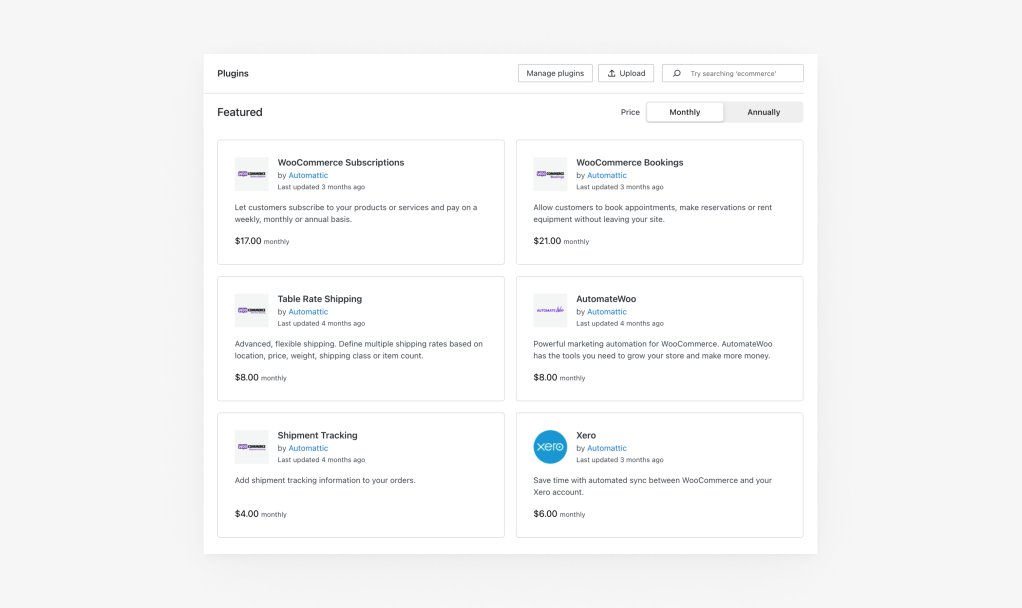
For users on our Business and eCommerce Plans, plugins are a critical part of the WordPress.com experience. We’re always looking for ways to simplify the process of discovering and installing powerful WordPress plugins.
As a result, we’re now making it possible to purchase certain plugins directly on the WordPress.com plugin page. Not only that, but WordPress.com will offer monthly and annual plugin pricing which provides site owners more flexibility.
Initially, you can purchase six of our most popular WooCommerce plugins on the WordPress.com plugins page.
WooCommerce Subscriptions — Allow customers to subscribe to your products or services and pay on a weekly, monthly or annual basis.WooCommerce Bookings — Allow customers to book appointments, make reservations or rent equipment without leaving your site.WooCommerce Table Rate Shipping — Advanced, flexible shipping. Define multiple shipping rates based on location, price, weight, shipping class or item count.WooCommerce AutomateWoo — Powerful marketing automation for WooCommerce. AutomateWoo has the tools you need to grow your store and make more money.WooCommerce Shipment Tracking — Add shipment tracking information to your orders.WooCommerce Xero — Save time with automated sync between WooCommerce and your Xero account.
Purchasing a plugin via the new WordPress.com interface is simple. On the plugins page, click on one of the paid plugin cards to be redirected to a detailed product listing page. When you’re ready, click the purchase button in the top right of the product listing page. Your purchase won’t be final until you confirm your payment method and details on the following page. The plugin will be installed automatically.
This announcement is just the start — look for more paid plugins and other exciting updates over the coming months. Let us know in the comments below what plugins you would like to see available for purchase directly on WordPress.com.
Stay tuned and click here to begin exploring plugins now!
As a reminder, all plugins (free or paid) are currently only available to customers with a WordPress.com Business or eCommerce Plan. If you’re interested in purchasing or upgrading to an annual Business Plan, click here for a 25% discount off your first year.
Promo code: PLUGINSBLOG25
Quelle: RedHat Stack
Quelle: Mirantis

Every month, Mirantis sends out a newsletter chronicling top industry and company news. Below you’ll find links to blogs, tutorials, videos, and the latest updates to our enterprise, open source, and training offerings. If you don’t currently receive the newsletter, you can subscribe by clicking the button on the top right. Mirantis Brings Secure Registries … Continued
Quelle: Mirantis
Enterprises face the challenge of consistently deploying and managing applications in production, at scale. Fortunately, there are more technologies and tools available today than ever before. However, transitioning from a traditional, monolithic architecture to a cloud native one comes with its own unique challenges. Below, you will find a list of the critical first steps … Continued
Quelle: Mirantis
RDO Xena Released
The RDO community is pleased to announce the general availability of the RDO build for OpenStack Xena for RPM-based distributions, CentOS Stream and Red Hat Enterprise Linux. RDO is suitable for building private, public, and hybrid clouds. Xena is the 24th release from the OpenStack project, which is the work of more than 1,000 contributors from around the world.
The release is already available on the CentOS mirror network at http://mirror.centos.org/centos/8-stream/cloud/x86_64/openstack-xena/.
The RDO community project curates, packages, builds, tests and maintains a complete OpenStack component set for RHEL and CentOS Stream and is a member of the CentOS Cloud Infrastructure SIG. The Cloud Infrastructure SIG focuses on delivering a great user experience for CentOS users looking to build and maintain their own on-premise, public or hybrid clouds.
All work on RDO and on the downstream release, Red Hat OpenStack Platform, is 100% open source, with all code changes going upstream first.
PLEASE NOTE: RDO Xena provides packages for CentOS Stream 8 only. Please use the Victoria release for CentOS Linux 8 which will reach End Of Life (EOL) on December 31st, 2021 (https://www.centos.org/centos-linux-eol/).
Interesting things in the Xena release include:
The python-oslo-limit package has been added to RDO. This is the limit enforcement library which assists with quota calculation. Its aim is to provide support for quota enforcement across all OpenStack services.
The glance-tempest-plugin package has been added to RDO. This package provides a set of functional tests to validate Glance using the Tempest framework.
TripleO has been moved to an independent release model (see section TripleO in the RDO Xena release).
The highlights of the broader upstream OpenStack project may be read via https://releases.openstack.org/xena/highlights.html
TripleO in the RDO Xena release:
In the Xena development cycle, TripleO has moved to an Independent release model (https://specs.openstack.org/openstack/tripleo-specs/specs/xena/tripleo-independent-release.html) and will only maintain branches for selected OpenStack releases. In the case of Xena, TripleO will not support the Xena release. For TripleO users in RDO, this means that:
RDO Xena will include packages for TripleO tested at OpenStack Xena GA time.
Those packages will not be updated during the entire Xena maintenance cycle.
RDO will not be able to included patches required to fix bugs in TripleO on RDO Xena.
The lifecycle for the non-TripleO packages will follow the code merged and tested in upstream stable/Xena branches.
There will not be any TripleO Xena container images built/pushed, so interested users will have to do their own container builds when deploying Xena.
You can find details about this on the RDO webpage
Contributors
During the Xena cycle, we saw the following new RDO contributors:
Chris Sibbitt
Gregory Thiemonge
Julia Kreger
Leif Madsen
Welcome to all of you and Thank You So Much for participating!
But we wouldn’t want to overlook anyone. A super massive Thank You to all 41 contributors who participated in producing this release. This list includes commits to rdo-packages, rdo-infra, and redhat-website repositories:
Alan Bishop
Alan Pevec
Alex Schultz
Alfredo Moralejo
Amy Marrich (spotz)
Bogdan Dobrelya
Chandan Kumar
Chris Sibbitt
Damien Ciabrini
Dmitry Tantsur
Eric Harney
Gaël Chamoulaud
Giulio Fidente
Goutham Pacha Ravi
Gregory Thiemonge
Grzegorz Grasza
Harald Jensas
James Slagle
Javier Peña
Jiri Podivin
Joel Capitao
Jon Schlueter
Julia Kreger
Lee Yarwood
Leif Madsen
Luigi Toscano
Marios Andreou
Mark McClain
Martin Kopec
Mathieu Bultel
Matthias Runge
Michele Baldessari
Pranali Deore
Rabi Mishra
Riccardo Pittau
Sagi Shnaidman
Sławek Kapłoński
Steve Baker
Takashi Kajinami
Wes Hayutin
Yatin Karel
The Next Release Cycle
At the end of one release, focus shifts immediately to the next release i.e Yoga.
Get Started
To spin up a proof of concept cloud, quickly, and on limited hardware, try an All-In-One Packstack installation. You can run RDO on a single node to get a feel for how it works.
Finally, for those that don’t have any hardware or physical resources, there’s the OpenStack Global Passport Program. This is a collaborative effort between OpenStack public cloud providers to let you experience the freedom, performance and interoperability of open source infrastructure. You can quickly and easily gain access to OpenStack infrastructure via trial programs from participating OpenStack public cloud providers around the world.
Get Help
The RDO Project has our users@lists.rdoproject.org for RDO-specific users and operators. For more developer-oriented content we recommend joining the dev@lists.rdoproject.org mailing list. Remember to post a brief introduction about yourself and your RDO story. The mailing lists archives are all available at https://mail.rdoproject.org. You can also find extensive documentation on RDOproject.org.
The #rdo channel on OFTC IRC is also an excellent place to find and give help.
We also welcome comments and requests on the CentOS devel mailing list and the CentOS and TripleO IRC channels (#centos, #centos-devel in Libera.Chat network, and #tripleo on OFTC), however we have a more focused audience within the RDO venues.
Get Involved
To get involved in the OpenStack RPM packaging effort, check out the RDO contribute pages, peruse the CentOS Cloud SIG page, and inhale the RDO packaging documentation.
Join us in #rdo and #tripleo on the OFTC IRC network and follow us on Twitter @RDOCommunity. You can also find us on Facebook and YouTube.
Quelle: RDO

In November 2021, we announced the general availability of Tau VMs. Since then, Google Cloud’s Tau VMs with Google Kubernetes Engine (GKE) have unlocked value for many customers who are now using Tau VMs for their production workloads, such as: Ascend, who achieved over 125% higher performance; Nylas, who gained over 40% higher price-performance; and OpenX, who achieved 40% better price-performance while at the same time reducing their application latency by 62%. T2D is the first instance type in the Tau VM family and is built on the latest 3rd generation AMD EPYCTM processors, offering 42% higher price-performance compared to general-purpose VMs from any of the leading public cloud vendors. Tau VMs offer a leading combination of performance, price, and full x86 compatibility, offering customers the lowest cost solution for scale-out workloads. Tau VMs are available in predefined shapes, with up to 60vCPUs per VM, 4GB of memory per vCPU, networking up to 32 Gbps and a slew of storage options including Standard, Balanced and Performance PD. Tau VMs are also available as Spot VMs, offering an over 60% discount compared to on-demand pricing. For customers looking for advanced container orchestration, GKE delivers high levels of reliability, security, and scalability, and has supported Tau VMs since the day they became available on Google Cloud. Tau VMs are ideal for CPU-bound workloads such as web-serving with encryption, video encoding, compression/decompression, image processing and horizontally-scaled applications. Using Tau VMs along with GKE’s cost-optimization best practices can help lower your total cost of ownership. You can add Tau VMs to new or existing GKE clusters by specifying the Tau T2D machine type in your GKE node-pools through the Cloud console or by using –machine-type in gcloud. Here is what some of our customers have to say about Tau VMs:Ascend provides a unified analytics and data engineering platform, and chose Tau VMs along with GKE to run their data-intensive workload — primarily because of Tau’s absolute performance and price-performance advantage.“Our core capability at Ascend is bringing together data ingestion, transformation, delivery, orchestration and observability into a single platform. To operate at scale and keep pace with our telemetry data production rates, high single-threaded performance is critical. With Google Cloud’s Tau VMs with Google Kubernetes Engine (GKE), we are able to achieve over 125% higher performance than previous generation families. This has completely changed our ability to query historical metrics. Where previously metric queries against historical data over ranges longer than a couple hours were difficult, we can now easily query data ranges of multiple weeks.” – Joe Stevens, Tech Lead – Infrastructure, Ascend.ioNylas is a pioneer and leading provider of productivity infrastructure solutions for modern software. In the past year, Nylas has been using GKE in their journey to reinvent their architecture and provide their enterprise customers with a bi-directional universal email sync, security compliance with the highest enterprise standards, and industry-specific machine learning services. “For our core application, Google’s Tau VMs with Google Kubernetes Engine delivers over 40% better price-performance than Amazon’s Graviton-based VMs. Further, Tau VMs maintain x86 compatibility and eliminate the need to maintain a separate stack for ARM. We are moving our workload from Amazon Web Services to Google Cloud to take advantage of these benefits.” – David Ting, SVP of Engineering, NylasOpenX operates an independent ad exchange. Operating 100% on Google Cloud has enabled OpenX to achieve improved performance, scalability, speed and global reach. “At OpenX, our ad-exchange services over 200 billion requests every day. Getting the best combination of performance and price from the infrastructure is critically important for us. We use multiple Google Kubernetes Engine (GKE) clusters across geographic regions with autoscaling to power our ad-delivery components. Running Google Cloud’s Tau VMs with GKE has enabled over 40% better price-performance and 62% latency reduction for our application as compared to the prior generation family. We have made the move to Tau VMs for our application to take advantage of these benefits.” – Paul T.Ryan, CTO, OpenXWe are excited to see Tau VMs adding value for so many of our customers by enabling industry leading price-performance for a variety of workloads. If you haven’t tried Tau VMs yet, give them a try today in our Iowa, Netherlands and Singapore regions and move your production workloads to Tau VMs. Tau VMs will be arriving in additional regions and zones in the coming weeks. You can provision GKE node pools based on Tau VMs and explore how you can take advantage of improved price-performance for your scale-out containerized workloads. To get started, go to the Google Cloud Console, select Google Kubernetes Engine, and choose Tau T2D for your GKE nodes. To learn more about Tau VMs or other Compute Engine VM options, check out our machine types and our pricing pages.Related ArticleTau T2D VMs now in Preview: Independent testing validates market-leading price-performanceT2D VMs powered by 3rd Generation AMD EPYC processors (code-named Milan) are now available for the Compute Engine Tau family in preview.Read Article
Quelle: Google Cloud Platform






