The Wage Gap In Tech In LA Is Getting Worse

FORT LAUDERDALE, FL – MARCH 14: Elana Goodman joins with other protesters to ask that woman be given the chance to have equal pay as their male co-workers on March 14, 2017 in Fort Lauderdale, Florida. The protest was held as the legislation in the state of Florida looks at passing the Helen Gordon Davis fair pay protection act that would strengthen state laws in terms of equal pay. (Photo by Joe Raedle/Getty Images)

Joe Raedle / Getty Images

The tech sector in Los Angeles has grown in the last decade — but women who work in the field here have been falling behind. According to data compiled by LiveStories based on the most recent American Community Survey, the gender pay gap in tech in Los Angeles has worsened. From 2006 to 2010, women in tech in LA made 97 cents for every dollar men made, one of the highest ratios in the country. But by 2015, women in tech in LA were only making 82 cents for that same men's dollar — a drop of 17%.

That's still higher than the 80 cents for every dollar that the average woman in the U.S. makes. Still, not only has no other occupation in the area become so much less equitable so quickly according to the survey data, but this also places LA among the worst places in the country for income parity in tech. In an industry dogged by pay disparity issues — in addition to several well-publicized sexual harassment and gender discrimination lawsuits — it's troubling that, at least in LA, this disparity has grown. (LiveStories' data encompasses the City of Los Angeles where Facebook, Google, Snap and YouTube all have offices. Santa Monica, which also hosts a number of tech companies, is not included.)

It's particularly surprising since, as a recent study by Hired.com showed, the wage gap is lowest at seed stage companies. According to the study, “Smaller companies have more institutional transparency into the salaries of everyone on the team, which can ultimately negate possible gender pay disparities.”

But tech jobs aren't just at small startups. According to the Bureau of Labor Statistics, jobs in this sector include a wide swath of professions — computer scientists, computer programmers, web developers, and database administrators, but also actuaries and mathematicians.

The most recent year for which American Community Survey data is available is 2015. That's also the year that California passed a Fair Pay Act, mandating that men and women be paid equally in the private sector starting Jan. 1, 2016. Employers are also barred from pay disparities that stem from differences in past salaries. It's possible, given the new law, that the pay disparity in LA will decrease in the coming years. But with companies like Google resisting orders to reveal pay data, it may take some time before we know.

Quelle: <a href="The Wage Gap In Tech In LA Is Getting Worse“>BuzzFeed
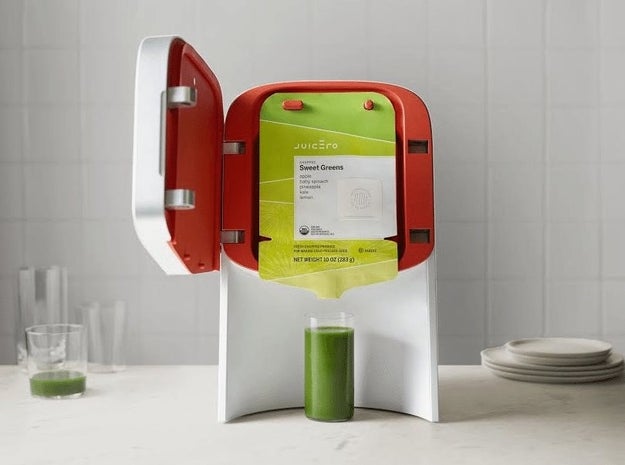
Goodbye Juicero, Silicon Valley's Favorite $400 Juicer

Juicero

There's nothing left to squeeze out of Juicero.

On Friday, the lavishly funded Silicon Valley startup said it was going down the drain, suspending sales of its Juicero Press and Produce Packs immediately. No longer will it sell its $400 (originally $700) machine that spits out eight-ounce glasses of juice as long as your Wi-Fi was working. Instead, it will search for an acquirer to “carry forward the Juicero mission.”

Juicero's announcement that it was seeking a buyer was a disappointment to everyone who believed the future of nutrition lay in five flavors of individual juice packs, delivered weekly. It was also blow to those lacked the strength to squeeze them with their bare hands.

“Not all juice is equal. … How do you measure life force? How do you measure chi?”

Juicero's supporters included some of the valley's highest-profile venture capital firms, from Kleiner Perkins Caufield Byers to Peter Thiel's Thrive Capital to GV (formerly Google Ventures), big companies like Campbell Soup, and other investors who poured nearly $120 million into the enterprise before it launched in March 2016. They believed that it would tap into time-pressed consumers' obsession with wellness and fresh produce.

It was a strategy that won over some high-profile fans like Ivanka Trump.

Juicero's most fervent believer was its CEO, Doug Evans, who came up with the idea after finding flaws with every juicer on the market. “It didn’t have the magic that I was accustomed to,” he has said of them. “Not all juice is equal,” he has also said. “How do you measure life force? How do you measure chi?”

Evans likened his product development process to that of Steve Jobs. “I said, 'I'm going to do what Steve did,'” he recounted to Recode. “'I'm going to take the mainframe computer and create a personal computer. I'm going to take a mainframe juice press and I'm going to create a personal juice press,' and my original design was supposed to be easy to clean.”

Sadly, Juicero's lifespan — without an acquirer — seems to be slightly shorter than Apple's. The company says it will offer refunds for the next 90 days.

So long, Juicero.

Quelle: <a href="Goodbye Juicero, Silicon Valley's Favorite 0 Juicer“>BuzzFeed

Alexa, Play "My Neck, My Back"

Alexa, Play "My Neck, My Back"

Casey Picker had a surprise when the song “iSpy” by Kyle (feature Li' Yachty) came on his Echo. It's a catchy kid-friendly tune, but it does feature some not exactly kid-friendly words. Lyrics like “I won't fuck a bitch without a rubber” might help teach your teens about the importance of safe sex, but they're probably not ideal for younger ones.

youtube.com

Amazon Music doesn't offer yet explicit language filters. Which means that the company's Echo and Dot smart speakers — which use Amazon Music as a default streaming service — don't yet offer profanity-free versions of the music that, say, a plucky 7-year-old might ask it to play. Amazon told BuzzFeed News the company is “actively working on a solution to this issue,” but it didn't say what that solution might be or when it's expected to arrive.

Amazon Alexa does have some built-in filters for cusswords. For example, if it's reading a message someone texted you through the Alexa platform, it will bleep out the word “fuck.” I've tested this, of course.

Fretting about explicit lyrics in songs is very 1985 Tipper Gore, I know. Sure, your kid's head won't explode should she hear a few cuss words. But it's reasonable for parents to want to avoid f-bomb exposure, if for no reason other than kids love to repeat naughty words just to annoy adults.

I'm no prude (see, I'll prove it: butts, fart, crap, fuck, turd, shit), but even I sometimes find myself shocked by the explicit lyrics in pop songs. Ever have that experience where you hear the “real” version of a song you only ever heard on the radio, and you're shocked, SHOCKED! at all the dirty words? Like that Enrique Iglesias hit song that goes “tonight I'm loving you…” but then you discover he's planning on doing something way more than “loving” you?? Yeah, that.

Here's the current state of explicit lyric filtering on streaming services:

No Explicit Lyric Filters:

  • Tidal

  • Spotify

  • Amazon Music

Yes Explicit Lyric Filters:

  • Apple Music

  • Pandora

  • Google Music

Echo and Dot devices are popular with kids for obvious reasons: they're basically toys that talk to you. There are tons of kid-friendly apps for them that tell jokes or serve up fun facts about animals. The devices can help spell words, or do math problems. In fact, in a lot of ways, the Echo and the Dot seem more appropriate for kids than adults.

There's been a smattering of handwringing that Echos are turning kids into assholes who never have to tell Alexa, “please,” or are enablers of unforeseen consumer binges. Consider the viral story of a girl who ordered an expensive dollhouse and four pounds of cookies; Then in a Murphy's Law self-suck, the TV news coverage of that story triggered viewers Echos to place orders for the same items.

But for the most part, the Echo and Dot are devices that kids love. Amazon seems to know it, and has actively marketed them to parents in the form of both back to school sales and kid-specific skills. So the fact that the Echo doesn't yet have a kid-friendly music offering is surprising — and frustrating for more than a few parents. Indeed, Amazon customer forums show threads of parents frustrated and confused as to why they can't stop their kids from hearing naughty music.

While Amazon is working on a solution to the issue, it's unclear when it might arrive. So in the meantime here's a suggested workaround: only listen to Swedish death metal, so your kids can't understand it (unless you speak Swedish, in which case, you're fucked).

Quelle: <a href="Alexa, Play "My Neck, My Back"“>BuzzFeed

Design and machine learning: The emerging role of design in tech

IBM Design San Francisco has recently been given the prestigious Red Dot Communications Design Award for IBM Data Science Experience. The Red Dot Award is one of the highest forms of recognition in the design world.
The Data Science Experience design team faced unique challenges throughout this project, firstly having to understand the data science workflow, then collaborating on a design that best addresses the challenges data scientist face. The team was broaching unprecedented territory as it set out to design for the fast-paced and rapidly changing fields of data science and machine learning.

While the Red Dot Award gives recognition to the hard work of the design team, it also signifies the emerging role of design in tech fields like data science and machine learning. The field of design has evolved to become an integral part of software and product development, reshaping problem-solving approaches, development process, and user focus across the tech industry. Machine learning and data science are current trends in tech that are expanding possibilities of technology, and design is helping shape these possibilities.

For more details, read about the challenges and design strategies that the IBM DSX design team faced, hearing it directly from their perspective.

The post Design and machine learning: The emerging role of design in tech appeared first on Cloud computing news.
Quelle: Thoughts on Cloud

Why IBM MQ lets you choose the cloud best for you

Nobody likes to be restricted. They don’t want to have decisions made for them. Would you really go to a restaurant if the menu had only one option? “Oh, you’d like a side salad with your hamburger?” the waiter asks. “No, sorry. We only can give you this one thing.”
And here’s my point: We all crave choice. A restaurant that offers no options to pair with your burger is ludicrous.
So shouldn’t your technology give you the freedom to choose and use the cloud solution that is best for your business? IBM understands this and is working to help clients capitalize on cloud by providing industry leading offerings like IBM MQ enterprise messaging across multiple clouds to achieve ultimate data security and scale.
Why so many dang clouds, anyway?
Name a leading business with only one cloud today, I dare you. Today’s reality for many businesses undergoing digital transformation is access to applications and data regardless of where they are located.  But in a multicloud world, one requirement remains constant: transaction security. And that’s where IBM MQ come into play.
Multiple clouds. No fear. Data Is safe anywhere.
Leif Davidsen, Offering Manager of IBM MQ, has seen this requirement first-hand. “Almost all of our clients are starting to explore the benefits of cloud – and what that means to them.”
A priority for many businesses is to find a way to exchange data in the form of messages between applications, systems and services. And they need messaging exchanges that are reliable, secure, rapid and simple.
That’s why MQ gives customers the freedom to choose and use the clouds they need. In addition to MQ running on the IBM Cloud, IBM supports deployment of MQ on AWS, Google Cloud Platform, and Azure. As part of the IBM commitment to multicloud we are working to create a first-class experience for our clients. For example, we are now launching an AWS Quickstart to make it easier for AWS customers to try MQ.  Learn more.
Data security is a top-of-mind concern for all businesses today. Not a day goes by, it seems, without a news headline talking about a data breach. That’s why IBM is working to provide the industry’s leading enterprising messaging platform everywhere its needed in today’s multi-cloud world.
To learn more about what MQ can do for your business, click here.
The post Why IBM MQ lets you choose the cloud best for you appeared first on Cloud computing news.
Quelle: Thoughts on Cloud

My First Ansible Control Action (Video)

With this short video, we continue our series based on Red Hat Knowledge Base articles exploring how to take advantage of Ansible Automation inside Red Hat CloudForms. This post is a follow-up of our previous My First Ansible Service article.
As a summary, what we do in this video is to create a control policy that checks if the VM CPU or memory size has changed, and if so, resets the size to 1 CPU and 1GB automatically.

Specifically, what we show in this video is how to:

Create VMware credentials for vCenter
Create a new Service Item to reconfigure our VM
Create a new Action and Policy for running an Ansible Playbook
Create and assign a new Policy Profile to VMs
Test the Policy by re-configuring VM resources manually, and validating our control Policy


The Red Hat Knowledge Base article, including the necessary playbooks to implement this example, are available on this Red Hat Knowledge Base article.
Please note that you need to install pysphere from the appliance console for the playbook to run:
easy_install -U pysphere
Quelle: CloudForms