Debian 9 erscheint: Stretch saugt sich fest

Releases der Linux-Distribution Debian sind von vielen Beobachtern als langweilig verschrien, da die Entwickler sehr konservativ an die Paketauswahl heran gehen. Nichtsdestotrotz ist das Erscheinen einer neuen Debian-Version ein wichtiges Ereignis.

Quelle: Heise Tech News

Docker and Booz Allen Hamilton Modernize Traditional Apps in Government IT

Existing applications and infrastructure account for the majority of IT spend in maintenance and support. Docker and Booz Allen Hamilton are partnering together to help Federal agencies modernize traditional apps with Docker Enterprise Edition (EE), deploy onto modern infrastructure to save infrastructure and operational costs, increase security and gain workload portability.
This program helps accelerate the path to modern microservices and infrastructure with containers:

First by containerizing the app in place and using container architecture to break up the app into smaller services over time
The full stack portability provided by Docker EE allows for workload consolidation for greater app density per server, accelerate hardware refresh cycles and cloud migration.
Lastly, Docker EE provides new levels of security for the legacy app. Scanning provides binary level visibility into components and their security profile for proactive remediation and configurable isolation properties can greatly reduce the attack surface area

View the webinar on demand here:

Here are some of the top Q&A from the session:
Q: What does Image2Docker exactly capture in the VM?
A: Image2Docker captures the application in the VM and pulls out what can be provided by the base image or the underlying linux/win kernel.
Q: When it comes to Docker, what do I do about other users who may be using a different Linux distro than I am?
A: Docker is supported on all major Linux distributions using a modern kernel. The containers are fully compatible between those distros and 100% portable from one OS host to another. View the supported OS list here.
Q: Do you have any metrics on how long an MTA engagement takes? Do you have it packaged as a week long effort or does it depend?
A: The MTA program is a 30 days program which is inclusive of one week onsite and three weeks remote. The program includes trial subscription of Docker Enterprise Edition (EE) and application migration services for 1-2 applications. The program is designed to demonstrate value very quickly while providing an opportunity to learn the Docker EE platform.
Q: What applications should I MTA and what about all the ones not covered in the Image2Docker tool? How do we deal with them?
The Image2Docker tool currently supports .NET and Java applications with more detectors coming soon. Give the Windows Server and Linux tools a try.
More Resources:

Learn More about Modernizing Traditional Apps
Register for an upcoming webinar
Try Docker Enterprise Edition for free

#Docker and @boozallen Modernize Traditional Apps in Government IT #dockerEE Click To Tweet

The post Docker and Booz Allen Hamilton Modernize Traditional Apps in Government IT appeared first on Docker Blog.
Quelle: https://blog.docker.com/feed/

Amazon CloudWatch Events now supports Amazon Kinesis Firehose as a target

We are excited to announce that Amazon CloudWatch Events now supports Amazon Kinesis Firehose as a target. Amazon CloudWatch Events enables you to respond quickly to application availability issues or configuration changes that might impact performance or security by notifying you of AWS resource changes in near-real-time. You simply write rules to indicate which events are of interest to your application and what automated action to take when a rule matches an event. You can, for example, invoke AWS Lambda functions or notify an Amazon Simple Notification Service (SNS) topic.
Quelle: aws.amazon.com

OpenStack Developer Mailing list Digest June 10-16

Summaries

TC report 24 by Chris Dent 1
Release countdown for week R-10 and R-9, June 16-30 by Thierry 2
TC Status Update by Thierry 3.

Making Fuel a Hosted Project

Fuel originated from Mirantis as their OpenStack installer.
Approved as an official OpenStack project November 2015.
The goal was to get others involved to make one generic OpenStack installer.
In Mitaka and Newton it represented more commits than Nova.
While the Fuel team embraced open collaboration, it failed to attract other organizations.
Since October 2016 Fuel’s activity dropped from it’s main sponsor.

68% drop between 2016 and 2017.
Project hasn’t held a meeting for three months.
Activity dropped from ~990 commits/month (April 2016, August 2016) to 52 commits in April 2017 and 25 commits May 2017.

Full thread: 4

Moving Away from “big tent” Terminology

Back in 2014 our integrated release was not really integrated, too big to be installed by everyone, yet too small to accommodate the growing interest in other forms of “open infrastructure”.
Incubation process created catch-22’s.
Project structure reform 4 discussions switched us to a simpler model: project teams would be approved based on how well they’d it the OpenStack overall mission and community principles rather than maturity.

Nick named the big tent 5

It ended up mostly creating confusion due to various events and mixed messages which we’re still struggling with today.
This was discussed during a TC office hour in channel openstack-tc 6
There is still no agreement on how to distinguish official and unofficial projects. The feedback in this thread will be used to assist the TC+UC+Board sub group on better communicating what is OpenStack.
Full thread: 7

 
[1] – http://lists.openstack.org/pipermail/openstack-dev/2017-June/118314.html
[2] – http://lists.openstack.org/pipermail/openstack-dev/2017-June/118476.html
[3] – http://lists.openstack.org/pipermail/openstack-dev/2017-June/118480.html
[4] – https://governance.openstack.org/tc/resolutions/20141202-project-structure-reform-spec.html
[5] – http://inaugust.com/posts/big-tent.html
[6] – http://eavesdrop.openstack.org/irclogs/%23openstack-tc/%23openstack-tc.2017-06-15.log.html#t2017-06-15T13:00:53
[7] – http://lists.openstack.org/pipermail/openstack-dev/2017-June/thread.html#118368
#openstack #openstack-dev-digest
Quelle: openstack.org

Whole Foods Is A Luddite Among Retailers. Can Amazon Fix It?

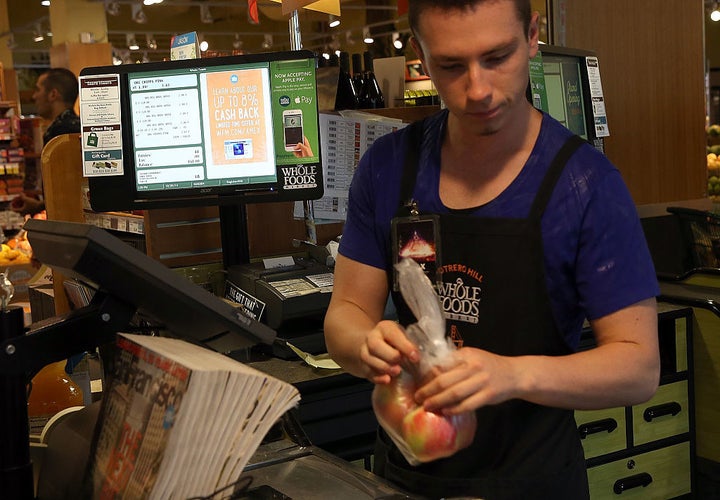
Spencer Platt / Getty Images

Being a “buyer” for Whole Foods — the people who traverse the country finding products to sell on its store shelves — can earn you a certain kind of celebrity status in the food industry.

Getting your product on the shelves at Whole Foods can be a ticket to riches, and when people hawking their all-natural snacks find out a Whole Foods buyer is in the room, the result can look like Kim Kardashian being swarmed by the grocery paparazzi. “You're just a human being, and you need to be able to breathe,” recalls Tim Sperry, a 15-year veteran of Whole Foods who now is a natural food consultant.

But while buyers like Sperry curated Whole Foods' dazzling selection of natural, organic and gourmet foods, the company's technology infrastructure was been far less impressive — a flaw rooted in its history as a highly decentralized business. Whole Foods had 12 different IT systems running across its stores in 2015, when it finally began consolidating them into one, reported pymnts.com. It only unified its point-of-sale system in 2016.

The decentralized management was designed to help stores focus on offering locally grown and made products, a popular selling point for customers. But it reduced the company's ability to crunch the numbers on its overall supply chain, inventory, pricing and sales — all major opportunities for grocery companies trying to master the big data game.

The regional focus also limited its ability to launch a rewards program, a robust mobile app, and other online services that were taking off in other segments of retail.

“IT at Whole Foods has always been weak,” Sperry said. “In the early days, we loved the decentralization…. But when you’re a $15 billion company, you really need to be operating on one platform.”

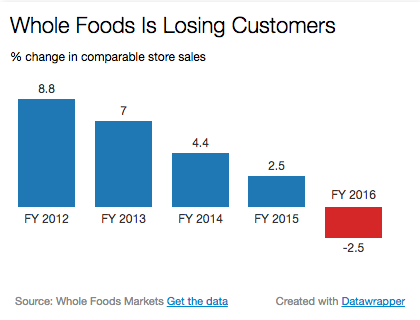
Those struggles, Sperry says, contributed to the overall troubles at Whole Foods in recent years, with the chain losing customers and its stock price slumping. But now, Amazon's $13.7 billion takeover could quickly turn things around.

“This deal puts them lightyears ahead,” said Errol Schweizer, a former Whole Foods executive and industry advisor. “Amazon picks up Whole Foods' experience in perishables, and Whole Foods gets Amazon's data, platform and pricing tools.”

While details are not yet clear, merging with Amazon potentially opens up a vast online customer base for Whole Foods, helping it leapfrog grocery competitors that have also been looking at online sales. Amazon has 80 million US subscribers to its Prime delivery program, and an estimated 42% of all US consumers bought something from Amazon last year according to the NPD Group,

In addition to e-commerce, Amazon is also testing new ways to make brick-and-mortar shopping faster and easier. It runs a checkout-free, grab-and-go store in Seattle, using technology that could eventually be rolled out at Whole Foods stores, which often have long lines.

Justin Sullivan / Getty Images

Whole Foods was trying other ways to keep up with the times — it was one of the first retailers to launch Apple Pay and it partnered with grocery delivery service Instacart in 2014 — but its fragmented tech infrastructure meant it remained fundamentally splintered as competitors from Wal-Mart and Costco to Kroger were rapidly expanding their own natural food offerings.

It also showed a complacency about the threat posed by its biggest competitors. In 2015, as Amazon and Walmart were moving aggressively toward online grocery delivery, its CEO told Bloomberg that he was not worried about the competition, and that online grocery delivery would be “Amazon's Waterloo.”

By 2016, sales at existing Whole Foods stores turned negative. The company declined to comment for this story.

BuzzFeed News

Food manufacturers that now sell to Whole Foods see the deal as an opportunity to reach new consumers, and hopefully shake off the grocer's “whole paycheck” reputation. “Amazon has a brand of offering the best prices to consumers,” said Nona Lim, who makes a line of soups and bone broths that retail for about $5. “Whole Foods is priced competitively, but consumers may not know that because of the impression they have about their pricing. Maybe this can change their perception.”

“Fresh foods are the final frontier for Amazon. And figuring out how to get it to your front door is the ultimate in convenience for consumers. In order for Amazon to get the volume growth they are looking for, fresh foods has to be part of the equation,” David Portalatin, NPD Group's vice president of industry analysis, Food, in an emailed statement. “This deal gives them credibility with consumers and a major foothold in that space.”

Amazon Is Buying Whole Foods, And The Grocery Industry Is In Big Trouble

Amazon's And Whole Foods' Competitors Are Tanking

Quelle: <a href="Whole Foods Is A Luddite Among Retailers. Can Amazon Fix It?“>BuzzFeed

What data scientists can do with better machine learning

Smart companies are finding new ways to squeeze more value out of their massive data storehouses. They’re unlocking insights from their data that build new business models, improve customer experiences and outpace competitors. So where do these business-changing insights come from?
Data doesn’t interpret itself. A table of numbers won’t arrange themselves in a pattern that spells out “here’s what your customers really want.” We look to data scientists to find meaning and value—and those insights can fuel transformation across your business.
Data science itself is undergoing rapid transformation. Early this year, Gartner predicted that nearly half of data science tasks will be automated by 2020.
That’s not alarming. In my view, machine learning won’t just automate data science, it will more profoundly transform and accelerate the businesses that embrace it.
Better machine learning doesn’t replace what data scientists do. But machine learning is building better tools to help them automate processes like discovery and visualization. There’s a huge opportunity for automation to improve the tools that will bring data and data-driven insights outside of analytics organizations. When business users can access and interpret data more effectively, data scientists can focus on more complex data analysis.
It’s no secret that IBM is invested in elevating data science. Year after year, analysts consistently rank IBM as a leader in the data science platform space. We want to give data scientists a platform to share successes and be partners in identifying and overcoming roadblocks.
I hope you’ll join us at Fast Track Your Data – Live from Munich starting June 22, where data science and the impact of machine learning are a core topic. Join IBM and industry leaders for demos, breakout sessions and panels. Highlights include:

Demo: immersive insights from 3-D visualization for the data scientist. IBM data professionals will show how to bring the power of data science tools to Augmented Reality (AR) visualizations helping to improve user experience, data exploration and analysis.
Build smarter apps with data science and app developers. This session will explore collaboration and integration opportunities to connect processes that can fuel business decisions.
Ask a data scientist: A one-on-one experience. Data specialists from the Machine Learning Hub in Germany will be on-hand to tackle problems, answer questions and share best practices.
Mixing oil and water: Getting data scientists and business analysts to work together painlessly. This session will explore ways to help improve collaboration and speed data insights beyond the analytics organization.  

Data scientists are building the data-driven future of business. Machine learning will help them do it. I look forward to sharing ideas and best practices at Fast Track Your Data – Live from Munich. If you can’t make it in person, I hope you’ll join us at the conference through the live stream.
In the meantime, explore more about the IBM data science platform and machine learning.
A version of this article was originally published on the IBM Big Data and Analytics Hub.
The post What data scientists can do with better machine learning appeared first on Cloud computing news.
Quelle: Thoughts on Cloud

Gartner names Microsoft Azure as a leader in the Cloud IaaS MQ

As customers bet more and more on Cloud to drive digital transformation within their organizations, we’re seeing tremendous usage of Azure. Recently, Forbes reported a study done by Cowen and Company Equity Research, and stated that Microsoft Azure is the most used Public Cloud as well as most likely to be renewed or purchased. More than 90 percent of the Fortune 500 use Microsoft’s cloud services today. Large enterprises such as Shell, GEICO, CarMax and MetLife, as well as smaller companies like Medpoint Digital and TreasuryXpress are all leveraging Azure to fuel business growth and reinvent themselves. We strongly believe that the momentum we’re seeing has been possible because of what Azure offers and stands for – a comprehensive and secure Cloud platform across IaaS and PaaS, unparalleled integration with Office 365, unique hybrid experience with Azure Stack, first-class support for Linux and open-source tooling, and a robust partner ecosystem.

Today we’re delighted that Gartner has recognized Microsoft as a leader in their Cloud Infrastructure as a Service (IaaS) MQ for the fourth consecutive year. We’re excited that Gartner continues to recognize Microsoft for completeness of our vision and ability to execute in this key area.

While we’re honored by our placement in the leaders quadrant for Cloud IaaS, we believe many of our customers choose Microsoft not just for our leadership in this area but because of our leadership across a broad portfolio of cloud offerings spanning Software as a Service (SaaS) offerings like Office 365, CRM Online and Power BI in addition to Azure Platform Services (PaaS). It’s the comprehensiveness of our cloud portfolio that gives customers the confidence that that no matter where they’re in their cloud adoption journey, they’re covered with a breadth of solutions for their problems instead of having to work with multiple vendors.

Here’s the list of cloud-related Gartner MQs where Microsoft is placed in the leader’s quadrant:

We look forward to continuously innovating and delivering across our portfolio of cloud offerings, and sincerely believe that every customer – whether big or small, new or seasoned to the Cloud, relying on open-source or otherwise –  has meaningful business value to gain from Azure. If you haven’t dug into Azure yet, here’s an easy way to do it!

If you’d like to read the full report, “Gartner: Magic Quadrant for Cloud Infrastructure as a Service,” you can request it here.

Disclaimer: Gartner does not endorse any vendor, product or service depicted in its research publications, and does not advise technology users to select only those vendors with the highest ratings or other designation. Gartner research publications consist of the opinions of Gartner's research organization and should not be construed as statements of fact. Gartner disclaims all warranties, expressed or implied, with respect to this research, including any warranties of merchantability or fitness for a particular purpose.

**Gartner Magic Quadrants

Gartner Magic Quadrant for Cloud Infrastructure as a Service; Lydia Leong, Raj Bala, Craig Lowery, Dennis Smith; June 17, 2017
Gartner Magic Quadrant for Public Cloud Storage Services, Raj Bala, Arun Chandrasekaran, July 26, 2016
Gartner Magic Quadrant for Access Management, Gregg Kreizman, Anmol Singh, June 7, 2017
Gartner Magic Quadrant for Business Intelligence and Analytics Platforms, Rita Sallam, Cindi Howson, Carlie Idoine, Thomas Oestreich, James Laurence Richardson, Joao Tapadinhas, February 16, 2017
Magic Quadrant for the CRM Customer Engagement Center, Michael Maoz, Brian Manusama, May 8, 2017
Magic Quadrant for Data Management Solutions for Analytics, Roxane Edjlali, Adam Ronthal, Rick Greenwald, Mark Beyer, Donald Feinberg, February 20, 2017
Magic Quadrant for Enterprise Agile Planning Tools, Thomas E. Murphy, Mike West, Keith James Mann, April 27, 2017
Magic Quadrant for Horizontal Portals, Jim Murphy, Gene Phifer, Gavin Tay, Magnus Revang, October 17, 2016
Magic Quadrant for Mobile Application Development Platforms, Jason Wong, Van Baker, Adrian Lowe, Marty Resnick, June 12, 2017
Magic Quadrant for Operational Database Management Systems, Nick Heudecker, Donald Feinberg, Merv Adrian, Terilyn Palanca, Rick Greenwald, October 5, 2016
Magic Quadrant for Sales Force Automation, Tad Travis, Ilona Hansen, Joanne Correia, Julian Poulter, August 10, 2016
Magic Quadrant for Unified Communications, Bern Elliot, Megan Marek Fernandez, Steve Blood, July 13, 2016
Magic Quadrant for Web Conferencing, Adam Preset, Mike Fasciani, Whit Andrews, November 10, 2016

Quelle: Azure