Drivers In NYC Feel Cheated By Juno, Which Promised To Save Them From Uber

Juno&;s first birthday cake.

Juno

Juno, a ride-hailing upstart in New York City, promised to be a savior for drivers. While Uber and Lyft employ drivers as independent contractors, Juno said it would give drivers the option of being full-time employees, and it doled out promises of equity. “Can this ride-sharing start-up kill Uber with kindness?” Vanity Fair asked. “You get to take more money home and put food on the table with Juno,” Talmon Marco, Juno’s chief executive, told BuzzFeed News in July.

On Wednesday, Juno was acquired by Gett, another ride-hailing company based in New York, for $200 million. And now, it’s terminating the stock program that the company had said “gives you, the driver, an opportunity to become a Juno shareholder and benefit from the company’s future potential success if it goes public or is sold.”

“We helped them build the startup and they cashed the money and ran away,” said Ahmed Hashem, who drives for Juno, Uber, and Lyft in New York. “They’re all the same – Uber, Lyft, Juno, Gett. We are slaves.”

Spokespeople for Juno and Gett did not return a request to make Talmon available for an interview, and they didn&039;t comment in response to drivers&039; complaints.

Drivers who sign up to drive for the new service – Juno by Gett – will instead be offered cash bonuses based on how much they’ve driven. In July, Talmon told BuzzFeed, “The plan is definitely to take the company public when it makes sense so our drivers can actually get something out of these [shares].”

Juno launched in NYC in beta mode last year and said it reached 1 million rides in August. To gain riders in a market saturated with taxis, Uber and Lyft, it appealed to the hearts of drivers by pledging to be “socially responsible” – a move that capitalized on Uber’s poor reputation among drivers. Drivers who referred new riders to the app – for example, by telling their Uber riders about Juno – received bonuses. Now, those same drivers told BuzzFeed they feel used by the company.

Hashem received an email from Juno on Wednesday about the sale to Gett. The company told him his 14,173 RSUs would instead amount to a cash bonus of $251.

“I’m going to still continue working for them, but I’m not going to give them all my time. I have Uber, I have Juno, I have Lyft,” Hashem said. “They cheated us.”

“Given the actions of driving apps to date, it comes as little surprise that Juno is cashing out, leaving the drivers who helped build the company with next to nothing. This latest bait-and-switch underscores the need for industry-wide protections to ensure a living wage for drivers in the face of deceptive tactics, empty promises, and manipulation from ride-hail apps,” said Ryan Price, executive director of the Independent Drivers Guild, which represents and advocates for 50,000 ride-hail drivers in NYC.

Regardless of the sale to Gett, Juno said in the email to drivers that its stock program had faced scrutiny from a securities regulator. Juno had already been considering whether the previously granted shares to drivers were “void.” Asked to comment further on the regulatory issues raised by the Securities and Exchange Commission, a spokesperson for Juno did not return a request for comment. The SEC did not immediately return a request for comment.

Quelle: <a href="Drivers In NYC Feel Cheated By Juno, Which Promised To Save Them From Uber“>BuzzFeed

Amazon's New Device Will Tell You How Your Ass Looks In Those Jeans

Amazon

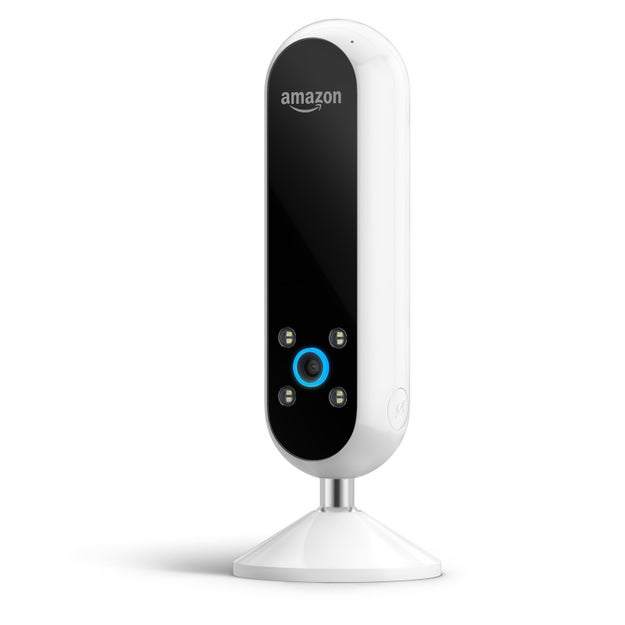
Today in Bizarre Gadget News: Amazon has unveiled a hands-free camera, powered by its voice-activated assistant Alexa, called Echo Look. It’s essentially an Amazon Echo speaker with eyes and no fear about telling you how your ass really looks in those jeans. The 5MP camera can sit atop a dresser or be mounted on a wall, and there’s a speaker, mic, and four LED lights built-ins. It also kind of looks like the dildo version of Eve from Wall-E.

An Internet-connected device with video and audio capture that you set up where you get dressed — what could go wrong?&; Crucial note: There’s a camera/mic mute button on the side.

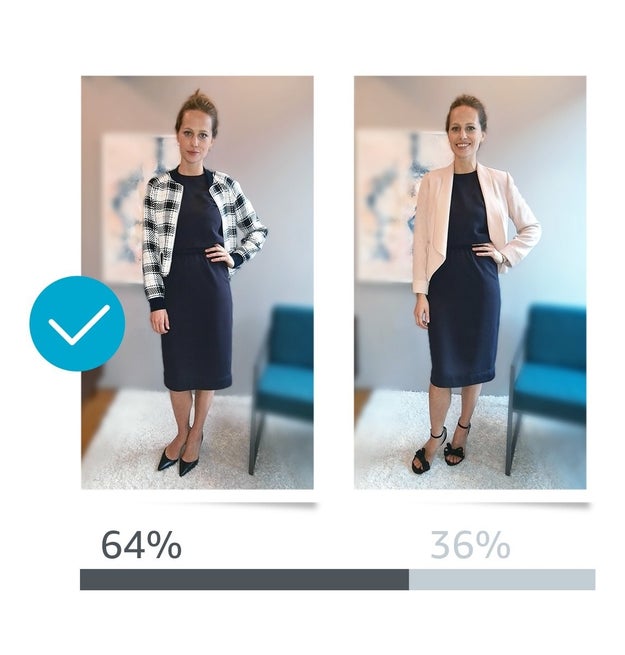
The Echo Look’s marquee feature is “Style Check,” which uses “advanced machine learning algorithms” and advice of unidentified fashion specialists to determine which outfit looks best on you, “based on current trends and what flatters you,” kind of like a bizzaro version Cher’s wardrobe software from Clueless. You can also give Style Check feedback, which I imagine gets fed into some unique Amazon user profile to inform what kind of clothes will get recommended to you when you visit Amazon.

Amazon did not immediately respond to an inquiry about how the device will support its other businesses.

The Echo Look appears to target people who take photos of their ~lewk~ (like fashion bloggers). By saying, “Alexa, take a photo,” you can take “full-length photos and short 360º videos” of your outfit of the day. The photos are then uploaded to the Echo Look app. You can use the camera’s so-called “computer vision” software to blur the the background and make your pic look more professional and less like it was taken from, oh say, a voice-activated camera. Then you presumably share it on Instagram and slap on an #ootd hashtag?

Amazon

Aside from obvious privacy/surveillance concerns, the fundamental question is whether you trust an e-commerce and electronics company in Seattle to tell you what to wear. My hunch is, at least at first, no. But maybe I’m just afraid that trusting software will catalyze our transformation into a homogenous, J. Crew wearing society. And what if Style Check always chooses skinny jeggings over loose fit vintage jeans because it’s “more slimming”? That feels wrong.

If you saw this product announcement and never clicked on something so fast, @ me asap. This thing feels like such a classic example of solving a problem that really didn’t exist.

The Echo Look is the first major Echo release since the first-generation Echo Dot in March 2016 (the second-generation was basically the same thing, but cheaper). You can also do regular Alexa stuff with the Echo Look: “Alexa, turns the lights off,” “Alexa, will it rain today,” “Alexa, set a timer for seven minutes,” etc. It’s the most expensive Echo at $200 (the Echo speaker is $180 and the Dot is $50), but is currently only open via invitation.

If you love your frumpy vintage jeans, buy at your own risk.

Amazon

Quelle: <a href="Amazon&039;s New Device Will Tell You How Your Ass Looks In Those Jeans“>BuzzFeed

Blue Apron Has “Concerns” Over Proposed Food Safety Regulation

Portland Press Herald / Getty Images

Blue Apron hired lobbyists to push back against a California State Assembly bill aimed at expanding state-mandated food safety training to include employees in the emerging meal-kit delivery space.

The goal of the bill is to require employees of these businesses to obtain food-handler cards, a type of food safety certification already required in restaurants and other food-prep jobs. The bill is sponsored by the UFCW, a major food and grocery union, and authored by Assemblyman Tony Thurmond, who represents the district where one of Blue Apron’s facilities is located.

“We&;re acknowledging that there&039;s a growth of a new way of handling food, and raising the question: Why not utilize the same best practice that we used in traditional food handling to ensure that these new companies are handling food in good ways, and keep the public safe?” Thurmond told BuzzFeed News.
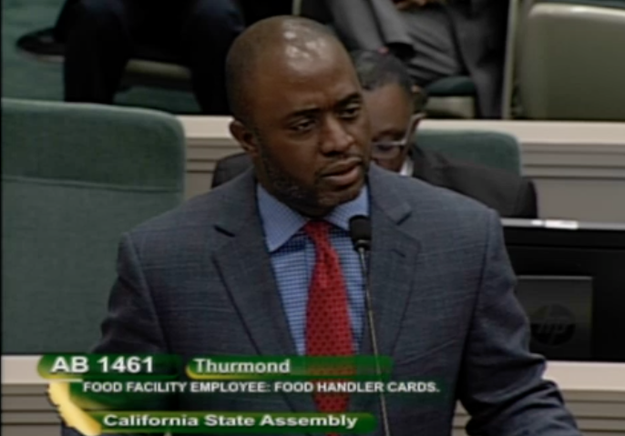
Assemblyman Tony Thurmond presents his food safety bill at a Health Committee hearing last week.

Via calchannel.granicus.com

But Blue Apron has “concerns” about the bill. The company hired a lobbyist, Mercury Public Affairs&039; Duncan McFetridge, to represent it at a Health Committee hearing on Thurmond’s bill last week. “We see this as being redundant, superfluous, and unnecessary to the business, and moreover, we frankly don’t see how this language as crafted even touches us,” he said at the hearing.

Blue Apron told BuzzFeed News via email that it doesn’t formally oppose the proposed legislation. In fact, the company argues, as written, the bill doesn’t even apply to it, because Blue Apron is a food-processing facility, not a food retailer. It says food-processing facilities have higher safety standards than food retailers and that it hired McFetridge to “advocate for the continued statutory distinction” between the two. (Representatives from Mercury Public Affairs did not return multiple requests for comment for BuzzFeed News.)

Furthermore, Blue Apron said food safety is “paramount” and it provides “targeted instruction on areas such as temperature control, personal hygiene, and cleaning and sanitation,” and that it “also provide detailed training in allergen controls, equipment handling, inventory management, and other food safety practice.”

The language of the bill and which companies it pertains to will continue to be debated as it makes its way through the California State Assembly; it will be heard by the Appropriations Committee sometime in May.

But the union that sponsored the bill said in a press release that it is aimed at companies “like Blue Apron, Plated and Gobble,” which it says need additional oversight.

“This bill is necessary to help clarify that companies like Blue Apron need to be regulated by the state. They can&039;t hide behind federal regulation, or that they are only a food-processing entity. They&039;re not — they advertise directly to consumers,” a spokesperson for the union told BuzzFeed News.
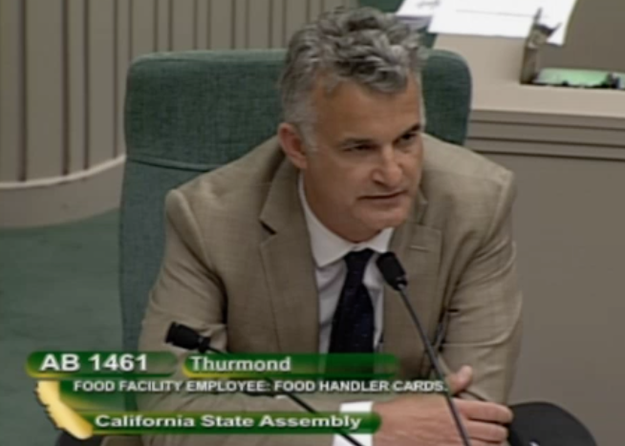
Mercury Public Affairs lobbyist Duncan McFetridge comments on behalf of Blue Apron at a California State Assembly Health Committee hearing last week.

Via calchannel.granicus.com

So far, Blue Apron is the only meal-kit company that’s weighed in on the proposed food-safety training regulation — but it’s not the only one that could be affected. At least 10 similar companies operate distribution centers in California, including HelloFresh, Home Chef, Plated, and Purple Carrot.

At least two of Blue Apron’s competitors with facilities in California — El Segundo’s Chef’d and Stockton’s Gobble Inc. — told BuzzFeed News that they already require their employees to get food-handler cards. A third, Sunbasket, said if the bill passed in California, it would readily comply.

“We’re not opposing it,” said Gobble CEO Ooshma Garg of the legislation. “And prior to this bill being proposed, we’ve been abiding by these standards. When you walk in the door, you can see a book of everyone’s food-handler cards.” Purple Carrot declined to comment on this story; Plated, HelloFresh, Amazon, Good Eggs, Marley Spoon, and Home Chef did not respond to a request from BuzzFeed News. The food-handler training program entails a small fee and a short online training course.

Prior to authoring this bill, Assemblyman Thurmond toured Blue Apron’s facility in Richmond. With regard to the food-handler card program, Thurmond told BuzzFeed News, “I think it is really good training.”

“I think it&039;s a skill they could use at Blue Apron, or anywhere in the industry. Being able to have a food-handler card is a real tangible skill. To me, that&039;s a way you can earn more money. You can say, ‘I have experience handling food in a way that is safe.&039; I think it would be a good thing for anybody that&039;s handling raw food, or anyone that&039;s working in the food-handling sector,” he said.

Thurmond also told BuzzFeed News that he asked to review Blue Apron’s training materials but had not yet received a copy.

Though Blue Apron has struggled at times to meet standards set by workplace health and safety regulators — it is currently contesting a total of 14 violations and more than $18,000 in proposed penalties from the California Division of Occupational Health and Safety — the company has passed every food safety inspection it has undergone. Blue Apron first registered with and was inspected and approved by the California Department of Public Health in October, following a BuzzFeed News investigation published the same month. The company is reportedly planning to go public this year.

“We&039;re not opposed to innovation,” Thurmond said during last week’s hearing. “This is a new area for how raw food is handled and packaged, and we&039;re saying this is an opportunity to err on the side of caution and provide additional training to those who are working in this new area.”

You can view a recording of the California State Assembly Health Committee hearing for Thurmond&039;s food-safety regulation bill below.

You can view a recording of the California State Assembly Health Committee hearing for Thurmond’s food-safety regulation bill here:

View Video ›

video-cdn.buzzfeed.com

Quelle: <a href="Blue Apron Has “Concerns” Over Proposed Food Safety Regulation“>BuzzFeed

A Local Government Just Blocked Social Media In Kashmir For A Month

Police fired into a crowd of stone-throwing students in Indian-administered Kashmir on April 24, as violence in the disputed region intensified.

Tauseef Mustafa / AFP / Getty Images

On Wednesday, the Indian state of Jammu and Kashmir suddenly imposed a month-long block on 22 social media and instant messaging services for citizens living in the conflict-ridden Kashmir Valley. These include Facebook, Twitter, WhatsApp, Snapchat, Skype, Pinterest, Telegram, and Reddit, among others, some of which locals rely on for day-to-day communication. This is just the latest internet shutdown in a region where the local government has throttled or blocked internet access dozens of times the past five years.

According to the government order issued Wednesday, these services were “being misused by anti-national and anti-social elements” in the Valley to disturb “peace and tranquility.” A WhatsApp spokesperson declined to comment. None of the other companies affected immediately responded to BuzzFeed News’ requests for comment. R K Goyal, the Kashmir government official who signed the order, did not respond to repeated requests for comment from BuzzFeed News.

Violence-ridden Kashmir, which both India and Pakistan claim as their own territory, has been plagued for decades by clashes between local residents and the Indian army in India-administered Kashmir. Both countries have gone to war over the disputed territory thrice since they were partitioned in 1947. A 2008 Reuters report puts the death toll at 47,000 from nearly two decades of insurgency against the Indian government in Kashmir. In recent times, Kashmir’s government has resorted to turning off parts of the internet or blocking access entirely to discourage people from mobilising and, it claims, to prevent misinformation and hoaxes from spreading.

Kashmir has had 31 internet shutdowns since 2012.

During protests related to the death of a well-known separatist leader called Burhan Wani in 2016, young men from Kashmir reportedly broadcast violence by the Indian army on Facebook Live. Shortly after, the state government turned off internet services in the Valley for over six months.

Kashmir has had 31 internet shutdowns since 2012, according to an internet shutdown tracker created by New Delhi-based non-profit Software Law and Freedom Centre (SFLC), which counts both full blocks as well as partial blocks on services as shutdowns. Last week, the Kashmir government turned off 3G and 4G access in the state for a day after hundreds of student protesters threw rocks at the police and chanted anti-India slogans.

“The idea [behind the shutdowns] is to prevent unlawful assembly or any disturbance,” SFLC director Mishi Choudhary told BuzzFeed News. “But there’s simply no data available to assess whether they are actually effective.”

Muhammad Faysal, the 25-year-old founder of WithKashmir.org, a blogging platform for “opinionated Kashmiris,” told BuzzFeed News these bans make it difficult for his site to stay online. Since it launched in December 2016, internet access in Kashmir was shut down for varying lengths of time four times. “Banning internet access is not a preventative measure when it happens so often,” Faysal said. “It’s a collective punishment — a way to crush dissent.”

Some residents of the Valley also say that these internet clampdowns hurt Kashmir’s nascent online startup industry. “Our business is driven by social media,” said Muheet Mehraj, co-founder of KashmirBox, a Srinagar-based startup that sells handicrafts from local artists through its website. “A lot of small entrepreneurs like us don’t have marketing budgets to advertise on the internet, so access to social media is crucial for us.” Mehraj said he’ll send a small team of KashmirBox employees to Delhi to keep operations running. “But we work closely with a lot of vendors from Kashmir, so the next month is going to be tough.”

“Platforms like WhatsApp, Facebook and Twitter are 90% of our social lives. That’s what you’re taking away when you block them.”

The law the Kashmir government used to enforce this most recent social media ban is the Indian Telegraph Act, which was created in 1885 when India was still under British rule. It allows the Indian government and law enforcement agencies to monitor both wired and wireless telephone and radio messages under certain conditions. But some technology experts say the Telegraph Act doesn’t apply to internet messaging ever since a controversial section of India’s IT Act from 2000 empowered the federal government, but not state governments, to selectively block websites and internet services. Under the IT Act, Kashmir’s state government isn’t permitted to enforce this kind of internet block.

“What’s happening in Kashmir is illegal and is against people’s freedom of expression,” said Pranesh Prakash, policy director at the Centre for Internet and Society, a Bangalore-based think tank.

For years, said Faysal, the India’s federal government has been painting people living in the Kashmir Valley in a certain way — “terrorists, anti-India, pro-Pakistan, and secessionist.”

“Social media has allowed Kashmiris to humanize their struggles through photos and videos. In a region torn by violence, platforms like WhatsApp, Facebook and Twitter are 90% of our social lives. That’s what you’re taking away when you block them.”

Quelle: <a href="A Local Government Just Blocked Social Media In Kashmir For A Month“>BuzzFeed

3 imperatives for self-service in a multicloud environment

The advent of cloud-based platform services has dramatically expanded the options available to developers. While many developers have flocked to cloud-based development tools, others continue to use on-premises development environments.
What has become clear is that there is no single development platform or cloud deployment model that fits every situation. With the advent of the hybrid cloud, developers have never had more options. IT management can get caught in a difficult situation of having to please multiple groups of constituents. It must provide departmental developers with the options they need to quickly develop new solutions while maintaining security, governance and cost control.
While self-service is fairly straightforward in a single cloud environment, it can be much more complicated across multiple clouds and cloud services. Administrators must decide which teams should have access to which services. For example, a team that routinely handles personal information might be restricted to on-premises services. Alternatively, teams working on developing mobile applications might receive access to a variety of public cloud services. Each environment needs its own self-service interface and environment. The challenge is to provide an overall self-service interface across cloud development tools.
But enabling self-service is more than simply providing an interface to access the right image from a public cloud service. Increasingly, we are moving to a world where companies are using microservices and a variety of application and data services to help developers quickly create new applications in quickly changing markets. Creating new applications from highly-distributed services requires coordination among a variety of elements: basic cloud compute, storage, complex application services, data services, security and governance.
Below are three imperatives that businesses can achieve by implementing a multicloud self-service environment.
1. A consistent way to evaluate options
Users need to have a way to evaluate their options and choose the best cloud environment that meets their technical and financial requirements. A self-service portal will expose the options that are appropriate for that developer based on the type of data that is involved, their workload requirements and cost restrictions. The developer can read a brief description of each service, assess the tools that are available on that service and decide if it will fulfill their needs.
2. Balance control while allowing choice
Executive management should make sure they retain overall visibility and control of costs and governance. At the same time, developers want to the freedom to choose the platforms that meets their immediate needs. By giving developers choice, organizations are avoiding the problem of “shadow IT.”
3. Allow DevOps teams to focus on creativity and coding
Business leaders don’t want DevOps teams investing time setting up environments, selecting tools and environment teardowns. Instead, teams should be focused on rapidly improving applications, responding to feedback and creating new services. A self-service, multicloud environment with automation allows teams to quickly spin up tested images so that they can focus on coding.
There’s only one way to pragmatically approach the complexities of a multicloud environment: create a self-service portal that is designed with well-defined APIs. This self-service portal must include rules that assist developers in selecting the most appropriate service. All of these services need to be managed with a carefully-vetted catalog so that only approved services are used.
A self-service portal provides a predictable and safe environment to ensure that a business can create innovation at the pace of change. To be successful, the business demands ease of use for the developer with the right safeguards to protect the integrity of the business. The portal brings together the tools for the developers in context with the deployment models needed to support scalability and protection.
To learn about IBM Cloud Automation Manger, visit ibm.biz/tryICAM. The first version of IBM Cloud Automation Manager is now available on IBM Bluemix and supports IBM Cloud and other public cloud offerings.
The post 3 imperatives for self-service in a multicloud environment appeared first on news.
Quelle: Thoughts on Cloud

We’re In An Artificial Intelligence Hype Cycle

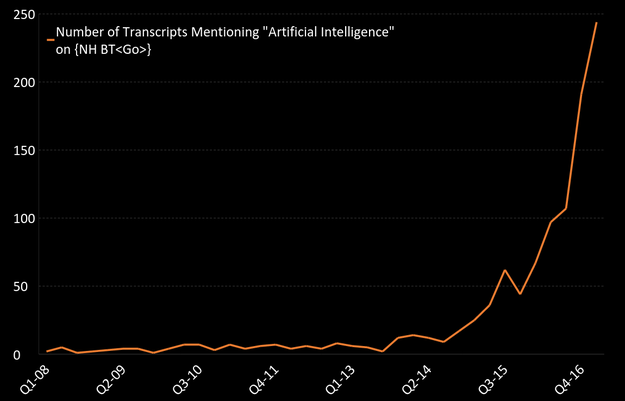
Artificial intelligence mentions in corporate earnings calls are going through the roof.

Bloomberg

The hype around artificial intelligence is skyrocketing. After going nearly-unmentioned in corporate earnings calls four years ago, the promising technology is name-checked far more frequently in such calls today.

Just six companies mentioned AI in their earnings calls in the first quarter of 2013, according to data compiled by Bloomberg. But by the first quarter of 2017, their number had increased to 244. And between the third and fourth quarters of 2016, the number of companies name-checking AI during earnings calls rose to 191 from 107. The data comes from Bloomberg transcript wire and covers hundreds of thousands of public earnings call transcripts.

“The hype and the expectations in some cases are far beyond the technical reality.”

“We’re in a hype cycle,” Oren Etzioni, CEO of the AIlen Institute for Artificial Intelligence, told BuzzFeed News. “The hype and the expectations in some cases are far beyond the technical reality.”

Artificial intelligence is being mentioned on earnings calls by executives at companies with big AI research operations like Facebook and Alphabet. But it’s also rolling off the tongues of executives at companies you might not expect — Starbucks and Mastercard, for example.

AI’s new role in earnings calls is largely aspirational, Etzioni argued, noting that artificial intelligence is not plug and play, and typically requires a good deal of labor to develop and implement. “It’s not like now we have hundreds of companies delivering cutting edge AI applications,” Etzioni said. “It’s more the case that they perceive the potential.”

Etzioni was careful to note that real progress in artificial intelligence field undergirds the current wave of optimism, but cautioned that too much enthusiasm could be problematic. The hype puts the AI field is at risk of another “AI Winter,” a period in which AI scientists’ failure to deliver on outsized expectations causes funding to dry up, along with technological progress. The last such winter occurred in the 1990s.

“[If] AI is currently the flavor of the month, we could swing back to an AI winter where the government and major corporations will decline to invest,” Etzioni said. But he also cautioned against dismissing true AI progress out of hand. “The challenges we’re going to have in the transportation sector of job losses there — that’s not hype,” Etzioni said. “That’s coming soon and we need to address it.”

LINK: Meet The Man Who Makes Facebook’s Machines Think

Quelle: <a href="We’re In An Artificial Intelligence Hype Cycle“>BuzzFeed

Here's What We Know About The FCC's Plan To Roll Back Net Neutrality

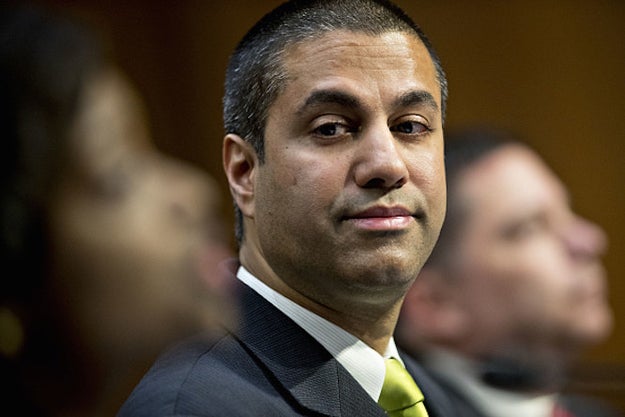
Ajit Pai, chairman of the Federal Communications Commission (FCC)

Andrew Harrer / Getty Images

FCC Chairman Ajit Pai outlined his plan to roll back net neutrality rules during a speech at the Newseum in Washington, DC today.

The proposal Pai outlined has three parts: First, he plans to reclassify the internet as an information service, as it was classified under President Clinton, rather than a telecommunications service. When the FCC passed net neutrality rules in 2015 and reclassified internet companies as a kind of public utility, like telephone companies, it gave the commission more solid legal footing to impose tighter regulations.

Pai said he also plans to do away with the Internet conduct standard, which he characterized as “a roving mandate to micromanage the Internet.” The standard was used to investigate whether or not data cap exemptions (like those T-Mobile and Comcast sometimes offered customers) unfairly favored some content over others.

Pai is also seeking to overturn the “so-called bright lines rules” of neutrality, which prevent ISPs from blocking websites and services, slowing them down, or creating internet “fast lanes” for certain services and content in exchange for a premium.

David Segal, executive director of the internet activism nonprofit Demand Progress, called the announcement “outrageous.” “Millions of Americans as well as internet companies, startups, innovators, and nonprofits have supported the order. The order’s main opponents are large ISPs that have made it clear they want to subvert the public interest by manipulating internet traffic to benefit corporate bottom lines,” he said in a statement.

Pai, who was nominated to his position as chairman of the FCC by President Trump, was formerly general counsel for Verizon. The argument he and other opponents of net neutrality make is that regulating the internet as though it were a public utility puts a damper on competition, making it harder for small businesses to grow.

In his speech Wednesday, Pai argued that his proposed rules would help increase investment in building networks. “More Americans will go to work building these next generation networks,” said Pai. “These are good, paying jobs — laying fiber, connecting equipment to utility poles, and digging trenches.”

Pai argued that Google, Facebook and Netflix became some of the “world’s most successful online companies” as a result of the more lenient internet regulation that existed prior to 2015. But earlier this month, representatives from those three companies met with Pai via a trade organization called the Internet Association, and asked him to support net neutrality, which they argued, “preserves the consumer experience, competition, and innovation online.”

Pai&;s proposal isn&039;t likely to pass without a fight. Several other tech companies, including Vimeo and Mozilla, have also spoken out against Pai&039;s proposal. And activist groups like Fight for the Future, which advocates for net neutrality and was part of an effort to get 3.7 million people to file comments on net neutrality with the FCC in 2014, are also gearing up for a fight.

“Pai’s speech was an insult to the intelligence of internet users,” said campaign director Evan Greer in an email statement. “He attempts to portray basic free speech protections as heavy handed government regulation.”

Pai will formally introduce his Notice of Proposed Rulemaking to the FCC on Thursday; the proposal will be discussed at a committee meeting on May 18th, after which it will be open to public comment. “In other words, this will be the beginning of the discussion, not the end,” Pai said during his live-streamed speech on Wednesday.

Quelle: <a href="Here&039;s What We Know About The FCC&039;s Plan To Roll Back Net Neutrality“>BuzzFeed