How businesses can get the cognitive edge

The buzz in the computing industry is all about cognitive.
My clients are at various stages of understanding its implications. They want to know what cognitive truly is and how it solves real business challenges.
So what is cognitive?  As many observers have noted, it’s not a specific product. Instead, it’s an era that includes multiple vendors and various technologies. The move to this new era is driven by changes in the data landscape. Cognitive computing is vital to turning zettabytes of data into meaningful information. It enables computers to understand, reason and learn without a person programming everything to achieve answers.
For a business, cognitive’s implications are enormous. It is the “disruptive enabler.”
IBM has identified five areas where a business can benefit now if it starts building a cognitive business:

Drive deeper engagement. Help clients behind the scenes for better customer experience.
Scale expertise. Companies spend lots of money training employees. This can be scaled more effectively.
Put learning in every product. Build products that adapt to each customer&;s needs.
Change operations. Streamline your supply chain to help margins.
Transform how discovery is done. From pharmaceuticals to financial industries, research will be the foundation of how many companies work in the future.

In our survey of companies on a cognitive journey, the results were profound. For advanced users, the gains in customer engagement and the ability to respond faster to market needs were nearly doubled compared to beginners. Improvements to productivity and efficiency were just as significant.
For example, Mueller, a privately held company that employs 700 people across four manufacturing and distribution centers in the south-central United States, has implemented cognitive systems to assist with revenue forecasting, supply chain management, marketing, employee health and safety, and talent management. Within 12 months, one solution returned 113 percent on investment, creating a net annual benefit of more than $780,000, and reducing scrap metal waste by 20 to 30 percent. Another solution reduced the time spent creating reports by more than 90 percent, while a third solution resulted in a 90 percent improvement in the time to value in data processing.
USAA, a financial services company, provides banking and insurance services to 10.4 million past and present members of the US armed forces and their immediate family members. To better service these customers, USAA has implemented an innovative cognitive computing solution that uses IBM Watson. The solution enables transitioning military members to visit usaa.com or use a mobile browser to ask questions specific to leaving the military, such as “Can I be in the reserve and collect veterans compensation benefits?” or “How do I make the most of the Post-9/11 GI Bill?” As a result, USAA can provide customers comprehensive answers to complex questions in a non-judgmental environment.
WellPoint (now part of Anthem), one of the largest health benefits companies in the United States, delivers numerous health benefit solutions through its networks nationwide. For complex decisions, patients can often wait weeks for the clinical review to occur, and a lack of available evidence or ability to process in a timely fashion can delay treatment or lead to errors. To address this business challenge, WellPoint implemented a cognitive computing solution powered by IBM Watson that provides decision support for the pre-authorization process. Providing these decision support capabilities and reducing paperwork gives clinicians the chance to spend more time with patients.
These are the competitive business advantages an enterprise needs: the capabilities to transform business processes, impact business outcomes and engage customers in the new era ahead.
This fundamental change in computing needs leading-edge providers to drive it. We agree with research analysts at Gartner who said in their latest report that the IBM approach to cognitive computing is “likely to be one of the most attractive platforms in the future.&;
If your business hasn’t done so already, now’s the time to start your cognitive journey.
Learn more about cognitive capabilities with IBM Watson.
The post How businesses can get the cognitive edge appeared first on news.
Quelle: Thoughts on Cloud

Better VM Rightsizing Recommendations with the Stackdriver Agent

By Pawel Siarkiewicz, Product Manager

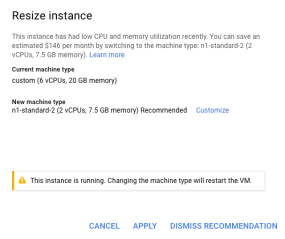
We launched the VM Rightsizing Recommendations beta in July of 2016 and since then many users have taken advantage of it to achieve savings or more optimal machine shapes.

Until recently, Rightsizing Recommendations were based solely on the CPU and memory statistics visible to the Compute Engine virtual machine manager. This approach works well for CPUs that can be accurately monitored, but is fairly limited for memory. There, the challenge is that the virtual machine manager has no insight into how the guest operating system manages the memory and what part is allocated for processes and caches, etc. Without understanding what exactly is happening inside a VM instance, a recommendation can’t be tailored to the real memory usage.

Recommendations without visibility to how the accessed RAM is used

This is where the Stackdriver Agent comes in. When you install it on your VM instance, the Stackdriver Agent exports additional metrics to our monitoring system. These metrics allow the Rightsizing Recommendations system to accurately determine how much memory is allocated by processes vs. operating system caches and how much memory it freed up. This, in turn, allows us to calculate recommendations that more closely match the real workload.

Stackdriver Agent-based recommendations with a look through to the used RAM

Is there a real benefit to the user? Absolutely! When comparing RAM recommendations made with and without the Stackdriver Agent, we see that on average the Agent-based recommendations save 50% more memory, and in some cases, even more. The agent provides better visibility, giving the Rightsizing Recommendations system more and better data to work with, which results in tangible savings to users.

If you wish to get started with Stackdriver Agent-based recommendations, just install the agent on your VMs. The additional metrics will be automatically used for Rightsizing Recommendations and you don’t even need a Stackdriver account.

Quelle: Google Cloud Platform