Announcing public preview of Instance Metadata Service

We are excited to announce the public preview of Instance Metadata Service in Azure’s West Central US region. Instance Metadata Service is a RESTful endpoint that allows virtual machines instances to get information regarding its compute, network and upcoming maintenance events. The endpoint is available at a well-known non-routable IP address (169.254.169.254) that can be accessed only from within the VM. The data from Instance Metadata Service can help with your cluster setup, replica placement, supportability, telemetry, or other cluster bootstrap or runtime needs. 

Previews are made available to you on the condition that you agree to the terms of use. For more information, see Microsoft Azure Supplemental Terms of Use for Microsoft Azure Previews.

Service Availability

Service is available to all Azure Resource Manager created VMs currently in West Central US region. As we add more regions we will update this post and the documentation with the details.

Regions where Instance Metadata Service is available

West Central US

Detailed documentation

Learn more about Azure Instance Metadata Service

Retrieving instance metadata

Instance Metadata Service is available for running VMs created/managed using Azure Resource Manager. To access all data categories for an instance, use the following sample code for Linux or Windows

Linux

curl -H Metadata:true http://169.254.169.254/metadata/instance?api-version=2017-03-01

Windows

curl –H @{‘Metadata’=’true’} http://169.254.169.254/metadata/instance?api-version=2017-03-01

The default output for all instance metadata is of json format (content type Application/JSON)

Instance Metadata data categories

Following table has a list of all data categories available via Instance Metadata

Data
Description

location

Azure Region the VM is running

name
Name of the VM

offer
Offer information for the VM image, these values are present only for images deployed from Azure image gallery

publisher
Publisher of the VM image

sku
Specific SKU for the VM image

version
Version of the VM Image

osType
Linux or Windows

platformUpdateDomain
Update domain the VM is running in.

platformFaultDomain
Fault domain the VM is running in.

vmId
Unique identifier for the VM, more info here

vmSize
VM size

ipv4/Ipaddress
Local IP address of the VM

ipv4/publicip
Public IP address for the Instance

subnet/address
Address for subnet

subnet/dnsservers/ipaddress1
Primary DNS server

subnet/dnsservers/ipaddress2
Secondary DNS server

subnet/prefix
Subnet prefix , example 24

ipv6/ipaddress
IPv6 address for the VM

mac
VM mac address

scheduledevents
see scheduledevents


FAQs

I am getting Bad request, Required metadata header not specified. What does this mean?
Metadata Service requires header of Metadata:true to be passed in the request. Passing header will allow access

Why  am I not getting compute information for my VM?
Currently Instance Metadata Service supports Azure Resource Manager created instances only, in future we will add support for Cloud Services VMs

I created my Virtual Machine through ARM a while back, Why am I not seeing compute metadata information?
For any VMs created after Sep 2016 you can simply add a new Tag to start seeing compute metadata. For older VMs (created before Sep 2016) you would have to add/remove extensions to the VM to refresh metadata

Why am I getting error 500 – Internal server error?
Currently Instance Metadata Preview is available only in West US Central Region, please deploy your VMs there.

Where do I share Additional questions/comments?
Send your comments on http://feedback.azure.com

Quelle: Azure

4 characteristics that set blockchain apart

I speak to lots of customers who are using or thinking of using blockchain.
Depending on who you speak to, blockchain is either a new power poised to change the way we do business or the latest IT hype.
I believe blockchain has characteristics which mark it as something transformative, perhaps even more transformative than the web.
At its core, blockchain is just a database, one that is particularly good at dealing with transactions about assets, whether they’re financial assets, physical assets such as cars, or something more abstract like customer data.
But blockchain has four key characteristics which make it different:

It is designed to be distributed and synchronized across networks, which makes it ideal for multi-organizational business networks such as supply chains or financial consortia. It also encourages organizations to come out from behind their firewalls and share data.

You can&;t just do whatever you want to the data. The types of transactions one can carry out are agreed between participants in advance and stored in the blockchain as “smart contracts,” which helps give confidence that everyone is playing by the rules.

Before one can execute a transaction, there must be agreement between all relevant parties that the transaction is valid. For example, if you&8217;re registering the sale of a cow, that cow must belong to you or you won&8217;t get agreement. This process is known as “consensus” and it helps keep inaccurate or potentially fraudulent transactions out of the database.

Immutability of the data. Once you have agreed on a transaction and recorded it, it can never be changed. You can subsequently record another transaction about that asset to change its state, but you can never hide the original transaction. This gives the idea of provenance of assets, which means that for any asset you can tell where it is, where it&8217;s been and what has happened throughout its life.

Taken together, these four characteristics give organizations a high degree of trust in the data and the business network. That level of trust makes blockchain important for the next generation of business applications.
To understand why, one must understand the nature of trust. To do that, I’m going to take a short detour through 25 centuries of human economic history in my next post.
Learn more about the IBM cloud-based blockchain platform.
The post 4 characteristics that set blockchain apart appeared first on news.
Quelle: Thoughts on Cloud

Azure #DocumentDB Service Level Agreements

Why enterprises trust us for their globally distributed applications.

Enterprise applications and massive scale applications need a data store that is globally distributed, offers limitless scale, geographical reach, and is fast and performant. Along with enterprise grade security and compliance, a major criterion is the level of service guarantees the database provides in terms of availability, performance, and durability. Azure DocumentDB is Microsoft’s globally distributed database service designed to enable you to build planet-scale applications, enabling you to elastically scale both throughput and storage across any number of geographical regions. The service offers guaranteed single-digit millisecond low latency at the 99th percentile, 99.99% high availability, predictable throughput, and multiple well-defined consistency models.

We recently updated our Service Level Agreements (SLA) to make them comprehensive to include latency, availability, throughput, and consistency. By virtue of its schema-agnostic and write-optimized database engine, DocumentDB, by default, is capable of automatically indexing all the data it ingests and serves across SQL, MongoDB, and JavaScript language-integrated queries in a scale-independent manner. As one of the foundational services of Azure, DocumentDB has been used virtually ubiquitously as a backend for first-party Microsoft services for many years. Since its general availability in 2015, DocumentDB is one of the fastest growing services on Azure.

Industry leading comprehensive SLA

Since its inception, Azure DocumentDB always offered the best SLA in the industry with 99.99% guarantees for availability. Now, we are the only cloud service offering a comprehensive SLA for:

Availability: The most classical SLA. Your system will be available for more than 99.99% of the time or you get refund.
Throughput: At a collection level, we guarantee the throughput for your database collection is always executed according to the maximum throughput you provisioned.
Latency: Since speed is important, we guarantee that 99% of your requests will have a latency below 10ms for document read or 15ms for document write operations.
Consistency: We ensure that we will honor the consistency guarantees in accordance with the consistency levels chosen for your requests.

While everyone is familiar with the notion of SLA on availability or uptime, providing financial guarantees on throughput, latency, and consistency is a first and industry leading initiative. This is not only difficult to implement but also hard to provide transparency to users. Thanks to the Azure portal, we provide full transparency on uptime, latency, throughput, and the number of requests and failures. In the rare case that we are unable to honor any of these SLA, we will provide credits from 10% to 25% of your monthly bill as a refund.

Availability SLA – 99.99%

The following equation shows the SLA formula for availability, given a month with 744 hours:

A failed request has the HTTP code 5xx or 408 (for document Read/Write/Query operations) as shown in the portal.

Throughput SLA – 99.99%

The following equation shows the SLA formula for throughput, given a month with 744 hours:

What defines "Throughput Failed Requests", are requests that are throttled by the DocumentDB collection resulting in an error code, but before consumed RUs have exceeded the provisioned RUs for a partition in the collection for a given second. To avoid being throttled due to a misuse, we highly recommend you to look into the best practice in partitioning and scaling DocumentDB.

Consistency SLA – 99.99%

"Consistency Level" is the setting for a particular read request that supports consistency guarantees. You can monitor the consistency SLA through Azure portal:

Note: In this screenshot SLA = Actual

The following table captures the guarantees associated with the Consistency Levels. Please note:

"K" is the number of versions of a given document for which the reads lag behind the writes.
"T" is a given time interval.


CONSISTENCY LEVEL
CONSISTENCY GUARANTEES

Strong
Strong

Session
Read Your Own Write

 
Monotonic Read

 
Consistent Prefix

CONSISTENCY LEVEL
CONSISTENCY GUARANTEES

Bounded Staleness
Read Your Own Write (Within Write Region)

 
Monotonic Read (Within a Region)

 
Consistent Prefix

 
Staleness Bound < K,T

Consistent Prefix
Consistent Prefix

Eventual
Eventual

If a month has 744 hours, the SLA formula for consistency is:

Latency SLA – P99

For a given application deployed within a local Azure Region, in a month, we sum the number of one-hour intervals during which Successful Requests submitted by an Application resulted in a P99 latency greater than or equal to 10ms for document read or 15ms for document write operations. We call these hours “Excessive Latency Hours.”

If Monthly P99 Latency Attainment % is below 99%, we consider it a violation of the SLA and we will refund you up to 25% of your monthly bill.

We hope that this short blog helped you understand the large coverage of our Enterprise SLAs.

Azure DocumentDB, home for Mission Critical Applications

Azure DocumentDB hosts a growing number of customer mission critical apps. Our customers come from diverse verticals such as banking and capital markets, professional services, discrete manufacturers, startups, and health solutions. However, they share a common characteristic, the need to scale out globally while not compromising on speed and availability. Thanks to one of the best architectures, Azure DocumentDB can deliver on these promises and at a very low cost.

Build your first globally distributed application

Our vision is to be the database for all modern applications. We want to enable developers to truly transform the world we are living in through the apps they are building, which is even more important than the individual features we are putting into DocumentDB. Developing applications is hard, developing distributed applications at planet scale that are fast, scalable, elastic, always available, and yet simple, is even harder. Yet it is a fundamental pre-requisite in reaching people globally in our modern world. We spend limitless hours talking to customers every day and adapting DocumentDB to make the experience truly stellar and fluid.

So what are the next steps you should take? Here are a few that come to mind:

First, understand the core concepts of Azure DocumentDB.
Download the emulator and start developing locally!
Build a web/mobile app easily (you have a lot of choices):

.Net web app
.Net web app for MongoDB API
Build a mobile application with Xamarin and DocumentDB
Node.js web app
Java web app
Python Flask web app

If you need any help or have questions or feedback, please reach out to us on the developer forums on Stack Overflow. Stay up-to-date on the latest DocumentDB news and features by following us on Twitter (@DocumentDB) and join our LinkedIn Group.
Quelle: Azure

Nobody Knows What Five Star Ratings Mean. That’s Bad For Gig Workers.

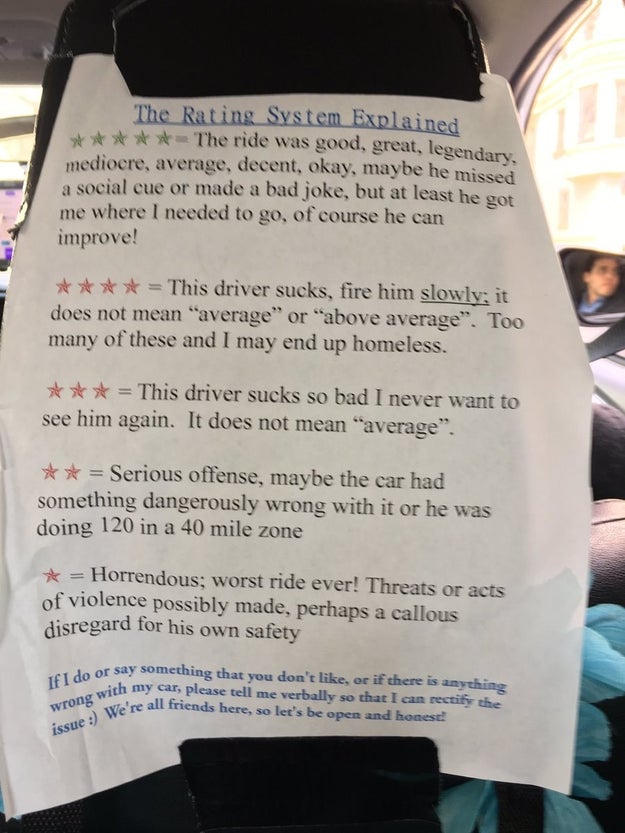
In a San Francisco Lyft car, there&;s a chart taped to the back of the front passenger seat: “The Rating System Explained.” It details — in exaggerated terms — what Lyft&039;s one- to five-star rating scale really means to drivers.

Beginning at five stars — “got me where I needed to go” — the explanations quickly descend into parodic paranoia. Four stars: “This driver sucks, fire him slowly … Too many of these and I may end up homeless.” Three stars: “This driver sucks so bad I never want to see him again.” Two stars: “maybe the car had something dangerously wrong with it or he was doing 120 in a 40 mile zone.”
Caroline O’Donovan / BuzzFeed News

One star? “Threats or acts of violence possibly made, perhaps a callous disregard for his own safety.”

Though tongue-in-cheek, this rating system explainer touches on an essential truth of the gig economy: When companies like Lyft, Uber, and Postmates penalize workers who have low ratings, anything less than five stars feels like a rebuke.

“The rating system works like this: You start off as a five-star driver,” Don, a San Francisco Lyft driver told BuzzFeed News. “If you drop below a 4.6, then your career becomes a question. Uber or Lyft will reach out to you and let you know that you are on review probation. And if you continue to drop, then you&039;re going to lose your job. They&039;ll deactivate you.”

The gig economy has made us comfortable rating the people we pay to do tasks for us. Both data and anecdotes suggest five-star rating systems are subjective, prone to bias, and generally confusing, yet labor marketplaces continue to ask customers to choose from one to five stars to determine who’s good at their job and who isn’t. Last week, Netflix officially replaced its five-star system for rating movies with a more simple thumbs-up, thumbs-down. Maybe it’s time for other data-driven platforms to consider making a change, too.

“They think that 3 is okay, and a 4 is like a B.”

Don’s concern about the impact of a low rating is well-established: Workers in the on-demand economy are at the mercy of the customers, whose in-app ratings can jeopardize an individual’s ability to earn bonuses, land gigs, and generally make a living.

Uber says only a very small percentage of drivers have ratings anywhere close to the deactivation threshold, which is a different number depending on where in the world you’re driving.

In a statement, a Lyft spokesperson said that in order to “ensure that drivers are not rated unfairly for circumstances that are out of their control, a number of steps are taken, including: ratings are based on an average of the last 100 rides; the system does not look at drivers in isolation, rather it looks at them in comparison to other drivers in their region; and drivers are able to submit comments after each ride to raise any concerns about the ride or passenger.”

But ratings are nonetheless a stressor for some drivers. Julian, who drives for both Uber and Lyft in San Francisco, said maintaining a good rating can be difficult because customers don’t really understand them. “They think that 3 is okay, and a 4 is like a B, and 5 is exceptional,” he told BuzzFeed News. “Well, if you got a 4 every time, you’d be terminated. You have to maintain a 4.7, so anything less than a 5 is not okay.”
Julian, a driver for Uber and Lyft

A few months ago, Julian was driving a female passenger to her hotel when he realized she had passed out in the back of his car. Julian called the police, who told him to roll her over onto her stomach — but he was worried about what might happen if she woke up while he was trying to help her. “The sad thing is, I was most concerned about my rating, because it was below a 4.7,” he said. (The woman woke up and ran into her hotel, Julian said; he doesn’t remember if she left a rating.)

This sort of rating anxiety extends well beyond Uber and Lyft. “The rating system is terrible,” said Ken Davis, a former Postmates courier, who noted that under the company&039;s five-star rating system couriers who fall below 4.7 for more than 30 days are suspended. Said Joshua, another Postmates courier, “I really don’t think customers understand the impact their ratings have on us.”

“I really don’t think customers understand the impact their ratings have on us.”

Instacart uses a five-star system, too; shoppers whose rating is in the top 25% of their region earn a $100 bonus. Shoppers say in most regions, just one rating that isn’t a perfect five stars usually disqualifies you for that week’s bonus. “It&039;s unbelievably annoying to wake up and see that a customer complained about something and you know it&039;s either not your fault or not true,” said Liz Temkin, who shops on Instacart in Los Angeles. (Temkin is a named plaintiff in the recently settled Instacart class-action lawsuit.)

Instacart had not provided a comment by the time this story was published. Postmates did not respond to multiple requests for comment.

The problem is, for an Instacart shopper to earn a bonus or a Postmates courier to keep their ratings up, they need the vast majority of their ratings to be five stars. Some savvy users (read: millennials) know this, and are sparing with their four- and three-star ratings. “Unless they&039;re super rude or weird, I tend to give everybody five,” said Kristen, a visitor to San Francisco who had just stepped out of a Lyft in Union Square. “That actually means something on the app. I don&039;t want to mess up their life, you know?”

But not all customers are so well informed. Wendy and her son Brian, visiting San Francisco from Indiana and using Uber for their first time, were surprised to hear that most drivers consider four stars to be a bad rating. “I would have thought 5 is excellent, and 4 is good,” Wendy said. That revelation was equally shocking to Elnaz, a longtime Uber user visiting San Francisco from LA. “Four-star sucks,” she said, incredulous. “Really?”

“Customers don&039;t understand the impact ratings have on couriers at all,” said a former Postmates community manager, who requested anonymity while discussing her previous employer. “A customer might rate a delivery three stars, assuming that three stars is fine. Several three-star ratings could bring a courier’s rating down significantly, especially if they’re new. It could even get the courier fired.”

Matthew Smith is yet another Uber and Lyft driver who, frustrated with the five-star rating system, took it upon himself to draw up a custom explainer for the back seat of his car. Smith&039;s is succinct, and reads “5 stars = This ride was acceptable or better, 4 stars = this driver should be fired.”
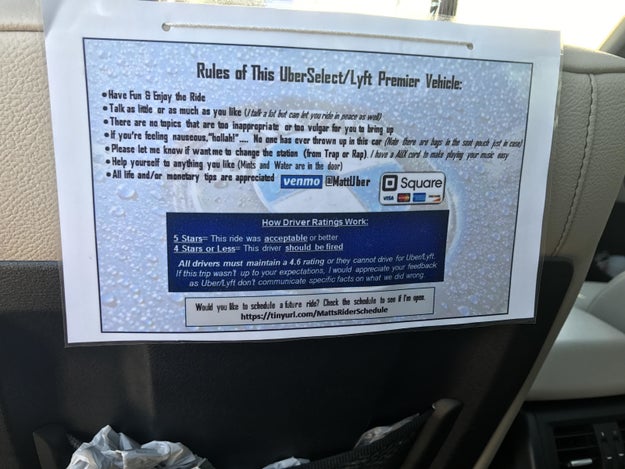
Yet another homemade ratings explainer, this one by Matthew Smith, who wrote “4 stars or less = This driver should be fired.”

Matthew Smith

“I have consistently had riders blown away that giving me a 4 was such a bad thing… they really do feel that a 4 was a good ride,” Smith, who lives in Colorado, wrote via email. “Since having this sign up, I have had about 35 rated trips, all five stars.”

Uber and Lyft both say the vast majority of drivers do get five-star ratings. But while they argue this is evidence that most drivers are doing an excellent job, it might actually be further proof that the five-star rating system doesn’t work.

Some ride-hail passengers say they give drivers five stars because they’re worried about what might happen if they don’t. I always give five, unless they&039;re really rude or something,” said Golda, another Uber passenger. “I actually heard that even below a four or five, they can get in trouble. They&039;re just trying to earn some money, so it has to be pretty bad for me to give a bad rating.”

David Celis, a software engineer at Github who used to run a beer-rating website, says it’s not just empathy that causes people to give a lot of five-star ratings. It’s also because five-star ratings systems in and of themselves lead to choice paralysis. “The more options are presented within a rating system, the more mental effort it&039;s going to take to give a rating,” he said.

Back in 2009, YouTube found that “the overwhelming majority of videos on YouTube have a stellar five-star rating.” Shiva Rajaraman, then a product manager, started to wonder if there was something wrong with their feedback system, which was “primarily being used as a seal of approval, not as an editorial indicator of what the community thinks about a video.” Six months later, YouTube replaced its five-star ratings with a thumbs-up, thumbs-down system. If Uber and Lyft were to adopt a simple thumbs-up, thumbs-down rating system, Celis said, “on the consumer end, it would be a much better experience.”

The other problem is that not everyone can agree on what the star ratings mean — not even the companies themselves. Lyft says that five stars means “awesome,” four means “Ok, could be better,” and three means “below average.” But for Uber, five stars is “excellent,” four is “good,” and three is “OK.”

Individuals have different interpretations, too. “For some people, three could mean this is good, while four is great and five is perfect. Some people might say, nowhere is going to be perfect, so I’m going to say five stars is really good, and four is good,” Celis said. “The way you can interpret those stars is infinite, and most people don’t have the exact same system.”

Five years before Uber even existed, Yelp popularized the use of five-star rating system for reviewing restaurants and other businesses. “On Yelp, anything four stars or above is very good. Three to four stars is, it might be worth your time. Less than three stars, that’s where you start to see businesses actually fail,” said Darius Kazemi, a computer programmer and former elite Yelp user. But because of the artificial cutoff use by Uber and other apps, that system doesn’t map perfectly to the gig economy, which leads to confusion for consumers. “The Yelp cutoff for ‘You’re fired’ is three. That’s the point where you see businesses lose money. That’s a lot lower than Uber’s parallel cutoff.”

If people ascribe different meaning to the five-star ratings, and the ratings functionally mean different things depending on what app or website you’re using, it seems unlikely that the data these rating inputs produce are very meaningful. Some labor marketplaces, recognizing this, have started experimenting with ways to lessen the impact of five-point rating systems on their workers.

Rinse, an on-demand laundry service, used to text customers asking them to rate their delivery person from one to five, but the average score “basically hovered around 4.9 over the entire time period we tested it,” said co-founder Ajay Prakash. Prakash determined that the texts, which very few customers responded to anyway, weren’t producing data of much value, and scrapped them. Another example is Managed by Q, a startup that dispatches field operators to clean and manage office spaces, which stopped asking customers to rate workers partly because it created tension with clients. “Five-star review systems on their own are not good barometers of individual performance,” said Director of Product John Cockrell in an email.

“I was like, Holy shit&; The guy was nice, I wish I hadn’t done this.”

But in the world of online work, the five-star rating system remains pervasive. On sites like Fiverr and Freelancer.com, ratings left by clients affect freelancer search rankings. Feedback systems on sites like these tend to have more components than gig economy apps, but the impact is similar: the lower your rating, the lower your search rank — and the less likely you are to book a lucrative gig. Said Freelancer.com’s CEO Matt Barrie, “It&039;s kind of like Uber.”

Michael Truong is a senior product manager at Uber, where he’s working on improving the company’s rating system. We&039;re really trying to understand what riders’ feedback is for a ride,” he said.

Truong told BuzzFeed News that Uber once considered switching to a thumbs-up, thumbs-down system, but decided against it. “The emotional burden riders have, where they feel like their driver is going to get deactivated if they give a low rating, pushes people away from a thumbs-down,” he said. “So we would have no opportunity to relay that feedback to drivers.”

For the last few months, the Good Work Code has been compiling research on how to build a better rating system for labor platforms. “The managers of the company want information about how a job or gig was done, and the customer wants to offer feedback. But how do the workers actually get information that allows them to succeed and thrive in these working arrangements?” asked Palak Shah, director of the Good Work Code’s parent organization, Fair Care Labs. “It&039;s our sense … that there&039;s a lot of opportunity for growth and improvement.” The report — which recommends transparency, human interaction, processes for disputing ratings, and system that’s more dynamic than “on a scale of one to five” — is supposed to be published in the next few weeks.

John Gruber, publisher of Daring Fireball, is among those who believe that five-star rating systems don’t produce particularly useful data, and that generally speaking, binary systems are better. “There’s no universal agreement as to what the different stars mean,” Gruber told BuzzFeed News. “But everybody knows what thumbs-up, thumbs-down means.”

A few years ago, during a trip to Orlando, Gruber had an experience that made him realize how this confusion over what the stars mean can impact individuals in ways customers don’t realize. After taking a ride in an Uber that had an overpoweringly strong smell of air freshener, Gruber gave the driver a four-star rating. The next day, he got a call from an Uber employee asking him to explain what the driver had done wrong.

“I was like, Holy shit&033;” Gruber said. “The guy was nice, I wish I hadn’t done this.”

Quelle: <a href="Nobody Knows What Five Star Ratings Mean. That’s Bad For Gig Workers.“>BuzzFeed

The state of Ruby on Google Cloud Platform

By Aja Hammerly, Developer Advocate

At Google Cloud Next ’17 last month we announced that App Engine flexible environment is now generally available. This brings the convenience of App Engine to Rubyists running Rails, Sinatra or other Rack based web frameworks.

One question we frequently get is, “Can I run gems like nokogiri or database adapters that have C extensions on App Engine?” and the answer is yes. We tested the top 1000 Ruby libraries, a.k.a., gems, to ensure that the necessary dependencies are available. We also tested common tools like paperclip that don’t build against C libraries but require them at runtime. And we know that people are using different versions of Ruby and Rails; App Engine obeys .ruby-version and we support all currently supported versions of MRI. We’ve also tested the gems with Rails 3, Rails 4 and Rails 5. At Next we also announced that Postgres on Cloud SQL is in beta. All of these things should make it easier to move your Rails and Sinatra applications to App Engine. More info on using Ruby on Google Cloud Platform (GCP) is available at http://cloud.google.com/ruby.

New gems on tap
We also have three gems that have reached general availability for the following products: Stackdriver Logging, Google Cloud Datastore and Google Cloud Storage. In addition there are three gems currently in beta for Google BigQuery, Google Cloud Translation API and Google Cloud Vision API. Our philosophy when working on the gems has been to embrace the Ruby ethos that programming should be fun. We try to make our gems idiomatic and make sense to Rubyists. For example, our logging library provides a drop-in replacement for the standard Ruby logger:

require “google/cloud/logging”

logging = Google::Cloud::Logging.new
logger = logging.logger “my_app_log”, resource, env: :production

logger.info “Job started”
logger.info { “Job started” }
logger.debug?

With the Cloud Datastore gem, creating entities is similar to creating tables using ActiveRecord. And with Cloud Storage, you can upload files or you can upload Ruby IO Objects. Using our products should not add significant cognitive load to your development tasks. And having a philosophy of “By Rubyists for Rubyists” makes that easier to do.

RailsConf
If you want to try out some of these libraries or spin up an application on App Engine, come find us at RailsConf 2017 in Phoenix, Arizona later this month. We’re proud to be a Gold sponsor again this year. Based on feedback from last year, we’re making our booth more interactive with codelabs, demos and of course even more stickers.

We also have three folks from the Google Ruby team giving talks. Daniel Azuma’s talk, “What’s my app really doing in production” will show you tools and tricks to instrument and debug misbehaving apps. Remi Taylor’s talk, “Google Cloud >3 Ruby,” will teach you about all the different tools we have for Ruby developers. Finally, in my talk, “Syntax isn’t everything: NLP for Rubyists,” I use the Google Cloud Natural Language API library and some stupid Ruby tricks to introduce you to natural language processing. If you’ll be at RailsConf we really hope you’ll come say hi.
Quelle: Google Cloud Platform






