Diebold-Nixdorf: Umstieg auf Windows 10 bei Geldautomaten
Wincor-Nixdorf läutet den Abschied von Windows 7 ein: Auf den Geldautomaten des Unternehmens soll künftig nur noch Windows 10 laufen.
Quelle: Heise Tech News

Wincor-Nixdorf läutet den Abschied von Windows 7 ein: Auf den Geldautomaten des Unternehmens soll künftig nur noch Windows 10 laufen.
Quelle: Heise Tech News

War der Arbeitstag wieder zu stressig? Der Fitnesstracker Vivosmart 3 von Garmin soll das erfassen können. Auch beim Krafttraining im Fitnessstudio soll das schlanke Wearable helfen. (Garmin, Fitness)
Quelle: Golem

AT&T, a US-based multinational communications company, is connecting millions of Internet of Things (IoT) devices. Partnering with IBM, developers can deliver IoT innovation and insights on a hybrid cloud platform.
Taking the next step forward in a long-standing collaboration
AT&T and IBM have a longstanding relationship which has deepened over the past 20 years as we have leveraged each other drive value to the market. We are extending our collaboration to the Internet of Things, where we are integrating our capabilities to make it easier for developers to create end-to-end IoT solutions and gain deeper insights from data collected from connected devices.
This partnership is a first of a kind in the industry, providing one platform that scales from the device, through the network to powerful analytics to gain deep insights into IoT data.
Paving the way for new opportunities using deeper data insight
There is a strong industry and business need for developers who can create the next generation of innovative IoT solutions, so enterprises can benefit from the massive amounts of data to be generated by more than 29 billion devices IDC says will be connected by 2020.
According to the VisionMobile 2016 Internet of Things Megatrends report, nearly 10 million developers will be active in IoT by 2020, doubling from the estimated 5 million today. As businesses depend more on IoT solutions to succeed, they must invest in developers to stay competitive.
AT&T Flow Designer is now open for business
As of January 2017, AT&T Flow Designer, a graphical application development tool based on IBM Node-RED, is available on IBM Bluemix. Flow Designer, a unique, single platform for IoT DevOps, has been integrated with Watson APIs to enable developers to easily embed cognitive capabilities in their IoT solutions.
The solution integrates IBM Watson IoT cognitive capabilities and IBM Bluemix cloud technology with AT&T Flow Designer to help companies transform their businesses. The new solution will enable developers to quickly gain deeper insights from data collected by connected devices, which has the potential to reveal new market opportunities and improve productivity. These open standards-based tools allow developers to improve their skills and avoid the churn of learning new tools, protecting investments made in IoT solution development.
Using the solution, IoT developers can realize faster time to value, enhanced levels of security and simple, one-stop shopping that can increase their productivity in building innovative applications.
Creating open standards-based tools to build IoT solutions quickly
Combining the unique strengths in cognitive computing and global connectivity to create open standards-based tools on the IBM Cloud, the partnership between AT&T with IBM enables developers to quickly build and implement widely compatible IoT solutions. For example, Node-RED, an IBM-developed IoT tool now open source through the Linux Foundation, is embedded in AT&T’s Flow Designer. This allows developers to tap the Node-RED community’s hundreds of nodes to include new capabilities into their flows.
With this enhanced ability to deploy apps on the IBM Cloud, developers will have more visibility and understanding into the “things” they connect. For example, imagine an asset tracking app that has the ability to not only show the location of an asset, but to couple that with weather data, businesses would then be able to predict delays in the supply chain and reroute deliveries due to bad weather. Adding the Watson Speech API would enable operators of these assets to use the “hands-free” driving capability to monitor engine performance in real time to help avoid breakdowns.
A convenient one-stop shop for developers
The IBM and AT&T collaboration provides one-stop-shop access to the tools and capabilities needed to create end-to-end IoT solutions – inclusive of device, global connectivity, platforms, applications and analytics. Developers can rapidly compose and deploy IoT analytics applications and industry focused solutions that provide data to generate new business models and insights.
IBM brings its Watson IoT Platform and strong analytics capabilities, which partners nicely with the global connectivity (cellular and satellite) and IoT services that have made AT&T a leader in connected devices. The solution makes it easier for developers and enterprises to create innovative IoT applications and gain deeper insights from connected devices.
Multiple Watson APIs available to use
Watson APIs can be used to break down barriers to analyzing unstructured data and provide access to powerful capabilities, including advanced cognitive computing, machine learning and deep learning approaches to help better understand and engage users and tackle the massive growth of data in multiple formats.
The full list of IBM APIs available in AT&T Flow Designer is:
Cloudant
IBM Push Notifications
Watson IoT Platform
OpenWhisk
IBM Watson
Alchemy Feature Extract
Alchemy Image Analysis
Watson Language Identification
Watson Language Translation
Watson Natural Language Classifier
Watson Personality Insights
Watson Relationship Extraction
Watson Speech-to-Text
Watson Text-to-Speech
Watson Tradeoff Analytics
Watson Visual Recognition
Exciting use cases continue to emerge
Internet of Things use cases have a common set of fundamental requirements, such as easily onboarding any connected thing, creating a real-time communication channel with the thing, capturing data from the thing and storing it in a historical database, providing access to the collected data, and managing the things and the connectivity to them. In addition to these common elements, there are more complex use cases with extended requirements such as: providing a layer of analytics on the data in both real-time and on historical trend data, triggering events based on specific data conditions, and interacting with the thing from business apps and/or from mobile devices.
Here are two simple use case examples which use different APIs with Flow Designer and Watson IoT Platform:
Manage fleets using Watson Speech API:
Businesses share data on their vehicles in near real-time using fleet management apps. Fleet operators can track a vehicle’s location, tap into Watson Speech API for ‘hands-free’ driving and help monitor engine performance to avoid breakdowns. The IBM Watson IoT Platform gives operators more detailed analytics.
Benefit: They’re then better prepared to face unexpected challenges. Fleets can become more efficient, profitable and deliver better customer service.
Maintain tools tapping Watson Tradeoff Analytics API:
A predictive maintenance and quality solution offers near real-time analytics to increase the lifetime of business assets tapping into Watson Tradeoff Analytics API. A farming company can determine which tractors are in the best condition, if proactive maintenance is required and make better decisions about which equipment to take out of service and when. The app uses current and historical data to recommend which to use and which to repair, which helps to minimize equipment downtime.
Benefit: The farm is more productive, saves costs, and its tractors perform better.
A global solution
The IoT landscape is becoming more mobile and more divergent as devices proliferate around the world. The integration of AT&T and IBM IoT platforms provides global device connectivity, ease of development, shortens the application development life cycle and provides faster time to benefit realization. AT&T and IBM’s commitment to open standards and industry standards bodies ensure that solutions are scalable and extensible across a wide variety of device types and platforms.
Enterprises that are global with footprints in multiple regions will find the technology especially valuable due to the combined global reach of IBM and AT&T. AT&T is connecting more IoT devices than any other provider in North America, with a global network that reaches over 200 countries and territories. IBM is an established leader in the IoT, with more than 4,000 IoT client engagements in 170 countries, 1,400 partners in its growing ecosystem and more than 750 IoT patents.
Get started with AT&T Flow Designer on IBM Bluemix
Unlock the power of the Internet of Things by prototyping, building and hosting IoT applications with AT&T’s Flow Designer on Bluemix. AT&T Flow Designer is a robust web-based development environment where data driven applications can be designed and deployed with ease. Flow makes it easy to prototype IoT and machie-to-machine (M2M) solutions. Flow nodes are Open Source and available via GitHub. The solution is available to the vast network of the AT&T and IBM developer communities.
Learn more about AT&T Flow Designer, IBM Watson IoT Platform and IoT tools from AT&T.
A version of this article originally appeared on the IBM IoT blog.
The post Enabling faster prototyping of IoT solutions appeared first on #Cloud computing news.
Quelle: Thoughts on Cloud

Google hat ein kleines Online-Tool veröffentlicht, das Kritzeleien mit künstlicher Intelligent erkennt und dazu passende Cliparts vorschlägt. AutoDraw ist kostenlos und funktioniert auch auf Mobilgeräten.
Quelle: Heise Tech News

Showcase für die Unigine-2-Engine: Der Superposition ist ein neuer Benchmark inklusive VR-Modus und einem Stresstest für Grafikkarten. Er läuft unter Linux und Windows. (Benchmark, Grafikhardware)
Quelle: Golem

Amazon baut seine Kinderoberfläche FreeTime fürs Fire Tablet aus und ermöglicht mehr Kontrolle mit dem Eltern-Dashboard. "Gesprächsideen" sollen besser über den Inhalt von Apps, Büchern und Filmen informieren und den Austauch in der Familie anregen.
Quelle: Heise Tech News

Die Drahtzieher des Botnetzes haben IBM zufolge IoT-Geräte zum Schürfen von Bitcoins missbraucht. Dabei handelt es sich offenbar um einen Testballon.
Quelle: Heise Tech News

In einem Rechtsstreit um Lizenzgebühren soll Qualcomm mehr als 800 Millionen US-Dollar an Blackberry zahlen. Diese Summe ist aber noch vorläufig und soll erst in einigen Wochen abschließend geklärt werden. Die Blackberry-Aktie sprang trotzdem in die Höhe.
Quelle: Heise Tech News

If your kids use Amazon's Kindle app Freetime to tablet to read, play games, or access the web, you can use a new tool called the Amazon Parent Dashboard to track — and control — what they&039;re doing.
Giphy
Fights over screen time can be a nuisance to both parents and kids, as a wealth of parenting blogs can attest to. But it&039;s not just kids who might be holding onto their devices too long: The American Academy of Pediatrics writes that “Heavy parent use of mobile devices… may be associated with more parent-child conflict.” So watch yourself, parents.
The Parent Dashboard, which parents can access through their own Amazon accounts, displays how much time a child has spent using their tablet and breaks it down into four categories: books, videos, apps, and the web. You can click on each category in the dashboard to see what your kids have been reading or playing. Parents have to go into the FreeTime app on the kids&039; Kindles to make changes to time restrictions and settings.
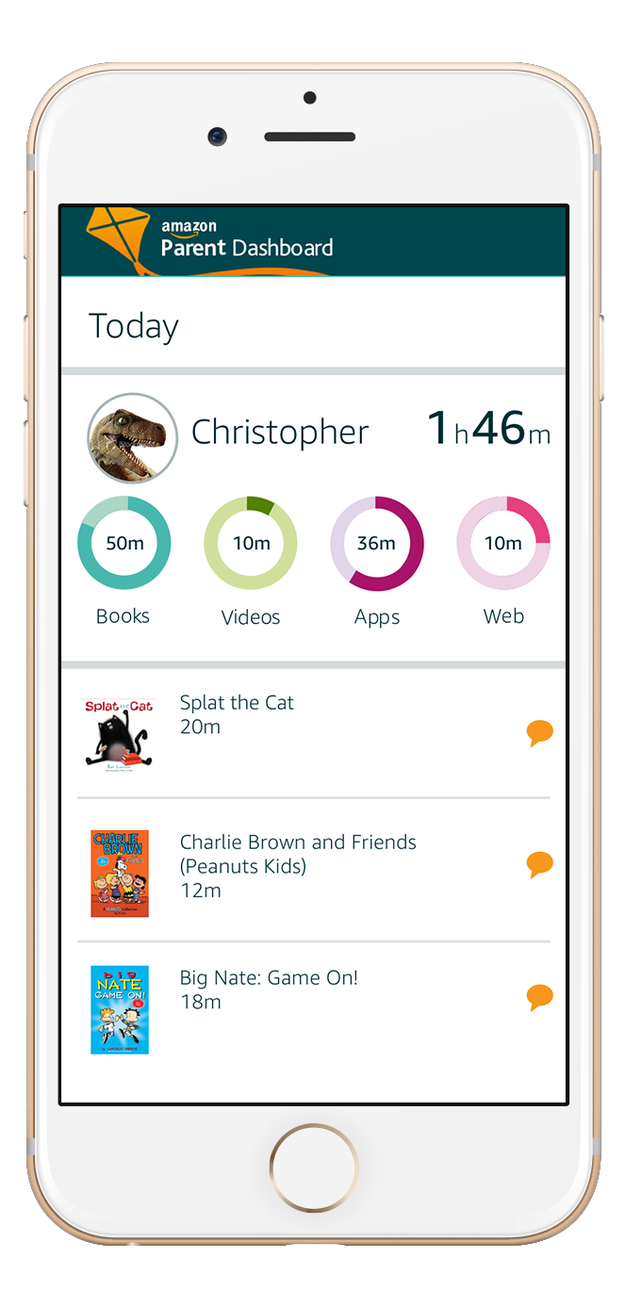
FreeTime already allows parents to limit how much time their kids spend on any one type of media and in the app overall, so Amazon said a tracking dashboard was the next logical step.
To make sure content available on kids&039; Kindles is appropriate, Amazon content editors whitelist sites and YouTube videos as safe for kids. The tablets are aimed at kids between the ages of three and 12 and have 10 million users worldwide, according to Amazon, though it won&039;t say how many users have bought a subscription for access to premium content. Kids also can&039;t make in-app purchases in FreeTime. (The FTC recently fined the company over unauthorized in-app game purchases made by users&039; children as they played on Amazon devices.)
Not literally. But almost. They&039;re called “Discussion Cards,” and Amazon content editors have written summaries and discussion questions for books, educational apps, games, and videos you can access on your kids&039; Kindle.
But they&039;re basically cheat sheets for whatever your kids are watching, reading, and playing, and give you prompts for talking with your kids about what they&039;re doing on their tablets. They might work especially well for parents with multiple kids who don&039;t want to read yet another Curious George book.
Amazon said it&039;s releasing thousands of Discussion Cards for its most popular titles within the app, but it wouldn&039;t specify exactly how many.
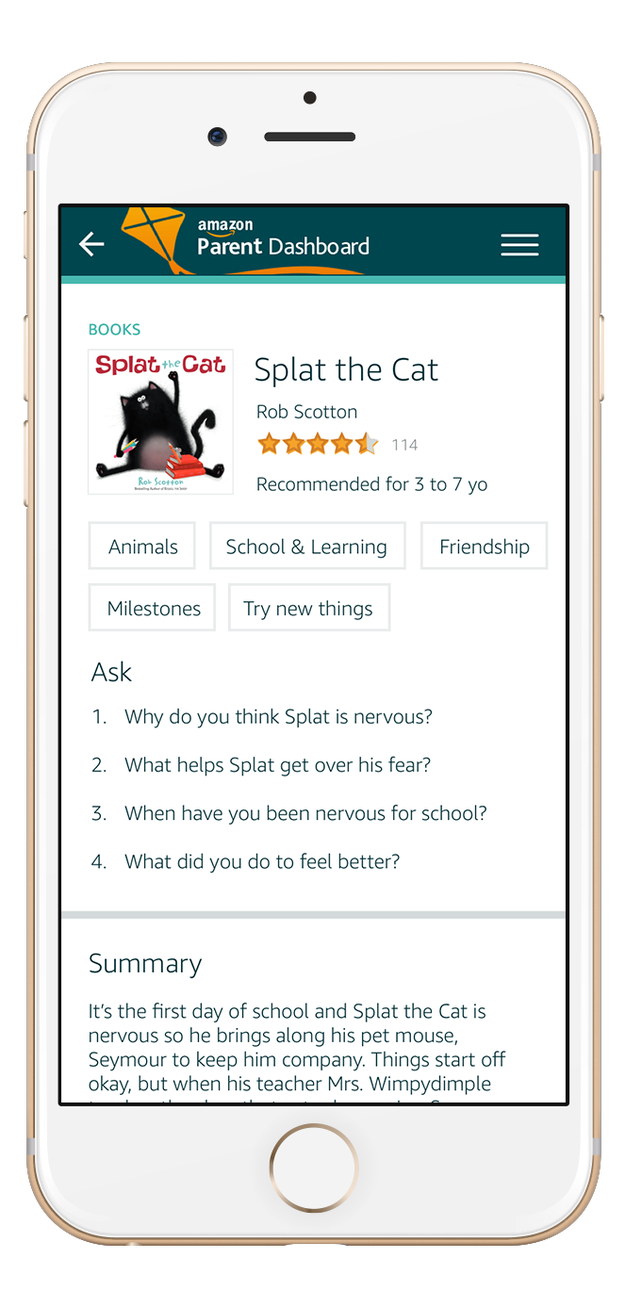
Kurt Beidler, Director of Kids Family at Amazon, said in a statement that the feature is intended for parents to “avoid the dreaded one-word response.” He went on: “Ideally, parents will have read the book, but they may not have had time to go through it and develop in-depth questions like we have, or they may have read the book a long time ago.”
Quelle: <a href="Amazon Just Gave You A Way To Monitor What Your Kids Are Doing Online“>BuzzFeed

Das Bundesinnenministerium hat unter dem Aufhänger "Sicherheitsbahnhof" eine erste Skizze für ein Pilotprojekt mit neuen Überwachungsmethoden vorgelegt. Freiwillige Probanden werden noch gesucht.
Quelle: Heise Tech News






