How to make a movie the secure way

At the RSA 2017 Conference this week, we’ll be presenting “Securing the Making of the Next Hollywood Blockbuster” (San Francisco | February 15, 2017 | 1:30 PM – 2:15 PM) with Academy Award®-winning studio New Regency. It’s a spellbinding adventure about their transition to secure movie production in the cloud, made possible by Microsoft Azure and a cadre of ISV partners who’ve ported their solutions to the platform.

New Regency, responsible for critically acclaimed feature films such as The Revenant and Birdman, and blockbuster titles including the recent Assassin’s Creed, knows what it’s like to be on the bleeding-edge of technology while at the same time telling vivid stories in full cinematic glory. They use technology to both help convey elements of the script to deliver on the producer’s vision, and to optimize workflows for efficiency and cost savings. In the middle of it all: securing the content that is the lifeblood of the business.

That content comes in many forms—memos, scripts, pictures, audio, email, contracts, videos, and more—all with an ever-growing association of metadata. It’s also stored in many places—on servers, workstations, mobile storage, archives, etc.—which presents a massive security challenge. Data flies far and wide, challenging all efforts to lock it down. On top of that, personal information such as health records, contract details, and paystubs have entered the mix, adding to an already strenuous data governance situation.

In this session, we’ll look at the end-to-end workflow designed by New Regency that leverages Azure and the combined wizardry of Avid, 5th Kind, Contractlogix, Docusign, MarkLogic, and SyncOnSet. Lulu Zezza, Physical Production Executive at New Regency and the driving force behind the project, noted that, “Moving to the cloud is the best way to implement security controls across so many different physical and logical environments, locations, and data types. We have people working all over the world, for different companies, using different systems, all contributing to the same production. In the past, it’s been like a free-for-all, with contractors getting access to things they shouldn’t, information being duplicated and stored in the wrong places, and sensitive content left out in the open.”

The new digital workflow enables a secure “script-to-screen” experience for the management of both production data and the crew’s personal HR information (to which new global privacy standards apply). Metadata captured from contracts, script, and camera is associated with filming days, scenes and takes recorded and later to the final edit of the film, reducing the need for document sharing and film screenings. Plus communications are kept protected and confidential. It’s a whole new way to make movies.

Join us at our session where you’ll hear about:

Architectural considerations for multi-domain cloud environments
Secure access and device management for BYOD users
Content protection and privacy in connected and disconnected networks
And glimpses behind-the-scenes of the making of The Revenant, Assassins Creed, A Cure for Wellness and Unfinished Business!

Quelle: Azure

The “open” part of open source doesn’t mean “free”

It’s a common misconception that opening the source code for a product is a fast, easy path to success. After all, how much easier can it get than to have other developers fix your bugs, add new features and answer support questions?
That panacea is what draws so many misguided tech companies to releasing open source software (OSS) versions of their products. They aim to draw in crowds of free-version users that will undoubtedly shift over to becoming paid subscribers of a different offering.
Let’s take a good look at that “free” offering and see what it really means to the programmer providing it to the developer community.
Free marketing?
There are a lot of OSS repositories out there. If you are using your open source project to drive downloads and build a lead funnel, you will have to spend as much or possibly more on marketing budget as you would for a traditional project. If you are using it as a recruitment tool for new developers, or to build community around your software, you will still have to allocate some investment to getting the word out that you’re in the OSS space.
Free community management?
Let’s say promoting your product goes well and the community grows the way you hoped it would. Now you need to manage that community. And it’s potentially two communities – users and contributors – each making their own demands on your time.
Users want documentation, support and the ability to request new features. You will need to make sure you have someone listening and responding to all of that feedback. Successful open source projects often have an engaged set of advocates who can help you. But you need to constantly nurture that group to make sure they stay engaged.
Contributors are looking for a way to make a difference. They could be your most valuable commodity. But you will have to work with them to make sure they understand the vision of the product. And you will need to engage in a dialog about the contributions you need against the contributions they want to make.
Free repository management?
Oh, and let’s not forget that you also have a bunch of code and documentation to maintain. Performing code reviews, merging pull requests and ensuring the documentation is up-to-date requires a level of staffing that people often forget to allocate. Like any good software, an OSS project is only as good as its underlying code sanitation. With a lot of contributors, this becomes an important part of your mission as the project owner.
OSS drives some of the most rewarding collaboration and innovation in our industry. But it’s important to see it as an investment in time, money and staffing if you want to be successful.
To learn more about Open Source, join me and several other experts at the Open Technology Summit at IBM InterConnect in Las Vegas on March 19, 2017.
The post The “open” part of open source doesn’t mean “free” appeared first on news.
Quelle: Thoughts on Cloud

The First Rule of These Facebook Groups: Don't Talk Trump

Kat Ayres moderates “Heughan&;s Heughligans,” a Facebook group devoted to the Outlander book series and its Starz adaptation. It&039;s a big job. The group&039;s 22,000 members write around 1,000 new posts a day — about everything from the show&039;s stars, Sam Heughan and Caitriona Balfe, to ancient Scottish tea sets — and Ayres and her nine co-moderators have to ensure they adhere to community guidelines that, in part, prohibit the discussion of politics.

“If there’s politics, it&039;s shut down,” Ayres told BuzzFeed News. “It leads to ugliness and bad feelings and drama.”

Leading up to the presidential election, that big job got even bigger. Heughan&039;s Heughligans had banned political discussion since the group started in 2013, but in 2016 political posts became more frequent and, as Ayres put it, “more intense.” She found herself spending hours a day poring over every post, trying to remove political content from the group; it felt like every other comment referred disparagingly to Donald Trump or Hillary Clinton. Finally, after Trump was elected and the political talk didn&039;t abate, Ayres and the other mods decided to take a drastic step: They enabled “Post Approval,” which requires everything posted to Heughan&039;s Heughligans to be blessed by a mod first.

“It was around Thanksgiving,” Ayres said. “We wanted to spend more time with our families.”

That&039;s right: It takes the the Heughan&039;s Heughligans mods less time to read and approve 1,000 posts a day than it does to retroactively spot-scrub the page and deal with the conflicts that emerge from letting people discuss politics before the posts can be taken down.

Yet such is the life of a certain kind of moderator in the age of the Trump administration. Across the internet of nonpolitical interest groups, from college football and Catholic community message boards to parenting, professional sports, and New Age Facebook groups, determined — if beleaguered — admins are trying their best to keep their spaces free from politics, which in 2017 really means the looming presence of one extremely polarizing person. They&039;re doing so on behalf of an untold number of users who have quickly found fandom and personal interest communities to be some of the last politics-free spaces on the English-language internet.

“A lot of the messages we get say, &039;Thank you for having this rule,&039;” Ayres said. “&039;Because this is the one place I know I’m not going to have to deal with politics.&039;”

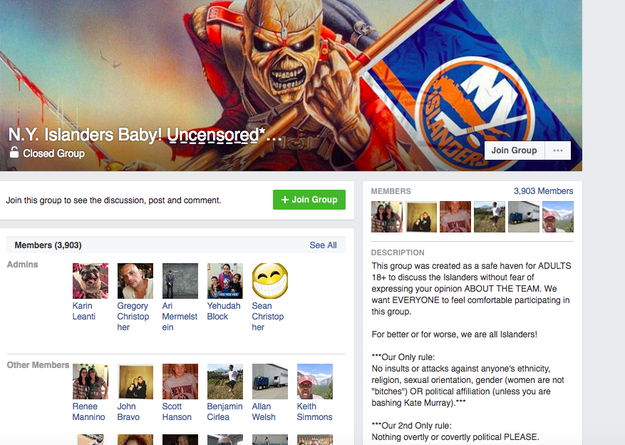
A post on the “N.Y. Islanders Baby&; Uncensored* Isles Talk for Adults” Facebook group.

Explicit or tacit bans on political talk in specialty message boards and other groups are nearly as old as the internet. And indeed, Heughan&039;s Heughligans and other no-politics groups would (and do) readily ban posts about Barack Obama, Bernie Sanders, and Hillary Clinton.

But over the past year, a half dozen moderators of various political persuasions told BuzzFeed News, something has changed. Begin with a presidential campaign that in the words of one mod was “the most heated and volatile one that most of our subscribers can remember.” Add a president who uses one social network, Twitter, as his own personal news channel, to the point of saturation. Throw in hyperpartisan filter bubbles that create parallel versions of current events (and nasty fights in the comments sections) on the biggest social network, Facebook. Finish it off with a mainstream media that has become all Trump, all the time, and you&039;ve got the recipe for a social internet that seems to be downright Trump-themed, no matter your politics.

In such an environment, the moderators of niche-interest communities say their spaces are more important than ever.

“We look at it as an oasis to get away from all the madness.”

“We look at it as an oasis to get away from all the madness,” said Gregory Christopher, who moderates a Facebook group called “N.Y. Islanders Baby&033; Uncensored Isles Talk for Adults,” which, well, censors political talk. “CNN is just 24 hours a day Trump.”

Christopher, in fact, has had to go further than just banning political speech. His group, which is made up of Islanders fans from across the political spectrum, doesn&039;t allow Trump&039;s image (or the image of any national politician).

“Someone posted a meme of an Isles fan in a Trump mask holding a sign saying “Make the Isles Great Again,” Christopher said. “It immediately set off a firestorm and we asked the poster to take down the post.”

Christopher and Ayres, as well as other moderators, said they don&039;t police political speech simply for the benefit of their users; it&039;s also for the overall health of the communities. As anyone who has spent time on Twitter or Reddit in the last few years will tell you, political arguments can quickly turn toxic.

“It is such an incendiary topic that you’re going to drive people away,” said John Borton, editor of The Wolverine, a magazine and message board devoted to University of Michigan football that significantly limits political opinion online. “It doesn’t matter which side it happens to fall on. You’re going to see people walking away saying, &039;I don’t need this. I can go to a hundred different websites.&039;”

These politics-safe spaces do welcome most off-topic conversation. It&039;s common for users of the The Wolverine to ask for legal advice, prayers for an ailing relative, or grilling tips. Indeed, the ability of these communities to draw in off-topic discussion is part of what makes them communities. But politics — particularly in the age of Trump — is a third rail.

“I don’t mind reading that you lost your yellow Lab, but those aren’t the kind of things that engender the fury that will make people not want to be here,” Borton said.

At times, no-politics rules can lead to unintended and alienating consequences. Olga Tomchin, an immigrants&039; rights lawyer and a former child refugee, submitted a post to a Facebook anxiety support group asking how to deal with stress related to the recent executive order banning travel from some Muslim-majority countries. A moderator of the group asked Tomchin to change the language in her post to make the cause of her anxiety less specific, and less political. Tomchin refused and left the group.

Another tricky situation for no-politics communities arises when someone who is an important figure to the group does something political. Last month, Outlander star Caitriona Balfe tweeted that she would be taking part in the Women&039;s March in Edinburgh. Despite the tweet&039;s relevance to the show&039;s fans, Ayres and her fellow mods decided not to allow any posts referencing it.

Yet for most niche-interest sites, Ayres said, despite pushback from a few posters, this form of censorship is necessary to preserve the increasingly rare places on the internet where people who love Donald Trump and people who hate Donald Trump can come together and talk about something completely unrelated to Donald Trump.

“It&039;s kind of like a vacation on Facebook to come to our group,” Ayres said, “and not have to deal with politics, drama, and constant fighting.”

Quelle: <a href="The First Rule of These Facebook Groups: Don&039;t Talk Trump“>BuzzFeed

Introducing Cloud Spanner: a global database service for mission-critical applications

By Deepti Srivastava, Product Manager for Cloud Spanner

Today, we’re excited to announce the public beta for Cloud Spanner, a globally distributed relational database service that lets customers have their cake and eat it too: ACID transactions and SQL semantics, without giving up horizontal scaling and high availability.

When building cloud applications, database administrators and developers have been forced to choose between traditional databases that guarantee transactional consistency, or NoSQL databases that offer simple, horizontal scaling and data distribution. Cloud Spanner breaks that dichotomy, offering both of these critical capabilities in a single, fully managed service.
“Cloud Spanner presents tremendous value for our customers who are retailers, manufacturers and wholesale distributors around the world. With its ease of provisioning and scalability, it will accelerate our ability to bring cloud-based omni-channel supply chain solutions to our users around the world,” — John Sarvari, Group Vice President of Technology, JDAJDA, a retail and supply chain software leader, has used Google Cloud Platform (GCP) as the basis of its new application development and delivery since 2015 and was an early user of Cloud Spanner. The company saw its potential to handle the explosion of data coming from new information sources such as IoT, while providing the consistency and high availability needed when using this data.

Cloud Spanner rounds out our portfolio of database services on GCP, alongside Cloud SQL, Cloud Datastore and Cloud Bigtable.

As a managed service, Cloud Spanner provides key benefits to DBAs:
Focus on your application logic instead of spending valuable time managing hardware and software
Scale out your RDBMS solutions without complex sharding or clustering
Gain horizontal scaling without migration from relational to NoSQL databases
Maintain high availability and protect against disaster without needing to engineer a complex replication and failover infrastructure
Gain integrated security with data-layer encryption, identity and access management and audit logging

With Cloud Spanner, your database scales up and down as needed, and you’ll only pay for what you use. It features a simple pricing model that charges for compute node-hours, actual storage consumption (no pre-provisioning) and external network access.

Cloud Spanner keeps application development simple by supporting standard tools and languages in a familiar relational database environment. It’s ideal for operational workloads supported by traditional relational databases, including inventory management, financial transactions and control systems, that are outgrowing those systems. It supports distributed transactions, schemas and DDL statements, SQL queries and JDBC drivers and offers client libraries for the most popular languages, including Java, Go, Python and Node.js.

More Cloud Spanner customers share feedbackQuizlet, an online learning tool that supports more than 20 million students and teachers each month, uses MySQL as its primary database; database performance and stability are critical to the business. But with users growing at roughly 50% a year, Quizlet has been forced to scale its database many times to handle this load. By splitting tables into their own databases (vertical sharding), and moving query load to replicas, it’s been able to increase query capacity — but this technique is reaching its limits quickly, as the tables themselves are outgrowing what a single MySQL shard can support. In its search for a more scalable architecture, Quizlet discovered Cloud Spanner, which will allow it to easily scale its relational database and simplify its application:
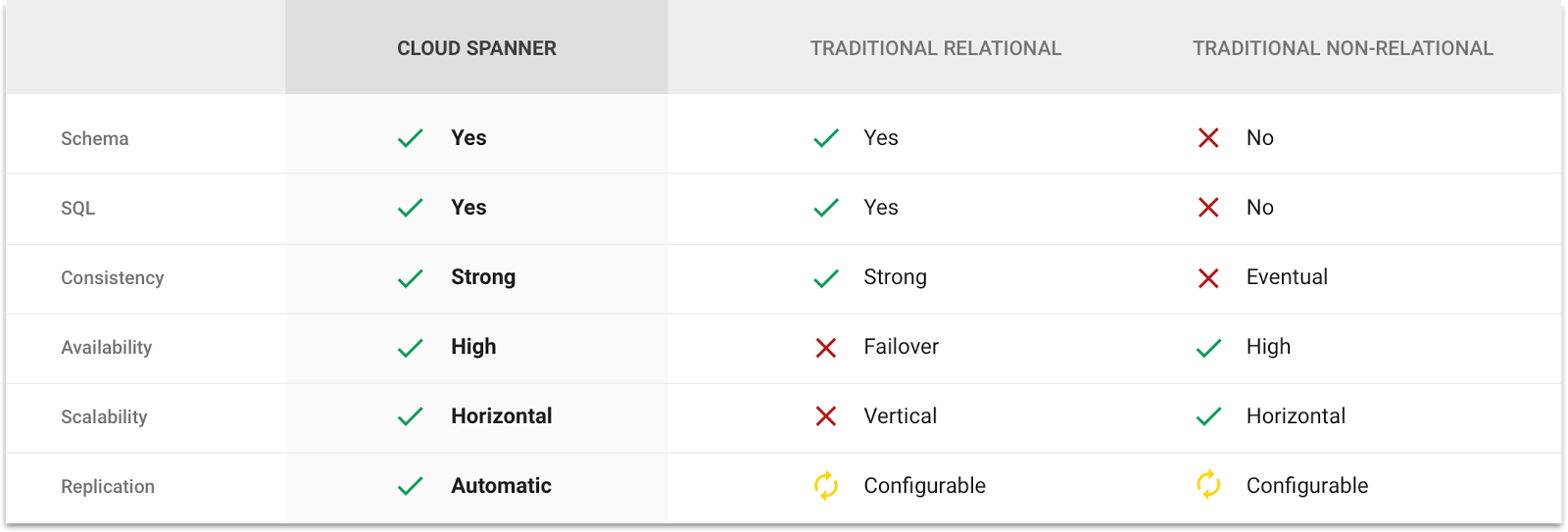
“Based on our experience and performance testing, Cloud Spanner is the most compelling option we’ve seen to power a high-scale relational query workload. It has the performance and scalability of a NoSQL database, but can execute SQL so it’s a viable alternative to sharded MySQL. It’s an impressive technology and could dramatically simplify how we manage our databases.” — Peter Bakkum, Platform Lead, QuizletThe history of Spanner For decades, developers have relied on traditional databases with a relational data model and SQL semantics to build applications that meet business needs. Meanwhile, NoSQL solutions emerged that were great for scale and fast, efficient data-processing, but they didn’t meet the need for strong consistency. Faced with these two sub-optimal choices that customers grapple with today, in 2007, a team of systems researchers and engineers at Google set out to develop a globally-distributed database that could bridge this gap. In 2012, we published the Spanner research paper that described many of these innovations. The result was a database that offers the best of both worlds:

(click to enlarge)

Remarkably, Cloud Spanner achieves this combination of features without violating the CAP Theorem. To understand how, read this post by the author of the CAP Theorem and Google Vice President of Infrastructure, Eric Brewer.

Over the years, we’ve battle-tested Spanner internally with hundreds of different applications and petabytes of data across data centers around the world. At Google, Spanner supports tens of millions of queries per second and runs some of our most critical services, including AdWords and Google Play.

If you have a MySQL or PostgreSQL system that’s bursting at the seams, or are struggling with hand-rolled transactions on top of an eventually-consistent database, Cloud Spanner could be the solution you’re looking for. Visit the Cloud Spanner page to learn more and get started building applications on our next-generation database service.
Quelle: Google Cloud Platform

Inside Cloud Spanner and the CAP Theorem

By Eric Brewer, Vice President of Infrastructure, Google Cloud

Building systems that manage globally distributed data, provide data consistency and are also highly available is really hard. The beauty of the cloud is that someone else can build that for you.

The CAP theorem says that a database can only have two of the three following desirable properties:

C: consistency, which implies a single value for shared data
A: 100% availability, for both reads and updates
P: tolerance to network partitions

This leads to three kinds of systems: CA, CP and AP, based on what letter you leave out. Designers are not entitled to two of the three, and many systems have zero or one of the properties.

For distributed systems over a “wide area,” it’s generally viewed that partitions are inevitable, although not necessarily common. If you believe that partitions are inevitable, any distributed system must be prepared to forfeit either consistency (AP) or availability (CP), which is not a choice anyone wants to make. In fact, the original point of the CAP theorem was to get designers to take this tradeoff seriously. But there are two important caveats: First, you only need to forfeit consistency or availability during an actual partition, and even then there are many mitigations. Second, the actual theorem is about 100% availability; a more interesting discussion is about the tradeoffs involved to achieve realistic high availability.

Spanner joins Google Cloud
Today, Google is releasing Cloud Spanner for use by Google Cloud Platform (GCP) customers. Spanner is Google’s highly available, global SQL database. It manages replicated data at great scale, both in terms of size of data and volume of transactions. It assigns globally consistent real-time timestamps to every datum written to it, and clients can do globally consistent reads across the entire database without locking.

In terms of CAP, Spanner claims to be both consistent and highly available despite operating over a wide area, which many find surprising or even unlikely. The claim thus merits some discussion. Does this mean that Spanner is a CA system as defined by CAP? The short answer is “no” technically, but “yes” in effect and its users can and do assume CA.

The purist answer is “no” because partitions can happen and in fact have happened at Google, and during some partitions, Spanner chooses C and forfeits A. It is technically a CP system.

However, no system provides 100% availability, so the pragmatic question is whether or not Spanner delivers availability that is so high that most users don’t worry about its outages. For example, given there are many sources of outages for an application, if Spanner is an insignificant contributor to its downtime, then users are correct to not worry about it.

In practice, we find that Spanner does meet this bar, with more than five 9s of availability (less than one failure in 106). Given this, the target for multi-region Cloud Spanner will be right at five 9s, as it has some additional new pieces that will be higher risk for a while.

Inside Spanner 

The next question is, how is Spanner able to achieve this?

There are several factors, but the most important one is that Spanner runs on Google’s private network. Unlike most wide-area networks, and especially the public internet, Google controls the entire network and thus can ensure redundancy of hardware and paths, and can also control upgrades and operations in general. Fibers will still be cut, and equipment will fail, but the overall system remains quite robust.

It also took years of operational improvements to get to this point. For much of the last decade, Google has improved its redundancy, its fault containment and, above all, its processes for evolution. We found that the network contributed less than 10% of Spanner’s already rare outages.

Building systems that can manage data that spans the globe, provide data consistency and are also highly available is possible; it’s just really hard. The beauty of the cloud is that someone else can build that for you, and you can focus on innovation core to your service or application.

Next steps

For a significantly deeper dive into the details, see the white paper also released today. It covers Spanner, consistency and availability in depth (including new data). It also looks at the role played by Google’s TrueTime system, which provides a globally synchronized clock. We intend to release TrueTime for direct use by Cloud customers in the future.

Furthermore, look for the addition of new Cloud Spanner-related sessions at Google Cloud Next ‘17 in San Francisco next month. Register soon, because seats are limited.
Quelle: Google Cloud Platform