This Fancy Chromebook Has a Touchscreen, Stylus, And A Price You Can Actually Afford

Google goes after Microsoft’s Surface Pro and Apple’s iPad Pro with its new premium Samsung Chromebook Pro and Plus laptop-tablet hybrids.
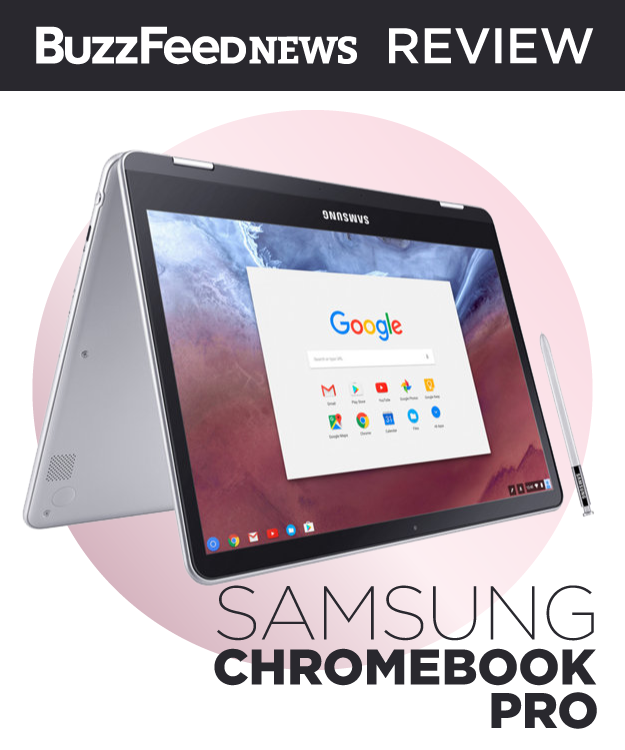
It’s a laptop&; It’s a tablet&033; It has a stylus&033; You can fold it backwards&033; You can draw on it&033; The Samsung Chromebook Pro and Plus aren’t your kid brother’s classroom Chromebooks. Google is adding new premium options to its low-cost laptop line: two Samsung-branded hybrid computer-tablets (what gadget p33ps call “convertibles”) with styluses built-in.

The devices are clearly aimed at customers who are interested in Microsoft&;s Surface Pro (between $699-$1,049) or Apple&039;s iPad Pro tablets ($599-$929), but who aren’t keen on those products’ hefty price tags. The Chromebook Pro is now Google’s most high-end Chromebook offering — and it costs just $549, while the Chromebook Plus is priced at $449.

What’s unique about the devices aren’t just that they’re ~fancier~ than Chromebooks past – it’s that the laptops can run Android apps for phones and tablets. All of them. Google is hoping that opening its Chromebooks to the over two million touchscreen-friendly games and mobile apps available in its Play Store will give its lightweight laptops even more of an edge over other devices.

I’ve been letting my MacBook Air collect dust for two weeks while testing out a pre-production version of the new Chromebook Pro, the faster and more powerful of the two. It&039;s available at the end of April with no specific release date set. I found the Pro to be impressively versatile. It was sufficient at most of my work computer tasks (namely messaging my boss, writing reviews like this one, and reading articles). The other bells and whistles, like the stylus and touchscreen, were non-essential, but worked well when I needed them.

Samsung / Buzzfeed News

If you’re already familiar, just jump to the next section.

Chromebooks are breathtakingly cheap computers. I once bought two mascaras and a foundation at Sephora and it was more expensive than the cheapest Chromebook you can get at Best Buy.

But you get what you pay for. They’re simple machines that can handle a lot of things, like responding to email, scrolling through Facebook, watching YouTube videos, streaming Netflix, word processing, and reading articles. Chromebooks need a strong Wi-Fi connection, and, while you can still use Google Docs, watch some Netflix shows, and listen to Spotify offline, there’s isn’t a ton of functionality for people who don’t have access to reliable Internet.

Chromebooks are the conceptual opposite of Android phones, which have, historically, been more appealing to tinkerers and gadget geeks. Chromebooks, on the other hand, are grab-and-go machines designed for people who know how to surf the web, but don’t consider themselves techies.

The laptops are dead simple. To start using one, all you need is a Google account. The devices are less susceptible to malware than others, and benefit from automatic security updates every six weeks. They’re a good fit for a lot of people. Chromebooks outsold Macs for the first time in 2016, with over half of that market going to the education sector. Over 20 million students now use Chromebooks in classrooms worldwide.

But they’re not for everyone.

Processors typically aren’t very good in Chromebooks. Gamers and extreme multi-taskers will find that the computers become slow and unusable under a heavy load. People who prefer to optimize their digital workspace with apps like F.lux and BetterSnapTool might find the cookie cutter Chrome environment too limiting. Lastly, and most importantly, Chromebooks can’t do most photo and video editing. You can do lightweight stuff (adjust brightness, draw on photos, and add filters, etc.) but Chromebooks can’t run Photoshop CC or Premiere CC.

First of all, the new Samsung Chromebook Pro can do this:

First of all, the new Samsung Chromebook Pro can do this:

Nicole Nguyen / BuzzFeed News


View Entire List ›

Quelle: <a href="This Fancy Chromebook Has a Touchscreen, Stylus, And A Price You Can Actually Afford“>BuzzFeed

5 must-see security sessions at Google Cloud Next ’17

By David B. Cross, Cloud Security Engineering Director

So many sessions, so little time. Google Cloud Next ’17, taking place next month, features over 200 breakout sessions; many geared directly at security professionals. If you only have time on your schedule for a few security breakouts, here are the ones you can’t afford to miss.

For a foundation in how we help secure Google Cloud Platform (GCP) — and for a peek at the various security threats Google grapples with day in and day out — check out “Lessons learned from securing both Google and Google Cloud customers.” Here, Andy Chang, Google Senior Product Manager, will discuss the various layers of Google security, its security team and what it’s learned from preventing, detecting and responding to cyber attacks over the years.

Now that you better understand our security features, learn how to attach your on-prem environment to Google Cloud via Virtual Private Cloud. In “How to create a secure, private environment in the cloud and on-prem with Google Cloud Virtual Private Clouds,” Ines Envid, Google Product Manager, and Neha Pattan, Software Engineer, will show you how to build a sandbox to run your cloud workloads alongside on-prem applications, as well as how to integrate with GCP’s machine learning, big data and storage services.

More and more, building cloud applications means building mobile applications. In “Security first for a mobile first strategy,” director of Android security Adrian Ludwig discusses the multiple layers of protection that the Android platform provides to help keep business and personal information safe.

We do our part on the backend, but it’s up to you to write quality apps. In “Designing secure UX into your products,” Google senior developer advocate Mandy Waite discusses best practices you should follow when building apps and services, plus how Google protects against threats like malware and phishing attacks.

At a fundamental level, for many of our customers, keeping their business safe is rooted in protecting email. In “Trends in data security,” Gilad Golan, Google Director for Security and Data Protection, and Nicolas Lidzborski, Staff Software Engineer, describe our latest innovations in email security — and how you can apply those to your organization.

As an added bonus, we’re also offering a full-day security bootcamp before the show. Register now to reserve your spot, and see you at NEXT!
Quelle: Google Cloud Platform

Cloud and cognitive technologies are transforming the future of retail

Though the retail industry is rapidly changing, one fact remains constant: the customer is king.
Some 35,000 attendees made their way to the National Retail Federation’s “Big Show” (NRF) at New York’s Javits Center last month for a first-hand look into the future of retail. Talk of digital transformation created buzz on and off the show floor.
Just south of the show at the IBM Bluemix Garage in Soho, some of the industry’s revolutionary leaders gathered for a roundtable discussion on how cloud and cognitive technologies are becoming an integral part of how retailers reach and meet shopper’s expectations.
Attendees included Staples CTO Faisal Masud; Shop Direct CIO Andy Wolfe; Retail Systems Research analyst Brian Kilcourse; Forbes retail and consumer trends contributor Barbara Thau; The New Stack journalist Darryl Taft; IBM Bluemix Garages Worldwide Director Shawn Murray; IBM Blockchain program director Eileen Lowry; and Pace University clinical professor of management and Entrepreneurship Lab director Bruce Bachenheimer. The group took a close look at how retailers experiment with new ways to give customers what they want and drive that transformation using cloud and cognitive computing.
Consumers drive tech adoption
Retail is a famously reactive business; it’s slow to adopt new technologies and innovation. However, in today’s consumer-driven age, retailers must quicken their pace, often setting aside internal strategies to tune into consumers’ demands and adopt the technology necessary to keep up.
Yet that’s often not the case. The IBM 2017 Customer Experience Index study found that 84 percent of retail brands offered no in-store mobile services and 79 percent did not give associates the ability to access a customer’s account information via a mobile device. These are key services for a seamless customer experience.
Retailers must capture the attention of consumers armed with smartphones and tablets. They are comparing product prices and reading reviews on social networks all the time. The hyper-connected consumer is the new norm, and understanding and engaging with them in real time is essential.
What customers really want
While retailers are busy selling, customer expectations are changing by the second. Retail is now about providing high-quality, engaging experiences.. Forward-thinking retailers use cloud infrastructure and AI-powered innovations such as cognitive chatbots to amplify and augment, not replace, the core human element of retail.
For example, for a retail recommendations strategy, Masud said that Watson Conversation on IBM Cloud helped Staples discover a gap between what the company assumed customers wanted and what they actually wanted. When Staples worked with IBM to develop its &;Easy Button&; virtual assistant, Masud said, “We thought we would just be making recommendations for more office supplies based on their purchases.”
What Staples found was that customers were also seeking solutions to help track administrative details in their office. “They wanted us to remember things for them like the catering company they used or the name of the person who signs for the delivery,” Masud said.
A cloud-powered, cognitive technology solution provides clear benefits for Staples. As it continues to learn customer orders and preferences, the office-supply-ordering tool continues to improve its predictive and order-recollection capability, making it more valuable to users for everyday tasks. Staples can bring the on-demand world to customers, allowing them to order anytime, anywhere and from any device.
“The one thing customers want is ease,” added Shop Direct CIO Andy Wolfe. He noted people want to easily shop online from whatever device or online channel they prefer. Shop Direct is the UK&;s second largest pureplay digital retailer.
Retailers must have actionable insights derived from backend systems data such as supply chains, as well as the data that customers produce and share.
Shop Direct had a wealth of data, but needed to identify the most important information, which is why the company adopted IBM Watson and IBM Cloud. Shop Direct wanted to better understand customers and run its business more efficiently to meet shoppers’ needs.
Wolfe and his team were able to use the power of cloud and cognitive to mine and understand data, turning it into a resource to personalize the company’s retail product offerings and make brands even more affordable for customers.
The future of retail and technology
“There will always be retail,” said Brian Kilcourse, analyst at Retail Systems Research. “It will just be different.”
The nature of shopping is evolving from a purposeful trip to a store or a website toward the &8220;ubiquitous shopping era&8221;: shopping everywhere, by any means, all the time. This has created a significant challenge for retailers to create an operationally sustainable and engaging experience that inspires loyalty as customers hop from store to web to mobile to social and back again.
That’s where cognitive and cloud comes into play. Retailers can harness the power of data from their business and their customers to better personalize, contextualize and understand who customers are and offer them the products they want when they want them.
Timing and convenience are key for customers now. Cloud and cognitive technologies enable brands to authentically connect with consumers in an agile and scalable way. Cloud is no longer an IT trend. With apps, chatbots and new ways to reach customers, it is the platform keeping retailers available to consumers and in business.
Learn more about IBM Cloud retail solutions.
The post Cloud and cognitive technologies are transforming the future of retail appeared first on news.
Quelle: Thoughts on Cloud






