Immigrants In Tech Wonder If Trump Will Make Their Problems Worse

David J. Phillip / AP

Attending the same college that Google CEO Sundar Pichai went to was Nisha’s first step out of the poor neighborhood in India where she grew up. After graduating with a degree in computer science, she landed an internship at a tech company in California and, later, a job.

For Nisha — that’s not her real name, she asked to remain anonymous because the company she works for doesn’t allow employees to talk to journalists — that first job wasn’t just a gateway to a career in tech, but also to a visa, and the beginning of a permanent life in the United States. “Do I regret coming to the US?,” Nisha told BuzzFeed News. “Not at all.”

But now, like many high-skilled immigrants working in tech — especially those from India — Nisha finds herself in a situation far more tenuous than she anticipated when she moved to the U.S. six years ago. Immigrants in Nisha’s position, — she moved here at a time when President Barack Obama’s ambitious immigration agenda promised to resolve the bureaucratic speedbumps around high-skilled immigration — are now facing an incoming Trump administration that has threatened to crack down on legal immigration. Already in the midst of a decade-long wait for a green card, they’re wondering whether forthcoming policy decisions will make their lives in the United States more difficult — or impossible.

“I&;ve made peace the with the fact that I probably won&039;t get a green card in my lifetime,” Nisha said.

Currently, 65,000 visas for high-skilled workers — known as H-1Bs — are allotted each year. While engineers come from all over the world to work in the US tech industry, a particularly large number come from India. But a much smaller number of Indians are granted green cards, and this has caused a decades-long backlog in the system.

Since the election, Madhuri Nemali, an immigration attorney who specializes in small businesses hiring foreign workers, has been hoping to avoid telling her clients “it’s going to get worse than it already is.”

“I don’t want to have to do that,” she said. “But I’m thinking I&039;ll probably have to based on the rhetoric from last year.”

An engineer at Cisco who asked to remain anonymous has been waiting for a green card for five years. He’s optimistic that the recent gathering of tech CEOs at Trump Tower will mean more immigrant-friendly policies under the new administration. But even so, he plans to return to India within the next five years, where’s he’s confident that, given his resume, he’ll find a job with a US company. Many — including Google, Apple, Facebook, Intel and Cisco — have campuses In India now.

“I don’t see a possibility unless something drastic happens with regards to green card regulations,” he said. “It’s been an excruciating process.”

How Trump’s administration plans to handle immigration policy for high-skilled workers remains, on the eve of his inauguration, more or less a mystery. After declaring last year that he would “end forever” the use of high-skilled immigrant workers as cheap labor, Trump later hedged, acknowledging that we “need highly skilled people in this country.” His administration is actively considering reforms for the program, with Reuters reporting that meetings with tech CEOs have nudged the president elect further in favor of the program. The high-skilled immigration program does have a legitimate gray market fraud problem, which regulators have recently begun to crack down on. Meanwhile, Republican Congressman Darrell Issa has recently reintroduced legislation that would limit skilled immigration to the U.S..

One anonymous engineer who’s three years into his green card wait described how, for immigrants in Silicon Valley, everyday financial decisions around taxes, 401Ks, and stock options, are more complicated because of the precariousness of their positions. “Everything else all along was bad — but at least it was predictably bad,” he said.

Already, this engineer explained, things like becoming a startup founder are more or less off limits to him because of what investors perceive as unnecessary risk. Now, the possibility of further job insecurity and economic stability is exacerbating those frustrations. For example, immigrants who lose their jobs have thirty days to find a new one or leave the country, a predicament that would be much worse if the economy dips and major tech companies initiated hiring freezes, as they did during the 2008 recession. “If the economy goes south, the housing market will go down as well. In a month, you might have to do a fire-sale of your house because you might never be able to enter the US again to sell it,” he said.

Current visa holders are hoping new regulations won’t impact immigrants who are already here. But given the current climate, they’re not rushing to encourage friends and family back home to join them. Avinash Conda, an engineer and immigration reform advocate, said he recently cautioned a cousin planning to get his masters in the US against the idea, at least for now. “My suggestion for now is stay tight, at least for another year,” Conda said. “Let the president walk in, and see what happens — on April 1st, how many applications are filed — what are the new laws being passed, and we’ll have to take it from there.”

Others reported telling loved ones back home to consider getting an education in Canada, where tech companies have big offices and it’s easier to get residency. “The job opportunities aren’t as good as in the US, but are still pretty good,” said one anonymous tech worker.

Nisha, the engineer who went to the same college as Google’s CEO, shares the same concerns. If the worst should happen, she’s confident her employer could move her to an office somewhere in Europe, or Canada — or even back to India. But she’s also worried that moving away from headquarters in Silicon Valley, where “all the interesting stuff that attracts people” gets done. A move like that could delay her career goals — possibly forever.

“If I move back right now, it’s sort of a dead end for me,” she said. “But I grew up next to a slum in India. I’ve seen way more difficult times than anything that could possibly happen now.”

Quelle: <a href="Immigrants In Tech Wonder If Trump Will Make Their Problems Worse“>BuzzFeed

Trump-Linked Insurance Startup Tells Members That Obamacare Is OK For Now

Josh Kushner speaks onstage at the Wall Street Journal Magazine&;s “Innovator Of The Year” Awards 2013.

Dimitrios Kambouris / Getty Images

The election seemingly made life complicated for Oscar Health. The insurance startup’s business model is based on the Affordable Care Act that President-elect Donald Trump has vowed to repeal. Yet one of its founders is the brother of Trump adviser and son-in-law Jared Kushner, and Peter Thiel, another Trump adviser, is an investor.

Oscar hasn’t said much about the ACA since November. But on the eve of Trump’s inauguration, the New York startup published a blog post that sought to reassure members that their ACA coverage would remain intact for now. It also noted it’s seen a spike in members researching birth control — which many women fear may no longer be covered if Congressional Republicans succeed in repealing the health care law.

In the post, which was previewed by BuzzFeed News and published on Oscar’s website Thursday evening, Dr. Harry Ritter, vice president of care delivery, wrote that searches for birth control on the site’s internal search engine for care options, known as the Care Router, were “up 300%.” This figure refers to the number of search queries over the first two weeks of January versus the last two weeks of December, a spokesperson told BuzzFeed News.

Ritter noted that Oscar covers a variety of FDA-approved birth control methods, from diaphragms to pills and IUDs, and urged members to consult their doctor. “If you need help finding one in Oscar’s network, do a search and filter based on your preferences,” he wrote, adding, “Or just call your Oscar concierge, and we’ll help you find someone great.”

Jared Kushner, the son-in-law of President-elect Donald Trump, with his wife Ivanka on November 18, 2016.

Spencer Platt / Getty Images

Ritter also wrote, “Our plans cover birth control benefits in compliance with the Affordable Care Act. To date, there have been no changes that impact your 2017 coverage. If any legal changes impact you, we will be in touch to make sure you have all the facts and understand your options.”

Prior to Thursday, Oscar’s last blog post was Nov. 17, in which its co-founders both lamented the health care law’s flaws and praised the law for allowing the business to get started.

The increased interest in birth control isn’t surprising. Since the election, other online startups that prescribe and ship birth control have seen a flurry of sign-ups as they fielded concerns from female customers.

Oscar Health

But Oscar — which serves people who became eligible for insurance under the ACA — isn’t your average health care network.

Joshua Kushner co-founded the startup in 2012; his brother, Jared, is Trump’s son-in-law and newly appointed White House senior adviser. Oscar, which was most recently valued at $2.7 billion, has backing from a venture capital firm led by Thiel — who is also a member of Trump’s transition team. Meanwhile, Congressional Republicans have actively been moving to repeal the ACA. And Tom Price, Trump’s health secretary pick, both supports the repeal and opposes the law’s requirement that insurers cover birth control at no cost to customers.

Publicly at least, Oscar executives don’t see any reason to be concerned. Chief policy and strategy officer Joel Klein told Backchannel this month that the Kushner coverage is an “amusing media story” and that “what happens on health care is going to happen.” Oscar executives have said that starting in the first quarter of 2017, they plan to start selling to &;small companies in addition to individuals.

Oscar serves 135,000 members across New York, Long Island, Los Angeles, the Bay Area, Orange County, San Antonio, and Dallas.

Quelle: <a href="Trump-Linked Insurance Startup Tells Members That Obamacare Is OK For Now“>BuzzFeed

Introducing Docker 1.13

Today we’re releasing 1.13 with lots of new features, improvements and fixes to help Docker users with New Year’s resolutions to build more and better container apps. Docker 1.13 builds on and improves Docker swarm mode introduced in Docker 1.12 and has lots of other fixes. Read on for Docker 1.13 highlights.

Use compose-files to deploy swarm mode services
Docker 1.13 adds Compose-file support to the `docker stack deploy` command so that services can be deployed using a `docker-compose.yml` file directly. Powering this is a major effort to extend the swarm service API to make it more flexible and useful.
Benefits include:

Specifying the number of desired instances for each service
Rolling update policies
Service constraints

Deploying a multi-host, multi-service stack is now as simple as:
docker stack deploy –compose-file=docker-compose.yml my_stack
Improved CLI backwards compatibility
Ever been bitten by the dreaded Error response from daemon: client is newer than server problem because your Docker CLI was updated, but you still need to use it with older Docker engines?
Starting with 1.13, newer CLIs can talk to older daemons. We’re also adding feature negotiation so that proper errors are returned if a new client is attempting to use features not supported in an older daemon. This greatly improves interoperability and makes it much simpler to manage Docker installs with different versions from the same machine.
Clean-up commands
Docker 1.13 introduces a couple of nifty commands to help users understand how much disk space Docker is using, and help remove unused data.

docker system df will show used space, similar to the unix tool df
docker system prune will remove all unused data.

Prune can also be used to clean up just some types of data. For example: docker volume prune removes unused volumes only.
CLI restructured
Docker has grown many features over the past couple years and the Docker CLI now has a lot of commands (40 at the time of writing). Some, like build or run are used a lot, some are more obscure, like pause or history. The many top-level commands clutters help pages and makes tab-completion harder.
In Docker 1.13, we regrouped every command to sit under the logical object it’s interacting with. For example list and startof containers are now subcommands of docker container and history is a subcommand of docker image.
docker container list
docker container start
docker image history
These changes let us clean up the Docker CLI syntax, improve help text and make Docker simpler to use. The old command syntax is still supported, but we encourage everybody to adopt the new syntax.
Monitoring improvements
docker service logs is a powerful new experimental command that makes debugging services much simpler. Instead of having to track down hosts and containers powering a particular service and pulling logs from those containers, docker service logs pulls logs from all containers running a service and streams them to your console.
Docker 1.13 also adds an experimental Prometheus-style endpoint with basic metrics on containers, images and other daemon stats.
Build improvements
docker build has a new experimental –squash flag. When squashing, Docker will take all the filesystem layers produced by a build and collapse them into a single new layer. This can simplify the process of creating minimal container images, but may result in slightly higher overhead when images are moved around (because squashed layers can no longer be shared between images). Docker still caches individual layers to make subsequent builds fast.
1.13 also has support for compressing the build context that is sent from CLI to daemon using the –compress flag. This will speed up builds done on remote daemons by reducing the amount of data sent.
Docker for AWS and Azure out of beta
Docker for AWS and Azure are out of public beta and ready for production. We’ve spent the past 6 months perfecting Docker for AWS and Azure and incorporating user feedback, and we’re incredibly grateful to all the users that helped us test and identify problems. Also, stay tuned for more updates and enhancements over the coming months.
Get started with Docker 1.13
Docker for Mac and Windows users on both beta and stable channels will get automatic upgrade notifications (in fact, beta channel users have been running Docker 1.13 release clients for the past couple of months). If you’re new to Docker, download Docker for Mac and Windows to get started.
To deploy Docker for AWS or Docker for Azure, check out the docs or use these buttons to get started:

If you are interested in installing Docker on Linux, check the install instructions for details.
Helpful links:

Join us for the next Docker Online Meetup on Wed 1/25 at 9am PST 
Become a member of the Docker community
Read the product documentation


Introducing Docker 1.13 with compress, squash, prune and service logsClick To Tweet

The post Introducing Docker 1.13 appeared first on Docker Blog.
Quelle: https://blog.docker.com/feed/

Amazon EC2 Spot Instances Now Support Dedicated Tenancy

Amazon Web Services, Inc. (AWS) today announced that Amazon EC2 Spot Instances now support dedicated tenancy. Customers can now use Spot instances to run high scale workloads in a single-tenant manner on physically isolated hardware within a VPC. Using dedicated Spot instances, customers can satisfy security, privacy, or other compliance requirements for their high scale workloads while saving up to 90% off On-Demand pricing.
Quelle: aws.amazon.com

It's Not Just Your Phone: Trump Tweets Are Now All Over $25,000 Bloomberg Terminals

On a Monday afternoon a few weeks ago, Donald Trump was moved to discuss where Toyota builds its cars.

Wall Street&;s most beloved machine lit up. The Bloomberg terminal, the operating system of the financial industry, is now well-equipped to turn a Trump tweet into money.

Bloomberg&039;s years-long partnership with Twitter means the terminals, which cost about $25,000 a year each for the company&039;s more than 300,000 subscribers, now come with tools to track the president-elect&039;s every market moving statement — and make money from them.

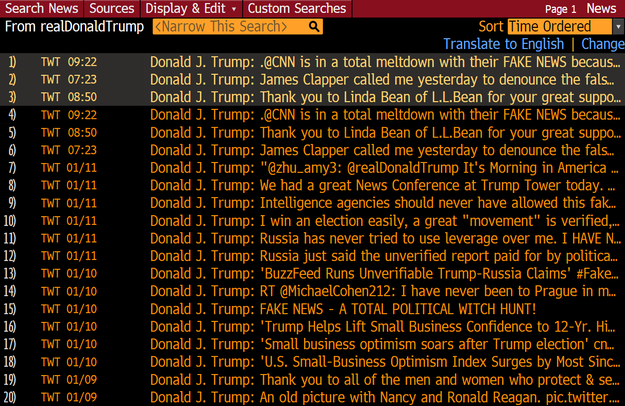
In typical Bloomberg fashion, you can customize your alerts for Trump tweets to see only when he mentions certain companies you are following. You can see, in real time, how the things he says translate into changing public sentiment on a company, and what happens to a stock, currency, or pretty much anything else being traded on markets at the time. And with the right screening, you can filter out his furious responses to SNL episodes and many praise-retweets.

BuzzFeed

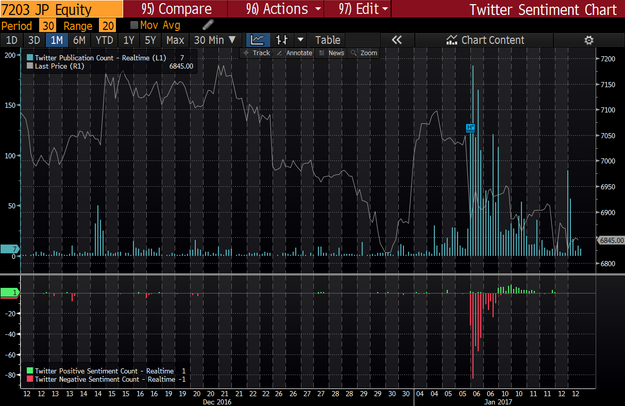
After that Toyota tweet in early January, Bloomberg terminals showed that as Toyota&039;s share price fell, the number of tweets about the company spiked, and the sentiment of the tweets turned sharply negative, according to Bloomberg&039;s tool for analyzing Twitter content.

Toyota’s share price (grey) and tweet volume (blue) alongside Twitter sentiment (green/red) after the Trump tweet.

Toyota's share price (grey) and tweet volume (blue) alongside Twitter sentiment (green/red) after the Trump tweet.

BuzzFeed

These tools are being used more and more as Trump picks the corporate winners and losers of the day. It happened to Lockheed Martin when he criticized the price of the F-35 fighter jet, and to Boeing when he declared the price of a new Air Force One too high.

This stuff matters to investors — especially if they get be on the right side of the stock market moves that happen as a result. Many financial institutions forbid social media use at work, making Bloomberg terminals a lifeline for traders wanting to keep up with the President-elect.

Morgan Stanley and JPMorgan Chase traders access tweets through their Bloomberg terminals, The Wall Street Journal reported last week, while just this month, the Japanese bank Mizuho gave its U.S. traders the ability to read tweets at work.

“He is publicly shaming people and companies,” Peter Tchir, a managing director at Brean Capital, said in a note. “He is trying to sway companies in a very public manner.” Investment banks now regularly rush out notes to clients based on Trump&039;s tweets about companies.

After the President-elect tweeted about Toyota, the Japanese bank Nomura said in an note to clients that “this tweet does not mark the first time Mr Trump has intervened in a company&039;s plans for the construction of a plant in Mexico, and we see the possibility of continued intervention in high-profile companies&039; plans for construction of Mexican plants after his inauguration.”

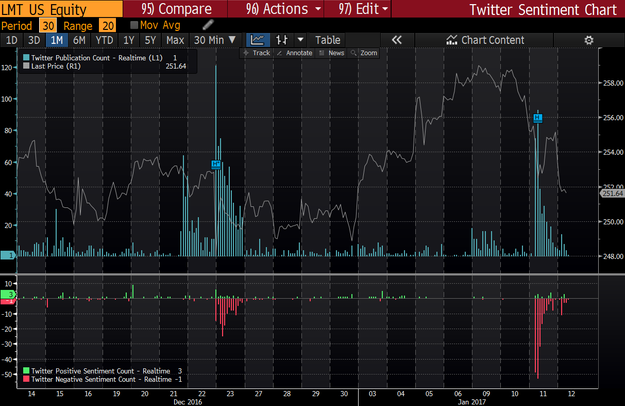
A few days before Christmas, Trump weighed in on federal contracting, tweeting that the cost of the F-35 fighter plane was “tremendous” and that he was asking a rival defense contractor (Boeing, another past victim of a Trump-shaming) to work on a comparable plane, leading to a 2% share dip in after-market trading.

Again, the Bloomberg analysis showed that tweets about Lockheed went from just a few every 20 minutes, to well over 100 — and they were mostly negative.

BuzzFeed

Quelle: <a href="It&039;s Not Just Your Phone: Trump Tweets Are Now All Over ,000 Bloomberg Terminals“>BuzzFeed

Uber Will Pay FTC $20 Million To Settle Claim It Misled Drivers On Pay

Uber will pay $20 million to settle allegations from the Federal Trade Commission that the ride-hail giant advertised inflated estimates of how much its drivers earn on its website and in Craigslist job postings to entice them to join the platform.

Uber claimed that drivers in San Francisco earn more than $74,000 annually, and that those in New York make more than $90,000 a year, according to the FTC’s complaint, filed in a California court. Less than 10% of drivers earn that much money, and the median income is $29,000 less in New York, and $21,000 less in San Francisco, according to the complaint.

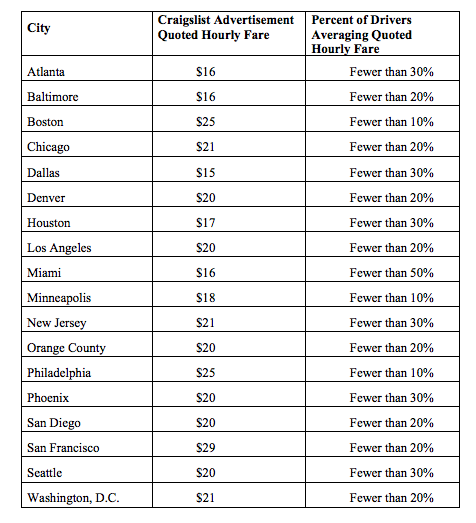
In 17 cities across the country, Uber advertised inflated hourly wages in job postings on Craigslist from at least January to March 2015, the FTC alleges, though the company’s own data showed that in several of those markets, fewer than 10% of its drivers had recently earned that rate.

“During and after the time period Uber has made these unsubstantiated earnings claims, in many markets, most Drivers have not made the claimed amount,” the complaint reads. “In many instances, Drivers have not made the promised amounts even when factoring in non-hourly earnings, such as payments for time-limited promotions and other incentives.”

Federal Trade Commission / Via documentcloud.org

Based on leaked documents and internal Uber calculations provided in response to the leak, BuzzFeed News reported in June that the net pay for drivers in some markets is comparable to that of a Walmart worker. BuzzFeed reported then that drivers in Denver take home an average of $13.17, those in Houston take home $10.75, and those Detroit take home $8.77.

The FTC also claimed that Uber promised to connect drivers with the “best financing options available” for a vehicle through third-party partner companies, but “Uber has not had any basis for making these claims.”

“Uber’s communications with at least one auto company have acknowledged payment terms and conditions that are inconsistent with Uber’s promises to Drivers,” the complaint reads.

As part of the settlement, Uber did not admit or deny the FTC’s allegations.

“We’re pleased to have reached an agreement with the FTC,” an Uber spokesperson said in a statement. “We’ve made many improvements to the driver experience over the last year and will continue to focus on ensuring that Uber is the best option for anyone looking to earn money on their own schedule.”

Quelle: <a href="Uber Will Pay FTC Million To Settle Claim It Misled Drivers On Pay“>BuzzFeed