Twitter Is Already Playing A Big Role In The Trump Administration

Alex Wong / Getty Images

Within his first minute at the podium Monday, White House Press Secretary Sean Spicer let the assembled press know he&;d been checking his Twitter mentions over the weekend.

“As I get started, I know that [Obama press secretary] Josh Earnest was voted the most popular press secretary by the press corps,” Spicer said. “After checking my Twitter feed, I shot Josh an email last night letting him know that he can rest easy, that his title is secure for at least the next few days.”

The Trump administration is only four days old, but it&039;s already evident that Twitter is playing a significant role inside it — not just as a publishing tool, but as a feedback channel. Spicer and other members of the administration are clearly watching the platform closely, monitoring the activity on it and acting based on what they see there. Trump used the platform vigorously and effectively during his campaign; now, it seems, little has changed.

In fact, in each of his two visits to the James S. Brady Press Briefing Room, Spicer has led with Twitter. On Saturday, much of his statement focused on tweets the administration didn&039;t like.

“For all the talk about the proper use of Twitter, two instances yesterday stand out,” Spicer said at the start of his Saturday remarks. After criticizing a report that falsely claimed Trump had removed the bust of Dr. Martin Luther King from the Oval Office, Spicer then criticized news organizations&039; (accurate) tweets on the size of Trump&039;s inauguration crowd size. “Photographs of the inaugural proceedings were intentionally framed in a way, in one particular tweet, to minimize the enormous support that had gathered on the National Mall,” Spicer said.

The Trump administration&039;s focus on Twitter has already extended beyond news organizations. After the National Park Service retweeted tweets pointing out Trump&039;s smaller crowd size, administration officials ordered it to temporarily stop tweeting, reportedly out of concern it was hacked.

The Park Service apologized Saturday, calling the retweets mistaken.

And, of course, President Trump is keeping his “big, beautiful Twitter account” active, having tweeted more from @realDonaldTrump than @POTUS since his swearing-in. Trump regularly takes to the service to go around traditional media and its filters. His tweets often move markets and have already broken with behavior expected of a President.

As BuzzFeed News has reported, the discussion of Trump on Twitter far outpaces anything else on the platform. Trump is discussed more than ten times as often as all of the Kardashians combined.

Spicer, for his part, has suggested replacing traditional press conferences with social-media question-and-answer sessions.

Quelle: <a href="Twitter Is Already Playing A Big Role In The Trump Administration“>BuzzFeed

Snapchat Will Start Cracking Down On Fake News

Snap Inc (formerly Snapchat) is getting more strict about what shows up in its app&;s Discover section. On Monday, the New York Times reported, the company introduced guidelines requiring publishers to start fact-checking Discover content, both linked and within the app. The rules also prohibit misleading and unnecessarily shocking headline images in Discover. The move comes as Snap heads to a likely IPO.

The updated guidelines on headlines and Discover Tiles prohibit profanity, overly sexualized content, and violent content. There are, however, exceptions for news, according to Snap, if the content comes with appropriate warnings. Publishers will also have the ability to filter content for Snapchatters younger than 18 starting in February.

Snap told BuzzFeed News, “It’s been two years since we first launched Discover. During that time, our partners’ editorial content has continued to evolve in look and feel, and we felt our guidelines should be updated to thoroughly reflect these changes.”

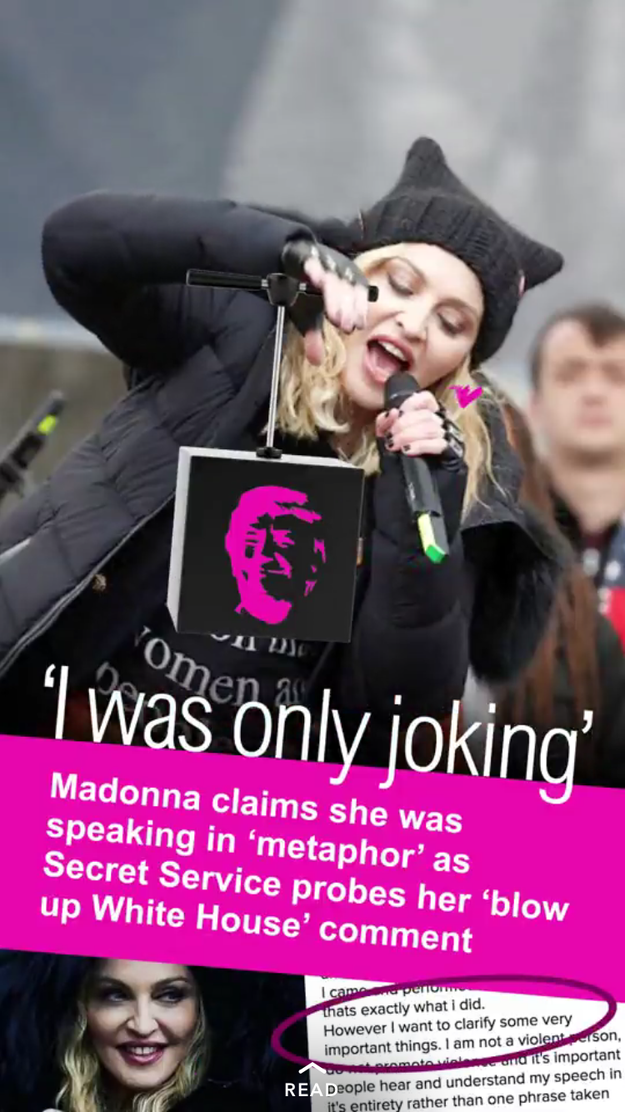
Snapchat may have trouble vetting the accuracy of all its publishers&039; content, though. On the same day as the update, the British tabloid The Daily Mail published a series of unverified Snapchat posts: “The Bigfeet Family,” “Did aliens &039;unlock&039; Uri?” and a story about one of Madonna&039;s Instagram posts, which the publication said was a response to a unverified secret service investigation.

The Daily Mail/Snapchat

The Daily Mail/Snapchat

The Daily Mail/Snapchat

The story about Madonna relies on an unconfirmed report from the Gateway Pundit, a pro-Trump site that publishes stories with headlines like “Organizer For DC Women’s March Against Trump Pictured Flashing the ISIS Sign” and “Trump And Mattis Take The Fight To ISIS, Bomb ISIS 31 Times On Day 1 (VIDEO)”. The Secret Service did not verify the alleged investigation to the Daily Mail, instead declining to comment.

Snap told BuzzFeed News that publishers maintain editorial independence once they are accepted as a partner, so the company doesn&039;t see content before it is published. But it said it follows up with publishers if users raise questions about their sourcing, accuracy, or other factors.

Snapchat&039;s move against dubious and exaggerated content comes at a time when Facebook and Twitter have faced sharp criticism over their unwillingness to fight the scams and fake news that proliferate on their platforms. Snap has managed to largely sidestep those debates, in part because of the tight control it&039;s always exercised over the Discover section. (BuzzFeed has partnered with Snapchat Discover for content distribution.)

Snapchat still faced a lawsuit in July 2016 alleging that, via Discover, it was “currently engaged in an insidious pattern and practice of intentionally exposing minors to harmful, offensive, prurient, and sexually offensive content, without warning minors or their parents” and that it “placed profit from monetizing Snapchat Discover over the safety of children.” The lawsuit was settled out of court, according to the Times.

Even before the new guidelines, the company already required that images and headlines in Discover be appropriate for users as young as 13. More than 100 million people view content in the Discover channels each month, according to the New York Times.

Facebook and Twitter have defended themselves against criticisms over fake news, harassment, and scams by claiming that they are content-agnostic tech platforms. Snap has taken an opposite tack, describing itself as “a publishing platform, built on values of providing Snapchatters with content that informs and entertains, from authoritative and credible media partners.” Those partners, Snap said, earn the community&039;s trust through “substantial, sourced and rewarding content.”

“We take the responsibility of being a source of news, entertainment and information for our community,” the company told BuzzFeed News.

Quelle: <a href="Snapchat Will Start Cracking Down On Fake News“>BuzzFeed

The Breathalyzer Device On "Shark Tank" Allegedly Ran False Ads

The Breathalyzer Device On "Shark Tank" Allegedly Ran False Ads

youtube.com

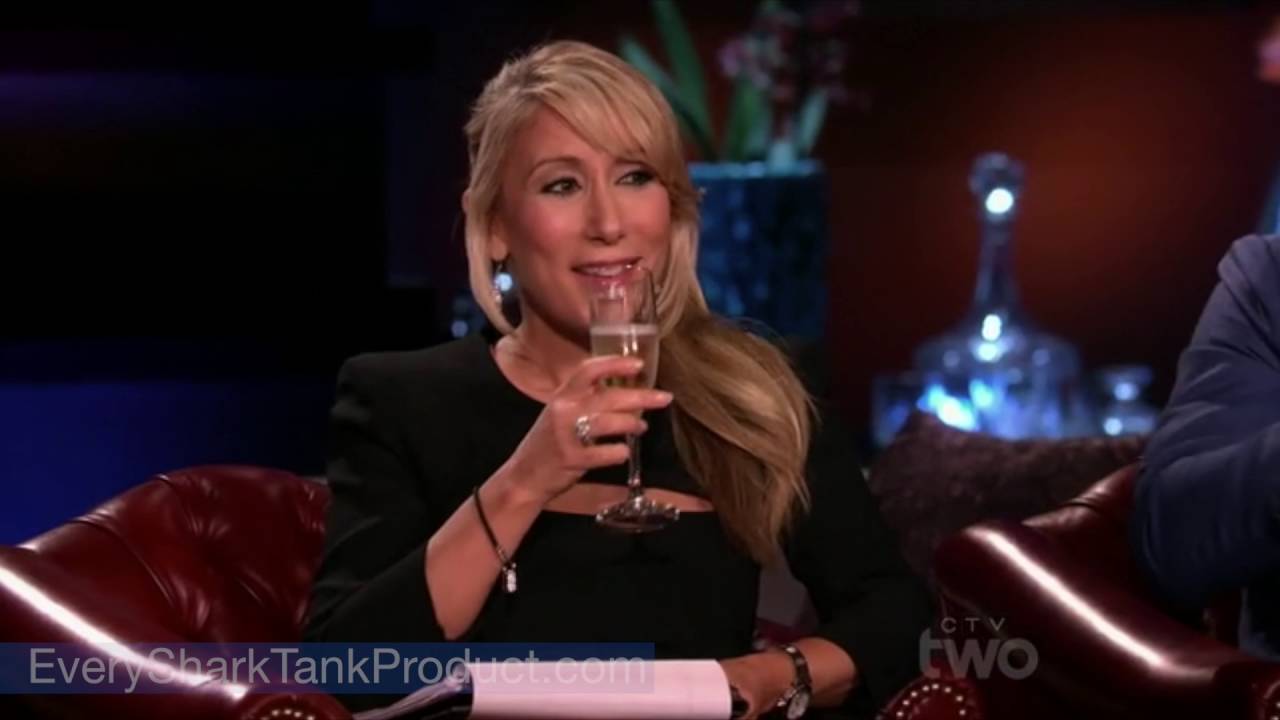
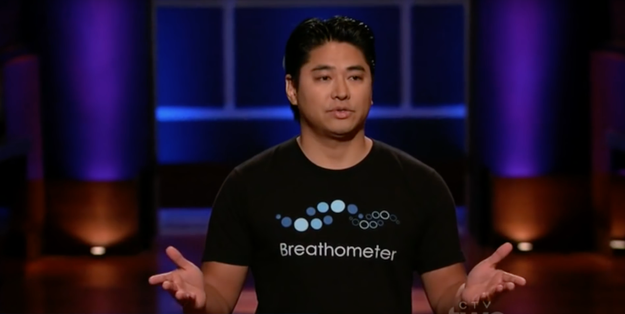
On the fifth season of ABC&;s hit show Shark Tank, entrepreneur Charles Michael Yim handed the sharks champagne as he pitched them on an irresistible invention: a smartphone-attached breathalyzer. Blow into the device and the app would calculate your alcohol levels, Yim explained, so you would know if it were safe to drive home. So charmed were all five investors that they offered to put $1 million in his startup, Breathometer, for a 30% stake.

But the Federal Trade Commission took a more sober view of the startup’s promises. On Monday, more than three years after the Shark Tank episode, the FTC said that Breathometer had settled allegations that “they lacked scientific evidence to back up their advertising claims.”

Under the settlement, Yim and Breathometer are prohibited from making accuracy claims about a consumer breathalyzer product unless backed by “rigorous testing,” according to the FTC. They must also notify consumers of the devices&039; inaccuracy and refund them.

“People relied on the defendant’s products to decide whether it was safe to get behind the wheel,” Jessica Rich, director of the FTC’s Bureau of Consumer Protection, said in a statement. “Overstating the accuracy of the devices was deceptive — and dangerous.”

The company acknowledged the settlement on its website, writing, “We feel it is important to clarify that this settlement does not undermine our achievements in creating quality consumer health devices.” It said that it had stopped making both Breathometer products in 2015, before the FTC’s inquiry.

As part of the settlement, Breathometer did not admit or deny the FTC’s allegations.

The Breathometer settlement is the latest in a series of incidents in which snazzy-sounding apps and gadgets make health claims that may be too good to be true. Scanadu, which was selling a Star Trek-style “tricorder” that claimed to instantly monitor your vital signs, recently told customers that it would stop making the devices per Food and Drug Administration orders. Last year, the company behind Lumosity, the online brain-training game, paid $2 million to settle FTC allegations that its marketing claims — that playing could stave off cognitive decline — were not scientifically validated.

Breathometer CEO Charles Michael Yim.

Via youtube.com

The Breathometer device was sold online in two versions, Original ($49.99) and Breeze ($99.99), and generated $5.1 million in sales, according to the FTC. The company also raised nearly $140,000 in a successful Indiegogo campaign to make the gadget.

Ads for both products claimed that their accuracy was proven by “government-lab grade testing,” while Breeze was also touted as a “law-enforcement grade product,” according to the FTC. But the agency alleged that neither was properly tested for accuracy, and that the company knew that Breeze “regularly understated” blood alcohol concentration levels.

The startup has since switched gears and started selling a new device, Mint, in September. The $99.99 smartphone-attached device purports to measure your oral health by measuring gases correlated with bad breath and gum disease. “We stand behind our current product, Mint, and its quality and pioneering technology,” the company wrote on its website.

Quelle: <a href="The Breathalyzer Device On "Shark Tank" Allegedly Ran False Ads“>BuzzFeed

Can’t-miss Innovation Talks, only at IBM InterConnect 2017

Are you interested in hot-button issues like cyberbullying, fake news, blockchain and cyberwarfare? Then you can’t afford to miss the all-new Innovation Talks at IBM InterConnect 2017.
On March 19 through 23, thousands of the best and brightest in will gather in Las Vegas for IBM’s annual gathering of innovators, thought leaders, academics and technical experts. World-renowned experts from industry and academia will share unique perspectives on how to differentiate your business in the changing world of cloud, cognitive computing, security and the Internet of Things (IoT).
Here are just a few highlights among many fascinating subjects to be tackled at the Innovation Talks:
Fighting cyberbullying with cognitive
According to experts, more than half of today’s teens have already experienced cyber bullying, and 95 percent have observed bullying among their peers. This is rapidly becoming one of the most prevalent psychological issues of the century. Join actor and activist Wayne Brady and additional special guests in this incredible and entertaining session.
Blockchain
Blockchain is transforming the world of money by providing the ability to validate and secure transactions with little or no human intervention. Don Tapscott, author of Blockchain Revolution, will discuss how you can use this technology to create new models of digital trust and disrupt your industry.
Ethics and artificial intelligence
As artificial intelligence continues to advance, we will increasingly see questions about ethical and legal challenges. Dr. Sabine Hauert of the University of Bristol will discuss how to maintain our moral compass when AI removes humans from portions of the decision-making process.
IoT & DDoS attacks
When Fortune magazine asked top business leaders about their biggest challenges in the Fortune 500 CEO survey, two-thirds cited cyber security. As connectivity spreads globally, so does the threat of cyberwarfare, from sophisticated fraud to business-crippling distributed denial of service attacks. CTO and cryptographer Bruce Schneier will discuss how to save IoT and the connected home from a security crisis.

Visit the InterConnect website to learn more, browse a complete listing of sessions, agenda, keynotes and a preview of our exciting entertainment. The conference provides $8,000 worth of training and education, more than 2,000 speaker sessions and 200-plus hands-on exhibitions. Need more reasons to attend? Check out more blogs here.
You can’t afford to miss this word-class event. Register today.
The post Can’t-miss Innovation Talks, only at IBM InterConnect 2017 appeared first on Cloud computing news.
Quelle: Thoughts on Cloud

Amazon RDS now supports Read Replicas of Encrypted Database Instances across Regions

Starting today, you can easily create cross-region read replicas for your Amazon RDS for MariaDB, MySQL and PostgreSQL database instances encrypted at rest with AWS Key Management Service (KMS). Previously, you could create cross-region read replicas for unencrypted database instances only, and the only option for creating copies of encrypted database instances was to copy encrypted DB snapshots to the target region. Now, you can create cross-region read replicas for your encrypted database instances in just a few clicks on the AWS Management Console.
Quelle: aws.amazon.com

Is This An Ad? Mindy Kaling And Casper Mattresses

Welcome to “Is This an ?,” a column in which we take a celebrity social media post about a brand or product and find out if they’re getting paid to post about it or what. Because even though the FTC recently came out with rules on this, it’s not always clear.

Instagram: @mindykaling

THE CASE:

We have Mindy Kaling, comedian, writer, star and creator of The Mindy Project and best-selling author.

And then Casper, a startup that sells reasonably priced mattresses. They’re foam, so they can be folded up and shipped in a neat little box.

On January 13, 2017, Kaling posted an Instagram of herself with a box from the mattress company, saying something sort of confusing about how it’s cold so she needed a new mattress, and “thanks to my friends @Casper.”

THE EVIDENCE:

Let’s start with the tangible evidence. The photo was actually split into two photos, one where she is smiling at the camera, the second where she is examining the box. She’s wearing a winter jacket inside, which is not typical for receiving a new mattress, and opens even more questions — did she just come in and find the box waiting for her, and took photos in a rush of glee before removing her coat? Or does the coat suggest she’s somewhere other than home — say, the Casper showroom? This one goes deep.

But let’s take a step back and think about who the parties are here. Mindy Kaling is not the kind of celebrity who is prone to posting ads for detox tea or tooth whiteners on her Instagram. She’s an A-list television actress who can definitely afford her own mattress and has a main job (making a TV show) that isn’t about leveraging her social media presence.

Also, Kaling is an enthusiast of things. I am admittedly a big Mindy Kaling fan and I find this aspect of her endearing and charming. Some stars, like Beyoncé, have a highly manicured social media presence, and if you see a product or brand in there, it’s likely not just, “hey this is what I’m eating right now.” Kaling uses Instagram more like a plebeian, capturing lots of casual moments on the fly, and like the rest of us, brands are woven into her life. When she Instagrams herself at her family’s home holding a tub of Friendly’s ice cream, we don’t assume that’s an ad from Friendly’s. We assume that she is fondly remembering the regional New England ice cream brand of her youth, just like the rest of us do when we go home for the holidays and pig out on the kinds of junk food our parents keep around.

When she photographs herself posing on some suitcases outside the luxury brand Goyard store in Manhattan with the caption “Photo taken quickly before the store owner could tell what I was doing,” we believe that she was just goofing around with friends on a walk, not that she’s a paid spokesperson for Goyard. Because posing surreptitiously in front of a weird store display is something the rest of us would totally do. People love Mindy Kaling because she&;s very relatable — she feels like she could be one of your friends, and her social media reflects that. She is, as they say, just like us.

Instagram: @mindykaling

And yet….. Are we really to believe that she just happened to order a mattress and then instagrammed it? And the caption “thanks to my friends at @Casper” — that implies it’s a gift, right? Or could the “thanks” just be thanking them for excellent customer service?

THE VERDICT:

While representatives for Mindy told me she was unable to comment since she was in production, Casper did respond.

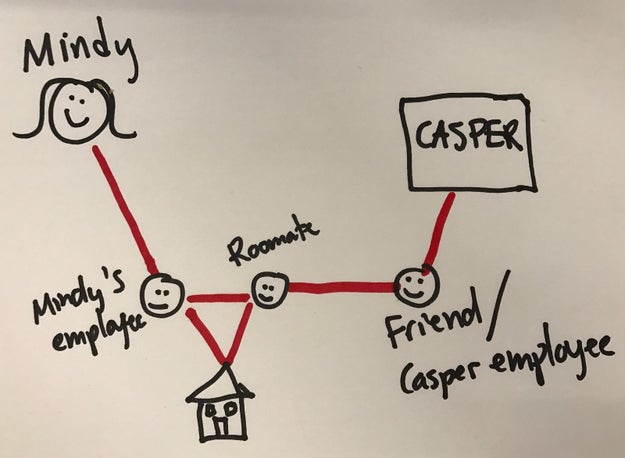
Turns out, Casper and Kaling really are “friends” Well, sort of. A Casper rep told me, “Mindy is a Casper employee&039;s roommate&039;s friend&039;s boss. She&039;s also one of our favorite comedians.” Did you get that? Here, I made a chart for you:

But did she get it free? Yup. According to Casper, “we heard she was interested in buying a mattress and we were happy to gift her new beds.”

Wait, beds plural? How many exactly did she receive? Her photo seem to suggest it was just one bed, photographed twice. But Casper confirmed the gift was actually two beds. This means the gift had a retail value of $1,100–$2,200 depending on the size of the beds.

The FCC rules about disclosing ads on social media posts dictate that a gift of goods is akin to cash compensation, so any related post should be marked as an ad (or something like ad, , etc). Though the FCC claims that it’s clear on this rule, in practice, it’s the most frequently ignored. Celebrities have been getting free shit since time immemorial (I imagine Jesus got lots of free sandals). Considering Mindy Kaling is an A-list star who has probably gotten free clothes and swag for years, the minutiae of FCC rules originally meant for bloggers isn’t top of mind.

Kaling’s original caption (“thanks to my friends”) is ambiguous. Sure, there’s a connotation that it was a free gift, but it’s phrased in really obscure terms – you have to know the freebie dialect to read between the lines.

The fans are getting wise to this. In the comments of Kaling’s post, someone clearly calls her out for not using sponsored or ad, against the FCC rules. But you’ll notice in the comments that… it’s also clearly working for Casper, regardless of whether or not it’s an ad. Mindy Kaling fans are chatting with each other about Casper mattresses — one person has some of her own and recommends them, another asks if they’re really too firm, other people say how they want to get one. This, my friends, is exactly why Casper gave two free mattresses to a celebrity.

When Casper replied to me about whether they were a free gift, they also wrote that they now realized that the Instagram caption was ambiguous, and were going to reach out to Kaling to change it. Now the caption reads “Thanks @Casper for the gift&;”

Impact, my friends. Impact.

Quelle: <a href="Is This An Ad? Mindy Kaling And Casper Mattresses“>BuzzFeed

A Thriving Chat Startup Braces For The Alt-Right

By most any measure, Discord is a thriving startup. After a $20 million funding round last January led by the august venture capital firm Greylock Partners, the voice-and-text chat app for gamers — lauded as a slick combination of “the best elements of Skype, IRC, and Slack” — has swelled over the past year from 3 to 25 million users.

Now, thanks to that growing community and ease of use, Discord has found favor with an unintended and inflammatory audience: The alt-right, the online movement of hardcore trolls, white nationalists, and neo-Nazis that have dominated discussion of internet life in the Trump era.

It&;s a familiar story. From Reddit to Twitter, the internet has produced a series of groundbreaking communication platforms, the very popularity and technological ingenuity of which have led to their adoption by hatemongers, trolls, and harassers. This trend has led the leadership of these services to have to make hard and sometimes ideologically inconsistent choices about free speech, including banning users and entire communities.

Discord didn’t start, like Reddit and Twitter, with any grand ideals about freedom of expression; it was built from the ground up as a tool for facilitating chat between cooperative gamers.

“We’re very focused on making an amazing communication product for gamers,” Discord CEO Jason Citron told BuzzFeed News. “I had a hunch that it would be used outside of gaming, but it wasn’t anything we thought specifically about.”

But a quick look at popular Discord servers shows that discussions on the service have trickled down from purely gaming into gaming-adjacent interests like anime, marijuana, porn, and rare Pepes. And where there are memes, in 2017, there are trolls, and worse.

In a Discord chat server called “/pol/Nation” — named for the controversial 4chan imageboard — more than 3,000 users participate in a rolling multimedia chat extravaganza of Hitler memes, white nationalist revisionist history, and computer game strategy. And in a voice-over-IP chatroom within the server, users keep up a steady chatter about the same subjects. It&039;s like a cutting-edge, venture-backed version of its namesake; 4chan on steroids.

“There&039;s a huge diversity of opinions,” pol/Nation&039;s publisher, who goes by the handle “theBigKK,” told BuzzFeed News over Discord voice chat. “Center-right, alt-right, national socialist.”

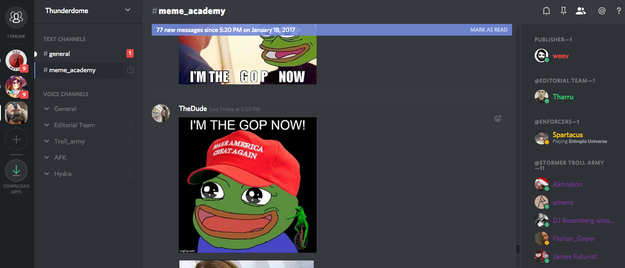
A separate server called “Thunderdome” hosts the enthusiastic staff and fans of the Daily Stormer, the neo-Nazi website. “Thunderdome” is published by Andrew “Weev” Auernheimer, the white nationalist troll known most recently for printing reams of Nazi propaganda on hundreds of open IP printers around the country.

Discord differs from other communication platforms in one key way: Its chats are entirely opt-in, meaning the potential for unsolicited public harassment is significantly lower. That&039;s why, Citron told BuzzFeed News, the presence of the alt-right on his platform won&039;t work the same way as on Twitter.

“We’ve noticed it,” Discord CEO Jason Citron told BuzzFeed News. “We read the news. But the way Discord is designed, it&039;s not a public communication tool. Someone can’t airdrop out of the sky and bother you.”

Still, the private nature of the chats may raise a different issue for Discord. It may not be the place where harassment is carried out, but it may be the place where harassment is planned, or worse. In Thunderdome, Weev posted the code necessary to print Nazi propaganda remotely:
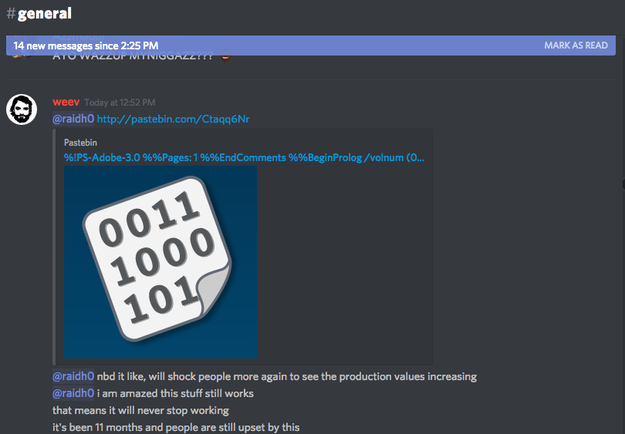
Asked about the potential for such abuses, Citron was philosophical. “Because we have such a large product, I think it&039;s inevitable that you have people who are misbehaving,” he said. “If something is important to us and it’s against the law, we act against it very quickly.”

So, what&039;s important to Discord? In November, TheBigKK contacted Discord customer service over Twitter to ask if /pol/Nation was “in any danger of being removed.” The Discord Twitter account responded, “The only thing that we would ever need to get authorities involved in is illegal speech such as acts of terrorism and the sharing of illegal content such as child pornography.”
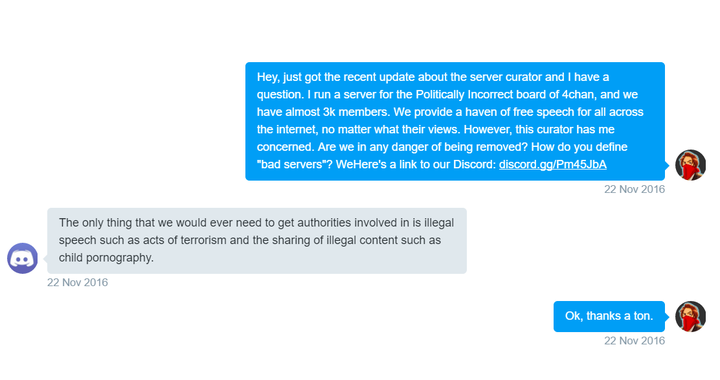
Even if a server or a user met this standard, consistent enforcement against infringing users or communities would be nearly impossible. Anyone can create a Discord server with the click of a button, and it&039;s nearly as easy to transfer administrative roles between users. The server /pol/Nation started on October 22, and by election night two weeks later it had grown into a thriving community with more than 1,000 simultaneous users from around the world celebrating Donald Trump&039;s victory. According to TheBigKK, a minimum of 10 users are on /pol/Nation&039;s voice chat at all times.

Indeed, Citron seems resigned to the idea that Discord will be a place where the kinds of users who have made the social internet toxic over the past few years congregate and plan.

“It’s inevitable that there will be actors using the product for things that are not completely wholesome,” he said.

In other words, as Discord continues to grow, don&039;t expect the alt-right to go anywhere — and don’t expect the company to do very much about it.

“It seems natural to me,” TheBigKK said, over Discord&039;s crystal clear voice chat. “It&039;s natural for a place that allows free speech.”

Quelle: <a href="A Thriving Chat Startup Braces For The Alt-Right“>BuzzFeed