“The government wants to know where you’re headed … on every ride.”
That’s the subject line of an email New York City Uber passengers received from the company today. The message goes on to warn riders that city taxi regulators want to start collecting private data about where individual Uber rides begin and end, and it encourages recipients to send an auto-generated tweet that includes the hashtag #TLCDontTrackMe. (TLC is the Taxi and Limousine Commission, which regulates cabs and ride-hail services in New York City.)
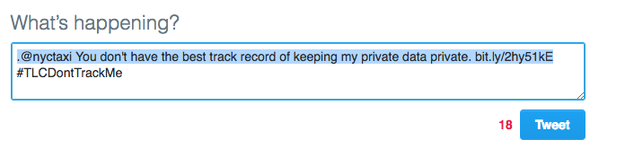
Uber first warned riders about the proposed rules in late December.
New York City already collects data on Uber rides. But now, in order to better monitor the issue of driver fatigue, the city wants to collect even more information, recording where riders get off as well as where they get picked up.
Uber says it is happy to provide the city with information on trip duration, but that regulators asking for specific locations of drop offs is an overreach.
“Several independent privacy experts have said this policy creates ‘serious privacy risks,’” Uber’s email reads. “And that it would give the government 'and anyone else who accesses this information a comprehensive, 360-degree view into the movements and habits of individual New Yorkers.&039;”
The part about “anyone who accesses this information” is a direct reference to a data privacy blunder New York taxi regulators made a few years ago. A 2014 blog post by a former Twitter engineer (which Uber’s auto-generated tweet links to) revealed that the city failed to properly anonymize the data it collected on taxi pick ups and drop offs, making it very easy to decode. The point Uber is trying to emphasize is that this type of mistake could happen again, leaving Uber passengers vulnerable.
TLC Deputy Commissioner for Public Affairs Allan Fromberg said the error that made the anonymized data identifiable back in 2014 was immediately corrected, and that it wouldn’t have impacted any Uber data collected by the city. He also noted that yellow cabs have been required to provide their pickup and dropoff locations to the city for a decade already. On Twitter, transportation experts concurred that the city’s data request is within normal regulatory bounds.
Some people on Twitter also noted the irony of Uber framing itself as a champion of data privacy, given the ways the company has attempted to leverage its riders’ private data in the past, including threatening to monitor individual users. And just last month, the Electronic Frontier Foundation called on Uber to offer passengers a way to opt out of a controversial new feature that tracks their location for up to five minutes after a ride ends.
Uber has a well-established strategy of leveraging its user base to fight back against regulations it doesn’t want to comply with. Before ultimately pulling out of Austin, Texas, for example, Uber sent both texts and emails urging customers to vote against legislation that would require drivers to be fingerprinted. In NYC, the company added a tab to users’ Uber apps that projected how long ride wait times would be if an unfavorable law supported by Mayor Bill DeBlasio was passed. (It wasn’t.) And in India, Uber also rallied users to oppose government rules that would change how ride-hailing apps could operate in the country.
A hearing regarding the proposed rules on data collection will be held Thursday morning. At time of publishing, dozens of Twitter accounts had already tweeted Uber’s warning in an effort to resist the city’s plan to collect the information it says it needs to keep them safe.
Here&039;s the full text of Uber&039;s email:
“Today, New York City requires Uber and other companies to hand over a lot of sensitive personal passenger data, including where you&039;re picked up on every trip. Now, New York City wants more. They&039;re trying to force companies to tell them where you’re dropped off, as well.
In other words, they want to piece together the full details of every trip you ever take. Several independent privacy experts have said this policy creates &039;serious privacy risks.&039; And that it would give the government &039;and anyone else who accesses this information a comprehensive, 360-degree view into the movements and habits of individual New Yorkers.&039; Click below to send a clear message that enough is enough.
Yours is the most powerful voice in this debate. We need your help. New York City doesn’t need this data and they’ve shown in the past that they cannot prevent it from becoming public.”
Quelle: <a href="Uber Sent Riders A Creepy Email About NYC’s Plan To Track Their Trips“>BuzzFeed