Twitter Bug Is Inserting Tweets Into People's Timelines From Users They Don't Follow

A Twitter bug is baffling some of the social media platform&;s users Wednesday by inserting tweets in their timelines from people they don&039;t follow.

The inserted tweets, which are being placed into timelines without any initial explanation from Twitter, set off a chorus from users asking, well, what the hell is happening?

Twitter is based on a follow model, which means tweets should appear in someone&039;s timeline only when posted by someone they&039;ve elected to follow, or when retweeted by someone they&039;ve followed. The mystery tweets were not received with a great appreciation by Twitter&039;s user base. Here&039;s a sample of their reactions:

Reached for comment, a Twitter spokesperson told BuzzFeed News, “This is a bug and we&039;re working on a fix.”

Quelle: <a href="Twitter Bug Is Inserting Tweets Into People&039;s Timelines From Users They Don&039;t Follow“>BuzzFeed

This Man's Bank Wanted To Read All His Emails To Approve A Credit Card

All your info are belong to us.

Twitter: @coderzombie

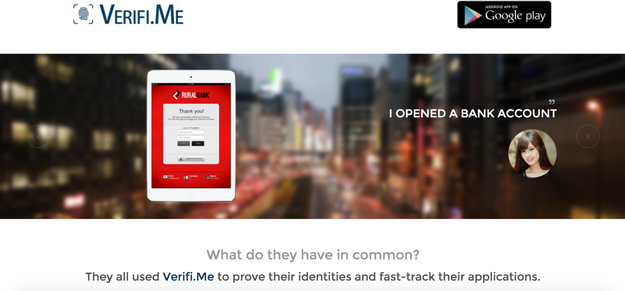
It turns out that his bank, HDFC, used a third-party company called Verifi.Me, whose website describes it as a verification service that lets users “prove their identities and fast-track their applications”.

It turns out that his bank, HDFC, used a third-party company called Verifi.Me, whose website describes it as a verification service that lets users “prove their identities and fast-track their applications”.

BuzzFeed News screenshot / Via verifi.me

Here’s everything that Verifi.Me collects about a user when they use the service, according to the company’s privacy policy.

Here's everything that Verifi.Me collects about a user when they use the service, according to the company's privacy policy.

That&;s pretty much everything important. Worse, the policy says that the company may share this information with people “who are required to know such information in order provide [services] to you.”

BuzzFeed News screenshot


View Entire List ›

Quelle: <a href="This Man&039;s Bank Wanted To Read All His Emails To Approve A Credit Card“>BuzzFeed

Azure SQL Database is increasing read and write performance

It is our pleasure to announce that we have doubled the write performance across all Azure SQL Database offers and additionally have doubled the read performance for our Premium databases. These performance upgrades come with no price change and are available world-wide.

The increased performance will allow for price optimization of existing workloads as well as for onboarding of even more demanding workloads to the platform.

Especially heavy OLTP workloads in Premium database with random read patterns will benefit from the increases read performance and may fit into a smaller performance tier than they are running in today. In general, if your Premium workload is below 50% DTU utilization now, you may be able to run in the next lower Premium performance level.

The increase in write performance will benefit bulk inserts, heavy batched data manipulation and index maintenance operations. You may notice up to double the logical insert throughput or 1/2 of the previous response times.

Learn More:

What is Azure SQL Database

Create a SQL Database or an Elastic Database Pool

Azure SQL Database Pricing

Quelle: Azure

Stay tuned to Thoughts on Cloud for cloud integration stories

Hello to regular readers of Thoughts on Cloud, home for news and expert analysis from the world of . I am thrilled to announce that, beginning today, the cloud content previously published at the IBM site In the Making will now run here.
We’ve moved to make it easier than ever for cloud professionals to learn, explore and engage with cloud stories from across IBM. On Thoughts on Cloud, we’ll continue to deliver insight and analysis on cloud integration topics from IBM thought leaders and experts, as well as from the broader world of cloud computing.
Some of the topics we’ll be adding or expanding include:

Application deployment and platforms
Business process
DevOps
IT Service Management
Software integration for cloud, business and applications

We’re always interested in your feedback. Follow us @IBMCloud and share your opinions, questions and ideas for future posts.
Stay tuned to Thoughts on Cloud by bookmarking our landing page or subscribing to our RSS feed.
The post Stay tuned to Thoughts on Cloud for cloud integration stories appeared first on Cloud computing news.
Quelle: Thoughts on Cloud

Managing encryption keys in the cloud: introducing Google Cloud Key Management Service

By Maya Kaczorowski, Product Manager

Google has long supported efforts to encrypt customer data on the internet, including using HTTPS everywhere. In the enterprise space, we’re pleased to broaden the continuum of encryption options available on Google Cloud Platform (GCP) with Cloud Key Management Service (KMS), now in beta in select countries.

“With the launch of Cloud KMS, Google has addressed the full continuum of encryption and key management use cases for GCP customers. Cloud KMS fills a gap by providing customers with the ability to manage their encryption keys in a multi-tenant cloud service, without the need to maintain an on-premise key management system or HSM.” — Garrett Bekker, Principal Security Analyst at 451 Research
Customers in regulated industries, such as financial services and healthcare, value hosted key management services for the ease of use and peace of mind that they provide. Cloud KMS offers a cloud-based root of trust that you can monitor and audit. As an alternative to custom-built or ad-hoc key management systems, which are difficult to scale and maintain, Cloud KMS makes it easy to keep your keys safe.

With Cloud KMS, you can manage symmetric encryption keys in a cloud-hosted solution, whether they’re used to protect data stored in GCP or another environment. You can create, use, rotate and destroy keys via our Cloud KMS API, including as part of a secret management or envelope encryption solution. It’s directly integrated with Cloud Identity Access Management and Cloud Audit Logging for greater control over your keys.

Forward thinking cloud companies must lead by example and follow best practices. For example, Ravelin, a fraud detection provider, encrypts small secrets, such as configurations and authentication credentials, needed as part of customer transactions, and uses separate keys to ensure that each customer’s data is cryptographically isolated. Ravelin also encrypts secrets used for internal systems and automated processes.

“Google is transparent about how it does its encryption by default, and Cloud KMS makes it easy to implement best practices. Features like automatic key rotation let us rotate our keys frequently with zero overhead and stay in line with our internal compliance demands. Cloud KMS’ low latency allows us to use it for frequently performed operations. This allows us to expand the scope of the data we choose to encrypt from sensitive data, to operational data that does not need to be indexed.” — Leonard Austin, CTO at Ravelin
At launch, Cloud KMS uses the Advanced Encryption Standard (AES), in Galois/Counter Mode (GCM), the same encryption library used internally at Google to encrypt data in Google Cloud Storage. This AES GCM is implemented in the BoringSSL library that Google maintains, and continually checks for weaknesses using several tools, including tools similar to the recently open-sourced cryptographic test tool Project Wycheproof.

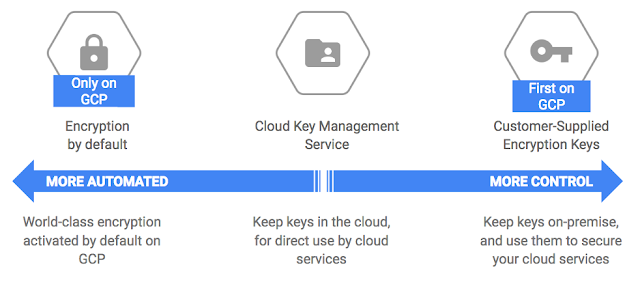
The GCP encryption continuum

With the introduction of Cloud KMS, GCP now offers a full range of encryption key management options, allowing you to choose the right security solution for your use-case based on the nature of your data (e.g., is there financial, personal health, private individual, military, government, confidential or sensitive data?) and whether you want to store keys in the cloud or on-premise.

By default, Cloud Storage manages server-side encryption keys on your behalf. If you prefer to manage your cloud-based keys yourself, select “Cloud Key Management Service,” and if you’d like to manage keys on-premise, select “Customer Supplied Encryption Keys” (for Google Cloud Storage and for Google Compute Engine). See the diagram below for a use-case decision tree:

Your data is yours
While we’re on the topic of data protection and data privacy, it might be useful to point out how we think about GCP customer data. Google will not access or use GCP customer data, except as necessary to provide them the GCP services. You can learn more about our encryption policy by reading our whitepaper, “Encryption at Rest in Google Cloud Platform.”

Safe computing!
Quelle: Google Cloud Platform