Those 100,000 New Amazon Jobs Might Not Be Good For Everyone

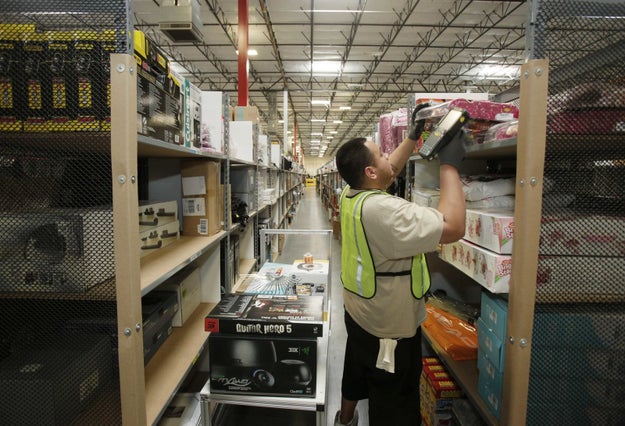
Shipment picker Marcus Marintez of Phoenix pulls items for shipment inside the 800,000 sq. ft. Amazon.com warehouse in Goodyear, Ariz.

Ross Franklin / AP

President elect Donald Trump was quick to take part of the credit for Amazon’s announcement this week that it will create 100,000 new jobs in the US in the next 18 months.

Amazon has not confirmed whether the job creation is the result of a conversation with Trump, who last spring falsely called the e-commerce giant a “huge antitrust problem.” He also accused CEO Jeff Bezos of manipulating coverage by the Washington Post, which he owns, to his advantage. Bezos was among the tech titans who met with Trump last month.

100,000 new jobs would be a coup for Trump, who has spent the weeks leading up to his inauguration talking about efforts by companies like Carrier and Sprint to keep manufacturing jobs in the US. For a figural comparison, Japanese billionaire Masayoshi Son told the incoming president that he planned to invest $50 billion in the US economy, a massive sum that he says will result in just 50,000 new jobs. But while Amazon’s planned growth is impressive, whether those jobs end up being good for the economy is debatable.

“Many of these jobs will be low-paid, short-term, and have high turnover. Some will be temporary positions,” said Stacy Mitchell, co-director of the Institute for Local Self-Reliance, a research and advocacy group focused on stimulating local economies. “Those are not the kind of jobs we need in order to address the economic challenges that so many Americans are facing.” (In its press release, Amazon said all 100,000 new positions will be “full-time, full-benefit” jobs.”)

Earlier this year, Mitchell — who literally wrote the book on the negative impacts big box stores have on communities — co-authored a report on Amazon about the kinds of jobs it creates and the kinds of jobs it destroys. As the New York Times reported Friday, for every position Amazon fills, a greater number of traditional retail jobs are eliminated, undercutting the company’s job creation claims.

But even if the warehouse and delivery jobs Amazon generates are replacing retail jobs at brick-and-mortar shops and department stores, the quality of the jobs isn’t necessarily the same. And what Mitchell has to say about the working conditions for many Amazon workers does not sound good. (Mitchell’s insights on working conditions at Amazon comes from original interviews with warehouse workers and labor organizers, as well as extensive previous reportage from news outlets including Mother Jones, The Seattle Times, and The Morning Call.)

“Amazon’s warehouses are very finely tuned machines and the company organizes the human labor to be parts of the machine,” Mitchell said. “So the tasks are highly repetitive, and they are physically demanding. In warehouses that haven’t been automated yet, it involves running across warehouses that are multiple football fields in size to pick items.”

The report also describes the experience of employees who had to kneel on the ground hundreds of times a day, and a job posting that says employees must be able to lift up to 49 pounds in temperatures of up to 90 degrees. But Mitchell said, in researching Amazon, what struck her most was the psychological stress to which even Amazon’s lowest paid workers were exposed.

“Amazon consistently sets the performance goals above what people can actually achieve,” Mitchell said. “You’re always racing and running and falling behind and, among other things, not only does it make you do more, but it makes you demoralized, and less likely to speak up or join with your fellow workers in speaking up about working conditions.”

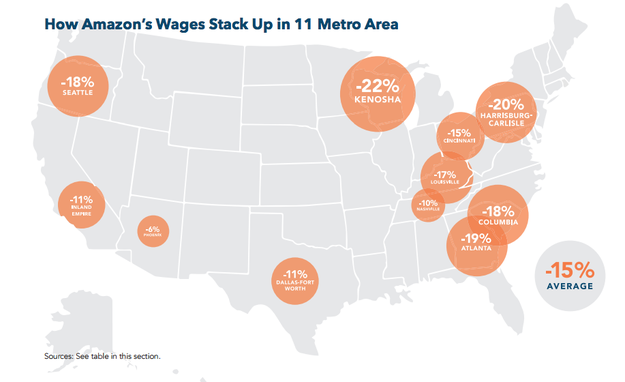
On top of all that, Mitchell’s report also found that Amazon paid its warehouse workers less to do these unpleasant jobs than comparable employers paid theirs. Comparing Amazon hourly wages found on Glassdoor to Bureau of Labor Statistics data, Mitchell found that, in 11 markets where Amazon is currently active, Amazon wages were on average 15% lower than the prevailing wage for warehouse workers; in Atlanta it was 19% less, while in Phoenix it was 6% less.

Wages submitted to Glassdoor are anonymous and therefore difficult to fact-check, but Mitchell said the data, which she only pulled from markets with a significant volume of submissions, was corroborated by job postings and staffing agency listings.

In a statement, an Amazon spokesperson said that its fulfillment center employees earn 30 percent more than retail workers typically do and that the company is “proud of the work environment and the culture we have at Amazon.”

Amazon prefers to compare the wages it pays fulfillment center employees to prevailing wages in the retail industry. Retail work, because it’s less physically demanding, is typically lower paid than warehouse work.
Institute for Local Self-Reliance / Via ilsr.org

While more jobs are generally good news, for low-skill workers, Mitchell thinks the fact that Amazon pays comparatively low wages despite its dominance of the online retail market is definitely a cause for concern, especially in communities where a decline in manufacturing has led to high unemployment.

“There’s a lot of economic research that suggests the biggest problem facing the US economy is not so much lack of jobs, but that the jobs we do have pay too little,” she said. “This is more of the same.”

In Amazon’s press release announcing the new jobs, the company details the unusually generous benefits it offers entry-level workers, including subsidized job training, retirement savings and stock options, and a generous 20-week parental leave program for all parents. Though the company’s release focuses on fulfillment centers, some of the new positions Amazon creates in the next 18 months will be white-collar jobs in fields like AI and cloud services.

Quelle: <a href="Those 100,000 New Amazon Jobs Might Not Be Good For Everyone“>BuzzFeed

How did we develop software without Docker?

Software developers have used container technology for some time now, but why is Docker so darn popular?
With Docker, a developer can use a command to build everything needed to run an application into a single package. Docker’s developers built its API to fit seamlessly into most development and deployment workflows.
Remember when it was a pain to move an application from one cloud environment to the next? This is no longer the case with Docker. Until recently a developer would write an application and then have to cobble together the runtime, database and operating system.
Now with Docker, a developer can package an application in a standard image and transfer it to virtually any server anywhere, whether a physical server in your company’s private cloud or an off-premises, virtual cloud such as Bluemix. With Docker, the developer no longer needs to know in advance where their application will end up running.
IBM developed an open integration model with Docker and the open-source Docker community. By combining IBM Java, Docker and WebSphere Application Server Liberty, a developer can now take advantage of faster startup time, half the memory usage, and dramatically faster input/output when compared to a traditional virtual server.
WebSphere Application Server Liberty is lightweight and designed for cloud. It makes it easier to build and deploy any kind of enterprise Java application on the public or private cloud. You can incorporate web, mobile, social, big data or any other services needed to innovate and move your business forward into the future.
You don’t have to worry about which cloud environment on which your application will be deployed. With Docker, you can package your application into a container with one command and ship it anywhere. This means much less effort and troubleshooting for your development team.
To learn more about how you can increase productivity with WebSphere Liberty, click here, or to see a comparison of costs between WebSphere Application Server Liberty and open source tools, click here.
The post How did we develop software without Docker? appeared first on news.
Quelle: Thoughts on Cloud

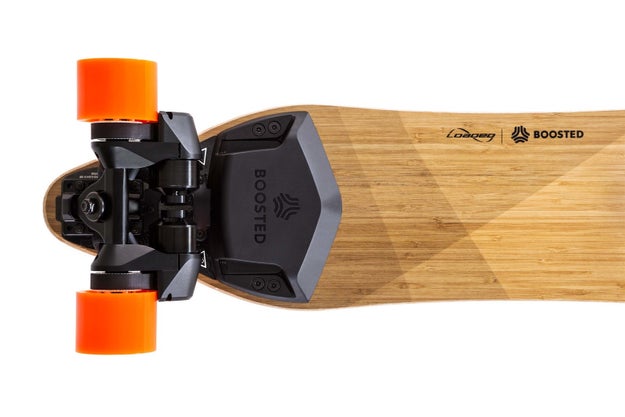
Boosted's Latest Electric Board Is Recalled For Smoking Battery

Boosted's Latest Electric Board Is Recalled For Smoking Battery

Boosted

Federal product safety commissioners on Thursday issued a recall notice for the second generation of Boosted Boards, electric longboards popular with the tech crowd.

“Consumers should immediately stop using the recalled skateboards and contact Boosted for a free replacement battery pack,” the Consumer Product Safety Commission (CPSC) warned.

Roughly 3,300 of the Dual+ boards, which retail for $1,500, are subject to the recall. The recall is voluntary, but both the CPSC and Boosted recommend that all Dual+ owners return their batteries.

Boosted said in a statement on its website that it investigated the batteries after two claims that they smoked while in operation and found the issue was a result of water entering the battery pack. No injuries were reported.

The company posted instructions to return the battery for a replacement on its website: remove the battery, record the serial number, recycle the battery, retain a receipt for doing so, and fill out a form. Removing the battery pack requires a hex wrench, which Boosted will mail to consumers if need be.

The boards received glowing reviews from various tech publications and bloggers. Josh Constine, an editor at TechCrunch, is a particular personal fan. He did not immediately respond to request for comment.

And reviews of the boards frequently accrue millions of views on YouTube.

youtube.com

Boosted Boards are the latest victim in a long line of problems with lithium ion batteries, which have accrued no small amount of negative press in the past two years. Hoverboards, e-cigarettes, and the Samsung Galaxy Note7 smartphone all have all fallen prey to the explosive issues the batteries may cause. Airlines have banned devices that use them from flights.

Boosted and the CPSC did not immediately respond to requests for comment.

Boosted is based in Mountain View, CA, and the boards are manufactured in China.

Quelle: <a href="Boosted&039;s Latest Electric Board Is Recalled For Smoking Battery“>BuzzFeed

Explore Stackdriver Monitoring data with Cloud Datalab

By Mary Koes, Product Manager

Google Stackdriver Monitoring allows users to create charts and alerts on monitoring metrics gathered across their Google Cloud Platform (GCP) and Amazon Web Services environments. Stackdriver users who want to drill deeper into their monitoring data can use Cloud Datalab, an easy-to-use tool for large-scale data exploration, analysis and visualization. Based on Jupyter (formerly IPython), Cloud Datalab allows you access to a thriving ecosystem, including Google BigQuery and Google Cloud Storage, plus many statistics and machine learning packages, including TensorFlow. We include notebooks of detailed tutorials to help you get started with your Stackdriver data, and the vibrant Jupyter community is a great source for more published notebooks and tips.

Libraries from the Jupyter community open up a variety of visualization options. For example, a heatmap is a compact representation of data, often used to visually highlight patterns. With a few lines of code included in the sample notebook, Getting Started.ipynb, we can visualize utilization across different instances to look for opportunities to reduce spend.

The Datalab environment also makes it possible to do advanced analytics. For example, in the included notebook, Time-shifted data.ipynb, we walk through time-shifting the data by day to compare today vs. historical data. This powerful analysis allows you to identify anomalies in your system metrics at a glance, by visualizing how they change from their historical values.

Compare today’s CPU utilization to the weekly average by zone

Stackdriver metrics, viewed with Cloud Datalab

Get started

The first step is to sign up for a 30-day free trial of Stackdriver Premium, which can monitor workloads on GCP and AWS. It takes two minutes to set up. Next, set up Cloud Datalab, which can be easily configured to run on Docker with this Quickstart. Sample code and notebooks for exploring trends in your data, analyzing group performance and heat map visualizations are included in the Datalab container.

Let us know what you think, and we’ll do our best to address your feedback and make analysis of your monitoring data even simpler for you.

Quelle: Google Cloud Platform