Amazon CloudWatch Releases CloudWatch collectd Plugin

Amazon CloudWatch announces the availability of an open source collectd output plugin to simplify sending custom metrics to CloudWatch. collectd is a popular, open-source daemon that gathers system statistics for a wide variety of applications. The CloudWatch collectd plugin can be used on both AWS and non-AWS environments to gather host and application metrics such as memory and disk usage for a variety of applications such as Apache, NXGINX, MySQL, etc. The metrics gathered by collectd will be published as custom metrics to CloudWatch. These collectd metrics can then be used to set up alarms for triggering notification and auto-scaling actions or saved to dashboards for quick viewing in CloudWatch. 
Quelle: aws.amazon.com

This Startup Wants To Smarten Up Your Smart Home Devices

Today, Thington launches. It’s a smart assistant app that aims to simplify smart home devices.

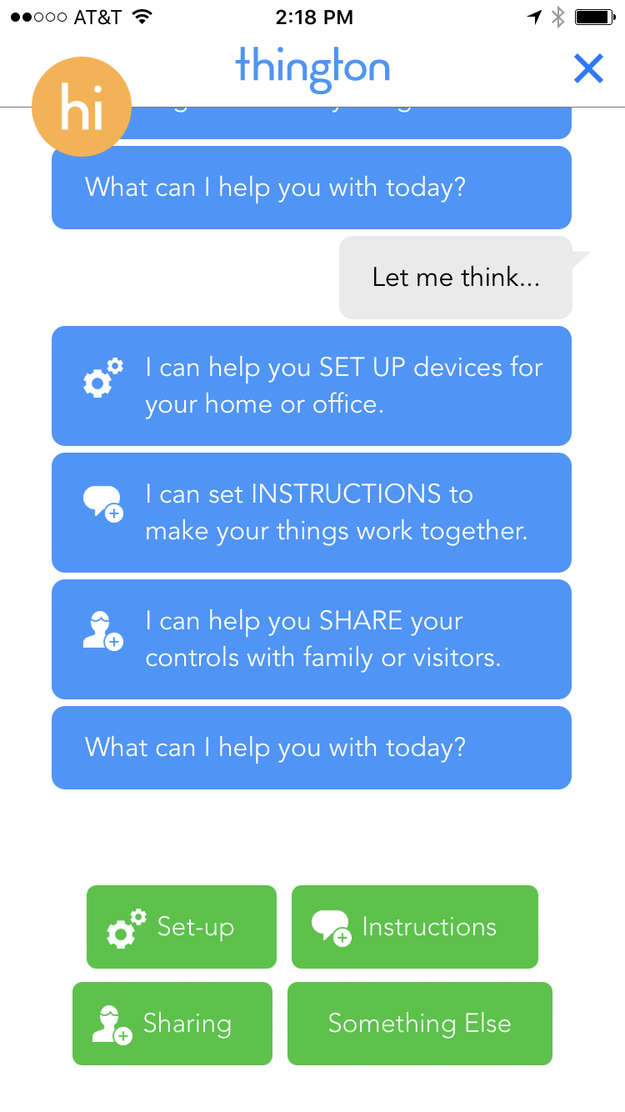
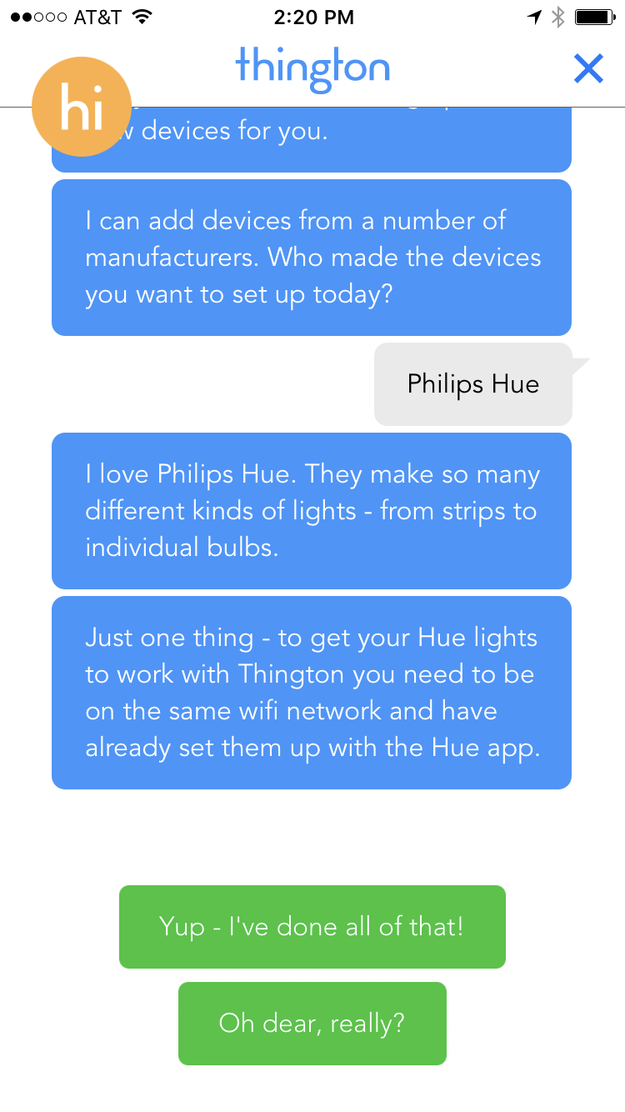
Thington’s distinctive feature? Thington Concierge, a conversational bot that helps you set up and control the smart things you’ve already set up in your home. From weather stations to light switches to security cameras, it supports a range of devices.

How does it work?

With its bot messenger interface, Concierge allows you to create rules for your house. You can set your lights to glow fluorescent during the day and incandescent during the night, or to turn on when you get home. Or, for example, you can program your Nest thermostat to lower the heat while you’re sleeping in your cozy bed, and then to raise the temperature before you wake up. And you can add people to a “Guest List” to give them access to your home&;s controls when they’re visiting you. These kinds of combinations and features, Thington founders Tom Coates and Matt Biddulph believe, is their product’s competitive edge: It’s more like an assistant with a personality than a remote.

Giving your smart home that personality, Biddulph said, is only made possible by simplifying all the different devices and unifying their interfaces. That&039;s Thington&039;s biggest technical challenge. “We want it to be like texting a friend who knows how to set up this kind of stuff instead of needing a degree in computer science.”

Image courtesy of Thington

Coates and Biddulph founded Thington after Coates created House of Coates, an automated Twitter account for his house that tracks when his electronics turn on and off, as well as Coates’ own movements. The account received a fair amount of positive press, which got Coates thinking about how the Internet will connect and transform homes.

“After the social web, there’s the physical. The tendrils of the internet extend,” Coates said. It’s no coincidence Thington’s feed looks a lot like Twitter’s; users even have to log in with their Twitter accounts. This is one of the more perplexing Thington features: If you, or your guests, aren&039;t on Twitter, you&039;re out of luck. Creating a Twitter account just to control your smart home devices seems like an unnecessary hurdle for an app that&039;s designed to simplify your life.

How big is the connected home market?

Do we need a conversational remote for smart homes? Biddulph told BuzzFeed News, “These aren’t ‘wildly niche’ devices; it’s just an early market.” The Thington founders estimate these devices are in “10 to 25% of American homes.” They might be a little optimistic — The Economist cites research that 6% of US homes have smart devices.

Right now, Thington only works with devices from five manufacturers. But Biddulph and Coates estimate that 80 to 85% of manufacturers they&039;ve spoken to have agreed to work with them, so they say more device compatibility is on the way.

Image courtesy of Thington

How will Thington make money?

Thington will, eventually, recommend other smart devices for users’ homes. That capability isn’t launching today, though.

“We want to build that trust first with our users first, then take advertisements by manufacturers,” Biddulph told BuzzFeed News. “We don’t want to be invasive.” The company also encrypts users’ data and scrubs it after a few weeks. According to the founders, the app only tracks your movements when you’re inside a Thington-enabled house.

What else is out there?

According to Business Insider, an estimated 1.6 to 3 million homes have an Amazon Echo speaker, which comes with the smart home system Alexa, according to Business Insider. Alexa can also serve as a central control for smart devices. Google announced Google Home, an Alexa lookalike, on Tuesday. And Apple’s HomeKit comes pre-installed on iPhones. Thington is competing with a number of smart home apps.

Coates pointed out that the apps don’t do the same thing — HomeKit only works with pre-approved smart devices, whereas Thington aims to work with every flavor. But it&039;s yet to be seen if the average user will discern that difference.

Quelle: <a href="This Startup Wants To Smarten Up Your Smart Home Devices“>BuzzFeed

Instagram At 6: Kevin Systrom On Moments, Mission, Ads, And Stories

Instagram CEO Kevin Systrom in front of a photo wall at the Blue Bottle café inside the company&;s new headquarters building.

Mat Honan

It’s been a hell of a year for Instagram. The photo and video sharing network shipped a slew of new features and updates in 2016, many of them controversial. In March, it irked people by changing the way it displays updates in its feed, moving from purely chronological to an algorithmic ordering. In May, it set off a ruckus with a change to the familiar Instagram logo. And in August it absolutely, positively steamed the internet by rolling out a new Stories feature that obviously cloned a marquee Snapchat feature. Along the way, Instagram also released new tools to fight trolls, went big on video, added an army’s worth of advertisers, and — just last week — moved into a new office. Phew&;

That&039;s a bevy of changes for a company that was once famously deliberate — perhaps even slow — at evolving its product. But they&039;ve all had a healthy effect on Instagram. It is now sitting on 500 million daily active users, 100 million of whom view its new Stories feature daily. According to the company’s leadership, people are spending far more time in the app both viewing and posting images. And because of that, Instagram now boasts more than half a million advertisers on its platform every month. That translates into a lot of revenue for a company that today turns 6 years old.

For Instagram&039;s sixth birthday, BuzzFeed News sat down with founder and CEO Kevin Systrom to talk about the company&039;s recent past and near future, and the rapid evolution it has undergone. He was upbeat — happy, even — and insistent that the changes Instagram has undertaken this year are crucial to its continued growth and relevance — even if they did provoke a backlash from users and critics.

“I think companies that fail are typically companies that look at themselves as a set of features,” Systrom said of Instagram&039;s decision to get into video and move beyond its iconic square photo. “Companies that succeed look at themselves as mission-based companies. … So if Instagram&039;s mission is to make sure that everyone can capture and share the world’s moments, and use them to form stronger relationships with one another, how do you say to someone, ‘I&039;m sorry, you can&039;t post that photo unless you crop it into a square and fit everyone in’? That&039;s a ridiculous argument.”

That kind of thinking made the decision to introduce video to Instagram an easy one. Thanks to better cameras, faster networks, and more on-device storage, our video usage is rapidly increasing, and every social platform — Twitter, Facebook, Snapchat — is barreling to highlight it. Instagram is no different. But where the company&039;s photo content is instantly recognizable and iconic, its video looks pretty much the same as everyone else’s. Systrom maintains that the videos posted to Instagram differ from those found elsewhere, but he acknowledged that Instagram&039;s video-viewing experience isn&039;t quite there yet.

“I agree, the video format in our viewer does feel similar to what a lot of other people are doing,” Systrom said. “I think that&039;s fine for now, but it&039;s not where we want to end up. We want to innovate and improve the experience.”

This mission-driven approach also explains Instagram&039;s decision to abandon its original logo (which Systrom himself designed) for a new one with a flatter, more abstracted aesthetic.

“You form your own identity over time,” Systrom explained. “We wanted to make sure that people knew we were not just a camera app on your phone. We are much more than that. We are about media. We are about diversity. We are about expression. The new logo aligns with our principles — simplicity, universality, understandability. It also aligns with our mission, which is not just to be a camera company, but to be a moments company. The logo is abstracted from the physical camera. It acknowledges that we are, in fact, about moments.”

That moments line sounded a bit odd given Instagram&039;s recent move away from a purely chronological feed. If the the company&039;s mission is capturing and sharing moments, doesn’t it make more sense to display them as they happened? One of Instagram’s early big cultural breakthroughs, for example, was in 2011, when New York City was hit by a blizzard, and its residents relentlessly shared photos of their slogs through the snow. We as a society experience these unexpectedly serendipitous moments where we fire up Instagram and see our friends all experiencing the same things at the same time. How will people showcase and experience those moments — such as a particularly vivid sunset in Manhattan or a gorgeous rainbow stretching across San Francisco — in an algorithm-driven world?

“Nowhere in our mission is it about being real-time,” Systrom said. “I don&039;t think we are focused on making sure you have a news feed of an unfolding event in real-time view. And I think that&039;s okay. You should still see rainbows, generally, together — especially if they&039;re good rainbows, in which case the best ones will rise to the top.”

According to Systrom, when Instagram rolled out its algorithmic timeline, people were missing about 70% of the images and videos in their feeds. So the company introduced tweaked things so that the 30% they do see is likely to be the stuff they care about most.

Systrom said Instagram experimented with several different versions of a ranked feed before landing on the one it rolled out and has since refined. The feed is now calibrated to prioritize the content with which people are most likely to engage. And, according to Systrom, that has driven people to spend more time on Instagram and upload more even more content to it.

“In general, feed is still a very, very real time,” Systrom observed. “We just take the last [updates] since you checked Instagram — which for most people is maybe a couple of hours — and we make sure that the best stuff&039;s at the beginning.”

Mat Honan

But nothing else has been as controversial for Instagram as its decision to clone Snapchat Stories. Systrom consistently talks about taking problem-solving and mission-driven approaches to the company&039;s product. In this particular case, the problem that needed solving was a simple one: getting people to post more content to Instagram more often.

“It’s pretty well-known that on Instagram you post the highlights of your day,” Systrom said. “I wish it weren&039;t that way. I wish people felt more free to share as much as they wanted during the day.”

For Instagram, that was a troubling conundrum.

“As we dug into our user studies, I realized very quickly that we had to find a solution that made it so you didn&039;t have to post your profile,” Systrom explained. “After some tests, we added a check box that said ‘expire from my profile’ or ‘don&039;t post to my profile.’ But no one understood why they would do that.”

So in August, in an attempt to get people to post more casual kinds of content in a way they already understood, Instagram rolled out Stories. For anyone who had used Snapchat — which offers a near-identical feature of the same name — the update felt…pretty familiar&033; The Verge called it a “near perfect copy” of Snapchat Stories. TechCrunch described it as “a Snapchatty feature.” The New York Times said it “takes a page” from Snapchat. BuzzFeed News wrote, “It’s hard to view Instagram Stories as anything other than a direct shot at (or, less charitably, blatant rip-off of) Snapchat Stories.”

Systrom, at the time, leaned into the criticism. And he still vigorously defends Instagram&039;s move to adopt a feature that has been for Snapchat a huge driver of engagement.

“We have a lot employees that believe passionately in ephemerality,” Systrom said. “And I wanted to be sure that we were doing the right thing for the community — not just reacting to what was out there because it was cool or hip. Ephemerality had to be adopted in a way that worked. And a signal that it is working is that after just a few months, over 100 million people, daily, use Instagram Stories. So, forget about pride of authorship, internally or externally — it&039;s working.”

Quelle: <a href="Instagram At 6: Kevin Systrom On Moments, Mission, Ads, And Stories“>BuzzFeed

Why VMware on IBM Cloud matters

Enterprises large and small have made significant investments in VMware-based technology, deriving substantial business value over a number of years. Today, there are some 40 to 50 million virtual servers running workloads in client data centers around the world. Along with VMware virtualization technology, enterprises are using critically important VMware-based management tools and have steadily developed a robust set of VMware-based skill sets.

A majority of these same companies are also looking for the best ways to use cloud service provider capabilities as part of an emerging hybrid cloud strategy. As their cloud expertise grows and their hybrid strategies mature, many are looking to exercise their existing investments while also embracing newer approaches for born-in-the-cloud applications.
Put simply, the vision for many IT organizations is to “extend” what they are doing from a VMware perspective into a hybrid cloud model while also taking advantage of additional cloud services that go beyond basic infrastructure as a service.
The IBM and VMware partnership announced earlier this year was formed to help clients achieve this vision. The payoff from using VMware on IBM Cloud can be truly compelling. Clients can enjoy a seamless VMware experience using the same tools, processes and security policies they are already using in their data center, such as VMware vSphere HA and vMotion for resiliency, vSAN for storage and NSX for networking.
In addition, they can gain access to the rest of the IBM Cloud portfolio, which extends beyond infrastructure as a service.

One of the major US-based life science companies has realized the advantages of VMware on IBM Cloud. This company’s journey actually began like most: major investments were put into VMware based on a desire to employ a hybrid cloud model without incurring major costs or expending too much effort on migration. Then the company discovered that extending its VMware software-defined data center (SDDC) into a hybrid cloud model in a way that met its requirements was possible with IBM Cloud. Beyond that, this company now sees an opportunity to access a broader set of cloud services including Watson, data analytics and Internet of Things (IoT).
The combination of VMware on IBM Cloud, along with broader access to the greater IBM Cloud Portfolio, can offer a broad range of benefits:

Accelerating hybrid cloud by using the same tools, processes and security polices
Consuming VMware SDDC as part of an OPEX Model
Deploying and scaling quickly using IBM supplied automated orchestration and provisioning
Seamlessly moving workloads among IBM Cloud and client data centers
Using the IBM Cloud data center global footprint and backbone network
Optimizing performance by using a family of bare metal servers to fit a broad set of workloads
Extending beyond the VMware SDDC into a broad range of additional cloud services

This is a journey that is still in its early stages. The possibilities are endless. What is clear is that the IBM and VMware partnership is helping clients to more easily adopt and derive the benefits of hybrid cloud in a way that is unique in the industry today.
Watch this video to learn how IBM Cloud and VMware are streamlining hybrid cloud adoption.

The post Why VMware on IBM Cloud matters appeared first on news.
Quelle: Thoughts on Cloud