Little Policy Talk At Trump Meeting With Tech, Telecom Lobbyists

Facebook/ Donald Trump

If you&;re eager for a policy agenda outlining Donald Trump&039;s vision for American technology, you&039;ll have to keep waiting.

Trump&039;s presidential transition team met with dozens of tech, telecom, and media representatives Friday, but according to several people familiar with the meeting, team Trump offered little insight into the Republican Presidential candidate&039;s view on tech policy. The transition team instead outlined planning priorities for the first days of a Trump administration, selecting presidential appointments, and soliciting donations.

Representatives from Google, Uber, and Twitter attended the meeting. They were joined by trade and advocacy groups including the Consumer Technology Association, the Information Technology Industry Council and the Internet Association. About 50 people attended the off-the-record meeting, which took place at the offices of the law firm Baker Hostetler, in Washington, DC. The Motion Picture Association of America (MPAA) and AT&T were also represented.

Tech groups were asked to name regulations they&039;d like to see abolished under a Trump presidency.

Sources familiar with the gathering said the Trump transition team referred attendees to the Trump campaign website for details on policy priorities. They noted as well that tech groups were asked to recommend agency appointments, and to name regulations they&039;d like to see abolished under a Trump presidency.

The tech companies and groups were given a chance to share their own policy priorities, which focused around international trade, STEM education, Federal IT, as well surveillance and privacy.

Trump’s transition team was represented by executive director Rich Bragger and general counsel Bill Palatucci. While the chair of the transition operation Gov. Chris Christie was billed to attend, his campaign schedule with Trump in New Hampshire kept him away, according an invitation obtained by BuzzFeed News. Ado Machida, the head of policy implementation, and Cam Henderson, the finance director, were there as well.

Many of the same organizations in attendance were involved in private sessions with the RNC earlier this year, leading up the party’s convention in July. The GOP platform calls for expanding broadband access across the country, support for so called “on-demand” platforms like Uber and Airbnb, and Congressional leadership on the controversy surrounding government access to encrypted communication.

Several trade and advocacy groups have called on the Trump campaign to release a detailed tech policy agenda. Hillary Clinton unveiled her technology plan this summer, which includes a proposal to connect every American household to high speed internet by 2020.

While Trump has campaigned largely on his business acumen, an influential group of Silicon Valley leaders has openly criticized him, voicing their opposition to his campaign. This summer, nearly 150 executives, engineers, researchers, and investors, including Apple co-founder Steve Wozniak, Vint “father of the internet” Cerf, and the CEOs of Slack, Box, Yelp, and Tumblr said “Trump would be a disaster for innovation.” In dramatic fashion, Trump himself has antagonized the chief executives of Apple and Amazon as well, and has appeared to take positions on net neutrality, encryption, and internet censorship that clash with widely held views among technologists.

Quelle: <a href="Little Policy Talk At Trump Meeting With Tech, Telecom Lobbyists“>BuzzFeed
Announcing the Hadoop Distributed File System Support for AWS Import/Export Snowball

We are pleased to announce the launch of Hadoop Distributed File System (HDFS) support for the AWS Import/Export Snowball client. The new HDFS support accelerates the movement of big data workloads. The Snowball client allows end users to import data directly from on premises HDFS clusters to Amazon Simple Storage Service (S3). Big data workloads may now skip intermediary staging and go straight from HDFS to Snowball.
Quelle: aws.amazon.com

Here’s Alphabet’s Pitch To “Smart”-ify Your City

Sidewalk Labs

In April, a team of representatives from Sidewalk Labs — a subsidiary of Alphabet, which is also Google’s parent company — visited Columbus, Ohio, to pitch city officials on a sprawling, ambitious plan to overhaul the city’s transportation infrastructure.

Sidewalk proposed managing and expanding the city’s transportation data on transit routes, passengers, parking spaces, cars, and more. In the process, Sidewalk promised to give the city “new superpowers” and make it more accessible.

By mid-year, Sidewalk Labs had pitched at least six other tech-hungry cities — San Francisco, Austin, Pittsburgh, Denver, Kansas City, and Portland — on the same bold proposal.

In Columbus, the company’s representatives said, two systems called Flow and Link could “pinpoint the causes of congestion,” reduce the “emissions and distracted driving that results from circling for parking,” “encourage ride-sharing,” and provide “ultra-fast gigabit WiFi.” That could be a significant improvement in a city where an estimated 82% of commuters drive to work. And though Sidewalk’s presentation does not name the final cost of the systems — it’d depend on a range of factors — it claims that the new approach could ultimately return a profit to Columbus.

But outsourcing these traditionally municipal concerns to a private company — and a high-profile technological innovator, at that — would be a stark change that could have implications well beyond central Ohio.

Those promises and more are detailed in a set of documents BuzzFeed News obtained through a freedom-of-information request to Columbus. Among the contents:

  • Sidewalk Labs’ slide decks presented to Columbus in the April meeting.
  • A proposed “memorandum of understanding” that Sidewalk sent to city officials.
  • A spreadsheet that Sidewalk shared to help the city estimate potential revenues and costs associated with the company’s proposal.

Some excerpts from these documents have been published by other outlets, including The Guardian and Recode. But until now the documents have not been reproduced in full. You can find them at the bottom of this post.

Sidewalk Labs targeted its pitch to cities competing for the Department of Transportation’s Smart City Challenge. In June the DOT named Columbus the competition’s winner, beating the six other finalists for the $40 million prize.

Columbus and Sidewalk Labs haven’t reached any formal agreements, according to Jeff Ortega, assistant director for the city’s Department of Public Service.

“At this point, discussions are centered around whether or not the company’s ‘Flow’ platform can help link health providers and residents in disadvantaged neighborhoods to facilitate transportation options,” Ortega told BuzzFeed News this week. “At this point, if Sidewalk Labs were to be engaged, the engagement would only be specific to this purpose.”

Sidewalk Labs declined to comment specifically on its pitch to Columbus. But in an op-ed published this summer, Daniel Doctoroff, the company’s CEO, wrote that its “conversations with city officials and urban planners” around the country “taught us many important lessons.” He continued: “Our role during these talks was to learn what the public sector is already trying, and discuss ways to help those trials become successful.”

The pitch

Transportation is rapidly becoming consumerized,” the pitch deck begins. To keep pace, “cities must innovate with the private sector.”

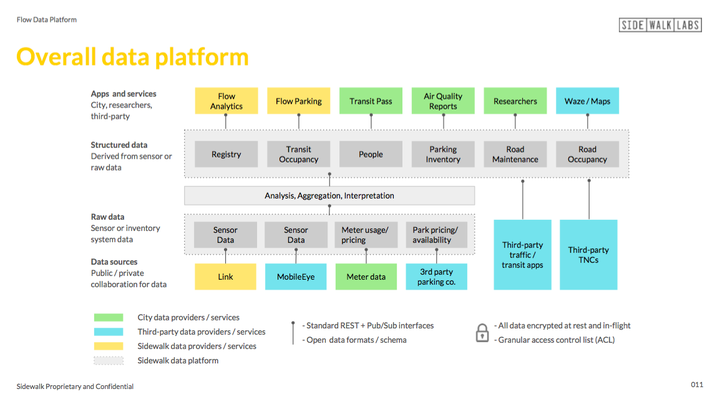
At the heart of the proposed collaboration is Sidewalk’s data platform, which would integrate data from city records, digital sensors, and “third-party data providers” such as Google Maps, Waze (the navigation app acquired by Google in 2013), Uber, and Lyft.

Sidewalk Labs / Via documentcloud.org

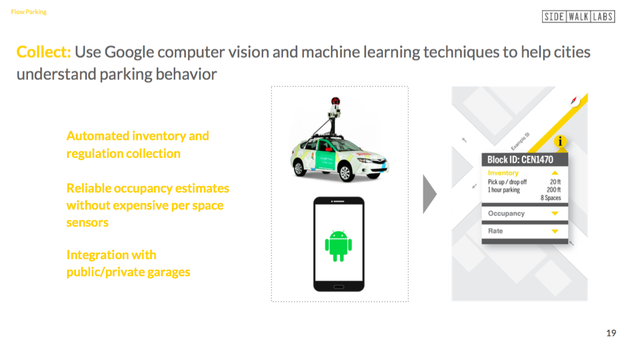
Some of the data might come from camera-equipped cars…

Sidewalk Labs / Via documentcloud.org

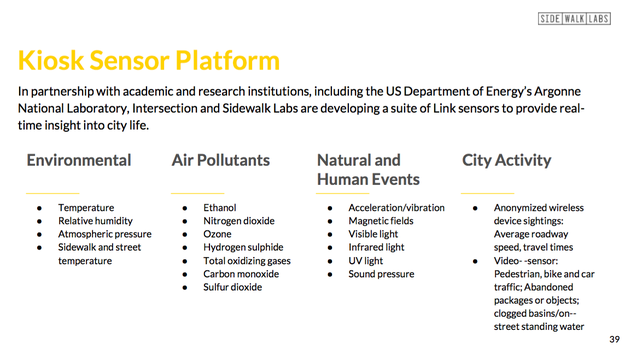
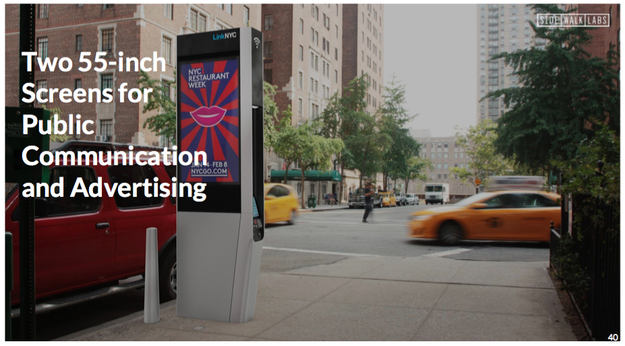
…or camera-equipped, smartphone-sensing kiosks, such as those already installed in New York City:

Sidewalk Labs / Via documentcloud.org

Sidewalk Labs / Via documentcloud.org

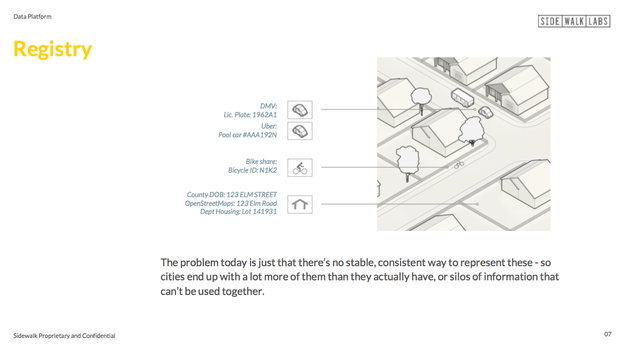
Sidewalk also proposes helping cities standardize data from their various, cacophonous databases, and collate that data into a core “registry”:

Sidewalk Labs / Via documentcloud.org

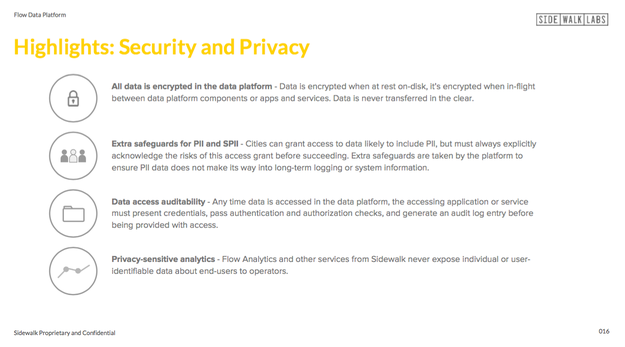
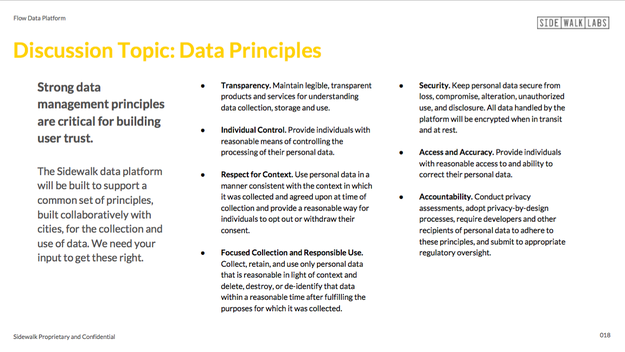
Worried about the implications of vast, privately managed database containing loads of sensitive information? Sidewalk Labs says it hears you:

Sidewalk Labs / Via documentcloud.org

Sidewalk Labs / Via documentcloud.org

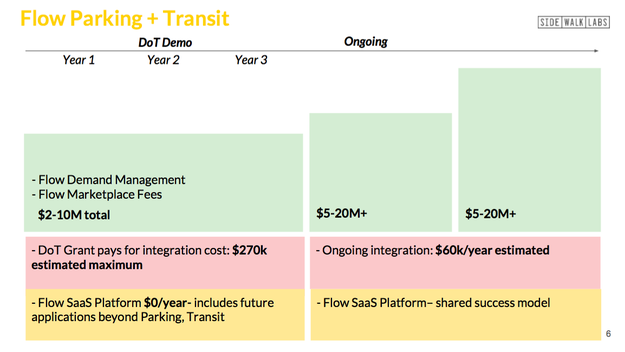
Toward the end of the pitch, Sidewalk throws in a sweetener: Not only will its services improve transportation in Columbus, but they could actually make the city money.

Some of that money could come from fees for matching people with transit options and parking spots…

Sidewalk Labs / Via documentcloud.org

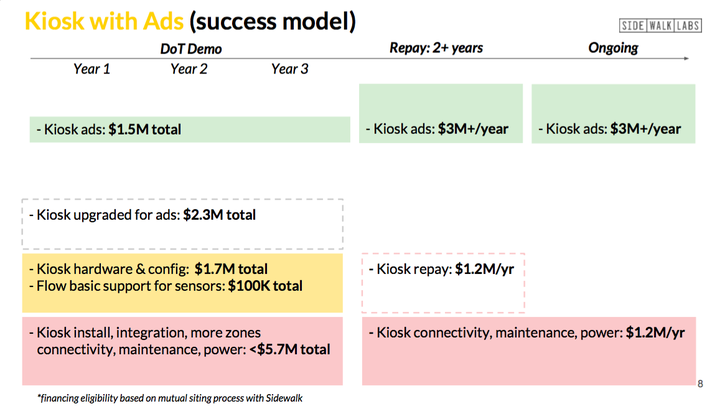
…while other revenue could come from ads placed on those roadside kiosks:

Sidewalk Labs / Via documentcloud.org

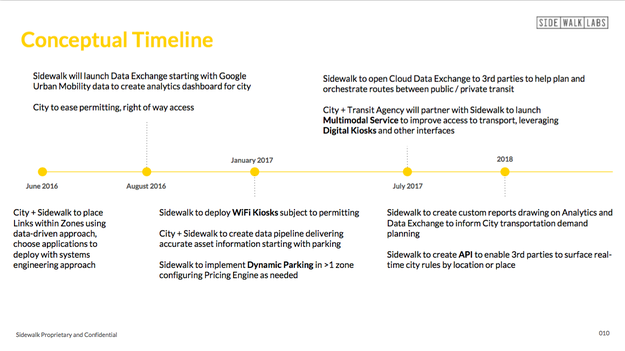
In the final slide of the main pitch deck, Sidewalk lays out its “conceptual timeline”:

Sidewalk Labs / Via documentcloud.org

Want to explore the documents in full? Here they are:

Sidewalk Labs / Via documentcloud.org

Via documentcloud.org

Via documentcloud.org

Via documentcloud.org

Via documentcloud.org

To download the financial modeling spreadsheet, click here.

Quelle: <a href="Here’s Alphabet’s Pitch To “Smart”-ify Your City“>BuzzFeed