The Rise Of Viral Trump Merchandise
Redbubble

We’ve all been there: About to buy a cool new shirt, but afraid of showing up to the party and everyone’s wearing the same thing.

Donald Trump enthusiasts, however, are in luck: They’ve got options.

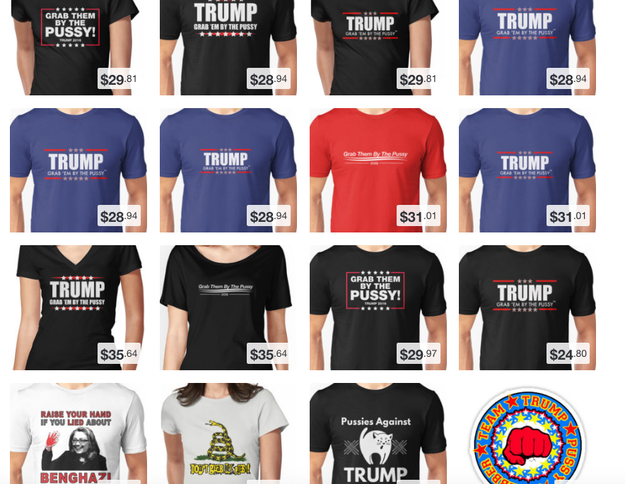
It’s only been four days since the Washington Post reported Trump’s vulgar 2005 suggestion to an NBC reporter to “grab them by the pussy,” but there are already 43 different styles with the quote available for sale on Redbubble.com.

On the social marketplace, which makes it easy to design and sell shirts, mugs, and posters, creators have already emblazoned Trump&;s latest not-quite-disqualifying remark onto a wide range of designs. They include a tasteful red-and-white, a cartoon speech bubble coming out of Trump&039;s mouth, and, for the subtler customer, a screen print of a black cat beneath the words “Locker Room Talk.” And these few dozen represent just a tiny fraction of the more than 10,000 Trump-related products ready for purchase on Redbubble, ranging from “The H Is Silent in Benghazi” t-shirts to “Pussy Game Strong” mugs to “1-800-Hotline-Trump” stationary.

They&039;re all part of a frantic, obscene, and crazily prolific market in unofficial and knockoff Trump merchandise that has flourished on big sites like Etsy and Redbubble (an Australian company that is sort of like Etsy crossed with Deviantart) and small web shops alike. Though the Trump campaign has its own official slogan and a corresponding acronym, this merch market is hardly limited to “Make American Great Again” and “MAGA.” Like the roiling internet communities that support Trump, the goods take the images and words of history&039;s most meme-able presidential candidate as a starting point from which to iterate endless $25 variations. It&039;s like 4chan or r/the_donald that you can wear.

“A picture of a red hat with &039;Grab Them By The Pussy&039; written on it had 2,000 retweets. That&039;s when it hit me.”

And like the global coalition of nihilists, ironists, racists, and actual conservatives who form these communities, the people who make merchandise are drawn to Trump&039;s image and speech for a variety of reasons.

Take Tyler Djokovic, a 19-year-old marketing student from Michigan. He got his start in viral t-shirts when he designed one featuring the inspirational musings of DJ Khaled, when those were a meme, all the way back in January. His Redbubble page also offers shirts featuring Harambe, Dat Boi, and Arthur&039;s fist.

Last week, shortly after the release of the now-infamous Access Hollywood video in which Trump lewdly discusses his pickup methods, Djokovic was searching the Twitter Moments tab, where he often goes to get an idea about trending memes. “Someone had tweeted out a picture of a red hat with Grab Them By The Pussy written on it, and it had 2,000 retweets,” he said. “That&039;s when it hit me.”

And so the “Grab Them By the Pussy” t-shirt was born. Or, maybe: The market for meme merch moves so fast that Tyler can&039;t be totally sure he was the first.

Djokovic said he didn&039;t make the t-shirt because he supports Trump — he declined to say whom he would vote for in November — but because it&039;s fun for him to try to predict what will go viral, and it&039;s a way to build his already robust social media presence. In fact, he considered the actual contest between Trump and Clinton an afterthought, merely a catalyst for creating internet culture.

“We&039;re not paying attention to the election,” Djokovic said. “We&039;re paying attention to the memes.”
Cameron Lee

Other meme-chandisers are paying attention to Trump&039;s speech — specifically his disdain for political correctness.

Cameron Lee, a 37-year-old designer from Southern California who lives in Tokyo, started making Trump t-shirts in March after being inspired by an image of Trump in World War One-era military regalia on 4chan. Shortly after, he came across a Facebook post in which several of his friends called all Trump supporters racist.

“I was standing there in my room thinking, this is horrible, this is terrible that I can’t say something like that without people thinking that I&039;m something I&039;m not,” Lee said. “Thats when I decided to go for it.”

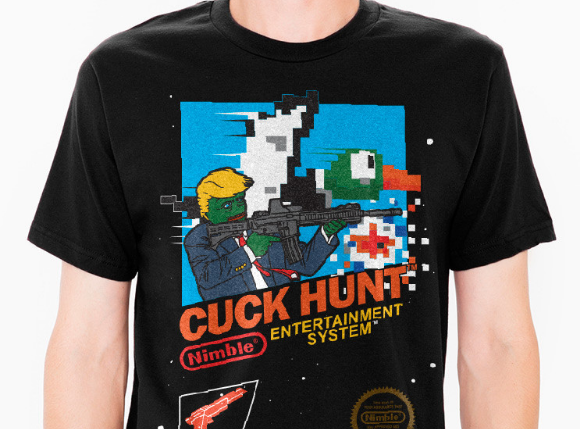
Lee, who has a background in streetwear design (he once made t-shirts for Monarchy — think Ed Hardy and Affliction) moved on to other 4chan-inspired images like “Cuck Hunt,” a t-shirt depicting a rifle-toting Trump-Pepe in the style of the NES classic Duck Hunt; a Supreme-style MAGA snapback hat; and a coffee mug entitled “Sakura Bloodbath” that features a drawing of Trump clad in futuristic battle armor while bearing a blood-stained sword and plucking cherry blossoms.

And then there is the rare viral Trump merchandiser who finds inspiration offline. Kristie, a 44-year-old graphic designer from Kentucky, was eating her annual birthday dinner at Red Lobster when she overheard a couple complaining about a comment Hillary Clinton had made about “deplorable” Trump supporters.

“I looked at my husband and said, &039;Hmm, that&039;s going to be a moneymaker,&039;” she said.

“I don’t like Hillary as far as I can throw her. But I have some Hillary stuff on Etsy.”

After dinner, Kristie came home and “threw something together that looks good on a shirt.” She uploaded it to Etsy and Redbubble. Within days, she was selling over $1,000 a day in shirts.

Kristie considers herself a Trump supporter. “I can’t wear my own Trump shirt because I’m afraid I’m going to get shot,” Kristie said. “I’m one of those silent people.” But like many of the Trump merchandisers, her ultimate allegiance is to what sells. “I don’t like Hillary as far as I can throw her,” Kristie said, “But I have some Hillary stuff on Etsy.”

Indeed, success in the viral merchandise market depends on a hyper-awareness of what is popular and current. Kristie said she hasn&039;t sold any “Deplorable” t-shirts in two weeks; Tyler said his Dat Boi and DJ Khaled merch are “dead.” (Meanwhile, there are already 40 Ken Bone t-shirts available for sale on Redbubble.)

While the Trump merchandise market appears vast, like the campaign and the online communities that inspire it, its depth and its staying power are unclear. The Redbubble sellers are hardly making a killing. Djokovic said he&039;ll make a couple thousand dollars off of the shirts; Lee said he&039;s sold at the most a thousand t-shirts; and Kristie said no one has bought a “Deplorable” shirt in weeks. (Though, she added, her Deplorable garden flags are still a hot item.)

And though the shirts do sell, and though Lee said happy customers send him pictures of themselves in his clothing, it&039;s difficult to find people showing the merchandise off on social media. Perhaps that&039;s because, like Kristie, there is a legion of Trump supporters who have stayed quiet and are waiting to flaunt their shirts on Inauguration Day, if their candidate wins. Or perhaps it&039;s because the shirts are, as Djokovic put it, “impulse buys,” forgotten as soon as they arrive.

The Republican nominee will probably keep saying crazy stuff through November 8, so Trump viral merchandise will persist at least that long. Beyond that, well, it depends on what people like Djokovic see trending on Twitter.

And for Lee, no matter what happens next month, there are always ways to cater to 4chan: “I thought I’d make a nice comfy green Pepe shirt for the winter.”

Quelle: <a href="The Rise Of Viral Trump Merchandise“>BuzzFeed
Azure PowerShell 3.0.0–Highlights and breaking changes

Azure PowerShell is a set of PowerShell cmdlets which assist you in managing your assets in Azure using Azure Resource Manager (ARM) and Azure Service Management (RDFE).  Azure PowerShell 3.0.0 adds various improvements and fixes across multiple Azure resources; however, in accordance with semantic versioning, the introduction of a new major revision indicates breaking changes in a small subset of our cmdlets.  You can install the cmdlets via your favorite installation path indicated in the Azure PowerShell 3.0.0 release notes.

Resource improvements

ApiManagement

Enable support of Importing and Exporting SOAP based APIs (Wsdl Format)

Import-AzureRmApiManagementApi
Export-AzureRmApiManagementApi

Deprecated cmdlet Set-AzureRmApiManagementVirtualNetworks. In place, place used cmdlet Update-AzureRmApiManagementDeployment
Enabled support for ARM based VNETs for configuration Vpn via cmdlet Update-AzureRmApiManagementDeployment
Introduced support for VpnType (None, External, Internal) to differentiate ApiManagement workloads for Internet and Intranet
Fixed PowerShell issues


Batch

Added new cmdlet for reactivating tasks

Enable-AzureBatchTask

Added new parameter for application packages on job manager tasks and cloud tasks

New-AzureBatchTask -ApplicationPackageReferences

Added new parameters for job auto termination

New-AzureBatchJob -OnAllTasksComplete -OnTaskFailure
New-AzureBatchJob -ExitConditions

ExpressRoute

Added new parameter service key in return object when provider list all cross connection

Get-AzureCrossConnectionCommand

MachineLearning

Get-AzureRmMlWebService supports paginated response
Remind user Get-AzureRmMlWebService "Name" parameter needs to work with "ResourceGroupName" parameter

Network

Added new cmdlet to get application gateway backend health

Get-AzureRmApplicationGatewayBackendHealth

Added support for creating UltraPerformance sku

New-AzureRmVirtualNetworkGateway -GatewaySku
New-AzureVirtualNetworkGateway -GatewaySku

RemoteApp

Added cmdlets to enable User Disk and Gold Image Migration feature

Export-AzureRemoteAppUserDisk
Export-AzureRemoteAppTemplateImage

SiteRecovery

New cmdlets have been added to support one to one mapping with service objects.

Get-AzureRmSiteRecoveryFabric
Get-AzureRmSiteRecoveryProtectableItem
Get-AzureRmSiteRecoveryProtectionContainerMapping
Get-AzureRmSiteRecoveryRecoveryPoin
Get-AzureRmSiteRecoveryReplicationProtectedItem
Get-AzureRmSiteRecoveryServicesProvider
New-AzureRmSiteRecoveryFabri
New-AzureRmSiteRecoveryProtectionContainerMapping
New-AzureRmSiteRecoveryReplicationProtectedItem
Remove-AzureRmSiteRecoveryFabric
Remove-AzureRmSiteRecoveryProtectionContainerMapping
Remove-AzureRmSiteRecoveryReplicationProtectedItem
Remove-AzureRmSiteRecoveryServicesProvider
Set-AzureRmSiteRecoveryReplicationProtectedItem
Start-AzureRmSiteRecoveryApplyRecoveryPoint
Update-AzureRmSiteRecoveryServicesProvider

Following cmdlets have been modified for to support one to one mapping with service objects.

Edit-AzureRmSiteRecoveryRecoveryPlan
Get-AzureRmSiteRecoveryNetwork
Get-AzureRmSiteRecoveryNetworkMapping
Get-AzureRmSiteRecoveryProtectionContainer
Get-AzureRmSiteRecoveryStorageClassification
Get-AzureRmSiteRecoveryStorageClassificationMapping
Start-AzureRmSiteRecoveryCommitFailoverJob
Start-AzureRmSiteRecoveryPlannedFailoverJob
Start-AzureRmSiteRecoveryTestFailoverJob
Start-AzureRmSiteRecoveryUnplannedFailoverJob
Update-AzureRmSiteRecoveryProtectionDirection
Update-AzureRmSiteRecoveryRecoveryPlan

HUB support added to Set-AzureRmSiteRecoveryReplicationProtectedItem.
Deprecation warning introduced for cmlets/parameter-sets which does not comply to SiteRecovery service object model.

Breaking changes

Data Lake Store

The following cmdlets were affected this release (PR 2965):

Get-AzureRmDataLakeStoreItemAcl (Get-AdlStoreItemAcl)

This cmdlet was removed and replaced with Get-AzureRmDataLakeStoreItemAclEntry (Get-AdlStoreItemAclEntry).
The old cmdlet returned a complex object representing the access control list (ACL). The new cmdlet returns a simple list of entries in the chosen path&;s ACL.

# Old
Get-AdlStoreItemAcl -Account myadlsaccount -Path /foo

# New
Get-AdlStoreItemAclEntry -Account myadlsaccount -Path /foo

Get-AzureRmDataLakeStoreItemAclEntry (Get-AdlStoreItemAclEntry)

This cmdlet replaces the old cmdlet Get-AzureRmDataLakeStoreItemAcl (Get-AdlStoreItemAcl).
This new cmdlet returns a simple list of entries in the chosen path&039;s ACL, with type DataLakeStoreItemAce[].
The output of this cmdlet can be passed in to the -Acl parameter of the following cmdlets:

Remove-AzureRmDataLakeStoreItemAcl
Set-AzureRmDataLakeStoreItemAcl
Set-AzureRmDataLakeStoreItemAclEntry

# Old
Get-AdlStoreItemAcl -Account myadlsaccount -Path /foo

# New
Get-AdlStoreItemAclEntry -Account myadlsaccount -Path /foo

Remove-AzureRmDataLakeStoreItemAcl (Remove-AdlStoreItemAcl), Set-AzureRmDataLakeStoreItemAcl (Set-AdlStoreItemAcl), Set-AzureRmDataLakeStoreItemAclEntry (Set-AdlStoreItemAclEntry)

These cmdlets now accept DataLakeStoreItemAce[] for the -Acl parameter.
DataLakeStoreItemAce[] is returned by Get-AzureRmDataLakeStoreItemAclEntry (Get-AdlStoreItemAclEntry).

# Old
$acl = Get-AdlStoreItemAcl -Account myadlsaccount -Path /foo
Set-AdlStoreItemAcl -Account myadlsaccount -Path /foo -Acl $acl

# New
$aclEntries = Get-AdlStoreItemAclEntry -Account myadlsaccount -Path /foo
Set-AdlStoreItemAcl -Account myadlsaccount -Path /foo -Acl $aclEntries

ApiManagement

The following cmdlets were affected this release (PR 2971):

New-AzureRmApiManagementVirtualNetwork

The required parameters to reference a virtual network changed from requiring SubnetName and VnetId to SubnetResourceId in format/subscriptions/{subscriptionId}/resourceGroups/{resourceGroupName}/providers/Microsoft.ClassicNetwork/virtualNetworks/{virtualNetworkName}/subnets/{subnetName}

# Old
$virtualNetwork = New-AzureRmApiManagementVirtualNetwork -Location <String> -SubnetName <String> -VnetId <Guid>

# New
$virtualNetwork = New-AzureRmApiManagementVirtualNetwork -Location <String> -SubnetResourceId <String>

Deprecating Cmdlet Set-AzureRmApiManagementVirtualNetworks

The Cmdlet is getting deprecated as there was more than one way to Set Virtual Network associated to ApiManagement deployment.

# Old
$networksList = @()
$networksList += New-AzureRmApiManagementVirtualNetwork -Location $vnetLocation -VnetId $vnetId -SubnetName $subnetName
Set-AzureRmApiManagementVirtualNetworks -ResourceGroupName "ContosoGroup" -Name "ContosoApi" -VirtualNetworks $networksList

# New
$masterRegionVirtualNetwork = New-AzureRmApiManagementVirtualNetwork -Location <String> -SubnetResourceId <String>
Update-AzureRmApiManagementDeployment -ResourceGroupName "ContosoGroup" -Name "ContosoApi" -VirtualNetwork $masterRegionVirtualNetwork

Network

The following cmdlets were affected this release (PR 2982):

New-AzureRmVirtualNetworkGateway

Description of what has changed :- Bool parameter:-ActiveActive is removed and SwitchParameter:-EnableActiveActiveFeature is added for enabling Active-Active feature on newly creating virtual network gateway.

# Old
# Sample of how the cmdlet was previously called
New-AzureRmVirtualNetworkGateway -ResourceGroupName $rgname -name $rname -Location $location -IpConfigurations $vnetIpConfig1,$vnetIpConfig2 -GatewayType Vpn -VpnType RouteBased -EnableBgp $false -GatewaySku HighPerformance -ActiveActive $true

# New
# Sample of how the cmdlet should now be called
New-AzureRmVirtualNetworkGateway -ResourceGroupName $rgname -name $rname -Location $location -IpConfigurations $vnetIpConfig1,$vnetIpConfig2 -GatewayType Vpn -VpnType RouteBased -EnableBgp $false -GatewaySku HighPerformance -EnableActiveActiveFeature

Set-AzureRmVirtualNetworkGateway

Description of what has changed :- Bool parameter:-ActiveActive is removed and 2 SwitchParameters:-EnableActiveActiveFeature / DisableActiveActiveFeature are added for enabling and disabling Active-Active feature on virtual network gateway.

# Old
# Sample of how the cmdlet was previously called
Set-AzureRmVirtualNetworkGateway -VirtualNetworkGateway $gw -ActiveActive $true
Set-AzureRmVirtualNetworkGateway -VirtualNetworkGateway $gw -ActiveActive $false

# New
# Sample of how the cmdlet should now be called
Set-AzureRmVirtualNetworkGateway -VirtualNetworkGateway $gw -EnableActiveActiveFeature
Set-AzureRmVirtualNetworkGateway -VirtualNetworkGateway $gw -DisableActiveActiveFeature
Quelle: Azure

Keeping up with Azure Government: September Highlights

I’m super excited to recap a busy month of service launches and releases. This has been an extra busy month for us where we landed critical and key features that you all have been waiting for. We believe these updates provide a richer, more robust customer experience and are excited to bring these additional awesome products to the US Government market including: SQL v12, Redis Cache, Virtual Machine Scale Sets, A1-A7 VM series for ARM, D/DS VM Series for ARM and F-Series VMs for ARM, Service Fabric, Storage Service Encryption, Web Apps.

Specifically, major updates to the platform include:

Enhancements to Azure Government Resource Management (ARM), making it much easier to setup and configure your virtual machines and other services
SQL v12 allows users to focus on rapid app development and get rid of your need to worry about managing the VMs and infrastructure that support your SQL databases
Storage Service Encryption encrypts your data at rest to meet government security and compliance requirements
Bringing F-Series VMs to USGov Iowa

Other highlights from this month include:

Azure Government pricing is now in the pricing calculator allowing government consumers to better budget the use of Azure services.
Microsoft signing the CJIS security addendum for Oregon, which marked the 23rd state to the list of states that Microsoft supports for CJIS, more than any other cloud provider, making up the cloud leader in CJIS

To stay up to date on all things Azure Government, be sure to subscribe to our RSS feed and to receive emails by clicking “Subscribe by Email!” on the Azure Government Blog. To experience the power of Azure Government for your organization, sign up for an Azure Government Trial.
Quelle: Azure

Supreme Court Presses Apple And Samsung On The Value Of Design

Court documents / Apple v. Samsung

Several Supreme Court justices challenged Samsung&;s argument on Tuesday that the company should owe Apple less than $399 million for infringing on the design of the iPhone. Other justices, though, pressed Apple to show why its damages in the case should be connected to Samsung&039;s profits made from the entire phone — rather than just the part of its exterior that Samsung was found to infringe.

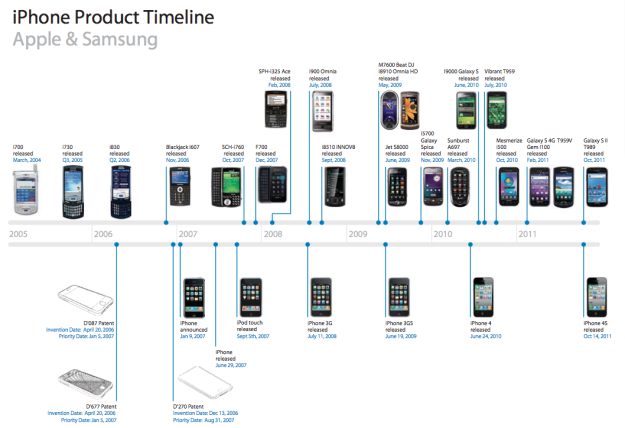
The dispute between the warring phone companies revolves around the $399 million penalty Samsung was ordered to pay Apple, stemming from a lawsuit that began in 2011. A lower court found that Samsung infringed on three of Apple’s design patents: the iPhone’s rectangular face with rounded edges, the phone&039;s bezel edge frame of the phone, and a home screen populated by apps arranged in a grid. The dollar amount comes from the total profits Samsung banked from eleven of its phone models that the lower court found ripped off Apple’s iPhone design. But exactly how much money Samsung must hand over is what the Supreme Court will decide.

Samsung tried to convince the Supreme Court that it shouldn’t have to forfeit all of the profits it generated from the phones, since only some parts of its devices were patented by Apple.

The law that the high court will interpret states that a design patent infringer is liable for “total profits” from the sale of an “article of manufacture.” But the oral arguments focused on pinning down what “article of manufacture” actually means: the justices could determine it refers to the entire phone, or just the components that were patented by the iPhone maker.

Apple, for its part, argued that the design of the iPhone is not merely ornamental — a minor aspect that that can be separated from the phone. The iPhone, when released, was a revolutionary product, Apple maintains, and its iconic design was integral to its success.

Chief Justice John Roberts needled Apple&039;s attorney on the “article of manufacture” point, saying that Apple&039;s design patent applies only to the phone&039;s exterior, not its “chips and wires.” Roberts said that the money awarded to Apple, if that&039;s so, shouldn&039;t be the total profits from the Samsung phones.

Samsung raised the issue of what it claims were problematic jury instructions in the lower court where this dispute began. Samsung argued that the jury should have been told to consider awarding Apple profits based on portions of the phone that could be economically tied to its design patent. Instead, the jury was instructed that if infringement did occur, Apple would be entitled to the total profit of the phone. Justice Anthony Kennedy, one of the more active participants on the dais, began his questioning by pointing to the confusion he might have serving on the jury under Samsung&039;s proposed instructions. “If I was a juror, I simply wouldn&039;t know what to do,” he said.

Justice Sonia Sotomayor echoed justice Kennedy&039;s remarks and said. “The phone could be seen by a purchasing consumer as being just … that rounded edge, slim outer shell.” Justice Ruth Bader Ginsburg asked Samsung to clarify how a jury might determine the value of a phone&039;s design if these component parts of aren&039;t sold separately.

The US Department of Justice also appeared before the court, speaking in favor of neither party, but advocated a multi-pronged approach. According to the lawyer for the government, the justices should consider taking a dynamic, contextual reading of design patent cases, where infringement penalties are determined by the scope of the design and how important a design element is to a product as a whole.

An extended comparison deployed by several justices was to look at this case as if it involved the Volkswagen Beetle, and it&039;s signature look. To determine what role the Beetle&039;s exterior had in people&039;s willingness to buy it, the government argued that expert witnesses from the industry could be brought in, along with consumer surveys.

Tech giants including Facebook, Google, Dell, and eBay are backing Samsung. In a brief to the court, they described Apple&039;s stance as “out of step with modern technology,” pointing to the undue power design patents could potentially wield. Justice Breyer Stephen mentioned this brief several times, and pointedly asked Apple to explain why its Silicon Valley neighbors are mistaken. (While Justice Clarence Thomas did not pose a question, he put his glasses on and appeared to read case material after Breyer referenced the tech companies&039; brief. They leaned closer to each other as Breyer&039;s case booklet was open few moments later, with Breyer appearing to point him to a certain page.)

Samsung and its supporters have argued that a victory for Apple could lead to absurd scenarios, in which a company that infringes on a tiny percentage of another firm’s design could be held liable for 100% of its profits. This is like a car company being forced to hand over its earnings because it copied someone else&039;s design for a back seat cup holder, Samsung has suggested. The company fears that a ruling in favor of Apple would breed a new class of patent troll, especially in the realm of technology where products are made up of thousands of complex parts, in addition to their design features.

Apple, in turn, claims more than 100 design professionals as allies, including Calvin Klein and Alexander Wang. The designers urged the court to consider that, in the minds of consumers, design often represents the product itself.

Samsung v. Apple was argued as both companies face heightened scrutiny from government officials around the world. In August, the executive arm of the European Union ordered Ireland to collect $14.5 billion in unpaid taxes from Apple. Meanwhile, Samsung phones have been exploding. The manufacturer has halted sales of the Galaxy Note7 amid a worldwide recall, following reports of the devices catching fire. The Federal Aviation Administration urged passengers Monday to “power down, and not use, charge, or stow in checked baggage, any Samsung Galaxy Note7″ while aboard an aircraft.

As the justices contemplate the design patent case, the Supreme Court continues to operate with only eight members, following the death of Justice Antonin Scalia in February. While President Obama has nominated Merrick Garland to fill the vacancy on the court, Senate Republicans have refused to move forward on the nomination. For both Hillary Clinton and Donald Trump, the filling of that vacancy remains a galvanizing campaign issue. A question about how they would choose to fill the vacancy drew sharp contrasts between them during the second presidential debate on Sunday night.

Quelle: <a href="Supreme Court Presses Apple And Samsung On The Value Of Design“>BuzzFeed

TIBCO DataSynapse comes to the Azure Marketplace

We are pleased to announce the launch of TIBCO DataSynapse GridServer Engine – cloud edition in the Azure Marketplace. Available from today, this collaboration expands on the HPC burst work we have been doing with DataSynapse customers over the last few months to provide an easy deployment method in a cost effective manner.

Over the last 15 years TIBCO Software has been working to empower executives, developers and business users through the integration of applications and ecosystems to analyze data and create real-time solutions.

TIBCO DataSynapse GridServer is a service execution platform for dynamically scaling any application at any time across grid infrastructure. As a result of its improvement in productivity, performance and uptime to existing applications, it is used heavily within Financial Services for parallel computing certain risk calculations. By bringing DataSynapse GridServer Engine 6.2.0 to Azure, Microsoft its extending the possibilities of this platform by providing infrastructure flexibility, increased scalability and cost control.

The pay-as-you-go Marketplace image is intended for those customers that have an existing GridServer DataSynapse installation on-premises and wish to extend the environment beyond its current capacity into Azure.

This solution provides one or more virtual machines in Azure which are configured to connect to the director, the IP and FQDN that are provided at the time the Marketplace offering is purchased. The solution assumes that the customer is either running one or more on-premises managers and has a VPN connection between their Azure account and their managers already set up, or they are running their grid in Azure and already have a virtual network to which they intend to add the engine VM.

TIBCO has provided the option of installing the image on three VM families, A-series, D-series and Dv2. This was intended to give customers a range of price vs. performance and appeal to a number of different workloads.

"Microsoft Azure and TIBCO have worked closely together to deliver the perfect solution that combines Azure&;s compute resources with TIBCO&039;s Datasynapse Grid Server in a pay-as-you-go model. This enables our investment banking customers to tackle new regulations, such as Basil III&039;s FRTB and meet the large compute demands."

                                                                                                     – Mike Kennedy – TIBCO Sr. Director of Engineering

We are excited to see the continued development of DataSynapse GridServer for use with critical compute workloads and enable the benefits of the scale and elasticity of the Azure cloud. Further information on this release can be found here.

 
Quelle: Azure

Announcing DockerCon 2017

The Docker Team is excited to announce the next DockerCon will be in held in Austin, Texas from April 17-20. For anyone not in an event planning role, finding a venue is always an adventure. Finding a venue for a unique event such as DockerCon adds an extra layer of complexity. After inquiring on over 15 venues and visiting 3 cities, we are confident that we have chosen a great venue for DockerCon 2017 and the Docker community.
DockerCon US 2017: Austin
April 17-20, 2017
Between the lively tech community, amazing restaurants and culture, Austin will be a natural fit for DockerCon. A diverse range of companies such as Dell, Whole Foods Market, Rackspace, HomeAway and many more of the hottest IT startups call Austin home. We can’t wait to welcome back many returning DockerCon alumni as well as open the DockerCon doors to so many new attendees and companies in the Austin area.
One of the most exciting additions to the DockerCon program is an extra day of content! We reviewed every attendee survey from Seattle in June, debriefed with Docker Captains and others in the community and came to the overwhelming conclusion that two days was not enough time to get the most value out of the jampacked DockerCon agenda. In 2017, we will introduce a third day of content that will repeat the top voted sessions, give more time to complete Hands-on Labs and allow more time for other learning opportunities that are in the works.
Let’s get this party started!
Save the dates:

Monday April 17: Paid training, afternoon workshops and evening welcome reception
Tuesday April 18: DockerCon Day 1, After Party
Wednesday April 19: DockerCon Day 2
Thursday April 20: DockerCon Day 3 &; half day of repeat top sessions, Hands-on Labs and workshops

Pre-register now for early bird pricing and we’ll send you an additional $50 discount code once DockerCon registration launches.
 
Pre-register for DockerCon
 
Calling all speakers!
We’re excited to hear about all of the interesting ways you’re using Docker. We’re looking for a variety of talks such as cool and unique use cases and Docker hack projects, advanced technical talks, or maybe you have a great talk on tech culture. Check out our sample CFP proposals for DockerCon for more information on what the program committee is looking for when reviewing a proposal, our tips for getting a proposal accepted, and our previous talks from DockerCon 2016. Our Call for Proposals will be open November 17, 2016 &8211; January 7, 2017.
Are you interested in learning more about sponsorship opportunities at DockerCon? Please sign up here to be among the first to receive the sponsorship prospectus.
 
Sponsor DockerCon
 
So, by now you’ve read this entire blog post and are now shouting, “What about DockerCon Europe?!” The truth is that we have spent many months searching for an available venue and we were unable to secure a site for this year. The reality is that the conference industry is incredibly competitive and we need to lock in venues farther in advance. For this reason we are now working on bringing DockerCon back to Europe in 2017. We will update the community as soon as we concrete details.
 
About DockerCon
DockerCon 2017 is a three day, Docker-centric conference organized by Docker. This year’s US edition will take place in Austin, TX and continue to build on the success of previous events as it grows and reflects Docker’s established ecosystem and ever growing community. DockerCon will feature topics and content covering all aspects of Docker and will be suitable for Developers, DevOps, Ops, System Administrators and C­-level executives. You will have ample opportunities to connect and learn about how others are using Docker. We&;re confident that no matter your level of expertise with Docker or your company size, you&8217;ll meet and learn from other attendees who share the same use cases and overcame the same challenges using Docker.

Save the date for @DockerCon 2017 in Austin April 17-20 ! we hope to see you all at To Tweet

The post Announcing DockerCon 2017 appeared first on Docker Blog.
Quelle: https://blog.docker.com/feed/

Law Enforcement Tracked Activists Using Twitter, Facebook And Instagram Data

Law Enforcement Tracked Activists Using Twitter, Facebook And Instagram Data

Recode/via screenshot / Via youtube.com

According to a report from the American Civil Liberties Union, law enforcement officials across the country used special feeds of raw data, including location information, from Instagram, Twitter, and Facebook to track and monitor racial protests.

The ACLU claims the social data used by law enforcement was provided by Geofeedia, a social media monitoring company that provides information to hundreds of local police departments. According to public records requests obtained by the ACLU, Geofeedia was granted special access to data feeds from the major social networks, including: access to the Instagram API that includes any location information; access to Facebook&;s Topic Feed API, which allowed Geofeedia to monitor public posts “including hashtags, events, or specific places;” and searchable access to a database of public tweets from Twitter.

All three social networks attempted to stop or, at least restrict Geofeedia&039;s access to data after the the ACLU reported its knowledge of the partnerships. Facebook and Instagram (which is owned by Facebook) cut off access to the topic feed and the Instagram API. According to a report from The Washington Post, this week Twitter ordered Geofeedia to stop accessing its public database with a cease and desist letter. The company said today that it would block Geofeedia&039;s access to its public feed.

The ACLU report raises concerns over how social media data can be coopted for the purposes of surveillance and stifling civil unrest. Emails obtained by the ACLU show a Geofeedia representative boasting to a law enforcement official that their tools “covered Ferguson/Mike Brown nationally with great success.

The report also presents a different face for Facebook and Twitter, which have taken numerous public stands in support of Black Lives Matter and activism intended to address police violence and racial inequality.

When reached, a Facebook spokesperson told BuzzFeed News that Geofeedia “only had access to data that people chose to make public. Its access was subject to the limitations in our Platform Policy, which outlines what we expect from developers that receive data using the Facebook Platform. If a developer uses our APIs in a way that has not been authorized, we will take swift action to stop them and we will end our relationship altogether if necessary.”

Geofeedia has not yet responded to a request for comment. Twitter declined to provide one.

Quelle: <a href="Law Enforcement Tracked Activists Using Twitter, Facebook And Instagram Data“>BuzzFeed

How to run Rally on Packstack environment

Rally is a benchmarking tool that automates and unifies multi-node OpenStack deployment, cloud verification, benchmarking & profiling.
For OpenStack deployment I used packstack tool.

# Rally

[1.] Install rally:

$ sudo yum install openstack-rally

[2.] After the installation is complete set up the Rally database:

$ sudo rally-manage db recreate

# an OpenStack deployment

You have to provide Rally with an OpenStack deployment it is going to benchmark. To do that, we’re going to use keystone configuration file generated by packstack installation.

[1.] Evaluate the configuration file:

$ source keystone_admin

[2.] Create rally deployment and let’s name it “existing”

$ rally deployment create –fromenv –name=existing
+————————————–+—————————-+———-+——————+——–+
| uuid | created_at | name | status | active |
+————————————–+—————————-+———-+——————+——–+
| 6973e349-739e-41af-947a-34230b7383f8 | 2016-10-05 08:24:27.939523 | existing | deploy->finished | |
+————————————–+—————————-+———-+——————+——–+

[3.] You can verify that your current deployment is healthy and ready to be benchmarked by the deployment check command:

$ rally deployment check
+————-+————–+———–+
| services | type | status |
+————-+————–+———–+
| ceilometer | metering | Available |
| cinder | volume | Available |
| glance | image | Available |
| gnocchi | metric | Available |
| keystone | identity | Available |
| neutron | network | Available |
| nova | compute | Available |
| swift | object-store | Available |
+————-+————–+———–+

# Rally

The sequence of benchmarks to be launched by Rally should be specified in a benchmark task configuration file (either in JSON or in YAML format).
Let’s create one of the sample benchmark task, for example task for boot and delete server.

[1.] Create a new file and name it boot-and-delete.json

[2.] Copy this to the boot-and-delete.json file:

{% set flavor_name = flavor_name or “m1.tiny” %}
{% set image_name = image_name or “cirros” %}
{
“NovaServers.boot_and_delete_server”: [
{
“args”: {
“flavor”: {
“name”: “{{flavor_name}}”
},
“image”: {
“name”: “{{image_name}}”
},
“force_delete”: false
},
“runner”: {
“type”: “constant”,
“times”: 10,
“concurrency”: 2
},
“context”: {
“users”: {
“tenants”: 3,
“users_per_tenant”: 2
}
}
},
{
“args”: {
“flavor”: {
“name”: “{{flavor_name}}”
},
“image”: {
“name”: “{{image_name}}”
},
“auto_assign_nic”: true
},
“runner”: {
“type”: “constant”,
“times”: 10,
“concurrency”: 2
},
“context”: {
“users”: {
“tenants”: 3,
“users_per_tenant”: 2
},
“network”: {
“start_cidr”: “10.2.0.0/24″,
“networks_per_tenant”: 2
}
}
}
]
}

[3.] Run the task:

$ rally task start boot-and-delete.json

After successfull ran you’ll see information such as: Task ID, Response Times, duration, …
Note that the Rally input task above uses cirros as image name and ‘m1.tiny’ as flavor name. If this benchmark task fails, then the reason for that might be a non-existing image/flavor specified in the task. To check what images/flavors are available in the deployment you are currently benchmarking, you might use the rally show command:

$ rally show images
$ rally show flavors

More about Rally tasks templates can be found on Rally documentation
Quelle: RDO

Azure Backup hosts Ask Me Anything session

The Azure Backup team will host a special Ask Me Anything session on /r/Azure, Thursday, October 20, 2016 from 09:00 am to 1:00 pm PDT.

What&;s an AMA session?

We&039;ll have folks from across the Azure Backup Engineering team available to answer any questions you have. You can ask us anything about our products, services or even our team!

Why are you doing an AMA?

We like reaching out and learning from our customers and the community. We want to know how you use Azure and Azure Backup and how your experience has been. Your questions provide insights into how we can make the service better.We did this last year and we are excited about the questions and feedback we have received and we are doing it again.

Who will be there?

You, of course! We&039;ll also have PMs and Developers from the Azure Backup team participating throughout the day.
Have any questions about the following topics? Bring them to the AMA.

•    Backup of Azure IaaS VMs (both Classic and Resource Manager VMs)
•    Azure Backup Server
•    System Center Data Protection Manager (We announced VMware VM backup support couple of months ago)
•    Microsoft Azure Recovery Services Agent

Why should I ask questions here instead of StackOverflow, MSDN or Twitter? Can I really ask anything?

An AMA is a great place to ask us anything. StackOverflow and MSDN have restrictions on which questions can be asked while Twitter only allows 140 characters. With an AMA, you’ll get answers directly from the team and have a conversation with the people who build these products and services.

Here are some question ideas:
•    What is Azure Backup? What is the cloud-first approach to backup?
•    How should I choose between Azure Backup Server and System Center Data Protection Manager for my application backup?
•    What are the pros/cons of using VM backup versus File/Folder backup?
•    How does the “Protected Instances” billing model work?
•    Why should I pick cloud over tape for long term retention?
•    What can be protected in Recovery Services vault?

Go ahead, ask us anything about our public products or the team. Please note, we cannot comment on unreleased features and future plans.

Join us! We&039;re looking forward to having a conversation with you!
Quelle: Azure