Microsoft’s true hybrid cloud: consistent, not just connected

Today marked the announcement of Windows Server 2016 general availability, another milestone in Microsoft’s commitment to hybrid cloud. You can start using Windows Server 2016 today with the availability of Windows Server 2016 images in the Azure Marketplace.

Hybrid cloud is the reality for all enterprise customers we work with, even those with the most ambitious cloud plans. Some applications should and will move quickly to public cloud, while others face technological and regulatory obstacles.  As such, we’ve built-in hybrid capabilities across the Microsoft portfolio, covering data, identity, management, applications, and the infrastructure platform overall.

Figure 1: Hybrid cloud capabilities built-in across Microsoft products and services

True hybrid cloud enablement goes beyond connectivity and provides consistency. Great network connectivity and the ability to “lift and shift” virtual machines are basic requirements. Consistency goes a step further, providing IT professional, developer, and end user experiences that don’t change based on the location of the resource. Consistency across a hybrid cloud environment enables uniform development, unified dev-ops and management, common identity and security, and seamless extension of existing applications to the cloud. Consistent hybrid cloud helps customers execute on their cloud strategy faster, in a way that makes the most sense for their business.

Read more about Microsoft’s Hybrid Cloud and Windows Server 2016. 
Quelle: Azure

Microsoft Cloud achieves Gov. of India’s provisional accreditation… in rare company

The Ministry of Electronics and Information Technology (MeitY) for the Government of India, announced that Microsoft is one of the first global cloud service providers to achieve MeitY’s provisional accreditation.  With this accreditation, Microsoft can now deliver a solution in India that provides truly innovative digital services to a wider range of customers. 

MeitY’s provisional accreditation empowers government agencies and departments in India to choose the Microsoft Cloud to advance their digital transformation, optimize IT operations, and transform societies.  The Microsoft Cloud provides industry-leading levels of security, privacy controls, compliance, and transparency for Indian government agencies to achieve higher efficiencies, with greater reliability and scalability.

MeitY is the key agency for IT related policies and guidelines.  It is the governing body that provides guidelines to all the public sector organizations, government funded and controlled organizations, state and local bodies, and state owned enterprises in India.  MeitY’s guidelines are then adopted by private sector organizations in regulated industries and other sectoral regulators which influences the criteria for the use of cloud services in all of India.

With this new accreditation, Microsoft can now do more to support the Government of India in its journey to provide transformational e-governance services, financial inclusion opportunities, quality healthcare, and education to billions of people in the country.
Quelle: Azure

GEP uses Azure and SQL Database to expand global reach

GEP delivers software and services that enable procurement leaders around the world to maximize their impact on their businesses’ operations, strategies, and financial performances. One of GEP&;s SaaS solutions for their customers is SMART by GEP​®, a cloud-based, comprehensive procurement-software platform built on Azure from the ground up.

One critical motivation for GEP was the greater scalability, less downtime, and reduced maintenance costs that GEP could experience with Azure SQL Database compared to what GEP could achieve on-premises. GEP also needed a way to overcome regulatory barriers that kept it out of some global markets. For many of GEP’s potential European customers, regulatory compliance would require having data stored in their local geographic regions. But it would not have been practical for GEP to build out multiple datacenters. By moving to Microsoft Azure, GEP has been able to accommodate its rapid growth and its potential to expand into new markets.

To learn more about GEP&039;s journey and how you can take advantage of Azure SQL Database to build SaaS applications, take a look at this newly published case study.
Quelle: Azure

AWS GovCloud (US) now supports Amazon EBS encrypted boot volumes and AMI copy

Starting today, you can launch Amazon EC2 instances with encrypted Amazon Elastic Block Store (EBS) boot volumes in AWS GovCloud (US). This feature simplifies security compliance processes by now providing encryption for both EBS data and boot volumes using the AWS Key Management Service (KMS). It can also help simplify your auditing processes because you now have the ability to ensure all data on EBS is encrypted at rest and in transit. This feature is supported with all EBS volume types.
Quelle: aws.amazon.com

This Scientist Made A Meatless, Plant-Based Burger That Bleeds

The “blood” is actually heme, a iron-based molecule Impossible Foods derives from soy plants.

Jess Misener / BuzzFeed

Six years ago, Dr. Pat Brown was a scientist on sabbatical. The Stanford University biochemist had built a career out of studying how genes are expressed in cancer, invented microchips that dramatically expanded the scale and possibilities of genetic research, and held prestigious titles such as Howard Hughes Medical Investigator and National Academy of Sciences member.

But during his break, Brown decided he wanted to focus his energy outside academia and tackle what he called “the most important problem in the world I thought I could have an impact on”: animal-based food. Brown, a vegan, thought that meat and dairy placed an undue burden on natural resources from land to water, and that plant-based alternatives, if done correctly, could be more sustainable — and, perhaps, equally tasty.

Dr. Pat Brown, founder and CEO of Impossible Foods.

Impossible Foods

Brown ended up leaving his “dream job” at Stanford for a new workplace he founded himself in 2011: Impossible Foods, a 130-employee vegan food startup whose first product is the meatless, meat-like Impossible Burger. After debuting at David Chang’s Momofuku Nishi in New York City in July, the company said today that, starting Thursday, the burger will be on the menu of three upscale California restaurants: Jardinière and Cockscomb in San Francisco, and Crossroads Kitchen in Los Angeles.

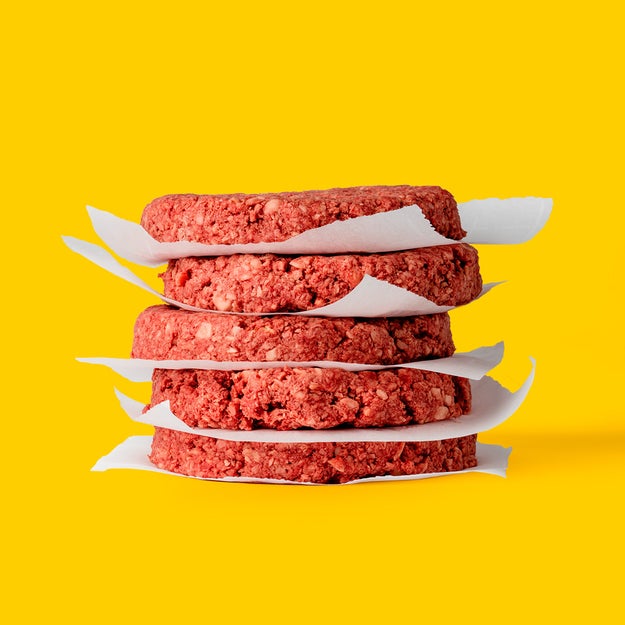
It’s not a Tofurkey-style, mashed-up vegetable kind of patty. Ingredients include water, wheat, coconut oil, soy and potato proteins, and a proprietary broth of amino acids and sugars. The key component, which the company says is the subject of several pending patents, is heme — an iron-containing molecule that can be extracted from the roots of nitrogen-fixing plants such as soybeans. (It’s also what makes your blood red, and the burger pink.)

“Animals are really, if you think about it, just a technology for transforming plants in meat, fish, and dairy foods,” Brown, who is Impossible Foods’ CEO and founder, told reporters recently. “They didn’t evolve for that function and they’re really not very good at it. We had the opportunity to take a fresh look at that problem and say, ‘OK, if you were in 2016 trying to come up with the best possible way to make these foods sustainably, affordably, scalably delicious and optimized for nutrition and so forth, how would you do it?’ Well, the last thing you would probably ever think of is ‘let’s just put plants into animals and kill them and eat them.’”
Impossible Foods

The goal is not necessarily to appeal to vegetarians, but to carnivores who like the taste of meat yet, for health or environmental reasons, are inclined to give up or cut back. Brown claims that, compared to a burger from cows, the Impossible Burger uses 95% less land and 74% less water, and emits 87% fewer greenhouse gases. It also lacks antibiotics, carbohydrates, artificial flavors, and hormones, and derives its fat from coconut oil, according to the company.

“People around the world love meat, fish, and dairy foods,” Brown said. “They’re really not going to stop eating them, and in fact, the demand for those foods has gone through the roof.”

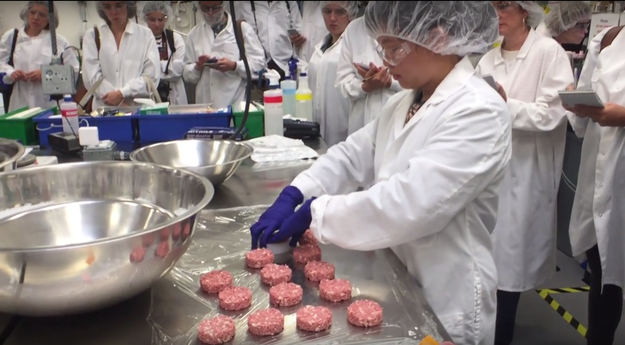
The patties are cranked out at Impossible Foods’ lab, which reporters were recently invited to tour. Here, white-coated PhDs spend their days obsessing over the molecules that make up the texture, flavor, color, and smell of meat. How do you duplicate the experience of turning a patty red to brown on a grill? How do you make sure it’s moist and tough, but not too moist and tough?
Stephanie M. Lee / BuzzFeed News

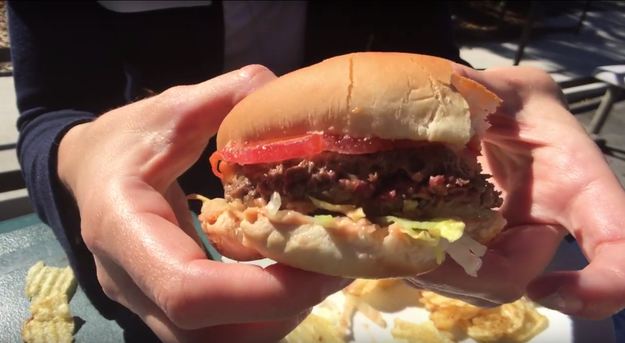
For BuzzFeed’s lifelong vegetarian tester, who doesn’t enjoy the taste of meat and has never eaten a “real” hamburger, the Impossible burger was viscerally unappetizing. In taste and texture, the burger’s resemblance to real meat was so strong that eating it stirred up a weird cognitive dissonance. But from a carnivore’s perspective, it was very close to the real thing, dense and chewy, although it was a bit softer and more prone to fall apart than is usually the case with burgers.

While these questions require complex problem-solving in molecular biology and biochemistry, the company, which is headquartered in Silicon Valley (an office park in Redwood City, to be precise), also has a strong connection to the tech world. Its $182 million in funding comes from Khosla Ventures, Bill Gates, and Google Ventures, as well as Hong Kong tycoon Li Ka-Shing’s Horizons Ventures, UBS, and Viking Global Investors. Google even tried to buy Impossible Foods for $200 to $300 million, The Information reported in 2015, but the deal fell through because the startup wanted more money.

As Impossible Foods tries to take a swing at animal-based agriculture, it’s not alone. Other rivals are growing animal cells into cultured meat to be used in the future for food or clothing. (Brown said this process, compared to Impossible’s, is much more difficult and labor-intensive on a big scale.) And Beyond Meat, a Los Angeles competitor, has a few years’ head start in selling plant protein-based beef and chicken strips and ground beef in grocery stores nationwide. This year, it’s starting to sell its own plant-based Beyond Burger (which has different ingredients, not including heme) in grocery stores rather than restaurants. Brown says Impossible Foods is entering restaurants first in an attempt to introduce the product to as many people as possible.
The Impossible Burger.

Stephanie M. Lee / BuzzFeed News

Impossible Foods next wants to work on chicken, pork, fish, and dairy products. One potential challenge for those, and for the current product, is costs of production, since the company is still getting off the ground. The burger (with fries or chips) will be $18 at Jardinière, $20 at Cockscomb, and $14 at Crossroads Kitchens — prices clearly targeted at an upscale clientele.

Brown says that while the company profitably sells an Impossible Burger at a cost equal to that of organic, grass-fed ground beef right now, it projects that the cost will drop to or below that of its mass-market equivalent (currently averaging $3.65 a pound nationwide) in two to three years and still be profitable. But that’s provided that Brown sells as many burgers as he thinks he can, and increases the manufacturing process accordingly without sacrificing quality. To scale up, “there’s no discoveries, inventions, breakthroughs required, just smart engineering required — and money, because producing any physical substance at a very large scale, to some degree it’s capital-intensive,” he said.

In the meantime, he’ll be waiting to see if customers bite.
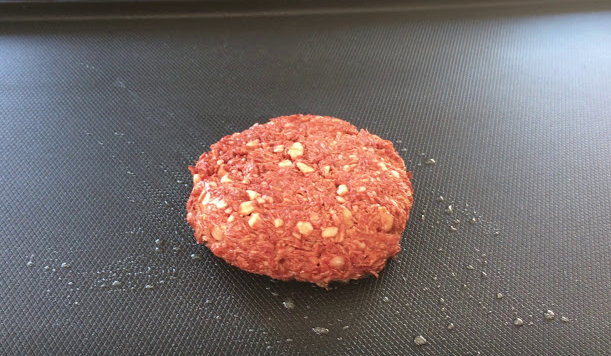
Dat sizzle though. (The white chunks are pieces of coconut oil.)

Jess Misener / BuzzFeed

Quelle: <a href="This Scientist Made A Meatless, Plant-Based Burger That Bleeds“>BuzzFeed

Simpler Azure management libraries for .NET

One C# statement to authenticate. One statement to create a virtual machine. One statement to modify an existing virtual network, etc. No more guessing about what is required vs. optional vs. non-modifiable.

https://github.com/Azure/azure-sdk-for-net/tree/Fluent

We are announcing the first developer preview release of the new, simplified Azure management libraries for .NET. Our goal is to improve the developer experience by providing a higher-level, object-oriented API, optimized for readability and writability. These libraries are built on the lower-level, request-response style auto generated clients and can run side-by-side with auto generated clients.

Azure Authentication

One statement to authenticate and choose a subscription. The Azure class is the simplest entry point for creating and interacting with Azure resources.

Azure azure = Azure.Authenticate(credFile).WithDefaultSubscription();

Create a Virtual Machine

You can create a virtual machine instance by using a Define() … Create() method chain.

Console.WriteLine("Creating a Windows VM");

var windowsVM = azure.VirtualMachines.Define("myWindowsVM")
.WithRegion(Region.US_EAST)
.WithNewResourceGroup(rgName)
.WithNewPrimaryNetwork("10.0.0.0/28")
.WithPrimaryPrivateIpAddressDynamic()
.WithNewPrimaryPublicIpAddress("mywindowsvmdns")
.WithPopularWindowsImage(KnownWindowsVirtualMachineImage.WINDOWS_SERVER_2012_R2_DATACENTER)
.WithAdminUserName("tirekicker")
.WithPassword(password)
.WithSize(VirtualMachineSizeTypes.StandardD3V2)
.Create();

Console.WriteLine("Created a Windows VM: " + windowsVM.Id);

Update a Virtual Machine

You can update a virtual machine instance by using an Update() … Apply() method chain.

windowsVM.Update()
.WithNewDataDisk(10)
.DefineNewDataDisk(dataDiskName)
.WithSizeInGB(20)
.WithCaching(CachingTypes.ReadWrite)
.Attach()
.Apply();

Management libraries unleash the power of IntelliSense in Visual Studio

Fluent interface-inspired method chains in combination with IntelliSense deliver a wizard-like developer experience by presenting required and optional methods in the right sequence. For example, once you choose a Windows virtual machine image, IntelliSense will prompt for an admin password and nothing else.

Then, IntelliSense will prompt for a password and nothing else. This will continue until you reach the minimum required to call create().

As another example, if you were to choose a Linux virtual machine image, IntelliSense would prompt for a root user name and then SSH key.

Samples

You can find plenty of sample code that illustrates key management scenarios in Azure Virtual Machines, Virtual Machine Scale Sets, Storage, Networking, Resource Manager, Key Vault and Batch …

Service

Management Scenario

Virtual Machines

Manage virtual machine

Manage availability set

List virtual machine images

Manage virtual machines using VM extensions

List virtual machine extension images

Virtual Machines – parallel execution

Create multiple virtual machines in parallel
Create multiple virtual machines with network in parallel

Virtual Machine Scale Sets

Manage virtual machine scale sets (behind an Internet facing load balancer)

Storage

Manage storage accounts

Network

Manage virtual network
Manage network interface
Manage network security group
Manage IP address
Manage Internet facing load balancers
Manage internal load balancers

Resource Groups

Manage resource groups
Manage resources
Deploy resources with ARM templates
Deploy resources with ARM templates (with progress)

Key Vault

Manage key vaults

Batch

Manage batch accounts

Give it a try

This is a developer preview that supports major parts of Azure Virtual Machines, Virtual Machine Scale Sets, Storage, Networking, Resource Manager, Key Vault and Batch. You can run the samples above or go straight to our GitHub repo.

Give it a try and let us know what do you think (via e-mail or comments below), particularly –

Usability and effectiveness of the new management libraries for .NET?
What Azure services you would like to see supported soon?
What additional scenarios should be illustrated as sample code?

The next preview version of the Azure Management Libraries for .NET is a work in-progress. We will be adding support for more Azure services and tweaking the API over the next few months.
Quelle: Azure






