Welcome to the new Thoughts on Cloud

Notice anything different?
Today we launch a brand new design for Thoughts on Cloud, with several new features and navigational tools we hope will improve your reading experience. The changes are intended to make whatever you&;re looking for a snap to find, easy to share, enjoyable to read and open to your feedback.
The first thing you surely noticed is our new user interface, which we hope you find aesthetically pleasing and intuitive.
Here&8217;s what won&8217;t be changing: our content. We will continue to bring you the best in thought leadership and analysis from within IBM Cloud and elsewhere on topics within the sphere of , including hybrid cloud, security, app development, cognitive computing, storage, mobile, big data and more. If any of those topics are of particular interest to you, we have categorized all our posts by topic for easy access. Simply hover over the dropdown menu at the top of the page for a list of categories.
If you click on a specific post of interest, scroll to the bottom to find three recommended, related articles. If you&8217;d like to know what&8217;s popular on the particular day you&8217;re browsing the site, that&8217;s available in the sidebar to the right of the post text. Also in that sidebar is a quick, real-time look at the IBM Cloud Twitter feed so you can see the latest in cloud news.
We have opened up comments on many of our posts, so please join in our conversation about what&8217;s new in cloud computing. Thanks for reading Thoughts on Cloud. Stay tuned for much more about the world of cloud computing.
Save
The post Welcome to the new Thoughts on Cloud appeared first on Cloud Computing.
Quelle: Thoughts on Cloud

Using IBM Cloud, KLM Open mobile app gives fans real-time access

Every September, 40,000-plus fans and visitors come to the KLM Open, the oldest golf tournament on the European Tour. To keep all these visitors engaged over the four-day event, KLM Open strives each year to improve the live experience for fans by creating new features to their mobile application.
Golf has never been the kind of spectator sport that soccer or baseball are, because fans are not allowed to cheer while the golfers play (or make any noise), and, unlike stadium sports, the players do not perform in a confined viewing area. Fans must know where and when their favorite player will be on the course at any given time. They watch players when they tee off and then watch the players walk the course for three or four hours. The fans might catch the players when they arrive at the last hole, but even that is not certain because it’s hard to predict what time they will be there.
The KLM Open promoter and organizer, TIG Sports, worked with IBM Cloud Services to develop an interactive mobile app with IBM MobileFirst software hosted on IBM Cloud. The team developed the solution’s back end using the IBM Bluemix platform and IBM DevOps for Bluemix services.
Each flight, or group, of golfers carries an IBM-developed GPS tracker during the tournament. Location data is transmitted to the IBM cloud infrastructure and combined with scores and other media content using API Connect, giving fans real-time access to leaderboards, players’ locations and maps that show the user’s current location and how to get to various points of interest. Golf officials use the app on an iPad and knowing the location of the players has proven useful when there is a dispute, a rules official is needed. Location data helps the official get there sooner and keep the game moving.

The app, created in 2014, gets better and better each year. In 2015, there were three times as many downloads as the year before and it supported as many as 6,000 concurrent users. The app was even modified mid-tournament to address a fan’s suggestion and updated overnight with enhanced radio functionality. When users opened the app the next morning, they received a pop-up notification and a prompt to download the update. This MobileFirst direct update capability enables developers to bypass the review and approval cycles of app stores, which would likely take longer than the golf tournament itself. Radio broadcast integration only works with a headset so the app itself is silent.
The 2015 version of the app was nominated for a Dutch Computable Award in the Cloud category. This years’ version of the app has been created following the IBM renowned Design Thinking process and is designed using the best in class IBM iX user interface design guidelines.
Because golf courses are huge and busy and the 2016 tournament will be at a different course than in previous years, finding people will be important. “Find my Friend” is a way for fans to meet up with each other, and will include an option for navigation so they’ll even know how to get where they need to go. Additionally, the new version of the app will include the ability for fans to be alerted when their favorite player is going to tee off giving the fan ample time to get to the hole and actually watch.
Also new in 2016 is gamification at Hole 14, an experience which will be modeled after the Waste Management Phoenix Open’s 16th Hole. This is one location where neither the fans nor the app must remain silent, and in fact, clapping and shouting are allowed and interaction is expected. The app will be able to sense when a user’s mobile device is near the 14th hole and sounds are permitted. There will be a “Closest to the Pin” contest between spectators, seated on three sets of bleachers. They will use the app to predict which golfer will tee the ball closest to the flag. The Watson Internet of Things platform on Bluemix will be used to collect and analyze the data from the thousands of smartphones’ and visitors placing bets. The KLM Open tournament will provide prizes for those spectators who have the highest scores or streaks (best of three) in predicting the contest. Watson Analytics is used to analyze five years of historical players’ data to help predict the winner.
The KLM Open mobile app has indeed transformed the event for fans from a standing-around-waiting occasion to a more interactive, engaging experience — like soccer or baseball — which is attractive especially to younger fans.
Learn more about IBM Cloud solutions.

The post Using IBM Cloud, KLM Open mobile app gives fans real-time access appeared first on .
Quelle: Thoughts on Cloud

Can a secure private cloud excel in an on-premises VMware environment?

IT departments have a lot on their plates.
A typical IT department managing workloads and systems is measured by key performance indicators (KPIs) including security, addressing service failures, restoring systems quickly, minimizing the mean time to repair, helping improve staff efficiency by being proactive and not reactive, aiming for a faster deployment of services, minimizing migration costs to newer platforms, supporting service-level agreements and efficiently planning for capacity changes.
In enterprises that run VMware, IT staffs are trained to support the KPIs for on-premises production as well as development and test workloads. However, as businesses are looking to cut costs, many choose hybrid cloud with a dedicated, off-premises private cloud. While the enterprise goal is to reduce capital expenditures (CAPEX), the current ecosystem of cloud provider solutions requires migration efforts, because the source and target cloud architectures are often not based in VMware.
IBM has worked with thousands of clients. We’ve found that workload integration and migration issues are exacerbated by mergers, acquisitions, divestures, unexpected service interruptions, changes in IT productivity, the need for IT agility and when lines of business launch new innovation initiatives.
Enterprises need a cloud offering that:

Leverages the current IT department skillset, tools, processes, VM templates and scripts used on-premises, and offers an option to self-manage.
Allows root access to systems and hypervisor for system administrators to have full control over the environment And only need to open tickets on failure.
Facilitates data centers across the globe with private, high-speed connections and resources providing the highest performance.
Has secure and dedicated off-premises private cloud resources supporting VMware software-defined data center (SDDC) architectures.
Meets compliance standards such as SOC1-2-3 reports, ISO 270001, ISO 27017, ISO 27018, CSA STAR, PCI, HIPPA, Intel Trusted Execution Technology and EU clauses.
Is based on VMware SDDC architecture completely configured on-demand and ready to use.
Can scale quickly, up or down, and allows existing VMware workloads to be lifted and shifted with minimal effort, alleviating the cost of migration.
Allows live migration of workloads from and on-premises environment to and off-premises, dedicated private cloud that delivers mission-critical services on-demand.
Supports software-defined networking solutions based on VMware NSX, providing virtually unlimited networking flexibility in defining new VLANs, assigning IP addresses, and establishing network services such as load balancing, firewalls and routers.
Supports backup and disaster scenarios, as well as the ability to set up development, test, training or lab capacity.
Supports VSAN shared storage, providing highly available, high performance, single-tenant storage which grows automatically as additional capacity nodes are added.
Offers additional VMware components procured on a simple, per-CPU per-month basis with no long term contracts (Site Recovery Manager, VMware Integrated OpenStack, etc.).

What is the solution that address these requirements?
While there are offerings that support VMware based solutions, enterprises should consider the global presence of data centers and high speed private network connectivity across the globe and consistent delivery.
Learn more about VMware on IBM Cloud.
Save
The post Can a secure private cloud excel in an on-premises VMware environment? appeared first on .
Quelle: Thoughts on Cloud

Facebook Pulls Its 9/11 Trending Topic After It Promotes A Hoax

After Facebook&;s Trending column highlighted a conspiracy theory on Friday that claimed the Twin Towers were brought down by bombs on 9/11, the company has removed its “September 11th Anniversary” topic entirely.

Facebook acknowledged the hoax and indicated it was working to resolve the issue. But the incident is yet another embarrassing moment for Facebook, whose Trending Topics product seems to create headlines as often as it highlights them.

“We&039;re aware a hoax article showed up there, and as a temporary step to resolving this, we&039;ve removed the topic,” a Facebook spokesperson told BuzzFeed News in an email.

Until last month, the Trending column — which highlights widely discussed topics and news stories within the platform — was run by a handful of human curators, many of whom had news training. But not long after a controversy in May when critics accused the curators of introducing bias to the column, Facebook dismissed them all, elevated the role of its algorithm in selecting topics and, according to Quartz, placed engineers in charge of correcting its mistakes. Today, those engineers sure had their hands full.

Facebook did not give any concrete explanation detailing how the 9/11 conspiracy story, from the UK-based Daily Star, ended up being the featured article for the “September 11th Anniversary” topic. Asked if engineers made the final call to include it, a Facebook spokesperson did not immediately respond.

Quelle: <a href="Facebook Pulls Its 9/11 Trending Topic After It Promotes A Hoax“>BuzzFeed

An Iconic Photo Was Deleted From Facebook And People Are Not Happy

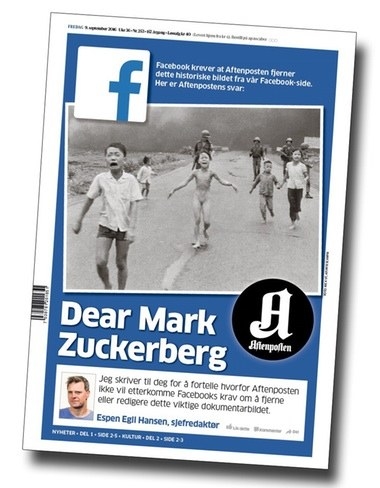
The photo censored by Facebook.

Nick Ut / AP

Norway&;s Prime Minister Erna Solberg on Friday slammed Facebook in an escalating row between the social media giant and the country&039;s politicians and media over its repeated censoring of an iconic image of the Vietnam War.

The photograph, which shows naked 9-year-old Kim Phúc running away from a napalm attack after being severely burned, appeared on Facebook in a post about the terror of war by Norwegian writer Tom Egeland, The Guardian reported.

Facebook deleted the post, and Egeland was suspended from Facebook for sharing a photo that included “nudity.”

On Friday, a Facebook spokesperson told BuzzFeed News that they would reinstate the image in posts where it had been removed.

“After hearing from our community, we looked again at how our Community Standards were applied in this case. An image of a naked child would normally be presumed to violate our Community Standards, and in some countries might even qualify as child pornography. In this case, we recognize the history and global importance of this image in documenting a particular moment in time,” wrote a Facebook spokesperson in a statement to BuzzFeed News. “Because of its status as an iconic image of historical importance, the value of permitting sharing outweighs the value of protecting the community by removal, so we have decided to reinstate the image on Facebook where we are aware it has been removed. We will also adjust our review mechanisms to permit sharing of the image going forward. It will take some time to adjust these systems but the photo should be available for sharing in the coming days.”

Norway&039;s largest newspaper Aftenposten then published a story on Egeland&039;s Facebook suspension using the same “napalm girl” photo, and received a message telling it to “either remove or pixelize” the photo.

“Any photographs of people displaying fully nude genitalia or buttocks, or fully nude female breast, will be removed,” the notice from Facebook said.

However, Facebook deleted the article and image before the newspaper could respond.

In a front page editorial in response to the notice, Aftenposten Editor-in-Chief Espen Egil Hansen accused Facebook CEO Mark Zuckerberg of abusing his power. In an open letter, he said:

Listen, Mark, this is serious. First you create rules that don’t distinguish between child pornography and famous war photographs. Then you practice these rules without allowing space for good judgement. Finally you even censor criticism against and a discussion about the decision – and you punish the person who dares to voice criticism.

Dear Mark, you are the world’s most powerful editor. Even for a major player like Aftenposten, Facebook is hard to avoid. In fact we don’t really wish to avoid you, because you are offering us a great channel for distributing our content. We want to reach out with our journalism.

However, even though I am editor-in-chief of Norway’s largest newspaper, I have to realize that you are restricting my room for exercising my editorial responsibility. This is what you and your subordinates are doing in this case.

I think you are abusing your power, and I find it hard to believe that you have thought it through thoroughly.

Read the full open letter here.

The open letter on the front page of Aftenposten.

Aftenposten / Via aftenposten.no

Solberg then weighed into the debate by writing her own post in support of Aftenposten calling for the social media company to “review its editing policy,” only for Facebook to delete that as well.

A censored version of the image is now up in a post on Solberg&039;s profile, in which she said: “While I was on a plane from Oslo to Trondheim, Facebook deleted a post from my Facebook page. What Facebook does by removing images of this kind, good as the intentions may be, is to edit our common history.”

View Video ›

Facebook: ernasolberg

Quelle: <a href="An Iconic Photo Was Deleted From Facebook And People Are Not Happy“>BuzzFeed

New Social Network Gab.ai Is Growing Fast Thanks To Its Free Speech Policy

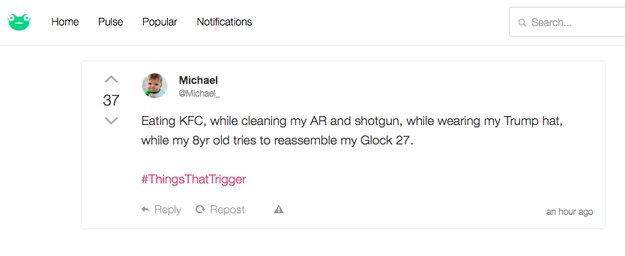
Screenshot from Gab&;s popular page.

Upstart social network Gab.ai is just over three weeks old, but it&039;s adding thousands of people to its waitlist every day by promising them almost total freedom of speech.

Gab, founded by Silicon Valley-based Trump supporter Andrew Torba, is promoting itself as an alternative to Facebook and Twitter, which are both trying to find a balance between free speech and the inflammatory discourse such freedom sometimes begets. Facebook, which relies on users to flag objectionable content, has temporarily removed political speech multiple times, later chalking it up to glitch and error. Twitter seems caught between reining in harassment and giving people room to speak freely on its platform.

Gab’s message seems to be resonating, at least with some people. As of this week, the social network has 12,000 users, with another 42,000 on its waitlist. It&039;s registered more than 2.7 million pageviews on 240,000 posts, with people spending an average of 12 minutes on the site each time they log in. The site is built on a follow model, and people can upvote or downvote the posts they see from people they follow in a central feed. Posts with the most upvotes are collected in a popular tab within Gab.

One Gab.ai user&039;s artwork portraying the tiny social network&039;s fight against Twitter.

Brent Kathrens / Via Instagram: @brentkart

As of now, you could put Gab in the category of an Ello or Peach, social networks that grew temporarily popular when they debuted, but faded as alternatives to the big, established platforms. Torba, formerly the CEO of ad-tech company Automate Ads, just resigned from that job in an effort to give Gab a shot to move past that. He’s building the platform, along with 3 other people, with no outside funding.

In an email to BuzzFeed News, Torba wrote that his frustration with existing social networks’ content moderation policies was one catalyst for creating Gab. “What makes the entirely left-leaning Big Social monopoly qualified to tell us what is ‘news’ and what is ‘trending’ and to define what “harassment” means?” he said. “It didn&039;t feel right to me, and I wanted to change it, and give people something that would be fair and just.”

At the moment, Gab feels like a conservative chatroom. Some popular posts from earlier this week include: “Everytime Hillary coughs, the souls of her victims escape her body,” and “I will not attack any Liberals until they say stupid shit.” It also appears that Milo Yiannopoulos, a conservative writer who was permanently suspended from Twitter in July after his attack on actress Leslie Jones, has joined Gab. Yiannopoulos did not respond to a BuzzFeed News email seeking to confirm that the account is indeed his.

But Torba said the platform isn’t meant just for those of one ideology. “Gab is not FOR any particular group of people, political leaning, race, beliefs, or anything,” he wrote. “Anybody is welcome to express themselves on Gab.”

To deal with the inevitable harassment that occurs on the social web, Gab offers a number of features, including keyword filtering and user muting. And Gab plans to verify any user who presents a valid form of ID to confirm their identify. Users will be able to choose whether or not they want to see posts from verified users only. “We’re placing the onus on the user to handle harassment, and we’re giving them the tools to handle harassment themselves, as opposed to us taking an editorial stance,” Torba said. Both Facebook and Twitter have compelled users to remove posts in the past.

Despite its strict freedom of speech policies, Gab has some guidelines: Users can’t make threats of violence, post illegal pornography, or expose personal information without that person’s consent. None of its users have been banned to date, Torba said.

And though far from a surefire hit, Gab may be more than simply a blip. The United States is in the midst of a contentious Presidential election, and some conservatives feel a growing unease on Facebook and Twitter, platforms they see as being biased. If anything, Gab’s early, ideologically-narrow success plays into a larger trend in social media: people are moving towards smaller groups.

Quelle: <a href="New Social Network Gab.ai Is Growing Fast Thanks To Its Free Speech Policy“>BuzzFeed

Monitor and React to Deployment Changes in AWS CodeDeploy with Amazon CloudWatch Events

You can now monitor and automatically react to changes in your AWS CodeDeploy deployments using Amazon CloudWatch Events. This lets you detect changes in the state of an Amazon EC2 instance or deployment managed by CodeDeploy, and then invoke an action based on rules that you set. This is useful for building workflows and processes that are triggered by changes in your deployments. 
Quelle: aws.amazon.com

Encoding and delivery of UHD content

As recent studies have demonstrated, high efficiency codecs like HEVC/H.265 now have mature software implementations that deliver on the promise of 50% bitrate savings over AVC/H.264, at the same quality. Such efficiency improvements are critical to enable delivery of video at ultra high definition (UHD) and beyond. Today I am pleased to announce that we are conducting trials of HEVC encoding and delivery in Azure Media Services with our customers. Built on the same platform as the Premium Encoder, the new encoder provides enhancements including the following:

HEVC encoding at UHD/4K resolutions, including 4096×2160 pixels at 60 frames/second
Support for high dynamic range (HDR) content via HDR10 Media Profile with bit depth of 10-bits per color sample, BT.2020 color primaries, encoded at HEVC Main 10 Profile

Your encoding process would be very similar to that using the Premium Encoder. Your mezzanine files can be encoded to HEVC video/Dolby Digital Plus or AAC audio, and stored as ISO MP4 files. These can subsequently be dynamically packaged into MPEG DASH, streamed to devices, such as 4K TVs. TSUTAYA, a video rental and online VoD service company based in Japan, is currently testing such a workflow, validating that the compression tools meet their requirements. You can check the output of the encoder yourself – here is a link to a test video that you can view in the Edge browser, on a Windows 10 device with hardware HEVC decode support.

Are you interested in participating in these trials? Please contact us at ams-uhdsup@microsoft.com
Quelle: Azure

The 4 Biggest Questions About Docker from VMworld 2016

Simply incredible. We spent last week at speaking with thousands of enterprise security, infrastructure and virtualization pros. It was humbling to witness all of the curiosity and excitement around at the show, and how Docker clearly made a strong impression on the attendees.

This curiosity around Docker and its use within enterprise environments is the reason why i’m writing this blog. We noticed that there were many of the same questions that arose, and we figured we should share them with you, as you start your journey towards adopting Docker containers and VMs.
Here are the most commonly asked questions from the conference.

What is Docker? Or even a container? Is it a lightweight VM? Can I use it with vSphere? What value do they provide?


Containers are really about applications, not servers. That&;s why they aren&8217;t VMs. @docker VMWorld
— Karen Lopez (@datachick) August 29, 2016
 
A Docker container is a standard unit in which application code, binaries and libraries can be packaged and isolated. The Docker Engine is the runtime installed on your infrastructure of choice and is what executes commands to build and deploy containers. Many containers can be connected together to form a single application or one container can include the entire codebase. Docker provides an abstraction layer between the application itself and the underlying compute infrastructure making the application completely portable to any other endpoint running Docker.
Docker containers are not VMs nor even lightweight VMs as their architecture is different.The image below displays the key differences between Docker containers and VMs .  Docker containers share the OS kernel on the host where each VM has a full copy of an OS inside the VM.

This does not mean these two models are mutually exclusive. Docker containers run anywhere a Docker Engine is installed&;and Docker Engine runs on bare metal, in VMs (vSphere, Hyper-V) and clouds (AWS, Google, Azure, and more). This also means that Docker containers are portable from any one of the above environments to the other without having to recode the application. Additionally many users add containers into an existing virtual infrastructure to increase the density of workloads possible per VM.

There are several reasons why Docker containers are being adopted within the enterprise:

Security &; Docker containers are completely isolated from one another, even when running on the same host and sharing the same OS. This makes them ideal for enterprise teams leveraging (for example) bare metal servers and are looking to comply with industry security regulations. And with the Docker Datacenter platform enterprise teams receive on-premises tools chock full of security features.
Portability across infrastructure and app environments &8211; Docker containers can run anywhere the Docker Engine is installed. This gives teams the ability to move their applications across different environment without having to tweak the code. For example, teams can easily move from vSphere to other environments like Azure and AWS .
Optimize Resources &8211; Docker containers can be deployed within VMs, and in fact vSphere is a great place to run them. This allows teams to run multiple containers within VMs. This reduces the overall VM footprint and decreases maintenance costs associated with maintaining legacy apps. Given that there are now less VMs, companies can spend less on vSphere including reduced hypervisor licensing costs as well.


Are you currently using @docker containers & VMs together? VMWorld
— Docker (@docker) August 21, 2016

Speed &8211; Docker containers help streamline the application lifecycle, helping developers build applications more quickly and IT ops teams react faster to changing business needs. Containers spin up on average in ⅜ of a second, compared to VMs which take several seconds or minutes. This sub second spin up time of Docker containers allow teams to onboard developers more quickly and deploy out to production more frequently.

Does Docker support Windows Server?

Will @Docker like containers ever catch on in Windows? http://t.co/jMHaVVVMFo VMworld
— Keith Townsend (@CTOAdvisor) August 26, 2014

Today Docker Engine runs on all major Linux distros like: Ubuntu, CentOS, RHEL, OpenSUSE and more.  Support for Windows Server is the most popular question as most companies have a mix of Windows and Linux based applications.  I’m pleased to say that very soon, Docker Engine will run on Windows Server 2016.  This means that the same Docker container technology and workflow can be applied to Linux and Windows Server workloads. For example, going forward, admins can have applications that have a back-end windows piece e.g. Microsoft SQL server and leverage a linux-based web front end, and have be part of the same app… running in vSphere VMs, baremetal or cloud (boom)!
Windows Server 2016 and Docker is available as a tech preview to try here.

Docker sells commercial solutions built specifically with enterprise teams in mind


And here are the @Docker Commercial Management tools: Cloud VMworld pic.twitter.com/CxYKBVX8pL
— Arjan Timmerman (@Arjantim) August 29, 2016

Our commercial management platform, Docker Datacenter, is what enterprise teams are leveraging across the entire application lifecycle. Developers use our solution to quickly create apps, update apps and deploy them and IT Ops uses the platform to secure their application environment, comply with industry regulations, and deploy applications out to production more frequently.  In addition they are able to reduce the overall application-related costs to the business.
As mentioned, Docker Datacenter is our enterprise solution. Sold as a monthly or annual subscription, Docker Datacenter (DDC) delivers an on-premises Containers as a Service environment that IT ops teams use to manage and secure the environment and devs use to create applications in a self-service manner. The tool provides an image registry, orchestration/management plane and commercial support from the Docker Customer Success team. This support also includes validated configurations of operating systems and support for previous versions of the Docker engine.
Oh, and Docker Datacenter has got the GUIs
 
lots of options with @Docker &8211; CLI, API, and GUI for deploying VMworld tfdx
— Tim Smith (@tsmith_co) August 29, 2016

Many VMware customers are accustomed to managing VMs in their vCenter GUI. So, they were happy to know that yes, there are Docker tools to help manage images and containers, and they come complete with a GUI. Well, there’s a couple actually. And just like how VMware users use tools built by VMware, for VMware, we recommend Docker users use tools built by Docker, for Docker.
With Docker Datacenter, IT Operations teams have the ability to manage, orchestrate and scale their Dockerized apps across their environment. The tool is chock full of enterprise features including:

Ability to deploy containers onto nodes directly from within the UCP GUI
Manage nodes, images and applications
Scale instances horizontally for times of peak application usage
Role-based access controls to control who can access what
Integration with LDAP/AD to quickly create teams and organizations

Here is a quick look at the Docker Datacenter management  dashboard.

Docker Datacenter also provides the capability to store, manage, and secure your images.Key features include:

Ability to sign images and ensure images are not tampered with
Ability to manage images, repositories, tags
Quickly update/patch apps and push new images to DTR
Integration with Universal Control Plane for quick deployment

How Docker Datacenter is priced, and what we mean when we say Docker “node”

The Docker Datacenter subscription is licensed by the number of Docker engines you require. A node is anything (VM, bare metal server or Cloud instance) with the Docker Engine installed on it. A good way to understand how many engines you require is to think about the number of existing VMs, or bare metal servers or cloud instances you want to begin Dockerizing. Datacenter is available on a monthly or annual subscription basis with the option of business day or business critical support to align to your application service levels.  Check out our pricing page to learn more.
For any virtualization gurus looking to learn more about Docker and how Docker containers and VMs can be used together I highly recommend you give this ebook on “Docker for the Virtualization Admin” a read.
Additional Resources

Read the eBook: Docker for The Virtualization Admin
Learn more about Docker Datacenter
See a demo of Docker Datacenter
Hear from Docker Datacenter Customers


Top 4 Docker questions from VMworld answered hereClick To Tweet

The post The 4 Biggest Questions About Docker from VMworld 2016 appeared first on Docker Blog.
Quelle: https://blog.docker.com/feed/