Apple "Rejiggers" Self-Driving Car Project

Josh Edelson / AFP / Getty Images

Apple is “rejiggering” its electric self-driving car program, cutting some employees and reassigning others to new areas of focus, sources told BuzzFeed News.

The New York Times reported Friday that Apple has “shuttered parts of its self-driving car project and laid off dozens of employees.” Sources confirmed to BuzzFeed News that while Apple has cut some employees, others have been shifted to new positions as the company refines Project Titan’s focus, which is increasingly oriented on autonomous driving technologies and away from self-driving cars.

Apple hired the former head of Blackberry’s auto software division, Dan Dodge, to support an increased focus on self-driving technology, Bloomberg reported in July. The company also moved Bob Mansfield, a longtime senior executive and hardware veteran, to Project Titan this year.

An Apple spokesperson declined to comment Friday.

The increased focus on autonomy comes as automakers race to put self-driving vehicles on the road. Uber will begin a pilot program next week in Pittsburgh to pick up passengers in self-driving Volvos. Ford said last month that it plans to mass-produce self-driving vehicles by 2021.

Tesla has also made clear its plans to eventually allow owners to add their cars to a self-driving Tesla fleet. And Google has been testing its own self-driving cars in Mountain View and several other states for years.

Apple has been much more secretive about its ambitions, but has reportedly set a target a design in 2020.

Quelle: <a href="Apple "Rejiggers" Self-Driving Car Project“>BuzzFeed

State Election Officials Confront Fears Of Election Day Hacking

Justin Sullivan / Getty Images

A month after 20,000 private emails from the Democratic National Committee were published online, election officials across the country received a series of warnings from the FBI: Hackers were targeting states’ election websites and, in at least one case, were able to steal voter registration data. The Department of Homeland Security has since created an election cybersecurity action campaign, and US intelligence officials have begun investigating the possibility of a covert Russian intelligence operation that seeks to undermine the integrity of the American election.

But despite the growing concerns over foreign meddling coming from Congress, intelligence experts, and the Clinton campaign, state election officials say American voters have little to fear.

Rand Careaga

“There are over 9,000 jurisdictions that operate elections at a very local level, so that’s both a blessing and a curse,” Denise Merrill, Connecticut’s secretary of state and president of the National Association of Secretaries of State (NASS), a nonpartisan organization that represents the country’s top state election officials, told BuzzFeed News. “It really saves us from worrying too much about cybersecurity — we have other concerns, but that’s kind of not one of them.”

Merrill was appointed by NASS to join Homeland Security’s special working group on election cybersecurity. The group&;s goal is to build closer ties between the federal government and local election officials, and alsoto consider designating state voting systems as “critical infrastructure,” akin to dams and power grids, granting election offices additional resources and protections from the federal government.

Merrill, along with the secretaries of state and election officials representing California, Florida, Ohio, Minnesota, Colorado, and Iowa, told BuzzFeed News that pre–Election Day simulations, paper trail audits, and the fact that voting machines are not connected to the web provide strong safeguards to the electoral system.

State election officials emphasized that the recent hack into voter registration databases differs from the risks faced by their offices, because these databases aren’t directly tied to voting on Election Day and because voting machines cannot be accessed remotely through the internet. “That’s the voter registration system, which is not at all connected to the actual voting,” Merrill said, adding that in almost every state, voter registration is completed on paper. “There are backup paper systems for every process in our election, and that means cybersecurity is not the concern that it’s being portrayed to be nationally.”

“The fact that most of these machines aren’t connected to the internet doesn’t make them immune to malicious software,” Ariel Feldman, a computer science professor at the University of Chicago, told BuzzFeed News. “In fact, our initial study, many years ago, demonstrated a voting machine virus that spread from machine to machine — not on the internet, but over memory cards,” he said.

In 2006, Feldman was part of a three-person research team at Princeton University that published an influential study demonstrating startling vulnerabilities in the Diebold AccuVote-TS voting machine, the most widely used voting machine in America at the time (and one viciously parodied in a faux ad campaign called “The Diebold Variations”). “There are various places where malicious software can be injected into the electoral process, and spread very broadly, even beginning with voting machine manufacturers,” he said.

Other experts have pushed back against the argument that our decentralized voting system provides adequate protection against outside interference. “Those 9,000 jurisdictions are still purchasing their election software from the same four or five vendors,” Andrew Appel, a computer science professor at Princeton University, told BuzzFeed News. “So there aren’t 9,000 different kinds of election systems to hack, there’s just a few kinds,” he said. Appel added that some of those jurisdictions might be situated in competitive swing states, where the margins of victory are small and only hundreds or thousands of votes determine the final outcome.

“It really saves us from worrying too much about cybersecurity — we have other concerns, but that’s kind of not one of them.”

This November, about 75% of American voters will cast their ballots on paper or on a machine that produces a paper record, according to Pamela Smith, the president of Verified Voting, a nonpartisan watchdog organization focused on electoral accountability. But five states — Georgia, New Jersey, Louisiana, South Carolina, and Delaware — exclusively use machines that generate no paper audit trail. This, experts say, makes it difficult to determine whether those machines accurately capture the preferences of voters. Several other states, including some of the country’s most populous, like Texas, Pennsylvania, and Virginia, use paperless voting machines in at least some of their districts.

Of course, having a paper record does not in itself make voting machines less vulnerable to hackers who gain physical access to them, nor do paper audit trails prevent software malfunctions. But they can act as a deterrent and fail-safe, according to Lawrence Norden, the deputy director of the democracy program for the Brennan Center for Justice and co-author of a recent study that catalogued the state of US voting machines. Norden told BuzzFeed News that the national trend is moving away from paperless voting machines. But many of the machines still in use are woefully out of date and are serviced by election offices with meager budgets. However, election officials have, he said, come to realize that the idea of Election Day hacking has moved from the theoretical into the real.

“Fortunately this is something that we’ve been talking about for years,” Ohio Secretary of State Jon Husted told BuzzFeed News. Ohio has not seen any attempted hacks into its election-related websites, Husted said. And the IP addresses linked to the Arizona and Illinois breaches, which the FBI shared with election officials, have been flagged by his office and have not been detected.

Ohio, like other states BuzzFeed News spoke with, limits physical access to voting machines, conducts audits before and after Election Day, and has sought help from state and federal law enforcement in detecting cybersecurity threats. “This latest news is just one more moment for us to go back and double-check our work to make sure we have done it the right way,” Husted said.

“You can’t hack a paper ballot. Sometimes old technology is good.”

100% of votes cast in Ohio on Election Day will generate a paper record, Husted said, a practice that several other states pointed to as a robust preventive measure against manipulation. “You can’t hack a paper ballot. Sometimes old technology is good.”

“Ironically, in this high-tech age, good old-fashioned paper provides a lot of security,” Minnesota Secretary of State Steve Simon told BuzzFeed News. “Unlike other states that have in the last 15 years adopted systems that are completely or mostly electronic, we vote in Minnesota on paper ballots.” In addition to a state-mandated paper audit trail, Simon said, Minnesota has brought in private-sector firms to conduct an outside audit of election systems’ security.

But even the most thoughtful defensive measures can be circumvented by determined and creative adversaries, a fact acknowledged by California Secretary of State Alex Padilla, who said that his state is constantly testing its voting equipment and seeking expertise from federal law enforcement to stay ahead.

And beyond compromising specific vote tallies, other officials have said that merely casting doubt on the electoral results may diminish public confidence in the democratic process. “For me the worst thing about all this is that it’s creating suspicion in the American public that really could be destructive,” said Secretary Merrill of Connecticut.

The Department of Homeland Security has continued to offer its assistance to election officials in the form of security audits, incident response plans, and information sharing, according to the agency’s chief, Jeh Johnson. But even as the feds are eager to help, Johnson characterized the idea of an Election Day hack as a far-fetched scenario. “It would be very difficult, through any sort of cyber intrusion, to alter the ballot count, simply because it is so decentralized and so vast,” Johnson said Thursday during an event hosted by The Atlantic.

Some state election officials have expressed concerns that the fears aroused by vote manipulation may invite a heavy-handed response from the federal government, encroaching on the authority of state and local election offices, according to several secretaries of state who were on a conference call with Johnson last month. But Johnson said Homeland Security is merely offering help to those who ask. “There’s a lot of chatter on the internet about what that could mean — it does not mean a federal takeover of state elections systems,” he said. We don’t have the authority to do that. What we do in Homeland Security, in cybersecurity, is offer some assistance when people ask for it.”

Quelle: <a href="State Election Officials Confront Fears Of Election Day Hacking“>BuzzFeed

Creating a PostgreSQL Cluster using Helm

Editor’s note: Today’s guest post is by Jeff McCormick, a developer at Crunchy Data, showing how to deploy a PostgreSQL cluster using Helm, a Kubernetes package manager.Crunchy Data supplies a set of open source PostgreSQL and PostgreSQL related containers. The Crunchy PostgreSQL Container Suite includes containers that deploy, monitor, and administer the open source PostgreSQL database, for more details view this GitHub repository. In this post we’ll show you how to deploy a PostgreSQL cluster using Helm, a Kubernetes package manager. For reference, the Crunchy Helm Chart examples used within this post are located here, and the pre-built containers can be found on DockerHub at this location. This example will create the following in your Kubernetes cluster:postgres master servicepostgres replica servicepostgres 9.5 master database (pod)postgres 9.5 replica database (replication controller)This example creates a simple Postgres streaming replication deployment with a master (read-write), and a single asynchronous replica (read-only). You can scale up the number of replicas dynamically.ContentsThe example is made up of various Chart files as follows:values.yamlThis file contains values which you can reference within the database templates allowing you to specify in one place values like database passwordstemplates/master-pod.yamlThe postgres master database pod definition.  This file causes a single postgres master pod to be created.templates/master-service.yamlThe postgres master database has a service created to act as a proxy.  This file causes a single service to be created to proxy calls to the master database.templates/replica-rc.yamlThe postgres replica database is defined by this file.  This file causes a replication controller to be created which allows the postgres replica containers to be scaled up on-demand.templates/replica-service.yamlThis file causes the service proxy for the replica database container(s) to be created.InstallationInstall Helm according to their GitHub documentation and then install the examples as follows:helm initcd crunchy-containers/examples/kubehelmhelm install ./crunchy-postgresTestingAfter installing the Helm chart, you will see the following services:kubectl get servicesNAME              CLUSTER-IP   EXTERNAL-IP   PORT(S)    AGEcrunchy-master    10.0.0.171   <none>        5432/TCP   1hcrunchy-replica   10.0.0.31    <none>        5432/TCP   1hkubernetes        10.0.0.1     <none>        443/TCP    1hIt takes about a minute for the replica to begin replicating with the master. To test out replication, see if replication is underway with this command, enter password for the password when prompted:psql -h crunchy-master -U postgres postgres -c ‘table pg_stat_replication’If you see a line returned from that query it means the master is replicating to the slave. Try creating some data on the master:psql -h crunchy-master -U postgres postgres -c ‘create table foo (id int)’psql -h crunchy-master -U postgres postgres -c ‘insert into foo values (1)’ Then verify that the data is replicated to the slave:psql -h crunchy-replica -U postgres postgres -c ‘table foo’You can scale up the number of read-only replicas by running the following kubernetes command:kubectl scale rc crunchy-replica –replicas=2It takes 60 seconds for the replica to start and begin replicating from the master.  The Kubernetes Helm and Charts projects provide a streamlined way to package up complex applications and deploy them on a Kubernetes cluster.  Deploying PostgreSQL clusters can sometimes prove challenging, but the task is greatly simplified using Helm and Charts.–Jeff McCormick, Developer, Crunchy DataDownload KubernetesGet involved with the Kubernetes project on GitHub Post questions (or answer questions) on Stack Overflow Connect with the community on SlackFollow us on Twitter @Kubernetesio for latest updates
Quelle: kubernetes

Docker Weekly Roundup | September 4, 2016

Each week, rounds up the most popular, informative, and thought-provoking articles from the tech community. This week, we delve into current options for securing Docker in production environments, unveil Microsoft’s container monitoring solution and answer the top Docker questions from VMWorld. As we begin a new week, let’s recap our top five most-read stories for the week of September 4, 2016:
 

Security in Production overview of the options available for securing Docker in production environments by Delve Labs.

OMS Container Monitoring Microsoft unveils Docker container monitoring solution, signaling the company’s interest in delving deeper into the open-source container space by Christopher Tozzi at Container Journal.

Windows Containers and Docker the five things you need to know in preparation of Docker running natively as a Windows service, with the release of Windows Server 2016 by Elton Stoneman.

VMWorld Questions the top four questions about Docker asked at VMWorld 2016 by Chris Hines.

Docker Cache on Travis learn a workaround using Travis cache with the upgrade of Travis to Docker 1.12 (from 1.9) by Giorgos Logiotatidis.

Weekly : Top 5 Docker stories for the week 09/04/16 via @DockerClick To Tweet

The post Docker Weekly Roundup | September 4, 2016 appeared first on Docker Blog.
Quelle: https://blog.docker.com/feed/

Ford Just Bought Chariot, A San Francisco-Based Shuttle Service

Courtesy of Ford

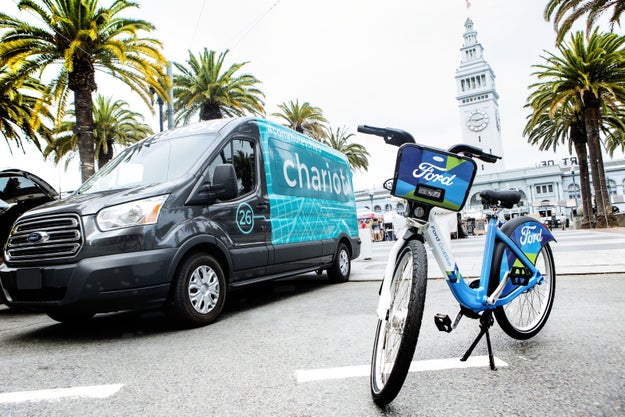
Ford announced Friday that it’s buying Chariot, a San Francisco-based shuttle service, and plans to expand it to at least five more cities over the next 18 months. The automaker is also creating a team focused on partnering with cities to provide transportation services.

Acquiring Chariot, which runs about 100 Ford vans that transport up to 14 passengers each along 28 crowdsourced routes throughout the Bay Area, gives Ford an established ride-hail-style network. The more than 100-year-old automaker said last month that it plans to put self-driving cars on the road through a ride-hail network by 2021. Chariot could be Ford’s means to do that.

“We’re working very hard to make sure we get that fully autonomous vehicle on the road in 2021 in a ride-hail type service, and certainly this will be one of the options,” Mark Fields, CEO of Ford, told BuzzFeed News.

Ford declined to say how much it paid for Chariot, but the startup raised $3 million from investors in April 2015. Ford also said Friday that it’s partnering with Motivate, the operator of New York’s bike share system Citi Bike, to offer 7,000 Ford bicycles called GoBikes in the Bay Area.

Chariot, which started in San Francisco in 2014, is just one of many startups Ford has partnered with recently. The auto manufacturer invested $75 million into Velodyne, a company that makes light detection and ranging sensors, last month. It has also invested in the Berkeley, California mapping startup Civil Maps and partnered with more than 40 other startups to develop new car technology.

In March, Ford created a subsidiary called Ford Smart Mobility to “design, build, grow and invest in new mobility services.” The Chariot acquisition is an example of that. (Ford has also been testing its own ride-hailing program called Dynamic Shuttle in Dearborn, Michigan.)

And Ford isn’t the only auto manufacturer to partner with upstart transportation companies. General Motors has invested $500 million in Lyft and is working on developing electric self-driving vehicles. And Uber has partnered with Volvo in a non-exclusive $300 million deal to develop a self-driving car.

San Francisco will be Ford’s first city partnership; some of the other partnerships will be international. Chariot, Fields said, is meant to complement public transportation. Ford already has plenty of competition in this race to be the new form of public transportation. Across the country, Uber and Lyft are partnering with public transportation agencies to make the cost of hailing comparable to hopping on a bus. For now, Chariot won’t be subsidized by public transportation agencies, but Fields told BuzzFeed News he wouldn’t rule out the idea.

Quelle: <a href="Ford Just Bought Chariot, A San Francisco-Based Shuttle Service“>BuzzFeed

Most enterprises tailor hybrid cloud to their specific needs

CIOs, CTOs and all line-of-business leaders looking to gain differentiation and strategic advantage: you&;ve come a long way in the last four years when it comes to cloud technology.
That&8217;s one of the key takeaways from a new IBM Institute for Business Value report, Tailoring Hybrid Cloud.
My co-authors — IBMers Justin Chua, Robert Freese, Anthony Karimi, Julie Schuneman — and I wanted to answer a specific question: how are organizations currently differentiating themselves using cloud? To find out, we interviewed 30 executives and surveyed 1,000 global respondents from 18 industries. Sixty-one percent of respondents held the title of CIO, CTO or head of IT.
We learned some interesting things:

In 2012, cloud was still viewed as something &;special.&; No longer. Seventy-eight percent of the executives we spoke with described their cloud initiatives as coordinated or fully integrated.
However, even with the rising use of cloud overall, almost half of computing workloads are expected to remain on dedicated, on-premises servers.

The implications of this became clear as we spoke to executives. Each enterprise is trying to tailor hybrid cloud to what best suits it.
Most often, it&8217;s a blend of public cloud, private cloud and traditional IT services. For many of these enterprises, finding the right cloud technology mix starts with deciding what to move to the cloud and addressing the challenges that can affect migration.
Our study also found that innovation advantages can be gained through rapid experimentation,strategic application programming interfaces (APIs) and extended access to external talent and technologies.
Conducting rapid experimentation gives innovative organizations the crucial ability to test and fail quickly. Cloud, with its on-demand and scalable attributes, enables this sort of nimble development and testing. What’s more, quick and automated resource provisioning can shorten development time and reduce time to market.
We discovered that executives achieved the strongest results, true strategic advantage and differentiation, by integrating cloud initiatives company-wide and tapping external resources for access to additional skills and greater efficiency.
Probably the most important thing the study revealed for organizations that are just beginning to tap into cloud technology or are ready to take the next step in digital transformation comes by way of three questions:

How is your organization planning to incorporate hybrid cloud into your overall transformation strategy?
What is the optimal combination of cloud and on-premises IT investments for your organization? What factors will you regularly monitor to identify needed changes over time?
How effective are you in tapping into external resources in assessing and implementing cloud-based solutions?

Cloud can be the centerpiece of an overall organizational transformation. Potential business impacts and the associated financial implications require ongoing scrutiny. During each stage of cloud adoption, combine the insights of business and IT. A tailor-made environment for your organization will be possible when IT employees truly understand what the business needs and line-of-business employees know what technologies/IT can do for them.
To learn more, read the IBM Institute for Business Value report, Tailoring hybrid cloud: designing the right mix for innovation, efficiency and growth.

The post Most enterprises tailor hybrid cloud to their specific needs appeared first on .
Quelle: Thoughts on Cloud

Report: IBM public cloud empowers developers

The latest edition of Forrester Research’s Forrester Wave report which evaluates global public cloud platforms characterized IBM as a “strong performer” in public cloud.
IBM earned “the highest possible score for its private and hybrid cloud strategy as well as the top ranking for IBM’s infrastructure services,” eWeek reports. Forrester’s study used 34 evaluation criteria to evaluate eight global cloud platform service providers.
In particular, IBM empowers enterprise developers with the tools they need to build applications, Forrester’s report contends. It cites “platform configuration options, app migration services, cognitive analytics services, security and compliance certifications, complex networking support, growing partner roster and native DevOps tools” as strengths.
In a statement, Bill Karpovich, general manager of the IBM Cloud Platform, said:
We believe being recognized as a strong performer in Forrester&;s latest Wave report reinforces what we hear from our clients every day—that cloud is not &;one size fits all.&8217; Enterprises require choice and expertise to evolve their diverse application portfolios, and IBM Cloud was designed to deliver on those core tenets.
For more about the Q3 Forrester Wave study, check out eWeek’s full report.
The post Report: IBM public cloud empowers developers appeared first on .
Quelle: Thoughts on Cloud