There’s an episode of Black Mirror, a British television show that imagines life in the near future, that tells the story of a woman who reunites with her deceased lover, reincarnated thanks to the wonders of artificial intelligence. While alive, Ash, the boyfriend, spends his time religiously jotting down observations and recording images of things he sees in an app. And when he dies, a tech company uses this information to create a chatbot that mimics the way he talks and what he’s interested in (it gets darker from there). It's a future that seems a bit far off in the show, but then again, the episode came out a few years before Google’s new messaging platform, Allo.

Channel 4
Allo is a new AI-powered messaging app that debuts today on iOS and Android. It’s a fun, conversational interface, to be sure. But not only does it host your conversations, it also learns how you talk, and composes messages for you, in your style.
Using Allo, which I first got my hands on last week, you can feel the mind-blowing aspects of AI in a way you simply can’t in other daily-use consumer products. And while Allo will likely struggle to break through in a saturated messaging app market, it would be foolish to write off its capacity to bring AI deeper into our lives. Remember, it&039;s powered by the heft of Google’s 18 year history of learning what we want via our searches, and its seven distinct billion-plus user products. Allo doesn’t quite take you into Black Mirror territory, but, for likely the first time in your life, it travels close enough for you to see it.
Consider the following conversation between Nick Fox, Google’s VP of communications products, and myself:
Me: “Hey! How are you?”
Nick: “Pretty good. How are you?”
Me: “I’m doing well”
Nick: “That’s good to hear&033;”
It may appear banal, but there’s something amazing about this conversation: None of it was written by either of us.

For each of those messages, Nick and I picked text suggested by Allo via a feature called Smart Replies. Smart Reply suggestions are shown underneath the compose field in Allo and updated based on the context of the conversation. Tapping a Smart Reply sends it along as a message. When Fox sent me a picture of his kid, Allo looked at the picture and suggested I write back “beautiful smile” along a smile emoji.
What’s even more remarkable is how Allo adjusts after some use. If you usually say “Yo&033; Sup?” as a greeting, Allo will learn that and suggest the phrase instead of something more generic like “Hey&033; How are you?” It will also learn how you converse with different people, so it will suggest different messages to send to your boss and your wife and your pal. (Unless they’re the same person.) Smart Replies are available in Google’s Inbox product already (where people opt to use the AI-generated replies about 10% of the time, according to Google), but the live, fluid world of messaging is very different than the stilted world of email. In Allo’s case, the machines can talk to us — or each other, or some hybrid — in near real time.
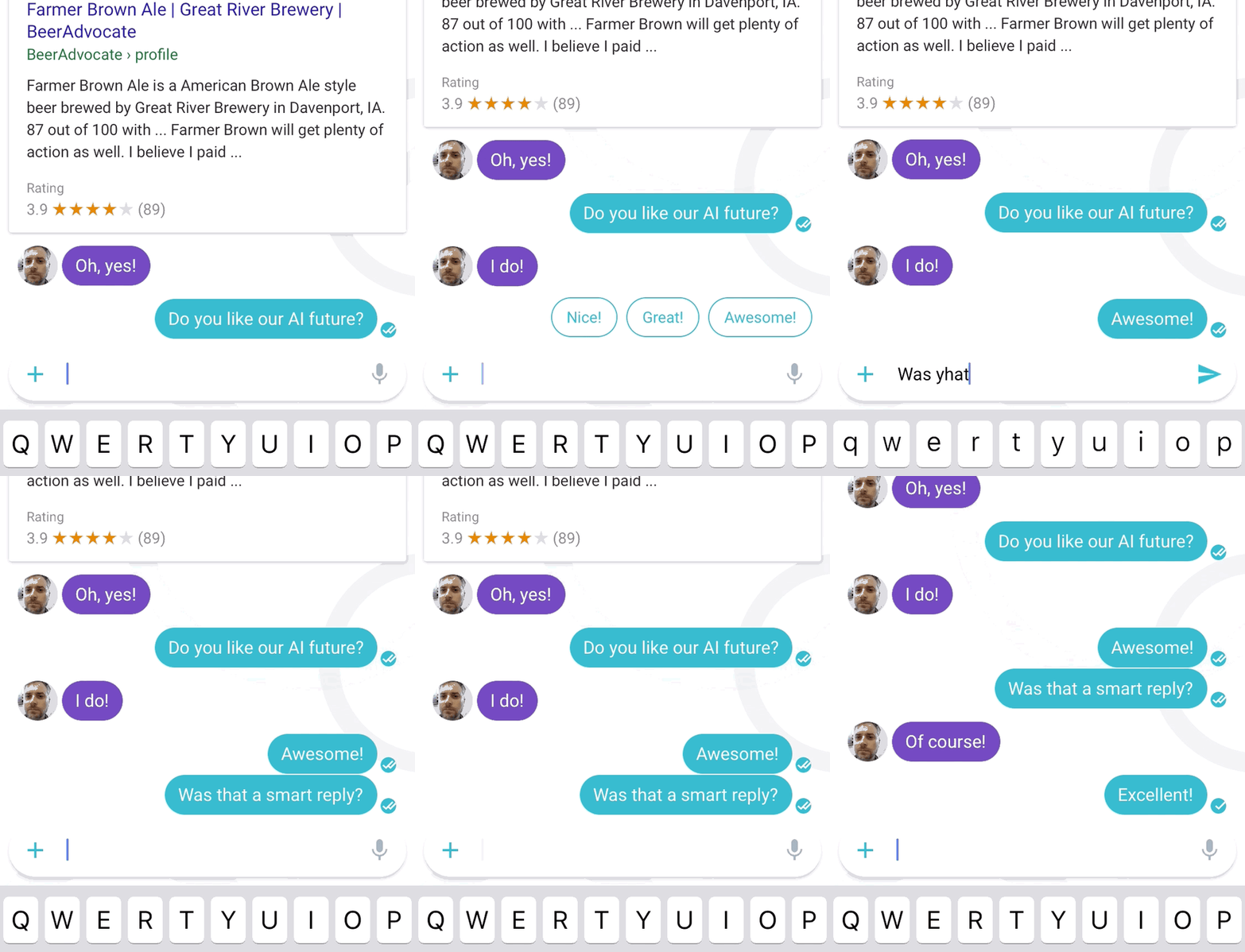
When Fox and I spoke without the assistance of AI, he told me that Allo’s Smart Replies work better for pleasantries and basic responses, and it probably won’t suggest things with deep detail, such as intentions to fly to another city later that day. “We&039;re not trying to replace human expression with smart replies,” he said. “We think of Smart Reply like a spell check, it&039;s assisting you with your expression, it&039;s helping you with your expression rather than a replacement.”
Smart Replies, of course, are not simple spell check. They are far more advanced. But Fox’s implication was clear: temper your expectations, and don’t fear this thing taking over human expression. Fair enough, but I still found myself tapping Smart Replies at almost every opportunity.
The Google Assistant
While I was messaging with a Google team member on Allo, I wanted to share a bit more information about “Be Right Back,” the Black Mirror episode starring the chatbot boyfriend. My usual process for doing this would be to go to Google, search for “black mirror be right back” click a link, copy it, and paste it into the messaging app. But inside Allo I simply wrote “@google black mirror be right back” and Google replied with a card filled more information about the episode. This was the work of the Google Assistant, the other big AI-powered feature in Allo.

Assistant is akin to a souped up Chatbot included in Allo, and you can bring it into any conversation you’re having within the app. In my discussion with Fox, he suggested I ask it to find nearby sushi places, and after I asked, it instantly replied with ten options. Fox responded with the name of one place, and Assistant sent a card showing its rating, cost, hours, and a short description. Within the card, I could hit shortcuts to call the restaurant, get directions or look at the menu.
You can also talk directly to Google Assistant in a private chat. It can tell you the weather, find places to eat, search the internet, call up messages from your Gmail, play games and more. It’s the most useful chatbot I’ve used other than Facebook’s M. (Of course, that’s a weak field; most chatbots make me want to throw my phone out the window.)
But it is perhaps most useful when it just pops into chats to help out. When I sent a colleague a photo of the Golden Gate Bridge, it suggested he respond with the a Google query for Golden Gate Bridge, which fired a “quick intro” culled from Wikipedia. Tapping a follow-up prompt gave us toll information, and then another tap sent us to Google Maps for directions. This all happened within a few seconds, and none of it felt like “searching.”

With Assistant, Google is creating a version of search adjusted for the fact that we spend most of our time in apps when we use our phones, and not in web browsers, which Google Search is built for. To remain competitive in this new world, Google knows search must live in various other forms, and releasing Assistant in Allo is just the start. Google will also embed Assistant in its Amazon Echo-like, voice operated product Google Home, and elsewhere. Fox described the product as “a cohesive glue across a number of Google services.”
So yes, Allo is another messaging app entering a market where there are already more than enough. But to think of it as simply a messaging service misses the point. Allo’s introduction gives humans a place to interact with AI more intimately than ever before. A few days into using Allo, I’m on board with that. And frankly, if a company wants to take my conversations turn me into chatbot after I die, I’m down with that too. Google, you have my permission.
Quelle: <a href="Meet Google Allo: The New Messaging App That Talks For You“>BuzzFeed








