Asus setzt auf AMD: Ryzen 9 mit 90 Watt
Gleich sieben Gaming-Notebooks von Asus sind demnächst mit AMDs Cezanne-Generation erhältlich. (Asus, Mobil)
Quelle: Golem

Gleich sieben Gaming-Notebooks von Asus sind demnächst mit AMDs Cezanne-Generation erhältlich. (Asus, Mobil)
Quelle: Golem

Durch die ROG XG Mobile von Asus wird das spieletaugliche Convertible ROG Flow X13 noch leistungsfähiger. (CES 2021, Notebook)
Quelle: Golem

Lückenbüßer, bis die Octacores kommen: Mit hochtaktenden 10-nm-Vierkernern will Intel die Ryzen-APUs in Schach halten. (Tiger Lake, Prozessor)
Quelle: Golem

Geltende Gesetze machen es Arbeitgebern nach Ansicht der FDP schwer, Homeoffice umzusetzen – was im Lockdown aber dringend erforderlich sei. (Homeoffice, Internet)
Quelle: Golem

Bachelorabsolventen von Fachhochschulen gehen überwiegend sofort in den Job. Einen Master machen sie später und dann gerne in IT. Studienangebote für Quereinsteiger gibt es immer mehr. Ein Bericht von Peter Ilg (Arbeit, Studium)
Quelle: Golem

Microsofts Surface Pro 7+ nimmt das bekannte Chassis und erweitert es um Tiger Lake. Es soll aber für Geschäftskunden reserviert werden. (Surface, Microsoft)
Quelle: Golem

Die Probleme mit dem Infotainmentsystem des Golf VIII von Volkswagen sind so groß, dass wohl Fahrzeuge wegen eines Updates in die Werkstatt müssen. (VW, Technologie)
Quelle: Golem
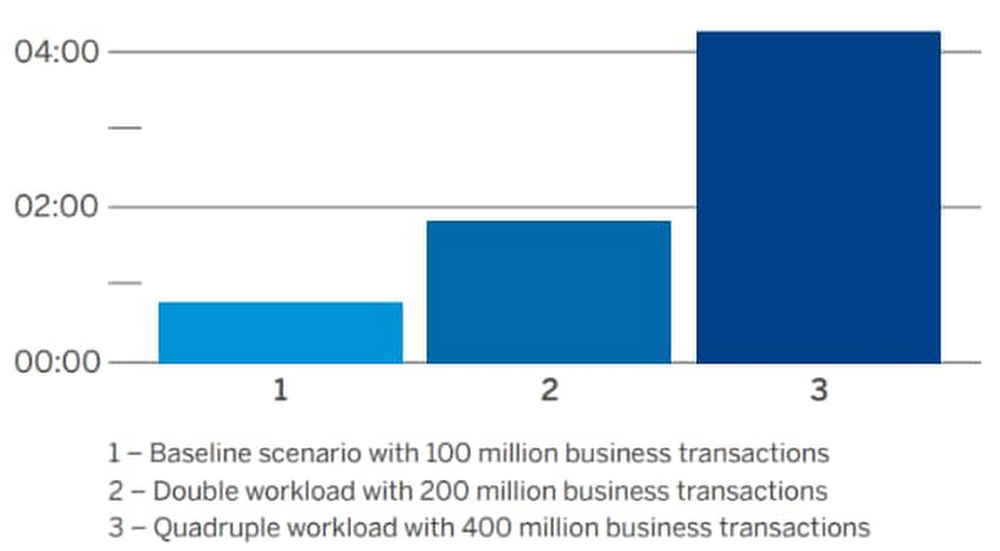
The mission: Proving a scale-out cloud solution for SAP financial products subledger delivers performance, scale and reliabilityWhen financial firms run a critical, resource-intensive application like SAP’s financial products subledger (FPSL), they have traditionally adopted a monolithic, single-node, scale-up architecture. But this type of system isn’t designed to sustain long-term growth. As these systems grow, they get increasingly unwieldy and expensive.To demonstrate the cloud’s capabilities to run FPSL at scale, Google Cloud and SAP engineers conducted a six month proof of concept (POC), using SAP S/4HANA for financial products subledger on Google Cloud. The scale-out architecture was leveraged to run a payment scenario similar to those run by specialized payment providers such as PayPal. While financial firms have been running this product for years on legacy single-node systems, SAP has optimized FPSL today to run on public clouds as an easily deployed scale-out solution. In a scale-out scenario as system demand grows, admins add new system instances that run in parallel as part of a distributed application architecture. But could a cloud-native, scale-out architecture handle the real-world demands of an application like FPSL, especially at extreme scale?Testing included a variety of Google Compute Engine VM instance types, plus network and storage resources. Both the SAP HANA database and application server environments spanned multi-node clusters that were scaled to a 96TB SAP HANA scale-out landscape. More details on the test environment can be found in the white paper. To give FPSL a real workout, the test data set generated for this purpose included a total of 10 million current accounts and daily postings of 40 million business payment transactions. The team used this data to simulate processing for all of the 2020 fiscal year plus half of FY2021—yielding a total of 12 billion payments and more than 200 billion subledger items intended for end-of-year accounting.Scale-out SAP S/4HANA FPSL on Google Cloud: 3 key findingsThe project yielded a wealth of hard data, based on internal measurements conducted by Google Cloud and SAP from April to September 2020. Performance, reliability and efficiency are key benefits for FPSL customers. 1. Performance and scale are no longer limitations for FPSL. System performance and scale was demonstrated on a number of levels with 200 billion records touched in 30 seconds for year to date balances. The system successfully maintained performance and throughput as it scaled with increasing parallel tasks from multiple application servers. A 40X acceleration in query runtime speed was achieved through parallelization. Engineers reduced runtime 2.7X—from two hours down to 44 minutes compared with performance levels for on premise scale-up systems. For peak data volume testing to simulate a Black Friday or Cyber Monday, loads were increased progressively from 40 million transactions to 160 million, quadrupling the number of line items per posting date from 500 million to 2 billion per day. Under these conditions, the figure below shows, the system responded, as expected, with slightly more than linear performance (volumes of 200% required slightly more than 200% runtime).OLTP Performance“The technology, products and services available through the SAP and Google Cloud partnership has given our Back Office significant agility and scalability. By moving to Google Cloud, we are positioning ourselves to keep pace with elevated transaction volumes, constant new financial product releases around the globe and M&A integration activities requiring swift operations.” —Dan Torunian, VP, Employee Technology and Experiences, PayPal2. Reliability was not compromised but improved due to Live Migration of Google Cloud VMs. The Google Cloud test environment ran actively for 24 weeks straight. The system ran continuous cycles of daily payment processing and year to date balances, with each day of actual system runtime handling the processing for multiple, simulated business days. When this process finished, the test environment started it again, without a second of intervening downtime.Not only were there no unplanned outages, but downtime as a result of system maintenance or applying security patches was also avoided. Google Cloud’s Live Migration capability keeps HANA VM database and application instances up and running by moving them seamlessly between servers when systems require maintenance or patching. The team also demonstrated plenty of headroom for additional workload demands with only 20-40% CPU utilization for the database and 15-30% CPU utilization for the application layer.Data protection for the environment was also put to the test. Multiple backups were performed and stored in Google Cloud’s multiregional Cloud Storage using the Cloud Storage Backint agent for SAP HANA. This resulted in 99.95% availability (or “11 nines” durability) with multi region replication, comprehensive encryption, and no egress cost. Engineers consistently measured speeds faster than 5 GB/second for backups to a multi-region-replicated cloud storage bucket (16.97 TB at 5.39 GB/second = 54 minutes).3. Enabling new optimizations like data tiering resulted in a 78% memory footprint reduction. The study also put the spotlight on data tiering as a strategy for managing storage costs. Powered by SAP HANA’s native storage extension data can be separated into “hot” and “warm” partitions for higher vs. lower priority access. The lower priority data is deemed “page loadable” and removed from memory, although it remains visible to the applications. Thanks to this capability, the test results showed a 78% reduction in memory footprint, in return for a very minor increase in data volume to the system’s disk storage—an important source of efficiency as transaction and data volumes continue to expand.”The SAP S/4HANA for financial products subledger solution on a 96 TB SAP HANA scale-out configuration brings the best of SAP and Google Cloud engineering together to deliver groundbreaking capabilities to PayPal. By combining Google Cloud’s expertise in building scalable, distributed systems with SAP’s relentless focus on delivering mission critical business process automation, PayPal now runs one of the world’s largest scale-out clusters of SAP HANA, with room to scale even further.” —Urs Hoelzle, SVP Technical Infrastructure, Google We’ve only scratched the surface of the findings here. If you’re looking to learn why more financial firms are trusting Google Cloud to host their most critical and sensitive core applications, download the white paper for even more insights into SAP and Google Cloud’s test results. Check out SAP’s perspective on this great achievement. Learn more about all Google Cloud solutions for SAP customers here.
Quelle: Google Cloud Platform

Scaling a business that sorts through millions of documents daily, across a global operation, is a tall order. Workday, with more than 3,400 core Workday Financial Management and Workday HCM customers, offers the Workday Expenses solution to provide a frictionless expense reporting experience for their customers. Here’s how they did it using Google Cloud’s Procurement DocAI.Solving for multi-language support for international expansionWorkday provides enterprise cloud applications for finance and human resources. Their in-house expense receipt parsing functionality needed to scale for international customers in multiple languages.Workday leverages Google Cloud’s Procurement DocAI machine learning solution to automate the processing of receipts with multi-language support as a key component of its expense receipt scanning capability. This partnership delivers data capture at scale, enabling Workday customers to gain deeper insights (e.g., fraud detection) and find new opportunities to keep their businesses moving forward. “At Workday, we believe enterprise software should simplify how organizations manage finance, HR, and planning. Google Cloud’s Procurement DocAI, combined with our document processing machine learning models, enables streamlined receipt intake for our customers at global scale.” – Shane Luke, VP Machine Learning & AI, WorkdayIncorporating Procurement DocAI’s multi-language support into Workday applications means faster innovation for customers to support their global deployments. Expanding languages to include French, German, and Spanish enables Workday to extend the reach of its solution to serve more customers around the world. It also offers higher data accuracy in data extraction, with an F1 score1 (measure of model’s accuracy) of > 85% for receipts, enabling a high level of satisfaction. Additional support in Workday for other languages and more documents like supplier invoices is in the near future.The partnership between Google Cloud and Workday is just one of the latest examples of how we’re providing AI-powered solutions to solve business problems.Procurement DocAI accelerates critical document processingProcurement DocAI is built on the recently announced Document AI platform, a unified console for document processing. Customers can easily create and customize all of the specialized parsers (e.g., invoices and receipt parsers) on the platform without the need to perform additional data mapping or training. All of Google Cloud’s specialized parsers are fine-tuned to achieve industry-leading accuracy, helping customers and partners confidently unlock insights from documents with machine learning.To learn more about how to get started with Procurement DocAI to automate your document workflows, check out this step-by-step guide.1. Google Internal DataRelated ArticleUsing Document AI to automate procurement workflowsShine a light on all your “dark” data with Google’s Document AI. Turn unstructured pdfs into fully automated workflows with machine learn…Read Article
Quelle: Google Cloud Platform
Editor’s note: Today, we’re speaking with Austin Sheppard, CTO of StubHub, the world’s largest ticket marketplace. We’ll hear how Google Bare Metal Solution is helping StubHub on their journey into the cloud by reducing their dependency on Oracle, lowering overall costs, and driving performance. At StubHub, we’ve been at the very forefront of ticket marketplace innovation since 2000. We were the first to introduce a ticketing application, interactive seat mapping, 360-degree virtual views of seating, innovative price recommendation technology, and an algorithm for determining the best value of tickets—all features that have become standard.Ticket marketplaces go beyond standard ticket sales and distribution. They are in the business of helping buyers and sellers connect in a safe, convenient, and reliable environment. And when you serve millions of customers a year, data is not just an enhancement but one of the primary vehicles for unlocking opportunities and providing personalized experiences. At Stubhub, we have been on a journey to move all of our applications to the cloud and ultimately retire our data center. One of the most challenging migrations for us was going to be our Oracle databases, which power our ecommerce platform. We had been migrating the applications that have a large dependency on Oracle to Google Cloud, but we hadn’t been able to find an easy approach to moving the Oracle databases as well. Having Oracle on-premises and large chunks of the application layer in the cloud was causing latency issues and wasted team resources to synchronize data between the environments. To meet our performance requirements, we needed to have all of the data physically co-located (or close to it) with the application. Additionally, our Oracle databases are a legacy holdover and are still running on Solaris. This has caused performance challenges and it can be hard to get up-to-date service and maintenance. Our upgrade cycles require a colossal coordination effort and are difficult to do with minimized downtime and customer impact. We wanted to break free of this cycle and wanted a solution that would help to reduce our dependency on legacy technologies such as Oracle, while meeting our performance needs, and ultimately help to retire the data center.Moving to Google Cloud and the Bare Metal Solution was a great opportunity for us to take a leap into the future.Bare Metal Solution: The bridge off of OracleWe ultimately selected Google Cloud’s Bare Metal Solution (BMS) since it allows us to continue using Oracle databases without sacrificing performance. This gives us a fast way to move these workloads as-is to the cloud, which solves the latency issue and accelerates our ability to completely eliminate our on-premises footprint. BMS also seamlessly integrates with the rest of the Google Cloud services that we have already been using.For my team, it was critical that we were not just able to move to the cloud, but that we could also modernize what we used to run our business. Within the next year, we are looking to fully retire the data center. Once that is complete, we intend to modernize our Oracle databases onto the cloud-native Spanner for its unlimited scale, strong consistency, and high availability.Google Bare Metal Solution is our bridge to get off the Oracle database entirely. It gives us the flexibility to move the rest of our platform to the cloud so we can now modernize faster. We are planning to modernize these workloads on Cloud Spanner and this gives us the path to do so.Early results running Oracle on Google Cloud’s Bare Metal SolutionThe early results we’ve seen so far as we’ve started migrating have been promising. Our side-by-side performance tests between on-premises Solaris systems and the newly configured BMS servers are already showing a performance improvement. We have also projected that our overall operating costs would decrease due to consolidating environments and eliminating hardware support needs, and we’re already seeing lower licensing costs as well.We’re seeing some of our costs go down right away because we are able to do more with less. We can now run Oracle on a smaller hardware footprint because of the better, faster, cheaper Intel Cascade Lake processors, resulting in an overall lower licensing cost of Oracle database.The biggest benefit, though, is the independence BMS gives us as a business by reducing our dependency on legacy vendors like Oracle. We now have control over our own destiny as we move to a cloud-native organization.Explore Stubhub and learn more about migrating Oracle to Google Cloud.Related ArticleBare Metal Solution: Coming to a Google Cloud data center near youWith Bare Metal Solution, now you can run specialized databases in five new Google Cloud regions.Read Article
Quelle: Google Cloud Platform






