Einführung von Machine to Cloud Connectivity Framework v2.2

Das Team für AWS-Lösungen hat kürzlich Machine to Cloud Connectivity Framework aktualisiert – eine Lösung, die eine sichere Anbindung von Werksausrüstung zur AWS Cloud bietet. Bei dieser Lösung handelt es sich um ein Framework zum Senden von Gerätetelemetriedaten an Ihr AWS-Konto. So können Sie AWS-Services nutzen, um Analysen Ihrer Gerätedaten durchzuführen, anstatt die zugrunde liegenden Infrastrukturvorgänge zu verwalten. Diese Lösung ermöglicht derzeit eine robuste Datenaufnahme, entweder über das OPC-Data-Access-Protokoll (OPC DA) oder das CC-Link Partner Association (CLPA) Seamless Messaging Protocol (SLMP). Das OPC-Unified-Access-Protokoll (OPC UA) wird ab dem nächsten Release unterstützt. 
Quelle: aws.amazon.com
Neues Beratungsangebot für AWS-Lösungen – IoT Resource Monitoring Framework

IoT Resource Monitoring Framework ist ein Beratungsangebot für AWS-Lösungen, das über einen Beratungsauftrag von Trek10, einem AWS IoT-Kompetenzpartner, bereitgestellt wird. IoT Resource Monitoring Framework bietet Unternehmen einen übersichtlichen und konstanten Einblick in ihre IoT-Geräte und Back-End-Vorgänge auf nur einer Oberfläche. Kunden, die dieses Beratungsangebot anfordern, nehmen an einem Projekt teil, das eine Erkundungssitzung, die Bereitstellung der AWS-Infrastruktur, ein Dashboard mit Überwachungen und Warnungen sowie ein Dokument zum Anwendungsdesign umfasst.
Quelle: aws.amazon.com

Überprüfen der Informationen zum letzten Zugriff, um ungenutzte EC2-, IAM- und Lambda-Berechtigungen zu identifizieren und den Zugriff für Ihre IAM-Rollen zu verschärfen

IAM unterstützt Kunden mit Funktionen zur Analyse von Zugriffen und zur Umsetzung des Prinzips der geringsten Rechte. Wenn Sie an neuen Berechtigungen für Ihre Teams arbeiten, können Sie die Richtliniengenerierung von IAM Access Analyzer verwenden, um eine Richtlinie auf der Grundlage Ihrer Zugriffsaktivitäten zu erstellen und detaillierte Berechtigungen festzulegen. Zum Analysieren und Anpassen bestehender Berechtigungen können Sie Informationen über den letzten Zugriff verwenden, um ungenutzte Aktionen in Ihren IAM-Richtlinien zu identifizieren und den Zugriff zu reduzieren. Bei der Einführung von Informationen über den letzten Zugriff auf eine Aktion im Jahr 2020 haben wir mit S3-Management-Aktionen begonnen, um Ihnen zu helfen, den Zugriff auf Ihre kritischen Geschäftsdaten einzuschränken. Jetzt erhöht IAM die Transparenz des Zugriffsverlaufs, indem die Informationen über den letzten Zugriff auf Amazon-EC2-, AWS-IAM- und AWS-Lambda-Aktionen erweitert werden. Dies erleichtert Ihnen die Analyse von Zugriffen und das Reduzieren von EC2-, IAM- und Lambda-Berechtigungen, indem der letzte Zeitstempel bereitgestellt wird, wann ein IAM-Benutzer oder eine Rolle eine Aktion verwendet hat. Anhand der Informationen über den letzten Zugriff können Sie ungenutzte Aktionen in Ihren IAM-Richtlinien identifizieren und die Berechtigungen sicher verschärfen.  
Quelle: aws.amazon.com

Red Hat honors North American partners for open hybrid cloud innovation

Red Hat partners continue to be a driving force behind open source innovation and customer success. The circumstances of 2020 brought many changes to the industry landscape and IT market, but Red Hat partners remained resilient and customer-centric to build new solutions and support scalable, flexible hybrid cloud environments for sustainable growth.
Quelle: CloudForms

Accelerated Database Performance on Red Hat Enterprise Linux 8.3 with Intel Ice Lake

This post compares the performance of some of the most popular database workloads on Red Hat Enterprise Linux 8.3 powered by Intel’s Cascade Lake and the recently available Intel’s Ice Lake CPU. In our performance runs, the two CPU designs are compared on the performance lab’s “white-box” hardware servers with similar performance optimized memory configurations using the same NvME IO controllers and the HammerDB workload driver. 
Quelle: CloudForms

Proxyless gRPC adds support for advanced traffic management features

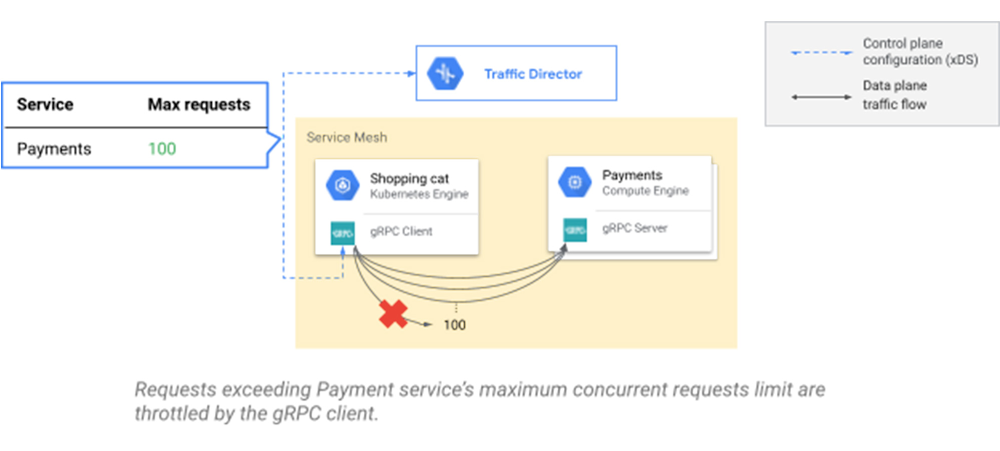
For developers building cloud-native microservices, an increasingly common choice is to use gRPC, a high-performance, open-source RPC framework that you can use with Traffic Director for your service mesh. Last year, the gRPC community introduced support for the xDS APIs, bringing service mesh capabilities to proxyless gRPC services. With the most recent release of gRPC, we are adding support for three new capabilities: maximum stream duration (timeout), circuit breaking, and fault injection, enabling you to improve the reliability of your microservices. If you’re already using Traffic Director with proxyless gRPC services, you can add these capabilities via a simple API call. Let’s take a look at these new capabilities.Stop misbehaving calls with maximum stream durationThe addition of maximum stream duration allows you to configure time limits for all RPCs within the mesh. This feature can be used to ensure clients abort operations that are running unusually slowly when it is unlikely they will succeed, enabling them to try another backend or report an error more quickly. The new xDS maximum stream duration is well integrated with gRPC’s per-RPC deadline, which is set by the client application. When both of them are configured, the effective timeout of requests will be the smaller of the two, respecting the requirements for both the service manager and the client application.Prevent request flooding with circuit breakersCircuit breaking can be used to control the maximum number of simultaneous RPCs allowed from each client to your service. This helps prevent excessive load that, if unchecked, could cause a widespread service outage. With circuit breakers, new RPCs won’t be sent out if the client has reached the limit of outstanding requests specified by the service manager. Compared to server-side rate limiters, which deny incoming requests when the server is experiencing heavy load, excessive RPCs are throttled by the clients, so no network or service resources will be consumed.Provision system robustness with fault injection testsFault injection provides a way to test the resiliency of microservices in the presence of different types of failures. With this feature, you can artificially delay or fail a percentage of RPCs to determine how well your system handles these scenarios before they happen due to a real production event. Fault injection can be configured for all RPCs or  a specific set of requests based on headers set by clients. This gives you the ability to stage different failure scenarios without completely bringing down the production service.If you’ve been thinking about adopting a service mesh, improving performance, or increasing the reliability of your system, proxyless gRPC and Traffic Director can help you do that.  Once you have proxyless gRPC applications set up with Traffic Director, you can enable the above reliability features on all your applications via a single API call, as opposed to having to code each application independently. For more information about using gRPC with Traffic Director and these new features, see the following links:Traffic Director with proxyless gRPC services overviewAdvanced traffic management overviewRelated ArticleTraffic Director and gRPC—proxyless services for your service meshWith the addition of xDS API support, you can now use Traffic Director with proxyless gRPC services.Read Article
Quelle: Google Cloud Platform






