Steam Deck: Valve kündigt leistungsstarkes PC-Handheld an
Wie eine Switch auf PC-Basis: Ab 420 Euro können PC-Nutzer von Dezember 2021 an mobil mit dem Steam Deck von Valve spielen. (Steam Deck, AMD)
Quelle: Golem

Wie eine Switch auf PC-Basis: Ab 420 Euro können PC-Nutzer von Dezember 2021 an mobil mit dem Steam Deck von Valve spielen. (Steam Deck, AMD)
Quelle: Golem
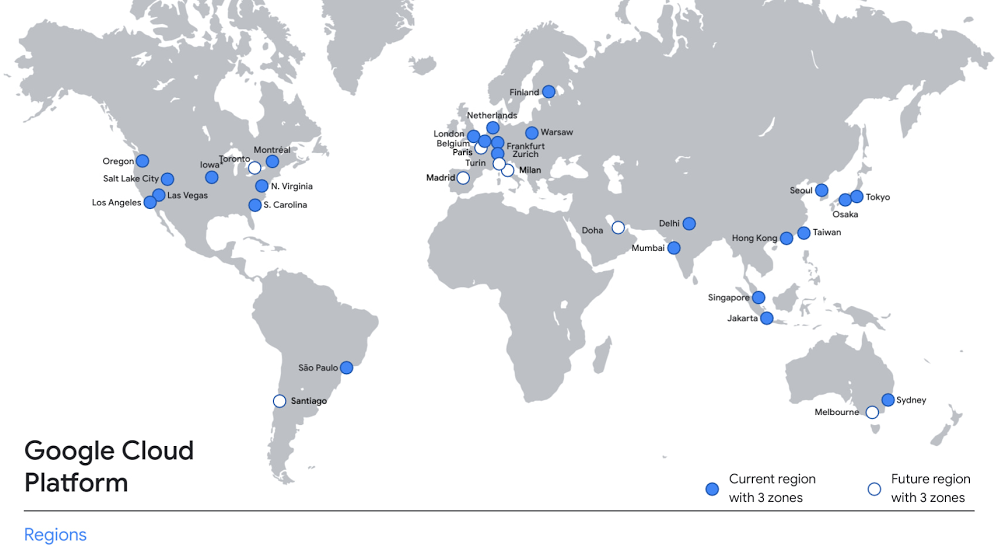
In the past year, Google has worked to surface timely and reliable health information, amplify public health campaigns, and help nonprofits get urgent support to Indians in need. Now, we are continuing to focus on helping India’s businesses accelerate their digital transformation, deepening our commitment to India’s digitization and economic recovery. To support customers and the public sector in India and across Asia Pacific, we’re excited to announce that our new Google Cloud region in Delhi National Capital Region (NCR) is now open. Designed to help both Indian and global companies alike build highly available applications for their customers, the Delhi NCR region is our second Google Cloud region in India and 10th to open in Asia Pacific. What customers and partners are sayingNavigating this past year has been a challenge for companies as they grapple with changing customers demands and economic uncertainty. Technology has played a critical role, and we’ve been fortunate to partner with and serve people, companies, and government institutions around the world to help them adapt. The Google Cloud region in Delhi NCR will help our customers adapt to new requirements, new opportunities and new ways of working, like we’ve helped so many companies do in the region: InMobi scaled a personalized AI platform to support 120+ million active users. “With the arrival of the Google Cloud Delhi NCR, InMobi Group sees the opportunity to continue closing the gap between our users and products,” says Mohit Saxena, Co-founder and Group CTO of Inmobi. “Glance, especially, has been serving AI-powered personalised content to over 120 million active users. We can’t wait to continue giving them truly meaningful experiences that are speedy, scale well, and are relevant to them, by expanding the use of our current tools working on Google Cloud with the opening of a new region.”Groww now supports a sizable user base. “Google Cloud provides great technology that enables us to build and scale infrastructure to millions of users, and the new Google Cloud region in Delhi NCR will continue to help more businesses and startups in India access powerful cloud-based infrastructure, products and services,” says Neeraj Singh, Co-founder and Chief Technology Officer, Groww.HDFC Bank is positioned for the future. “At HDFC Bank, we are harnessing technology platforms to both run and build the bank. As we progress to be future ready, the objective is to invest in future technologies that give us scale, efficiency and resiliency. Towards this the Google Cloud region in Delhi NCR will enable us to enhance our resiliency and help us in building an active-active design framework for our new generation applications on cloud,” says Ramesh Lakshminarayanan, CIO, HDFC Bank. Dr. Reddy’s Lab built a modern data platform with Google Cloud. “At Dr Reddy’s, we pride ourselves in helping patients regain good health, acting quickly to provide innovative solutions to address patients’ unmet needs and in accelerating access to medicines to people worldwide. Our Google Cloud-powered data platform is helping us realize these objectives and we welcome Google’s investment in the new Delhi NCR region as helping us and other businesses in India make further contributions to our social and economic future,” says Mukesh Rathi, Senior Vice President & CIO, Dr. Reddy’s Laboratories.“To survive the disruption caused by the pandemic and to succeed in the long term, organizations need to become digital natives, so they can be more agile, explore new business models and build new capabilities that boost resilience. A cloud-first strategy plays a key role in enabling businesses to do this,” said Piyush N. Singh, Lead – India market unit & lead – Growth and Strategic Client Relationships, Asia Pacific and Latin America, Accenture. “Harnessing the potential of cloud requires the right data infrastructure and this expansion by Google Cloud will undoubtedly help Indian enterprises in their digital transformation journeys.”A global network of regionsDelhi NCR joins 25 existing Google Cloud regions connected via our high-performance network, helping customers better serve their users and customers throughout the globe. As the second region in India, customers benefit from improved business continuity planning with distributed, secure infrastructure needed to meet IT and business requirements for disaster recovery, while maintaining data sovereignty.Click to enlargeWith this new region, Google Cloud customers operating in India also benefit from low latency and high performance of their cloud-based workloads and data. Designed for high availability, the region opens with three availability zones to protect against service disruptions, and offers a portfolio of key products, including Compute Engine, App Engine, Google Kubernetes Engine, Cloud Bigtable, Cloud Spanner, and BigQuery. Supporting India’s recovery with training and educationGoogle and Google Cloud will also continue to support our customers with people and education programs. We’re investing in local talent and the local developer community to help enterprises digitally transform and support economic recovery. Through the India Digitization Fund, we expanded our efforts to support India’s recovery from COVID-19—in particular, through programs to support education and small businesses. In addition to expanding internet access, and investments to help start-ups accelerate India’s digital transformation, we’ve grown our Grow with Google efforts. Businesses can access digital tools to maintain business continuity, find resources like quick help videos, and learn digital skills—in both English and in Hindi.Helping customers build their transformation cloudsGoogle Cloud is here to support businesses, helping them get smarter with data, deploy faster, connect more easily with people and customers throughout the globe, and protect everything that matters to their businesses. The cloud region in Delhi NCR offers new technology and tools that can be a catalyst for this change. To learn more, visit the Google Cloud locations page, and be sure to watch the region launch event here.Related ArticleGCP arrives in India with launch of Mumbai regionThe first Google Cloud Platform region in India is now open for you to build applications and store your data.Read Article
Quelle: Google Cloud Platform

Docker Captains are select members of the community that are both experts in their field and are passionate about sharing their Docker knowledge with others. “Docker Captains Take 5” is a regular blog series where we get a closer look at our Captains and ask them the same broad set of questions ranging from what their best Docker tip is to whether they prefer cats or dogs (personally, we like whales and turtles over here). Today, we’re interviewing Lucas Santos who has been a Docker Captain since 2021. He is a Cloud Advocate at Microsoft and is based in São Paulo, Brazil.
How/when did you first discover Docker?
My first contact with Docker was in 2015 when I worked at a logistics company. Docker made it very easy to deploy applications in customer’s infrastructure. Every customer had a different need and a different architecture that needed to be taken into account, unfortunately I had to leave the company before I could make this real. So I took that knowledge to my next company where we deployed over 100 microservices using Docker images and Docker infrastructure.
What is your favorite Docker command?
I would say it’s “pull”. Because it makes it look as if images are incredibly simple things. However, there’s a whole system behind image pulling and, despite being simple to understand, a simple image pull contains a lot of steps and a lot of aggregated knowledge about containers, filesystems and so much more. And this is all transparent to the user as if it’s magic.
What is your top tip you think other people don’t know for working with Docker?
Some people, especially those who are not familiar with containers, think Docker is just a fancy word for a VM. My top tip for everyone that is working with Docker as a fancy VM, don’t. Docker containers can do so much more than just run simple processes and act as a simple VM. There’s so much we can do using containers and Docker images it’s an endless world.
What’s the coolest Docker demo you have done/seen ?
I think I don’t have a favorite, but one that really stuck with me all those years was one of the first demos I’ve seen with Docker back in 2016 or 2017. I won’t remember who was the speaker or where I was but it stuck with me because it was the first time I was seeing someone using CI with Docker. In this demo, the speaker not only created images on demand using a Docker container, but also spinned up several other containers, one for each part of the pipeline. I had never seen something like that before at that time.
What have you worked on in the past 6 months that you’re particularly proud of?
I’m proud of my work with my blog and even prouder of my work in the KEDA HTTP Add-On (https://github.com/kedacore/http-add-on) team. We’ve developed a way to scale applications in a Kubernetes cluster using KEDA native scalers. One of the things that I’m proudest is of the DockerCon community room for the Brazilian community, we had an amazing engagement and this was one of the most amazing events I’ve ever helped to organize.
What do you anticipate will be Docker’s biggest announcement this year?
This is a tricky question. I really don’t know what to hope for, technology moves so fast that I literally hope for anything.
What do you think is going to be Docker’s biggest challenge this year?
I think one of the biggest challenges Docker is going to face this year is to reinvent itself and reposition the company in the eyes of the developers.
What are some personal goals for the next year with respect to the Docker community ?
One of my main goals is to close the gap between the people who are still beginners in containers, and those who are experts because there is too little documentation about it. Along with that I plan to make the Brazilian community more aware of container technologies. I can say that my main goal this year is to make everyone understand what a Docker container is, deep down.
What talk would you most love to see at DockerCon 2021?
I’d love to see more Docker integration with the cloud and new ways to use containers in the cloud.
Looking to the distant future, what is the technology that you’re most excited about and that you think holds a lot of promise?
I think one of the technologies that I’m most excited about is the future of containers. They evolve so fast that I’m anxious to see what it’ll hold next. Especially in the security field, where I feel there are a lot of things we are yet to see.
Rapid fire questions…
What new skill have you mastered during the pandemic?
Patience, probably. I started to learn IoT, Electronics, Photography, Music and a lot of other things.
Cats or Dogs?
Cats
Salty, sour or sweet?
Salty
Beach or mountains?
Mountains
Your most often used emoji?
The post Docker Captain Take 5 – Lucas Santos appeared first on Docker Blog.
Quelle: https://blog.docker.com/feed/

Im Prozess um den Cyberbunker an der Mosel steht eine Wende bevor. Der angebliche Manager will ein Geständnis ablegen – zumindest teilweise. Ein Bericht von Friedhelm Greis (Cyberbunker, Server)
Quelle: Golem

Windows 365 ist ein neuer Dienst, mit dem Microsoft einen virtuellen PC in der Cloud anbietet, auf den über einen Webbrowser zugegriffen werden kann. (Microsoft 365, Citrix)
Quelle: Golem

General Motors warnt Besitzer des Elektroautos Chevy Bolt davor, nachts zu laden oder in einer Garage zu parken: Grund sind mehrere Brände. (Chevrolet, Technologie)
Quelle: Golem

Früher Command & Conquer, nun Netflix: Der Streamingdienst hat den Branchenexperten Mike Verdu von Oculus abgeworben – und große Pläne. (Netflix, Command & Conquer)
Quelle: Golem

Die Alder-Lake-Prozessoren sollen schnelle 5-GHz-Performance- und flotte 4-GHz-Effizienz-Kerne kombinieren, insgesamt gibt es 16 Cores. (Intel Alder Lake, Prozessor)
Quelle: Golem
Part of our ongoing series about digital transformation featuring fictional company Davie Street Enterprises. In this post, DSE continues the company’s digital transformation by combining Red Hat Ansible Automation Platform and Chocolatey to install applications to Windows servers and desktops quickly.
Quelle: CloudForms

Every IT team wants to get the right information to employees and vendors as quickly as possible. Yet the task is always getting harder as more information becomes available and results invariably become stale. Disparate internal systems hold vital information. Search capabilities are not consistent across tools. No universal system exists. And even inside Google we can’t use our web search technology, because that assumes a fully public dataset, a lot of traffic, and more active content owners. It’s so hard to get internal search right because each person has individual goals, access levels and needs.All too often, this sisyphean task ends up requiring huge amounts of manual labor, or leads to inferior results and frustrated people. At Google we transitioned our internal search to rank results using machine learning models. We found this helps surface the most relevant resources to employees – even when needs change rapidly and new information becomes available.Sudden changeOur internal search site–Moma–is Googlers’ primary way to source information. It covers a large number of data sources, from internal sites to engineering documentation to the files our employees collaborate on. Over 130,000 weekly users issue queries each week – to get their job done and to learn the latest about what’s going on at Google.With COVID-19 and working-from-home changing so much so rapidly, lots of new content and guidance for Googlers was created quickly and needed to be easily accessible and discoverable by all employees. But how to make sure it gets shown?Manual tweakingBefore adopting ML for search ranking, we used to tweak ranking formulas with literally hundreds of individual weights and factors for different data sources and signals. Adding new corpora of information and teaching the search engine new terminology was always possible, but laborious in practice. Synonyms, for example, would rely on separate datasets that needed manual updating, for example to make sure that searches for “Covid19”, “Covid”, and “Coronavirus” all return the relevant pages. The involved human effort to carefully craft and apply changes, validate them and deploy them often meant that new content for new topics was slow to rank highly. Even then, search results could be hit-or-miss depending on how users formulated their queries, as writers often wouldn’t know exactly which keywords to use in their content – especially in situations where trends emerge quickly, and the terminology was evolving in real time.Automated scoringWe now use ML for scoring and ranking results based on many signals, and our model learns quickly because we continuously train on our own usage logs of the last four weeks. Our team integrated this ranking method in 2018, and it served us well with recent shifts in search patterns. When new content becomes available for new needs, the model can pick up new patterns and correlations that would have otherwise taken careful manual modelling. This is the fruit of our investments over the last years, including automatic model releases and validation, measurement and experimentation, which allowed us to get to daily ranking model rollouts.Create training dataCreating training sets is the prerequisite for any application of machine learning, and in this case it’s actually pretty straightforward: Generate the training data from search logs that capture which results were clicked for which queries. Choosing an initial simple set of model features helps to keep complexity low and make the model robust. Click through rate for pages by queries and a simple topicality score like TF-IDF can serve as starting points. Each click on a document gets a label of 1, everything else a label of 0. Each search impression that gets a click should become a training example to the ML model. Don’t do any aggregations on query or such; the model will learn these by itself. Feed the training data into an ML ranking model, like tensorflow_ranking.MeasurementOnce the basics are working, you’ll want to gauge the performance of the model, and improve it. We combine offline analysis – replaying queries from logs and measuring if the clicked results ranked higher on average – and live experimentation, where we divert a share of traffic to a different ranking model for direct comparison. Robust search quality analysis is key, and in practice it’s helpful to consider that higher-up results will always get more clicks (position bias), and that not all clicks are good. When users immediately come back to the search results page to click on something different, that indicates the page wasn’t what they were looking for.Expanding the modelWith more signals and page attributes available, you can train more sophisticated models that consider e.g. page popularity, freshness, content type, data source or even user attributes like their job role. When structured data is available, it can make for powerful features, too. Word embeddings can outperform manually defined synonyms while reducing reliance on human curation, especially on the “long tail” of search queries. Running machine learning in production with regular model training, validation and deployment isn’t trivial, and comes with quite a learning curve for teams new to the technology. TFX does a lot of the heavy lifting for you, helping to follow best practices and to focus on model performance rather than infrastructure. Positive impactThe ML-driven approach allows us to have a relatively small team that doesn’t have to tweak ranking formulas and perform manual optimizations. We can operate driven by usage data only, and don’t employ human raters for internal search.This ultimately enabled us to focus our energy on identifying user needs and emerging query patterns from search logs in real time, using statistical modelling and clustering techniques. Equipped with these insights, we consulted partner teams across the company on their content strategy and delivered tailor-made, personalized search features (called Instant Answers) to get the most helpful responses in front of Googlers where they needed them most. For example, we could spot skyrocketing demand for (and issues with!) virtual machines and work-from-home IT equipment early, influencing policy, spurring content creation and informing custom, rich promotions in search for topical queries. As a result, 4 out of 5 Googlers said they find it easy to find the right information on Covid-19, working from home, and updated company services.Give it a try Interested in improving your own search results? Good! Let’s put the pieces together. To get started you’ll need:Detailed logging, ranking quality measurements and integrated A/B testing capabilities. These are the foundations to train models and evaluate their performance. Frameworks like Apache Beam can be very helpful to process raw logs and generate useful signals from them. A ranking model built with Tensorflow Ranking, based on usage signals. In many open source search systems like Elastic Search or Apache Solr, you can modify, extend or override scoring functions, which can allow you to plug in your model into an existing system.Production pipelines for model training, validation and deployment using TFXWe want to acknowledge Anton Krohmer, Senior Software Engineer, who contributed technical insight and expertise to this post.Related ArticleGoogle supercharges machine learning tasks with TPU custom chipEditor’s Update June 27, 2017: We recently announced Cloud TPUs.Machine learning provides the underlying oomph to many of Google’s most-l…Read Article
Quelle: Google Cloud Platform






