Liberty-Klasse: Erstes autonomes US-Kriegsschiff braucht keine Crew
Die U.S. Navy bekommt bis Ende 2026 ihr erstes vollautonomes Kriegsschiff. Das 58 Meter lange Schiff fährt monatelang ohne Besatzung. (Militär, Politik)
Quelle: Golem

Die U.S. Navy bekommt bis Ende 2026 ihr erstes vollautonomes Kriegsschiff. Das 58 Meter lange Schiff fährt monatelang ohne Besatzung. (Militär, Politik)
Quelle: Golem
Amazon Aurora DSQL now supports identity columns and sequence objects enabling developers to generate auto-incrementing, integer-based IDs directly in the database using familiar SQL patterns. This launch simplifies migrations of existing PostgreSQL applications and supports development of new workloads that rely on database-managed integer identifiers. Developers can create compact, human-readable IDs, such as order numbers, account IDs, or operational references without custom ID generation logic in application code or middleware.
Quelle: aws.amazon.com
Amazon Relational Database Service (RDS) and Amazon Aurora now offer greater flexibility for restore operations to view and modify backup retention period and preferred backup window prior to and upon restoring database snapshots. The backup retention period lets you specify how many days backups are retained, while the preferred backup window allows you to set your desired backup schedule. Previously, restored database instances and clusters inherited backup parameter values from snapshot metadata and could only be modified after restore was complete. This launch introduces two enhancements – you can now view the backup retention period and preferred backup window settings as part of automated backups and snapshots, providing visibility into backup configurations before initiating restore operation. Additionally, you can now specify or modify the backup retention period and preferred backup window when restoring database instances and clusters, eliminating the need to modify the instance or cluster after restoration. These enhancements are available for all Amazon RDS database engines (MySQL, PostgreSQL, MariaDB, Oracle, SQL Server, and DB2) and Amazon Aurora (MySQL-Compatible and PostgreSQL-Compatible editions) in all AWS commercial regions and AWS GovCloud (US) regions where RDS and Aurora are supported and respective database engines are available. You can use these features through the AWS Management Console, AWS Command Line Interface (CLI), and AWS SDKs at no additional cost. For more information, see Amazon RDS and Amazon Aurora User Guide.
Quelle: aws.amazon.com
Amazon Connect now provides AI-powered Task overviews with suggested next actions so agents can understand work items faster and resolve them more quickly. For example, when an agent receives a Task to process a refund request submitted through an online form, Amazon Connect summarizes earlier activities such as verifying order details, checking return eligibility, and confirming the payment method, and then presents recommended next steps to complete the refund. To enable this feature, add the Connect assistant flow block to your flows before a Task contact is assigned to your agent. You can guide the recommendations of your generative AI-powered Tasks assistant by adding knowledge bases. This new feature is available in all AWS regions where Amazon Connect real time agent assistance is available. To learn more and get started, refer to the help documentation, pricing page, or visit the Amazon Connect website.
Quelle: aws.amazon.com
Amazon Connect now supports in-app notifications in the workspace header, visible from any page, so your team can stay informed without interrupting their workflow— whether configuring, analyzing data, or servicing customers. A notification icon appears in the header of every workspace page, with a badge indicating unread messages. Click the icon to view messages, access relevant resources through embedded links, and manage read/unread status—all without navigating away from your current task. For example, if all supervisors need to complete a certain training by end of week, a notification can be published to non-compliant users to remind them. The new notification APIs enable you to programmatically send targeted messages to specific audiences within your organization, ensuring teams stay aware of urgent updates, policy changes, and action items requiring immediate attention. Amazon Connect will also leverage this capability to deliver system updates and important announcements. In-app notifications are available in all AWS regions where Amazon Connect is available and offer public API and AWS CloudFormation support. To learn more about in-app notifications, see the Amazon Connect Administrator Guide. To learn more about Amazon Connect, please visit the Amazon Connect website.
Quelle: aws.amazon.com
AWS Batch now provides Queue and Share Utilization Visibility, giving you insights into how your workloads are distributed across compute resources. This feature introduces queue utilization data in job queue snapshots, revealing compute capacity used by your first-in-first-out (FIFO) and fair share job queues, along with capacity consumption by individual fair share allocations. Additionally, the ListServiceJobs API now includes a scheduledAt timestamp for AWS Batch service jobs, allowing you to track when jobs are scheduled for execution. Queue and Share Utilization Visibility helps you understand which fair-share allocations consume the most capacity and pinpoint the specific jobs driving resource consumption. You can monitor overall queue utilization and drill down into active shares to optimize resource distribution, or filter jobs by share identifier to analyze consumption patterns and scheduling behavior across your workloads. You can access this feature using the GetJobQueueSnapshot, ListJobs, and ListServiceJobs APIs, or through the AWS Batch Management Console by navigating to your job queue details page and selecting the new Share Utilization tab. This feature is available today in all AWS Regions where AWS Batch is available. To learn more, visit the Job Queue Snapshot, List Jobs, and List Service Jobs pages of the AWS Batch API Reference Guide.
Quelle: aws.amazon.com

KI verändert viele Spielregeln. Auch in Sachen Liebe wird sie für manche Menschen immer attraktiver, mit unabsehbaren Folgen. Ein Bericht von Lars Lubienetzki (KI, Software)
Quelle: Golem
In today’s globally connected environment, even minutes of downtime can disrupt supply chains, hinder customer experiences, and affect regulatory commitments costing organizations thousands of dollars per minute and risking lasting reputational harm. Data resiliency is no longer optional—it is the foundation that keeps mission‑critical applications running, teams productive, and compliance intact. Organizations must ensure continuous data availability and zero data loss to meet stringent regulatory and audit standards.
Azure NetApp Files (ANF) is an Azure first party, enterprise-grade file storage offering in the cloud built to deliver unmatched performance, security with instant provisioning, and enterprise data management capabilities like snapshots, replication, backups, and flexible, cost-efficient service levels. It’s the trusted platform for critical workloads and the engine behind numerous migrations that drive Azure enterprise cloud journeys.
As businesses scale, the impact of service disruptions grows, and storage platforms must evolve to help maintain operational continuity. To support these needs, we are introducing Azure NetApp Files Elastic zone‑redundant storage (ANF Elastic ZRS)—a new service that provides enhanced resiliency across availability zones (AZs) and advanced data management capabilities. Built on Azure infrastructure, ANF Elastic ZRS can be deployed rapidly, accelerating availability across a broad set of regions. As a customer, you benefit from a service that can quickly adapt, whether that means expanding to a new Azure region you require, or adopting new technological advancements faster.
Synchronous replication and service managed failover
Built on Microsoft Azure’s zone-redundant storage (ZRS) architecture, ANF Elastic ZRS synchronously replicates data across multiple AZs within a region.
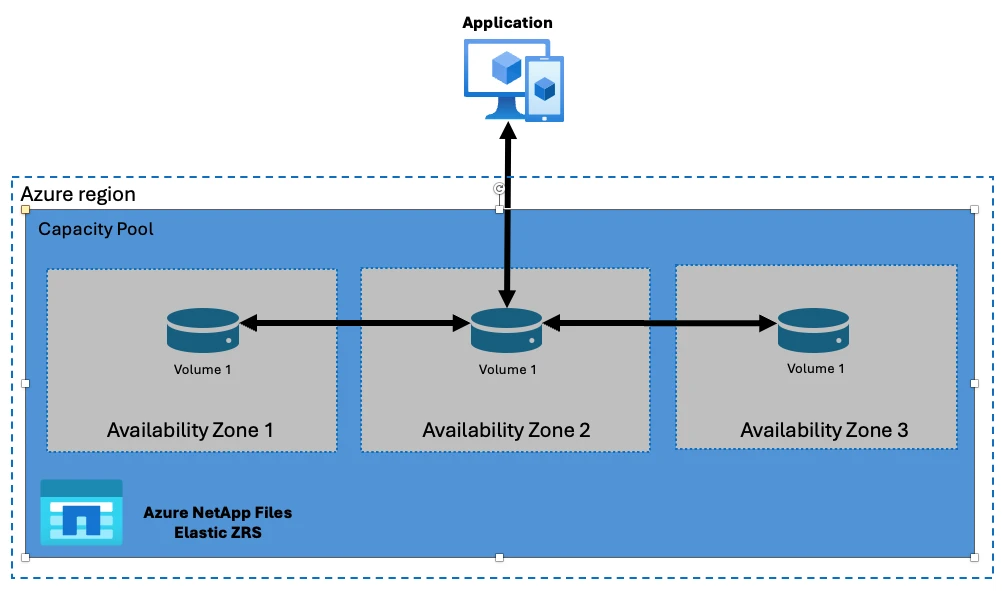
The graphic below shows the high-level architecture of ANF Elastic ZRS.
The following summarizes the operational methodology used:
Synchronous replication: ANF Elastic zone-redundant storage (ZRS) volume replicates data within your NetApp Elastic Account to three or more AZs within the primary region of choice.
Service managed failover: If one AZ goes down (think single datacenter failure, power outage), ANF Elastic ZRS automatically routes traffic to the failover zone that was chosen during initial setup without customer intervention. The mount target and service endpoint remain the same, so your applications barely notice.
Zero data loss and high availability for mission-critical applications: ANF Elastic ZRS ensures uninterrupted operations for mission-critical applications and regulated systems by combining synchronous replication with service-managed failover. This architecture guarantees zero data loss and seamless continuity even during zone-level failures, meeting enterprise resiliency standards.
Capabilities for enterprise mission-critical applications
NFS, SMB protocol support, multi-AZ file service: ANF Elastic ZRS supports NFS and SMB independently with the added benefit of zonal redundancy.
Rich enterprise data management capabilities: Instant writeable space-efficient snapshots, clones, tiering, and backup integration all powered by the NetApp ONTAP® Unified data management platform.
Metadata performance: Beyond consistent throughput, ANF Elastic ZRS provides efficient handling of metadata operations such as rapid file creation and fast enumeration of numerous small files, improving responsiveness of metadata-heavy workloads. Its shared QoS architecture dynamically allocates IOPS across volumes to maintain low-latency, metadata-intensive operations consistently.
Cost optimized: ANF Elastic ZRS delivers multi-AZ high availability in a single volume at a lower cost than cross-zone replication with three separate ANF volumes, making it an efficient and valuable investment. You can create volumes as small as 1 GiB, giving you the flexibility to optimize storage for workloads of any size.
Apart from the above capabilities that are already supported, we will be adding the below capabilities in the future:
Simultaneous multi-protocol, multi-AZ file service: The service will support simultaneous NFS, SMB, and Object REST API access to the same dataset. This flexibility is crucial for environments where Windows and Linux workloads share data, such as analytics platforms and enterprise file shares.
Custom region pair for cross-region replication: ANF Elastic ZRS will be offering the flexibility to choose custom region pairs for cross-region replication, meeting strict compliance and disaster recovery requirements for large enterprise customers. This capability ensures business continuity while aligning with unique geographic or regulatory needs.
Migration Assistant: This capability will simplify data movement from on-premises or other ONTAP® systems to Elastic ZRS service level for seamless cloud adoption.
Targeted use cases
Use caseHow ANF Elastic ZRS helps
General file shares
Corporate user data including home directories or departmental file shares, remain accessible even during zone outages, ensuring seamless employee productivity and business continuity.
Financial services and trading platforms
Delivers zero data loss and nonstop trading even in a zone outage, so financial apps stay compliant, and customers stay confident.
Kubernetes/containerized applications
Keeps Kubernetes and container workloads running even during zone outages by instantly synchronizing data across zones and enabling rapid, automated failover. Your stateful apps stay online with zero data loss and minimal downtime.
Applications
Ensure nonstop access to in-house/line of business apps, even if an AZ fails, as data stays online with zero outages or lost transactions.
Innovation in action
A global healthcare enterprise running mission-critical application, on-premises is looking to modernize its infrastructure by moving mission-critical workloads to the cloud. The organization’s top priorities are eliminating downtime during maintenance and ensuring seamless failover to maintain application availability.
By adopting ANF Elastic ZRS, the organization gained a fully managed, zone-resilient storage solution that synchronously replicates data across three Azure AZs. This ensures zero data loss and near-instant failover, even during zone outages or platform maintenance. The mission-critical application remains highly available without requiring operational intervention, dramatically improving uptime, and simplifying infrastructure management.
ANF Elastic ZRS delivers the same enterprise-grade features as existing Azure NetApp Files service levels—such as NFS/SMB support, snapshots, encryption, and backup—all while removing the complexity of managing high availability (HA) clusters or VM-level failover. For the healthcare provider, this translates into higher SLA compliance, reduced operational overhead, and a more resilient foundation for its mission-critical application landscape.
Take the next step toward resilient storage
NetApp on premises customers: this is the inflection point you’ve been waiting for to move to Azure. ANF Elastic ZRS‑ brings the ONTAP®-powered data management you trust to a fully managed, multi-AZ file service, so you can modernize mission‑AZ file service, so you can modernize mission‑critical workloads with enterprise resilience, meet availability commitments, and reduce operational overhead—without re‑architecting your applications.
ANF Elastic ZRS is available now in these Azure regions and we will be rapidly expanding region availability.
Learn more:
Understand Azure NetApp Files Elastic zone-redundant storage
Create an SMB volume for Azure NetApp Files
Create an NFS volume for Azure NetApp Files
Comparison of Elastic vs other ANF service levels
Explore ANF Elastic ZRS in Azure today
Join the ranks of enterprises who demand the best in performance, availability, and simplicity.
Start experimenting
The post Enhanced storage resiliency with Azure NetApp Files Elastic zone-redundant service appeared first on Microsoft Azure Blog.
Quelle: Azure

At Microsoft we believe that intelligence and trust are the core requirements of agentic AI at scale. Built on Azure, Microsoft Foundry brings these capabilities together on a secure, scalable cloud foundation for enterprise AI. Today, with the launch of Claude Opus 4.6 in Microsoft Foundry, we bring even more capability to agents that increasingly learn from and act on business systems.
Explore Claude in Microsoft Foundry today
Claude Opus 4.6 brings Anthropic’s most advanced reasoning capabilities into Microsoft Foundry, our interoperable platform where intelligence and trust come together to enable autonomous work. In Foundry, Opus 4.6 can activate knowledge from everywhere: leveraging Foundry IQ to access data from M365 Work IQ, Fabric IQ, and the web. The model is best applied to complex tasks across coding, knowledge work, and agent-driven workflows, supporting deeper reasoning while offering superior instruction following for reliability.
Developers can now delegate their most complex work to AI systems for full-lifecycle development from, requirements gathering to implementation and maintenance. Business users can generate documents, perform research, and draft copy with professional polish and domain awareness.
At Adobe, we’re continuously evaluating new AI capabilities that can help us deliver more powerful, responsible, and intuitive experiences for our customers. We’ve been testing Claude models in Microsoft Foundry and are excited about the direction of Anthropic’s model roadmap. Foundry gives us a flexible, enterprise-ready environment to explore frontier models while maintaining the trust, governance, and scale that are critical for Adobe.
—Michael Marth, VP Engineering for Experience Manager and LLM Optimizer, Adobe
Introducing Opus 4.6: Frontier intelligence, built for real work
Claude Opus 4.6 is the latest version of Anthropic’s most intelligent model, and is considered the best Opus model for coding, enterprise agents, and professional work. With a 1M token context window (beta) and 128K max output, Opus 4.6 is ideal for:
Production code
Sophisticated agents
Office tasks
Financial analysis
Cybersecurity
Computer use
By combining Anthropic’s most advanced model with Foundry’s end-to-end tooling, customers can move from experimentation to production faster, without stitching together infrastructure.
1. Autonomous coding at a new level
Opus 4.6 handles large codebases well and is particularly effective at long-running tasks like refactoring, bug detection, and complex implementations.
This allows senior engineers to delegate work that previously took days, covering everything from requirements gathering to implementation and maintenance, while staying focused on reviews and decision-making.
With Foundry’s managed infrastructure and operational controls, teams can compress development timelines from days into hours, while maintaining the rigor required for real-world production systems.
Macroscope has relied on Anthropic’s frontier models to push what’s possible in AI code review, helping us catch the bugs that matter most to customers before they ever reach production. We’re incredibly excited to deepen this partnership by scaling on Azure infrastructure and delivering our product to teams around the world.
—Kayvon Beykpour, CEO & Co-Founder, Macroscope
2. Better knowledge work across the enterprise
Opus 4.6 delivers a step-change in how enterprises approach knowledge work, which Anthropic defines across three pillars: search, analyze, and create. In Microsoft Foundry, these capabilities can be applied directly to enterprise data, workflows, and agent-driven applications.
Opus 4.6 understands the conventions and norms of professional domains, producing documents, spreadsheets, and presentations that look and read like expert-created work. Combined with Foundry’s governance and access controls, this makes Opus 4.6 a great fit for finance, legal, and other precision-critical industries where quality, context, and compliance matter.
At Dentons, we are scaling generative AI across drafting, review, and research workflows across our global teams. Claude in Microsoft Foundry brings the frontier reasoning strength we need for legal work, backed by the governance and operational controls required in an enterprise environment. Better model reasoning reduces rework and improves consistency, so our lawyers can focus on higher value judgment.
—Matej Jambrich, CTO, Dentons Europe
High context financial analysis
Opus 4.6 excels at connecting insights across regulatory filings, market reports, and internal enterprise data, surfacing conclusions that would traditionally take analysts days to compile.
Its advanced reasoning capabilities allow it to:
Navigate nuanced financial and regulatory contexts
Generate compliance-sensitive outputs
Maintain consistency and traceability across complex analytical workflows
When deployed through Microsoft Foundry, these workflows benefit from Azure’s security, compliance, and auditability, helping organizations apply frontier AI to high-stakes analysis with confidence.
3. Advancing agentic and computer use capabilities
According to Anthropic, Opus 4.6 delivers major gains in computer use, with strong performance on industry benchmarks for visual understanding and multi-step navigation. Opus 4.6 sets a new standard for computer use. Claude can now operate computers more accurately, handle more complex tasks, and work across multiple applications seamlessly.
It can interact with software, navigate interfaces, complete forms, and move data across applications. When deployed in Microsoft Foundry, these actions can run as secure, governed agents, enabling automation of workflows that span legacy systems, document processing, and operational tools.
Opus 4.6 can manage complex, multi-tool workflows with less oversight—an essential requirement for teams operating AI systems at scale.
Anthropic on Azure provides Momentic with the reliability guarantees needed to process millions of tokens per hour on state-of-the-art models like Opus 4.5. Azure’s platform works seamlessly with Anthropic’s SDK, even supporting beta features such as reasoning effort out of the box.
—Jeff Ann, CTO & Co-Founder, Momentic AI
4. Agents, security, and high-stakes reasoning
Opus 4.6 is also best suited for agentic workflows, reliably orchestrating complex tasks across dozens of tools. It can proactively spin up sub-agents, parallelize work, and drive tasks forward with minimal oversight.
For security workflows, Opus 4.6 delivers deep reasoning, enabling teams to identify subtle patterns and complex attack vectors with high accuracy.
Anthropic is a trusted partner for governments and companies alike. Their speed, accuracy, and toolkit are already helping Everstar make fast, safe nuclear energy deployments a reality. I’m excited to see these capabilities integrated natively on Azure for secure deployments for our government and nuclear customers.
—Kevin Kong, Founder & CEO, Everstar
New API capabilities co-launching with Opus 4.6
Alongside Opus 4.6, Anthropic is introducing new API capabilities, available through Microsoft Foundry—that give developers greater control, scalability, and efficiency:
Adaptive thinking: Allows Claude to dynamically decide when and how much reasoning is required, optimizing performance and speed on simpler tasks, while allowing Claude to think harder on complex tasks.
Context Compaction (beta): Supports long-running conversations and agentic workflows by summarizing older context as token limits are reached.
1M Context Window (beta): Support for up to 1M tokens, with premium pricing applied beyond 200K tokens.
Max effort control: A new max effort level joins high, medium, and low, offering finer control over token allocation across thinking, tools, and output.
128K Output Tokens: Enables richer, more comprehensive outputs in a single response.
Claude Opus 4.6 in Microsoft Foundry
As AI systems move from assistance to autonomy, success depends on more than frontier intelligence, it requires intelligence that can be trusted to operate in real-world environments. Claude Opus 4.6 brings advanced reasoning and long-horizon execution, and Microsoft Foundry provides the system context where that intelligence can be applied responsibly, at scale.
Together, Claude in Foundry enables organizations to move beyond isolated experiments and toward intelligent, agent-driven systems that deliver real business impact—grounded in trust, governance, and operational rigor.
Opus 4.6 is also available through Microsoft Copilot Studio, enabling organizations to quickly build, orchestrate, and deploy advanced AI agents without custom code.
Explore Claude Opus 4.6 in Microsoft Foundry
Explore how Claude Opus 4.6 can power trusted, autonomous work in Microsoft Foundry.
Discover Opus 4.6
The post Claude Opus 4.6: Anthropic’s powerful model for coding, agents, and enterprise workflows is now available in Microsoft Foundry appeared first on Microsoft Azure Blog.
Quelle: Azure
The SQL community is gathering in Atlanta this March for the first‑ever SQLCon, co‑located with FabCon, the Microsoft Fabric Community Conference, March 16-20. One registration unlocks both events, giving you access to deep SQL expertise and the latest in Fabric, Power BI, data engineering, real‑time intelligence, and AI. Whether you’re a DBA, developer, data engineer, architect, or a leader building data‑driven team, this is your chance to learn, connect, and shape what’s next.
One pass, two conferences—double the valueRegister once, benefit twice. With SQLCon and FabCon under the same roof, you can mix a deep SQL session in the morning with a Fabric or AI talk in the afternoon, then drop into the shared expo and community lounge. It’s a seamless, high‑impact week that lets specialists go deep while cross‑functional teams build a common language across data, analytics, and AI.
Dive Deep with Interactive Sessions and Hands-On WorkshopsThere are 50 SQL sessions at SQLCon. Fifty! The program is designed for momentum. Across the week, you’ll find practical content on SQL Server, Azure SQL, SQL database in Fabric, performance tuning, security and governance, migration and modernization, and building AI‑powered experiences with SQL. Monday and Tuesday are hands‑on workshop days—bring your laptop and leave with repeatable scripts, patterns, and demos you can apply immediately. Wednesday through Friday, you’ll stack conference sessions to round out your plan for the year.
Experience Atlanta: The Perfect Setting for SQLConSQLCon + FabCon take place at the Georgia World Congress Center, in the heart of a walkable downtown that’s tailor‑made for a great conference week. You’ll be just a short walk from Centennial Olympic Park, near State Farm Arena—home to major keynote events—and amid lively dining and music options. The attendee party is at the Georgia Aquarium, an unforgettable after‑hours experience with spectacular exhibits and a perfect setting for relaxed conversations with peers and product teams. Want a quick vibe check on the city and the conference energy? Watch the short video of Guy in a Cube and me:
Announcements on roadmap, engineering insights, and live updatesIf you want to understand where SQL Server, Azure SQL, and SQL database in Fabric are heading, this is the place. Expect direct updates from engineering (we’re sending over 30 members from the SQL product team); first‑look announcements; and live demos of upcoming capabilities across SQL tooling and drivers, SSMS/VS Code extensions, Copilot integrations, and Fabric SQL experiences. You’ll leave with clarity on what’s coming, how it impacts your environment, and where to invest next.
The SQL Community: Revitalized and EngagedSQLCon goes beyond a conference—it’s a gathering where the lounge hosts meetups and active conversations. Ask‑the‑Experts sessions connect you with engineers, MVPs, and product teams. Shared keynotes bring everyone together, and the city makes it easy to extend conversations into the evening. Bring your toughest questions, real-world challenges, and bold goals—you’ll leave with practical solutions, valuable connections, and new inspiration.
Bonus: make the budget workDepending on timing, look for early‑bird pricing, team discounts, or buy‑one‑get‑one offers on the registration page. These deals move fast, so check what’s live when you register. You can always use SQLCMTY200 for $200 off!
Wrap‑up: build the next chapter of your data strategy at SQLConSQLCon + FabCon is the highest‑leverage week of the year to sharpen your technical skills, understand SQL’s next chapter, accelerate modernization and performance, and build meaningful connections across the global community. If SQL plays any role in your data estate, this is the one event you shouldn’t miss.
See you in Atlanta!
The post Five Reasons to attend SQLCon appeared first on Microsoft Azure Blog.
Quelle: Azure






