Teamarbeitstool: Zendesk für 10,2 Milliarden US-Dollar verkauft
Zendesk wird von Finanzinvestoren gekauft. Noch im Februar 2022 wurde ein Angebot mit einem Volumen von rund 17 Milliarden US-Dollar abgelehnt. (Wirtschaft, Asana)
Quelle: Golem

Zendesk wird von Finanzinvestoren gekauft. Noch im Februar 2022 wurde ein Angebot mit einem Volumen von rund 17 Milliarden US-Dollar abgelehnt. (Wirtschaft, Asana)
Quelle: Golem

Beim LTE-Ausbau für die anderen Netzbetreiber geht es dagegen weiter nur langsam voran. Telefónica nennt einige Gründe dafür. (5G, UMTS)
Quelle: Golem
At Google, our mission is to organize the world’s information and make it universally accessible and useful. For our Document AI solutions suite, as well as the Vertex AI platform atop which Document AI is built, achieving this goal involves building capabilities to extract structured data from unstructured sources. Since launching Document AI in late 2020, we’ve tailored this technology to many of the most common and complex workflow challenges that enterprises face when dealing with unstructured data. Watching customers adopt these solutions has been gratifying, and today, we’re thrilled to share that leading global research and advisory firm Forrester Research has named Google Cloud as a Leader in two recently published reports: The Forrester Wave™: Document-Oriented Text Analytics Platforms, Q2 2022 and The Forrester Wave™: People-Oriented Text Analytics Platforms, Q2 2022 authored by Boris Evelson. The Forrester Wave™ serves as an important guide for buyers considering technology options and is based on Forrester’s objective analysis and opinion.Our Document AI suite of offerings is helping enterprises large and small automate data capture at scale to improve the speed of doing business and reduce document processing costs. In addition to our general processors for Document OCR (Optical Character Recognition), which allow you to identify and extract text from documents in over 200 languages for printed text and 50 languages for handwritten text, we’ve also invested in specialized parsers for procurement, contracts, lending and, most recently, identity—all based on the challenges we’ve seen our customers face in industries like financial services, retail, and public sector. Forrester recognizes the power of our investments and innovations in its analysis in The Forrester Wave™: Document-Oriented Text Analytics Platforms, Q2 2022 report, saying: “Google Cloud’s strengths include document capture, image analytics, full ModelOps cycle capabilities, unstructured data security, and integration with Google Cloud’s augmented BI platform Looker.”Google Cloud has a close relationship with the Google Research organization that allows us to move very quickly to integrate bleeding edge technologies into our solutions. Large Language Models like LaMDA (our breakthrough conversation technology), and MUM (Multitask Unified Model, which can process complex queries and information across text and images) are examples of research technologies that we are currently using to develop our Document AI offerings. The power of connecting Google’s research to applications was acknowledged by both of Forrestor’s Wave reports for text analytics. In The Forrester Wave™: Document-Oriented Text Analytics Platforms, Q2 2022 report, Forrester says, “Google’s text analytics strategy is impressive, particularly its development and use of language models – such as its own LaMDA to improve cognitive search via conversational UX, open-source BERT, and partnering with PEGASUS project for document summarization.”Our customers such ase Mr Cooper, Workday,Unified Post, State of Hawaii and many others are seeing great success in improving efficiency of document processing and customer service speed and satisfaction. If you’re dealing with a document based workflow and are not satisfied with the efficiency, accuracy, or cost of your current processes talk to your Google Cloud sales executive about how Document AI may help your business. You can read the findings from The Forrester Wave™: Document-Oriented Text Analytics Platforms, Q2 2022 by downloading your complimentary copy here.Related ArticleGoogle Cloud simplifies customer verification and benefits processing with Document AI for Identity cardsGoogle Cloud simplifies customer verification and benefits processing with Document AI for Identity.Read Article
Quelle: Google Cloud Platform

Der größte Akkuhersteller der Welt hat seine Akkupacks weiter optimiert und stellt damit Teslas alte 4680-Technik in den Schatten. Eine Analyse von Frank Wunderlich-Pfeiffer (Elektromobilität, Elektroauto)
Quelle: Golem

Im April 2022 beherrschen Apples iPhone-13-Modelle den Markt, gefolgt von Samsung-Smartphones. Nur Xiaomi kommt noch in die Top 10. (Smartphone, Apple)
Quelle: Golem

Mit dem W600D bringt ZTE den laut eigener Aussage ersten Cloud-Laptop in den Handel. Darin stecken ein ARM-Chip und Android 11. (ZTE, Thin Clients)
Quelle: Golem

Mit enttäuschenden Umsätzen begründet der Streamingdienst einen erneuten Stellenabbau. Es könnte nicht der letzte sein. (Netflix, Streaming)
Quelle: Golem

Der Kupferschrottpreis ist gering, doch das hält Diebe nicht davon ab, Ladeinfrastruktur für Elektroautos zu zerstören und Kabel abzuschneiden. (Elektroauto, Technologie)
Quelle: Golem
Governments play a vital role in understanding and responding to climate change; however, they often lack the actionable insights they need to respond quickly. To help solve this problem, Google Cloud is introducing new offerings that help organizations utilize Earth observation data to better understand climate risks and provide insights to inform policies for adaptation strategies. With these data-driven insights, public sector agencies and researchers can improve their response time to climate disasters, make more accurate predictions, and implement disaster-response plans with greater confidence. These offerings — Climate Insights for natural resources and Climate Insights for infrastructure — are already having an impact in the public sector and can be used to inform a multitude of use cases, including land and infrastructure management, and city and regional planning.Introducing Climate InsightsClimate Insights leverages the scale and power of Google Earth Engine (GEE) running on Google Cloud and combines artificial intelligence (AI) and machine learning (ML) capabilities with geospatial analysis using Google BigQuery and Vertex AI. Through GEE, climate researchers can access a multi-petabyte catalog of satellite imagery and geospatial datasets with planetary-scale analysis capabilities. Climate Insights can help Earth observation and remote-sensing scientists standardize and aggregate data from different sources, analyze them quickly, and easily visualize their outputs. Climate Insights for natural resources By unlocking geospatial data, Climate Insights for natural resources can help leaders manage the risks of extreme heat, wildfires, floods, droughts, which have dramatically impacted communities, and economies around the globe. It draws on GEE’s data catalog of more than 900 open datasets spanning 40 years, and leverages the expertise of Climate Engine to provide departments and agencies with an efficient way to ingest, process, and deliver pre-built Earth observation insights via API into decision-making contexts. For example, Natural Resources Canada (NRCan) has been using GEE to process satellite data to track environmental changes at scale. NRCan researcher Dr. Richard Fernandes has been using GEE to power his LEAF Toolbox, which creates customizable maps of foliage density in real time. Agriculture Canada is currently exploring using the LEAF toolbox to assess how crops are progressing, which impacts local economies and the global food supply. Furthermore, NRCan is currently piloting Climate Insights to provide scientists tools to accelerate their research.“Through a strategic partnership with Google Cloud, our scientists are leveraging cutting-edge cloud technologies to enhance the value of Earth observation science and data,” says Dr. Fernandes. “These types of next-generation geo-solutions allow massive volumes of Earth observation data to be converted into actionable insights supporting evidence-based decision-making that improve Canada’s economic and environmental performance.” Climate Insights for infrastructureUnderstanding and anticipating climate risk to the built environment is a challenge for any organization managing infrastructure. Not only is it necessary to have up-to-date insights regarding climate risks, but also current climate data needs to be combined with infrastructure data to assess risk and prioritize investments. Public sector organizations store large amounts of data in Geographic Information System (GIS) systems. Climate Insights for infrastructure helps make that data easy to access, analyze, and share through a unified solution. Building on top of GEE, Google Cloud, and CARTO, these insights enable planners, policy analysts, operations staff, and executives to access data for their decision making through an intuitive and easy to use location intelligence platform. The State of Hawaii Department of Transportation (HDOT) manages 2,500 miles of highway, with 20% of roads facing risks due to erosion and sea-level rise. With Climate Insights for infrastructure, HDOT can assess risk and prioritize investment decisions based on multiple climate factors, asset conditions, and community impact. “Our goal is to have a common data-driven platform to collect and share information across agencies, counties, and cities,” says Ed Sniffen, deputy director of highways for HDOT. “This helps us collaborate within our department and engage with our communities so we can better serve the public.”All running on the cleanest cloud in the industryWe support our cloud customers by operating the cleanest cloud in the industry, helping them act today to decarbonize their digital applications and infrastructure, and achieve their most ambitious sustainability targets. And by 2030, Google aims to operate on 24/7 carbon-free energy at all of our campuses, cloud regions and offices around the world.To learn more about Climate Insights and Google’s solutions for the public sector, register for the Google Cloud Sustainability Summit or contact our team. Click here to learn more about Google Cloud sustainability.Related ArticleAdopting real-world sustainability solutions with Google Cloud’s ecosystemGoogle Cloud and its ecosystem of sustainability-focused partners provide data, insights, and intelligence to support customer sustainabi…Read Article
Quelle: Google Cloud Platform
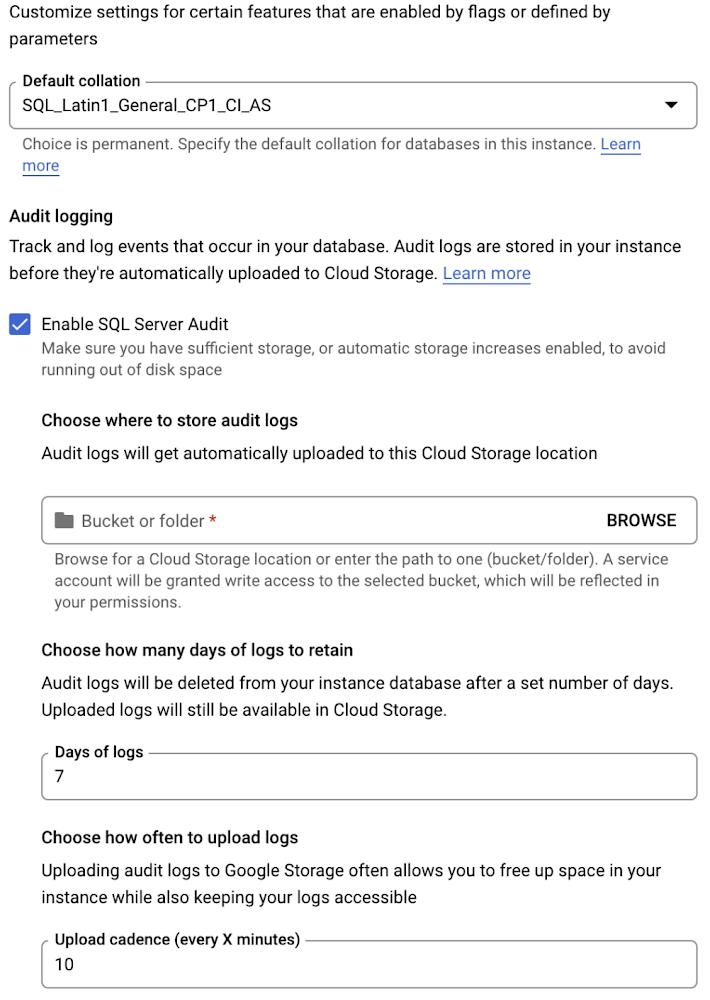
Cloud SQL for SQL Server is a fully-managed database service that allows you to run SQL Server in the cloud and let Google take care of the toil. In the past year, we’ve launched features that help you get the most out of SQL Server, like support for Active Directory authentication, SQL Server 2019, and Cross Region Replicas. We’re happy to add another SQL Server security feature: database auditing. Database auditing allows you to monitor changes to your SQL Server databases, like database creations, data inserts, or table deletions. Cloud SQL writes audit logs generated by SQL Server to the local disk and to Google Cloud Storage. You can specify how long logs should be stored on the instance – for up to seven days – and use a SQL Server function to inspect logs. Cloud SQL will also automatically write all audit files to a Google Cloud Storage bucket that you manage, so you can decide how long to retain these records if you need them for longer than seven days, or consolidate them with audit files from other SQL Server instances. To enable database auditing, go to the Google Cloud console, select your Cloud SQL for SQL Server instance, and select Edit from the Overview page. You can also enable SQL Server Audit when you create a new Cloud SQL instance:Once you’ve enabled auditing for your Cloud SQL for SQL Server instance, you can create SQL Server audits and audit specifications, which determine what information will be tracked on your databases. You can capture granular information about operations performed on your databases, including, for example, every time a login succeeds or fails. If you want to capture different information for each of your databases, you can create different audit specifications for each database on your instance, or you can create server-level audit specifications to track changes across all databases. SQL Server auditing is now available for all Cloud SQL for SQL Server instances. Learn more about how to get started with this feature today!Related ArticleCloud SQL for SQL Server: Database administration best practicesCloud SQL for SQL Server is a fully-managed relational database service that makes it easy to set up, maintain, manage, and administer SQ…Read Article
Quelle: Google Cloud Platform






