Amazon WorkSpaces Web ist jetzt in den Regionen Asien-Pazifik (Mumbai), Asien-Pazifik (Singapur), Asien-Pazifik (Sydney) und Asien-Pazifik (Tokio) verfügbar

Amazon WorkSpaces Web ist nun allgemein in den AWS-Regionen Asien-Pazifik (Mumbai), Asien-Pazifik (Singapur), Asien-Pazifik (Sydney) und Asien-Pazifik (Tokio) verfügbar. Die Erstellung eines WorkSpaces-Webportals in einer lokalen Region stellt eine reaktionsstärkere Erfahrung für Benutzer beim Streamen von Web-Inhalten sicher. Ebenfalls ermöglicht es Kunden, örtliche Datenresidenzanforderungen zu erfüllen. WorkSpaces Web ist nun insgesamt in 7 Regionen verfügbar.
Quelle: aws.amazon.com

Die neuen automatisierten Performance-Einstellungen von Amazon EBS Elastic Volumes machen das Modifizieren von Volumes und Sparen von Kosten noch leichter

Wenn sich Ihre Anwendung ändern muss, gestattet Ihnen Amazon EBS Elastic Volumes leicht, die Kapazität zu steigern, die Performance abzustimmen und die Art von Amazon EBS-Volumes zu ändern. Kunden verwenden EBS Elastic Volumes zur Migration zu gp3-Volumes und sparen bis zu 20 % pro GB im Vergleich zu gp2-Volumes.
Quelle: aws.amazon.com

Amazon Redshift gibt Open-Source-ODBC-Treiber mit Binärprotokoll-Support und verbesserter Leistung bekannt

Der ODBC-Treiber von Amazon Redshift ist jetzt Open Source und steht der Benutzergemeinschaft unter der Apache-2.0-Lizenz zur Verfügung. Mit dieser Version erhalten Kunden einen besseren Einblick in die Treiber-Implementierung und können zu deren Entwicklung beitragen. Benutzer können den Code für beide ODBC-Treiber in dem entsprechenden AWS-GitHub-Repository durchsuchen, Erweiterungen der Treiberfunktionalität über Github-Pull-Anforderungen einreichen und Probleme zur Überprüfung melden.
Quelle: aws.amazon.com

The next generation of Dataflow: Dataflow Prime, Dataflow Go, and Dataflow ML

By the end of 2024, 75% of enterprises will shift from piloting to operationalizing artificial intelligence according to IDC, yet the growing complexity of data types, heterogeneous data stacks and programming languages make this a challenge for all data engineers. With the current economic climate, doing more with cheaper costs and higher efficiency have also become a key consideration for many organizations.Today, we are pleased to announce three major releases that bring the power of Google Cloud’s Dataflow to more developers for expanded use cases and higher data processing workloads, while keeping the costs low, as part of our goal to democratize the power of big data, real time streaming, and ML/AI for all developers, everywhere.The three big Dataflow releases we’re thrilled to announce in general availability are:Dataflow Prime – Dataflow Prime takes the serverless, no-operation benefits of Dataflow to a totally new level.  Dataflow Prime allows users to take advantage of both horizontal autoscaling (more machines) and vertical autoscaling (larger machines with more memory) automatically for your streaming data processing workloads, with batch coming in the near future.  With Dataflow Prime, pipelines are more efficient, enabling you to apply the insights in real time.  Dataflow Go  – Dataflow Go provides native support for Go, a rapidly growing programming language thanks to its flexibility, ease of use and differentiated concepts, for both batch and streaming data processing workloads. With Apache Beam’s unique multi-language model, Dataflow Go pipelines can leverage the well adopted, best-in-class performance provided by the wide range of Java I/O connectors with ML transforms and I/O connectors from Python coming soon.  Dataflow ML – Speaking of ML transforms, Dataflow now has added out of the box support for running PyTorch and scikit-learn models directly within the pipeline. The new RunInference transform enables simplicity by allowing models to be used in production pipelines with very little code. These features are in addition to Dataflow’s existing ML capabilities such as GPU support and the pre and post processing system for ML training, either directly or via frameworks such as Tensorflow Extended (TFX).We’re so excited to make Dataflow even better.  With the world’s only truly unified batch and streaming data processing model provided by Apache Beam, the wide support for ML frameworks, and the unique cross-language capabilities of the Beam model, Dataflow is becoming ever easier, faster, and more accessible for all data processing needs.Getting startedTo get started with Dataflow Go easily, see the Quickstart and download the Go SDK.To learn more about Dataflow Prime, see the documentation. To learn more about Dataflow ML and RunInference, read about the new RunInference Beam transform on the Apache Beam website.Interested in running a proof of concept using your own data? Talk to your Google Cloud sales contact for hands-on workshop opportunities or sign up here.Related ArticleDataflow Prime: bring unparalleled efficiency and radical simplicity to big data processingCreate even better data pipelines with Dataflow Prime, coming to Preview in Q3 2021.Read Article
Quelle: Google Cloud Platform

Streamline data management and governance with the unification of Data Catalog and Dataplex

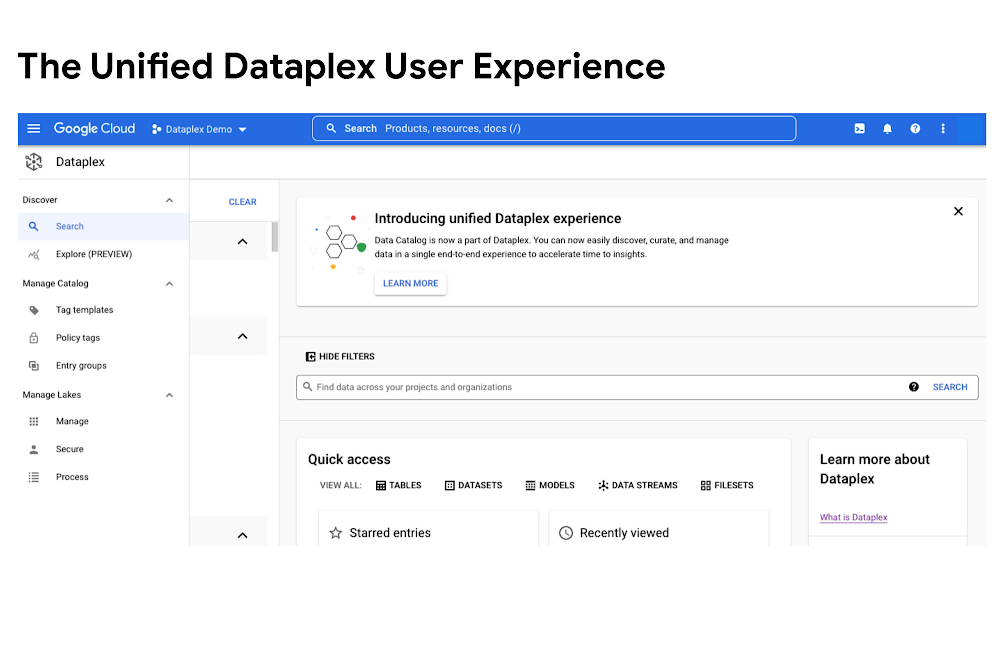
Today, we are excited to announce that Google Cloud Data Catalog will be unified with Dataplex into a single user interface. With this unification, customers have a single experience to search and discover their data, enrich it with relevant business context, organize it by logical data domains, and centrally govern and monitor their distributed data with built-in data intelligence and automation capabilities. Customers now have access to an integrated metadata platform that connects technical and operational metadata with business metadata, and then uses this augmented and active metadata to drive intelligent data management and governance. The enterprise data landscape is becoming increasingly diverse and distributed with data across multiple storage systems, each having its own way of handling metadata, security, and governance. This creates a tremendous amount of operational complexity, and thus, generates strong market demand for a metadata platform that can power consistent operations across distributed data.Dataplex provides a data fabric to automate data management, governance, discovery, and exploration across distributed data at scale. With Dataplex, enterprises can easily organize their data into data domains, delegate ownership, usage, and sharing of data to data owners who have the right business context, while still maintaining a single pane of glass to consistently monitor and govern data across various data domains in their organization. Prior to this unification, data owners, stewards and governors had to use two different interfaces – Dataplex to organize, manage, and govern their data, and Data Catalog to discover, understand, and enrich their data. Now with this unification, we are creating a single coherent user experience where customers can now automatically discover and catalog all the data they own, understand data lineage, check for data quality, augment that metadata with relevant business context, organize data into business domains, and then use that combined metadata to power data management. Together we provide an integrated experience that serves the full spectrum of data governance needs in an organization, enabling data management at scale.“With Data Catalog now being part of Dataplex, we get a unified, simplified, and streamlined experience to effectively discover and govern our data, which enables team productivity and analytics agility for our organization. We can now use a single experience to search and discover data with relevant business context, organize and govern this data based on business domains, and enable access to trusted data for analytics and data science – all within the same platform.” saidElton Martins, Senior Director of Data Engineering at Loblaw Companies Limited.Getting startedExisting Data Catalog and Dataplex customers and new customers can now start using Dataplex for metadata discovery, management and governance. Please note that while the user experience interface is unified via this release, all existing APIs and feature functionalities of both products will continue to work as before. To learn more, please refer to technical documentations or contact the Google Cloud sales team.Related ArticleScalable Python on BigQuery using Dask and NVIDIA GPUsTo accelerate data analytics and machine learning workflows, we introduce the Dask BigQuery connector to read data through BigQuery stora…Read Article
Quelle: Google Cloud Platform