Windows 11 22H2: Microsoft bestätigt langsames Kopieren von Dateien
Nach dem Update auf Windows 11 22H2 kann es länger dauern, wenn vor allem große Dateien kopiert werden. (Windows 11, Microsoft)
Quelle: Golem

Nach dem Update auf Windows 11 22H2 kann es länger dauern, wenn vor allem große Dateien kopiert werden. (Windows 11, Microsoft)
Quelle: Golem

Offenbar bestehen enge Kontakte zwischen der Cybersicherheits-Firma Protelion, einem dubiosen Cyber-Sicherheitsrat und russischen Geheimdiensten. (BSI, Internet)
Quelle: Golem

Das EU-Parlament will über mögliche Strafen für EU-Mitgliedsländer beraten, in denen der Aufbau der E-Auto-Ladenetzstruktur behindert wird. (Ladesäule, Technologie)
Quelle: Golem

Die elektrische Limousine ET7 von Nio lässt sich vorerst nur im Abo nutzen. Der Preis liegt deutlich niedriger als beim Mercedes-Benz EQE. (Elektroauto, Technologie)
Quelle: Golem

Horwin hat auf der Messe Intermot 2022 mit den Modellen SK1 und HT5 seine Produktpalette von Elektromotorrädern erweitert. (Elektromotorrad, Technologie)
Quelle: Golem

Die Rolle des BSI soll laut der Cybersicherheitsagenda gestärkt werden. Ob dafür auch Personal aufgestockt werden soll, ist noch nicht klar. Ein Bericht von Ulrich Hottelet (BSI, Internet)
Quelle: Golem

Netzwerke gab es schon immer, das Internet forciert sie. Die Dokumentation Networld sieht sich diese Netzwerke aus unterschiedlichsten Perspektiven an. Von Peter Osteried (Audio/Video, Internet)
Quelle: Golem
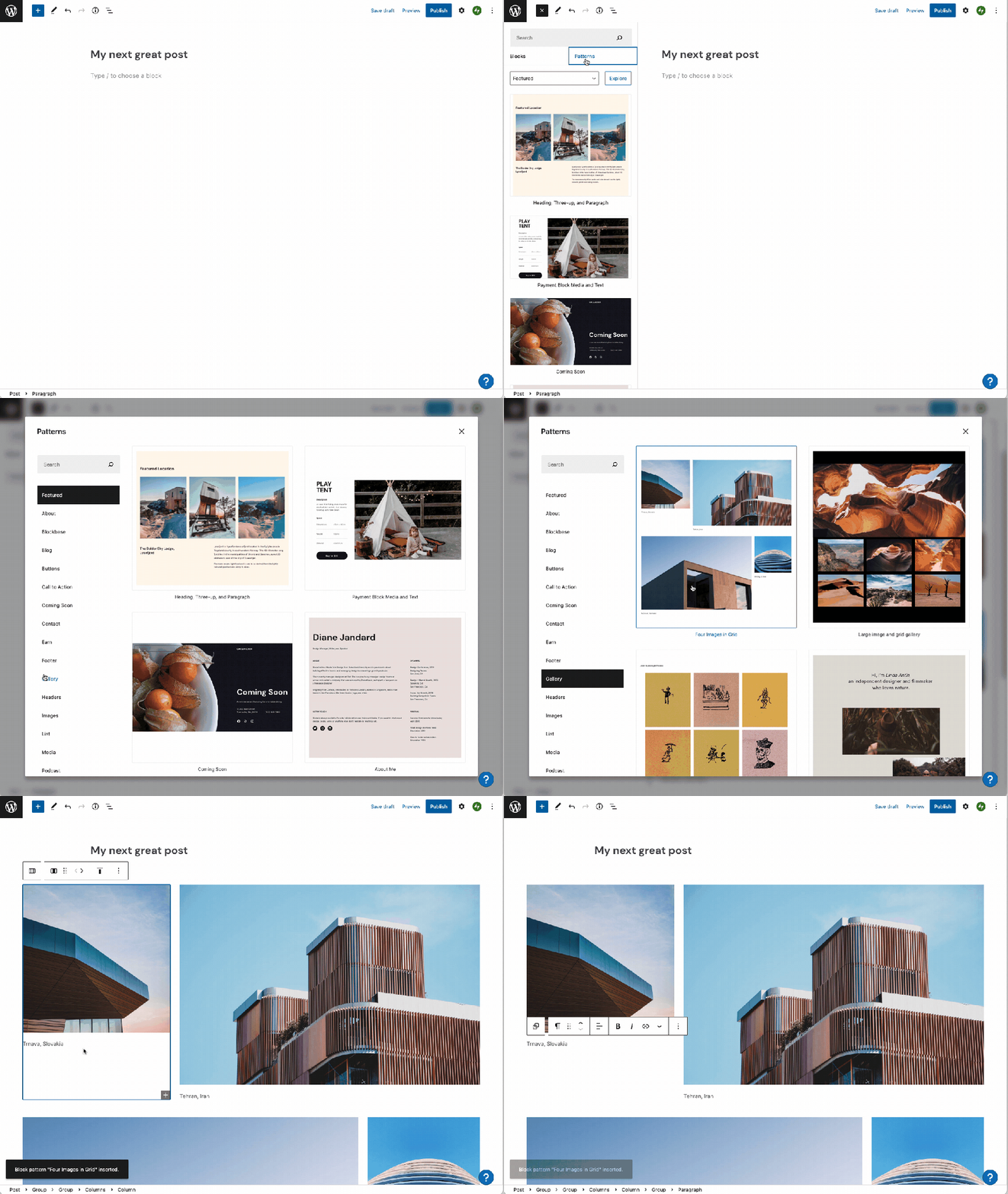
Have you used Patterns on your site yet?
These prebuilt, customizable templates combine professionally-designed blocks for specific uses like stylized quotes, contact page layouts, and product listings. But that’s just the beginning. All told, we have more than 260 Patterns you can insert into your pages and posts at the press of a button.
If you’ve never used Patterns before, they’re like any other site element: Access them by hitting the “+” button at the top left of the page or post you’re working on, then selecting the “Patterns” tab. You can also click on the “Explore” button to bring up our entire library of Patterns, organized by category.
Think of them as sophisticated slices of web design for your posts and pages. You can drop them in as-is, or customize them to your liking. Even better, we’re adding more all the time.
Here are just a few of the most recent arrivals to the Pattern library.
Headers and Footers
One of the most common questions our Happiness Engineers hear from users is how to customize a site’s header and footer areas. One way to easily and efficiently do that? Patterns. Note: Be sure to add these patterns to your header and footer template parts, which are found in the Site Editor (Appearance → Editor). A single update or change here will apply across all pages.
Find these and more in the “Header” and “Footer” categories.
Link in Bio Patterns
We’ve added a number of stunning Patterns for your link-in-bio pages and sites. Pick one, customize as desired, add your links, and you’ve got a brand new way to let your readers know what’s new.
Explore All of Our Patterns!
Even if you don’t have a specific need in mind, take a look around the full Patterns library. Galleries, contact pages, subscribe boxes, quotes: with so many options, you’re sure to find something that adds a fresh new wrinkle to your site.
Patterns can be an incredibly useful resource for your design toolbox. Customize, experiment, and turn inspiration into eye-catching reality.
If you need help with Patterns, check out our more detailed guide.
And be sure to let us know in the comments how you’ve used Patterns on your site and any ideas you have for new ones. We’re always working on more — so stay tuned!
Quelle: RedHat Stack
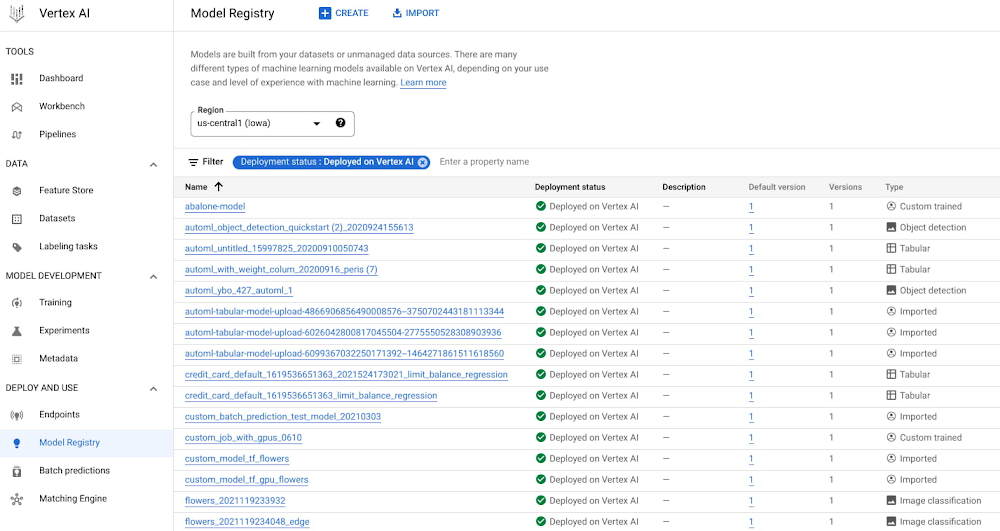
Machine learning (ML) is iterative in nature — model improvement is a necessity to drive the best business outcomes. Yet, with the proliferation of model artifacts, it can be difficult to ensure that only the best models make it into production.Data science teams may get access to new training data, expand the scope of use cases, implement better model architectures, or simply make adjustments as the world around your models is constantly changing. All of these scenarios require building new versions of models to be released into production. And with the addition of new versions, it matters to be able to manage, compare, and organize them. Moreover, without a central place to manage your models at scale, it’s difficult to govern model deployment with appropriate gates on release and maintenance according to compliance to industry standards and regulations. To address these challenges, today we are excited to announce the Global Availability (GA) launch of the Vertex AI Model Registry.Fig. 1 – Vertex AI Model Registry – Landing pageWith the Vertex AI Model Registry, you have a central place to manage and govern the deployment of all of your models, including BigQuery, AutoML and custom models. You can use the Vertex AI Model Registry at no charge. The only cost that occurs when using the registry is if you deploy any of your models to endpoints or if you run a batch prediction.Vertex AI Model Registry offers key benefits to build a streamlined MLOps process: Version control and ML metadata tracking to guarantee reproducibility across different model versions over time. Integrated model evaluation to validate and understand new models using evaluation and explainability metrics. Simplified model validation to enhance model release.Easy deploymentto streamline models to production. Unified model reporting to ensure model performanceVersion control and ML metadata tracking to guarantee model reproducibilityVertex AI Model Registry allows you to simplify model versioning and track all model metadata to guarantee reproducibility over time. With the Vertex AI SDK, you can register custom models, all AutoML models (text, tabular, image, and video), and BQML models. You can also register models that you trained outside of Vertex AI by importing them to the registry.Fig. 2 – Vertex AI Model Registry – Versioning viewIn Vertex AI Model Registry, you can organize, label, evaluate, and version models. The registry gives you a wealth of model information at your fingertips, such as model version description, model type, and model deployment status. You can also associate additional information such as the team who built a particular version or the application the model is serving.In the end, you can get a single picture of your models and all of their versions using the Model Registry console. You can drill down and get all the information about a specific model and its associated versions so you can guarantee reproducibility across different model versions over time. Integrated model evaluation to ensure model quality Thanks to the integration with the new Vertex AI Model Evaluation service, you can now validate and understand your model versions using evaluation and explainability metrics. This integration allows you to quickly identify the best model version and audit the quality of the model before deploying it in production. For each model version, the Vertex AI Model Registry console shows classification, regression, and forecasting metrics depending on the type of model.Fig. 3 – Vertex AI Model Registry – Model Evaluation viewSimplified model validation to improve model release. In an MLOps environment, automation is critical for ensuring that the correct model version is used consistently across all downstream systems. As you scale your deployments and expand the scope of your use cases, your team will need solid infrastructure for flagging that a particular model version is ready for production.In Vertex AI Model Registry, aliases are uniquely named references to a specific model version. When you register a new model, the first version automatically gets assigned the default alias. Then you can create and assign custom aliases to your models depending on how you decide to organize your model lifecycle. An example of model alias usage would be assigning the stage of the reviewing process (not started, in progress, under review, approved) or the status of the model life cycle (experimental, staging, or production).Fig. 4 – Vertex AI Model Registry – Aliases viewIn this way, the Model Registry simplifies the entire model validation process by making it easy for downstream services, such as model deployment pipelines or model serving infrastructure, to automatically fetch the right model.Easy deployment to streamline models to productionAfter a model has been trained, registered, and validated, the model is ready to be deployed. With Vertex AI Model Registry, you can easily productionalize all of your models (BigQuery models included) with point-and-click model deployment thanks to the integration with Vertex AI Endpoints and Vertex AI Batch Predictions. In the Vertex AI Model Registry console, you select the approved model version, you define the endpoint and you specify some model deployment and model monitoring settings. Then you deploy the model. After the model has been successfully deployed, you can see that the model status is automatically updated in the models view and it is ready to generate both online and batch predictions.Fig. 5 – Vertex AI Model Registry – Model DeploymentUnified model reporting to ensure model performanceA deployed model keeps performing if the input data remains similar to the training data. But realistically, data changes over time and the model performance degrades. This is why model retraining is so important. Typically, models are retrained at regular intervals, but ideally models should be continuously evaluated with new data before making any retraining decisions. With the integration of Vertex AI Model Evaluation, now in preview, after you deploy your model, you define a test dataset and an evaluation configuration as inputs. In turn, it returns model performance and fairness metrics directly in the Vertex AI Model Registry console. Looking at those metrics you can determine when the model needs to be retrained based on the data you record in production. These are important capabilities for model governance, ensuring that only the freshest, most accurate models are used to drive your business forward.Fig. 6 – Vertex AI Model Registry – Model Evaluation comparison viewConclusion The Vertex AI Model Registry is a step forward for model management in Vertex AI. It provides a seamless user interface which shows you all of the models that matter most to you free of charge, and at-a-glance metadata to help you make business decisions.In addition to a central repository where you can manage the lifecycle of your ML models, it introduces new ways to work with models you’ve trained outside of Vertex AI, like your BQML models. It also provides model comparison functionality via the integration with our Model Evaluation service, which makes it easy to ensure that only the best and freshest models are deployed. Additionally, this one stop view improves governance and communication across all stakeholders involved in the model training and deployment process. With all these benefits of the Vertex AI Model Registry, you can confidently move your best models to production faster. Want to learn more?To learn more about the Vertex AI Model Registry, please visit our other resources:Vertex AI Model Registry DocumentationBQML Model Registry Documentation Vertex AI Model Evaluation Documentation Want to dive right in? Check out some of our Notebooks, where you can get hands-on practice: Get started with Vertex AI Model RegistryGet started with Model Governance with Vertex AI Model RegistryDeploy BigQuery ML Model on Vertex AI Model Registry and Make PredictionsGet started with Vertex AI Model EvaluationSpecial thanks to Ethan Bao, Shangjie Chen, Marton Balint, Phani Kolli, Andrew Ferlitch, Katie O’Leary, and all the Vertex AI Model Registry team for support and great feedback.Related ArticleRead Article
Quelle: Google Cloud Platform

Editor’s note: The post is part of a series highlighting our awesome partners, and their solutions, that are Built with BigQuery.What are Customer Data Platforms (CDPs) and why do we need them?Today, customers utilize a wide array of devices when interacting with a brand. As an example, think about the last time you bought a shirt. You may start with a search on your phone as you take the subway to work. During that 20 minute ride, you narrow down the type of shirt . Later, as you take your lunch break, you spend a few more minutes refining your search on your work laptop and you are able to find two shirt models of interest. Pressed for time, you add both to your shopping cart at an online retailer to review at a later point. Finally, after you arrive back home and as you are checking your physical mail, you stumble across a sales advertisement for the type of shirt that you are looking for, available at your local brick and mortar store. The next day you visit that store during your lunch break and purchase the shirt. Many marketers face the challenge of creating a consistent 360 customer view that captures the customer lifecycle, as illustrated in the example above – including their online/offline journey, interacting with multiple data points across multiple data sources.The evolution of managing customer data reached a turning point in the late 90’s with CRM software that sought to match current and potential customers with their interactions. Later as a backbone of data-driven marketing, Data Management Platforms (DMPs) expanded the reach of data management to include second and third party datasets including anonymous IDs. A Customer Data Platform combines these two types of systems, creating a unified, persistent customer view across channels (mobile, web etc) that provide data visibility and granularity at individual level.A new approach to empowering marketing heroesTinyclues is a company that specializes in empowering marketers to drive sustainable engagement from their customers and generate additional revenue, without damaging customer equity. The company was founded in 2010 on a simple hunch: B2C marketing databases contain sufficient amounts of implicit information (data unrelated to explicit actions) to transform the way marketers interact with customers, and a new class of algorithms based on Deep Learning (sophisticated machine learning that mimics the way humans learn) holds the power to unlock this data’s potential. Where other players in the space have historically relied – and continue to rely – on a handful of explicit past behaviors and more than a handful of assumptions, Tinyclues’ predictive engine uses all of the customer data that marketers have available in order to formulate deeply precise models, down even to the SKU level. Tinyclues’ algorithms are designed to detect changes in consumption patterns in real-time, and adapt predictions accordingly.This technology allows marketers to find precisely the right audiences for any offer during any timeframe, increasing engagement with those offers and, ultimately, revenue; additionally, marketers are able to increase campaign volume while decreasing customer fatigue and opt-outs, knowing that audiences are receiving only the most relevant messages. Tinyclues’ technology also reduces time spent building and planning campaigns by upwards of 80%, as valuable internal resources can be diverted away from manual audience-building.Google Cloud’s Data Platform, spearheaded by BigQuery, provides a serverless, highly scalable, and cost-effective foundation to build this next generation of CDPs. Tinyclues Architecture:To enable this scalable solution for clients, Tinyclues receives purchase and interaction logs from clients in addition to product and user tables. In most cases, this data is already in the client’s BigQuery instance, in which case they can be easily shared with Tinyclues utilizing BigQuery authorized views. In cases where the data is not in BigQuery, flat files are sent to Tinyclues via GCS and are ingested in the client’s data set via a lightweight Cloud Function. The orchestration of all pipelines is implemented via Cloud Composer (Google’s managed Airflow). The transformation of data is accomplished by utilizing simple select statements in the Data Built Tool (DBT), which is wrapped inside an airflow DAG that powers all data normalization and transformations. There are several other DAGs to fulfill more functionalities, including: Indexing the product catalog on Elastic Cloud (Elasticsearch managed service) on GCP to provide auto-complete search capabilities to TCs clients as shown below:The export of Tinyclues-powered audiences to the clients’ activation channels, whether they are using SFMC, Braze, Adobe, GMP, or Meta.Tinyclues AI/ML Pipeline powered by Google Vertex AITCs ML Training pipelines are used to train models that calculate propensity scores. They are composed using Airflow DAGs, powered by Tensorflow & Vertex AI Pipelines. BigQuery is used natively, without data movement, to perform as much feature engineering as possible in-place. TC uses the TFX library to run ML Pipelines in Vertex AI. Building on top of Tensorflow as their main deep learning framework of choice due to its maturity, open source platform, scalability and support for complex data structures (Ragged and Sparse Tensors). Below is a partial example of TC’s Vertex AI Pipeline graph, illustrating the workflow steps in the training pipeline. This pipeline allows for the modularization & standardization of functionality into easily manageable building blocks. These blocks are composed of TFX components (TC reuses most of the standard components in addition to customizing some such as a proprietary implementation of the Evaluator to compute both ML Metrics (which is part of the standard implementation) but also more Business Metrics like Overlap of clickers etc. The individual components/steps are chained with DSL to form a pipeline that is modular and easily orchestrated or updated as needed.With the trained Tensorflow models available in GCS, TCs exposes these in BigQuery ML (BQML) to enable their clients to score millions of users for their propensity to buy X or Y within minutes. This would not be possible without the power of BigQuery and also frees TC from previously experienced scalability issues.As an illustration, TC has the need to score thousands of topics among millions of users. This used to take north of 20 hours on their previous stack, and now takes less than 20 minutes thanks to the optimization work that TC has implemented in their custom algorithm and the sheer power of BQ to scale to any workload accordingly. Data Gravity: Breaking the Paradigm – Bringing the Model to your DataBQML enables TC to call pre-trained TensorFlow models within an SQL environment, thus avoiding exporting data in and out of BQ using already provisioned BQ serverless processing power. Using BQML removes the layers between the models and the data warehouse and allows them to express the entire inference pipe as a number of SQL requests. TC no longer has to export data to load it into their models. Instead, they are bringing their models to the data.Avoiding the export of data in and out of BQ and the serverless provisioning and start of machines saves significant time. As an example, exporting an 11M lines campaign for a large client previously took 15 min or more to process. Deployed on BQML it now takes minutes with more than half of the processing time attributed to network transfers to our client system. Inference times in BQML compared to TCs legacy stack:As can be seen, using this approach enabled by BQML, the reduction in the number of steps leads to a 50% decrease in overall inference time, improving upon each step of the prediction.The Proof is in the puddingTinyclues has consistently delivered on its promises of increased autonomy for CRM teams, rapid audience building, superior performance against in-house segmentation, identification of untapped messaging and revenue opportunities, fatigue management, and more, working with partners like Tiffany & Co, Rakuten, and Samsung, among many others.ConclusionGoogle’s data cloud provides a complete platform for building data-driven applications like the headless CDP solution developed by Tinyclues — from simplified data ingestion, processing, and storage to powerful analytics, AI, ML, and data sharing capabilities — all integrated with the open, secure, and sustainable Google Cloud platform. With a diverse partner ecosystem, open-source tools, and APIs, Google Cloud can provide technology companies the portability and differentiators they need to serve the next generation of marketing customers. To learn more about Tinyclues on Google Cloud, visit Tinyclues. Click here to learn more about Google Cloud’s Built with BigQuery initiative. We thank the many Google Cloud team members who contributed to this ongoing data platform collaboration and review, especially Dr. Ali Arsanjani in Partner Engineering.Related ArticleRead Article
Quelle: Google Cloud Platform






