Legged Metamachines: Roboter läuft auch weiter, wenn Glieder abgehackt werden
Forscher arbeiten an einem obskur anmutenden modularen Roboter. Der funktioniert mit zwei, drei oder mehr Beinen. (Roboter, KI)
Quelle: Golem

Forscher arbeiten an einem obskur anmutenden modularen Roboter. Der funktioniert mit zwei, drei oder mehr Beinen. (Roboter, KI)
Quelle: Golem

Wir haben das ZX-Team getroffen und sprechen im Podcast über Geschichte und Zukunft des kleinen Sinclair. (Besser Wissen, Unterhaltung & Hobby)
Quelle: Golem

Der Antrieb per Kernfusion soll mit weniger Treibstoff eine vielfache Beschleunigung erreichen. Bereits 2027 sollen Tests im Orbit stattfinden. (Rakete, Mars)
Quelle: Golem
The world is racing to meet a historic surge in power demand with an infrastructure pipeline built for the analog age. Driven by the exponential expansion of digital technologies and the reindustrialization of supply chains, the mandate for always-on, carbon-free power is urgent and absolute. Nuclear energy is the essential backbone for this future, but the industry remains trapped in a delivery bottleneck. Before a shovel even hits the dirt, critical projects are slowed by highly customized engineering, fragmented data, and mountains of manual regulatory review.
Drive innovation to power a secure and sustainable futureThat is where AI comes in. To break the infrastructure bottleneck and shift the industry from ambition to delivery, Microsoft is announcing an AI for nuclear collaboration with NVIDIA, to provide end-to-end tools that streamline permitting, accelerate design, and optimize operations across the industry.
This set of technologies brings disciplined engineering to the entire lifecycle of a nuclear plant—spanning site permitting, design, construction, and continuous operations. By enabling these capabilities within a connected, AI-powered foundation, we are empowering energy developers to make highly complex work repeatable, traceable, secure, and predictable—slashing development timelines and eliminating rework without sacrificing safety.
PausedThe digital foundation for nuclear at scaleThe only thing that may be more complex than building a nuclear plant is designing and permitting one. Permitting alone can take years, cost hundreds of millions of dollars, and involve an immense amount of data processing and reporting. It’s not a lack of need, knowledge, or even willingness that’s holding development back, but rather the inability to progress efficiently and consistently through rigorous permitting and development processes.
Engineers can spend thousands of hours drafting, cross-referencing, formatting, searching, reviewing, and reworking materials. They have to identify and fix inconsistencies across tens of thousands of pages. It is little wonder that plants have been notorious for construction delays and cost overruns.
To break this infrastructure bottleneck, we need to move away from highly customized engineering towards repeatable, reference-based delivery—while maintaining regulatory standards and engineering accountability.
With AI, we can identify tiny documentation inconsistencies and resolve them quickly. By unifying data and simulation across the lifecycle, we ensure complex work remains:
Traceable: Every engineering decision is digitally linked to the evidence and regulations that back it up.Audit-Ready: The system keeps a perfect “paper trail,” ensuring that regulators can verify safety instantly.Secure: High-level intelligence is applied within a governed, protected environment.Predictable: High-fidelity simulations map time and cost, catching delays before they happen in the real world.This isn’t just about speed; it’s about trust. Engineers and regulators are freed to focus on what matters most: building a safe, secure, high-capacity, carbon-free power source that’s on-time and on-budget.
Here is how AI and Digital Twins can carry a project from the initial phases to efficient operations:
Design and engineering: Digital Twins and high-fidelity simulations enable faster iteration. Engineers can reuse proven patterns and instantly see how a tiny design change impacts the entire model, creating a validated plan before breaking ground.Licensing and permitting: Generative AI handles the heavy lifting of document drafting and gap analysis. It unifies all project information, ensuring comprehensive applications aligned with historical permits. This allows expert regulators to focus their time on safety judgments rather than reconciling thousands of pages of text.Construction and delivery: While traditional 3D models only map physical space, 4D (time scheduling) and 5D (cost tracking) simulations can virtually construct the plant before shovels hit the dirt. AI and Digital Twins allow developers to track physical progress against the digital plan in real-time, catching potential delays and preventing the schedule collisions that lead to expensive rework.Operations and maintenance: AI-powered sensors and operational digital twins detect anomalies early, ensuring higher uptime and predictive maintenance that keeps the grid stable with human operators firmly in control.By unifying data, traceability, and simulation across phases, AI accelerates design validation with high-fidelity 3D models and Digital Twins, improves licensing consistency through AI-assisted document workflows, and connects design assumptions to operational performance—giving operators, regulators, and stakeholders clearer, continuous visibility.
Accelerating delivery: How Aalo Atomics, Idaho National Labs, and Southern Nuclear are deploying AI for nuclearThe proof is in the progress. Our collaboration is already changing the pace of nuclear delivery.
Aalo AtomicsAalo Atomics has reduced the time-intensive permitting process by 92% using the Microsoft Generative AI for Permitting solution, saving an estimated $80 million a year. For Aalo, the value of the Microsoft and NVIDIA collaboration isn’t just speed—it’s confidence.
“Two things matter most: enterprise-scale complexity and mission-critical reliability. We’re deploying something complex at a scale only a company like Microsoft really understands. There’s no room for anything less than proven reliability.”
—Yasir Arafat, Chief Technology Officer, Aalo Atomics
PausedSouthern NuclearSouthern Nuclear has developed and deployed agents using Microsoft Copilot across its fleet, including engineering and licensing, to improve consistency, reuse knowledge faster, and support better decision-making in key workstreams.
Idaho National LaboratoryWhen it comes to the public sector and specifically United States Federal, Idaho National Laboratory (INL) has become an early adopter of AI for nuclear technology. By using the AI capabilities to automate the assembly of complex engineering and safety analysis reports, INL is streamlining the review process and creating standard methodologies for regulators to adopt these tools safely, further speeding deployment.
Expanding the ecosystem: How Everstar and Atomic Canyon are operationalizing AI for nuclear on Microsoft AzureMicrosoft is actively expanding this secure ecosystem. Everstar—an NVIDIA Inception startup—brings domain-specific AI for nuclear to Azure to modernize how the industry manages project workflows and governed data pipelines.
“The nuclear industry has been bottlenecked by documentation burden and regulatory complexity for decades. This partnership means our customers get the secure, scalable cloud deployments they demand. It’s a significant step toward making nuclear power fast, safe, and unstoppable.”
—Kevin Kong, Chief Executive Officer, Everstar
We are also excited to highlight Atomic Canyon, whose Neutron platform is now available in the Microsoft Marketplace, allowing nuclear developers to deploy these capabilities with consistency and control through trusted procurement pathways.
Progress at the pace this moment requiresAI is enabling the energy industry to deliver more power, faster, and safely. This Microsoft and NVIDIA collaboration provides the path to do exactly that for advanced developers, owners, and operators. By turning fragmented, high-variance workflows into governed, auditable systems, we can compress timelines without compromising rigor. By unifying data, simulation, and evidence across design, permitting, construction, and operations, we are accelerating the deployment of firm, carbon-free power while strengthening regulatory confidence and operational resilience.
The AI for nuclear operations collaboration brings together NVIDIA Omniverse, NVIDIA Earth 2, NVIDIA CUDA-X, NVIDIA AI Enterprise, PhysicsNeMo, Isaac Sim, and Metropolis with Microsoft Generative AI for Permitting Solution Accelerator and Microsoft Planetary Computer to create a comprehensive, AI-powered digital ecosystem for nuclear energy on Azure.
Microsoft, NVIDIA, and Aalo Atomics will be presenting this AI-lead industry perspective at CERAWeek 2026 in a session entitled “A Digital Age for Nuclear: Aalo Atomics, NVIDIA, and Microsoft.”
Discover moreReady to move from ambition to delivery? See how the Microsoft and NVIDIA nuclear for AI collaboration can drive change within your organization.
Contact us to learn more.
The post AI for nuclear energy: Powering an intelligent, resilient future appeared first on Microsoft Azure Blog.
Quelle: Azure
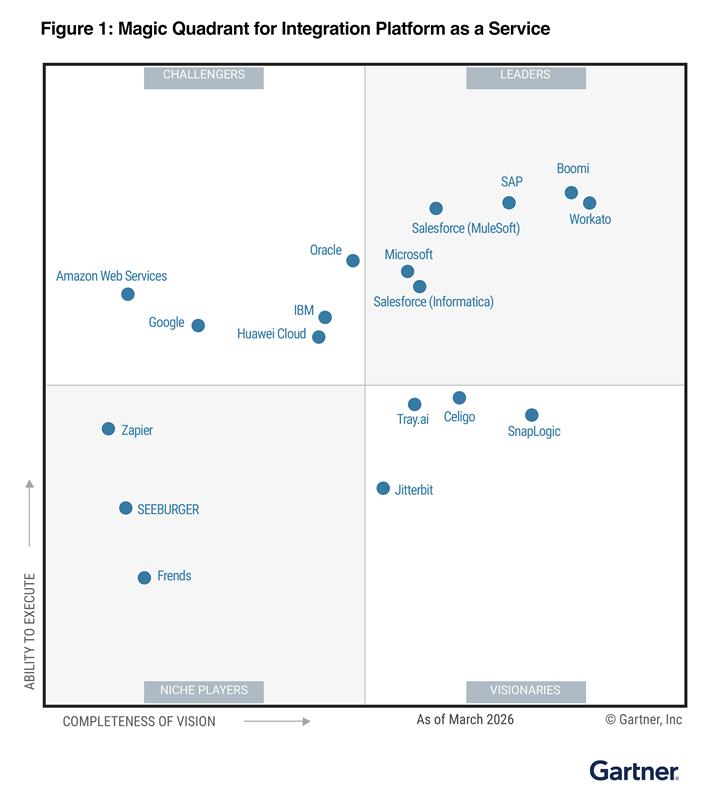
Enterprise digital transformation is entering a new phase. The challenge is no longer just connecting systems. It is about making those systems intelligent, able to reason, respond, and act in real time across the business.
As AI moves from experimentation into production, a clear pattern is emerging. Models and agents do not create value on their own. Value is created when AI can reliably access enterprise data, invoke APIs, trigger workflows, and operate within the guardrails of security, compliance, and governance. This makes integration essential to realizing AI value.
We are proud to share that Microsoft has been named a Leader in the 2026 Gartner® Magic Quadrant™ for Integration Platform as a Service, marking the eighth consecutive year of recognition. We believe this reflects both the strength of Azure Integration Services today and our conviction that integration must evolve to meet the demands of the AI era.
Read the full 2026 Gartner® Magic Quadrant™ for Integration Platform as a Service report
From integration to intelligent operations
For years, integration platforms have helped organizations connect applications and synchronize data. AI is changing what organizations expect from these platforms.
AI systems do not operate in isolation. They depend on APIs to take action, events to respond in real time, workflows to orchestrate decisions, and governance to ensure trust. Without strong integration, AI remains isolated.
This shift fundamentally redefines the role of integration.
Azure Integration Services provides a unified platform to connect applications, data, APIs, and events while operationalizing AI across the enterprise. This allows organizations to move beyond point-to-point connectivity and build systems that coordinate actions in real time.
Unify systems with the AI-powered Azure Integration Services
The rise of agentic workflows
As integration evolves, workflows are evolving with it.
Static, predefined automations are giving way to adaptive processes that combine APIs, real-time data, and AI-powered decisioning. This is driving the rise of agentic workflows, where AI agents and deterministic logic operate together within orchestrated systems.
With Azure Logic Apps, organizations can design workflows that incorporate AI agents alongside business rules. These workflows are context-aware, responsive, and continuously improving.
They can invoke models, integrate human approvals, react to real-time signals, and execute across distributed systems. The result is a shift from traditional automation to intelligent operations that adapt as conditions change.
AI at scale demands governance by design
As AI systems gain the ability to act, governance becomes non-negotiable.
AI can access sensitive data, call downstream systems, and trigger business actions at speed. Without strong controls, this introduces real risk across security, compliance, cost, and trust.
Azure Integration Services addresses this by embedding governance into how AI interacts with the enterprise. With AI Gateway capabilities in Azure API Management, organizations can define and enforce how AI systems access APIs, models, and data. This includes applying policies, managing usage, enforcing access controls, and ensuring AI-powered interactions comply with regulatory and organizational requirements.
This approach allows organizations to scale AI confidently while maintaining control.
From experimentation to real-world impact
Organizations are already using these capabilities to drive measurable outcomes.
In cybersecurity, Cyderes processes more than 10,000 security alerts each day. By combining AI-powered analysis with automated, integrated workflows, the team has reduced noise and transformed how investigations are handled. Investigation cycles are now five times faster, enabling analysts to focus on high-value signals while keeping pace with increasingly sophisticated, AI-powered cyberthreats.
In life sciences, Vertex Pharmaceuticals addressed the challenge of knowledge fragmented across dozens of systems, including ServiceNow, internal documentation, and training platforms. By orchestrating AI within integrated workflows, they built a solution that can search, summarize, and route information seamlessly across tools like Microsoft Teams and Outlook. Tasks that once took hours are now completed in minutes, improving productivity while maintaining compliance and supporting global teams.
Organizations are also applying these patterns to govern AI at scale. Access Group, for example, uses Azure API Management to govern how AI systems interact with enterprise APIs and services. By introducing centralized policies, access controls, and observability, they can securely expose capabilities to AI applications while maintaining control over usage, cost, and compliance. This approach ensures that AI-powered interactions remain consistent, auditable, and aligned with business requirements.
These examples reflect a broader shift. Integration is no longer just about connecting systems. It is enabling new ways of working, where AI is embedded directly into business processes and governed as part of the enterprise platform.
Looking ahead
Integration will play a central role as organizations scale their use of AI. As organizations adopt AI agents, event-driven architectures, and real-time decisioning, the ability to orchestrate and govern these interactions becomes increasingly important.
We are honored to be recognized as a Leader in the 2026 Gartner® Magic Quadrant™ for Integration Platform as a Service and look forward to helping customers build what comes next.
Ready to explore further?
Download your complimentary copy of the 2026 Gartner® Magic Quadrant™ for Integration Platform as a Service to learn why Microsoft was named a Leader.
Explore how Azure Integration Services helps organizations operationalize AI across applications, data, and workflows.
Gartner and Magic Quadrant are trademarks of Gartner, Inc. and/or its affiliates. Gartner does not endorse any company, vendor, product or service depicted in its publications, and does not advise technology users to select only those vendors with the highest ratings or other designation. Gartner publications consist of the opinions of Gartner’s business and technology insights organization and should not be construed as statements of fact. Gartner disclaims all warranties, expressed or implied, with respect to this publication, including any warranties of merchantability or fitness for a particular purpose.
The post Microsoft named a Leader in 2026 Gartner® Magic Quadrant™ for Integration Platform as a Service appeared first on Microsoft Azure Blog.
Quelle: Azure
Amazon OpenSearch Service extends access to Cluster Insights through the AWS Management Console, in addition to the existing OpenSearch UI Dashboards. This launch makes it easier to review performance and resilience recommendations and make necessary configuration changes, all within the same Console. In addition, Cluster Insights now publishes insights as events to Amazon EventBridge. Cluster insights presents curated insights of a cluster’s operational health along with actionable recommendations to help prevent issues before they affect the stability or performance of the cluster. You can continue to use OpenSearch UI Dashboards for more detailed metrics, including index and shard-level data and top-N query analysis. In addition, with this release, you can monitor insights through Amazon EventBridge events. Cluster Insights is available at no additional cost for OpenSearch versions 2.17 or later in all Regions where OpenSearch Service is available. View the complete list of supported Regions here. To learn more about Cluster Insights, refer to our technical documentation.
Quelle: aws.amazon.com
AWS Elemental MediaTailor is now available in the Europe (London) AWS Region. MediaTailor is a personalized ad insertion and channel assembly service that enables video providers to serve targeted ads in live and on-demand video streams using server-side ad insertion (SSAI) and Server Guided Ad Insertion (SGAI), delivering a broadcast-quality viewing experience without the buffering or ad blockers associated with client-side ad insertion. With this expansion, customers serving viewers in Northern Europe can now run ad insertion workloads closer to their audience, reducing ad decisioning latency and improving ad fill rates. Customers using SSAI or SGAI workflows benefit from lower-latency ad stitching and ad tracking closer to their European viewers, and customers already using MediaTailor in Europe (Ireland) gain an additional region for redundancy and increased capacity.
To learn more, visit the AWS Elemental MediaTailor product page or the AWS Elemental MediaTailor User Guide. To get started, sign into the AWS Elemental MediaTailor console.
Quelle: aws.amazon.com

“Nichts, aber auch gar nichts verstanden”: Tom Enders, Verwaltungsratschef des Rüstungskonzerns KNDS, ist entsetzt über Aussagen von Armin Papperger. (Drohne, Politik)
Quelle: Golem

Der Research-Agent für Copilot basiert weiterhin auf GPT, wird aber nun von Claude auf Genauigkeit, Vollständigkeit und Qualität geprüft. (Copilot, Microsoft)
Quelle: Golem

Amazon hat eine Wärmebildkamera fürs Handy im Angebot, die Temperaturunterschiede präzise erkennt und mit bis zu 512 x 384 Pixel darstellt. (Technik/Hardware)
Quelle: Golem






