WhatsApp Is Going To Start Sharing Your Account Information With Facebook

Patrick Sison / AP Photo

Global messaging service WhatsApp announced Thursday that it would begin sharing users’ account information with Facebook, which purchased the company for $19 billion in 2014.

The move, according to a WhatsApp blog post, is aimed at testing “ways for people to communicate with businesses in the months ahead.”

The company claims that it will continue to provide messaging services “without third-party banner ads and spam,” and that the change could allow users to hear from their bank about a potentially fraudulent transaction, or from an airline about a delayed flight.

WhatsApp maintains that messages sent via the app will continue to be encrypted, and will not be read by WhatsApp, Facebook, or anyone else.

“We won’t post or share your WhatsApp number with others, including on Facebook, and we still won&;t sell, share, or give your phone number to advertisers,” the blog post reads.

WhatsApp users will also have the option of declining the new policy, but they have to opt into it first.

“If you are an existing user, you can choose not to have your WhatsApp account information shared with Facebook to improve your Facebook ads and products experiences,” the company states on its legal page.

“Existing users who accept our updated Terms and Privacy Policy will have an additional 30 days to make this choice by going to Settings > Account.”

Why Facebook Had To Have WhatsApp

Quelle: <a href="WhatsApp Is Going To Start Sharing Your Account Information With Facebook“>BuzzFeed

An Afternoon In The Park With The Soylent CEO And A Star Of "Silicon Valley"

Josh Brener (left) with Soylent CEO Rob Rhinehart.

William Alden / Via BuzzFeed News

The press event could have been a scene from HBO’s Silicon Valley. At least, that&;s what the reporters who showed up were supposed to think, waiting for the CEO of Soylent in a Silicon Valley parking lot.

Rob Rhinehart, CEO and co-founder of the Los Angeles-based meal-replacement startup, arrived in a white truck emblazoned with the company’s logo, alongside the actor Josh Brener, who plays the character Nelson Bighetti, or Big Head, on Silicon Valley. The truck, too, was an inside joke: Cartoon Soylent trucks appear in the show&039;s opening credits, and Rhinehart said that inspired him to make one in real life.

The entrepreneur and actor were touring California’s actual Silicon Valley to pitch Soylent&039;s latest products, out this month: Coffiest, bottled nutrient sludge combined with coffee, and Food Bar, a caramel-flavored slab of soy protein, algal flour, and isomaltulose. By the time they pulled into the parking lot in Holbrook-Palmer Park, they had already visited eBay and Google X (officially known just as “X,” the “moonshot factory” of Google’s parent company, Alphabet), to hand out product samples and pose for selfies. Later that afternoon, they were scheduled to visit GoDaddy.

Rhinehart

William Alden / Via BuzzFeed News

If Rhinehart is among the weirdest CEOs in the tech world — he sells food whose brand alludes to dystopian sci-fi, he has blogged about getting rid of his fridge and giving up laundry, and he had a brush with the law this summer after installing a shipping container on a small piece of land he owns on an LA hilltop (as an “experiment” in housing) — then Brener is perhaps his perfect celebrity pitchman. The shaggy-haired actor approached the role of shill with a polished deadpan. You almost couldn&039;t tell whether he liked the product — or had even tried it.

“I don&039;t drink Coffiest, because caffeine makes me a monster, but Food Bar is delicious,” Brener, 31, said. “I had it for breakfast and will probably have it for the rest of the meals for my entire life.”

Later, he took a sip of the caffeinated goop. “That&039;s really friggin&039; good&;” he said. “I shouldn&039;t sound so surprised.”

“Everyone expects it to be bad,” Rhinehart replied.

At another point, the slightly built Brener said, “I like to use Soylent as a post-gym recovery drink. It gives me the protein I need to bulk up.”

Brener.

William Alden / Via BuzzFeed News

Silicon Valley has its finger on the pulse,” Brener said. “Soylent is coursing through the veins of this great township.”

This reporter&039;s attempts to ask normal questions — Is Soylent paying you? How much? — were futile. Rhinehart and Brener, who wore Soylent windbreakers that Velcroed up the front, are friends (they met through Rhinehart&039;s sister, a filmmaker). They shoot skeet together in LA. On Tuesday, they did a jokey friend routine.

“All my meals for the next — what is it, 300 years? — are taken care of,” Brener said, sitting at a table on a sun-baked dirt patch near the park&039;s Fitness Cluster.

“Or death, whichever comes first,” Rhinehart added.

So, that&039;s payment in Soylent?

“You wouldn&039;t pay an elephant in anything but peanuts,” Brener said.

What did he and Rhinehart do at the mysterious Google X?

“We handed out product, we stole company secrets,” Brener said. “They came by and hung out with us and told us what they were working on, in great detail.”

The whole thing was layered thick with irony. Even the visit to Google involved a wink or two: In Silicon Valley, Brener&039;s character works for a Google-like company, and previously, in the 2013 comedy The Internship, Brener played a Google employee. When Hollywood imagines a comical Googler, it sees Brener.

Brener on Silicon Valley.

HBO / Via hbogo.com

His TV show, packed full of inside jokes and references, seems at times like it&039;s tailor-made for the Soylent-drinking tech set. It&039;s satire, sure, but it&039;s gentle enough to be widely beloved among the young strivers and the power players of Silicon Valley, as BuzzFeed News&039;s Nitasha Tiku has written. Brener&039;s character, in theory, represents one of the show&039;s more pointed jokes, a slacker who manages to make millions without lifting a finger. But real-life Big Heads eat it up.

“It is shocking the number of people who are like, &039;Dude, I&039;m your character&033; I just sit around and do nothing and get paid for it,&039;” Brener said. “Which is sort of disheartening.”

Brener isn&039;t the only Silicon Valley actor to moonlight in the tech sector. Kumail Nanjiani, who plays Dinesh in the show, has shilled for the e-commerce startup Jet.com. This is the sort of convenient windfall can arise when you set out to mock a popular industry that has wealth. There&039;s nothing wrong with it, per se, but it does show how closely tied this satirized tech world is to the real one.

Or as Brener put it, “Who doesn&039;t like getting ribbed? Trojan built a whole empire on being ribbed.”

“I do think it shows great, not self-awareness, but at least a levity, that you embrace the satire instead of fighting against it,” Brener added later, getting serious. “People here are really big fans of the show and enjoy having that crossover.”

Coffiest.

Soylent

The people who make Silicon Valley like to talk about how realistic it is. In doing research, the show&039;s writers have to act almost like venture capitalists, searching for themes that will be relevant in a year&039;s time, when episodes finally air. Brener relayed an anecdote about a neighbor who found the show hard to watch because it was “too close to home.”

But the weirdness of the real tech world, embodied in Rhinehart, is sometimes too out-there for the show. A group of Silicon Valley writers once met with Astro Teller, the head of Google X, according to a recent New Yorker article, but when an annoyed Teller tried to leave the meeting in a dramatic huff, he ended up wobbling away on his Rollerblades. They didn&039;t use the joke because it was too “hacky,” the article says.

A joke like that “doesn&039;t feel real,” Brener said. “It&039;s so insane, it&039;s so bonkers.”
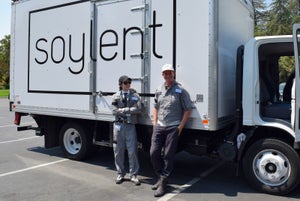
Brener and Rhinehart.

William Alden / Via BuzzFeed News

Minutes earlier, Rhinehart had given a small speech about his shipping container project, which was supposed to be an experiment in sustainable housing. Neighbors complained about the metal eyesore and said it attracted vandals. City prosecutors charged Rhinehart with violations including unpermitted construction. He removed the container and wrote a blog post offering his “sincerest apologies.”

But on Tuesday, Rhinehart said he wanted to try again.

“Hopefully by next year I&039;ll have four or five containers on the land,” he said.

He explained how he would arrange them on his quarter-acre property on top of the hill. “Where there&039;s a will,” he said, “there&039;s a way.”

Instagram: @robertrhinehart

Soylent Wants To Be The Red Bull Of Video Gaming

Quelle: <a href="An Afternoon In The Park With The Soylent CEO And A Star Of "Silicon Valley"“>BuzzFeed

Nextdoor Rolls Out Product Fix It Hopes Will Stem Racial Profiling

Via Flickr: 65487073@N03

Nextdoor, a location-based social network for neighbors that has more than 10 million registered users, is rolling out a new tool today that the company says has reduced incidents of racial profiling on its network by 75% during tests. In recent years, so many people have used Nextdoor to report things like black men driving cars or hispanic women knocking on doors as suspicious or even criminal that the site has become known as a hub for racial profiling.

The new tool, an algorithmic form for reporting crime and safety issues, has been in beta for an ever-increasing portion of Nextdoor’s 108,000 neighborhood groups since May. This feature, which automatically identifies racially coded terms and prevents users from posting without supplemental descriptors, goes live for all users today.

“The impact of being racially profiled in general is terrible,” CEO Nirav Tolia told BuzzFeed News on Tuesday. “It runs counter to the mission of Nextdoor. It’s something we feel morally obligated to take seriously.”

Racial profiling became an issue for Nextdoor in 2015, when a number of news outlets reported on the frequency of posts about crime or suspicious behavior that mentioned an individual’s race, but little or nothing related to actual criminal activity. In many cases, these posts would refer to people of color doing things such as talking on the phone or walking a dog.

Tolia said it wasn’t the bad press, but the work of civic groups in Oakland that brought the issue to his attention. Nextdoor touts its collaborations with police departments, city governments, and other public agencies. Last fall, Oakland Vice Mayor Annie Campbell Washington encouraged Oakland city departments to stop using the app to communicate with citizens until Nextdoor addressed the issue of racial profiling. By October, Tolia’s team was holding working groups with advocacy groups and city officials, and together they came up with a solution.

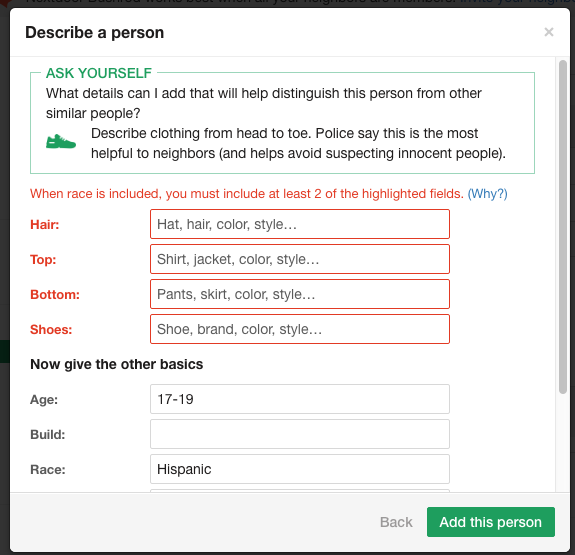
The idea, which Tolia credits to members of a group called Neighbors for Racial Justice, was to change the way crime and safety issues are reported on Nextdoor. Instead of a blank text box and subject line, it was suggested that Nextdoor design a form that more closely resembles a police report or 911 dispatcher questionnaire. By explicitly requesting details about height, clothing, and age, they would discourage people filing reports from focusing exclusively on the race or ethnicity of the subject.

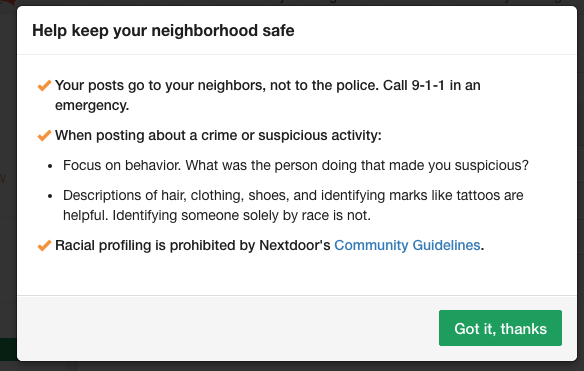
Nextdoor features a wide variety of post categories — Classifieds, Events, etc. — but it’s the Crime and Safety section where people tend to focus on race to the exclusion of other salient details. As of today, Nextdoor neighbors posting a “crime” or “suspicious behavior” to the site will be warned against allowing an individual’s race to color their interpretation of events. And if their post focuses too much on the race or ethnicity of the subject, they’ll be prevented from publishing it. “When race is invoked, we create a higher bar,” Tolia explained.

For example, try to post about your car windows being smashed, and you’ll be prompted with this message:

For example, try to post about your car windows being smashed, and you’ll be prompted with this message:

Try to describe someone with just a racial characteristic, and you’ll see this prompt, asking you to be more descriptive:

Try to describe someone with just a racial characteristic, and you’ll see this prompt, asking you to be more descriptive:

Nextdoor claims this new multi-step system has, so far, reduced instances of racial profiling by 75%. It’s also decreased considerably the number of notes about crime and safety. During testing, the number of crime and safety issue reports abandoned before being published rose by 50%. “It&;s a fairly significant dropoff,” said Tolia, “but we believe that, for Nextdoor, quality is more important than quantity.”

Vice Mayor Washington said she’s “thrilled” with the results Nextdoor has achieved. “I don’t think a lot of technology companies would have taken the steps they did, and made significant changes to their platform,” she said.

When tech companies come under fire for failing to take race issues seriously — Snapchat, Twitter, and Airbnb are examples — critics often assert that, were minorities better represented on the staffs of those companies, the same mistakes might not have been made. But Tolia, who himself identifies as a person of color, said that while he&039;s working actively to diversify Nextdoor&039;s staff, when it comes to racial profiling, “we believe we get the best information from our members, and in this case, our advisers.”

But not all of Nextdoor’s advisers on the racial profiling project are satisfied with how the process turned out. Two founding members of Neighbors for Racial Justice, Audrey Williams and Shikira Porter, said Nextdoor left them out of the development process after a flurry of early interest. Porter told BuzzFeed News that she continues to see instances of racial profiling in her Nextdoor neighborhood despite the rollout of the form. Nextdoor confirmed that the company has not met with Neighbors for Racial Justice since the test pilot began in April, but said it was made aware of only two instances of racial profiling that had slipped through its algorithms in the last few months.

“We&039;ve been doing the work of consultants for them, and they’ve been taking it as free, pro-bono, volunteer advice from the community,”said Williams, who works in digital marketing. “And we’ve been happy to give it, because it makes our lives better. But over time, it began to feel a bit like exploitation.”

Nextdoor will hold a conference call for local stakeholders on Wednesday, but neither Williams nor Porter will be able to attend. Porter said it “didn’t feel right” to have Neighbors for Racial Justice attached to a project they felt the organization hadn’t been given a chance to sign off on.

“We appreciate working with [Neighbors for Racial Justice] to create these improvements,” said Tolia in a follow-up email. “We are encouraged by the progress, but know there is still more work to do.”

However, it’s clear that the contributions of Neighbors for Racial Justice and other local organizations to Nextdoor’s efforts were integral to the design and execution of the final product. Some of the copy Nextdoor ended up using in the form — such as, “Ask yourself, &039;Is what I saw actually suspicious, if I take race or ethnicity out of the question?&039;” — came at the suggestion of Neighbors for Racial Justice.

The new racial profiling form isn’t the only change Nextdoor has made in service of tempering racial profiling on its platform. Last November, the company introduced a checkbox that allows users to flag posts for racial profiling. More recently, it&039;s trained the group of in-house customer service representatives that reviews such posts in conflict resolution and “cultural humility” with an eye towards helping users understand why their posts were flagged, and how racial profiling negatively impacts whole communities.

It’s unusual for a tech company to take such an active role in policing its users, or to make an investment in educating them about social and cultural issues. In addition to relying on community members, Nextdoor also hired consultants to help, among other things, define what racial profiling outside of a police setting even is. Debo Adegbile, a civil rights attorney with the NAACP who was nominated for US assistant attorney general by President Obama, and Grande Lum, a race relations expert with the Department of Justice, both worked as advisers to Nextdoor.

Because the new form makes it less likely that users will post to Nextdoor, Tolia said there&039;s a “business cost to doing this.” But given the way Airbnb, Twitter, and other tech companies have struggled with issues of race in recent months, it’s easy to see Tolia’s decision to meet the racial profiling problem head-on not just as morality, but also as good business sense.

“Let’s not be fooled,” said Audrey Williams of Neighbors for Racial Justice. “It’s a win for us, and it’s a win for them.”

Quelle: <a href="Nextdoor Rolls Out Product Fix It Hopes Will Stem Racial Profiling“>BuzzFeed

Facebook Messenger Is Testing "Add Contact" Request

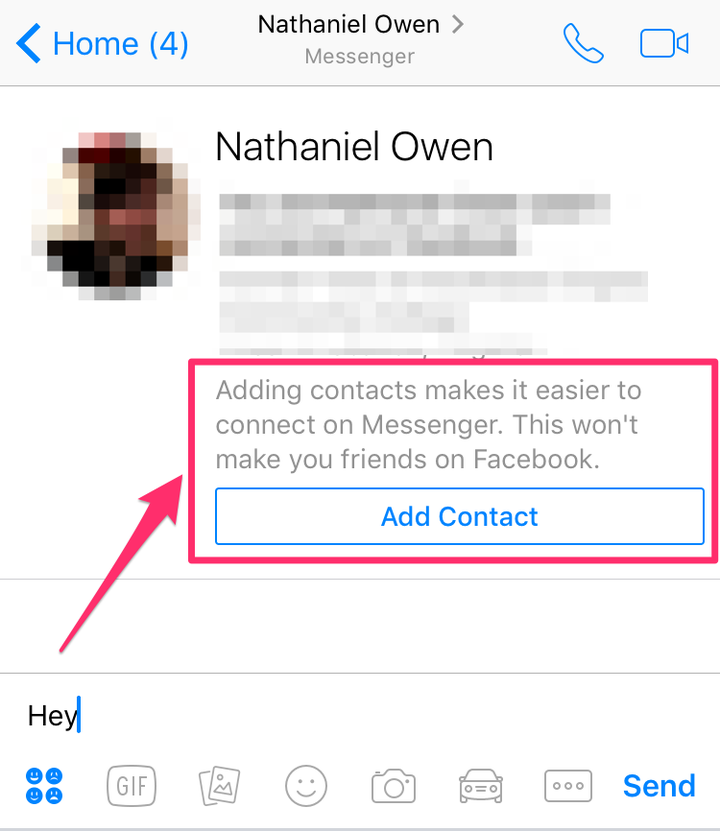
Facebook is testing an “Add Contact” feature in its Messenger app, the company confirmed to BuzzFeed News today.

The feature allows people to connect on the popular messaging app, used by more than 1 billion people, without becoming friends on Facebook itself. Facebook already allows non-Facebook friends to message each other on Messenger, via message requests, but if the company rolls out Add Contact broadly it could lead to a new network forming on Messenger and outside of the main Facebook product.

Messenger, though still behind Facebook&;s monthly active user count of 1.7 billion, is growing faster than the main product, and will likely increase in importance to the company now with original sharing down on Facebook proper and its ad load nearing capacity. In an April earnings call, Facebook CEO Mark Zuckerberg was clear about the importance of Messenger to his business: “A lot of people want to share messages privately, one-on-one or with very small groups.”

With Messenger on the rise, Facebook is clearly thinking about how it help develop the app into its own ecosystem, untethered in some respects to the Big Blue App. And the “Add Contact” request is one more tool to help accomplish that.

Quelle: <a href="Facebook Messenger Is Testing "Add Contact" Request“>BuzzFeed

Facebook Says Suspension Of Libertarian Groups Was An “Error"

View Video ›

Facebook: OccupyDemocratsLogic

Another controversial Facebook takedown, another muddy explanation for an erroneous removal.

Last week, Facebook mistakenly removed two big libertarian groups from its pages — Being Libertarian and Occupy Democrats Logic. Both claim over 100,000 members each. After the groups protested, Facebook restored them both on Monday, offering a vague explanation for the takedowns, one that&;s become increasingly common following the sudden, temporary disappearance of political speech and or contentious content from its platform.

“The pages were taken down in error,” a Facebook spokesperson told BuzzFeed News. “Both have been reinstated with any posts that violated our community standards removed.” Facebook did not say what posts it determined to be in violation of those standards, though Occupy Democrats Logic believes it was targeted for showcasing a meme on “progressive liberal logic.”

If Facebook&039;s statement sounds familiar, it&039;s because the company provided similar explanations when it temporarily removed a video showing the aftermath of the shooting of Philando Castile (that was “technical glitch”) and disappeared a handful of Bernie Sanders support groups (“one of our automated policies was applied incorrectly”).

What policies and protocols determined or informed these removals of political speech? Facebook isn&039;t saying. Asked to explain the “error” that removed Being Libertarian and Occupy Democrats Logic from Facebook, a company spokesman declined to do so.

An administrator for Occupy Democrats Logic told BuzzFeed News that Facebook did not provide a detailed explanation for the group&039;s takedown. And he insisted that the group was not forced to remove certain posts as a condition of reinstatement. “I didn&039;t remove jack shit,” the admin said. “I was confident nothing I posted violated standards.”

A cursory search of the restored Occupy Democrats Logic page no longer displays the “progressive liberal logic” meme post.

An administrator for Being Libertarian has not yet responded to a request for comment.

Facebook now boasts 1.7 billion monthly active users. It&039;s a massive network that for many is the extent of the internet itself. When political speech is removed from the platform, even temporarily, it&039;s a big deal. And Facebook is giving no indication that it&039;s ready to address these removals in more depth.

Quelle: <a href="Facebook Says Suspension Of Libertarian Groups Was An “Error"“>BuzzFeed

Dissent And Distrust In Tor Community Following Jacob Appelbaum's Ouster

The Tor Project, Inc.

When Shari Steele joined the Tor Project as executive director last December, she thought the job would resemble the start of her previous stint as the executive director of the digital civil liberties group Electronic Frontier Foundation: getting down to the hard work of turning a scrappy online privacy group with a reputation for chaos into a mature organization.

“I expected there were operational things I’d have to clean up,” Steele said. “Setting up bank accounts, and making sure contractors are treated properly, that kind of thing.”

Instead, the first eight months of Steele’s tenure have been defined by a scandal that has rocked the Tor Project, the nonprofit organization that administers and promotes Tor, the widely used and controversial software that conceals the online identity and location of its users. In June, anonymous accounts appeared online alleging that Jacob Appelbaum, a prominent developer and activist who was the Tor Project’s best-known member, had sexually assaulted several women.

In the two months after the allegations, Appelbaum resigned and the Tor Project replaced its entire board, following a BuzzFeed News report that it had known of allegations against Appelbaum for more than a year before they became public (and well before Steele came on). Last month, the group announced that a seven-week private investigation had confirmed the allegations. (Appelbaum, who lives in Berlin, has not been charged with any crime.)

Now, as Steele tries to pivot the organization past the scandal and toward the restructuring she was brought on to do, she faces the awkward task of handling a group of Tor community members and associates who are angry about the way she dealt with Appelbaum’s exit and its aftermath, some of whom are actively hostile toward the people she has empowered to make the organization more welcoming to women.

Last week, Marie Gutbub, a Tor Project core member and a former romantic partner of Appelbaum’s, announced she was quitting Tor in an email in which she accused Steele of “purging” those within the Tor community who signed an open letter in support of Appelbaum — and claimed to speak for many others.

“I know that there are others in the community who feel like something is not right about this,” she wrote. “And I assume that they only haven&;t spoken up because they are afraid.”

David W. Robinson, a Tor volunteer who gained fame in the community when police raided the Seattle home where he ran a Tor exit relay, published a letter last week calling the Appelbaum allegations “character assassination … with management’s collusion.” And over the weekend, an anonymous post appeared calling for a 24-hour boycott of Tor and demanding Steele’s resignation. (And add to all this a throng of anonymous Twitter commenters.)

The proposed boycott has been widely criticized, even by Robinson and Gutbub, as counterproductive and potentially harmful to people who rely on Tor to communicate safely. But as these loud and angry voices have made clear, the Appelbaum scandal has revealed fissures within the broader Tor community. That matters more than it might otherwise seem, because the Tor Project relies on its community for advocacy, code improvements to its software, and the donated bandwidth that facilitates the spread of its anonymous traffic. And it suggests that Steele’s job, for the time being at least, may be as much about managing changes to that community as it is expanding Tor’s user base, increasing its funding, and squashing its reputation as a high-tech cover for Dark Web criminals.

“It’s sad and unfortunate that we’re losing people like Marie and David,” Steele said. “We appreciate all that they’ve done. Hopefully more people are going to come based on the changes that we’re making.”

Among those changes: new anti-harassment, conflict of interest, complaint submission, and internal review policies, which Steele announced in a blog post last month. The new policies, Steele wrote, will be rolled out in time for Tor’s upcoming developer meeting in Seattle at the end of the month.

But that meeting, which Steele said will be the best-attended in the organization’s history, has itself become a flashpoint for controversy. In her open letter, Gutbub claimed that she and others had not been invited because of their public support for Appelbaum.

“There is this conspiracy that people were omitted because they were supporters of Jake,” Steele told BuzzFeed News. “Marie wasn’t invited because she hasn’t been working on Tor recently. She hasn’t been contributing.” Gutbub had been a Tor core member only since May of this year — a month before the allegations against Appelbaum came to light.

Still, an email sent by Steele to an internal Tor mailing list and obtained by BuzzFeed News supports Gutbub’s claim: “I initiated this meeting’s list a bit differently than we’d been doing it in at least the recent past, in that instead of simply reinviting people who had been invited in the past, I made an effort to build a list of people who were actively working with and for the Tor Project … Things worked differently with Marie. She was suggested on tor-internal, but then off-list I received a couple of people expressing discomfort with her attendance. I followed what I believed to be protocol and did not add her to the invitation list for this reason.”

Another contentious issue for Gutbub, Robinson, and the people behind is Alison Macrina’s role. Macrina is a librarian and privacy advocate who heads Tor’s new Community Team. The Community Team has been charged with writing a set of membership guidelines, a code of conduct, and a social contract. Macrina is also one of the members of the Tor Community Council, a small body that is in charge of enforcing rules established by the Community Team and resolving disputes within the Tor community.

One of those disputes: how to integrate two unnamed Tor employees back into the unpaid Tor community after they were fired as a result of the Appelbaum investigation. In June, Macrina came forward as one of Appelbaum’s accusers — a fact that Gutbub argues makes her unfit to be part of the council making the decision.

Macrina told BuzzFeed News that she will recuse herself from the process — the council decides by consensus — after another core member told her he was concerned that she had a conflict of interest. She said that the Community Council does not have access to the results of the internal investigation, which pertains to Tor employees and not the unpaid community. And she added that frequent insinuations that she has grabbed power in the vacuum of the past several months are off base because she is a volunteer. “I’m the lead of the Community Team mostly because no one else wanted to do it,” she said. “There is a vocal minority of people who are very angry, and a lot of them have the wrong information.”

Just how serious the discord within the Tor community is may not be clear until the Seattle conference, held the last week of September, when its most influential members will meet in person for the first time since the Appelbaum allegations came to light. Macrina and Steele both said a significant amount of time will be set aside to clear the air. There will be anti-harassment training, according to Steele. And after that, Steele said, talk will turn to the nuts and bolts of improving the organization and the community supporting a piece of technology that may be the safest way to get online without being surveilled.

“I came in here with the sole purpose of trying to make Tor strong and healthy,” Steele said. “Purging is not one of the things I’m trying to accomplish.”

Quelle: <a href="Dissent And Distrust In Tor Community Following Jacob Appelbaum&039;s Ouster“>BuzzFeed

Announcing Azure App Service MySQL in-app (preview)

Today, we’re announcing a cool new feature (in preview) for Web developers using Azure App Service to create Web applications that use MySQL. MySQL in-app enables developers to run the MySQL server side-by-side with their Web application within the same environment, which makes it easier to develop and test PHP applications that use MySQL.

We’re also making it very easy to get started with this feature via the Azure portal. During the creation of your Web App, you’ll be able to select a “MySQL in-app (preview)” provider for your database, which will help provision the database.

We think this feature will be very welcome by Web developers who are looking to accelerate their testing because:

It supports many PHP applications that use MySQL, such as WordPress, Joomla, and Drupal.
It’s cost-effective since there’s no additional cost to use this feature and you only pay for the App Service plan (since resources are shared).
The MySQL and Web processes are co-located in the same environment (hence the term in-app) which means storage is shared.
Includes support for slow query logging and general logging, which you’ll need to turn on as needed (this feature impacts performance, so you shouldn’t use it all the time).

Since this feature is in preview, and shares its resources with the Web application in the same App Service plan, MySQL in-app is not recommended for production applications. Please also keep in mind the following tips and limitations when using this feature:

Check your storage limits and upgrade the web app pricing plan as needed to accommodate data for both MySQL and your web app. For storage and memory limits for your pricing tier, review the quota limitations for all App Service plans pricing tiers.
Note you only get one MySQL database per web application. In a scenario where you have a deployment slot web app and a production web app, you will get one MySQL database for the deployment slot and one MySQL database for the production web app, if you decide to turn on this feature for each app. The database contents will not be synchronized, which makes it easier for you to try different schema versions and content.
The auto scale feature is not supported since MySQL currently runs on a single instance. Similarly, enabling local cache is not supported.
The MySQL database cannot be accessed remotely using the MySQL CLI or other tools that access external endpoints. You can only access your database content using PHPMyAdmin (which is bootstrapped upon provisioning) or using the KUDU debug console.

The team continues working with Web developers in improving their experience in Azure App Service, particularly when it comes to data solutions. Over the last few months, we’ve come a long way in our data solution portfolio for Web developers, including revamping our PHP client drivers for Azure SQL, a new version of the JDBC drivers, expanded support for Linux on our ODBC drivers, MongoDB protocol support in DocumentDB and, earlier this week, an early technical preview of the new PHP on Linux SQL Server drivers. We will continue working on more data solutions that make it easier for Web developers to bring great applications to market in Microsoft Azure, whatever the language, stack, and platform.

If you’re using MySQL in-app for development and testing and you are interested in migrating this application to production, Azure offers many solutions, including:

ClearDB Database
ClearDB Clusters
Marketplace solutions for MySQL, MariaDB, and other MySQL-compatible solutions from partners like Bitnami and MariaDB
Community-contributed Azure Resource Manager (ARM) templates deploying on VMs
MySQL on virtual machine on Linux or Windows OS

We hope you get started with MySQL in-app in Azure App Service today, and share with us your feedback. Don&;t have a subscription? Sign up for a free trial! And if you’re interested in getting more details about this feature, make sure you check out the detailed blog post.
Quelle: Azure

Is This An Ad? Beyoncé And Her Super Bowl Airbnb

Welcome to our weekly column, “Is This an Ad?”, in which we strap on our reportin&; hat and aim to figure out what the heck is going on in the confusing world of celebrity social media endorsements. Because even though the FTC recently came out with rules on this, sometimes when celebrities post about a product or brand on social media, it&039;s not immediately clear if they were being paid to post about it, got a freebie, or just love it, or what.

THE CASE:

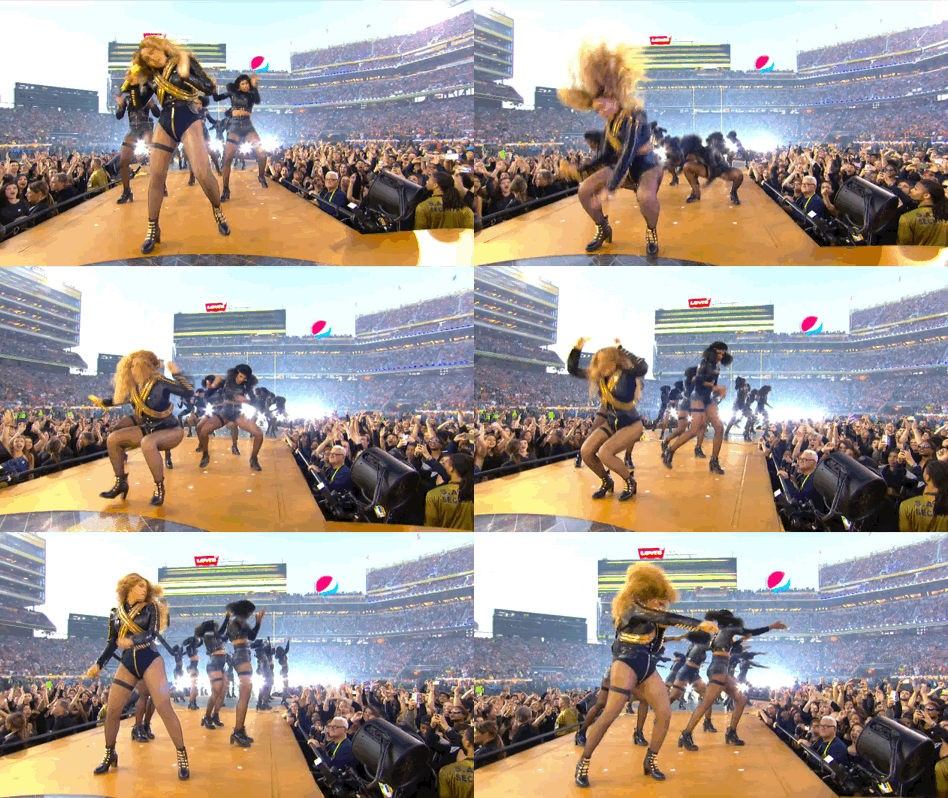
Remember, if you can, back to Super Bowl 2016. It was the Denver Broncos versus the Carolina Panthers, held in San Fransisco&039;s Levi&039;s Stadium. The halftime show was Coldplay featuring Bruno Mars and Beyoncé. You will probably not remember Coldplay, but you will remember this amazing moment where Beyoncé *almost* fell, but miraculously righted herself:

NFL / Via giphy.com

Beyoncé showed up in San Fransisco a few days before the Super Bowl, presumably to rehearse the show, which involves some complicated elements (Chris Martin&039;s tight henleys, unusual set designs, lots of dancers, etc…) She clearly needed a nice place to stay while she&039;s there. Some place nicer than just an anonymous hotel room… a comfortable place for her family to stay for a while.

On her Facebook, Beyonce posted this photo with the caption, “it was a Super weekend @Airbnb”:

On her Facebook, Beyonce posted this photo with the caption, "it was a Super weekend @Airbnb":

Beyonce’s Facebook (now deleted)

It was quickly reported that the particular Airbnb that Beyoncé was staying at was this one, which rents for $10,000 per night. The house is just outside San Fransisco in the town right next to Mountain View, and it looks super nice.

THE EVIDENCE:

Beyoncé is too classy to shill for stuff on her social media, right? She&039;s no Scott Disick, she&039;s fucking Beyoncé. She&039;s not posting crap like teeth whitening lights or hair growth gummies on Instagram. Why would she start now, with Airbnb?

Perhaps she just loved this particular rental, and wanted to shout it out. And isn&039;t the term “Airbnb” kind of almost like Kleenex at this point —a generic term to describe “rental home”? So maybe it&039;s not so weird she&039;d tag the company.

But do we think she paid for it? The place is 10 G&039;s a night – something that basically ONLY a Beyoncé can afford. That&039;s chump change to her, but it&039;s still … a lot of money&;

On the other hand, does the NFL pay for her accommodations as part of her performance fee for the Super Bowl? It&039;s not unusual for travel and accommodation fees to be added onto a musician&039;s performance fee. Or sometimes a large flat fee is offered, and any travel/hotel costs are built into that.

The halftime show is sponsored by Pepsi, a company that Beyoncé has done ads for and in 2012 made a $50 million deal with. Perhaps part of the deal is that Pepsi paid for her stay.

Or do we believe that Beyoncé isn&039;t posting anything about any company for free? If she&039;s tagging them, she&039;s getting paid?

THE VERDICT:

It was a freebie&033; According to reps for Airbnb, Beyoncé was not paid to post about her stay. However, a source familiar with the situation told BuzzFeed News that her rental fee was comped by Airbnb (the host got paid).

“We’re huge fans of Beyoncé and we’re thrilled to see her Facebook post and hope she was crazy in love with her Airbnb listing,” Airbnb wrote in a statement at the time. This is, you&039;ll notice, doesn&039;t indicate whatsoever that Beyoncé wasn&039;t a paying Airbnb customer — to me, this statement implies the opposite, that she is a paying customer.

The FTC has rules – lots of rules – about how bloggers or social media stars are supposed to disclose if they&039;re getting paid to post about a product or company. But these are confusing, especially if it&039;s not a paid ad, but a free gift like a comped hotel room – something that celebs get all the time. The general rule of thumb, though, is that the average person should be able to tell if something is an ad or not.

I consider myself pretty knowledgeable on this kind of stuff, and I couldn&039;t really tell. Bobby Finger, host of the Who? Weekly celebrity gossip podcast, wrote in Jezebel that he wasn&039;t sure if it was an ad, either. If someone whose job is writing and podcasting about celebrity gossip can&039;t tell if this was an ad or not, then how is the average person supposed to know? Especially when Airbnb PR&039;s statement to the press at the time was so ambiguous. Airbnb did not respond to several requests for comment from BuzzFeed News, and when the Washington Post wrote about how the lack of clarity may be an FTC violation of advertising rules, Airbnb did not respond their request for comment on wither or not it was actually an ad.

Getting a comped hotel doesn&039;t obviously feel the same as, say, a $50 million contract with Pepsi to do TV ads. So it&039;s very possible Beyoncé probably didn&039;t think of her post about Airbnb the same way she does about doing a TV ad for Pepsi.

But the FTC maybe does, based on its own rules. Last week, Bloomberg reported that the agency plans on cracking down on confusing celeb ads on social media. But how it plans on actually doing this isn&039;t really clear, and Bloomberg talked to many people in the advertising industry who said that the rules themselves aren&039;t even that clear.

The FTC&039;s moves so far have been to only dole out violations to the brands or ad agencies, not the individuals. This means if the FTC decided that Beyoncé&039;s post violated the rules, then it&039;s Airbnb who is on the hook for the misdeed, not the singer. (The agency does not comment on individual cases to the press.) And even then, the FTC doesn&039;t act on this often — in only been a handful of cases so far has it gone after a company for social media violations (most recently Warner Bros. for having video game vloggers doing positive reviews without disclosure).

Would the FTC have preferred it if Beyoncé had written “I was gifted a free vacation rental by Airbnb, but not paid to post about it”? Yes, I&039;m sure they would have liked that. But are they going to go after Beyoncé or Airbnb for not doing that? Who knows&033;

EPILOGUE:

A few months later, Justin Bieber stayed at that same Airbnb. While he Instagramed photos from inside the house, he didn&039;t give an Airbnb shoutout like Beyoncé did. Did he also get it for free? Who knows&033; Stay tuned for future installment of Is This An Ad?

Quelle: <a href="Is This An Ad? Beyoncé And Her Super Bowl Airbnb“>BuzzFeed

Live from LinuxCon – Sharing the latest news and learnings on Microsoft’s open journey

Greetings from LinuxCon North America in Toronto, where I am representing Microsoft as a keynote speaker for the first time! I&;m excited to share exciting new open source developments from Microsoft and things we&039;ve learned from our journey with Linux and open source. Of course, I also look forward to catching up with old friends and meeting up with some customers and partners.

Over the past few months I’ve been asked more times than I can count, “Wim, why did you join Microsoft?” As a Linux guy who has watched the company from afar, I am the first to admit that Microsoft hasn’t always been the most open company. After talking to some of the executives at the company, I found that the days of a closed Microsoft are over.

The reality is customers use more than one tool and more than one platform to operate their businesses. They need tools that support Linux and Windows, and they need a cloud that allows them to run any application. One of the things I shared with linux.com recently was how blown away I was to see how large Microsoft&039;s investment in Linux already is. We brought .NET Core, PowerShell, and SQL Server to Linux. We also open sourced Visual Studio Code and just recently PowerShell. And, we are contributing to and participating in numerous community projects. It’s incredible to be a part of it.

Our latest open source and Linux advancements

One of the areas we are focused on is delivering open management solutions. In today’s multi-cloud, multi-OS world, customers need simple, unified tools to reduce complexity. That’s why just last week, we announced that we’re open sourcing PowerShell and making it available on Linux. Now PowerShell users across Windows and Linux can use our popular command-line shell and scripting language to manage almost everything from almost anywhere. My colleague Jeffrey Snover wrote a fantastic story about the journey to open source PowerShell and how customer-centricity brought us here – go check it out!

We’re also investing in making Microsoft Operations Management Suite (OMS), which gives you visibility and control of your applications and workloads across Azure and other clouds, a first-class tool for managing Linux environments. Last week, we announced that the OMS Monitoring Agent for Linux is generally available, delivering rich insights and real-time visibility into customers’ Linux workloads to quickly remediate issues. A lot of the tools we use and integrate with are open source-based, such as fluentd and integration with auditd and the like.

Today, I’m also excited to share that OMS Docker Container monitoring is available in preview. By nature, containers are lightweight and easily provisioned, so without a centralized approach to monitoring, customers may find it difficult to manage and respond to critical issues quickly. With OMS Docker Container monitoring, you get visibility into your container inventory, performance, and logs from one place, get a simplified view of containers’ usage, and can diagnose issues whether your containers are running in the cloud or on-premises. You may have seen Mark Russinovich demo this live at DockerCon in June, and we’re thrilled you can try it for yourself.

What we’ve learned on our journey and what’s next

These are all important milestones for Microsoft that reflect our journey of learning and the thoroughness of our open source approach across infrastructure investments; new governance processes that work with and for the community; new ways to incorporate customer and partner feedback; and the deepening of partnerships to make great experiences possible for organizations of all types. In my keynote tomorrow, I will talk about how we are applying our learnings into the Linux ecosystem, what our approach to open source is, what it means for Linux users, and how me and my team are working to take this to the next level.

Our experiences with Linux in Azure, where nearly 1 in VMs today are Linux, have brought us closer to our customers and what they need to succeed in a rapidly advancing world. We have made significant investments in making Microsoft&039;s platform a great place to run open source software, and I will be working with my team to accelerate this effort over the coming months.

Choice and flexibility are important tenets of our platform. Also critical are our efforts to contribute to open source projects, integrate open source technologies in our platform, and forge commercial and community partnerships with the ecosystem. It’s not just about what we’re open sourcing or making available on Linux. Microsoft is committed to contributing and participating in open source projects, like our investments in OMI and fluentd, our focus on Chakra and TypeScript, and many other projects including the fantastic work from our Microsoft Research organization. To take it a step further, one of the things my team and I have learned is how to partner with the community to make our contributions viable and sustainable, in ways that work for the community. I will be sharing many of those examples in my keynote.

It’s now been a few months since I joined Microsoft. It’s an exciting time to be at this company. I have to say that Linux and open source have become a normal part of our day-to-day business at Microsoft – from our people, our products, our vision, and our investments. I’m excited at what the future will bring with more first- and third-party projects, technologies, and partnerships that will bring great experiences to our customers using Linux and open source technologies.

If you’re at LinuxCon, please join me and the open source team in booth 3 at LinuxCon this week, and follow us on Twitter for more details about my keynote. If you’re not attending, make sure you visit the Azure.com website on Linux to learn more about our work with Linux and open source technologies.
Quelle: Azure

Is This An Ad? Beyoncé And Her Super Bowl Airbnb

Welcome to our weekly column, “Is This an Ad?”, in which we strap on our reportin&; hat and aim to figure out what the heck is going on in the confusing world of celebrity social media endorsements. Because even though the FTC recently came out with rules on this, sometimes when celebrities post about a product or brand on social media, it&039;s not immediately clear if they were being paid to post about it, got a freebie, or just love it, or what.

THE CASE:

Remember, if you can, back to Super Bowl 2016. It was the Denver Broncos versus the Carolina Panthers, held in San Fransisco&039;s Levi&039;s Stadium. The halftime show was Coldplay featuring Bruno Mars and Beyoncé. You will probably not remember Coldplay, but you will remember this amazing moment where Beyoncé *almost* fell, but miraculously righted herself:

NFL / Via giphy.com

Beyoncé showed up in San Fransisco a few days before the Super Bowl, presumably to rehearse the show, which involves some complicated elements (Chris Martin&039;s tight henleys, unusual set designs, lots of dancers, etc…) She clearly needed a nice place to stay while she&039;s there. Some place nicer than just an anonymous hotel room… a comfortable place for her family to stay for a while.

On her Facebook, Beyonce posted this photo with the caption, “it was a Super weekend @Airbnb”:

On her Facebook, Beyonce posted this photo with the caption, "it was a Super weekend @Airbnb":

Beyonce’s Facebook (now deleted)

It was quickly reported that the particular Airbnb that Beyoncé was staying at was this one, which rents for $10,000 per night. The house is just outside San Fransisco in the town right next to Mountain View, and it looks super nice.

THE EVIDENCE:

Beyoncé is too classy to shill for stuff on her social media, right? She&039;s no Scott Disick, she&039;s fucking Beyoncé. She&039;s not posting crap like teeth whitening lights or hair growth gummies on Instagram. Why would she start now, with Airbnb?

Perhaps she just loved this particular rental, and wanted to shout it out. And isn&039;t the term “Airbnb” kind of almost like Kleenex at this point —a generic term to describe “rental home”? So maybe it&039;s not so weird she&039;d tag the company.

But do we think she paid for it? The place is 10 G&039;s a night – something that basically ONLY a Beyoncé can afford. That&039;s chump change to her, but it&039;s still … a lot of money&;

On the other hand, does the NFL pay for her accommodations as part of her performance fee for the Super Bowl? It&039;s not unusual for travel and accommodation fees to be added onto a musician&039;s performance fee. Or sometimes a large flat fee is offered, and any travel/hotel costs are built into that.

The halftime show is sponsored by Pepsi, a company that Beyoncé has done ads for and in 2012 made a $50 million deal with. Perhaps part of the deal is that Pepsi paid for her stay.

Or do we believe that Beyoncé isn&039;t posting anything about any company for free? If she&039;s tagging them, she&039;s getting paid?

THE VERDICT:

It was a freebie&033; According to reps for Airbnb, Beyoncé was not paid to post about her stay. However, a source familiar with the situation told BuzzFeed News that her rental fee was comped by Airbnb (the host got paid).

“We’re huge fans of Beyoncé and we’re thrilled to see her Facebook post and hope she was crazy in love with her Airbnb listing,” Airbnb wrote in a statement at the time. This is, you&039;ll notice, doesn&039;t indicate whatsoever that Beyoncé wasn&039;t a paying Airbnb customer — to me, this statement implies the opposite, that she is a paying customer.

The FTC has rules – lots of rules – about how bloggers or social media stars are supposed to disclose if they&039;re getting paid to post about a product or company. But these are confusing, especially if it&039;s not a paid ad, but a free gift like a comped hotel room – something that celebs get all the time. The general rule of thumb, though, is that the average person should be able to tell if something is an ad or not.

I consider myself pretty knowledgeable on this kind of stuff, and I couldn&039;t really tell. Bobby Finger, host of the Who? Weekly celebrity gossip podcast, wrote in Jezebel that he wasn&039;t sure if it was an ad, either. If someone whose job is writing and podcasting about celebrity gossip can&039;t tell if this was an ad or not, then how is the average person supposed to know? Especially when Airbnb PR&039;s statement to the press at the time was so ambiguous. Airbnb did not respond to several requests for comment from BuzzFeed News, and when the Washington Post wrote about how the lack of clarity may be an FTC violation of advertising rules, Airbnb did not respond their request for comment on wither or not it was actually an ad.

Getting a comped hotel doesn&039;t obviously feel the same as, say, a $50 million contract with Pepsi to do TV ads. So it&039;s very possible Beyoncé probably didn&039;t think of her post about Airbnb the same way she does about doing a TV ad for Pepsi.

But the FTC maybe does, based on its own rules. Last week, Bloomberg reported that the agency plans on cracking down on confusing celeb ads on social media. But how it plans on actually doing this isn&039;t really clear, and Bloomberg talked to many people in the advertising industry who said that the rules themselves aren&039;t even that clear.

The FTC&039;s moves so far have been to only dole out violations to the brands or ad agencies, not the individuals. This means if the FTC decided that Beyoncé&039;s post violated the rules, then it&039;s Airbnb who is on the hook for the misdeed, not the singer. (The agency does not comment on individual cases to the press.) And even then, the FTC doesn&039;t act on this often — in only been a handful of cases so far has it gone after a company for social media violations (most recently Warner Bros. for having video game vloggers doing positive reviews without disclosure).

Would the FTC have preferred it if Beyoncé had written “I was gifted a free vacation rental by Airbnb, but not paid to post about it”? Yes, I&039;m sure they would have liked that. But are they going to go after Beyoncé or Airbnb for not doing that? Who knows&033;

EPILOGUE:

A few months later, Justin Bieber stayed at that same Airbnb. While he Instagramed photos from inside the house, he didn&039;t give an Airbnb shoutout like Beyoncé did. Did he also get it for free? Who knows&033; Stay tuned for future installment of Is This An Ad?

Quelle: <a href="Is This An Ad? Beyoncé And Her Super Bowl Airbnb“>BuzzFeed