Instagram's Snapchat Clone Hasn't Hurt Snapchat's User Numbers

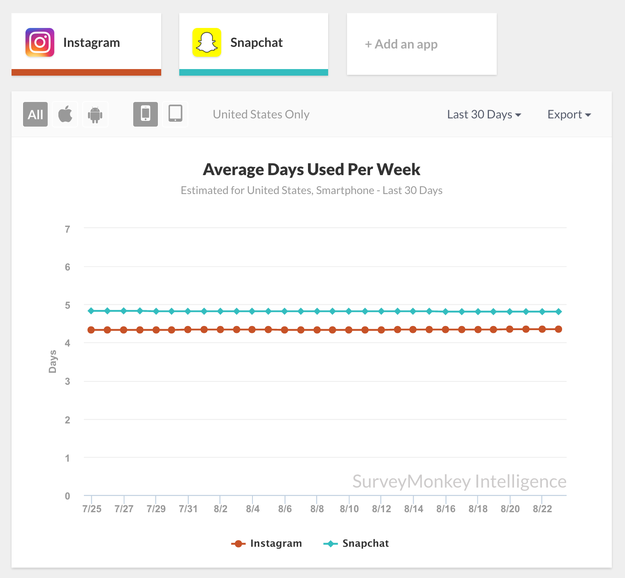
A month after Instagram released its clone of Snapchat Stories, Snapchat&;s user numbers are holding steady, according to four third-party data providers.

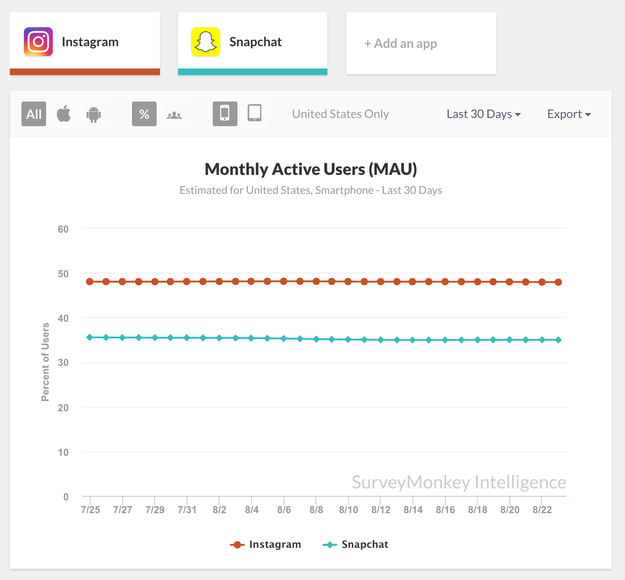
The data providers — App Annie, Apptopia, Sensor Tower, and SurveyMonkey — did not find any meaningful decline in Snapchat&039;s numbers in the weeks after the introduction of Instagram Stories. So for those who were quick to deem Instagram Stories a Snapchat killer, the early results suggest it may be wise to reconsider that label. It doesn&039;t look like Instagram&039;s number of users changed after it released Stories, either.

“About a month into the launch of Instagram&039;s Stories feature, we are still not seeing a significant increase of time spent in the app versus Snapchat,” Danielle Levitas, SVP of research at App Annie, told BuzzFeed News. “While there are several factors that may be contributing to this, the early stage of adoption by its user base is still ongoing.”

Wes McCabe, at Sensor Tower, said the trend lines remain the same as before Instagram&039;s introduction of Stories. Data from Apptopia showed no ill effects on Snapchat at all. And Snapchat usage among SurveyMonkey&039;s panel of over 1 million US iOS and Android users also didn&039;t flinch.

“Our data shows that Instagram Stories hasn&039;t made any discernible impact on Snapchat. The core usage metrics haven’t budged for either app throughout August,” a SurveyMonkey spokesperson told BuzzFeed News.

It&039;s still early in the battle between the two prominent social apps, but the data reveals that Instagram won&039;t be able to swiftly poach Snapchat&039;s users by simply adding the same features. It&039;s now clear that Snapchat&039;s users are loyal. And if Instagram wants to convince its rival&039;s 150 million daily users to port their activity over, it will need to be patient.

Snapchat declined to comment. An Instagram spokesman indicated Facebook will soon introduce even more features to the app: “We&039;re thrilled to see how quickly Instagram Stories has caught on with the community,” he said. “We’re working on some exciting new features for the coming weeks.”

Quelle: <a href="Instagram&039;s Snapchat Clone Hasn&039;t Hurt Snapchat&039;s User Numbers“>BuzzFeed

Sonos To Add Amazon Alexa Voice Control In 2017

Sonos To Add Amazon Alexa Voice Control In 2017

Sebastian Reuter / Getty Images

Sonos, the wireless home speaker company, is partnering with Amazon to add voice control to its devices, the company announced at an event in New York today.

Starting in 2017, users will be able to issue voice controls to any of their Amazon Alexa devices to play music from Sonos speakers. Voice requests such as playing specific songs in certain locations will be recognized by Amazon&;s smart assistant and passed over to Sonos software.

Voice control has been rumored for Sonos for months — and directly acknowledged by CEO John MacFarlane in March — but it wasn&039;t clear whether it would be integrated directly into the devices themselves or through a partner like Amazon. According to Sonos vice president of software Antoine Leblond, the new functionality has been in the works since March.

youtube.com

Though Sonos voice control is limited to Amazon Echo devices for the time being, the company said that the partnership is not exclusive, and would not rule out partnerships with other voice control platforms, like Siri, or even native voice control made by Sonos itself.

“We want to integrate with any voice provider that can provide a great voice driven experience for songs,” Leblond told BuzzFeed News. “And Amazon is clearly first out of the gate.”

In March, Sonos chief product officer Marc Whitten, who launched the company&039;s Play5 speaker, left the company to work for Amazon.

Sonos is also working to enhance the streaming music experiences it offers through its wireless systems. In October, the company will roll out a new feature that will enable its speakers to be controlled via Spotify&039;s desktop and mobile apps. It plans to do the same for Pandora.

Quelle: <a href="Sonos To Add Amazon Alexa Voice Control In 2017“>BuzzFeed

A Site That Facebook Made A Top Trending Topic Is A Sketchy Reprint Factory

EndingTheFed.com is filled with dubious articles taken from other right-wing websites.

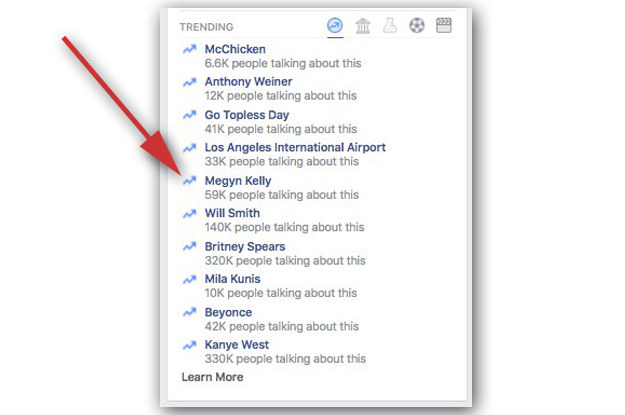
For much of Sunday and into Monday, Fox News host Megyn Kelly was one of the top Trending Topics on Facebook. Her name appeared in the sidebar seen by Facebook users in the United States:

For much of Sunday and into Monday, Fox News host Megyn Kelly was one of the top Trending Topics on Facebook. Her name appeared in the sidebar seen by Facebook users in the United States:

Facebook

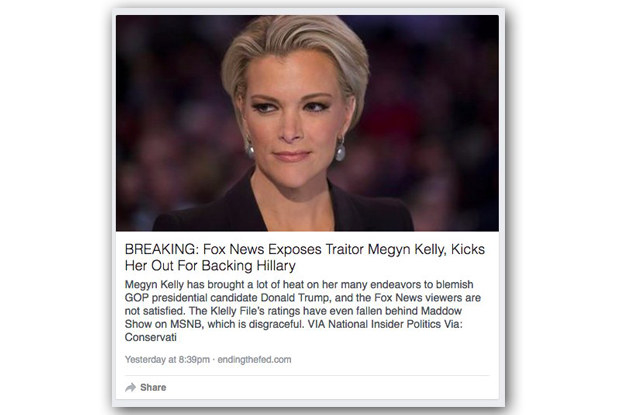
If you hovered your mouse over her name, up popped a story claiming that Kelly had been “kicked out” of Fox News “for backing Hillary.” The story was from a site called EndingTheFed.com — and it’s false.

If you hovered your mouse over her name, up popped a story claiming that Kelly had been "kicked out" of Fox News "for backing Hillary." The story was from a site called EndingTheFed.com — and it's false.

EndingTheFed.com was anonymously registered by its current owner in March of this year. The site has grown quickly thanks to a strategy of publishing aggressively pro-Trump, right wing stories. Even more notable is that the majority of its recent stories are simply taken word-for-word from other right-wing sites.

That means Facebook, the largest social network on the planet, actively promoted a fake story from a website that basically exists to republish other, often dubious, posts from fringe sites on the conservative web.

It&;s unclear whether Ending The Fed has permission to republish content from other sites, or if it&039;s committing mass plagiarism. BuzzFeed News contacted the site but has not heard back. Facebook declined to comment on the record about how the story made it to the Trending Topics list.

Facebook

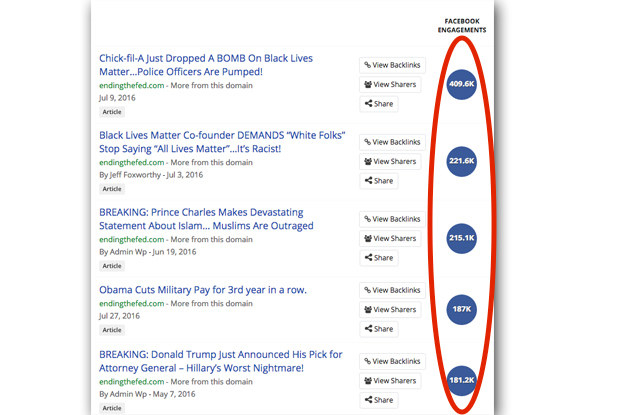
Even before Facebook gave it a boost, Ending The Fed was getting big hits on the social network. The site’s top five stories have together racked up over 1.2 million likes, shares, and comments since May:

Even before Facebook gave it a boost, Ending The Fed was getting big hits on the social network. The site's top five stories have together racked up over 1.2 million likes, shares, and comments since May:

The top story is a word-for-word reprint of this story, while the (partially false, partially true) claim about Obama cutting military pay is taken from here.

It&039;s unclear whether Ending The Fed&039;s success on Facebook in recent months caused it to be selected as the top story for the Megyn Kelly Trending Topic. On Friday, Facebook announced it was no longer using humans to write the summaries that accompany Trending Topics, though human engineers would be reviewing the topics selected by the algorithm.

Facebook previously announced measures to try and reduce the spread of fake news on its platform, but a BuzzFeed News report found that false stories continue to receive strong engagement.

BuzzSummo

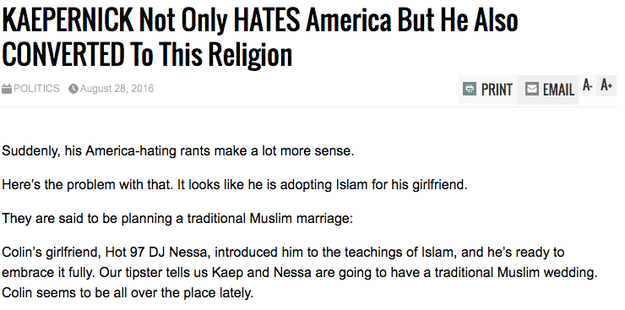
Ending The Fed often republishes false stories. The same day it ran the Kelly story it also incorrectly reported that NFL quarterback Colin Kaepernick had converted to Islam:

Ending The Fed often republishes false stories. The same day it ran the Kelly story it also incorrectly reported that NFL quarterback Colin Kaepernick had converted to Islam:

Ending The Fed&039;s story was a word-for-word repost of this from Clash Daily, which claimed Kaepernick had converted. That post was based on a claim from a sports gossip website, which cited anonymous “people close to the player” who said Kepernick is going to become Muslim.

Kaepernick recently attracted criticism after he refused to stand for the national anthem before a football game; he has said nothing about converting to Islam.

Ending The Fed / Via endingthefed.com


View Entire List ›

Quelle: <a href="A Site That Facebook Made A Top Trending Topic Is A Sketchy Reprint Factory“>BuzzFeed

Facebook Eliminates Human Trending Topic Editors And Replaces Them With An Algorithm

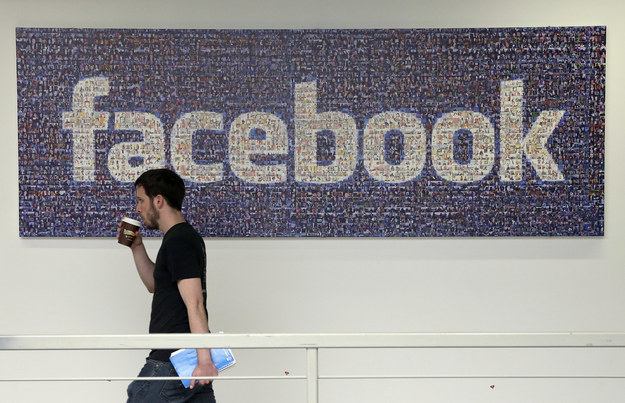
A Facebook employee walks past a sign at Facebook headquarters in Menlo Park, California, on March 15, 2013.

Jeff Chiu / AP

Facebook on Friday changed its controversial trending news section to be based more heavily on algorithms, eliminating the editors who had been curating the stories in the process.

The social network explained the changes in a statement, saying a more algorithmically driven process “allows us to scale Trending to cover more topics and make it available to more people globally over time.”

“In this new version of Trending we no longer need to draft topic descriptions or summaries, and as a result we are shifting to a team with an emphasis on operations and technical skill sets, which helps us better support the new direction of the product,” a Facebook spokesperson said.

BuzzFeed News confirmed that, as a result of the change, Facebook also eliminated the positions for people who had previously run the trending news section.

Quartz reported that the team — which included between 15 and 18 people contracted through an outside company — were laid off Friday and given severance equal to what they would have earned through September, plus two weeks.

Facebook has generated significant controversy in recent months over allegations that its trending section had a liberal bias. In May, Gizmodo published a report citing former “news curators” who said they were instructed to inject stories into the trending section, even if those stories weren&;t actually trending, while also suppressing other more conservative content.

The report prompted the US Senate to demand answers from Facebook over the alleged bias, after which the company published internal “trending guidelines” and promised to improve training, terminology, and practices for news curation.

In Friday&039;s announcement, Facebook explained that users visiting the new trending section will now see a “simplified topic,” along with information about who is discussing that topic. Hovering over or clicking on the link will bring up more information.

Facebook said Friday that articles in the trending section surface “based on a high volume of mentions and a sharp increase in mentions over a short period of time.” The company added that while it did not find evidence of “systematic bias” earlier this year, the new changes to the product “allows our team to make fewer individual decisions about topics.”

“Facebook is a platform for all ideas, and we’re committed to maintaining Trending as a way for people to access a breadth of ideas and commentary about a variety of topics,” the company added.

LINK: Facebook VP Says “No Evidence” Of Political Bias Against Conservatives

LINK: Facebook Publishes Internal “Trending Topics” Guidelines After Bias Claims

Quelle: <a href="Facebook Eliminates Human Trending Topic Editors And Replaces Them With An Algorithm“>BuzzFeed

Is This An Ad? Jonathan Cheban And The Whopperito

Welcome to our weekly column, “Is This an Ad?,” in which we strap on our reportin’ hat (it is NOT a fedora, please stop imagining that) and aim to figure out what the heck is going on in the confusing world of celebrity social media endorsements. Because even though the FTC recently came out with rules on this, sometimes when celebrities post about a product or brand on social media, it’s not immediately clear if they are being paid to post about it, got a freebie, just love it, or what.


Instagram: @jonathancheban

THE CASE:

Jonathan Cheban is a former publicist, current entrepreneur, bon vivant, internet troll, and, perhaps most famously, Kim Kardashian’s best friend. Martha Stewart does not know who he is.

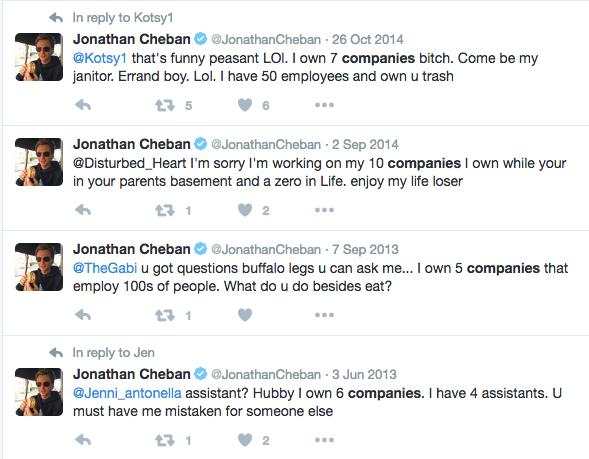
In his current career incarnation (Cheban is quick to point out that he hasn’t done PR in years, and now owns between 5-10 companies, depending what month you ask him), he has some sort of relationship (perhaps partial owner?) with a burger joint on Long Island and a lifestyle website called TheDishh.com.

Perhaps because of these new business developments, he’s taken a turn to positioning himself as some sort of culinary expert, referring to himself as the “Foodg&;d.” The bar over the “o” is called a macron, and it means the word should be pronounced “foodgoad”.

(I have a theory of how this came about: starting maybe two years ago, Cheban began experimenting with a fairly typical Instagram ploy to gain followers: reposting like-bait photos of decadent desserts or other foods. These were photos he found elsewhere and would caption things like “mmm yum&;” or about how much he wanted to eat it. He still does some of this sort of stuff, like a recent post where he posted a photo of an ice cream cotton-candy hybrid with the caption, “I need to try this cotton candy ice cream cone immediately …xx Foodg&x14D;d.”)

Instagram: @jonathancheban

But we’re not here to talk about ice-cream cotton candy. We’re here to talk about Cheban’s recent post about eating Burger King’s new menu item, the Whopperito.

The Whopperito is fairly straightforward: it’s Whopper filling (with spicer meat), in a burrito tortilla instead of a bun. Nick Gazin, a Vice reporter who recently ate three of these for a review, wrote: “It is my belief that this Whopperito was made to cater to the Jackass generation who want to do gross things on Instagram to show off. I don&;t think this was an earnest food invention. I think this is stunt-burgerism created to get press and hashtags.”

THE EVIDENCE:

So, the obvious thing here is that Mr. Cheban used the hashtag . That seems like, obvs it’s an , right? I mean, he’s saying it right there. OR IS HE?

Here’s the weird part: if you search that hashtag, two posts show up. The other is from 3 weeks before Jonathan&039;s, from a young fashion and lifestyle blogger named Ria Michelle (I reached out to her to ask if she could confirm she was paid; I did not hear back). The best theory here is that a digital marketing agency convinced Burger King to pay social influencers to post about the Whopperito using the cheeky and winking tag thekingpaidmetodoit (so transgressive and ironic, right?) And yet… they only found 2 people to actually use the tag? Sounds like some ad buyer somewhere has some explaining to do.

There’s something more mysterious about the fact that only two people used the tag – it confuses the obvious narrative that this is clearly a paid ad. Was this just a huge failure, or is there something else going on?

Here’s how celebrity endorsements work: companies want someone who will ~align with their brand’s message~. Even if consumers know it’s an ad, that’s ok, it still has to be someone who makes sense. When we see Matthew McConaughey monologuing to a cow in a TV ad for Lincoln cars, we know it’s he’s getting paid, but isn’t there something about it where you’re like “yeah, I could totally imagine he’d drive a Lincoln”? There’s a good brand alignment there.

Cheban’s recent personal branding as “foodgoad” is relevant here: He’s worked to establish himself as an influencer in the world of viral, unhealthy food. Remember what Vice said about the Whopperito, how it was just a social media stunt food? Well, what better way to align a product that is purely a vapid, frivolous trend food designed only to appeal to society’s lowest denominator than with Jonathan Cheban? It’s simply good brand alignment.

THE VERDICT:

UNDETERMINED.

Believe it or not, we couldn’t verify this. BuzzFeed News reached out to Burger King to confirm if this was a paid endorsement, and they refused to comment on it. Which…. is not a good look for them, since according to the FTC’s point of view, it’s the responsibility of the brand to be crystal-clear about paid social media endorsements.

So then we tried to ask Cheban. I’m already blocked by him for posting about how he is rude to fans on social media, so fellow BuzzFeed reporter Jess Misener asked:

Cheban didn’t reply, and promptly blocked Jess on Twitter.

WHAT ARE YOU HIDING, JONATHAN?

Since both Cheban and Burger King were stonewalling me, I went to some experts in the field of celebrity endorsements to find out their opinions on this.

According to Stefania Pomponi, founder and president of the Clever Girls influencer marketing agency:

I am 99.9% positive Jonathan Cheban&039;s Whopperito post is a paid sponsorship. He is being coy about disclosing his paid endorsement, which is in direct violation of FTC guidelines which state that standardized hashtags like ad or be used. The guidelines further explain that disclosure hashtags must have a clear meaning to the audience (meaning the audience shouldn&039;t have to guess if a post is sponsored) and hashtags can&039;t be abbreviated (e.g. instead of sponsored). If Cheban wants to be in compliance, he needs to make sure his disclosures … are clearly and easily understood by his audience.

Lucas Brockner, associate director of partnerships and business development at the social media agency Attention:

While nobody loves seeing the ad, sponsored or the somewhat sneaky sp, it’s part of the FTC guidelines and something we ask all influencers to include in posts. To no surprise, influencers don’t like putting this in their posts as it can result in negative backlash from their audiences. As a result and as seen in this example, you’re starting to see more clever ways that influencers are disclosing that they were paid for these types of social promotions. Of course, the more authentic the partnership, the more creative you can be. For example, the idea of using the language “in partnership with” has become a favored term amongst influencers/celebrities and brands when it’s an ongoing content series versus a one-off endorsement.

Dear readers, I have failed you here. Some secrets are too deep, too dangerous, too guarded by the forces of power and money to ever be revealed. Whether or not Jonathan Cheban ate that god-awful meat tube for fun or profit is one of those secrets.

Quelle: <a href="Is This An Ad? Jonathan Cheban And The Whopperito“>BuzzFeed

How To Save Mankind From The New Breed Of Killer Robots

A very, very small quadcopter, one inch in diameter can carry a one- or two-gram shaped charge. You can order them from a drone manufacturer in China. You can program the code to say: “Here are thousands of photographs of the kinds of things I want to target.” A one-gram shaped charge can punch a hole in nine millimeters of steel, so presumably you can also punch a hole in someone’s head. You can fit about three million of those in a semi-tractor-trailer. You can drive up I-95 with three trucks and have 10 million weapons attacking New York City. They don’t have to be very effective, only 5 or 10% of them have to find the target.

There will be manufacturers producing millions of these weapons that people will be able to buy just like you can buy guns now, except millions of guns don’t matter unless you have a million soldiers. You need only three guys to write the program and launch them. So you can just imagine that in many parts of the world humans will be hunted. They will be cowering underground in shelters and devising techniques so that they don’t get detected. This is the ever-present cloud of lethal autonomous weapons.

They could be here in two to three years.

— Stuart Russell, professor of computer science and engineering at the University of California Berkeley

Mary Wareham laughs a lot. It usually sounds the same regardless of the circumstance — like a mirthful giggle the blonde New Zealander can’t suppress — but it bubbles up at the most varied moments. Wareham laughs when things are funny, she laughs when things are awkward, she laughs when she disagrees with you. And she laughs when things are truly unpleasant, like when you’re talking to her about how humanity might soon be annihilated by killer robots and the world is doing nothing to stop it.

One afternoon this spring at the United Nations in Geneva, I sat behind Wareham in a large wood-paneled, beige-carpeted assembly room that hosted the Convention on Certain Conventional Weapons (CCW), a group of 121 countries that have signed the agreement to restrict weapons that “are considered to cause unnecessary or unjustifiable suffering to combatants or to affect civilians indiscriminately”— in other words, weapons humanity deems too cruel to use in war.

The UN moves at a glacial pace, but the CCW is even worse. There’s no vote at the end of meetings; instead, every contracting party needs to agree in order to get anything done. (Its last and only successful prohibitive weapons ban was in 1995.) It was the start of five days of meetings to discuss lethal autonomous weapons systems (LAWS): weapons that have the ability to independently select and engage targets, i.e., machines that can make the decision to kill humans, i.e., killer robots. The world slept through the advent of drone attacks. When it came to LAWS would we do the same?

Yet it’s important to get one thing clear: This isn&;t a conversation about drones. By now, drone warfare has been normalized — at least 10 countries have them. Self-driving cars are tested in fleets. Twenty years ago, a computer beat Garry Kasparov at chess and, more recently, another taught itself how to beat humans at Go, a Chinese game of strategy that doesn’t rely as much on patterns and probability. In July, the Dallas police department sent a robot strapped with explosives to kill an active shooter following an attack on police officers during a protest.

But with LAWS, unlike the Dallas robot, the human sets the parameters of the attack without actually knowing the specific target. The weapon goes out, looks for anything within those parameters, hones in, and detonates. Examples that don’t sound entirely shit-your-pants-terrifying are things like all enemy ships in the South China Sea, all military radars in X country, all enemy tanks on the plains of Europe. But scale it up, add non-state actors, and you can envision strange permutations: all power stations, all schools, all hospitals, all fighting-age males carrying weapons, all fighting-age males wearing baseball caps, those with brown hair. Use your imagination.

While this sounds like the kind of horror you pay to see in theaters, killer robots will shortly be arriving at your front door for free courtesy of Russia, China, or the US, all of which are racing to develop them. “There are really no technological breakthroughs that are required,” Russell, the computer science professor, told me. “Every one of the component technology is available in some form commercially … It’s really a matter of just how much resources are invested in it.”

LAWS are generally broken down into three categories. Most simply, there&039;s humans in the loop — where the machine performs the task under human supervision, arriving at the target and waiting for permission to fire. Humans on the loop — where the machine gets to the place and takes out the target, but the human can override the system. And then, humans out of the loop — where the human releases the machine to perform a task and that’s it — no supervision, no recall, no stop function. The debate happening at the UN is which of these to preemptively ban, if any at all.

“I know that this is a finite campaign — the world’s going to change, very quickly, very soon, and we need to be ready for that.”

Wareham, the advocacy director of the Human Rights Watch arms division, is the coordinator of the Campaign to Stop Killer Robots, a coalition of 61 international NGOs, 12 of which had sent delegations to the CCW. Unlike drones, which entered the battlefield as surveillance technology and were weaponized later, the campaign is trying to ban LAWS before they happen. Wareham is the group’s cruise director — moderating morning strategy meetings, writing memos, getting everyone to the right room at the right time, handling the press, and sending tweets from the @BanKillerRobots account.

This year was the big one. The CCW was going to decide whether to go to the next level, to establish a Group of Governmental Experts (GGE), which would then decide whether or not to draft a treaty. If they didn’t move forward, the campaign was threatening to take the process “outside”— to another forum, like the UN Human Rights Council or an opt-in treaty written elsewhere. “Who gets an opportunity to work to try and prevent a disaster from happening before it happens? Because we can all see where this is going,” Wareham told me. “I know that this is a finite campaign — the world’s going to change, very quickly, very soon, and we need to be ready for that.”

That morning, countries delivered statements on their positions. Algeria and Costa Rica announced their support for a ban. Wareham excitedly added them to what she and other campaigners refer to as “The List,” which includes Pakistan, Egypt, Cuba, Ecuador, Bolivia, Ghana, Palestine, Zimbabwe, and the Holy See — countries that probably don’t have the technology to develop LAWS to begin with. All eyes were on Russia, which had given a vague statement suggesting they weren’t interested. “They always leave us guessing,” Wareham told me when we broke for lunch, reminding me only one country needs to disagree to stall consensus. The cafe outside the assembly room looked out on the UN’s verdant grounds. You could see placid Lake Geneva and the Alps in the distance.

In the afternoon, country delegates settled into their seats to take notes or doze with their eyes open as experts flashed presentation slides. The two back rows were filled with civil society, many of whom were part of the campaign. During the Q&A, the representative from China, who is known for being somewhat of an oratorical wildcard, went on a lengthy ramble about artificial intelligence. Midway through, the room erupted in nervous laughter and Erin Hunt, program coordinator from Mines Action Canada, fired off a tweet: “And now the panel was asked if they are smarter than Stephen Hawking. Quite the afternoon at .” (Over the next five days, Hunt would begin illustrating her tweets with GIFs of eye rolls, prancing puppies, and facepalms.)

A few seats away, Noel Sharkey, emeritus professor of robotics and artificial intelligence at Sheffield University in the UK, fidgeted waiting for his turn at the microphone. The founder of ICRAC, the International Committee for Robot Arms Control (pronounced eye-crack), plays the part of the campaign’s brilliant, absent-minded professor. With a bushy long white ponytail, he dresses in all black and is perpetually late or misplacing a crucial item — his cell phone or his jacket.

In the row over, Jody Williams, who won the Nobel Peace Prize in 1997 for her work banning landmines, barely suppressed her irritation. Williams is the campaign’s straight shooter — her favorite story is one in which she grabbed an American colonel around the throat for talking bullshit during a landmine cocktail reception. “If everyone spoke like I do, it would end up having a fist fight,” she said. Even the usually tactful Wareham stopped tweeting. “I didn’t want to get too rude or angry. I don’t think that helps especially when half the diplomats in that room are following the Twitter account,” she explained later and laughed.

But passionate as they all were, could this group of devotees change the course of humanity? Or was this like the campaign against climate change — just sit back and watch the water levels rise while shaking your head in dismay? How do you take on a revolution in warfare? Why would any country actually ban a weapon they are convinced can win them a war?

And maybe most urgently: With so many things plainly in front of us to be fearful of, how do you convince the world — quickly, because these things are already here — to be extra afraid of something we can&039;t see for ourselves, all the while knowing that if you fail, machines could kill us all?

Jody Williams (left), a Nobel Peace Laureate, and Professor Noel Sharkey, chair of the International Committee for Robot Arms Control, pose with a robot as they call for a ban on fully autonomous weapons, in Parliament Square on April 23, 2013, in London, England.

Oli Scarff / Getty Images

One of the very real problems with attempting to preemptively ban LAWS is that they kind of already exist. Many countries have defensive systems with autonomous modes that can select and attack targets without human intervention — they recognize incoming fire and act to neutralize it. In most cases, humans can override the system, but they are designed for situations where things are happening too quickly for a human to actually veto the machine. The US has the Patriot air defense system to shoot down incoming missiles, aircraft, or drones, as well as the Aegis, the Navy’s own anti-missile system on the high seas.

Members of the campaign told me they do not have a problem with defensive weapons. The issue is offensive systems in part because they may target people — but the distinction is murky. For example, there’s South Korea’s SGR-A1, an autonomous stationary robot set up along the border of the demilitarized zone between North and South Korea that can kill those attempting to flee. The black swiveling box is armed with a 5.56-millimeter machine gun and 40-millimeter grenade launcher. South Korea says the robot sends the signal back to the operator to fire, so there is a person behind every decision to use force, but there are many reports the robot has an automatic mode. Which mode is on at any given time? Who knows.

Meanwhile, offensive systems already exist, too: Take Israel’s Harpy and second-generation Harop, which enter an area, hunt for enemy radar, and kamikaze into it, regardless of where they are set up. The Harpy is fully autonomous; the Harop has a human on the loop mode. The campaign refers to these as “precursor weapons,” but that distinction is hazy on purpose — countries like the US didn’t want to risk even mentioning existing technology (drones), so in order to have a conversation at the UN, everything that is already on the ground doesn’t count.

Militaries want LAWS for a variety of reasons — they&039;re cheaper than training personnel. There’s the added benefit of force multiplication and projection. Without humans, weapons can be sent to more dangerous areas without considering human-operator casualties. Autonomous target selection allows for faster engagement and the weapon can go where the enemy can jam communications systems.

Israel openly intends to move toward full autonomy as quickly as possible. Russia and China have also expressed little interest in a ban. The US is only a little less blunt. In 2012, the Department of Defense issued Directive 3000.09, which says that LAWS will be designed to allow commanders and operators to exercise “appropriate levels of human judgment over the use of force.” What “appropriate” really means, how much judgment, and in which part of the operation, the US has not defined.

In January 2015, the DoD announced the Third Offset strategy. Since everyone has nuclear weapons and long-range precision weapons, Deputy Secretary of Defense Robert Work suggested emphasizing technology was the only way to keep America safe. With the DoD’s blessing, the US military is racing ahead. Defense contractor Northrop Grumman’s X-47B is the first autonomous carrier-based, fighter-sized aircraft. Currently in demos, it looks like something from Independence Day: The curved, grey winged pod takes off from a carrier ship, flies a preprogrammed mission, and returns. Last year, the X-47B autonomously refueled in the air. In theory, that means except for maintenance, an X-47B executing missions would never have to land.

At an event at the Atlantic Council in May, Work said the US wasn’t developing the Terminator. “I think more in terms of Iron Man — the ability of a machine to assist a human, where the human is still in control in all matters, but the machine makes the human much more powerful and much more capable,” he said. This is called centaur fighting or human–machine teaming.

Among the lauded new technologies is swarms — weapons moving in large formations with one controller somewhere far away on the ground clicking computer keys. Think hundreds of small drones moving as one, like a lethal flock of birds that would put Hitchcock’s to shame, or an armada of ships. The weapons communicate with each other to accomplish the mission, in what is called collaborative autonomy. This is already happening — two years ago, a small fleet of ships sailed down the James River. In July, the Office of Naval Research tested 30 drones flying together off a small ship at sea that were able to break out of formation, perform a mission, and then regroup.

Quelle: <a href="How To Save Mankind From The New Breed Of Killer Robots“>BuzzFeed
Advocacy Group Files FTC Complaint Over Kardashians' Instagram Ads

Kylie Jenner&;s Instagram for Fit Tea.

Via instagram.com

Last week, the nonprofit consumer advocacy group Truth in Advertising (TINA) sent a letter to the Kardashian/Jenner clan warning them about deceptive advertising on their social media.

Today, the organization officially filed a complaint with the Federal Trade Commission, saying that Kim Kardashian West and her sisters had failed to comply with FTC disclosure standards for paid ads.

The Kardashians are notorious for hawking teeth whiteners, diet teas, waist trainers, and other products on social media, usually without disclosing that these are ads by using a hashtag like ad or . TINA has compiled a database of the these ads.

Since last week’s letter, the Kardashians have gone back and deleted a few old posts that were in violation, or updated them to say ad at the beginning.

The FTC has rules on sponsored social media posts. The agency wants it to be clear to consumers if something is a paid endorsement — especially because, unlike traditional TV or magazine ads, sponsored social media can be a bit murky. According to the FTC’s social media guidelines, “the question you need to ask is whether knowing about that gift or incentive would affect the weight or credibility your readers give to your recommendation. If it could, then it should be disclosed.” The FTC also prefers that posters include their disclaimers at the beginning, not the end, of a post (which may be cut off by Instagram), and that they don’t use abbreviations like .

A recent post for vitamins now says ad at the beginning:

Instagram: @kimkardashian

TINA filing a complaint doesn’t mean the FTC will actually do anything, and technically anyone can file an FTC complaint. TINA has a history of working with the FTC and has had some success getting the agency to act on complaints they’ve filed. TINA recently brought to the government&039;s attention Vemma, an energy drink company that was eventually shut down by the FTC for being a pyramid scheme.

“The Kardashian/Jenner family and the companies that have a commercial relationship with them have ignored this law for far too long, and it’s time that they were held accountable,” Bonnie Patten, executive director of TINA, said in their statement on the complaint.

A representative for TINA told BuzzFeed News that since sending the letter out, the organization has been working with a lawyer for the Kardashians, who had been cooperative. But as of today, lots of posts still hadn’t been changed.

Interestingly, posts about smaller companies like SugarBearHair (a vitamin supplement) or Fit Tea were updated quickly. But bigger companies like Estée Lauder (for which Kendall Jenner is a spokesmodel) or Puma (for which Kylie Jenner is a spokesmodel) were more likely to resist being updated with something as gauche as “ad.” In one of Kendall’s original posts, she tagged @EsteeLauder and hashtagged it — something that a casual Kendall fan might not know signifies that she has a longstanding advertising relationship with the company. Kendall recently updated the photo with an additional hashtag, .

Kendall’s updated post now says EsteeModel:

instagram.com

According to the complaint filed with the FTC, “The willingness of the Kardashians/Jenners to alter their Instagram posts endorsing companies such as SugarBearHair suggests they would also fix other similarly deceptive posts if permitted to do so by the other companies they endorse. As such, it is apparent that the issue is with the companies, who continue to flagrantly ignore the law.”

In general, the FTC considers brands/companies to be on the hook for making social media ads clear, and they don’t try to go after individual bloggers or social media personalities. For example, in a recent case involving Warner Bros. placing ads with video game vloggers, the agency fined Warner Bros., not the vloggers. But in the case of the Kardashians, who are running a huge business off of social media endorsements, it’s possible the FTC could decide to make an example out of them to set a precedent.

Earlier this week, lawyers for the Kardashian/Jenner family told TINA in a statement that they planned to “work swiftly and diligently with our brand partners and TINA” to clear up confusing old posts. BuzzFeed News has reached out to the lawyers for comment on the filing of the FTC complaint.

Quelle: <a href="Advocacy Group Files FTC Complaint Over Kardashians&039; Instagram Ads“>BuzzFeed

Want To Run Promoted Stickers On Twitter? It'll Cost At Least $500,000

Advertisers who want to run Promoted Sticker ad campaigns on Twitter will have to fork over at least $500,000 to do it, multiple sources tell BuzzFeed News.

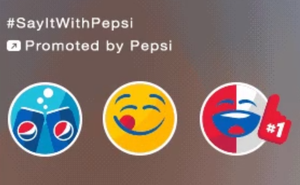
In June, Twitter introduced stickers, which you can overlay on top of pictures you tweet, and search just like hashtags. Earlier this month, Pepsi ran the first Promoted Sticker campaign.

The $500,000 minimum ad spend can be spread across multiple Twitter ad products — so advertisers who don&;t want to drop half a mil on Promoted Stickers can use some of the ad buy on Promoted Tweets and the like.

But even so, it&039;s a large sum for a product that didn&039;t exist two months ago. If Promoted Stickers do take off, they could help Twitter diversify its revenue sources — something it needs to do to stay competitive with Snapchat, which has introduced innovative ad products such as sponsored geo-filters and sponsored selfie lenses.

The $500,000 minimum comes at a moment when Twitter has been lowering its minimums on other ad products, BuzzFeed News has learned. “I think they are beginning to realize that the barriers to entry have historically been too high for a lot of the products,” one advertising executive told BuzzFeed News. “I was surprised that they came in at such a high figure with this.”

But companies do tend to open up their ad products to more customers over time, so the $500,000 figure could come down eventually. As one ad agency executive said, “When a platform prices a new ad offering that high, it&039;s generally to keep the riff-raff out; only the serious buyers need apply.”

Quelle: <a href="Want To Run Promoted Stickers On Twitter? It&039;ll Cost At Least 0,000“>BuzzFeed

The Alt-Right Has Its Own Comedy TV Show On A Time Warner Network

The Alt-Right Has Its Own Comedy TV Show On A Time Warner Network

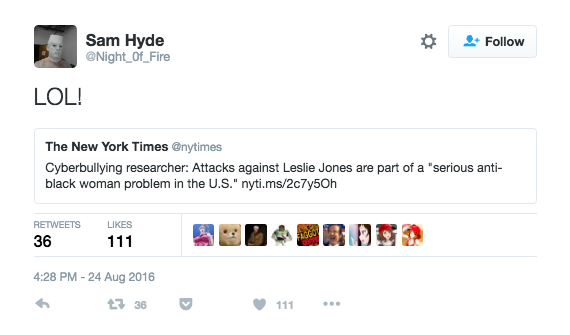
@Night_0f_Fire is in almost every way a quintessential alt-right Twitter user. He supports Donald Trump. He hates Hillary Clinton and questions her health. He retweets the full spectrum of the movement&;s icons, from macho culture warriors like Mike Cernovich and Pax Dickinson to conspiracy mongers like Alex Jones to overt racists. He calls Lena Dunham a “fat pig,” cheers the demise of Larry Wilmore&039;s Nightly Show, and bemoans the presence of “burkhas in video games.” He mocks Black Lives Matter. His tweets are fully in line with the wildly prolific online movement that has spawned Milo Yiannopoulos, triple parentheses to demarcate Jews, and the term “cuckservative.”

In fact, there&039;s really only one thing that separates @Night_0f_Fire — real name Sam Hyde — from the many other members of the angry, pro-Trump internet movement that grew out of Gamergate into a force capable of roiling American popular and political culture: Hyde has his own television show on Cartoon Network.

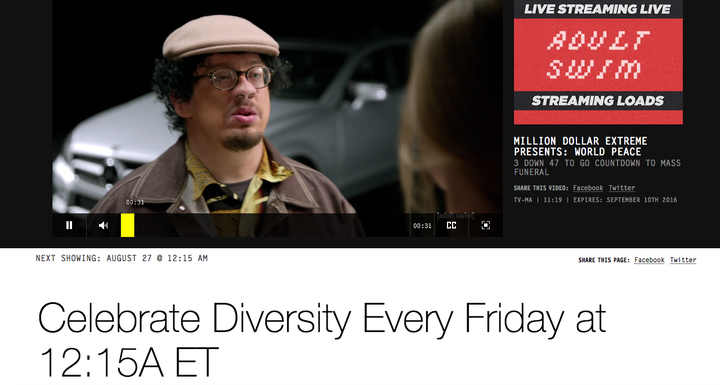
Million Dollar Extreme Presents: World Peace airs every Saturday at 12:15 a.m. on Adult Swim, the 8 p.m. to 6 a.m. incarnation of Cartoon Network famous for its stoner-y animation and sketch comedy. World Peace, which will air its fourth episode this weekend, is the latter. It&039;s the first wide exposure for MDE, a comedy group comprising Hyde and two collaborators that has gained a cult following on the internet and a reputation for being hugely offensive.

Promotional material for World Peace winks at Hyde&039;s alt-right fans. “Celebrate Diversity Every Friday at 12:15A ET,” reads the tagline on the Adult Swim website. Press copy announcing the show promised that “World Peace will unlock your closeted bigoted imagination, toss your inherent racism into the burning trash, and cleanse your intolerant spirit with pure unapologetic American funny_com.” Though none of the three episodes that have aired so far have touched on politics or the alt-right, they have hardly been in good taste. The most recent episode of the show opened with Hyde, in blackface, speaking in exaggerated black vernacular for three minutes.

According to Showbuzz Daily, World Peace ranked number two among original cable shows on the night of its premiere, with more than a million viewers.

Adult Swim

The alt-right — which will attain its greatest notoriety yet when Hillary Clinton gives a speech today denouncing it — has noticed the show. On Twitter, a steady stream of pro-Trump troll accounts have anointed World Peace “the only non cucked TV show” and “redpilled TV” that “will save the west.” A subreddit devoted to the show, moderated by someone claiming to be Hyde, describes itself with the ubiquitous Trump hashtag as “the Best Damn Internet Community™ on God&039;s green earth. .” My Posting Career, the 4chan-meets-far-right-politics forum that helped coin “cuckservative,” is running a special “Faggot alert” at the top of the page alerting readers that World Peace airs every Friday:

Reached via phone, Hyde attributed all of the tweets and Reddit posts to “his assistant.” Asked if he was a member of the alt-right, Hyde responded with a question: “Is that some sort of indie book store?”

Turner, which owns Cartoon Network and Adult Swim, responded to a request for comment by forwarding a written statement from an Adult Swim spokesperson:

“Adult Swim’s reputation and success with its audience has always been based on strong and unique comedic voices. Million Dollar Extreme’s comedy is known for being provocative with commentary on societal tropes, and though not a show for everyone, the company serves a multitude of audiences and supports the mission that is specific to Adult Swim and its fans.”

For the Carnegie Mellon and RISD–educated Hyde, World Peace is the latest act in a years-long career of making people uncomfortable. Though MDE has been publishing videos since at least 2009 (an early one is titled “old faggot”), Hyde is probably most famous for a 2013 stunt in which he hijacked a TEDx symposium in Philadelphia and gave a nonsensical presentation called “2070 Paradigm Shift,” to polite applause. More often — and surely the major reason for his popularity among the alt-right — he exploits, sometimes cruelly, cultural sensitivities around race, gender, and sexual orientation.

At a 2013 comedy event in Brooklyn, he performed a shocking set, a recording of which became a minor viral hit titled “Privileged White Male Triggers Oppressed Victims, Ban This Video Now and Block Him.” Hyde began by mocking the “hipster faggot” audience — at which point a few onlookers immediately left — then removed a piece of paper from his back pocket and proceeded to read 15 minutes of anti-gay pseudo science (“homosexuality is the manifestation of intense perversion and antisocial attitudes”) and outright hate speech (“next time you see a crazy gay person maybe it&039;s not because they were bullied, maybe it&039;s not because of homophobia … maybe it&039;s just because of their faggot brain that&039;s all fucked up”). He concluded by blaming positive portrayals of gay people on television on the “ZOG (Zionist Occupation Government) media machine destroying the family.” At the end of the set, he went outside to argue with some of the people who had left.

Last year, BuzzFeed News reported that a gun- and knife-brandishing internet personality named Jace Connors — who became notorious for claiming to crash his car while en route to the home of Brianna Wu, one of the most public victims of Gamergate – was actually the work of a member of MDE named Jan Rankowski, who created the Connors “character” with input from Hyde.

And last fall, Hyde and fellow MDE member Charls Carroll showed up near the Yale campus in New Haven bearing signs reading “All Lives Matter” and “No More Dead Black Children,” then proceeded to film a highly uncomfortable 15-minute video called “Yale Lives Matter” in which Hyde, among other things, lectures a black Apple store security guard that he is “playing a part in an oppressive system,” harangues the black employee of a preppy clothes store for selling “slave owner clothes,” and asks two young white men if they “killed any minorities today.”

This year, Hyde — or his assistant — seems to have decided to cast his lot in with the alt-right.Though Hyde has deleted all his tweets from before the new year, since then he&039;s been remarkably consistent in engaging with the major concerns of and personalities in the movement.

The alt-right, which idealizes offensive speech as a principled transgression against a censorious liberal culture, is a natural fit for MDE&039;s comedy, which combines nerdy references to anime and video games with the sinister goofiness of Tim and Eric, the anti-PC mean streak of pre-corporate Vice, and the terminal irony of meme culture. Indeed, MDE and Hyde specifically have been beloved on 4chan, one of the alt-right&039;s incubators, for years.

If Hyde isn&039;t quite of shitlord culture, he most certainly plays along. Earlier this year, Hyde became the possibly witting subject of a series of 4chan-perpetrated hoaxes that named him as the suspect in a series of mass shootings. A first cut of World Peace, aired online as part of an Adult Swim series called Development Meeting, featured a logo that fans quickly figured out was a copy of a symbol that Aurora shooter James Holmes scribbled in his notebooks. (It was cut from the actual broadcast.)

All of which raises the feeling that World Peace is one massive in-joke, designed to signify to a group of people online for whom the limits of irony have been misplaced and forgotten; identity content for the worst trolls in the world. After being revealed as the Jace Connors character, Jan Rankowski told BuzzFeed News that the videos had been a satire about “over-the-top, super-hyper-macho armed Gamergater.”

It&039;s a trap just to read Sam Hyde literally — he&039;s built a career out of making fun of people who take his speech too seriously. But that has not stopped Hyde&039;s alt-right admirers from trying to divine his true politics, in the same way they scan his show for secret messages. The closest they&039;ve come is a post by Hyde — or his assistant — on the MDE subreddit from late last year in which he – or his assistant — describes himself as basically a libertarian who believes that “we&039;re putting Western Civ on the alter [sic] as a sacrifice to white guilt because we&039;re worried some frizzy-haired Afro transsexual will wag his finger at us” and that “whites need to regain some sort of cohesive tribal self-interest and identity right now just like everybody else has.”


Whether or not this is genuine is basically unknowable, as Hyde never publicly breaks character. (Though he did add over the phone that “my assistant does a good job.”) It&039;s also beside the point for everyone except the converted — including executives at Adult Swim. Because it&039;s also a trap to not see the seriousness of what Hyde and co. are doing, even if they&039;re LOLiarng along the way and being disingenuous. Indeed, when the consequences of a culture involve the serial harassment and illegal publication of explicit photographs of a black actress because she had the temerity to stick up for herself, does it really matter whether the people having a laugh over it are in character?

Quelle: <a href="The Alt-Right Has Its Own Comedy TV Show On A Time Warner Network“>BuzzFeed