Announcing the release of Azure Mobile Apps Node SDK v3.0.0

We are excited to announce the next iteration of the Azure Mobile Apps Node.js Server SDK.  This release includes a stack of new features, improvements and bug fixes.

Data Transforms, Filters and Hooks

One of the great features within the Server SDK was the ability to provide security filtering and record transformation at the server level, allowing the developer to refine the request-response pipeline for the server by writing JavaScript code.  With the v3.0 release, we&;ve further refined the extensibility points to allow you to manipulate incoming queries and items, and trigger functionality after each data operation. You can, of course, create and distribute your own filters, transforms and hooks. However, we&039;ve packaged some common filters that reduce the amount of code you need to write.

Per-User Tables

Perhaps the most common filter request is to provide per-user data.  Per-user tables can be used with authentication to restrict data within the table to individual users.  To use this filter, add perUser = true to the table definition.  For example:

var table = require("azure-mobile-apps").table();
table.access = "authenticated";
table.perUser = true;
module.exports = table;

Web Hooks

Web hooks can be used to call external HTTP endpoints (for example, Azure Functions) after each data operation completes:

var table = require("azure-mobile-apps").table();
table.webhook = { url: "https://function.azurewebsites.net/apo/HttpTriggerNodeJS1" };
module.exports = table;

For more information on this feature, including the structure that is posted to the HTTP endpoint, refer to the API Reference.

Record Expiry

Another commonly requested filter is the ability to prevent access to records older than a certain interval. For example, you may want to deny access to records older than 1 day:

var table = require("azure-mobile-apps").table();
tables.recordsExpire = { days: 1 };
module.exports = table;

For more information on specifying intervals, see the API reference.

Data Query Improvements

Azure Mobile Apps Servers sometimes have to refer to other tables to produce the right tables. We&039;ve made some improvements to the Query API to make specific common scenarios easier.

Including Soft Deleted Records

When you have soft-delete turned on, records are marked as deleted instead of being actually deleted from the SQL table. This information then flows down to other mobile devices so that they can update their offline cache. You can specify .includeDeleted() in the query to include deleted items:

table.insert((context) => {
return context.tables(&039;otherTable&039;).includeDeleted().read()
.then((results) => {
context.item.count = results.length;
return context.execute();
});
});

Retrieving Records by ID

We&039;ve added a simple find function to make retrieving records by ID much simpler:

table.insert((context) => {
return context.tables(&039;otherTable&039;).find(context.item.parentId)
.then((parent) => {
context.item.parentName = parent.name;
return context.execute();
});
});

Object Queries

Previously, you could use object based queries to query tables, but the same functionality was not available on update and delete operations. This functionality is now available and allows you to, for example, delete dependent records:

table.delete((context) => {
return context.tables(&039;childTable&039;)
.delete({ parentId: context.item.id })
.then(context.execute);
});

Handling Callbacks in Table Functions

Prior SDK releases had no support for callbacks within table operation functions.  Such methods required you to re-factor the code to produce a Promise.  In v3.0.0, we directly support callbacks.  When the callback is completed, call context.next(err), passing in any error.  For example:

var mongo = require(&039;mongodb&039;).MongoClient;

table.insert(function (context) {
context.execute().then(function () {
mongo.connect(&039;mongodb://localhost:27017/test&039;, function(err, db) {
db.collection(&039;items&039;).insertOne(context.item, function (err) {
// signal that the operation is complete, passing in any error that may have occurred
context.next(err);
});
});
});
});

Breaking Changes

When executing a query with both a skip() and take() clause against SQL Server, an additional column (ROW_NUMBER) was returned that was generated by the underlying query. This column is no longer returned. Because this change was implemented using T-SQL features available in SQL Server 2012 and above, versions of SQL Server prior to 2012 are no longer supported.

Installing the SDK

Whether you are creating a new Mobile App or upgrading an existing app, The Azure Mobile Apps Server SDK for Node is installed via npm:

npm install –save azure-mobile-apps@3.0

You can find full API documentation at our GitHub repository and a handy HOWTO document explaining how to build a mobile backend.
Quelle: Azure

Anti-Defamation League Boosting Presence In Silicon Valley

WASHINGTON — The Anti-Defamation League is placing a representative in Silicon Valley to work on cyber hate and harassment issues, BuzzFeed News has learned.

The move comes after significant trolling, particularly on Twitter, of Jewish journalists and other public figures, amounting to a wave of anti-Semitic expression not seen in the American conversation for decades — and as tech companies struggle to reckon with their role in regulating abusive speech.

“As a leading civil rights advocacy organization, ADL was early to recognize the burgeoning issue of cyberhate and how extremists were exploiting online platforms to spread antisemitism and target Jews as well as other minorities,” said Brittan Heller, who will become the group’s first Director of Technology and Society, in a statement. “From its first report on these cyberhate more than 30 years ago to this year’s work tracking the harassment of journalists on social media, ADL has demonstrated its commitment to ensuring our online communities are a safe and just place for all.”

Heller is a former cyber crime and human rights investigator and prosecutor, has also been a high-profile victim of online harassment. While she was at Yale Law School, she was subjected to sexual harassment on a law school messaging board. She and another student sued the board’s administrator as well as anonymous commenters for invasion of privacy and defamation. Heller and the other plaintiff settled with the defendants in 2009.

“We&;ve really doubled down on the work that we&039;re doing to deal with this new emerging and metastasizing trend of online harassment and cyber hate,” said ADL director Jonathan Greenblatt in an interview with BuzzFeed News, calling what has been happening on social media “breathtaking and downright scary.”

The 103-year-old ADL has traditionally focused on combating anti-Semitism, an issue that has been in the spotlight this year as Donald Trump’s candidacy has had the effect of empowering online trolls. The organization conducted an online harassment survey of journalists over the summer.

“We&039;ve had some wins with companies,” Greenblatt said, citing its participation in Twitter&039;s Trust and Safety Council and its working with Google to take down the Chrome extension which enabled users to place parentheses around Jewish names, a common device employed by the alt-right. The ADL declared the parentheses used in this way to be a hate symbol.

The group has been vocal during this election cycle about highlighting the issue of online harassment, forming a task force to investigate bigoted harassment of journalists in June and participating in SXSW’s Online Harassment Summit.

Quelle: <a href="Anti-Defamation League Boosting Presence In Silicon Valley“>BuzzFeed

Your Voice Can Control GoPro's New Hero 5 Camera

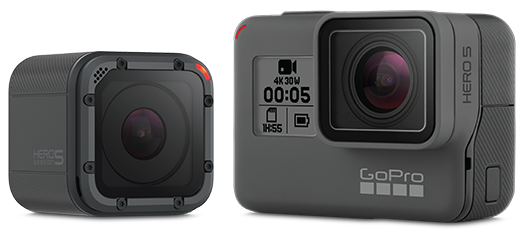
GoPro just unveiled two new cameras: the Hero 5 Black ($400) and the *slightly* more affordable Hero 5 Session ($300).

GoPro just unveiled two new cameras: the Hero 5 Black ($400) and the *slightly* more affordable Hero 5 Session ($300).

GoPro

GoPro is known for its rugged, outdoor sports-friendly cameras and its newest releases are no different. Both cameras also come something a little extra: voice control. Here&;s what you need to know about GoPro&039;s latest.

Both cameras are waterproof and can shoot 4k footage at 30 frames per second.

The Hero 5 Black and Hero 5 Session have the same water-resistance rating: submersion up to 10 meters (or 33 feet) without a separate housing case. Previously, GoPro&039;s most advanced camera, the Hero 4 Black, needed a protective case to protect it from water exposure.

The cameras also have the same video recording capabilities at 4K resolution and stereo microphones. GoPro has also dropped micro USB ports in favor of USB-C. The Hero 5 Black also has a micro HDMI port.

GoPro is introducing two new features: voice control and digital image stabilization.

Voice control offers hands-free control of the cameras. You&039;ll be able to say, “GoPro, take a photo” or “GoPro, start recording” in English, as well as German, French, Italian, Spanish, and Chinese.

The cameras also have video stabilization built-in for the first time. The software can produce smoother video capture than previous models.

The Hero 5 Black has a two-inch touchscreen and more advanced photo/video capabilities than the Session.

The Hero 5 Black has a two-inch touchscreen and more advanced photo/video capabilities than the Session.

GoPro

The Hero 5 Black has a touch display for changing settings, editing footage, and reviewing stills and clips, while the screen-less Session has a dedicated button for recording and is controlled through the companion GoPro mobile app.

The Hero 5 Black has the same photo/video capabilities of its predecessor, the Hero 4 Black: 12 megapixels for stills and, in addition to 4K at 30fps, 1440p video at 80 frames per second, and 1080p video at 120 frames per second – but is $50 less than the Hero 4 Black&039;s original $450 price.

Additionally, the camera also includes GPS for location capture and the ability to take photos in RAW or WDR mode.

It can capture 10 megapixel photos (vs. 8MP), and 1440p at 60 fps (vs. 30) and 1080p at 90 fps (vs. 60), as well as 4K video, which was not available in the first-generation Session.

GoPro

The drone, which can fly up to 400 feet high, 1000 feet away, can fold up and fit into a backpack that GoPro includes with the flying gadget. It costs $799 on its own.

The Hero 5 Black and Hero 5 Session will be available starting October 2 on GoPro.com.

Quelle: <a href="Your Voice Can Control GoPro&039;s New Hero 5 Camera“>BuzzFeed

How A Failed Hospital Algorithm Could Save Lives

Thomas Northcut / Getty Images

Sepsis is one of the biggest hospital hazards you’ve maybe never heard of. When the body overreacts to an infection, it can trigger widespread inflammation that can in turn cause tissue damage and organ failure. It causes one-third to one-half of all deaths in US hospitals.

But because sepsis’ symptoms, like fever and difficulty breathing, sometimes look a lot like other illnesses, it can be hard to detect, especially in the early stages. So a team at Banner Health, a hospital system in Phoenix, Arizona, turned to computer science for a solution. Maybe they could develop an algorithm that constantly monitored electronic health records and warned hospital staff in real time when patients were at high risk for sepsis.

It didn&;t work. At least, not in the way Banner had hoped for.

Five years after Banner put the alert in place, it turns out to not have done a very good job of diagnosing sepsis. But the team behind it, led by Dr. Hargobind Khurana, discovered it had an unexpected upside: It was good at identifying patients who were generally much sicker than average, even if they didn&039;t have sepsis. Although the alert mostly failed at its main goal, it ended up having a different, perhaps even more powerful potential: steering clinicians to their most vulnerable patients.

Compared to patients who didn’t set off the alert, those who triggered it had four times the chance of dying the next day.

Algorithms have infiltrated almost every part of our lives, quietly yet deftly shaping both the mundane — calendar alerts, Facebook ads, Google predictions — and the vital. One of the most critical roles algorithms play is in electronic medical record software, which hospitals and doctor’s offices use to track and manage patients’ health and illnesses. Algorithm-based alerts are supposed to point out important information hidden in mountains of data — things like when someone’s medication needs to be refilled, or when a patient has an unusually high heart rate.

At their best, these alerts save busy doctors and nurses precious decision-making energy and draw attention to dangers that would otherwise go unnoticed. Too often, however, they dilute their usefulness and urgency by beeping, buzzing, and flashing tens of thousands of times a day, often without a good reason.

Banner Health’s experiment demonstrates some of the core challenges of merging health care with 21st-century digital automation. It’s a continuing struggle despite the fact that the US government has poured billions into digitizing medical records in hopes of making them safer over the past few decades.

“It’s hard to create a good alert. And it’s hard to get buy-in from doctors and nurses because it’s ‘just another thing’ to do,” Khurana, Banner’s director of health management, told BuzzFeed News. “How do we keep that balance of not just expecting them to do more and more work, but how do we make sure the patient is taken care of? … How good do the alerts need to be? … Everybody in the health field is trying to figure out the answer to this.”

Moodboard / Getty Images

Banner Health started working on the alert in 2009; Khurana joined two years later. At first, they looked at the common criteria for sepsis and organ dysfunction, like high breath and heart rates, unusually high or low body temperature, and off-balance chemical levels in someone’s blood and organs. Then they used this criteria to design an alert that continuously analyzed electronic medical record data from medical device sensors and other sources. The alert would fire whenever a patient showed two of four symptoms for sepsis and at least one of 14 symptoms for organ dysfunction — if both of those things happened within eight hours of each other.

Khurana added the alert to Banner Health’s Cerner electronic medical record software, which, like other programs, comes with its own built-in alerts (but did not at the time have a sepsis alert). From April 2011 to June 2013, the sepsis algorithm monitored more than 312,000 patients across the emergency department, inpatient, and intensive care units of Banner Health’s 24 hospitals.

Weary, overworked staff are prone to ignore even alerts that point out signs of danger.

Not everyone was thrilled, Khurana recalls. Some nurses and doctors complained that not every patient flagged by the algorithm actually had sepsis — but the caregivers still had to evaluate the patients, override the alerts, and document it. Those steps may take just a few minutes, but the many false alarms made some staff members doubt if the algorithm was working at all.

A colleague who helped develop the alert, Dr. Nidhi Nikhanj, recalls similar sentiments. “There was certainly was a lot of skepticism, especially from those who had to actually answer the alerts, because of the extra workload it would bring on our shoulders,” he said.

These clinicians were grappling with a widespread phenomenon in health care dubbed “alarm fatigue.” In a 2013 report, the Joint Commission, a health care accreditation nonprofit, found that several hundred of alerts can fire per patient per day, which amounts to tens of thousands of buzzes or beeps throughout an entire hospital every day. But 85% to 99% of these warnings don’t actually require clinicians to intervene, often because the alerts&039; settings are too narrow or broad to correctly identify patients in need. Weary, overworked staff are then prone to ignore even alerts that point out signs of danger.

Alerts are best when they “continually tell physicians what they’re really not aware of,” said Lorraine Possanza, a risk management analyst at the ECRI Institute, a nonprofit that studies patient safety issues. “If you’re continuing to give them info they already know, the likelihood of them bypassing that alert, or ignoring the alert, or becoming overwhelmed by the number of alerts, is just much more likely.”

This May, nearly five years after the experiment started, Khurana’s team crunched the data and published the results in the American Journal of Medicine. His colleagues’ complaints had been partly accurate: The alert didn’t always flag patients with sepsis. More precisely, only about one-quarter of patients the alert flagged had the condition.

The patients identified by the alert did turn out, however, to be much sicker than average in general. This correlation wasn’t completely surprising, given how sepsis symptoms are known to overlap with other severe illnesses.

The algorithm identified a small minority of patients who accounted for nearly 90% of all deaths in the hospital.

But Khurana was taken by just how sick this group was by virtually every measure. The algorithm identified a small minority of patients — about one-fifth — who accounted for the overwhelming majority — nearly 90% — of all deaths in the hospital. Compared to patients who didn’t set off the alert, those who triggered it had four times the chance of dying the next day. They were also more likely to suffer chronic medical conditions, such as chronic kidney disease and obstructive pulmonary disease, and to stay in the hospital twice as long.

“We expected it would be sicker patients, and the rates would be higher, but not this high,” Khurana said. In other words, the data showed that the alert had the potential to bring sick, in-need patients to clinicians’ attention — just not quite the patients that the Banner Health team had first set out to find.

Since the initial data analysis of the alert in early 2014, clinicians at Banner Health have come to perceive the algorithm in a new light, Khurana said. The question it used to prompt, as he put it, was: “‘Does a patient have sepsis?’ If not, move on.”

Now, he said, the alert inspires clinicians to take a second look and ask themselves, “Is the patient sicker than what I expected? Is there anything I can do to look at a patient’s care plan and do things differently?” Khurana said those things include moving a patient to an intensive care unit, checking in on them more frequently, and re-evaluating their diagnosis and treatment.

Brianajackson / Getty Images

The team hasn’t crunched the numbers yet to definitively know how, or if, these interventions are improving patient health. But after seeing the first set of results, staff members are more willing to embrace the algorithm’s potential. “Because of a new enthusiasm and renewed interest in this, we were able to get a lot more buy-in,” Khurana said.

Electronic health record alerts are near-perpetual works-in-progress — as unnerving as that might be to hear.

While his team still wants to create a fully functioning sepsis alert, their main focus at the moment is refining the original algorithm to better identify the sicker-than-average patients. One insight from the first time around, for example, was that patients who triggered the alerts and had elevated lactic acid levels were likelier to die than alert-triggering patients with normal levels. (High levels can mean that the body is not getting enough blood supply.)

Taking this into account, their revamped alert doesn’t fire if a patient has normal lactic acid levels, and generally has stable vital signs. It’s too early to know if the tweak has made the algorithm more accurate or helped save more lives; answers to those questions will be revealed in future studies. But there are promising signs so far. “This has helped us filter out a lot of the false negatives,” Nikhanj said.

What Banner learned is that electronic health record alerts are near-perpetual works-in-progress — as unnerving as that may be for patients to hear. It’s likely that no one will ever come up with a set of algorithms that saves patients’ lives 100% of the time, but clinicians and programmers can’t stop trying to get there.

Depending entirely on algorithms was never the point, anyway. The goal, says John Gresham, a vice president at Cerner, the company making Banner Health’s electronic health record software, is to “guide the clinicians to make a different decision or to intervene more quickly. Not [to] take care out of the hands of the physician, but guide them to make a better clinical outcome.”

Quelle: <a href="How A Failed Hospital Algorithm Could Save Lives“>BuzzFeed

Explore Microsoft Cloud Platform System – delivering Azure experiences in an integrated system

Are you getting ready for your upcoming Ignite trip? Are you ready to learn how Microsoft Cloud Platform System (CPS) can help you get started with cloud without breaking the integrity of your existing virtualized environments? Join us at BRK2260 session “Explore Microsoft Cloud Platform System – delivering Azure experiences in an integrated system” to learn all about our hybrid cloud vision, new developments, and new possibilities that enable IT organizations to get the best of both public and private cloud infrastructures. Also learn about how you can take advantage of various technologies from Microsoft today to start your cloud journey and plan your investments so that they are aligned with the future. As part of the session, we’d like also to share with you on some real-life customer examples, and use-cases, that are based on CPS as well as best practices.

My name is Cheng Wei, a program manager on the Azure Stack team. And together with my colleagues Walter Oliver & John Haskin, we can’t wait to share with you on all these exciting topics at Ignite and would love to hear what’s hot in your mind and what you would like to discuss with us around this subject.

During the session, you can expect to hear from us on the following areas:

Explain Microsoft’s hybrid cloud vision
Introduce CPS product family (CPS Premium and CPS Standard)
Explain WAP / CPS and Azure Stack co-existing strategy and experience
Demo the experiences after connecting WAP to Azure Stack

Please note that not everything we’ll share at this session will be available at the Technical Preview 2 release. So don’t miss this opportunity to come learn and see the demo of how to continue your cloud investment with WAP/CPS today and connect them with Azure Stack next year when it’s released!

Again, if you’re coming to Ignite, we&;d love to hear your thoughts on if there is anything else you’d like to see and hear from this session, or if you have any specific questions that you’d like to start discussing with us. Feel free to follow us @cheng__wei, @walterov, and @AzureStack for more updates on this and other Microsoft Azure Stack session topics.

Thanks and look forward to meeting some of you at @MS_Ignite!

Quelle: Azure

Refreshing user logins in App Service Mobile Apps

Azure App Service&;s Easy Auth feature has made enabling app authentication extremely simple, whether you are working with client flow or server flow. Still, if you&039;ve worked with token-based authentication in the past, token expiry and refresh can be a hassle. Depending on the authentication provider, token expiry can range widely from minutes to months. Facebook has a 60-day expiry, while other common providers like Google, Azure AD, and us at Azure Mobile Apps have a 1-hour expiry. You probably had to handle these in your codes to ensure app user authentication and client experience, similar to what Adrian Hall detailed in his 30 Days of Azure Mobile Apps: Day 7 – Refresh Tokens post.

To simplify this token refresh experience, we recently baked Auth 2.0’s Refresh Token into Easy Auth&039;s client SDKs! Instead of adding your own refresh logic for authentication, here’s how you can use the built-in token refresh feature in our Managed Azure Mobile Client SDK 2.1.0. or later versions to keep app users logged in.

This feature is only available for server-managed authentication flow. And given the balance between security and an app&039;s possible inactivity during the weekend, refresh tokens can be obtained as long as the Mobile Apps authentication token has not expired for more than 72 hours (see Chris Gillum&039;s post for more details).

How to Use Refresh Tokens with Your Identity Provider

We assume that you have successfully set up desired identity providers with your Mobile App following how-tos for Microsoft Account, Google, or Azure Active Directory (Facebook and Twitter are not supported). 

Microsoft Account

Enable wl.offline_access scope on Portal > Settings > Easy Auth > Authentication / Authorization > Microsoft Account:

Then the following snippets will help you refresh users in a server-managed authentication workflow:

MobileServiceUser user = await client.LoginAsync(MobileServiceAuthenticationProvider.MicrosoftAccount);
//…
user = await client.RefreshUser();

Google

In server-managed authentication workflow, pass in additional parameter (access_type=offline) in MobileServiceClient.LoginAsync().

MobileServiceUser user = await client.LoginAsync(MobileServiceAuthenticationProvider.Google,

new Dictionary<string, string>() {{ "access_type", "offline" }});
//…
user = await client.RefreshUser();

AAD

After configuring your AAD client secret on Azure Resource Explorer (see the Azure Resource Explorer snippets here if you don&039;t know how), pass in an additional parameter in MobileServiceClient.LoginAsync() in your server-managed authentication flow.

MobileServiceUser user = await client.LoginAsync(MobileServiceAuthenticationProvider.WindowsAzureActiveDirectory,

new Dictionary<string, string>() {{ "response_type", "code id_token" }});
//…
user = await client.RefreshUser();


Handling Refresh Failures

RefreshUser would work only if all following requirements are satisfied:

The identity provider supports OAuth 2.0’s Refresh Token. Microsoft Account, Google and Azure Active Directory support Refresh Token, while Facebook and Twitter do not.
Permission/scope required for using Refresh Token is granted by the developer, e.g. wl.offline scope for Microsoft Account, offline access_type for Google account, code reponse_type for Azure Active Directory account.
Access token or refresh token is not revoked by the developer.
MobileServiceAuthenticationToken has not expired for more than 72 hours.

Here are some errors that you can be experiencing with the refresh call.

Error

Why?

What to do?

400 Bad Request

Lack of offline permission/scope

Identity provider (i.e. Facebook, Twitter) does not support refresh token

Prompt user to login again

401 Unauthorized

MobileServiceAuthenticationToken is invalid

MobileServiceAuthenticationToken expired for more than 72 hours

Prompt user to login again

403 Forbidden

Access token revoked

Refresh token revoked

User permission revoked

Prompt user to login again


Give it a try and let us know what you think!
Quelle: Azure

Backseat Driving With The Head Of Uber's Autonomous Car Team

Backseat Driving With The Head Of Uber's Autonomous Car Team

View Video ›

Facebook: video.php

PITTSBURGH — Anthony Levandowski, head of Uber&;s self-driving car team, folds his 6-foot-7-inch-frame into one of Uber’s new self-driving Ford Fusion hybrids for another ride-along through downtown Pittsburgh, Pennsylvania. He&039;s just finished up a trip with city Mayor Bill Peduto, and he&039;s visibly tired. Settling himself in the car&039;s backseat, he jokes that he&039;s looking forward to the rollout of Uber&039;s autonomous Volvo XC90 SUVs: Soon, he’ll actually fit comfortably inside one of the cars in his fleet.

Last week, Uber became the first technology company in the US to let people hail rides in self-driving cars. That&039;s quite a feat, considering Uber only opened the Pittsburgh Advanced Technologies Center that birthed the project about 18 months ago.

For Levandowski, the transition has been even quicker. He officially joined Uber last month, when the company acquired his autonomous truck startup, Otto. In a past life, Levandowski was the guy who built Google&039;s very first self-driving car. Now he&039;s quarterbacking Uber’s bet on autonomous vehicles.

It&039;s a big bet. But there&039;s still a lot of work to be done. Each self-driving car in Uber&039;s Pittsburgh pilot is manned by a safety driver (ready to take the wheel or hit the brakes during emergencies) and a co-pilot (to monitor the car and its route on a laptop).

“We still have a long way to go before the technology’s truly ready to take over, before nobody’s in the car,” Levandowski says.

Uber is looking at two core metrics to evaluate its self-driving cars’ performance: how long they can go before a human driver intervenes for any reason, and how long they can go without a “critical intervention” — basically, without having an accident.

“You have a number for both of those before you feel like the product is ready for launch without a safety driver,” Levandowski explains. “I’m not going to tell you where we’re at on those metrics or what the goals are, but that’s how we think about it.”

Regardless of where Uber currently stands on those goals, it’s clear that a fully autonomous future — or even a more autonomous one — is quite a ways off. Indeed, Levandowski says human drivers and human Uber drivers will be around for a long time.

“In a world where car ownership kind of goes away and you use Uber for all your transportation needs, you’re going to need more drivers than you have today on the Uber platform,” he explains. “The fraction of drivers might change over time, but we anticipate having a huge need as far as maintaining and servicing the vehicles, as well as driving vehicles.”

Quelle: <a href="Backseat Driving With The Head Of Uber&039;s Autonomous Car Team“>BuzzFeed

Early Data Suggests Twitter's NFL Live Stream Increased Fan Engagement

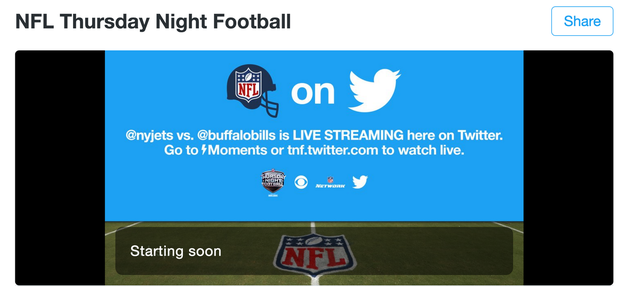
Twitter&;s rationale for spending $10 million for the rights to stream a package of 10 NFL games this season was simple: it believed airing live sports broadcasts on its platform, where people enthusiastically discuss the games, could help catalyze more of that behavior, and bring in some TV advertising dollars in the process. After streaming its first NFL game last night, the early fan engagement results look like Twitter made a good bet, according to data from the social analytics company SocialFlow.

Use of the Bills&039; emoji-generating hashtag on Twitter increased from 11,039 mentions in Week 1 to 22,216 for last night&039;s Week 2 game, counting game day and the day following, an increase of 101%. The Jets&039; hashtag went from 11,968 mentions to 24,742 in the same time span, a bump of 107%. Because the Thursday night game ended close to midnight eastern time, chatter spilled over into Friday — hence the metrics&039; two-day time span. SocialFlow has access to Twitter&039;s full firehose, so the numbers are global.

“The Twitter Live Stream of the New York Jets and Buffalo Bills positively and largely contributed to increasing the GoBills and JetUp hashtags,” Kleida Martiro, sr. analyst at SocialFlow, told BuzzFeed News.

The NFL streams are critical for Twitter, which is currently making a very large bet on premium, live content. Twitter has also struck streaming deals with the NHL and MLB, and is airing original live content from the upstart financial TV network Cheddar, and others. This week, Twitter released a handful of smart TV apps featuring premium live content and curated tweets from its Moments tab, which seems to show that they&039;re prioritizing this feature over its long-ago announced plan to expand Tweet character length, and even its reported goal to develop anti-harassment tools like keyword filtering.

“This may be [management&039;s] last opportunity to reignite growth in users, engagement and monetization,” Cantor Fitzgerald analyst Youssef Squali said of Twitter&039;s premium live-streaming efforts in a research note this week. “Failure to do so is likely to embolden shareholders to pressure the board to evaluate alternatives to maximize value, incl. [mergers and acquisitions] and taking the company private.”

For the first night at least, the results appeared promising for Twitter.

Quelle: <a href="Early Data Suggests Twitter&039;s NFL Live Stream Increased Fan Engagement“>BuzzFeed

Revenge Porn Facebook Page Returns As Private Facebook Group Chat

The Melbourne&;s Men&039;s Society Facebook page, used by Melbourne-based men to share revenge porn, has been moved to a series of private Messenger group chats after the page was shut down by Facebook for a second time.

facebook.com

facebook.com

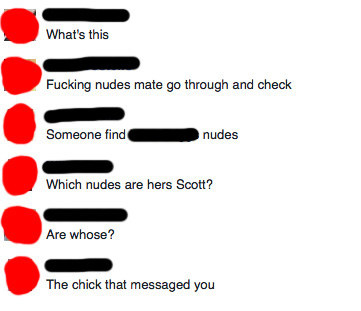
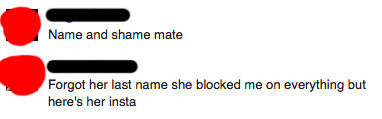
The group chats, which BuzzFeed News has seen, have a 24-hour lifespan before a new chat is formed. Members of the group are required to submit a naked photo of a girl before “naming and shaming” if they wish to be invited to the next day&039;s group chat.

facebook.com

facebook.com

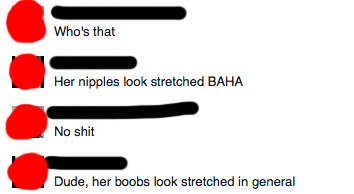
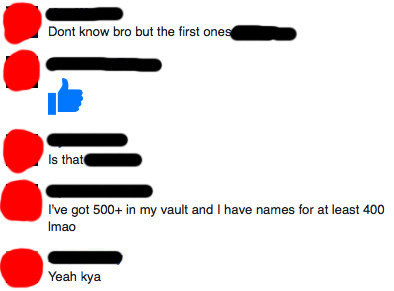
The Messenger chats are full of men asking others to identify the women in the photographs and to share videos.

facebook.com

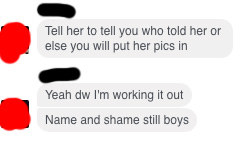
In one instance, members of the chat encourage another member to threaten a girl with the possibility that her pictures would be shared within the group if she didn&039;t confess who had told her about the group chat.

Facebook.com

The men in the group acknowledge that some of the women pictured are under 18.

facebook.com

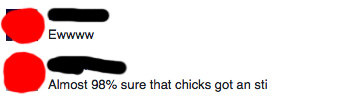
The chat has also become a forum for members to ridicule the bodies of the women in the pictures.

facebook.com

facebook.com

facebook.com

Some of the men boast about having their own personal “vault” of photos saved to their phone and that they have names for the women in hundreds of the photos.

facebook.com

The men believe the group chats are a safer option for sharing images than a private Facebook group, because it is much more difficult to report private group chats to Facebook. Users are required to fill out a form to report a Messenger conversation.

A Melbourne woman who knew of the group chat&039;s existence told BuzzFeed News she had tried to research how to report a group chat and had found that you can&039;t.

“There is an option to report as &039;abuse&039; but it&039;s an old feature,” she said. “It doesn&039;t work when you click it.

“It really is disgusting. I felt sick reading some of the messages.”

facebook.com

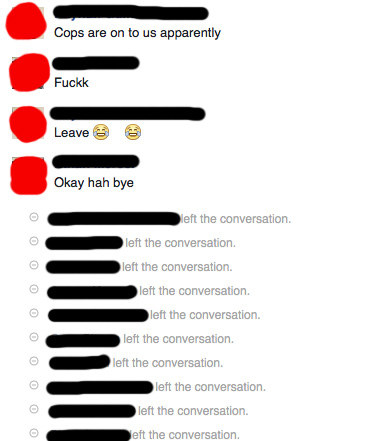
Members of the group can be seen rapidly fleeing one of the conversations when a user says “the cops are on to us”.

facebook.com

BuzzFeed News has contacted Victoria Police for comment and reported the activity to Facebook.

Quelle: <a href="Revenge Porn Facebook Page Returns As Private Facebook Group Chat“>BuzzFeed

Intelligence Committee Condemns Snowden In Scathing Report

Mathias Loevgreen Bojesen / AFP / Getty Images

Edward Snowden isn&;t a whistleblower, nor is he a patriot. He&039;s “a criminal” — at least according to every member of the House Permanent Select Committee on Intelligence.

Following what lawmakers have described as an exhaustive two-year investigation, the committee released a scathing report Thursday condemning the former NSA contractor as a liar and a thief whose disclosures have endangered national security in ways we have yet to understand.

“[T]he vast majority of the documents he stole have nothing to do with programs impacting individual privacy interests — they instead pertain to military, defense, and intelligence programs of great interest to America&039;s adversaries,” states an unclassified summary of the report.

The summary advances several key findings, which the committee presents as a rebuttal to the idea of Snowden as an earnest whistleblower working to reform an oppressive surveillance state. The committee found that Snowden&039;s disclosures helped to diminish the government&039;s ability to collect information about foreign intelligence targets, failed to express his concerns of legal or moral wrongdoing to any official government channel, and that Snowden “was, and remains, a serial exaggerator and fabricator.”

“Edward Snowden is no hero — he’s a traitor who willfully betrayed his colleagues and his country,” said committee chair Devin Nunes in a statement. “I look forward to his eventual return to the United States, where he will face justice for his damaging crimes.” Ranking member Adam Schiff said of Snowden, “The Committee’s Review — a product of two years of extensive research — shows his claims to be self-serving and false, and the damage done to our national security to be profound.”

Upon the report&039;s release, Snowden took to Twitter to rebut its accusations. “The American people deserve better,” he wrote. “This report diminishes the committee.”

The classified report on Snowden&039;s disclosures comes on the heels of a public campaign by the ACLU, Human Rights Watch, and others calling on President Obama to pardon him. The House Intelligence Committee today took issue with that effort as well. In a separate document signed by all its members, the committee urged Obama not to pardon Snowden, who they say “perpetrated the largest and most damaging public disclosure of classified information in our nation&039;s history.”

While the four-page summary is available to the public, the full 36-page report is classified; however, every member of the House of Representatives will have access to it, according to the Intelligence Committee.

Quelle: <a href="Intelligence Committee Condemns Snowden In Scathing Report“>BuzzFeed