Announcing Azure Command-Line Interface (Azure CLI) 2.0 Preview

With the continued growth of Azure, we’ve seen a lot of customers using our command-line tools, particularly the Windows PowerShell tools and our Azure XPlat command-line interface (CLI).  We’ve received a lot of feedback on the great productivity provided by command-line tools, but have also heard, especially from customers working with Linux, about our XPlat CLI and its poor integration with popular Linux command-line tools as well as difficulties with installing and maintaining the Node environment (on which it was based).

Based on this feedback – along with the growth in the Azure Resource Manager-based configuration model – we improved the CLI experience and now provide a great experience for Azure. Starting today, we’re making this new CLI available. We’re calling it the Azure Command-Line Interface (Azure CLI) 2.0 Preview, now available as a beta on GitHub. Please try it out and give us your feedback!

Now, if you’re interested in how we approached this project and what it means for you, read on!

What Makes a Great, Modern CLI?

As we set out to develop our next generation of command-line tools, we quickly settled on some guiding principles:

It must be natural and easy to install: Regardless of your platform, our CLI should be installed from where you expect it, be it from “brew install azure-cli” on a MacBook, or from “apt-get install azure-cli” for BASH on Windows (coming soon).

It must be consistent with POSIX tools: Success with command-line tools is the result of the ease and predictability that comes with the implementation of well-understood standards.

It must be part of the open source ecosystem: The value of open source comes from the community and the amazing features and integrations they develop, from DevOps (Chef, Ansible) solutions to query languages (JMESPath).

It must be evergreen and current with Azure: In an age of continuous delivery, it&;s not enough to simply deploy a service. We must have up-to-date tools that let our customers immediately take advantage of that service. 

As we applied these principles, we realized that the scope of improvements went beyond a few breaking changes, and when combined with the feedback we’ve received about our XPlat CLI, it made sense to start from the ground up. This choice allowed us to focus exclusively on our ARM management and address another common point of feedback: the ASM/ARM “config mode” switch of our XPlat CLI.

Introducing the Azure CLI 2.0 Preview

While we are building out support for core Azure services at this time, we would like to introduce you to the next generation of our command-line tool: Azure CLI 2.0 Preview.

Get Started without delay with a quick and easy install, regardless of platform

Your tools should always be easy to access and install, whether you work in operations or development. Soon, Azure CLI 2.0 Preview will be available on all popular platform package services.

Love using command-line tools such as GREP, AWK, JQ?  So do we!

Command-line tools are the most productive when they work together well. The Azure CLI 2.0 Preview provides clean and pipe-able outputs for interacting with popular command-line tools, such as grep, cut, and jq.

Feel like an Azure Ninja with consistent patterns and help at your fingertips

Getting started in the cloud can feel overwhelming, given all the tools and options available, but the Azure CLI 2.0 Preview can help you on your journey, guiding you with examples and educational content for common commands.  We&039;ve completely redesigned our help system with improved in-tool help.

In future releases, we will expand our documentation to include detailed man-pages and online documentation in popular repositories.

The less you type, the more productive you are

We offer &039;tab completion&039; for commands and parameter names. This makes it easy to find the right command or parameter without interrupting your flow. For parameters that include known choices, as well as resource groups and resource names, you can use tab completion to look-up appropriate values.

Moving to the Azure CLI 2.0 Preview

What does this mean to existing users of the XPlat CLI? We&039;re glad you asked! Here are a few key answers to some questions we&039;ve anticipated:

You don&039;t need to change anything: The XPlat CLI will continue to work and scripts will continue to function. We are continuing to support and add new features to the CLI.

You can install and use both CLIs side-by-side: Credentials and some defaults, such as default subscriptions, are shared between CLIs. This allows you to try out the CLI 2.0 Preview while leaving your existing Azure XPlat CLI installation untouched. 

No, ASM/Classic mode is not supported in the Azure CLI 2.0 Preview: We&039;ve designed around ARM primitives, such as resource groups and templates. ASM/Classic mode will continue to be supported by the XPlat CLI.

Yes, we&039;ll help you along the way: While we can&039;t convert scripts for you, we&039;ve created an online conversion guide, including a conversion table that maps commands between the CLIs.

Please note: credential sharing with the Azure XPlat CLI requires version 0.10.5 or later.

Interested in trying us out?

We&039;re on GitHub, but we also publish on Docker: get the latest release by running "$ docker run -it azuresdk/azure-cli-python".

If you have any feedback, please type "az feedback" into the CLI and let us know!

Attending the Microsoft Ignite conference (September 26-30, 2016, Atlanta, GA)? Come visit us at the Azure Tools booth for a demo or attend our session titled:  Build cloud-ready apps that rock with open and flexible tools for Azure.

Frequently Asked Questions

What does this mean to existing users of the XPlat CLI?

The XPlat CLI will continue to work and scripts will continue to function. Both of them support a different top level command (‘azure’ vs ‘az’), and you can use them together for specific scenarios. Credentials and some defaults (such as default subscription) are shared between CLIs allowing you to try out Azure CLI 2.0 Preview while leaving your existing CLI installation untouched. We are continuing to support and add new features the XPlat CLI.

I have scripts that call the “azure” command – will those work with the new tool?

Existing scripts built against the Azure XPlat CLI ("azure" command) will not work with the Azure CLI 2.0 Preview. While most commands have similar naming conventions, the structure of the input and output have changed. For most customers, this means changing scripts to &039;workarounds&039; required by the Azure XPlat CLI, or relying on the co-existence of both tools.

Are you going to discontinue the Azure XPlat CLI? When will you take Azure CLI 2.0 out of preview?

The current XPlat CLI will continue to be available and supported, as it is needed for all ASM/Classic based services. The new Azure CLI 2.0 will stay in preview for now as we collect early user feedback to drive improvements up until the final release (date TBD).

Is .NET Core and PowerShell support changing on this release?

Support for .NET Core and PowerShell is not changing with this release. They will continue to be available and fully supported. We feel that PowerShell and POSIX-based CLIs serve different sets of users and provides the best choice for automation/scripting scenarios from the command-line. Both of these options are available on multiple platforms.  Both are open source now and we are investing in both of them.
Quelle: Azure

Availability of H-series VMs in Microsoft Azure

We are excited to announce availability of the new H-series virtual machines in Azure.   With the availability of these new VM sizes we continue our mission to deliver great performance for HPC applications in Azure.  H-series VM sizes is an excellent fit for any compute-intensive workload.  They are designed to deliver cutting edge performance for complex engineering and scientific workloads like computational fluid dynamics, crash simulations, seismic exploration, and weather forecasting simulations. 

The new H-series sizes are initially available in the South Central US Azure region and will be rolled out across other regions in the near future. 

The H-series VMs will be available in six different sizes, all based on Intel E5-2667 V3 3.2 GHz (with turbo up to 3.5 GHz) processor technology, utilizing DDR4 memory and SSD-based local storage.  The new H-series VMs furthermore features a dedicated RDMA backend network enabled by FDR InfiniBand network, capable of delivering ultra-low latency.  RDMA networking is dedicated for MPI (Message Passing Interface) traffic when running tightly coupled applications.

*m: High Memory, r: RDMA network

We see a large number of enterprise customers embracing Microsoft Azure for their enterprise HPC workloads. Enterprise customers bursting their HPC jobs to Azure for additional compute power helping to solve complex design of experiments (DOE), optimizations, and other critical projects.  One of our premier partners, Altair Engineering Inc., with its suite of enterprise computing products is an excellent and current example of integration between customers&; on-premises environment and H-series VMs in Azure.

“We are excited about the introduction of new non hyper-threaded compute and network optimized H-series VMs in Azure, we worked closely with the Microsoft Team to test our solutions for performance and scaling on the H Series VMs. Based on the testing we are confident not only to deliver high performance to our customers but also provide deep integration with the Azure environment to enable HPC cloud environments”  Sam Mahalingam, CTO Altair Engineering Inc

H-series VMs can deliver great performance running a variety of applications, helping businesses around the world reducing their product development cycle and bring products faster to market.

"We are pleased to see the launch of the new Azure high performance H series VMs with InfiniBand and Linux RDMA technology. This performance accelerates the pace of product design cycles using simulation and helps engineers discover better designs, faster." – Keith Foston, Product Manager, CD-adapco, a Siemens Business

H-series virtual machines provide on demand compute capacity for our customers that want to solve complex automotive crash simulation problems.  Through partners like d3View we can bring large scale computing capabilities to our customers when needed.

“We see a great need for the best-in-class compute power and capacity. With the introduction of Azure’s new H-Series with E5-2667 processor and RDMA InfiniBand network, running large-scale simulations across hundreds of cores will offer reduced turn-around time for simulation engineers and scientists. Multi-physics simulation software like LS-DYNA is designed to scale to thousands of processors and with the H-Series, we look forward to helping our customers in evaluating designs quickly” Suri Bala, CEO d3View

The low-latency RDMA network enabled by FDR InfiniBand in the H-series VMs, particularly using the H16r and H16mr sizes, make up an ideal combination for delivering the necessary scale and performance for very large CFD (Computational Fluid Dynamics) simulations.

“The RDMA technology in the new H series VMs is critical when running large scale-out jobs on the cloud.  With clock frequencies flattening out the last few years, RDMA technology enables jobs to scale out to large number of nodes. Our testing of CFD codes with the TotalCAE Portal enabled us to achieve reduced runtimes at large core counts that would not be possible without RDMA technology in Azure.”  Rod Mach, CEO TotalCAE

Non-RDMA-enabled H-series sizes can be deployed with various Linux distributions and Windows Server OS images available in the Azure Marketplace.  RDMA-enabled H-series VM sizes can be deployed using Windows Server 2008 R2, Windows Server 2012, Windows Server 2012 R2, and CentOS-based 7.1 HPC and SUSE Linux Enterprise Server 12 SP1 HPC images.  For more information and a quick guide on how to get started, see the Linux and Windows documentation.

With this milestone in our HPC journey in the cloud, we’d like to re-emphasize our excitement in bringing world-class High Performance Computing infrastructure capabilities through the Cloud to every engineer and scientist in the world. 
Quelle: Azure

Square Says Its New Credit Card Chip Reader Is Faster Than What You're Used To

Square, the mobile payments processing company led by Twitter CEO Jack Dorsey, is introducing a chip card reader it says will process the payments in 4.2 seconds, compared to the industry average of between eight and 13 seconds. That’s big news for a couple reasons.

Giphy / Via giphy.com

Chip cards started rolling out in the US about a year ago, and, as we know by now, they’re glacially slow.

Giphy / Via giphy.com

They are, however, more secure, according to Square&;s head of hardware product development, Jesse Dorogusker. That’s why they exist in the first place. Or, rather, why the government mandated that US stores have chip-card-accepting technology by October 2015, which still hasn’t really happened, yet. As much as we want the speed of the old magnetic stripe, our money is safer with the chips, for the most part.

Here’s what a faster credit card chip reader could mean for your life:

1. Maybe you won&039;t lose your card

Chip cards are so slow that people have been leaving them at cash registers in droves. Maybe a faster reader will keep people’s attention.

2. A path to the future

Square’s new readers can also process payment methods like Apple Pay and Android Pay — which means you don’t even have to touch your card to the reader. According to Square’s Dorogusker, these are “far superior technology” because these methods typically require a second piece of authentication like a fingerprint.

The US desperately needs more secure credit cards. We have 25 percent of the world’s credit cards but 50 percent of all credit card fraud.

Dorogusker blames the risk of fraud squarely on the magnetic stripe technology. “They’re like cassette tapes,” he told BuzzFeed News.

Giphy / Via giphy.com

3. Shorter lines

During a lunch rush or the holidays at a retail store, every second counts. You might be quick to abandon a line if it’s not moving. Retail workers of the world, rejoice: much less awkward small talk with frustrated customers.

Giphy / Via giphy.com

Don’t expect to see Square’s readers at H&M or Whole Foods any time soon, though. Sellers who make over $500,000 per year only account for 14 percent of the company’s business, according to its Q2 2016 investor letter. However, the company hopes to bring the transaction speed down to three seconds in the near future — maybe that’ll attract more big clients.

Quelle: <a href="Square Says Its New Credit Card Chip Reader Is Faster Than What You&039;re Used To“>BuzzFeed

Azure Service Fabric for Windows Server now GA

Enterprises today need to walk a fine line between innovation and delivering reliable services. Firms need to be able to rapidly create and run mission critical enterprise applications that have the potential to capture new areas of growth for the organization, creating the opportunity to increase their exposure in the market and meeting changing customer needs. At the same time, system reliability is equally important since application downtime has a real cost to a business’s reputation, finances, and customer loyalty. For example, customers expect an online banking or e-commerce site to be up and running any time of day across any browser, device, or app. A company that doesn’t meet these 24/7 availability expectations and needs is at risk of losing customers to their competitors. Increasingly, businesses are turning to the cloud to develop and manage their applications at scale and with high availability.

Microsoft’s Azure Service Fabric, our microservices application platform for developing and managing cloud-scale applications, was released last year to help developers build and manage cloud-scale applications.

I am excited to announce today that Azure Service Fabric for Windows Server will be generally available for download at no cost. With today’s announcement, customers can now provision Service Fabric clusters in their own data centers or other cloud providers and run production workloads with the option to purchase support for ultimate confidence. One such customer is Owners.com, an online platform that gives consumers a convenient and cost-effective way to buy or sell a home.

"Our on-premise installation of Azure Service Fabric is a robust and highly scalable platform on which we&;ve been able to build very complex software as a collection of easily manageable modules.  This new paradigm of service development allows us to rapidly develop, test, and deploy (with zero downtime), all while meeting tight SLAs for our production environment." Marion Denny, Director of Engineering at Owners.com

We unveiled Service Fabric preview on Linux earlier this month, furthering our vision to enable developers to build Service Fabric applications on the OS of their choice and run them wherever they want. Battle-hardened internally at Microsoft for almost a decade, Service Fabric has been powering highly scalable services like Cortana, Intune, Azure SQL Database, Azure DocumentDB, and Azure’s infrastructure. We’ve seen tremendous response from our customers and great momentum since our recent GA at Build 2016.

Azure Service Fabric allows the creation of clusters on any machine running Windows Server or Linux which means that you can deploy and run Service Fabric applications in any environment that contains a set of interconnected computers, be it on-premises or with any cloud provider. Azure Service Fabric for Windows Server enables you to create clusters on Windows Server machines, particularly focused on running Service Fabric in your data centers. This means you get benefits such as:

Using data center resources you already own and developing microservice architectures on premise before moving to the cloud.
You can choose to create clusters on other cloud providers.
Service Fabric applications, can be deployed to any cluster with minimal to no changes. This can provider an added layer of reliability because you can move your applications to another deployment environment.
Developer knowledge of building Service Fabric applications and the operational experience of running and managing Service Fabric clusters carries over from one hosting environment to another.

We’re excited that with our continuous updates to Service Fabric, more businesses can take advantage of our innovations to develop and power their applications. Learn more about how to get started with Service Fabric.
Quelle: Azure

I Went To My Own Digital Funeral

BuzzFeed News

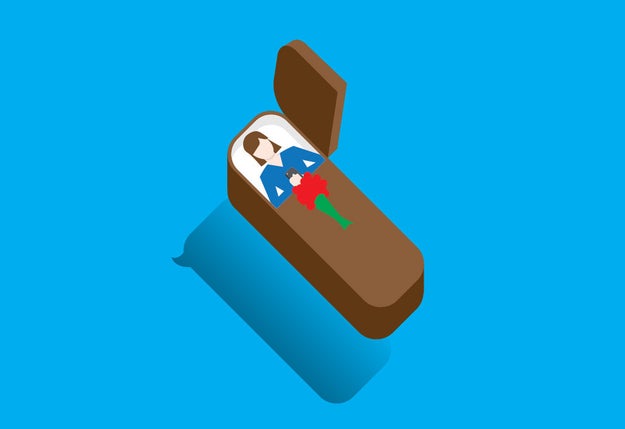
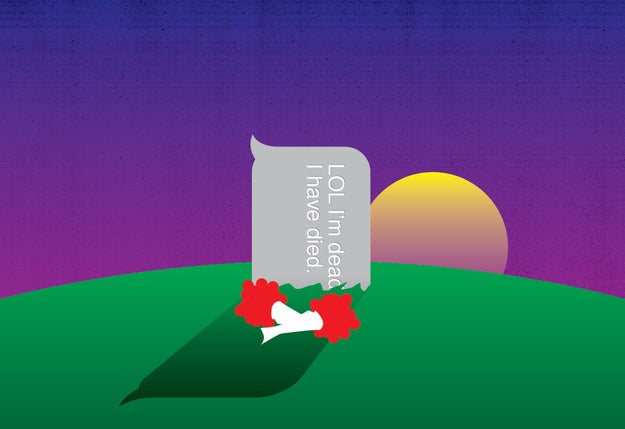
A few weeks ago, I went to my own funeral. Or at least a simulation of my own funeral. I was sitting in an auditorium, alone except for a trim young man in a black suit, who walked up to a lectern and began speaking. “Good evening,” he said. “We are here to honor the memory of Doree Shafrir. Doree was a beloved friend, daughter, and wife. Our thoughts go out to her loved ones on this day.”

It was more than a little jarring, sitting there listening to this guy talk about me. Doree, he said, was “committed to her work, to social justice and to literature. She showed support to women she’d never even met, and gave platforms to voices of color.” He went on like this for another minute or so, talking about how I’d passed away and “left an empty place” in the hearts of my loved ones. Next, there was a video — all my tweets, scrolling on a huge screen in front of me — and it was only then that I truly started recoiling. My legacy was going to be my tweets about Justin Bieber’s fling with Bronte Blampied, my neighbors&; love of Project Runway, my excitement about wearing a dress with pockets to a wedding.

I was at LACMA, the LA County Museum of Art, for an interactive exhibit put on by an organization called the Hereafter Institute, which was started by the 34-year-old artist Gabriel Barcia-Colombo. The pitch was vague: The Hereafter Institute, I was told, “evaluates a person&039;s digital afterlife using new technologies.” The “funeral” was the culmination of a half-hour personal tour through a series of exhibits meant to inspire reflection and conversation on our digital afterlives.

What would someone who doesn&039;t know me infer about who I was based solely on my online presence?

For centuries, people have been trying to figure out how to achieve immortality — or at least extend their lifespans. Today, billionaires like Larry Ellison, Peter Thiel, and Sergey Brin are spending part of their fortunes on research that they hope will allow them to extend their lifespans. Perhaps the most radical ideas are coming out of Dmitry Itskov&039;s 2045 Initiative, an organization that hopes to eventually be able to meld human heads with robot bodies. For the non-billionaires among us, digital immortality will have to do.

I&039;ve long been fascinated by the posthumous digital lives of others, but I&039;d never really thought about what would happen to my own self-created online presence after I&039;m dead — and more important, how it could be manipulated, even by people with the best of intentions. As someone who likes to maintain a modicum of control over her online presence (don&039;t we all?), this notion started to feel more than a little bit scary. What would someone who doesn&039;t know me infer about who I was based solely on my online presence? At least when I&039;m alive, my social media is a constantly updated, organically changing thing; once I&039;m dead, it&039;s all frozen in amber. Would that same online presence serve as a comfort to people who knew me, a kind of poignant memorial? Or, most terrifyingly of all, would no one care?

A “funeral” at the Hereafter Institute, an installation at LACMA.

Courtesy Gabriel Barcia-Colombo

I&039;m not proud of the fact that when I hear about a celebrity dying, I check to see what their last tweet was. I obsessively read the Last Message Received Tumblr, which posts the last communication (usually texts) that people got from exes, or family and friends who died; the ones that are the most painful to read are the mundane ones from friends who were then killed by drunk drivers.

In 2016, the human condition is marked by existential despair in thinking about being remembered for a few lackluster, dashed-off tweets and silly photos.

These transmissions can appear cruelly unremarkable, but after death, even the most ordinary dribs and drabs of communication feel poignant to their loved ones. Like the Hereafter Institute&039;s project, the Last Message Received is saying: You matter. You matter, and the world you lived in matters, and the people you loved — they matter too.

Still, I can’t help but think I&039;ll want to keep everything away from the prying eyes of people like me when someone I’m close to dies.

Aren&039;t we really just expressing anxieties about our own mortality when we voraciously consume the digital afterlives of others? When I think about it in this light, I&039;m more forgiving of my morbid, voyeuristic habit. If there is an upside to my obsession with these inadvertent social media memorials, it&039;s that they have made me more aware of the permanence of my online presence, which, in the moment, can seem deceptively ephemeral. In 2016, the human condition is marked by existential despair in thinking about being remembered for a few lackluster, dashed-off tweets and silly photos. What if the last thing I ever tweet is a complaint about how much Time Warner Cable sucks? And so, whether we like it or not, life now requires no small degree of constant self-examination about our own legacies, online and off.

Courtesy Gabriel Barcia-Colombo

When I arrived at the entrance of the Hereafter Institute&039;s exhibit, I was greeted by a young blonde woman (an actor, I later learned) in a lab coat, who began by asking me a series of questions about my online presence, including which social networks I had accounts on and which dating apps I’d used. I was left, by that simple exercise, with the uncomfortable knowledge that my digital legacy goes far beyond a bunch of photos on Instagram. It’s a LinkedIn profile where I’ll always be working at BuzzFeed, a Clue profile where my next period is always just a few weeks away, my Discover Weekly playlist on Spotify updating until the end of time. I sat there wondering if my Apple ID would exist forever and if new episodes of Who? Weekly would keep downloading well after I was gone.

Then I stood on a platform while another Hereafter Institute guide took a 3D scan of my body — a scan I would later see animated at my “funeral” — and led me to another building at the museum, where there exhibit continued. There, I saw a record player on a stand where tweets by a man named Fernando Rafael Heria Jr. scrolled on a black screen. (I later found out he had been hit by a car and killed in 2010 while riding his bike in Miami; he was 25.) “Ever wanted to kick someone in the throat?” said one tweet, from March 20, 2010. “Fernando Rafael Heria Jr. shared a link: Brian Piccolo: Thursday Night Criterium Series,” said another from March 25 of that year.

Next, I was led over to a different part of the same room, where I put on a virtual reality headset and found myself engulfed in the separate worlds of three people who had died. It was like a video game, with voiceovers by friends and family (and in one case, a reading by one of the deceased). Barcia-Colombo explained that his intention was to create a memorial to the dead that would allow people a small window into their lived experiences.

A few days after I went through the exhibit, I spoke with Barcia-Colombo by phone. “I was really interested in this sort of bizarre thing that’s happening now, where people pass away on the internet and there’s no real virtual practice put in place for what we do with this data,” he said. “I&039;ve had friends that have passed away, and yet people don&039;t really know, and they still wish them happy birthday. Or people tweet after they&039;ve died because they&039;ve set up auto-tweeting. I thought it was a really sort of interesting time in our culture, and our conversation about death is really changing.”

“At some point there&039;s going to be more people who&039;ve passed away on Facebook than there are alive people on Facebook.”

Last year, Facebook instituted a policy that allows you to designate a person to maintain your Facebook page after you die; your page lives on, but is changed to a “memorial” page. But what happens when that person dies? And so on? “At some point there&039;s going to be more people who&039;ve passed away on Facebook than there are alive people on Facebook,” Barcia-Colombo said. “What is that going to mean?”

We don’t know the answer to that question yet. But what does it mean when even the most off-the-cuff content that we produced when we were alive has the potential to become a posthumous representation of ourselves? It’s exhausting enough to maintain a digital presence while we’re alive. Now are we expected to also be mindful of how our digital selves will be perceived after death?

Today&039;s teenagers are enamored with pointedly ephemeral social media like Snapchat, where posts disappear quickly and (seemingly) forever, and maybe they&039;re onto something. Maybe the next generation is so conscious of digital legacies that they&039;ve decided not to create one at all. But I&039;m too far gone, I think, to make my social media presence disappear; I am a self-archivist by nature, and erasing everything is scarier to me than the idea that someone might piece together a contextless version of me after I die.

All of this awareness adds another complicated layer to the notion of the digital self — one that a quick perusal of my Twitter feed tells me I am definitely not ready for. We may not be sentient beings in death, but whether we like it or not, we will continue to exist long after our bodies are dead and gone.

BuzzFeed News

Quelle: <a href="I Went To My Own Digital Funeral“>BuzzFeed

Snapchat To Sell Sunglasses That Come With A Mounted Camera

Snapchat is releasing a pair of glasses with a mounted camera, dubbed Spectacles.

Business Insider first reported the product release Friday after obtaining a leaked promotional video for Spectacles.

CNBC later confirmed on Twitter that Snapchat, newly renamed Snap Inc, will release the product this fall and price it at $129.99.

The Wall Street Journal reported Friday that CEO Evan Spiegel rechristened the company because Spectacles is a piece of hardware and goes beyond the Snapchat app.

To record a video clip of up to 10 seconds, users press a button on the frames. Subsequent taps create new recordings, which will sync wirelessly with the Snapchat app on users&; phones.

The camera lens will also be 115 degrees, wider than a typical iPhone, the Wall Street Journal reported, and the videos will be circular.

Spectacles will be available in three colors: black, teal and coral, according to the Journal.

Snap Inc did not immediately respond to requests for comment.

Quelle: <a href="Snapchat To Sell Sunglasses That Come With A Mounted Camera“>BuzzFeed

Trump Hotels Kept Their Customers' Credit Card Hack Secret For Months

Republican presidential nominee Donald Trump speaks during a campaign rally September 22, 2016 in Aston, Pennsylvania.

Mark Wilson / Getty Images

The Trump Hotel Collection has agreed to pay thousands of dollars in penalties for not properly disclosing a series of hacks on its computer network, dating back to 2014, that resulted in the theft of 70,000 of its customers’ credit card numbers and other personal data.

New York Attorney General Eric T. Schneiderman announced the settlement with the Trump Hotel Collection on Friday. The hotel chain, whose locations from Las Vegas to New York were affected by the data breach, will have to shell out $50,000. As part of the settlement, the chain also committed to improving its data security practices.

In May 2015, according to the Attorney General’s press release, multiple banks found that thousands of fraudulent credit card transactions traced back to several hotels under the management of Trump International. Investigators soon linked the stolen credit card information to a cyber attack on May 19, 2014, when a hacker accessed Trump International Hotels’ payment processing system through an administrative account using legitimate login credentials. The hacker then deployed malware into the system that stole the hotels’ customer credit card information and other data, according to the Attorney General’s office.

Investigators alerted Trump International Hotels of the attack in June 2015, but the company did not notify its customers until September of that year, when it posted a notice of the breach on its website. This delay was the basis of the Attorney General’s recent charges, which found that Trump International violated a New York business law that requires hacked companies to notify consumers “in the most expedient time possible and without unreasonable delay.”

Six Trump hotels in New York City, Miami, Chicago, Honolulu, Las Vegas, and Toronto were affected by the hack.

A spokesperson for Trump Hotels said in a prepared statement, “Unfortunately, cyber criminals seeking consumer data have recently infiltrated the systems of many organizations, including almost every major hotel company. Safeguarding our customers’ data is a top priority for the company and we will continue taking actions to do so.”

The credit card theft was not Trump International Hotels’ only data breach in the past few years, the Attorney General’s office found. In November 2015 — five months after the hotel chain had learned of the first hack — a hacker installed credit card harvesting software in Trump International’s system that yielded information used in more credit card fraud. Fraud investigators found that the hacker later took more personal information, including the social security numbers of about 300 people, from a different company system in March 2016. Trump International received notice of these breaches in late March 2016, but the company waited three months, until June 2016, to tell its customers that their data had been stolen from its system.

Forensic investigators had recommended that Trump International implement two-factor authentication after the first breach, back in 2015. The company waited until April 2016 to do so, and the Attorney General said Trump International could have prevented the subsequent breaches if it had bolstered its security the first time it learned about its system’s security vulnerabilities.

Paul Martini, CEO of iBoss Cybersecurity, said of the breach, “Understanding the severity of [a] breach can be complex … but there&;s no excuse to withhold news of the breach. Some organizations say they&039;re going to gather more info; some raise their hands and say, &039;we don&039;t have the expertise&039; — but any choice should include reporting the breach.”

As for the forensic investigators&039; recommendations, Martini said even those steps might not have been enough to protect the hotel customers&039; data. “Multi-factor authentication would have helped preclude someone logging into the network administrator&039;s account, but it wouldn&039;t have prevented the hijacking after the malware was already in the payments processor,” he told BuzzFeed News.

When BuzzFeed News asked what this data breach means for Trump&039;s cybersecurity record as the Republican nominee, his campaign responded:

“Donald Trump is the only candidate who will ensure American interests are effectively protected, unlike Hillary Clinton who has proven herself to be utterly incompetent as evidenced by her illegal use of an unsecured email server that was completely vulnerable to hacking.”

Quelle: <a href="Trump Hotels Kept Their Customers&039; Credit Card Hack Secret For Months“>BuzzFeed

Cracking The Tinder Code: Love In The Age Of Algorithms

Alraun2014 / Getty Images

I used to be terrible at Tinder — but for a few weeks this summer, I was pretty good. Women responded to my messages. Our chats went deeper than usual. Previously stalled discussions were suddenly revived and I was right-swiped with increasing frequency. I began to understand my matches in a way I hadn’t previously, but not because of anything I&;d done. My Tinder messages were being composed by a woman who also set up my profile. And I was using Tinder’s on staff sociologist’s input to refine my approach.

I handed over my account to my colleague, Jessica Misener, on a hunch (correct) that I wasn’t doing things right on Tinder. And while Jessica didn’t really need the help, I took over her account as well. We embarked on our great switcheroo in an attempt to get to the bottom of what makes Tinder tick; customizing each other’s profiles to what we thought people of our gender wanted, releasing those accounts into the wild, and then comparing the results to our past luck.

We swapped accounts on the condition that no message could be sent without the explicit approval of its real owner — this was a quest to understand the inner workings of the platform, not dupe people. And, when we were done, we brought our findings to Tinder, which reviewed them and — based on its own research including some previously unreleased data — told us what we&039;d done right and wrong. Spoiler: I had a lot to learn. And judging from the Tinder profiles we saw, you probably do too.

Downloaded by more than 100 million people, Tinder is responsible for some 1.5 million in-person dates each week, according to its creators. It’s helped to normalize “meeting online.” Tinder did this with an ingeniously simple swipe “right for like”/”swipe left for dislike” vetting process, connecting people only when there is mutual interest. Its soaring popularity has helped revolutionize modern dating, shifting us from finding love via chance to finding it via algorithm.

Wearing a hat in your Tinder profile pic? That’ll hurt your chances by 12%.

The secrets of Tinder&039;s code lie in the hands of people like Dr. Jess Carbino, a Tinder employee with a sociology PhD. from UCLA. She has a lot of visibility into what works on Tinder and what doesn&039;t. For instance: Wearing glasses in your profile picture, whether for vision or sun, decreases your chances of being right-swiped by 15%. And a hat? That’ll hurt your chances by 12%.

“It&039;s really important for people to able to glean a great deal about your face, which indicates things beyond attractiveness,” Dr. Carbino explained in a phone interview from Tinder’s Los Angeles headquarters last week. Tinder is willing to share a good deal of this data because, at the end of the day, it wants people to find satisfying matches. And, if you use Tinder, you probably want more matches too. So take your damn hat off. And, while you’re at it, those shades need to go too.

In Trusted Hands

Stock_colors / Getty Images

Looking through the men showing up on Jessica’s Tinder account, I saw many dudes presenting themselves with blurry pictures, mirror selfies, hats, nowhere-looking gazes, and other off-the-charts terrible selfies. When I saw a guy with a clear picture, smiling and looking toward the camera, I instantly swiped right.

When Jessica set up my profile, she chose a picture of me looking sideways to start, and then followed with a few looking straight at the camera. A week in, thinking about that man with the straightforward smile, I suggested we switch up my own profile. We chose a photo I didn’t love, but where I looked straight at the camera and smiled. It worked significantly better than my previous profile pic.

“Individuals who are front facing are 20% more likely to be swiped right on.”

The forward-facing smile was the right move, according to Tinder’s Dr. Carbino. “Individuals who are front facing are 20% more likely to be swiped right on, relative to their counterparts who are facing sideways or not showing themselves,” Dr .Carbino said. Even though I felt the smiling picture was worse than any other, it made a big difference: you are 14% more likely to be swiped right on if you smile on Tinder, Dr. Carbino said.

After Jessica landed a few matches on my behalf, I watched in amazement as she crafted thoughtful, personalized messages to each. My opening message is perhaps best described as, “How’s it going?” Jessica describes hers as: “Not just, ‘Oh cool you&039;re from North Carolina? I like Asheville a lot,’ but: “Oh you&039;re from North Carolina? I&039;ve always wondered if the Carolinas have a rivalry about which is better. like South Carolina is OBVIOUSLY cooler but North Carolina is literally on top of it, which seems significant to me.”

Jessica’s method proved effective. Conversations kicked off with thoughtful messages were far richer than my usual “Hey,” “Sup,” “Nm, U?” variety. And Tinder’s data seems to bear this out. Dr. Carbino said Tinder is conducting a messaging analysis study, and its initial results indicate more thoughtful messages are more likely to generate responses. You can also always send a GIF, which is 30% more likely to get a response, according to Dr. Carbino.

Viewing Tinder from my colleague Jessica’s vantage point, I didn’t need any special conversational tactics. If anything, the biggest challenge was weeding people out.

Stampede

Xavier Arnau / Getty Images

Running Jessica’s account felt like watching dozens of men attempting to run through the same tiny door at once. It was overwhelming. As I swiped right, a pattern emerged: Match. Match. Match. Match. Message. Message. Message. Message. These guys meant business. They were relentless.

Watching them in action, I began to rethink one of my core Tinder principals: never double text. Sending a message, waiting, and sending another message despite no response had long been no go territory for me. It felt needy, and a bit delusional. If someone was interested, they’d respond. If not, they wouldn’t. But as I witnessed the volume and pace of messages hitting Jessica’s Tinder, I very quickly saw the folly of my ways.

Double texting works, according to Dr. Carbino, who calls it re-engagement. “The idea of re-engagement, if done in a way that&039;s appropriate, can be quite effective,” she told me. “You can say something along the lines of, “Hey, it&039;s time to step up your Tinder text game&039; and make a joke out of it to re-engage them and to try to further the conversation along in a way that&039;s more meaningful.”

On Tinder, you can also use a ‘Super Like’ button once every 24 hours to signal more interest than the ordinary ‘like,’ but the people using this feature felt a bit off to me, so I started swiping left and rejecting them all out of habit. That wasn’t a normal behavior. Super Likers, according to Tinder, are three times more likely to match, and their conversations typically last 70% longer than those of non-Super Likers.

Super Like or not, you may want to go for the real-world encounter early as possible. People who meet in person via Tinder typically do so within 2-7 days of matching, according to Dr. Carbino.

Tinder God Emerges

Siphotography / Getty Images


“I always said great advertising should be like dating.”

When you first sign up for Tinder, a text overlay appears on the app urging you to “Swipe more to help us learn your preferences. The more you swipe, the better our recommendations&;” The prompt is subtle, and it’s also the most prominent indicator that Tinder sorts the profiles it shows you via an algorithm — a mathematical formula that pulls in a number of data points and makes decisions about who comes next.

The keys to Tinder’s algorithm are held by Dan Gould, a former advertising technology executive who spent the early part of his career attempting to match the right ad to the right person at the right time — now he’s doing it with people. That a former ad-tech exec now holds a power position at a dating company says a lot about the role of algorithms in romance today. “I always said great advertising should be like dating,” Gould told me. “If advertising works perfectly, it would be like finding that great partner for you. It would find the right thing, at the right time, at the right price, and maybe something you didn’t even know.”

According to Gould, Tinder&039;s algorithm gives a lot of weight to the choices you make while setting preferences. Distance ranges, gender and age preferences — all these things need to match up before Tinder will show you a potential match. Two other critical factors are distance and recency. Distance is straightforward: being closer gives you an edge. But “active time,” i.e. recency, is more intriguing. “People who have been active recently are more likely to come back soon and interact with other people.” Gould said. “While I probably shouldn’t say how you can game the system, the one thing that a person can really do to appear to a lot more people and get more matches is to be active recently. If I were trying to get more matches I would open the app every hour and just swipe a little bit.”

Swipe Life

Demaerre / Getty Images

In their book Modern Romance: An Investigation, the comedian Aziz Ansari and NYU sociology professor Eric Klinenberg describe asking a woman to project her OkCupid in-box on a screen in an LA comedy club. “The moment we put her in-box up on the screen, you could see every man in the room just deflate,” Klinenberg said in a recent phone interview. “They suddenly realized what they were up against.”

The draw of that choice is so powerful that Seattle-based Ricky Burnett, founder of a company called Project Attraction, a dating coaching service that promises to help men “become the confident, bad ass guy that women obsess over,” said he sees a lot less competition when trying to meet someone in real life. “I consider it to be a lost art these days,” he explained. “You kind of put people in awe when you just walk up to them and say ‘hi.’”

Proliferation of choice can have negative consequences as well. With so many potential matches to swipe on, they all become a bit more … disposable. “Go back to [the pre-Tinder] era,” said relationship Psychologist Dr. Karen Sherman. “If you didn’t meet somebody in college then what the hell were you going to do? Because then you were pretty much out of possibilities. Now, so what?

For Dr. Carbino, algorithmically-assisted courtship is a clear net positive. “There&039;s so much data out there that suggests that individuals who meet their partners online have more satisfactory relationships and are more likely to get married faster, relative to individuals who meet offline,” she said.

Klinenberg is of a similar opinion. He likes to tell a story of how he and Ansari once asked a “pretty average looking” guy for a look at his dating in-box. The guy, Klinenberg said, had messages from women who “30 years ago, if he had gone to a bar and they had given him their phone number, he would’ve gone crazy, it would’ve been the greatest night of his life.” There&039;s a lesson in that in-box: “There’s a lot of volume. Even if that guy was striking out 95% of the time, it’s a whole lot easier to start flirting with someone and ask them out online, than it is in person.”

After swapping Tinder accounts with Jessica and getting Tinder&039;s input, I made more progress on long-unanswerable question: “What did I do wrong?” than ever before. You can&039;t quantify everything in the age of algorithms, but more and more is becoming knowable. Now if you&039;ll excuse me, I have some swiping to do.

Quelle: <a href="Cracking The Tinder Code: Love In The Age Of Algorithms“>BuzzFeed

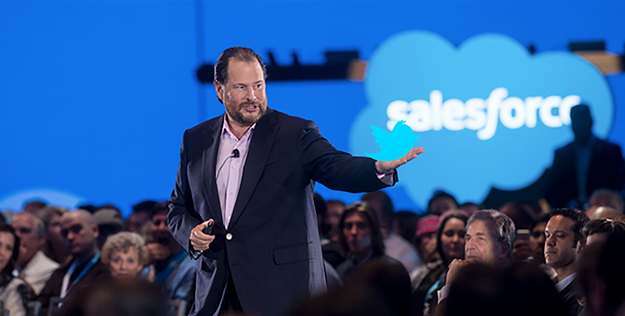
How Twitter Would Fit Inside Salesforce

Salesforce

As Twitter struggles to grow its userbase and meet Wall Street&;s expectations, its been increasingly the subject of rumors that it may have to sell out in order to stay alive. Those rumors really ramped up today following a CNBC report that a number of companies have expressed interest in buying the social platform and formal bids could be in soon from the likes of Google and others.

But one potential named suitor left a lot of people scratching their heads and others even downright sullen: Salesforce. Salesforce is a business-to-business technology company that&039;s prominent within that circle but relatively unknown in the consumer space.

But the two companies could fit well together, for a number of reasons. Consider the following:

The Ad-Tech

This is the big one. Salesforce&039;s core product helps you market and sell to people you know, ad-tech helps you market to people you don&039;t know (yet). Twitter has made two ad-tech acquisitions (MoPub and TellApart) and has hundreds of millions of logged in users, helping it connect user identify across devices. Bringing Twitter&039;s ad-tech capabilities in house could provide Salesforce with a more deeply integrated offering at a time when its entire industry is working on ways to own the “full funnel,” helping clients message from the point someone first becomes aware of their product to the moment when they buy it.

The Intelligence

If Salesforce can parse meaning from Twitter data (Executive A is interested in X,Y and Z), it could help prospecting sales reps be smarter about the way they approach potential customers. Earlier this month, Salesforce introduced “Einstein,” an AI-powered product that Salesforce promises can help its clients by “automatically discovering relevant insights, predicting future behavior, proactively recommending best next actions and even automating tasks.” For AI to work, it needs a lot of data. Twitter has a mountain of data. By purchasing Twitter and all its associated data, Salesforce could get that product revving fast.

The Small Social Fit

Salesforce has tried its hand at social with Chatter, a social platform built into its product, but that part of Salesforce could use some improvement (spoken as a former sales guy who&039;s used it). Having Twitter&039;s staff build up the social aspects of Salesforce could be big for the company. Executed right, it would increase the cohesiveness and communication among teams using the product.

Bret Taylor

Twitter board member Bret Taylor sold his company, Quip, to Salesforce in August for $582 million. As Recode points out, “some people think he’d be a good fit to run Twitter’s core product.” So Salesforce could already have a product head in place.

The Benioff Factor

Salesforce CEO Marc Benioff is a showman and a guy who likes to stir the pot. Benioff has stuck his neck out on enough social issues that he could probably enjoy some goodwill as he works to fix Twitter&039;s harassment issue, one of its biggest problems. Benioff also happens to like social, and thinks it&039;s critical to his customers&039; success. As he told CNBC a few years ago: “As a marketer, as a sales professional, you&039;d better know what&039;s happening on those social networks because those are your customers. We&039;ve seen brands go haywire when one tweet goes wrong.”

Quelle: <a href="How Twitter Would Fit Inside Salesforce“>BuzzFeed

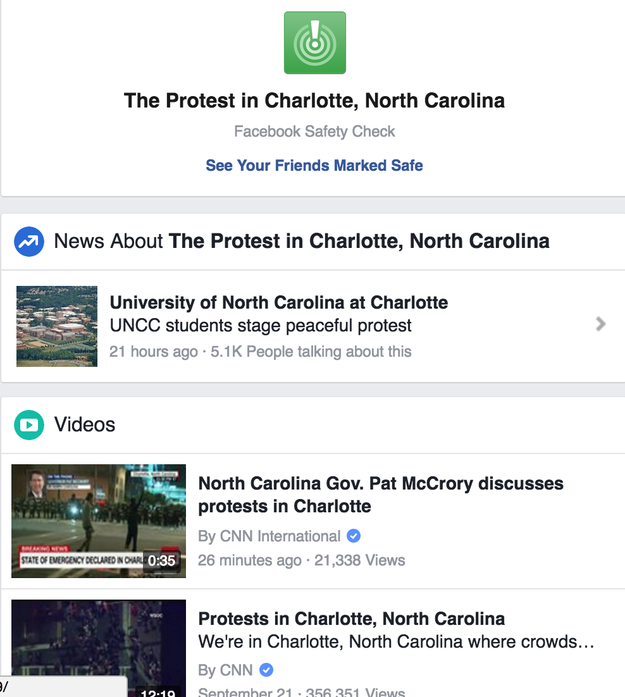
Facebook Says Safety Check Was Activated By People Near Charlotte Protests

What began as a tool for people in Nepal to mark themselves “safe” after 2015&;s devastating earthquake is now being used by protestors in Charlotte, North Carolina.

Facebook&039;s Safety Check — a feature that has so far been deployed in the wake of natural disasters, bombings, and violent crime — was activated Thursday following protests sparked by the police killing of Keith Lamont Scott, a 43-year-old black man.

A Facebook spokesperson told BuzzFeed News that this was the first time Safety Check has been activated for a protest. The company also confirmed that it was initiated by people in the protest area, and not the Facebook itself.

Thursday marked the third night of demonstrations in Charlotte, with Mayor Jennifer Roberts declaring a midnight curfew. But police did not enforce it early Friday morning, as the protests remained peaceful.

Earlier in the week, however, the violence led Gov. Pat McCrory to declare a state of emergency in Charlotte, calling in the National Guard and state troopers to help maintain order. In the midst of the unrest Wednesday night, one protestor, 26-year-old Justin Carr, was shot and later died on Thursday, according to the Charlotte-Mecklenburg Police Department.

Since its release in October 2014, Facebook&039;s Safety Check had been used by people in the immediate aftermath of earthquakes and cyclones, but that changed last year when the mass-shooting in Paris compelled Facebook to provide the tool to those affected by the bloodshed.

Safety check has since been triggered by other violent events, including the Orlando nightclub shooting and the attack in Nice, France. But never before has it been activated by protests.

Facebook confirmed to BuzzFeed News that the Charlotte safety check was triggered not by the company, but by people in the area. “When a significant number of people post about a specific incident and are in a crisis area, they will be asked to mark themselves safe through Safety Check,” the spokesperson said.

Those individuals can then invite their friends to mark themselves safe. Facebook began testing this community-based activation in June, but the social network can still choose to deploy Safety Check itself, notifying everyone in a particular area, as it did in Orlando.

For events that impact a large number of people, and demand haste, Facebook&039;s procedure is to “look at a combination of the scope, scale and duration of the incident to determine when it is appropriate for Facebook to notify everyone in an area,” the spokesperson said.

As with previous Safety Checks, notably following the Paris shooting, Facebook has drawn criticism for what some see as bias or selectivity in determining which events merit a Safety Check.

Addressing charges that Facebook was ignoring the plight of people in Beirut following a deadly suicide attack last year, the company&039;s vice president of growth said Safety Check isn&039;t useful for enduring conflicts. “During an ongoing crisis, like war or epidemic, Safety Check in its current form is not that useful for people, because there isn&039;t a clear start or end point and, unfortunately, it&039;s impossible to know when someone is truly safe,&039;” wrote Alex Schultz in a Facebook post last November.

The Charlotte Safety Check has prompted another strain of criticism — this time, about coloring the perceptions of what the protests represent.

The spokesperson said that Facebook is working “to find the best way for Safety Check to be helpful to the most people,” including testing and improving on safety alerts initiated by people in affected communities.

Quelle: <a href="Facebook Says Safety Check Was Activated By People Near Charlotte Protests“>BuzzFeed