Fernsehen über Mobilfunk: Smartphones mit 5G Broadcast sollen kommen
Qualcomm will zusammen mit europäischen Unternehmen Fernsehempfang auf dem Smartphone vorantreiben. Media Broadcast von Freenet ist dabei. (Fernsehen, Technologie)
Quelle: Golem

Qualcomm will zusammen mit europäischen Unternehmen Fernsehempfang auf dem Smartphone vorantreiben. Media Broadcast von Freenet ist dabei. (Fernsehen, Technologie)
Quelle: Golem

Auf dem Youtube-Kanal Der8auer ist ein ungewöhnlich gut gefälschter AMD Ryzen 7 7800X3D untersucht worden. (AMD, Prozessor)
Quelle: Golem

Schwimmen macht mit Musik gleich viel mehr Freude. Das beweisen die Openswim Pro von Shokz, die auch tolle Bluetooth-Kopfhörer sind. Es gibt aber auch Kritik. Ein Test von Ingo Pakalski (Kopfhörer, Test)
Quelle: Golem

Intel arbeitet an weiteren Sparmaßnahmen. Im Raum stehen der Verkauf der FPGA-Abteilung und der Baustopp der Foundry in Sachsen-Anhalt. (Intel, Pat Gelsinger)
Quelle: Golem

Der Interessenverband für Leih-Tretroller berichtet von mehr Fahrten 2023 verglichen mit dem Vorjahr. In den Städten mehrt sich aber die Kritik. (E-Scooter, Verkehr)
Quelle: Golem

Ein neues Problem ist am Wochenende beim Starliner von Boeing aufgetreten. Einer der Astronauten meldete der Nasa ein Geräusch aus den Lautsprechern. (Boeing, Nasa)
Quelle: Golem
GitHub is the home of the world’s software developers, with more than 100 million developers and 420 million total repositories across the platform. To keep everything running smoothly and securely, GitHub collects a tremendous amount of data through an in-house pipeline made up of several components. But even though it was built for fault tolerance and scalability, the ongoing growth of GitHub led the company to reevaluate the pipeline to ensure it meets both current and future demands.
“We had a scalability problem, currently, we collect about 700 terabytes a day of data, which is heavily used for detecting malicious behavior against our infrastructure and for troubleshooting. This internal system was limiting our growth.”
—Stephan Miehe, GitHub Senior Director of Platform Security
GitHub worked with its parent company, Microsoft, to find a solution. To process the event stream at scale, the GitHub team built a function app that runs in Azure Functions Flex Consumption, a plan recently released for public preview. Flex Consumption delivers fast and large scale-out features on a serverless model and supports long function execution times, private networking, instance size selection, and concurrency control.
Azure Functions Flex Consumption
Find out how can scale fast with Azure Functions Flex Consumption Plan
Learn more
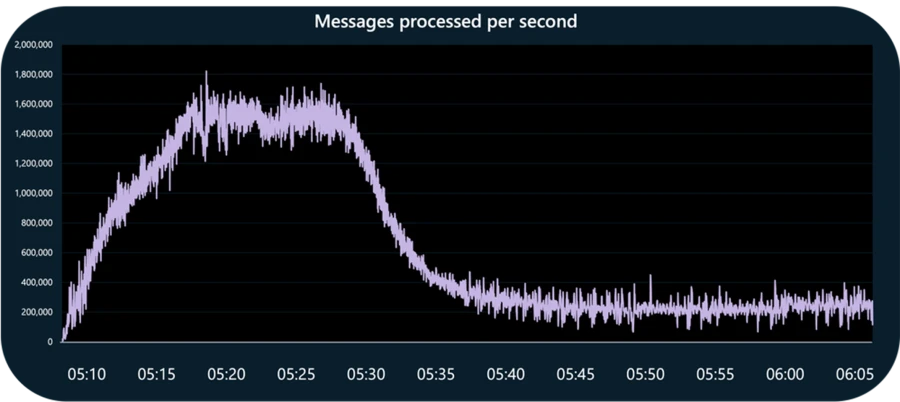
In a recent test, GitHub sustained 1.6 million events per second using one Flex Consumption app triggered from a network-restricted event hub.
“What really matters to us is that the app scales up and down based on demand. Azure Functions Flex Consumption is very appealing to us because of how it dynamically scales based on the number of messages that are queued up in Azure Event Hubs.”
—Stephan Miehe, GitHub Senior Director of Platform Security
In a recent test, GitHub’s new function app processed 1.6 million messages per second in the Azure Functions Flex Consumption plan.
A look back
GitHub’s problem lay in an internal messaging app orchestrating the flow between the telemetry producers and consumers. The app was originally deployed using Java-based binaries and Azure Event Hubs. But as it began handling up to 460 gigabytes (GB) of events per day, the app was reaching its design limits, and its availability began to degrade.
For best performance, each consumer of the old platform required its own environment and time-consuming manual tuning. In addition, the Java codebase was prone to breakage and hard to troubleshoot, and those environments were getting expensive to maintain as the compute overhead grew.
“We couldn’t accept the risk and scalability challenges of the current solution,“ Miehe says. He and his team began to weigh the alternatives. “We were already using Azure Event Hubs, so it made sense to explore other Azure services. Given the simple nature of our need—HTTP POST request—we wanted something serverless that carries minimal overhead.”
Familiar with serverless code development, the team focused on similar Azure-native solutions and arrived at Azure Functions.
“Both platforms are well known for being good for simple data crunching at large scale, but we don’t want to migrate to another product in six months because we’ve reached a ceiling.”
—Stephan Miehe, GitHub Senior Director of Platform Security
A function app can automatically scale the queue based on the amount of logging traffic. The question was how much it could scale. At the time GitHub began working with the Azure Functions team, the Flex Consumption plan had just entered private preview. Based on a new underlying architecture, Flex Consumption supports up to 1,000 partitions and provides a faster target-based scaling experience. The product team built a proof of concept that scaled to more than double the legacy platform’s largest topic at the time, showing that Flex Consumption could handle the pipeline.
“Azure Functions Flex Consumption gives us a serverless solution with 100% of the capacity we need now, plus all the headroom we need as we grow.”
—Stephan Miehe, GitHub Senior Director of Platform Security
Making a good solution great
GitHub joined the private preview and worked closely with the Azure Functions product team to see what else Flex Consumption could do. The new function app is written in Python to consume events from Event Hubs. It consolidates large batches of messages into one large message and sends it on to the consumers for processing.
Finding the right number for each batch took some experimentation, as every function execution has at least a small percentage of overhead. At peak usage times, the platform will process more than 1 million events per second. Knowing this, the GitHub team needed to find the sweet spot in function execution. Too high a number and there’s not enough memory to process the batch. Too small a number and it takes too many executions to process the batch and slows performance.
The right number proved to be 5,000 messages per batch. “Our execution times are already incredibly low—in the 100–200 millisecond range,” Miehe reports.
This solution has built-in flexibility. The team can vary the number of messages per batch for different use cases and can trust that the target-based scaling capabilities will scale out to the ideal number of instances. In this scaling model, Azure Functions determines the number of unprocessed messages on the event hub and then immediately scales to an appropriate instance count based on the batch size and partition count. At the upper bound, the function app scales up to one instance per event hub partition, which can work out to be 1,000 instances for very large event hub deployments.
“If other customers want to do something similar and trigger a function app from Event Hubs, they need to be very deliberate in the number of partitions to use based on the size of their workload, if you don’t have enough, you’ll constrain consumption.”
—Stephan Miehe, GitHub Senior Director of Platform Security
Azure Functions supports several event sources in addition to Event Hubs, including Apache Kafka, Azure Cosmos DB, Azure Service Bus queues and topics, and Azure Queue Storage.
Reaching behind the virtual network
The function as a service model frees developers from the overhead of managing many infrastructure-related tasks. But even serverless code can be constrained by the limitations of the networks where it runs. Flex Consumption addresses the issue with improved virtual network (VNet) support. Function apps can be secured behind a VNet and can reach other services secured behind a VNet—without degrading performance.
As an early adopter of Flex Consumption, GitHub benefited from improvements being made behind the scenes to the Azure Functions platform. Flex Consumption runs on Legion, a newly architected, internal platform as a service (PaaS) backbone that improves network capabilities and performance for high-demand scenarios. For example, Legion is capable of injecting compute into an existing VNet in milliseconds—when a function app scales up, each new compute instance that is allocated starts up and is ready for execution, including outbound VNet connectivity, within 624 milliseconds (ms) at the 50 percentile and 1,022 ms at the 90 percentile. That’s how GitHub’s messaging processing app can reach Event Hubs secured behind a virtual network without incurring significant delays. In the past 18 months, the Azure Functions platform has reduced cold start latency by approximately 53% across all regions and for all supported languages and platforms.
Working through challenges
This project pushed the boundaries for both the GitHub and Azure Functions engineering teams. Together, they worked through several challenges to achieve this level of throughput:
In the first test run, GitHub had so many messages pending for processing that it caused an integer overflow in the Azure Functions scaling logic, which was immediately fixed.
In the second run, throughput was severely limited due to a lack of connection pooling. The team rewrote the function code to correctly reuse connections from one execution to the next.
At about 800,000 events per second, the system appeared to be throttled at the network level, but the cause was unclear. After weeks of investigation, the Azure Functions team found a bug in the receive buffer configuration in the Azure SDK Advanced Message Queuing Protocol (AMQP) transport implementation. This was promptly fixed by the Azure SDK team and allowed GitHub to push beyond 1 million events per second.
Best practices in meeting a throughput milestone
With more power comes more responsibility, and Miehe acknowledges that Flex Consumption gave his team “a lot of knobs to turn,” as he put it. “There’s a balance between flexibility and the effort you have to put in to set it up right.”
To that end, he recommends testing early and often, a familiar part of the GitHub pull request culture. The following best practices helped GitHub meet its milestones:
Batch it if you can: Receiving messages in batches boosts performance. Processing thousands of event hub messages in a single function execution significantly improves the system throughput.
Experiment with batch size: Miehe’s team tested batches as large as 100,000 events and as small as 100 before landing on 5,000 as the max batch size for fastest execution.
Automate your pipelines: GitHub uses Terraform to build the function app and the Event Hubs instances. Provisioning both components together reduces the amount of manual intervention needed to manage the ingestion pipeline. Plus, Miehe’s team could iterate incredibly quickly in response to feedback from the product team.
The GitHub team continues to run the new platform in parallel with the legacy solution while it monitors performance and determines a cutover date.
“We’ve been running them side by side deliberately to find where the ceiling is,” Miehe explains.
The team was delighted. As Miehe says, “We’re pleased with the results and will soon be sunsetting all the operational overhead of the old solution.“
Explore solutions with Azure Functions
Azure Functions Flex Consumption
Azure Functions
The post GitHub scales on demand with Azure Functions appeared first on Azure Blog.
Quelle: Azure
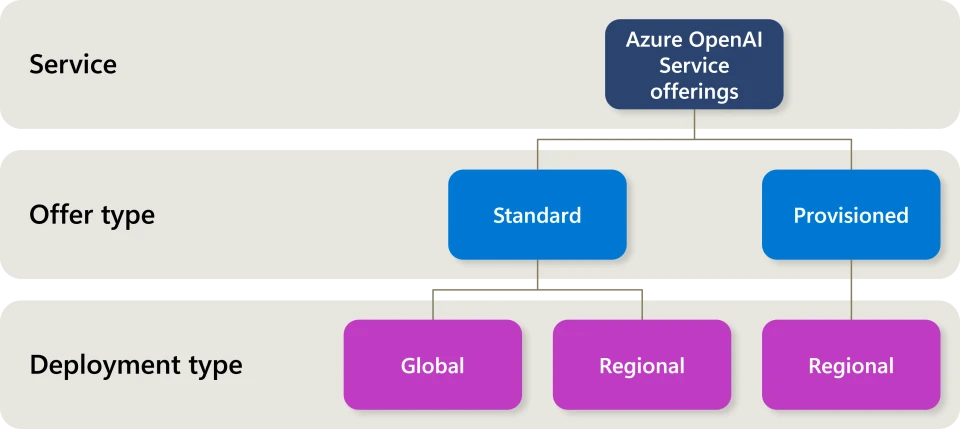
We’re excited to announce significant updates for Azure OpenAI Service, designed to help our 60,000 plus customers manage AI deployments more efficiently and cost-effectively beyond current pricing. With the introduction of self-service Provisioned deployments, we aim to help make your quota and deployment processes more agile, faster to market, and more economical. The technical value proposition remains unchanged—Provisioned deployments continue to be the best option for latency-sensitive and high-throughput applications. Today’s announcement includes self-service provisioning, visibility to service capacity and availability, and the introduction of Provisioned (PTU) hourly pricing and reservations to help with cost management and savings.
Azure OpenAI Service deployment and cost management solutions walkthrough
What’s new?
Self-Service Provisioning and Model Independent Quota Requests
We are introducing self-service provisioning alongside standard tokens, allowing you to request Provisioned Throughput Units (PTUs) more flexibly and efficiently. This new feature empowers you to manage your Azure OpenAI Service quata deployments independently without relying on support from your account team. By decoupling quota requests from specific models, you can now allocate resources based on your immediate needs and adjust as your requirements evolve. This change simplifies the process and accelerates your ability to deploy and scale your applications.
Visibility to service capacity and availability
Gain better visibility into service capacity and availability, helping you make informed decisions about your deployments. With this new feature, you can access real-time information about service capacity in different regions, ensuring that you can plan and manage your deployments more effectively. This transparency allows you to avoid potential capacity issues and optimize the distribution of your workloads across available resources, leading to improved performance and reliability for your applications.
Provisioned hourly pricing and reservations
We are excited to introduce two new self-service purchasing options for PTUs:
Hourly no-commitment purchasing
You can now create a Provisioned deployment for as little as an hour, with a flat hourly rate of $2 per unit per hour. This model-independent pricing makes it easy to deploy and tear down deployments as needed, offering maximum flexibility. This is ideal for testing scenarios or transitional periods without any long-term commitment.
Monthly and yearly Azure reservations for Provisioned deployments
For production environments with steady request volumes, Azure OpenAI Service Provisioned Reservations offer significant cost savings. By committing to a monthly or yearly reservation, you can save up to 82% or 85%, respectively, over hourly rates. Reservations are now decoupled from specific models and deployments, providing unmatched flexibility. This approach allows enterprises to optimize costs while maintaining the ability to switch models and adjust deployments as needed. Read our technical blog on Reservations here.
Azure OpenAI Service
Build your own copilot and generative AI applications
Try today
Benefits for decision makers
These updates are designed to provide flexibility, cost efficiency, and ease of use, making it simpler for decision-makers to manage AI deployments.
Flexibility: With self-service provisioning and hourly pricing, you can scale your deployments up or down based on immediate needs without long-term commitments.
Cost efficiency: Azure Reservations offer substantial savings for long-term use, enabling better budget planning and cost management.
Ease of use: Enhanced visibility and simplified provisioning processes reduce administrative burdens, allowing your team to focus on strategic initiatives rather than operational details.
Customer success stories
Before we made self-service available, select customers started achieving benefits of these options.
Visier Solutions: By leveraging Provisioned Throughput Units (PTUs) with Azure OpenAI Service, Visier Solutions has significantly enhanced their AI-powered people analytics tool, Vee. With PTUs, Visier guarantees rapid, consistent response times, crucial for handling the high volume of queries from their extensive customer base. This powerful synergy between Visier’s innovative solutions and Azure’s robust infrastructure not only boosts customer satisfaction by delivering swift and accurate insights but also underscores Visier’s commitment to using cutting-edge technology to drive transformational change in workforce analytics. Read the case study on Microsoft.
An analytics and insights company: Switched from Standard Deployments to GPT-4 Turbo PTUs and experienced a significant reduction in response times, from 10–20 seconds to just 2–3 seconds.
A Chatbot Services company: Reported improved stability and lower latency with Azure PTUs, enhancing the performance of their services.
A visual entertainment company: Noted a drastic latency improvement, from 12–13 seconds down to 2–3 seconds, enhancing user engagement.
Empowering all customers to build with Azure OpenAI Service
These new updates do not alter the technical excellence of Provisioned deployments, which continue to deliver low and predictable latency. Instead, they introduce a more flexible and cost-effective procurement model, making Azure OpenAI Service more accessible than ever. With self-service Provisioned, model-independent units, and both hourly and reserved pricing options, the barriers to entry have been drastically lowered.
To learn more about enhancing the reliability, security, and performance of your cloud and AI investments, explore the additional resources below.
Additional Resources
Azure Pricing Provisioned Reservations
Azure OpenAI Service Pricing
More details about Provisioned
Documentation for On-Boarding
PTU Calculator in Azure AI Studio
Unveiling Azure OpenAI Service Provisioned reservations blog
The post Elevate your AI deployments more efficiently with new deployment and cost management solutions for Azure OpenAI Service including self-service Provisioned appeared first on Azure Blog.
Quelle: Azure
Learn how multifactor authentication (MFA) can protect your data and identity and get ready for Azure’s upcoming MFA requirement.
As cyberattacks become increasingly frequent, sophisticated, and damaging, safeguarding your digital assets has never been more critical. As part of Microsoft’s $20 billion dollar investment in security over the next five years and our commitment to enhancing security in our services in 2024, we are introducing mandatory multifactor authentication (MFA) for all Azure sign-ins.
The need for enhanced security
One of the pillars of Microsoft’s Secure Future Initiative (SFI) is dedicated to protecting identities and secrets—we want to reduce the risk of unauthorized access by implementing and enforcing best-in-class standards across all identity and secrets infrastructure, and user and application authentication and authorization. As part of this important priority, we are taking the following actions:
Protect identity infrastructure signing and platform keys with rapid and automatic rotation with hardware storage and protection (for example, hardware security module (HSM) and confidential compute).
Strengthen identity standards and drive their adoption through use of standard SDKs across 100% of applications.
Ensure 100% of user accounts are protected with securely managed, phishing-resistant multifactor authentication.
Ensure 100% of applications are protected with system-managed credentials (for example, Managed Identity and Managed Certificates).
Ensure 100% of identity tokens are protected with stateful and durable validation.
Adopt more fine-grained partitioning of identity signing keys and platform keys.
Ensure identity and public key infrastructure (PKI) systems are ready for a post-quantum cryptography world.
Ensuring Azure accounts are protected with securely managed, phishing-resistant multifactor authentication is a key action we are taking. As recent research by Microsoft shows that multifactor authentication (MFA) can block more than 99.2% of account compromise attacks, making it one of the most effective security measures available, today’s announcement brings us all one step closer toward a more secure future.
In May 2024, we talked about implementing automatic enforcement of multifactor authentication by default across more than one million Microsoft Entra ID tenants within Microsoft, including tenants for development, testing, demos, and production. We are extending this best practice of enforcing MFA to our customers by making it required to access Azure. In doing so, we will not only reduce the risk of account compromise and data breach for our customers, but also help organizations comply with several security standards and regulations, such as Payment Card Industry Data Security Standard (PCI DSS), Health Insurance Portability and Accountability Act (HIPAA), General Data Protection Regulation (GDPR), and National Institute of Standards and Technology (NIST).
Preparing for mandatory Azure MFA
Required MFA for all Azure users will be rolled out in phases starting in the 2nd half of calendar year 2024 to provide our customers time to plan their implementation:
Phase 1: Starting in October, MFA will be required to sign-in to Azure portal, Microsoft Entra admin center, and Intune admin center. The enforcement will gradually roll out to all tenants worldwide. This phase will not impact other Azure clients such as Azure Command Line Interface, Azure PowerShell, Azure mobile app and Infrastructure as Code (IaC) tools.
Phase 2: Beginning in early 2025, gradual enforcement for MFA at sign-in for Azure CLI, Azure PowerShell, Azure mobile app, and Infrastructure as Code (IaC) tools will commence.
Beginning today, Microsoft will send a 60-day advance notice to all Entra global admins by email and through Azure Service Health Notifications to notify the start date of enforcement and actions required. Additional notifications will be sent through the Azure portal, Entra admin center, and the M365 message center.
For customers who need additional time to prepare for mandatory Azure MFA, Microsoft will review extended timeframes for customers with complex environments or technical barriers.
How to use Microsoft Entra for flexible MFA
Organizations have multiple ways to enable their users to utilize MFA through Microsoft Entra:
Microsoft Authenticator allows users to approve sign-ins from a mobile app using push notifications, biometrics, or one-time passcodes. Augment or replace passwords with two-step verification and boost the security of your accounts from your mobile device.
FIDO2 security keys provide access by signing in without a username or password using an external USB, near-field communication (NFC), or other external security key that supports Fast Identity Online (FIDO) standards in place of a password.
Certificate-based authentication enforces phishing-resistant MFA using personal identity verification (PIV) and common access card (CAC). Authenticate using X.509 certificates on smart cards or devices directly against Microsoft Entra ID for browser and application sign-in.
Passkeys allow for phishing-resistant authentication using Microsoft Authenticator.
Finally, and this is the least secure version of MFA, you can also use a SMS or voice approval as described in this documentation.
External multifactor authentication solutions and federated identity providers will continue to be supported and will meet the MFA requirement if they are configured to send an MFA claim.
Moving forward
At Microsoft, your security is our top priority. By enforcing MFA for Azure sign-ins, we aim to provide you with the best protection against cyber threats. We appreciate your cooperation and commitment to enhancing the security of your Azure resources.
Our goal is to deliver a low-friction experience for legitimate customers while ensuring robust security measures are in place. We encourage all customers to begin planning for compliance as soon as possible to avoid any business interruptions.
Start today! For additional details on implementation, impacted accounts, and next steps for you, please refer to this documentation.
The post Announcing mandatory multi-factor authentication for Azure sign-in appeared first on Azure Blog.
Quelle: Azure
Whether you’re a new student, a thriving startup, or the largest enterprise, you have financial constraints, and you need to know what you’re spending, where it’s being spent, and how to plan for the future. Nobody wants a surprise when it comes to the bill, and this is where Microsoft Cost Management comes in.
We’re always looking for ways to learn more about your challenges and how Microsoft Cost Management can help you better understand where you’re accruing costs in the cloud, identify and prevent bad spending patterns, and optimize costs to empower you to do more with less. Here are a few of the latest improvements and updates based on your feedback:
Exports enhancements: Parquet format support, file compression, and Fabric ingestion
Pricing updates on Azure.com
Your feedback matters: Take our quick survey!
New ways to save money with Microsoft Cloud
Documentation updates
Let’s dig into the details.
Exports enhancements: Parquet format support, file compression, and Fabric ingestion
In our last blog, I spoke about the support for FOCUS 1.0 (FinOps Cost Usage and Specification) datasets in Exports. We continue to make enhancements to the Exports functionality bringing support for the parquet format and file compression which can potentially help you achieve 40 to 70% file size reduction. These new cost saving features are initially available for the following datasets: Cost and usage details (Actual, Amortized, FOCUS) and Price Sheet. They aim to streamline your cost management processes, improve data handling efficiency, and reduce storage and network costs, all while providing comprehensive insights into your Azure spending.
Parquet is an open-source, columnar storage file format designed for efficient data processing and analytics. It offers several benefits over traditional formats like Comma-Separated Values (CSV), some of which are included below:
Efficient storage and reduced network cost: Parquet’s columnar format allows for better compression and encoding schemes, resulting in smaller file sizes. Compressed datasets occupy less space, translating to lower storage expenses and file transfer network cost.
Improved data transfer speed: Smaller file sizes mean faster data transfer rates, enhancing the efficiency of data operations.
Faster query performance: By storing data by column, parquet enables faster data retrieval and query performance, especially for large datasets.
Optimized analytics: Parquet format is optimized for big data tools and can be easily integrated with various analytics platforms.
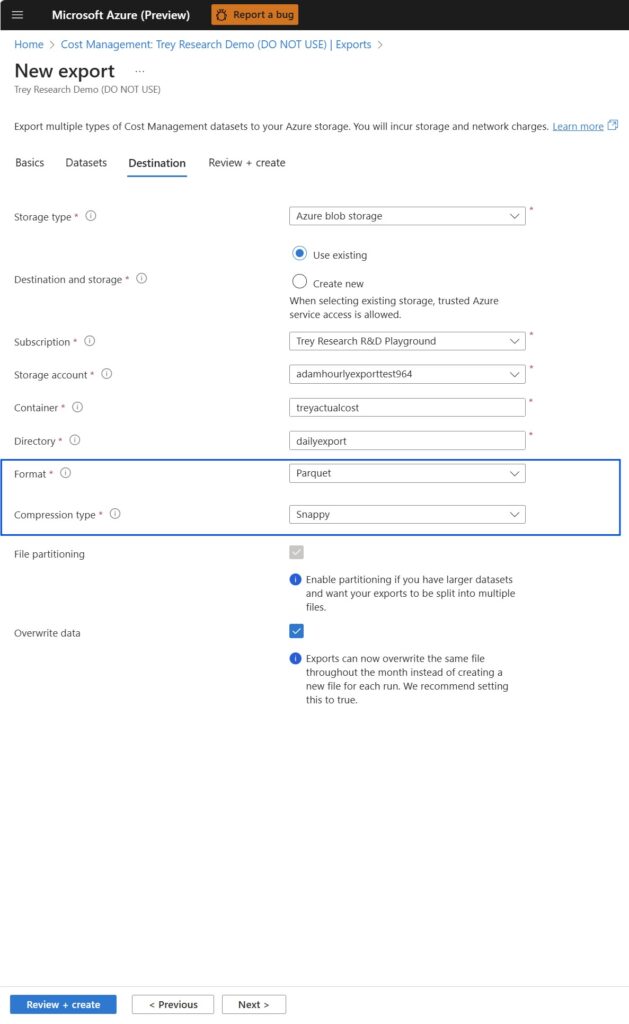
To further reduce the size of your datasets, you can now compress your CSV files using GNU ZIP (GZIP) and parquet files using Snappy.
Here is the screenshot showing the new configuration options:
Please refer to this article to get started.
Microsoft Fabric ingestion
Microsoft Fabric, as we know, is a great tool for data reporting and analytics where you can reference datasets from multiple sources without copying the data. We have now added new documentation to make it easy for you to ingest your exported costs datasets into new or existing Fabric workspaces. Just follow the steps included in this article.
Pricing updates on Azure.com
We’ve been working hard to make some changes to our Azure pricing experiences, and we’re excited to share them with you. These changes will help make it easier for you to estimate the costs of your solutions.
We’re thrilled to announce the launch of new pricing pages for Azure AI Health (now generally available) and the innovative Phi-3 service (now in preview), ensuring you have the latest information at your fingertips.
Our Azure AI suite has seen significant enhancements, with updated calculators for Azure AI Vision and Azure AI Language, ensuring you have access to the most current offers and SKUs. The Azure AI Speech service now proudly offers generally available pricing for the cutting-edge Text to Speech add-on feature “Avatar”, and Azure AI Document Intelligence has added pricing for new training and custom generative stock-keeping units (SKUs).
To maintain the accuracy and relevance of our offers, we’ve deprecated the Azure HPC Cache and SQL Server Stretch pricing pages and calculators. This step ensures that you’re only presented with the most up-to-date and valid options.
The pricing calculator has been updated with the latest offers and SKUs for Azure Container Storage, Azure AI Vision, Azure Monitor, and PostgreSQL, reflecting our commitment to providing you with the most accurate cost estimates.
We’ve introduced new prices and SKUs across various services, including pricing for the new Intel Dv6/Ev6 series (preview) and ND Mi300X v5 series for Virtual Machines, auxiliary logs offer for Azure Monitor, and audio streaming and closed caption SKUs for Azure Communication Services. The Azure Databricks service now features pricing for Automated Serverless Compute, and the Azure Container Storage service pricing page now reflects generally available pricing.
Our dedication to enhancing your pricing experience is reflected in the continuous improvements made to several pages, including Azure Synapse Analytics, Azure SQL Database, Azure Migrate, Azure Cosmos DB (autoscale-provisioned), Microsoft Purview, Microsoft Fabric, Linux Virtual Machines, Azure VMware Solution, Azure Web PubSub, Azure Content Delivery Network, and Azure SignalR Service.
We’re constantly working to improve our pricing tools and make them more accessible and user-friendly. We hope you find these changes helpful in estimating the costs for your Azure Solutions. If you have any feedback or suggestions for future improvements, please let us know!
Your Feedback Matters: Take our quick survey!
If you use Azure in your day-to-day work from deploying resources to managing costs and billing, we would love to hear from you. (All experience levels welcome!) Please take a few moments to complete this short, 5 to 10-minute survey to help us understand your roles, responsibilities, and the challenges you face in managing the cloud. Your feedback will help us improve our services to better meet your personal needs.
New ways to save money in the Microsoft Cloud
Here are new and updated offerings which can potentially help with your cost optimization needs:
Generally Available: Azure Virtual Network Manager mesh and direct connectivity
Generally Available: Announcing kube-egress-gateway for Kubernetes
Generally Available: Run your Databricks Jobs with Serverless compute for workflows
Generally Available: Azure Elastic SAN Feature Updates
Generally Available: Azure Virtual Network Manager mesh and direct connectivity
Public Preview: Summary rules in Azure Monitor Log Analytics, for optimal consumption experiences and cost
Public Preview: Continuous Performance Diagnostics for Windows VMs to enhance VM Troubleshooting
Public Preview: Azure cross-subscription Load Balancer
Public Preview: Advanced Network Observability for your Azure Kubernetes Service clusters through Azure Monitor
New Azure Advisor recommendations for Azure Database for PostgreSQL—Flexible Server
Want a more guided experience? Start with Control Azure spending and manage bills with Microsoft Cost Management.
Documentation updates
Here are a few costs related documentation updates you might be interested in:
Update: Centrally managed Azure Hybrid Benefit FAQ
Update: Pay for your Azure subscription by wire transfer
Update: Tutorial: Create and manage budgets
Update: Understand cost details fields
Update: Quickstart: Start using Cost analysis
Update: Tutorial: Improved exports experience—Preview
Update: Transfer Azure Enterprise enrollment accounts and subscriptions
Update: Migrate from Consumption Usage Details API
Update: Change contact information for an Azure billing account
New: Avoid unused subscriptions
Want to keep an eye on all documentation updates? Check out the Cost Management and Billing documentation change history in the azure-docs repository on GitHub. If you see something missing, select Edit at the top of the document and submit a quick pull request. You can also submit a GitHub issue. We welcome and appreciate all contributions!
What’s next?
These are just a few of the big updates from last month. Don’t forget to check out the previous Microsoft Cost Management updates. We’re always listening and making constant improvements based on your feedback, so please keep the feedback coming.
Follow the Microsoft Cost Management YouTube channel to stay in the loop with new videos as they’re released and let us know what you’d like to see next.
The post Microsoft Cost Management updates—July 2024 appeared first on Azure Blog.
Quelle: Azure






