Discover insights from text with AutoML Natural Language, now generally available

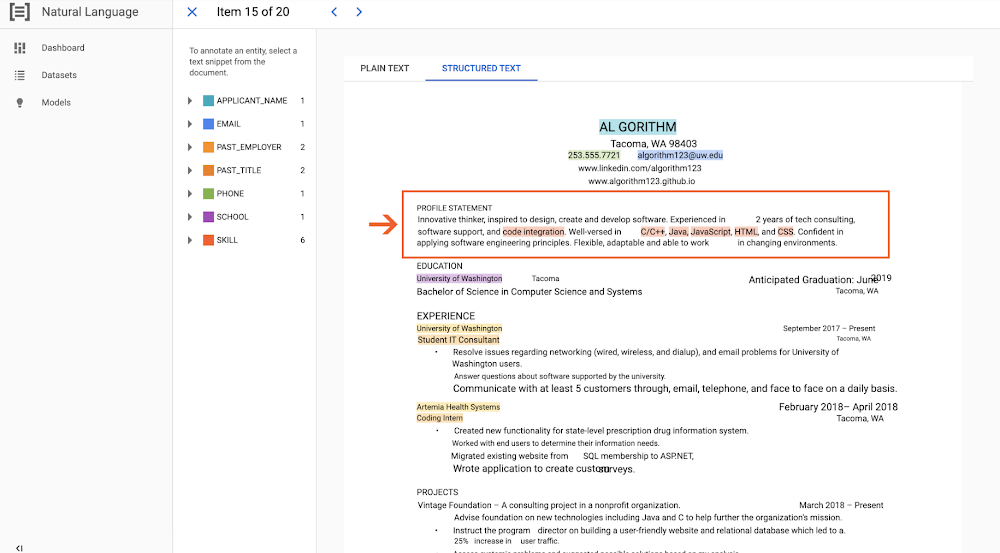
Organizations are managing and processing greater volumes of text-heavy, unstructured data than ever before. To manage this information more efficiently, organizations are looking to machine learning to help with the complex sorting, processing, and analysis this content needs. In particular, natural language processing is a valuable tool used to reveal the structure and meaning of text, and today we’re excited to announce that AutoML Natural Language is generally available. AutoML Natural Language has many features that make it a great match for these data processing challenges. It includes common machine learning tasks like classification, sentiment analysis, and entity extraction, which have a wide variety of applications, such as: Categorizing digital content, including news, blogs, and tweets, in real time to allow content creators to see patterns and insights—a great example is Meredith, which is categorizing text content across its entire portfolio of media properties in months instead of yearsIdentifying sentiment in customer feedbackTurning dark, unstructured scanned data into classified and searchable content We’re also introducing support for PDFs, including native PDFs and PDFs of scanned images. To further unlock the most complex and challenging use cases—such as understanding legal documents or document classification for organizations with large and complex content taxonomies—AutoML Natural Language now supports 5,000 classification labels, training up to 1 million documents, and document size up to 10 MB. One customer using this new functionality is Chicory, which develops custom digital shopping and marketing solutions for the grocery industry. “AutoML Natural Language allows us to solve complex classification problems at scale. We are using AutoML to classify and translate recipe ingredient data across a network of 1,300 recipe websites into actual grocery products that consumers can purchase seamlessly through our partnerships with dozens of leading grocery retailers like Kroger, Amazon, and Instacart,” Asaf Klibansky, Director of Engineering at Chicory explains. “With the expansion of the max classification label size to the thousands, we can expand our label/ingredient taxonomy to be more detailed than ever, providing our shoppers with better matches during their grocery shopping experience—a business challenge we have been trying to perfect since Chicory began. “Also, we see better model performance than we were able to achieve using open source libraries, and we have increased visibility into the individual label performance that we did not have before,” Klibanky continues. “This has allowed us to identify insufficient or poor quality training data per label quickly and reduce the time and cost between model iterations.” We’re continuously improving the quality of our models in partnership with Google AI research through better fine-tuning techniques, and larger model search spaces. We’re also introducing more advanced features to help AutoML Natural Language understand documents better. For example, AutoML Text & Document Entity Extraction will now look at more than just text to incorporate the spatial structure and layout information of a document for model training and prediction. This spatial awareness leads to better understanding of the entire document, and is especially valuable in cases where both the text and its location on the “page” are important, such as invoices, receipts, resumes, and contracts.Identifying applicant skills by location on the document.We also launched preferences for enterprise data residency for AutoML Natural Language customers in Europe and across the globe to better serve organizations in regulated industries. Many customers are already taking advantage of this functionality, which allows you to create a dataset, train a model, and make predictions while keeping your data and related machine learning processing within the EU or any other applicable region. Finally, AutoML Natural Language is FedRAMP-authorized at the Moderate level, making it easier for federal agencies to benefit from Google AI technology.To learn more about AutoML Natural Language and the Natural Language API, check out our website. We can’t wait to hear what you discover with your data.
Quelle: Google Cloud Platform

OpenShift 4.x Installation – A Quick Overview

In this video we will look at the options to install an OpenShift 4.x cluster and will see a fully automated quick installation with minor customizations on a cloud provider.
The post OpenShift 4.x Installation – A Quick Overview appeared first on Red Hat OpenShift Blog.
Quelle: OpenShift

Multicloud management: Why visibility, security and automation matter to CIOs

As a C-level or line of business executive, there’s a lot that can keep you up at night. While it’s critical that you invest in new technology to keep up with your competition, you don’t want to risk a gap in security or lose out on your current investments — whether it’s your technology, your people or your budget.
And if you do decide to spend the money and take the time required to modernize, you’re probably wondering if doing so will jeopardize your enterprise’s ability to remain secure and compliant, provide the ROI that you expect and most importantly maintain an optimized customer experience. A negative outcome to any of these areas could tarnish brand reputation and even cost your enterprise financially.
Multicloud management: Three key considerations
Now let’s think about this from the perspective of managing your hybrid, multicloud environment, and address the issues that your IT Operations and Site Reliability Engineer (SRE) teams may face daily. Ask yourself these three questions:

Governance and security. Can your teams easily enforce your enterprise’s policies, and know that the risk of a security breach is minimal?
Visibility. Do your teams have clear line of site across your environments and the ability to easily diagnose and triage issues? Are their actions powered by key business indicators and predicative monitoring?
Automated operations. Are your delivery, configuration, and management processes slow and manual, or are they efficient and automated, thus driving cost savings and improved productivity?

If you answered “no” to any of these questions, don’t worry, you’re not alone. According to a 2018 IBM Institute for Business Value study, more than 60 percent of customers responding state that they don’t have the tools and procedures to manage and operate in a complex multicloud environment.
Multicloud management: Finding a solution
IBM Cloud Pak for Multicloud Management, is an integrated suite of capabilities that delivers lifecycle management for cloud-native and traditional applications, as well as infrastructure lifecycle management for Kubernetes and Virtual Machines (VMs), underpinned with a consistent event management, automation and enterprise policy compliance framework.
Your enterprise can benefit by managing VMs and containers from a single control point which can increase operational efficiency that’s driven by intelligent data analysis and Golden Signal monitoring.
A 2019 Ovum report sponsored by IBM found that IBM Cloud Pak for Multicloud Management can reduce development time by up to 84 percent and operational expenses by up to 75 percent.
The addition of Red Hat capabilities can support your infrastructure, security and application management.
IBM Cloud Pak for Multicloud Management v1.2 includes additions to infrastructure, security and application management. But what’s more exciting is the addition of Red Hat CloudForm functionalities and the integration with Ansible Automation Platform. A new UX can help your operations team easily communicate to Ansible playbooks and perform day-two operations, thus helping to control inventory, discovery and management for VM-based applications.

Runbooks that event management executes to remediate problems can now be written in Ansible.
Operators can automate the configuration of networks, storage attachments in clouds and compute resources as part of application development using preexisting Ansible playbooks.
IT automation needed for operations or setup/deployment/configuration, scripting can be performed using Ansible.

Wherever you are on your cloud management journey, IBM can meet you there.
Hopefully you can sleep better at night knowing that your hybrid, multicloud environment can be modernized, secured and managed while you continue to use your existing investments. You can consistently automate deployment, manage, protect and govern applications wherever your workloads run, while driving operational efficiency to gain a competitive advantage and improving service levels.
Learn more.

Watch: IBM Cloud Pak for Multicloud Management in one minute
Watch: IBM Cloud Pak for Multicloud Management – demo video
Visit: IBM Cloud Pak for Multicloud Management website

 
The post Multicloud management: Why visibility, security and automation matter to CIOs appeared first on Cloud computing news.
Quelle: Thoughts on Cloud






