Announcing Speaker Line-Up for Openshift Commons Gathering in London January 29th 2020

 
OpenShift Commons Gathering in London brings together the OpenShift, Kubernetes, and Operator communities for a day-long OpenShift Commons Gathering on January 29th, 2020 at the IET London: Savoy Place.
Register Now!
The event will feature guest speakers from Worldpay, Public Health England and Asiakastieto. 
Speaker line up announced!

Future Finance Data Innovations with Open Banking and PSD2 – OpenShift Case Study at Asiakastieto by Eero Arvonen (Suomen Asiakastieto)
OpenShift Hive at Worldpay by Bernd Malmqvist (Worldpay) and Matt Simons (Worldpay)
State of Operators: Frameworks, Hubs, SDKs and the Road Ahead by Guil Barros (Red Hat)
OpenShift 4 Release Update and Road Map by Duncan Hardie (Red Hat)  and Jan Kleinert (Red Hat)
OpenShift State of the Union: Unified Hybrid Cloud  by Julio Tapia (Red Hat)
OKD 4 Release Update by Christian Glombek, OKD-WG co-chair (Red Hat)

In the afternoon, closing the day with the ever popular “Ask-Me-Anything” (AMA) live Q&A session with  Red Hat engineers, and upstream project leads.  The day includes an Evening Reception and Networking Event hosted by members of the OpenShift Commons community.
See the full agenda!
 
Sponsor Opportunities Available for OpenShift Commons Gathering London
Want to connect with the community? Sponsoring the OpenShift Commons Gathering is a great way to expand our joint collaboration and get face-to-face interaction with leaders and members of the Kubernetes & OpenShift ecosystem. Sponsorships are selling out quickly but you can review remaining sponsorship opportunities available here.
 
ABOUT OPENSHIFT COMMONS GATHERINGS
The OpenShift Commons Gatherings bring together experts from all over the world to discuss container technologies, best practices for cloud native application developers and the open source software projects. These events are designed for optimal peer-to-peer networking as ample time is given for networking with speakers and all the attendees.
 
To learn more about OpenShift Commons, please visit https://commons.openshift.org and join us soon!
The post Announcing Speaker Line-Up for Openshift Commons Gathering in London January 29th 2020 appeared first on Red Hat OpenShift Blog.
Quelle: OpenShift

Introduction to DevSecOps by John Willis (Red Hat) – OpenShift Commons Briefing

In this briefing, DevSecOps expert, John Willis, Senior Director, Global Transformation Office at Red Hat gives an introduction to DevSecOps and a brief history of the origins of the topics.
He also covers:

Why traditional DevOps has shifted and what this shift means.
How DevSecOps can change the game for your team.
How to get DevSecOps initiatives started within your organization.

About the Speaker:
John Willis is a Senior Director in Red Hat’s Global Transformation Office. Prior to Red Hat, he was the Director of Ecosystem Development for Docker, which he joined after the company he co-founded (SocketPlane, which focused on SDN for containers) was acquired by Docker in March 2015. Previous to founding SocketPlane in Fall 2014, John was the Chief DevOps Evangelist at Dell, which he joined following the Enstratius acquisition in May 2013. He has also held past executive roles at Opscode/Chef and Canonical/Ubuntu. John is the author of 7 IBM Redbooks and is co-author of the “DevOps Handbook” and the upcoming Beyond the Phoenix Project.
Slides: Intro to DevSecOps
Join the DevSecOps SIG Community
Join the conversation and collaborate with the DevSecOps community by joining the DevSecOps Special Interest Group on Google group here:

https://groups.google.com/forum/#!forum/DevSecOps

This group is for discussion,sharing best practices and help deploying, integrating and implementing DevSecOps.
About OpenShift Commons
OpenShift Commons builds connections and collaboration across OpenShift and OKD communities, upstream projects, and stakeholders. In doing so we’ll enable the success of customers, users, partners, and contributors as we deepen our knowledge and experiences together.
Our goals go beyond code contributions. OpenShift Commons is a place for companies using OpenShift to accelerate its success and adoption. To do this, we’ll act as resources for each other, share best practices and provide a forum for peer-to-peer communication.
To stay abreast of all the latest announcements, briefings and events, please join the OpenShift Commons and join our mailing lists & slack channel.
Join OpenShift Commons today!
The post Introduction to DevSecOps by John Willis (Red Hat) – OpenShift Commons Briefing appeared first on Red Hat OpenShift Blog.
Quelle: OpenShift

Amazon FSx erweitert die AWS-Managementkonsole

Amazon FSx, ein Service, der vollständig verwaltete Windows-(Amazon FSx for Windows File Server)- und hochleistungsfähige Linux-(Amazon FSx for Lustre)-Dateisysteme bereitstellt, bringt zahlreiche Erweiterungen für die AWS-Managementkonsole, unter anderem die Fähigkeit zur Anzeige von Amazon FSx CloudWatch-Metriken und die Möglichkeit, Tags direkt innerhalb der Amazon FSx Console hinzuzufügen und zu aktualisieren.
Quelle: aws.amazon.com

Using HLL++ to speed up count-distinct in massive datasets

If you’re working in modern data analytics, you likely have some go-to tools. One of the most useful tools in a data analyst’s toolbox is the count-distinct function, which lets you count the number of unique values in a column in a data set. (Think of this as counting distinct elements in a data stream where there are repeated elements.) This can come in handy when gathering all types of business data—for example:How many unique visitors came to our website last yearHow many users got to a certain level of our online game todayHow many different IP addresses did a slice of network traffic come from How many unique visitors searched for a particular news event in a single dayHow many unique IoT devices started to report error codes after the code rollout However, as the number of unique items gets larger, the calculation to obtain this number exactly requires memory in proportion to the number of unique items. Another problem is that computing the values for unique visitors per day doesn’t mean you can simply add seven days of results together to get the unique count for the week, because that would overcount visitors seen on multiple days. A simple solution to do an exact count-distinct is to create a set structure. Then, as you process elements in the input, add them to the set if they are not in it yet, while also incrementing a set size counter. That looks something like this:The set will continue to grow in direct proportion to the cardinality of the dataset (the number of unique elements in the set), using large amounts of memory for large input cardinalities. You’ll have to consider the memory space needed for the set, as well as how to deal with this when using distributed processing, where data is spread across many machines for its processing. Count distinct functions from several machines cannot just be summed up, as the set objects from different machines will overlap (unless we repartitioned the data, such as with a hash partition). To deduplicate the sets in order to obtain an exact count, the entire leaf set needs to be sent to the root machine and merged (requiring huge amounts of I/O).Performing count-distinct, faster and cheaperSo how do you avoid massive memory costs for count distinct, or make the computation feasible in the first place? Data analysts will often require only an approximate count, with a small error margin being acceptable. Allowing for a small error in the result opens the door for massively cheaper computations: Approximate algorithms can compute count distinct with a fraction of the memory and I/O of an exact solution, at the price of results which are, for example, within 0.5% of the exact solution. A widely used approximate algorithm is HyperLogLog. Google’s implementation of and improvements to this algorithm are discussed in detail in this paper on HyperLogLog in practice. This implementation is known as HyperLogLog++ (we’ll refer to it as HLL++ for the rest of this post).The HLL++ algorithm makes it possible to store the intermediate state of an aggregation in a very compact form, called a sketch. These sketches are constant in size, as opposed to growing linearly, as our earlier set objects. These sketches lend themselves well to distributed processing frameworks, since you can efficiently transfer aggregation states over the wire.A further important benefit of sketches is that you can reuse and merge results for different time periods without needing to go back to the raw data. In our example counting unique visitors, a sketch can be produced and stored, summarizing the data for each day. To compute sliding window stats like seven-day active users, you can just reuse and merge the sketches for the relevant seven days instead of computing everything from scratch!  The Google implementation of HyperLogLog includes several improvements to the original algorithm: a compact and standardized sketch format, and a special higher accuracy mode for small cardinalities. This implementation was added to BigQuery in 2017 and has recently been open sourced and made directly available in Apache Beam as of version 2.16. That means it’s available for use in Cloud Dataflow, our fully managed service for transforming and enriching data in stream (real-time) and batch (historical) modes with equal reliability and expressiveness.Let’s explore the use of the HLL++ across several pipelines, using data coming from a streaming source:Outputting the approximate count distinct directly Output sketches to BigQuery, allowing for interoperability between BigQuery and Cloud Dataflow.Using BigQuery to run analytics queries against the sketches stored in step 2Outputting the sketches and metadata to Cloud StorageMerging and extracting results from files stored on Cloud StorageWe’ll show you how to use the transform directly to output results as well as store the aggregated sketches in BigQuery and, along with metadata, as Avro files in Cloud Storage. Building HLL++-enabled pipelines Apache Beam lets you process and analyze data as a stream, so making use of the Beam API with real-time data is simply a matter of adding it to a pipeline. The following operations, added in Beam 2.16, will reappear throughout the examples below: HllCount.Init—aggregates data into a sketch; HllCount.MergePartial—combines multiple sketches into one; HllCount.Extract—Extracts the estimated count of distinct elements from a sketch.Check out more details in the HllCount transform catalog entry. With these building blocks, we can now go ahead and explore a few use cases: 1. Compute approximate count of unique visitors to a website  Note: When testing, you can easily create a stream of values using the GenerateSequence utility class in Beam, which generates a sequence of data for you in stream mode. The pipeline below will process the IDs of everyone visiting our website and compute the approximate count based on the durationOfWindow.2. Generate unique visitors per page countThe example above used a PCollection of anonymized IDs visiting our website, but what if we wanted a count based on specific pages? For that we can make use of the transforms’ ability to work with key-value pairs. In the example below, the key is the webpage identifier and the value is visitor IDs.3. Storing the sketches in BigQueryBigQuery supports HLL++ via the HLL_COUNT functions, and BigQuery’s sketches are fully compatible with Beam’s, so it’s easy to interoperate with sketch objects across both systems. This use case mirrors usage of HLL++ within Google with Flume and BigQuery. Even when using approximate algorithms, Google-order-of-magnitude data sets can still be too large for analysts to query at interactive/”online” speeds (especially for expensive statistics like count distinct). The remedy is to pre-aggregate data into cubes using Google Flume pipelines, the internal version of Cloud Dataflow. End-user queries just filter and merge (roll up) over dozens of rows in the cube.  For functions like sum or count, the rollup is trivial, but what about count distinct? As you will recall from earlier, it is not possible to simply sum up count distinct values corresponding to a small time interval (day) into larger time intervals (week or month). With sketches, this becomes possible as the values can simply be merged.In the example below we will:Pre-aggregate data into sketches in Beam; Store the sketches in BigQuery as byte[] columns along with some metadata about the time interval. Run a rollup query in BigQuery, which can extract the results at interactive speed, thanks to the sketches that were pre-computed in Beam.With the bytes stored in BigQuery we can use the BigQuery HLL_COUNT.* functions to merge the sketches and extract the counts, with the following SQL query:Note: If you have sketches with different intervals in the same table, then you will need to use Window_Start and Window_End time in the WHERE clause.4. Storing the sketches externally Now, let’s output the results of the sketches to a file system. This is useful is when generating feature files ready for machine learning, where Cloud Dataflow is being used to enrich multiple sources of data before the modeling phase. The sketches’ ability to merge together means there’s no need to reprocess all of the data again. You just have to gather the files that correspond to the relevant time interval.There are many Apache Beam SinkIOs that can be used to create and store files. We will explore three of the common ones: FileIO, TextIO, AvroIO.TextIOTextIO will write out a PCollection<String> to a text file, with each element delimited by a new line character. Since a sketch is a byte array (byte[]), you need to first Base64-encode the bytes before writing them to TextIO. This is a nice straightforward approach which has a small processing overhead.FileIOFileIO lets you create a file, then you need to write a custom writer/reader to output the byte[] into a file, including any mechanisms to deal with multiple sketch objects in a single file, like value separators.AvroIOUsing a format like AVRO lets you store the sketches (as bytes) together with metadata. AVRO is also a widely used serialization format, with connectors available for many systems. Due to its convenience, we’ll use AvroIO for this example.First, create an object type that supports some extra metadata about the sketch. The @DefaultCoder annotation lets you use the AvroCoder coder in the pipeline.Using this class, you can write a pipeline that turns our stream of key-value sketches into our custom HLLAvroContainer objects, ready for output to a file. For extra optimization, let’s add the start and end time as metadata to the filename as well. This lets you easily use a glob pattern when reading the files to process only items you’re interested in, as opposed to having to read all files and apply a filter. The code snippet below will generate files to GS_FOLDER with a file name format of “2019-10-22T08:33:00.000Z-2019-10-22T16:33:00.000Z-pane-0-last-00000-of-00001″. You can use AvroIO’s more advanced options to write your own filenames to act as additional metadata (not shown).It’s also possible to push sketch objects from many windows into a single file. In order to do this, you would need to apply a larger window after the creation of the HLLAvroContainer but before the AvroIO write, such as Window.into(FixedWindows.of(<1 week>)). 5. Reading the sketches from external storageWith the output files in a folder, you can now read and then merge all of the individual files together from November 2019 for the approximate count distinct of that month.This will result in an output line per key, since all the results have been merged into a single result.HLL++ efficiently solves the count-distinct problem for large data sets with a small error margin, solving for the large majority of data analysts’ needs around count distinct. By its incorporation within Apache Beam, Cloud Dataflow offers you this algorithm for both streaming and batch processing pipelines. You can switch between the two easily, depending on your needs, and also move the intermediate aggregation state seamlessly back and forth between Beam and BigQuery.Note: As of version 2.16, there are several implementations of approximate count algorithms. We recommend the use of HllCount.java, especially if you need sketches and/or need compatibility with Google Cloud BigQuery.Among the other implementations, ApproximateUnique.java does not expose its intermediate aggregation state in the form of sketches and has lower accuracy; ApproximateDistinct.java is a reimplementation of the algorithm described in the HLL++ paper, but its sketch format is not compatible with BigQuery.
Quelle: Google Cloud Platform

Cloud in 2020: The year of edge, automation and industry-specific clouds

It was a banner year for cloud computing in2019. The area that gained the most ground was hybrid multicloud, which emerged as the favored strategy of enterprises looking for a flexible and efficient way to move their workloads to the cloud while reducing costs, boosting productivity and avoiding vendor lock-in. Those advantages are so significant that hybrid cloud is now estimated to be a $1.2 trillion opportunity.
That momentum will accelerate further in 2020 as businesses in all sectors use hybrid multicloud strategies to rapidly roll out applications that accelerate the digital transformation of their businesses while delivering exceptional experiences to their customers. At the same time, enterprises will increasingly turn to advanced encryption and protection solutions to ensure that their clouds remain secure in today’s threat-rich environment, and they’ll embrace emerging technologies like edge to extend the reach of their capabilities. They’ll also begin to adopt automation tools to make it easier to keep their complex cloud ecosystems humming along.
Let’s dive deeper into five trends, which we expect to see in the year ahead as enterprises continue on their cloud journeys.
1. 5G will enable more enterprises to use edge as part of their hybrid cloud strategies
Edge computing, where computations are performed as close to where the data is generated as possible, is in many ways the next chapter in cloud. Retailers will benefit from faster updates on consumer buying trends, factories will be able to perform predictive maintenance on equipment that’s about to fail, cellphone carriers will be able to support mobile gaming and augmented reality.
5G is a critical element as more enterprises look to incorporate edge as part of their hybrid cloud strategies. Hybrid cloud will continue to serve as an aggregation point for the most relevant data and back-end functions, while the edge can support analytics and other core functions in real-time where the data is created and actions are taken.
“Edge computing is a transformative technology,” says Ryan Anderson, IBM platform strategist, CTO group for edge development. “Edge is an enabling technology to deliver things that do work to the places that work needs to get done.”
5G is edge’s key enabling technology because it delivers the higher speeds and broader bandwidths required to cut data latency to the bone. As 5G deployments begin to hit the cellular airwaves, hybrid cloud ecosystems will increasingly take advantage of opportunities to perform computations at the edge. The resulting innovations are projected by the GSMA’s Mobile Economy report to contribute as much as $2.2 trillion to the global economy over the next 15 years.
2. Automation will dominate the next phase of hybrid multicloud
Companies are adopting hybrid multicloud strategies at a rapid clip, taking advantage of the flexibility to move mission-critical business applications to the environment of their choosing — public cloud, on-premises or private clouds. Indeed, hybrid cloud is a $1.2 trillion market opportunity and nearly 80 percent of IT decision makers see it in their future. However, the very advantages of hybrid environments, including resiliency, scalability and support for a broad variety of applications, APIs and data types, means they are by nature complicated.
“One of the challenges that’s going to become really important is managing the hybrid multicloud landscape,” says Bala Rajaraman, IBM Fellow and VP IBM Hybrid Cloud. “In 2020, even more enterprises will find themselves using multiple clouds, and the make-or-break for capitalizing on these investments will be how they effectively manage all this data spread across environments.”
The upshot is that automated tools — including early offerings that incorporate artificial intelligence — will emerge in 2020 to help manage this complexity. “AI is transitioning into a function that helps manage operations complexity and security,” says Hillery Hunter, VP & CTO of IBM Public Cloud.
Along with increasingly automated tools, dashboards that provide a big-picture overview of cloud operations will become an important tool for administrators. This will enable enterprises to tune their environments, putting the right workloads in the right place, controlling costs and managing security keys and encryption effectively.
3. Security “command centers” will proliferate as part of hybrid cloud strategies
Some 60 percent of IT decision makers rated security as the most important attribute in selecting a cloud provider. In 2020, tools will emerge that can uncover security insights and respond to incidents faster through dashboards that help centralize operations.
“In the hybrid multicloud world, you need a command center,” says Hunter. “Traditionally, that’s been called a security operations center. That whole space is evolving significantly. We’re seeing tremendous resonance on the notion that a single dashboard in hybrid multicloud is going to be important.”
The emergence of DevSecOps, where security is integrated into the development process itself, is another indication that a more connected security ecosystem is in the cards for 2020.
“Security posture and visibility across all environments is one of the next fronts,” says Hunter.
4. More adoption of industry-optimized clouds, beyond banking
As organizations turn to the cloud, they’re looking for solutions that serve the needs of their specific industry. For highly regulated industries in particular, this means features that offload the burdens of compliance. According to a recent study by Thomson Reuters, financial service organizations, for example, deal with an average of 220 regulatory updates per day — and 71 percent of firms expected that number to increase in the next year.
The financial-services-ready public cloud launched in 2019. That Bank of America will use this industry-specific cloud to host key applications and workloads to support its 66 million banking customers provides both an important proof point and a useful template that other industries will follow.
“We’re going to see more and more industry-specific characteristics,” says Rajaraman. “Ecosystems will have to target particular markets, because it’s very hard to be generic. So, there will be more of a focus on delivering industry-specific value and addressing industry-specific requirements.”
Global research from IBM shows that only 40 percent of organizations today have the skills and strategy to manage a multicloud environment. Here, industry specific clouds help organizations by shielding them from the complexities of their cloud infrastructure and architecture. Perhaps that’s why, according to a recent survey, 61 percent of respondents said that one of the biggest benefits of adopting industry cloud services was ease of management and administration.
5. Open source tools will proliferate to make Kubernetes more consumable
Open source technology is having a profound impact on cloud. In 2019, enterprises turned to open source software to modernize their infrastructure and accelerate their adoption of hybrid multicloud. In 2020, developers will focus on tools that can support rapid deployment of applications, which their businesses need to stay at the cutting edge of digital transformation.
This means widespread uptake of the continuous delivery paradigm, where organizations embrace the DevOps philosophy of rapid builds, tests and deployments. The continuous delivery model is growing in tandem with the increased development of cloud-native applications built from the start to be deployed through containers and Kubernetes.
“You’re going to see an amplification of people moving to Kubernetes and OpenShift in 2020 and start adopting technologies like Red Hat Operators to become an integral part of the Kubernetes ecosystem,” says Rajaraman.
In sum, as we look ahead, enterprises will have a growing palette of options at their disposal to facilitate workload management, speed application deployments, ensure maximum security, exploit additive technologies such as edge, and more. Indeed, the brave new cloud world of the decade that’s about to begin will deliver value, resiliency and responsiveness that could only be dreamt of just a few short years ago.
The post Cloud in 2020: The year of edge, automation and industry-specific clouds appeared first on Cloud computing news.
Quelle: Thoughts on Cloud

Introducing Storage Transfer Service for on-premises data

There’s an enormous amount of data in the world today, and your company likely operates its own storage infrastructure to store this data. Running your business in the cloud can generate more value from your data and facilitate collaboration across your organization, all while optimizing for infrastructure costs. Before you can take advantage of all that cloud offers, though, you have to actually get your data to the cloud. That’s why we’ve developed a new software service that helps you accomplish large-scale, online data transfers: Transfer Service for on-premises data. This can help take the complexity out of data transfers and move data faster than existing online tools like gsutil.Transfer Service for on-premises data is a managed solution that lets you move your data without needing to engineer your own custom software or invest in an off-the-shelf solution. Now, you can complete large-scale data transfers online, which scale to high-speed network connections—up to billions of files, multiple PB of data, and tens of Gbps. Transfer Service for on-premises data validates data integrity, so you can transfer with confidence. It’s also designed to be reliable and secure, so that if agent failures occur, in-progress transfers will not be impacted. And with performance optimizations included from the application to the transport layer, the service can use your available bandwidth to minimize transfer times. Plus, this service requires no code or maintenance, allowing your organization to focus on innovation, not operations. On-premises data transfers can be complex. “I see enterprises default to making their own custom solutions, which is a slippery slope as they can’t anticipate the costs and long-term resourcing,” says Scott Sinclair, senior analyst at ESG. “With Transfer Service for on-premises data (beta), enterprises can optimize for TCO and reduce the friction that often comes with data transfers. This solution is a great fit for enterprises moving data for business-critical use cases like archive and disaster recovery, lift and shift, and analytics and machine learning.”Getting started with Transfer Service for on-premises dataHere’s how it works. First, install and start the on-premises software (the agent), then go to the Cloud Console and submit directories to transfer to Cloud Storage. When transferring data, the service will parallelize your transfer across many agents, and then coordinate these agents to transfer your data over a secure internet connection to Cloud Storage. Transfer Service for on-premises data also features a fully self-service GUI with detailed transfer logs so that you can create, monitor, and manage transfer jobs with confidence.Click to enlargeTransfer Service for on-premises data is now available in beta for you to try. Learn more about how the service works and how to get started today.
Quelle: Google Cloud Platform

Discover insights from text with AutoML Natural Language, now generally available

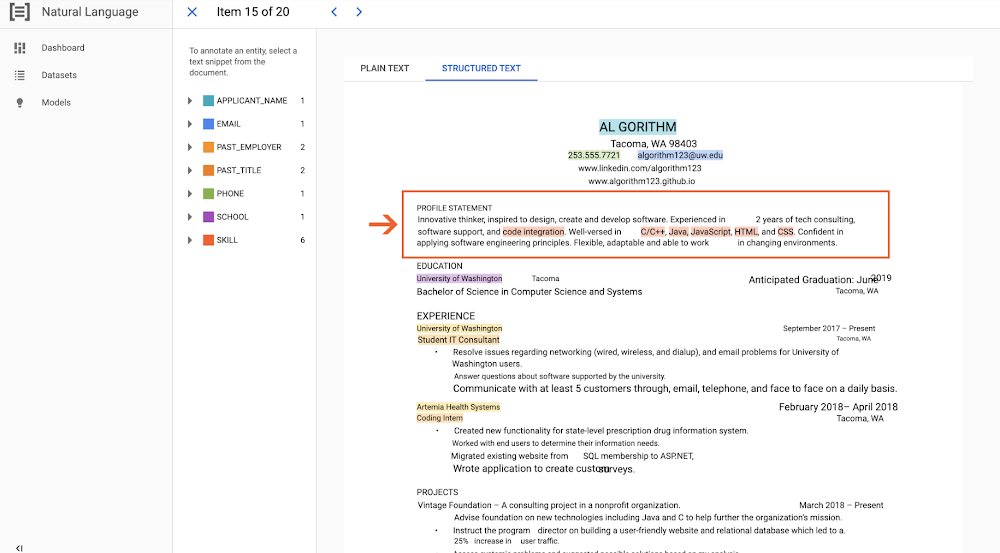
Organizations are managing and processing greater volumes of text-heavy, unstructured data than ever before. To manage this information more efficiently, organizations are looking to machine learning to help with the complex sorting, processing, and analysis this content needs. In particular, natural language processing is a valuable tool used to reveal the structure and meaning of text, and today we’re excited to announce that AutoML Natural Language is generally available. AutoML Natural Language has many features that make it a great match for these data processing challenges. It includes common machine learning tasks like classification, sentiment analysis, and entity extraction, which have a wide variety of applications, such as: Categorizing digital content, including news, blogs, and tweets, in real time to allow content creators to see patterns and insights—a great example is Meredith, which is categorizing text content across its entire portfolio of media properties in months instead of yearsIdentifying sentiment in customer feedbackTurning dark, unstructured scanned data into classified and searchable content We’re also introducing support for PDFs, including native PDFs and PDFs of scanned images. To further unlock the most complex and challenging use cases—such as understanding legal documents or document classification for organizations with large and complex content taxonomies—AutoML Natural Language now supports 5,000 classification labels, training up to 1 million documents, and document size up to 10 MB. One customer using this new functionality is Chicory, which develops custom digital shopping and marketing solutions for the grocery industry. “AutoML Natural Language allows us to solve complex classification problems at scale. We are using AutoML to classify and translate recipe ingredient data across a network of 1,300 recipe websites into actual grocery products that consumers can purchase seamlessly through our partnerships with dozens of leading grocery retailers like Kroger, Amazon, and Instacart,” Asaf Klibansky, Director of Engineering at Chicory explains. “With the expansion of the max classification label size to the thousands, we can expand our label/ingredient taxonomy to be more detailed than ever, providing our shoppers with better matches during their grocery shopping experience—a business challenge we have been trying to perfect since Chicory began. “Also, we see better model performance than we were able to achieve using open source libraries, and we have increased visibility into the individual label performance that we did not have before,” Klibanky continues. “This has allowed us to identify insufficient or poor quality training data per label quickly and reduce the time and cost between model iterations.” We’re continuously improving the quality of our models in partnership with Google AI research through better fine-tuning techniques, and larger model search spaces. We’re also introducing more advanced features to help AutoML Natural Language understand documents better. For example, AutoML Text & Document Entity Extraction will now look at more than just text to incorporate the spatial structure and layout information of a document for model training and prediction. This spatial awareness leads to better understanding of the entire document, and is especially valuable in cases where both the text and its location on the “page” are important, such as invoices, receipts, resumes, and contracts.Identifying applicant skills by location on the document.We also launched preferences for enterprise data residency for AutoML Natural Language customers in Europe and across the globe to better serve organizations in regulated industries. Many customers are already taking advantage of this functionality, which allows you to create a dataset, train a model, and make predictions while keeping your data and related machine learning processing within the EU or any other applicable region. Finally, AutoML Natural Language is FedRAMP-authorized at the Moderate level, making it easier for federal agencies to benefit from Google AI technology.To learn more about AutoML Natural Language and the Natural Language API, check out our website. We can’t wait to hear what you discover with your data.
Quelle: Google Cloud Platform

OpenShift 4.x Installation – A Quick Overview

In this video we will look at the options to install an OpenShift 4.x cluster and will see a fully automated quick installation with minor customizations on a cloud provider.
The post OpenShift 4.x Installation – A Quick Overview appeared first on Red Hat OpenShift Blog.
Quelle: OpenShift