All together now: our operations products in one place

Our suite of operations products has come a long way since the acquisition of Stackdriver back in 2014. The suite has constantly evolved with significant new capabilities since then, and today we reach another important milestone with complete integration into the Google Cloud Console. We’re now saying goodbye to the Stackdriver brand, and announcing an operations suite of products, which includes Cloud Logging, Cloud Monitoring, Cloud Trace, Cloud Debugger, and Cloud Profiler. The Stackdriver functionality you’ve come to depend on isn’t changing. Over the years, these operations products have seen a strong growth in usage by not just application developers and DevOps teams, but also IT operators and security teams. Complete integration of the products into the Cloud Console, along with in-context presence within the key service pages themselves—like the integrations into Compute Engine, Google Kubernetes Engine, Cloud SQL, and Dataflow management consoles—brings a great experience to all users. Putting operations tasks a quick click away, without users losing context of the activities they had been performing, shows how seamless an operations journey can be. In addition to this console integration, we’re very happy to share some of the progress in our products, with lots of exciting features launching today. Cloud LoggingContinuing with our goal to build easy-to-use products, we have completely overhauled the Logs Viewer and will be rolling this out to everyone over the next week. This makes it even easier for you to quickly identify and troubleshoot issues. We’re also pleased to announce that the ability to customize how long logs are retained is now available in beta. With both the new Cloud Logging user interface and the new 10-year log retention feature, you can search logs quickly and identify trends and correlations. We also understand that in some cases, it is very useful to export logs from Cloud Logging to other locations like BigQuery, Cloud Storage, or even third-party log management systems. To make this easier, we are making Logs Router generally available. Similarly, data from Cloud Trace can also be exported to BigQuery. Log Router’s support for customer management encryption keys (CMEK) also makes this a good solution for environments needing to meet that security need for compliance and other purposes. Cloud MonitoringOur biggest change of all that you’ll see in the console is Cloud Monitoring, as this was the last Stackdriver product to migrate over to our Google Cloud Console. You’ll now find a better designed, easy-to-navigate site, and important new features targeted to make your life easier. We are increasing our metrics retention to 24 months and writing metrics at up to 10-second granularity. The increased granularity is especially useful when making quick operational decisions like load balancing, scaling, etc. Like Cloud Logging, you can now access what you need more quickly, as well as prepare for future troubleshooting with longer retention. An additional key launch is Dashboards API, which lets you develop a dashboard once and share it multiple times in other workspaces and environments. Users might also notice better metrics recommendations by surfacing to the top of the selection list the most popular metrics for a given resource type. This is a great example of understanding the preferred metric by the millions of users on Google Cloud, and surfacing them quickly in other situations.This release makes it possible to route alerts to independent systems with Pub/Sub support, continuing with the ability to connect a broad variety of operational tools with Cloud Monitoring. To keep up with the needs of some of our largest users, we are also expanding support for hundreds of projects within a Workspace—providing a single point of control and management interface for multiple projects. Stay tuned for more details about all of these new capabilities in a series of blog posts over the next few weeks. 2020 will continue to see momentum for our operations suite of products, and we’re looking forward to the road ahead as we continue to help developers and operators across the world to manage and troubleshoot issues quickly and keep their systems up and running.Learn more about the operations suite here.
Quelle: Google Cloud Platform

A secure foundation for IoT, Azure Sphere now generally available

Today Microsoft Azure Sphere is generally available. Our mission is to empower every organization on the planet to connect and create secured and trustworthy IoT devices. General availability is an important milestone for our team and for our customers, demonstrating that we are ready to fulfill our promise at scale. For Azure Sphere, this marks a few specific points in our development. First, our software and hardware have completed rigorous quality and security reviews. Second, our security service is ready to support organizations of any size. And third, our operations and security processes are in place and ready for scale. General availability means that we are ready to put the full power of Microsoft behind securing every Azure Sphere device.

The opportunity to release a brand-new product that addresses crucial and unmet needs is rare. Azure Sphere is truly unique, our product brings a new technology category to the Microsoft family, to the IoT market, and to the security landscape.

IoT innovation requires security

The International Data Corporation (IDC) estimates that by 2025 there will be 41.6 billion connected IoT devices. Put in perspective, that’s more than five times the number of people on earth today. When we consider why IoT is growing so rapidly, the astounding pace is being driven by industries and companies that are investing in IoT to pursue long-term, real-world impact. They’re looking to harness the power of the intelligent edge to make daily life effortless, to transform businesses, to create safer working and living conditions, and to address some of the world’s most pressing challenges.

Innovation, no matter how valuable, is not durable without a foundation of security. If the devices and experiences that promise to reshape the world around us are not built on a foundation of security, they cannot last. But when innovation is built on a secure foundation, you can be confident in its ability to endure and deliver value long into the future. Durable innovation requires future-proofing IoT investments by planning and investing in security upfront.

IoT security is complex and the threat landscape is dynamic. You have to operate under the assumption that attacks will happen, it's not a matter of if but when. With this in mind, we built Azure Sphere with multiple layers of protection and with continually improving security so that it’s possible to limit the reach of an attack and renew and enhance the security of a device over time. Azure Sphere delivers foundational security for durable innovation.

Security is complex, but it doesn’t have to be complicated

Many of the customers we talk to struggle to define the specific IoT security measures necessary for success. We’ve leveraged our deep Microsoft experience in security to develop a very clear view of what IoT security requires. We found that there are seven properties that every IoT device must have in order to be secured. These properties clearly outline the requirements for an IoT device with multiple layers of protection and continually improving security.

Any organization can use the seven properties as a roadmap for device security, but Azure Sphere is designed to give our customers a fast track to secured IoT deployments by having all seven properties built-in. It makes achieving layered, renewable security for connected devices an easy, affordable, no-compromise decision.

Azure Sphere is a fully realized security system that protects devices over time. It includes four components, three of which are powered by technology, the Azure Sphere-certified chips that go into every device, the Azure Sphere operating system (OS) that runs on the chips, and the cloud-based Azure Sphere Security Service.

Every Azure Sphere chip includes built-in Microsoft security technology to provide a dependable hardware root of trust and advanced security measures to guard against attacks. The Azure Sphere OS is designed to limit the potential reach of an attack and to make it possible to restore the health of the device if it’s ever compromised. We continually update our OS, proactively adding new and emerging protections. The Azure Sphere Security Service reaches out and guards every Azure Sphere device. It brokers trust for device-to-cloud and device-to-device communication, monitors the Azure Sphere ecosystem to detect emerging threats, and provides a pipe for delivering application and OS updates to each device. Altogether, these layers of security prevent any single point of failure that could leave a device vulnerable.

The fourth component may be the most important: our Azure Sphere team. These are some of the brightest minds in security and they’re dedicated to the security of every single Azure Sphere device. Our team is at work identifying emerging security threats, creating new countermeasures, and deploying them to every Azure Sphere device. We are fighting the security battle, so our customers don’t have to.

Security obsessed, customer-driven

The challenges of IoT device security that keep us up at night lead to the features and capabilities that give our customers peace of mind. It’s ambitious and demanding work. To realize the defense-in-depth approach we had to integrate multiple distinct technologies and their related engineering disciplines. Our team can’t think about any component in isolation. Instead, we work from a unified view of interoperability and dependencies that brings together our silicon, operating system, SDK, security services, and developer experience. Having a clear mission gives us a shared focus to strategize and collaborate across teams and technologies. By eliminating boundaries among technologies or engineering teams, we’ve been able to create a product far greater than the sum of its parts.

We also made a point to collaborate with our early customers. We’ve used public preview to learn and improve how we deliver security in a way that supports customer and partner needs. Working closely with a wide range of customers has helped shape our investments in hardware, features, capabilities, and services. To support customers across the breadth of their IoT journeys, we’ve built strong partnerships with leading silicon and hardware manufacturers. This gives customers more choice, more implementation options, and new offerings that can speed time to market. Right now, customers are using Azure Sphere to securely connect everything from espresso machines to datacenters. Between those examples, there’s a whole range of use cases for home and commercial appliances, industrial manufacturing equipment, smart energy solutions, and so much more.

Our customers across a wide array of industries are putting their trust in Azure Sphere as they connect and secure equipment, drive improvements, reduce costs, and mitigate the real risks that cyberattacks present.

The Azure Sphere commitment

“Culture eats strategy for breakfast.” Only when we ground everything we do in our culture, can we support what’s necessary to execute a brilliant strategy. What we’ve set out to achieve with Azure Sphere is ambitious and Microsoft is deeply invested in a culture that can support the most ambitious ideas. We apply a growth mindset to everything we do and always strive to learn more about our customers. We actively seek diversity and practice inclusion as we work together toward the ultimate pursuit of making a difference in the world. Guided by our belief that a strong culture is an essential foundation for bringing our vision to life, we’ve focused on culture from the beginning.

To bring together the right technology and tactics as a single, end-to-end solution at scale, is an amazing amount of work that requires true teamwork. We’ve built a team with a broad variety of backgrounds, experience, and expertise across multiple disciplines to work together on Azure Sphere. To support collaboration and creativity, we have nurtured the Microsoft cultural values by practicing fearlessness, trustworthiness, and kindness. Without a strong and positive culture, the work we do would be much harder and far less fun. Our culture gives us the confidence to tackle seemingly impossible challenges and the freedom to take bold steps forward.

Azure Sphere general availability is a culmination of the focus, commitment, and investment we make as a team to realize our shared vision. I’m incredibly proud of the Azure Sphere team and what we’ve built together. And I’m grateful to share this accomplishment with all of the teammates, partners, and customers who have been a part of our journey to general availability. We’re ready to be our customers’ trusted partner in device security so that they can focus on unleashing innovation in their products and in their businesses.

If you are interested in learning more about how Azure Sphere can help you securely fast track your next IoT innovation:

Visit the Azure Sphere website to learn more. 
See how customers like Starbucks are using Azure Sphere to drive efficiency and consistency in their retail operations.
Get started.

Quelle: Azure

Tech Preview: Get visibility into your OpenShift costs across your hybrid infrastructure

Do you know if your OpenShift project is currently on budget? If you deploy more containers right now or if OpenShift dynamically increases capacity, would that put your project in the red? 
Red Hat is introducing a new cost management SaaS offering that is included at no additional charge with your Red Hat OpenShift Container Platform subscription. Cost management is an OpenShift Container Platform service that is currently available in Technology Preview. The service, which customers access from cloud.redhat.com/beta, gives you visibility into your costs across on-premises and cloud environments. 
With cost management for OpenShift, you can easily aggregate costs across hybrid cloud infrastructure (on-premises, Amazon Web Services, Azure, with more cloud platforms on the roadmap) and track budget requirements.

 
It’s easy to get started with AWS and Azure – just configure your cloud account to provide the required information and add it as a source for cost management. A unique benefit to Red Hat’s service is can also add your on-premises environments if you’re running OpenShift Container Platform 4.3 with metering. For more details, see the “Getting Started with Cost Management” guide.
Once you have your sources set up, you may want to take cost management to the next level with more advanced features. Cost models allow you to apply markup ratios to reflect the real costs of running an environment.
But one of the most powerful features is the use of tagging to map charges to projects and organizations. Tags are used for many things, not just cost management, and your organization may already have a taxonomy for tagging and/or naming. Our own cost management product manager, Sergio Ocón-Cárdenas, wrote a blog with some best practice guidelines for tagging, so take a look at that before jumping into the documentation for “Managing cost data using tagging.”
As I mentioned, cost management is still Tech Preview which means we’re providing early access to a feature that is not supported through normal channels. We are giving you the ability to test functionality and provide feedback during the development process. So give cost management a try, and if you have any questions or suggestions, please email costmanagement@redhat.com.
The post Tech Preview: Get visibility into your OpenShift costs across your hybrid infrastructure appeared first on Red Hat OpenShift Blog.
Quelle: OpenShift

Google Cloud Security – continuing to give good the advantage

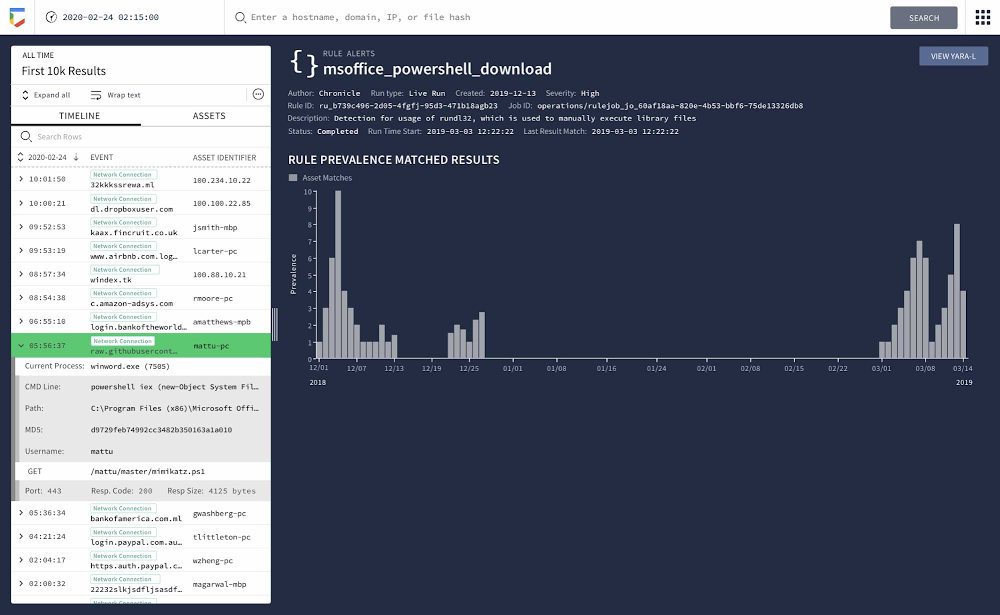
Cloud security is a top enterprise IT priority as organizations modernize their critical business systems both in-place and in the cloud. Our mission is to provide advanced security solutions that help give good the advantage, starting from building the most secure cloud platform to products that bring the power of Google’s global infrastructure and threat intelligence directly to your data centers.Today at the RSA Conference we’re introducing new capabilities that offer security wherever our customers’ systems and data may reside, including threat detection and timeline capabilities in Chronicle, threat response integration between Chronicle and Palo Alto Networks’ Cortex XSOAR, and online fraud prevention services. New advanced threat detection and automatic timelines in ChronicleDetection rule to find a PowerShell downloadChronicle launched its security analytics platform in 2019 to help change the way any business could quickly, efficiently, and affordably investigate alerts and threats in their organization. At RSA this year, as part of Google Cloud, we’ll show how customers can detect threats using YARA-L, a new rules language built specifically for modern threats and behaviors, including types described in Mitre ATT&CK. This advanced threat detection provides massively scalable, real-time and retroactive rule execution.We’re also introducing Chronicle’s intelligent data fusion, a combination of a new data model and the ability to automatically link multiple events into a single timeline. Palo Alto Networks, with Cortex XSOAR, is our first partner to integrate with this new data structure to enable even more powerful threat response. We’ll be demonstrating this integrated capability in the Google Cloud/Chronicle booth at RSA.“Cortex XSOAR offers automated enrichment, response and case management to enterprise-wide threats,” said Rishi Bhargava, VP, Product Strategy at Palo Alto Networks. “The integration with Chronicle’s new detection capabilities and event timelines, across months or years’ of data, enhances that response and enables comprehensive threat management for our mutual customers.”Prevent fraud and abuse with reCAPTCHA Enterprise and Web RiskTo protect your business, you need to protect your users. To help, we’re announcing the general availability of reCAPTCHA Enterprise and Web Risk API. These products are underpinned by two Google security technologies that have been protecting billions of web users and millions of websites for more than a decade—reCAPTCHA and Google Safe Browsing. reCAPTCHA Enterprise helps protect websites from fraudulent activities like scraping, credential misuse, and automated account creation. Protecting the web from bots has become increasingly important with the rise of threats like credential stuffing attacks, where malicious actors can test large volumes of breached passwords against legitimate sites. reCAPTCHA Enterprise recently added a new wave of commercial-grade bot defense capabilities to help ensure that a login attempt is being made by a legitimate user and not a bot. Google Nest is using reCAPTCHA Enterprise to help prevent automated attacks by actors seeking to obtain unauthorized access to accounts and devices.Overview of reCAPTCHA Enterprise protectionsUsing Web Risk API, enterprise customers can enable client applications to check URLs against Google’s constantly updated lists of unsafe web resources to prevent access to or inclusion of malicious content. Web Risk API alerts on, and includes information about, more than a million unsafe URLs that we keep up-to-date by examining billions of URLs each day in Google Safe Browsing.Web Risk API and reCAPTCHA Enterprise are now both globally generally available and can be purchased separately. Google Cloud security in 2020 and beyondWhen it comes to security, our work will never be finished. In addition to the capabilities announced today, we’ll continue to empower our customers with products that help organizations modernize their security capabilities in the cloud or in-place. To learn more about our entire portfolio of security capabilities, visit us at booth #2233 Moscone South, and check out our Trust & Security Center.
Quelle: Google Cloud Platform