AWS Config unterstützt jetzt die Aggregation in mehreren Konten und mehreren Regionen sowie die fortgeschrittene Abfrage in der Region Europa (Stockholm).

AWS Config unterstützt jetzt die Datenaggregation in mehreren Konten und mehreren Regionen sowie die fortgeschrittene Abfrage in der AWS-Region Europa (Stockholm). Mit dieser Funktion können Sie die Ressourcenkonfiguration und Regeleinhaltungsdaten von AWS Config in einem einzelnen Account bzw. einer einzelnen Region aggregieren und abfragen. Damit werden die erforderliche Zeit und die Ressourcen für einen unternehmensweiten Überblick über Ihren Ressourcenbestand und Compliance-Status reduziert. Die Datenaggregationsfunktion ist auch mit AWS Organizations integriert, damit Sie diese Daten zentral für jedes Konto in Ihrer Organisation abrufen können.
Quelle: aws.amazon.com

Important OpenShift Commons Gathering Amsterdam 2020 Update: Shifts again!

We’re shifting again! The OpenShift Commons Gathering/Amsterdam will be rescheduled to align with the soon-to-be announced new dates for CNCF/Kubecon/EU 
KubeCon + CloudNativeCon Europe (originally set for March 30 to April 2, 2020) has been postponed to instead be held in July or August 2020. The CNCF is finalizing the date and will announce it shortly.  We expect that by mid-summer, there will be more clarity on the effectiveness of control measures to enable safe travel to industry events.
We are looking forward to still delivering all of our sessions and workshops, including the OpenShift 4.Kubernetes Release Updates and Road Map with Clayton Coleman, and all of our engineering project leads will still be delivering their “State of” Deep Dive talks. We’re working with our case study speakers and other guest speakers to ensure they can adjust their schedules (and vacation plans) to share their talks as well.
We will provide updates on the OpenShift Commons Gathering here.  We will re-open registration once the dust settles and dates are confirmed. If you’ve purchased a ticket to the March 30 Gathering and any of the associated workshops, you will receive a full refund.
The full agenda will still be here.
Stay Tuned and Connected for More Information
Thank you for your enthusiasm for and participation in the OpenShift Commons community. We couldn’t do this without the ongoing support of our members, sponsors, speakers and staff.
Join OpenShift Commons and get on the mailing lists and slack channels to stay in touch and up to date.
 
Please Note:  CNCF is regularly updating their site with latest Novel Coronavirus Updates here: https://events.linuxfoundation.org/kubecon-cloudnativecon-europe/attend/novel-coronavirus-update/
The post Important OpenShift Commons Gathering Amsterdam 2020 Update: Shifts again! appeared first on Red Hat OpenShift Blog.
Quelle: OpenShift

Turning a Page with Page Layouts

Need to add a new page to your site but don’t know where to start? Making a brand new site on WordPress.com and want to design a homepage quickly? There’s a new addition to the WordPress experience that’ll help with exactly that.

Let’s take a look at Page Layouts! They’re pre-designed pages you can drop content into, without needing to decide what to put where.

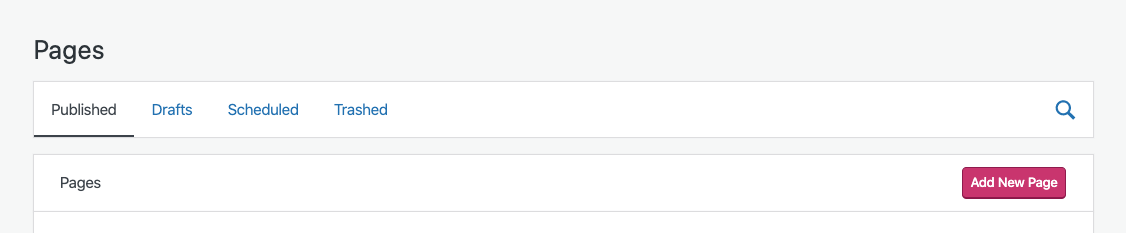
To add a Page Layout to your site, head to My Sites > Site > Pages and click the “Add New Page” button — it’s the pink one:

Next, we’ll show you a selection of layouts you can choose from — there are layouts available for

About pagesContact pagesServices pagesPortfolio pagesRestaurant Menu, Team, and Blog pagesand even starting points for Home pages

Here’s one of the available Portfolio Page Layouts, for example.

These layouts are all made using blocks in our block editor, which means you can edit the images, content, and layout all in one place. Start by replacing the default images and text, and you’ll be on your way!

You can use Page Layouts to make great-looking pages with only a few clicks. For inspiration, here are a selection of layouts using a variety of WordPress.com themes.

What other types of pages and designs would be useful for your site? Let us know what you’d like to see — we’d love to hear from you!
Quelle: RedHat Stack

Helping Developers Simplify Apps, Toolchains, and Open Source

It’s been an exciting four months since we announced that Docker is refocusing on developers. We have spent much of that time listening to you, our developer community, in meetups, on GitHub, through social media, with our Docker Captains, and in face-to-face one-on-ones. Your support and feedback on our refocused direction have been helpful and positive, and we’re fired-up for the year ahead!

What’s driving our enthusiasm for making developers successful? Quite simply, it’s in recognition of the enormous impact your creativity – manifested in the applications you ship – has on all of our lives. Widespread adoption of smartphones and near-pervasive Internet connectivity only accelerates consumer demand for new applications. And businesses recognize that applications are key to engaging their customers, partnering effectively with their supply chain ecosystem, and empowering their employees.

As a result, the demand for developers has never been higher. The current worldwide population of 18 million developers is growing approximately 20% every year (in contrast to the 0.6% annual growth of the overall US labor force). Yet, despite this torrid growth, demand for developers in 2020 will outstrip supply by an estimated 1 million. Thus, we see tremendous opportunities in helping every developer to be even more creative and productive as quickly as possible.

But how best to super-charge developer creativity and productivity? More than half of our employees at Docker are developers, and they, our Docker Captains, and our developer community collectively say that reducing complexity is key. In particular, there is an opportunity to reduce complexity stemming from three potential sources:

Applications. Developers want to ship their ideas from code to cloud as quickly as possible. But, while cloud-native microservices-based apps offer many compelling benefits, these can come at the cost of complexity. Orders of magnitude more app components, multiple languages, multiple service implementations – Containers? Serverless functions? Cloud-hosted services? – and more risk increasing the cognitive load on development teams.

Toolchains. In shipping code-to-cloud, developers want the freedom to select their own tools for each stage of their app delivery toolchains, and there are rich breadth and depth of innovative products from which to select. But integrating together multiple point products across the toolchain stages of source code management, build/CI, deployment, and others can be challenging. Often, it results in custom, one-off scripts that subsequently need to be maintained, lossy hand-off of app state between delivery stages, and subpar developer experiences.

Open Source. No surprise to the Docker community, an increasing number of developers are attracted by the creativity and velocity of innovation in open source technologies. But development teams often struggle with how to integrate and get the most out of open source components in their apps, how to manage the lifecycle of open source updates and patches, and how to navigate open source licensing dos and don’ts.

And for all the complexities above, development teams are seeking code-to-cloud solutions that won’t slow them down or lock them into any specific tool or runtime environment.

At Docker, we view our mission as helping developers bring their ideas to life by conquering the complexities of application development. In conquering these complexities, we believe that developers shouldn’t have to trade off freedom of choice for simplicity, agility, or portability.

We are fortunate that today there are millions of developers already using Docker Desktop and Docker Hub – rated “Second Most Loved Platform” in Stack Overflow’s 2019 survey – to conquer the complexity of building, sharing, and running cloud-native microservices-based applications. In 2020 we will help development teams further reduce complexity so they can ship creative applications even faster. How? Stay tuned for more this week!
The post Helping Developers Simplify Apps, Toolchains, and Open Source appeared first on Docker Blog.
Quelle: https://blog.docker.com/feed/