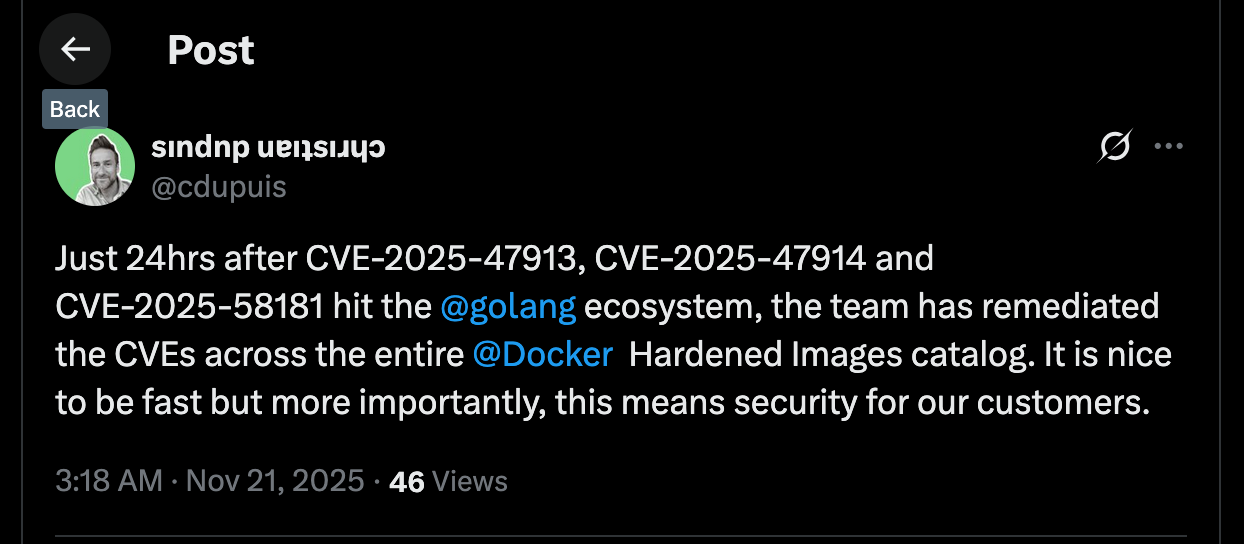
How Docker Hardened Images Patches Vulnerabilities in 24 hours
On November 19, 2025, the Golang project published two Common Vulnerabilities and Exposures (CVEs) affecting the widely-used golang.org/x/crypto/ssh package. While neither vulnerability received a critical CVSS score, both presented real risks to applications using SSH functionality in Go-based containers.
CVE-2025-58181 affects SSH servers parsing GSSAPI authentication requests. The vulnerability allows attackers to trigger unbounded memory consumption by exploiting the server’s failure to validate the number of mechanisms specified in authentication requests. CVE-2025-47914 impacts SSH Agent servers that fail to validate message sizes when processing identity requests, potentially causing system panics when malformed messages arrive. (These two vulnerabilities came just days after CVE-2025-47913, a high-severity vulnerability affecting the same Golang component that Docker also quickly patched)
For teams running Go applications with SSH functionality in their containers, leaving these vulnerabilities unpatched creates exposure to denial-of-service attacks and potential system instability.
How Docker achieves lightning fast vulnerability response
When these CVEs hit the Golang project’s security feed, Docker Hardened Images customers had patched versions available in less than 24 hours. This rapid response stems from Docker Scout’s continuous monitoring architecture and DHI’s automated remediation pipeline.
Here’s how it works:
Continuous CVE ingestion: Unlike vulnerability scanning that runs on batch schedules, Docker Scout continuously ingests CVE information from upstream sources including GitHub security advisories, the National Vulnerability Database, and project-specific feeds. The moment CVE data becomes available, Scout begins analysis.
Instant impact assessment: Within seconds of CVE ingestion, Scout identifies which Docker Hardened Images are affected based in Scout’s comprehensive SBOM database. This immediate notification allows the remediation process to start without delay.
Automated patching workflow: Depending on the vulnerability and package, Docker either patches automatically or triggers a manual review process for complex changes. For these Golang SSH vulnerabilities, the team initiated builds immediately after upstream patches became available.
Cascading builds: Once the patched Golang package builds successfully, the system automatically triggers rebuilds of all dependent packages and images. Every Docker Hardened Image containing the affected golang.org/x/crypto/ssh package gets rebuilt with the security fix.
The entire process, from CVE disclosure to patched images available to customers, was completed in under 24 hours. Customers using Docker Scout received immediate notifications about the vulnerabilities and the availability of patched versions.
Why Docker’s Security Response Is Different
One of Docker’s key differentiators is its continuous, real-time monitoring, rather than periodic batch scanning. Traditional vulnerability management relies on daily or weekly scans, leaving containers exposed to known vulnerabilities for hours or even days.
With Docker Scout’s real-time CVE ingestion, detection starts the moment a vulnerability is published, enabling remediation within seconds and minimizing exposure.
This foundation powers Docker Hardened Images (DHI), where packages and dependencies are continuously tracked and automatically updated when issues arise. For example, when vulnerabilities were found in the golang.org/x/crypto library, all affected images were rebuilt and released within a day. Customers simply pull the latest tags to stay secure, no manual patching, emergency maintenance, or impact triage required.
But continuous monitoring is just the foundation. What truly sets Docker apart is how that real-time intelligence flows into an automated, transparent, and trusted remediation pipeline, built on over a decade of experience securing and maintaining the Docker Official Images program.These are the same images trusted and used by millions of developers and organizations worldwide, forming the foundation of countless production environments. That long-standing operational experience in continuously maintaining, rebuilding, and distributing secure images at global scale gives Docker a proven track record in delivering reliability, consistency, and trust few others can match.
Beyond automation, Docker’s AI guardrails add yet another layer of protection. Purpose-built for the Hardened Images pipeline, these AI systems continuously analyze upstream code changes, flag risky patterns, and prevent flawed dependencies from entering the supply chain. Unlike standard coding assistants, Docker’s AI guardrails are informed by manual, project-specific reviews, blending human expertise with adaptive intelligence. When the system detects a high-confidence issue such as an inverted error check, ignored failure, or resource mismanagement, it halts the release until a Docker engineer verifies and applies the fix. This human-in-the-loop model ensures vulnerabilities are caught long before they can reach customers, turning AI into a force multiplier for safety, not a replacement for human judgment.
Another critical differentiator is complete transparency. Consider what happens when a security scanner still flags a vulnerability even after you’ve pulled a patched image. With DHI, every image includes a comprehensive and accurate Software Bill of Materials (SBOM) that provides definitive visibility into what’s actually inside your container. When a scanner reports a supposedly remediated image as vulnerable, teams can verify the exact package versions and patch status directly from the SBOM instead of relying on scanner heuristics.
This transparency also extends to how Docker Scout handles CVE data. Docker relies entirely on independent, third-party sources for vulnerability decisions and prioritization, including the National Vulnerability Database (NVD), GitHub Security Advisories, and upstream project maintainers. This approach is essential because traditional scanners often depend on pattern matching and heuristics that can produce false positives. They may miss vendor-specific patches, overlook backported fixes, or flag vulnerabilities that have already been remediated due to database lag. In some cases, even vendor-recommended scanners fail to detect unpatched vulnerabilities, creating a false sense of security.
Without an accurate SBOM and objective CVE data, teams waste valuable time chasing phantom vulnerabilities or debating false positives with compliance auditors. Docker’s approach eliminates that uncertainty. Because the SBOM is generated directly from the build process, not inferred after the fact, it provides definitive evidence of what’s inside each image and why certain CVEs do or don’t apply. This transforms vulnerability management from guesswork and debate into objective, verifiable security assurance, backed by transparent, third-party data.
CVEs don’t have to disrupt your week
Managing vulnerabilities consumes significant engineering time. When critical CVEs drop, teams rush to assess impact, test patches, and coordinate deployments. Docker Hardened Images eliminate this overhead by continuously updating base images with complete transparency into their contents with rapid turnarounds to reduce your exposure window.
If you’re tired of vulnerability whack-a-mole disrupting your team’s roadmap, Docker Hardened Images offers a better path forward. Learn more about how Docker Scout and Hardened Images can reduce your vulnerability management burden, or contact our team to discuss your specific security requirements.
Quelle: https://blog.docker.com/feed/








