Betriebssystem: Microsoft schafft 32-Bit-Version von Windows 10 ab
Stattdessen wird es künftig nur noch ein Windows 10 geben. Betreiber des eingeschränkten Windows sollen dies aber weiter nutzen dürfen. (Windows 10, Microsoft)
Quelle: Golem

Stattdessen wird es künftig nur noch ein Windows 10 geben. Betreiber des eingeschränkten Windows sollen dies aber weiter nutzen dürfen. (Windows 10, Microsoft)
Quelle: Golem

Die Entwickler von Google haben eine alte Idee neu aufgelegt und wollen die Funktion nun schrittweise an alle Nutzer verteilen. (Chrome, Browser)
Quelle: Golem
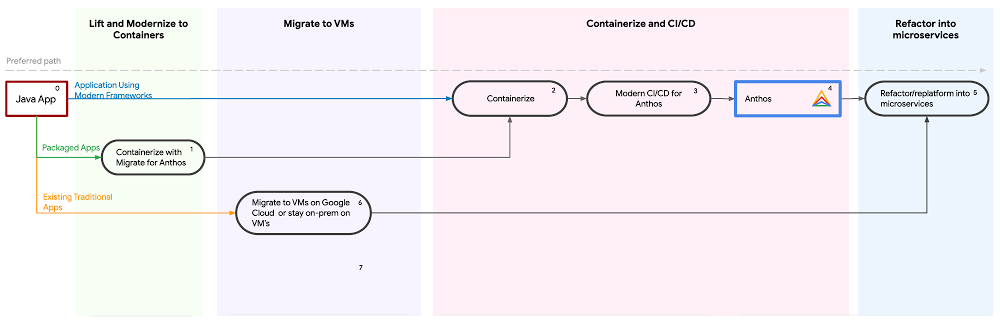
In many organizations, legacy applications can hold back business initiatives—and the business processes that rely on them. While new applications are being developed using cloud-native technologies, most existing applications are still large monolithic apps that run on proprietary application servers, incurring high licensing costs, slow release cycles, and vendor lock-in. And the lion’s share of those apps are written in Java. At Google Cloud, we’ve developed prescriptive guidelines to help you modernize your Java applications, for immediate operational cost savings, reduced dependencies on proprietary software, and increased software delivery speed. A key part of that path is Anthos, an open application platform which can help you modernize your existing apps with containerized microservices alongside VMs, plus integration into tools for policy management and modern application development and delivery. In this way, Anthos lets you innovate faster and deliver new experiences to your customers, while reducing risk and costs.Organizations looking to modernize a Java application typically have the following two goals in mind: Adopt modern development frameworks and architectures. Many modern Java applications are already built on open frameworks like Spring Boot. These frameworks allow enterprises to iterate fast and release features faster. At the same time, they can help developers adopt microservices-based development methods, where application “monoliths” are split into numerous smaller, more manageable problem domains. This microservices approach allows development teams to work independently on their domain without affecting others, so that they can release features faster and provide a better experience for customers.Move to containers and adopt DevOps practices – Organizations are trying to move away from traditional virtualization platforms and adopt modern container-based platforms—even for their legacy Java applications. Containers make efficient use of compute resources (compared to VMs) and can easily move between environments like multiple clouds and on-prem data centers. Here again, Anthos can help. Anthos lets enterprises build, deploy, and manage containerized applications anywhere in a secure, consistent manner. Anthos Config Management lets you define, automate, and enforce policies across environments, and Anthos Service Mesh lets you securely connect both containerized and non-containerized (i.e., VM-based) applications. Anthos also enables enterprises to secure their hybrid and multi-cloud deployments by providing consistent controls across any environment. From there, adopting containerization and a consistent, policy-based platform like Anthos can help you achieve DevOps goals of creating more secure and reliable applications, faster. Part of that is implementing modern CI/CD practices, which creates orchestrated and automated software delivery pipelines, to improve velocity and reliability, while reducing risk.Your paths to Java app modernization Here at Google Cloud, we see enterprise Java applications fall in one of three categories, and each requires that you take a unique approach to modernization.Click to enlargeApplications using modern frameworks – These are newer apps written on a modern Java framework like Spring Boot. The next step for these applications is to take advantage of Google Cloud managed services. Spring Cloud GCP lets your developers easily adopt Google Cloud services. Build tools like Jib and Cloud Native Buildpacks provide an easy way to containerize these applications using well known developer build tools (like Maven and Gradle). Once containerized you can manage these applications using Anthos. Packaged software – These are commercial off-the-shelf applications to which you don’t have the source code. For these types of applications, Migrate for Anthos allows you to move VMs from on-premises data centers to either VMs running in Google Cloud or to containers running on Anthos GKE, a cloud-agnostic implementation of GKE that runs in multiple environments. This lets you quickly adopt a modern platform, whether on-prem or in the cloud, and is especially useful if you have a large number of applications, as they can be migrated with minimal effort. Existing traditional applications – These are your Java applications developed in-house using older frameworks and often, running on commercial proprietary application servers. GCP provides a two-step process for modernizing these applications. First, use Migrate for Anthos to quickly migrate existing applications running in VMs to containers on Anthos. You can also migrate off of commercial app servers to open-source app servers to reduce or eliminate licensing costs. Second, refactor and rewrite migrated applications to use modern frameworks like Spring Boot and Spring Cloud GCP and move to a microservice development model.Google Cloud partners will help accelerate your modernization journeyGoogle Cloud and our partners are committed to modernizing and running your key workloads in whatever environment is best suited for your business. “Application modernization with Anthos enables significant improvements in scalability, high availability for business critical applications, and lowers operational cost,” said Volodymyr Yelchev, VP of Critical Services at SoftServe. “We see the lion’s share of the existing applications in enterprises written in Java. Significant re-architecturing and refactoring is required to meet new business objectives. Using Migrate for Anthos from Google Cloud, SoftServe has developed a proven, end-to-end approach for legacy, VM-based Java stack transformation to a modern, containerized application set. Our approach reduces complexity and improves speed of deployment within a short period of time.” If you’re looking to get started, we have partners that are eager to help you in your modernization journey. Getting startedThe need to improve operational cost savings by adopting cloud-native practices is more important than ever. Anthos can meet you where you are with your modernization journey. According to the Forrester Total Economic Impact study, customers adopting Anthos can achieve a range of up to 4.8x Return on Investment (ROI) within three years1. If you have existing Java applications that need to be modernized we are here to help. Please reach out to your account team or fill out this form so we can schedule an application assessment workshop with you.1. New Technology Projection: The Total Economic Impact™ Of Anthos, September 2019, a commissioned study conducted by Forrester Consulting on behalf of Google. *Based on the customer interview
Quelle: Google Cloud Platform
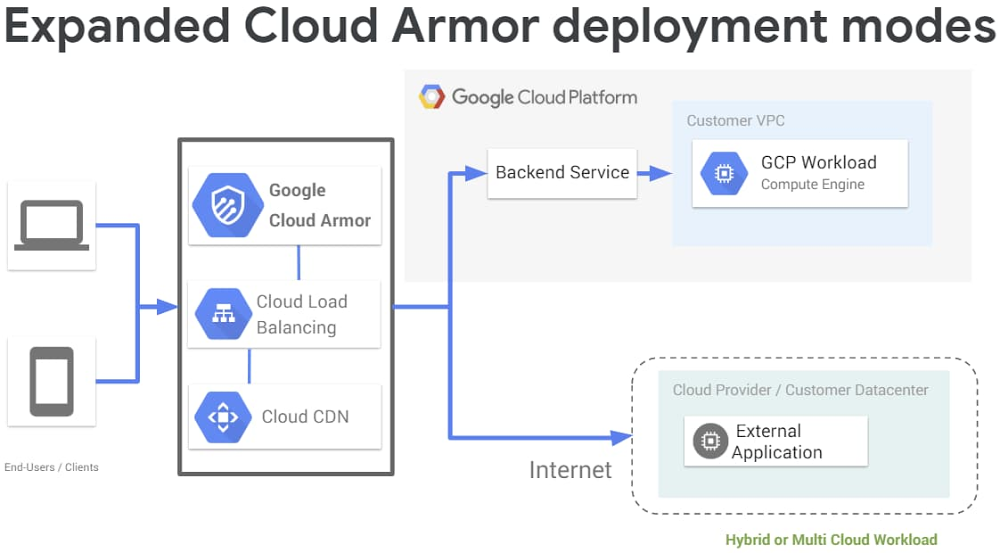
No matter where your applications are deployed, it’s important for admins to be able to quickly and easily scale security across the entire infrastructure. Google Cloud Armor is the web-application firewall (WAF) and DDoS mitigation service that helps users defend their web apps and services at Google scale at the edge of Google’s network. Last November, we introduced, as beta, new WAF capabilities and increased telemetry through the Security Command Center. Since then we’ve seen rapid adoption from customers looking to deploy Google Cloud-native offerings to defend and maintain the availability of their applications. As a result, we recently made the WAF generally available to all customers, including features such as:Geo-based access control Pre-configured WAF rules for SQL injection (SQLi) and Cross-Site Scripting (XSS) defense A custom rules language for custom Layer 7 (L7) filtering policies Security Command Center integration”At ATB Financial, security is a top priority,” says Innes Holman, Head of Technology Strategy and Architecture at ATB Financial. “With Google Cloud Armor, we can safely deploy workloads in the cloud. It protects our applications at scale while helping meet ATB’s security and compliance requirements.”What’s newToday, we’re also announcing the general availability of Cloud Armor support for Cloud CDN for origin server protection, as well as support for hybrid deployments, to help protect applications and services whether they’re deployed on Google Cloud, in a hybrid deployment, or in a multi-cloud architecture.Cloud Armor for Cloud CDN: origin server protectionWeb applications and websites often serve both static and dynamic content. While enabling Cloud CDN helps optimize the way static content is served, a client request for dynamic content still needs to reach the application server for processing and response. A CDN can typically scale to serve cached content in the face of an attack, but origin servers frequently need an upstream WAF to prevent unwelcome requests from overloading limited resources. Enterprises frequently have a security and compliance need to apply WAF rules and L7 filtering policies to reduce risk and ensure the availability of the application server. To fulfill this need, you can now configure Cloud Armor security policies to help protect backend services with Cloud CDN enabled. When a security policy is attached to a CDN-enabled backend service, Cloud Armor will enforce the policy for all requests destined to the origin server, including cache-misses and dynamic requests bypassing the cache. To get started, in your Google Cloud Load Balancing (GCLB) configuration, enable a backend service for Cloud CDN and then expand Advanced Configurations to attach a Cloud Armor security policy:Cloud Armor for hybrid and multi-cloud deploymentsCloud Armor, in addition to Cloud CDN and the Cloud Load Balancers, can now be used to front applications that are not deployed on Google Cloud. Enterprise workloads are increasingly complex and often are deployed with infrastructure on-prem and in the cloud, or spanning multiple infrastructure providers. Whether such hybrid architectures are a permanent fixture of an enterprise’s operations or part of a migration plan, security teams have a need to apply consistent security controls regardless of where the application is deployed—even internet-facing applications deployed on premise need to be protected from attacks from the internet.Users can now leverage the full scale and scope of Google’s edge infrastructure, including Cloud Armor, to help protect workloads that are deployed anywhere as long as they are accessible over the public internet. To get started, configure a GCLB backend service to point at an Internet Network Endpoint Group (NEG). Next, attach a Cloud Armor security policy to that backend service and configure one or more rules to filter Layer 7 traffic targeting the protected application.Next stepsWith Google Cloud Armor’s recent releases, Google Cloud customers can now utilize a native enterprise-grade WAF and DDoS mitigation service, leveraging the full scale of Google’s edge network to help defend their applications from DDoS attacks and mitigate risk from targeted application attacks. The support for hybrid deployment and CDN-enabled workloads means you have the option of deploying Google Cloud edge services—including Google Cloud Armor, Cloud CDN, and Cloud Load Balancing—to help protect applications and websites, whether they’re deployed on Google Cloud, on premise, or with other cloud providers, while maintaining a uniform edge and consistent set of policies and access controls. To learn more, check out the resources below:Cloud Armor documentation and resourcesCloud Armor security policy overview WAF rule tuning guideLanguage specificationInternet NEG documentationCDN origin protection documentation
Quelle: Google Cloud Platform
The global health crisis has transformed the way we work and live. Remote work has surged across industries, and the ability to scale and manage your business from anywhere has become essential. As our customers are moving beyond resolving immediate crisis needs, many are thinking about the next set of IT investments that can set them up for long term success. Microsoft is here to help.
Moving to the cloud has clear economic benefits. Convert upfront capital expenditures into operating expenditures and pay as you consume. The cloud scales up and down to meet demand as you need, so you don’t need to over-provision resources to be ready for peak usage and incur expenses on idle servers. Best of all, the cloud improves operational productivity for your staff, so they can focus on priority business initiatives.
When migrating to the cloud, Azure can provide unique and differentiated value that can help you save. Here’s how…
Save money with unique offers and programs
Meeting your business and budget needs has always been a priority for us. We make this possible through unique offers, transparent and competitive pricing, and free cost management tools. Azure is the most cost-effective cloud for Windows Server and SQL Server with offers like Azure Hybrid Benefit and free extended security updates—AWS is 5x more expensive. Lower your migration costs and risk through best practice guidance with the Cloud Adoption Framework for Azure, expert assistance with the Azure Migration Program, and free cost optimization tools.
Having worked with many of you, we have found that a simple ‘lift-optimize-shift’ migration strategy is your best bet to quickly realize cost savings and efficiencies. Start this process with a few simple steps. First, perform an assessment with our free Azure Migrate tool to help identify which workloads are cloud-ready, understand rightsizing recommendations, and opportunities to apply cost-savings offers unique to Azure. Next, migrate your Windows Server, SQL Server, and Linux infrastructure to Azure IaaS (or Azure VMware Solutions for VMware environments) using assessment results. And then keep your workloads secure and well managed on Azure. Customers such as Allscripts and Maersk have used this approach to save money and time.
Drive scale and operational efficiencies and focus on what matters
Many customers are migrating to the cloud to scale their most demanding workloads—for example, e-commerce web sites or health care portals—to drive cost savings and reliability. Migrating these web applications to Azure App Service unlocks benefits like automated load balancing and infrastructure maintenance, giving your staff valuable time back. There is opportunity to easily assess whether your website can be rapidly moved to App Service with the App Service Migration assistant. And, migrating your website’s database to a fully managed database like Azure SQL Database reduces the management and database administration overhead such as patching, high availability setup, and access control. Migrating to these Azure services requires little to no change to your existing web application and database, so it’s low-risk and cost-effective.
Keep your investments safe with unmatched security and built-in resiliency
Microsoft spends $1B annually on cybersecurity. We have over 3,500 Microsoft security professionals constantly monitoring our customers’ environments through advanced AI, analyzing more than 6.5 trillion security signals to detect and respond to threats with Azure Security Center. Use Azure Sentinel, a cloud native security information event management (SIEM) for end to end threat detection and response across your enterprise.
Azure provides built-in high-availability and disaster recovery options to ensure maximum resilience for your workloads. This includes infrastructure investments such as paired datacenter regions and availability zones for the best possible performance and security, as well as cost effective services like Azure Backup and Azure Site Recovery to keep your applications running during planned or unplanned outages.
Stay flexible with the cloud that’s hybrid by design
We understand that your organization will be in a hybrid state with investments that span multiple environments for the foreseeable future. We also know that you need flexibility to extend your on-premises investments and leverage them as you move to the cloud. Azure Hybrid Benefit enables you to re-use your existing Windows Server and SQL Server investments in the cloud and save money.
If you are ready to make the move and need help, join the Azure Migration Program, where we, along with our partner ecosystem, will help you accelerate your journey in a low-risk, cost-effective way. Learn more by visiting Azure migration center.
Quelle: Azure

Die Tage des alten UMTS-Netzes der Telekom sind gezählt. (UMTS, Telekom)
Quelle: Golem

Die EU-Kommission will die Nutzung von Corona-Apps nicht verpflichtend machen. Auch Innenminister Seehofer lehnt die Vorschläge von Axel Voss für Anreize ab. (Corona-App, Google)
Quelle: Golem

Die Gehäuse der Notebooks sehen schlanker und moderner aus. Auch gibt es ein Upgrade auf Intels Comet Lake H und neue Nvidia-GPUs. (Dell XPS 15, Notebook)
Quelle: Golem

Keine Begrenzung beim Detailreichtum und vollständig dynamisches Licht: Epic Games zeigt Grafik der Unreal Engine 5 auf der Playstation 5. (Epic Games, Sony)
Quelle: Golem

Bundeskanzlerin Angela Merkel findet den Hack des Bundestags “ungeheuerlich”. Maßnahmen gegen Russland könnten noch folgen. (Deutscher Bundestag, Applikationen)
Quelle: Golem






