Streaming: Amazon zeigt zwei neue Fire TV Sticks
Amazon erweitert das Sortiment der Fire TV Sticks. Der Einstieg in die Streaming-Welt wird noch mal preisgünstiger. (Fire TV Stick, Amazon)
Quelle: Golem

Amazon erweitert das Sortiment der Fire TV Sticks. Der Einstieg in die Streaming-Welt wird noch mal preisgünstiger. (Fire TV Stick, Amazon)
Quelle: Golem

Mit den mobilen Versionen von Google Maps können Risikogebiete in der Covid-19-Pandemie bald erkannt und von den Nutzern umgangen werden. (Google Maps, Google)
Quelle: Golem

Nvidia wartet auf AMD, denn der Konter zu Navi 21 liegt schon bereit – und diese Grafikkarte scheint schnell zu werden. (Nvidia Ampere, Grafikhardware)
Quelle: Golem

Fast 30 Rechner und Laptops will Lenovo künftig vorinstalliert mit Ubuntu ausliefern. Darunter auch die beliebten Thinkpad X1. (Lenovo, Ubuntu)
Quelle: Golem

Nach dem Upgrade auf iOS 14 haben einige iPhone-Nutzer offenbar Probleme mit der Risikoermittlung der Corona-Warn-App. (Coronavirus, Apple)
Quelle: Golem

Cloud-Dienste sind aus dem IT-Alltag nicht mehr wegzudenken – umso wichtiger ist es für IT-Profis, dass sie sich damit auskennen. Die Golem Akademie bietet Seminare zu den wichtigsten Themen an. (Golem Akademie, Server-Applikationen)
Quelle: Golem
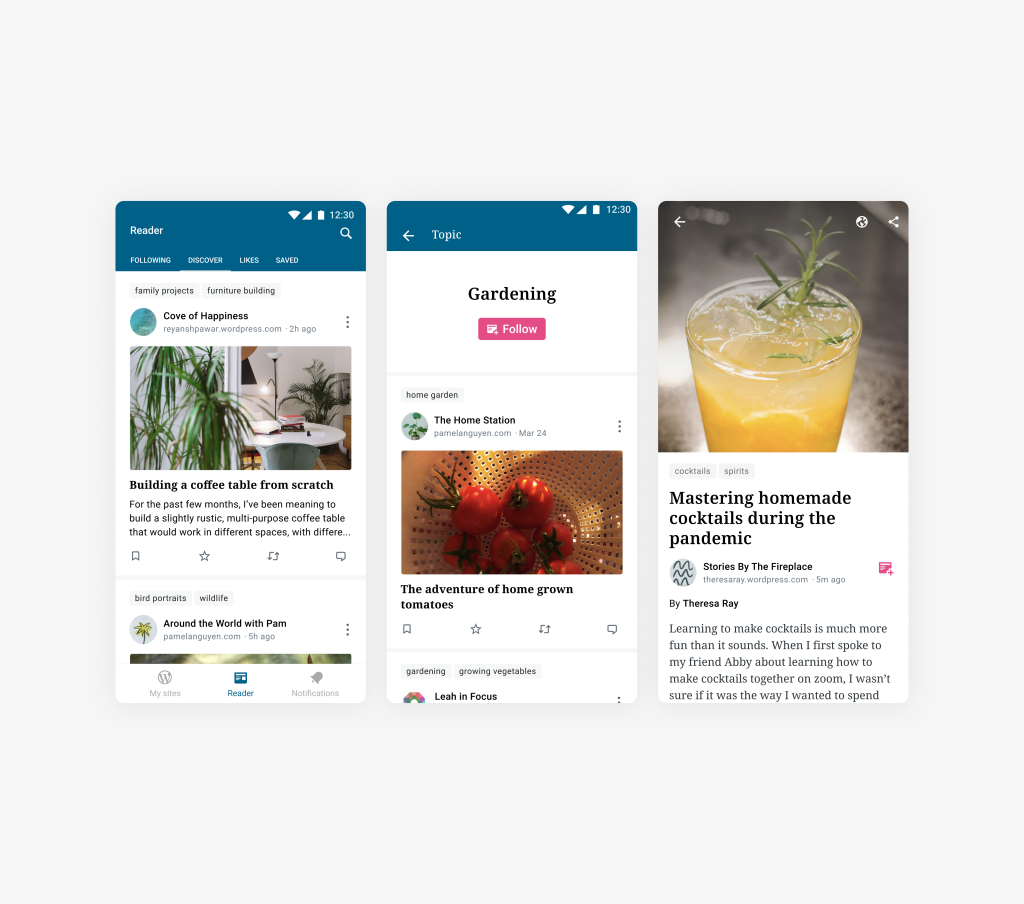
WordPress is home to millions of sites across countless topics. It’s a big and beautiful world, and we want to make it easier for you to discover new voices. Over the past few months, the mobile team has been working hard to improve the experience of your WordPress Reader on the mobile app. In particular, we’ve been exploring different ways for you to discover new blogs and find inspiration.
The new Discover tab on your Reader will recommend blogs and posts based on topics you follow. These changes give you more control over what you see, making it easier for you to find interesting voices, while also giving you and your site the opportunity to find a bigger audience.
How it works
Add appropriate tags and categories when drafting your blog posts — this helps us recommend your posts to the right audience.
The topics you now see in your improved Reader are a combination of tags and categories. If you want to find interesting blogs, follow topics you care about. The Discover tab will then show you recommended blogs and posts based on those topics.
Each post on the Discover tab has a list of topics on top. If you want to go deeper into a topic, tap on it to see a feed of blog posts from that specific topic.
If you’d like to see more posts from a particular topic on your Discover feed, tap the Follow button from that topic feed.
Soon we’ll be rolling out improvements to posts on the Reader as well. To give blog posts more room to shine, the featured image will be more prominent.
If you’d like to try the new Discover tab, make sure you update your WordPress app to the latest version. If you don’t have the app yet, you can download it for free, on both Android and iOS. We’d love to hear your thoughts on the new experience. For specific feedback on the updates, reach out to us from within the app by going to My Site, tapping your photo on the top right, tapping Help & Support → and then selecting Contact Support.
Quelle: RedHat Stack
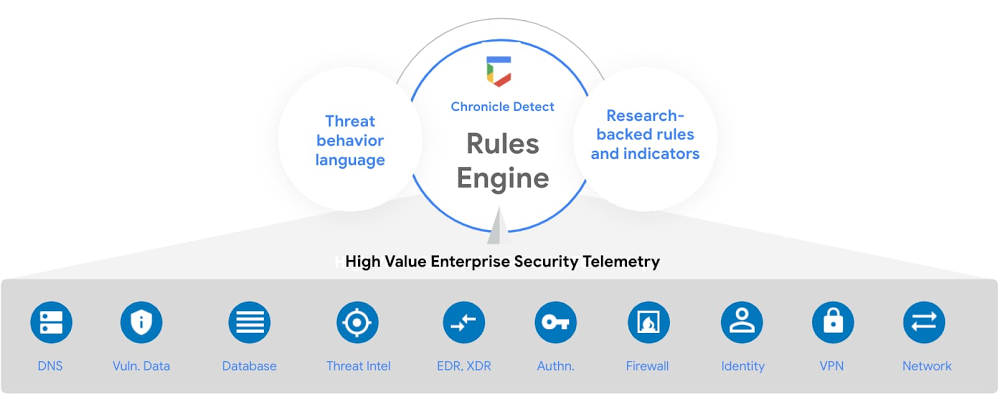
2020 has introduced complex challenges for enterprise IT environments. Data volumes have grown, attacker techniques have become complex yet more subtle, and existing detection and analytics tools struggle to keep up. In legacy security systems, it’s difficult to run many rules in parallel and at scale—so even if detection is possible, it may be too late. Most analytics tools use a data query language, making it difficult to write detection rules described in scenarios such as the Mitre ATT&CK framework. Finally, detections often require threat intelligence on attacker activity that many vendors simply don’t have. As a result, security tools are unable to detect many modern threats.To address these needs, today at Google Cloud Security Talks we’re announcing Chronicle Detect, a threat detection solution built on the power of Google’s infrastructure to help enterprises identify threats at unprecedented speed and scale. Earlier this year at RSA, we introduced the building blocks for Chronicle Detect: a data fusion model that stitches events into a unified timeline, a rules engine to handle common events, and a language for describing complex threat behaviors. With today’s announcement, we complete the rest of the solution.”The scale and SaaS deployment model of Google Chronicle drove NCR’s initial interest and investment. Their speed to deliver new features and integration have kept us productive and continued to impress. By operationalizing Chronicle for threat investigations, we have significantly improved our detection metrics. As an early design partner with Chronicle around its rules engine, Chronicle Detect, we see a clear opportunity to extend its benefits and impact to advanced threat detection.”—Bob Varnadoe, CISO at NCR CorporationIntroducing Chronicle’s next generation rules engineChronicle Detect brings modern threat detection to enterprises with the next generation of our rules engine that operates at the speed of search, a widely-used language designed specifically for describing threat behaviors, and a regular stream of new rules and indicators, built by our research team.Chronicle Detect makes it easy for enterprises to move from legacy security tools to a modern threat detection system. Using our Google-scale platform, security teams can send their security telemetry to Chronicle at a fixed cost so that diverse, high value security data can be taken into account for detections. We automatically make that security data useful by mapping it to a common data model across machines, users, and threat indicators, so that you can quickly apply powerful detection rules to a unified set of data.Detection rules trigger based on high value security telemetry sent to the Chronicle platform.With Chronicle Detect, you can use advanced rules out-of-the-box, build your own, or migrate rules over from legacy tools. The rules engine incorporates one of the most flexible and widely-used detection languages in the world, YARA, which makes it easy to build detections for tactics and techniques found in the commonly used MITRE ATT&CK security framework. YARA-L, a language for describing threat behaviors, is the foundation of the Chronicle Detect rules engine. Many organizations are also integrating Sigma-based rules that work across systems, or converting their legacy rules to Sigma for portability. Chronicle Detect includes a Sigma-YARA converter so that customers can port their rules to and from our platform.Using the YARA-L language, it’s easy to edit and build detection rules in the Chronicle interface.Get real-time threat indicators and automatic rules from Uppercase Chronicle customers can also take advantage of detection rules and threat indicators from Uppercase, Chronicle’s dedicated threat research team. Uppercase researchers leverage a variety of novel tools, techniques, and data sources (including Google threat intelligence and a number of industry feeds) to provide Chronicle customers with indicators spanning the latest crimeware, APTs, and unwanted malicious programs. The Uppercase-provided IOCs—such as high-risk IPs, hashes, domains, registry keys—are analyzed against all security telemetry in your Chronicle system, and let you know right away when high-risk threat indicators are present in your environment.“As an early adopter, Quanta has benefited from Chronicle’s scale, performance and economic benefits in security investigations and threat hunting. We are excited to see Chronicle extend the Google advantage to threat detection with the launch of Chronicle Detect backed by the Chronicle Uppercase research team.” —James Stinson, VP IT at Quanta Services, IncThe combination of these capabilities helps enterprises uncover multi-event attacks in their systems such as a new email sender followed by an HTTP post to a rare domain, or a suspiciously long powershell script accessing a low prevalence domain. Since joining Google Cloud over a year ago, the Chronicle team has been innovating on our investigation and hunting platform to bring a new set of capabilities to the security market—and we won’t stop here. Chronicle has also added new global availability and data localization options, including data center support for all capabilities in Europe and the Asia Pacific region. We’ll continue to build out integrations and help enterprises uncover threats with Chronicle wherever their data and applications reside, on-premises, in Google Cloud, and even in other cloud environments. To learn more about Chronicle Detect, read the Chronicle blog or contact the Chronicle sales team.
Quelle: Google Cloud Platform
Have you ever tried your hand at designing a resilient distributed software system? If you have, you likely found that there are many factors that contribute to the overall reliability of a system. Different parts of the system can fail in varied and unexpected ways. Certain architecture patterns work well in some situations, but poorly in others. There are many tradeoffs to be made about which parts of the system to optimize and when to optimize them.Navigating the many nuances of designing a distributed system can be daunting. However, anyone can be equipped to tackle these problems with the right tools and practice. There are many ways to design distributed systems. One way involves growing systems organically, adding and rewriting components as the system handles more requests or changes scope. At Google, we use a method called non-abstract large system design (NALSD). NALSD is an iterative process for designing, assessing, and evaluating distributed systems such as the Borg cluster management for distributed computing and the Google distributed file system. With this in mind, we’ve developed exercises to provide hands-on experience with the NALSD techniques. NALSD exercises are designed to equip engineers with the foundational knowledge and problem-solving skills needed to design planet-scale systems. You’ll learn how to evaluate whether a particular design achieves a service’s required service-level objectives (SLOs). These workshops challenge you to translate abstract designs into concrete plans using back-of-the-envelope calculations. Most importantly, they provide a chance for you to put these abstract concepts into practice.Planet-scale system (noun): A system that delivers services to users, no matter where they are around the world. Such a system delivers its services reliably, with high performance and availability to all of its usersSRE Classroom and the first NALSD workshopDeveloped by Google engineers, SRE Classroom is a workshop series designed to drive understanding of concepts like NALSD and other core SRE principles. Over the past few years, these workshops—taught within Google and at external conferences—have helped numerous engineers improve their system design and thinking skills. Our mission is to ensure engineering teams everywhere can understand and apply these concepts and best practices to their own systems.We’re pleased to make available all of the materials for our Distributed Pub/Sub workshop—the first of our NALSD-focused exercises from SRE Classroom. You can now freely use and re-use this material, available under the Creative Commons CC-BY 4.0 license, as long as Google is credited as the original author. Run your own version of this workshop and teach your coworkers, customers, or conference attendees about how to design large-scale distributed systems!What’s covered in the Distributed PubSub workshopThe PubSub exercise is about designing a planet-scale asynchronous publish-subscribe communication system. The workshop presents the problem statement, describes the requirements and available infrastructure, and walks through a sample solution.The workshop and material is broken into three stages:Design a working solution for a single data center.Extend that design to multiple data centers.Provision the system (i.e., how much hardware and bandwidth do we need?).For each stage of the workshop, participants will work through their own solution first. After they have a chance to explore their own ideas, the workshop leader presents a sample solution along with reasons for why certain design decisions were made.The exercise covers a wide variety of topics related to distributed system design, including scaling, replication, sharding, consensus, availability, consistency, distributed architecture patterns (such as microservices), and more. We present these concepts in contexts where they are useful to solving the problem at hand: designing a system to meet specific requirements. This helps bring clarity to where and why a particular concept might be useful for solving a particular problem.Typically, when we run this workshop, we break participants up into groups of four to six to work collaboratively toward a solution. Each group is paired with an experienced SRE volunteer who facilitates the discussion, encourages participation, and keeps the group on track.Run your own PubSub workshop!If this sounds interesting, check out the Presenter Guide and the Facilitator Guide, which have a lot more information on how to organize a Distributed Pub/Sub workshop. If you don’t have a whole team to educate, you can also work through this exercise with a buddy or on your own. Exploring multiple solutions to the problem and identifying the pros and cons of each solution may also be a meaningful exercise.Learn more about SRE and industry-leading practices for service reliability.
Quelle: Google Cloud Platform

Building microservices on Google Kubernetes Engine (GKE) provides you with maximum flexibility to build your applications, while still benefiting from the scale and toolset that Google Cloud has to offer. But with great flexibility comes great responsibility. Orchestrating microservices can be difficult, requiring non-trivial implementation, customization, and maintenance of messaging systems. Cloud Run for Anthos now includes an events feature that allows you to easily build event-driven systems on Google Cloud. Now in beta, Cloud Run for Anthos’ event feature assumes responsibility for the implementation and management of eventing infrastructure, so you don’t have to.With events in Cloud Run for Anthos, you getThe ability to trigger a service on your GKE cluster without exposing a public HTTP endpointSupport for Google Cloud Storage, Cloud Scheduler, Pub/Sub, and 60+ Google services through Cloud Audit logsCustom events generated by your code to signal between services through a standardized eventing infrastructureA consistent developer experience, as all events, regardless of the source, follow the CloudEvents standardYou can use events for Cloud Run for Anthos for a number of exciting use cases, including:Use a Cloud Storage event to trigger a data processing pipeline, creating a loosely coupled system with the minimum effort.Use a BigQuery audit log event to initiate a process each time a data load completes, loosely coupling services through the data they write. Use a Cloud Scheduler event to trigger a batch job. This allows you to focus on the code of what that job is doing and not its scheduling.Use Custom Events to directly signal between microservices, leveraging the same standardized infrastructure for any asynchronous coordination of services.How it worksCloud Run for Anthos lets you run serverless workloads on Kubernetes, leveraging the power of GKE. This new events feature is no different, offering standardized infrastructure to manage the flow of events, letting you focus on what you do best: building great applications. The solution is based on open-source primitives (Knative), avoiding vendor-lock-in while still providing the convenience of a Google-managed solution. Let’s see events in action. This demo app builds a BigQuery processing pipeline to query a dataset on a schedule, create charts out of the data and then notify users about the new charts via SendGrid. You can find the demo on github.You’ll notice in the example above that the services do not communicate directly with each other, instead we use events on Cloud Run for Anthos to ‘wire up’ coordination between these services, like so:Let’s break this demo down further. Step 1- Create the Trigger for Query Runner: First, create a trigger targeting the Query runner service based on a cloud scheduler job.Step 2- Handle the event in your code: In our example we need details provided in the trigger. These are delivered via the HTTP header and body of the request and can easily be unmarshalled using the CloudEvent SDK and libraries. In this example, we use C#:Read the event using CloudEvent SDK:Step 3 – Signal the Chart Creator with a custom event: Using custom events we can easily signal a downstream service without having to maintain a backend. In this example we raise an event of type dev.knative.samples.querycompletedThen we create a trigger for the Chart Creator service that fires when that custom event occurs. In this example we use the following gcloud command to create the trigger:Step 4 – Signal the notifier service based on a GCS event: We can trigger the notifier service once the charts have been written to the storage service by simply creating a Cloud Storage trigger.And there you have it! From this example you can see how with events for Cloud Run for Anthos, it’s easy to build a standardized event-based architecture, without having to manage the underlying infrastructure. To learn more and get started, you can:Get started with Events for Cloud Run for Anthos Follow along with our demo in our QwiklabView our recorded talk at Next 2020Related ArticleWhat’s new in Cloud Run for AnthosThe GA of Cloud Run for Anthos includes several new featuresRead Article
Quelle: Google Cloud Platform






