Docker’s Next Chapter: Our First Year

2020 has been quite the year. Pandemic, lockdowns, virtual conferences and back-to-back Zoom meetings. Global economic pressures, confinement and webcams aside, we at Docker have been focused on delivering what we set out to do when we announced Docker’s Next Chapter: Advancing Developer Workflows for Modern Apps last November 2019. I wish to thank the Docker team for their “can do!” spirit and efforts throughout this unprecedented year, as well as our community, our Docker Captains, our ecosystem partners, and our customers for their non-stop enthusiasm and support. We could not have had the year we had without you.

This next chapter is being jointly written with you, the developer, as so much of our motivation and inspiration comes from your sharing with us how you’re using Docker. Consider the Washington University School of Medicine (WUSM): WUSM’s team of bioinformatics developers uses Docker to build pipelines – consisting of up to 25 Docker images in some cases – for analyzing the genome sequence data of cancer patients to inform diagnosis and treatments. Furthermore, they collaborate with each other internally and with other cancer research institutions by sharing their Docker images through Docker Hub. In the words of WUSM’s Dr. Chris Miller, this collaboration “helps to accelerate science and medicine globally.”

WUSM is but one of the many examples we’ve heard this last year of Docker’s role in simplifying and accelerating how development teams build, share, and run modern apps. This inspires us to make the development of modern apps even simpler, to offer even more choices in app stacks and tools, and to help you move even faster.

Early indicators suggest we’re on the right path. There’s been a significant increase in Docker usage this past year as more and more developers embrace Docker to build, share, and run modern applications. Specifically, 11.3 million monthly active users sharing apps from 7.9 million Docker Hub repositories at a rate of 13.6 billion pulls per month – up 70% year-over-year. Furthermore, in May the 2020 Stack Overflow Developer Survey of 65,000 developers resulted in Docker as the #1 most wanted, the #2 most loved, and the #3 most popular platform.

One of the reasons for this growth is that Docker offers choice to developers by integrating with best-of-breed tools and services. This past year, the industry’s largest cloud providers – AWS and Microsoft – partnered with Docker to create fast, friction-free “code-to-cloud” automations for developers. We partnered with Snyk to “shift left” security and make it a natural part of a developer’s inner loop as well as to secure Docker Official Images and Docker Certified Images. And to help development teams further automate their pipelines, this year we shipped our own Docker GitHub Action. We’ll be sharing more in the months to come on how Docker and its ecosystem partners are working together to bring more choices to developers so watch this space. 

Sustainable Community, Code, & Company

The sustainability of open source businesses is often a topic of discussion. Docker isn’t immune to economic realities, and this past year we’ve focused on the sustainability of the community, code, and company. For the community, we’ve made investments to make it even more accessible, including virtual DockerCon which attracted 80,000 attendees from around the world. For the code, to ensure we can effectively engage and support we’ve intentionally aligned our open source efforts around projects relevant to developers, including BuildKit, Notary, OCI, the Docker GitHub Action, the Compose spec, and our Compose integrations with cloud providers.

For the company, achieving sustainability has been a multi-step process with the objective of continuing to offer all developers 100% free build, share, run tools and, as they scale their use, to provide compelling value in our subscriptions. First, we introduced per-seat pricing to make our subscriptions easier to understand for developers and development teams. Then we introduced annual purchasing options which offer discounts for longer-term commitments. More recently, we announced establishing upper limits on ‘docker pulls’ as the first step in our move toward usage-based pricing. This ensures we scale sustainably while continuing to offer 100% free build, share, and run tools to the tens of millions more developers joining the Docker community.

What’s Next?

As busy as our first year has been, we’re looking forward to working with our developer community in the coming year to deliver more great tools and integrations that help development teams build, share, and run modern apps. In fact, you’ve already given us plenty of great ideas and feedback in our public roadmap on GitHub – keep ‘em comin’. To prioritize and focus our efforts, our guiding questions continue to be:

“Does this feature simplify for the development team the complexity of building, sharing, and running a modern app?”

“Does this offer the development team more choice in terms of app stack technologies and/or pipeline tools – without introducing complexity?”

“Does this help a development team iterate more quickly and accelerate the delivery of their application?”

With that, here’s a sneak peek of what to look for in our second year:

App Dev Environments – To help teams get up-and-running quickly with new projects, expect more prescriptive development environments and pipeline tools in a “batteries included, but swappable” approach. You’ve maybe already seen our early hints around this for Go, Python, and Node.js – more to come.

Container Image Management – Expect more visibility and more tools for development teams to proactively manage their images.

Pipeline Automation –  Our GitHub- and Atlassian BitBucket-integrated autobuilds service and our Docker GitHub Action are loved by many of you, but you also have other favorite build and CI tools you’d like to see more tightly integrated. Stay tuned.

Collaboration –  Getting an app from code-to-cloud is a team effort. The more effortlessly a team can share – code, images, context, automation, and more – the faster they can ship. Docker Compose has already proven its value for development team collaboration; look for us to build on its success.

Content – Developers have already voted with their pulls – Docker Official Images are by far the most popular category of images pulled. Why? Because development teams trust them as the basis for their modern apps. In the coming year, look for additional breadth and depth of trusted content to be made available. This includes apps from ISVs distributing Docker Certified Images as Docker Verified Publishers. In fact, this program already recognizes more than 90 ISVs, with more joining every day.

As we look forward to 2021 – hopefully a year that frees us to meet safely together in person again – Docker remains committed to providing a collaborative application development platform to help teams build, share, and run modern apps that transform their organizations. The Docker team is thankful that we’re on this journey together with our community members, contributors, ecosystem partners, and customers – let’s have a great year!
The post Docker’s Next Chapter: Our First Year appeared first on Docker Blog.
Quelle: https://blog.docker.com/feed/

What is Infrastructure as a Service?

The post What is Infrastructure as a Service? appeared first on Mirantis | Pure Play Open Cloud.
There was a time when if you needed a computer, you had to go and get a physical piece of hardware, set it up, connect it to the network, and so on. These days, however, if you need a “computer”, what you’re really looking for is infrastructure — a collection of resources, such as compute, memory, storage, and so on — and you need to be able to get it in as flexible a manner as possible.  Enter Infrastructure as a Service (IaaS).
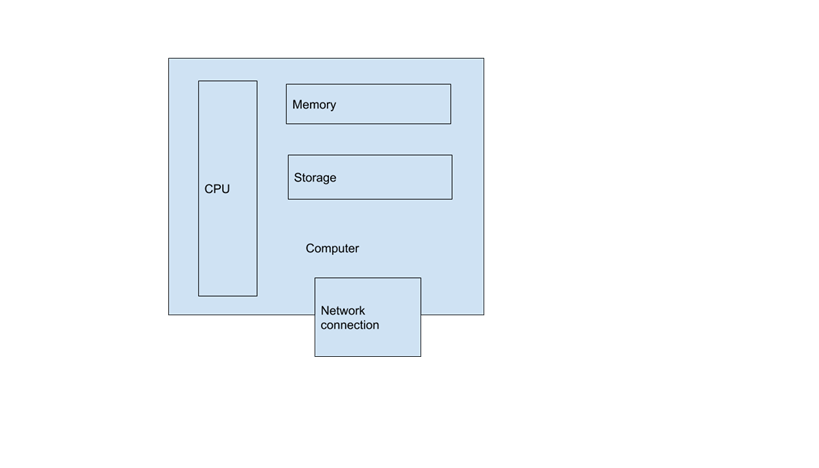
At its core, a computer is a collection of resources:

As long as your program has access to these resources, it doesn’t care what form the machine actually takes.

In fact, the program doesn’t even care if it’s a physical machine at all.  In fact, it could be a Virtual Machine:

In this case, you can see that a single physical machine, or host, can provide multiple Virtual Machines, or VMs.  Each of these VMs is like a tiny (or not-so-tiny) computer within the host computer, and each is completely isolated from all the others, so as far as the user and any of their programs are concerned, it’s just the same as a physical machine (for the most part).
The purpose of Infrastructure as a Service
The idea of Infrastructure as a service is to make it possible for users to request the infrastructure they need when they need it and get it without having to involve an administrator or fill out a ticket and wait 6 weeks to get a response.
Instead, they can go to a (typically web-based) user interface and specify the needed resources, which are provided near-instantly.
These resources may consist of compute power (CPUs, or more properly, virtual CPUs (vCPUs)), RAM, storage, and even networking. 
As a rule, the user neither knows nor cares where these resources are physically located — that is, which actual machine they live on.  For the purposes of them using the resources, it doesn’t matter.
What is IaaS in cloud computing?
Because IaaS resources are non-location-specific, they are a perfect application for cloud computing, where hardware resources can be dispersed over an arbitrarily large area.  For example, you might have a small data center on premises, or multiple data centers in multiple on-premise locations, or you might use public cloud resources.
In any case, the idea is that IaaS providers make IaaS services available over these hardware resources that are provided in a cloud-based architecture. In fact, when it comes to IaaS, cloud is a requirement.
Types of Infrastructure as a Service providers
So far, our discussion of Infrastructure as a Service has been completely generic.  In fact, there are multiple ways to handle Infrastructure as a Service, depending on your needs and the level of open source versus proprietary software you’re comfortable with.
VMware
In the beginning, there was VMware.  In many ways, VMware started the virtualization revolution, making it possible to run multiple virtual machines on a single host.  VMware created a large portfolio of products and services, but these were primarily proprietary software products, which meant that not only were they not interoperable with any other IaaS, but every additional VM involved additional licensing costs, sometimes referred to as the “VMware Tax.”  
Public Cloud
Meanwhile, the Public Cloud industry started with Amazon Web Services providing Infrastructure as a Service, as Amazon discovered it could squeeze revenue out of its enormous hardware portfolio by making it possible for external users to create and essentially rent virtual machines.  Amazon also created a large portfolio of different services, all of which were freely available — but firmly under the control of Amazon, on AWS servers.
Other public cloud providers also began offering IaaS, such as Google Cloud Services and Microsoft Azure.
All of these IaaS cloud providers also developed additional services to work with their Virtual Machines, and all of these services were largely proprietary (though some are based on open source projects) and their services are based on the idea that customer applications and data are hosted on and served from the provider’s hardware. Each also had its own independent (and non-interoperable) API.
While public cloud solutions did solve the problem of the VMware Tax, they introduced their own problems.  Companies realized that their data was outside of their owned infrastructure — and the meter was running. 
OpenStack
Enter OpenStack.  The idea behind the open source OpenStack project is to make it possible for companies to essentially create their own “on premise” cloud. This way internal end users could request Infrastructure as a Service just as they would from AWS or Google Cloud, but data and applications would remain under the company’s control and supervision — and starting a new VM wouldn’t trigger a new hourly charge the way it did with public cloud.
Like the OpenStack also provides a number of related services, such as Networking as a Service, Storage as a Service, DNS as a Service, and so on. 
OpenStack provides a robust platform for companies with significant IaaS needs and can be more cost effective than public cloud.  For example, this cloud TCO calculator shows the differences between running a datacenter on AWS and on Mirantis Cloud Platform OpenStack.
Other on-premise solutions
All of this assumes that you are mostly interested in running full Virtual Machines and other IaaS services and resources. But the concept of Infrastructure as a Service is rooted in the ability of users to create and enable resources on their own.
For example, you may be working with containerized applications rather than VMs.  In this case, you may need different kinds of Infrastructure as a Service.  You may need VMs on which to run your containers, or a container orchestration platform such as Kubernetes.
You may also want to provide these resources in an “as a Service” way.  For example, Docker Enterprise Container Cloud enables you to provide users with a UI from which they can create and provision their own Swarm or Kubernetes-based Docker Enterprise clusters, either on-premise or on Amazon Web Services.
Ultimately the idea behind Infrastructure as a Service is to give you and your users control over when and where to make resources available.
 
The post What is Infrastructure as a Service? appeared first on Mirantis | Pure Play Open Cloud.
Quelle: Mirantis

IKEA: Creating a more affordable, accessible and sustainable future with help from the cloud

Editor’s note: Today we hear from Barbara Martin Coppola, Chief Digital Officer at IKEA Retail (Ingka Group). Barbara chats about how cloud technologies helped IKEA respond to COVID-19, and what new connected customer experiences lie ahead.A better home creates a better lifeWe are here to create a better everyday life for many people with big dreams, big needs and thin wallets. Today’s life at home is more important than ever, not only to accommodate people’s basic needs, but also to make space for home offices, remote education and multi-purpose entertainment and exercise environments.People are looking for products and services that offer value for money, that are convenient and easily available. Consumers are increasingly connecting with brands and companies that are making a positive impact and contributing to the environment. Life at home has never been as important as it is today, and IKEA is determined to create a more affordable, accessible and sustainable future for all.It goes without saying that the pandemic has affected societies and communities at large. During these times, people are looking for different ways to shop and have their items delivered. Online shopping has reached new heights, with experienced online shoppers buying more than ever before and new shoppers entering the online space for the very first time. During lockdowns, many of our IKEA stores catered to customers online only, leading to increased levels of growth in e-commerce and an acceleration of our digital transformation. Things that would normally take years or months were accomplished within weeks and days.An adaptation strategy was important for our business whilst undergoing this period of change. We transformed our current technology infrastructure, converted our closed stores into fulfilment centers and enabled contactless Click & Collect services whilst increasing the capacity to manage large web traffic volumes and online orders. By using Google Cloud, among other key serverless technologies, we were able to instantly scale our business globally, on the web and in our stores.With the use of technology, we focused on taking care of co-workers as our first priority. We modified ways of working and engineered a solution where IKEA staff could borrow equipment online for a home office environment set-up. We empowered employees with data and digital tools, automating routine tasks, building advanced algorithms to solve complex problems, placing more modern technology in stores and designing additional self-serve tools. Through cloud technology we trained our data models to assist our co-workers, creating more efficient picking routes, which in turn enriched our customer experience.During this time, we have also committed to accelerating our investments towards a sustainable business. We will invest EUR 600 million into companies, solutions and our own operations to enable the transition to a net-zero carbon economy. As part of that journey, our goal is to use digital tools to help enable circularity across our value chain. We believe that doing good business is good business—both for us and for our planet.Fulfilling customer needs for the future With a growth mindset, we’ll continue to listen, learn and adapt our business to meet our customers where they are. We want to create an experience unlike any other, with the uniqueness of IKEA at the core. We are currently working on better fulfilling customer needs using recommendations through AI, chatbots for simpler and better customer service and 3D visualization design tools to picture furniture in photo realistic rooms. We want to show that IKEA can truly touch every customer around the globe with home furnishing products that provide an unforgettable everyday life at home experience. To learn more, please tune into my fireside discussion with Eva Fors, Managing Director, Nordics, Google Cloud, about innovation, accelerating omni-channel capabilities, diversity and inclusion, and more. Ingka Group recently acquired Geomagical Labs, a spatial computing company, developing mixed reality (real + virtual) experiences to support consumer needs. Using an ordinary smartphone, consumers will be able to quickly capture their spaces and virtually play with IKEA products in their rooms before purchasing them. Discover more here. The IKEA logo and the IKEA wordmark are registered trademarks of Inter IKEA Systems B.V.
Quelle: Google Cloud Platform